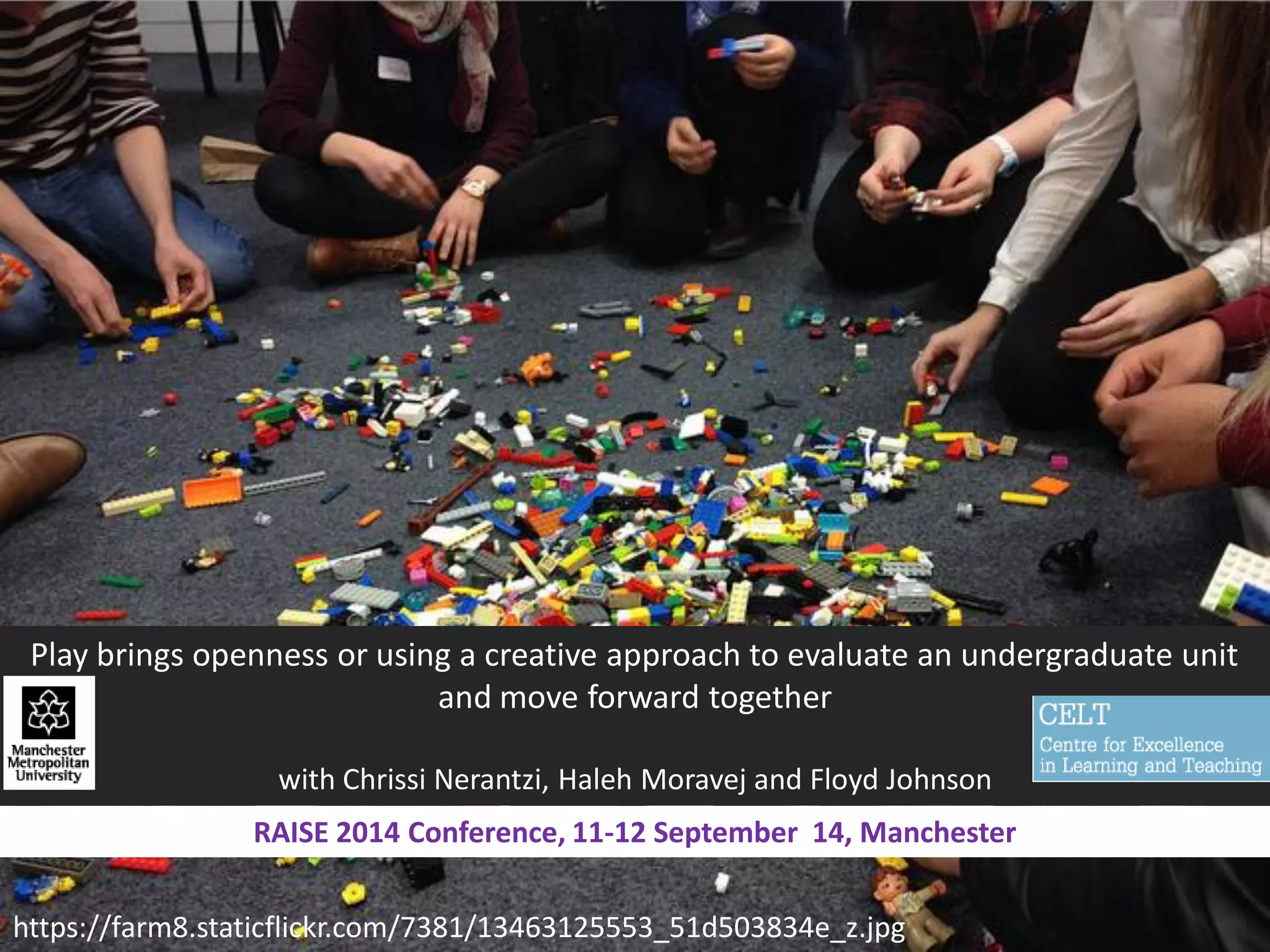
Play brings openness or using a creative approach to evaluate an undergraduate unit and move forward together with Chrissi Nerantzi, Haleh Moravej and Floyd Johnson 
RAISE 2014 Conference, 11-12 September 14, Manchester 
https://farm8.staticflickr.com/7381/13463125553_51d503834e_z.jpg
Intended learning outcomes 
During this workshop, you will be able to... 
•explore the benefits and challenges of evaluating and learning through making within Higher Education 
•discuss the LSP method used to evaluate an undergraduate unit at MMU 
•identify opportunities for evaluation and learning through forms of creative play in academic programmes and professional development
LSP and why?
Survey fatigue? 
“Will administering multiple surveys to students eventually result in less cooperation? [...] Yes.” (Porter et al, 2004) 
•“The prospect of multiple surveys can reduce response rates. 
•Nonrespondents often cite time concerns as reasons for nonresponse, 
implying that as the amount of time spent participating in surveys increases, survey nonresponse will increase. 
•The effects of survey fatigue may be moderated by the salience of survey 
content.” (Porter et al, 2004, 66) 
Caution for researchers! (Porter et al,2004) 
Multiple perspectives are more effective! (Braskamp et al, 1983)
Creative research methods 
“I was meant to be doing research about what people did, and why, but had always been uncomfortable with the idea of just speaking to them, taking them through an ‘interview’ for my own purposes, without giving them anything interesting to do. Therefore, for several years, I have been developing ‘creative research methods’ where people are asked to make something as part of the process. The idea is that going through the thoughtful, physical process of making something – such as a video, a drawing, a decorated box, or a Lego model – an individual is given the opportunity to reflect, and to make their thoughts, feelings or experiences manifest and tangible.” (Gauntlett, 2011, 4)
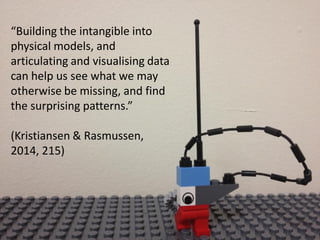
“Building the intangible into physical models, and articulating and visualising data can help us see what we may otherwise be missing, and find the surprising patterns.” 
(Kristiansen & Rasmussen, 2014, 215)
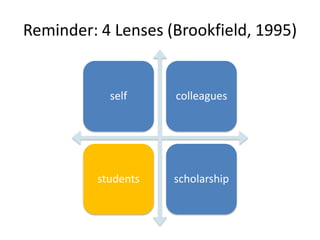
Reminder: 4 Lenses (Brookfield, 1995) 
self 
colleagues 
students 
scholarship
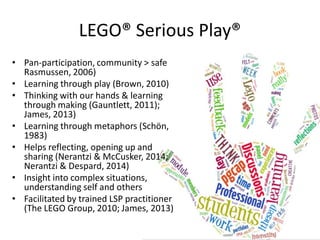
LEGO® Serious Play® 
•Pan-participation, community > safe Rasmussen, 2006) 
•Learning through play (Brown, 2010) 
•Thinking with our hands & learning through making (Gauntlett, 2011); James, 2013) 
•Learning through metaphors (Schön, 1983) 
•Helps reflecting, opening up and sharing (Nerantzi & McCusker, 2014; Nerantzi & Despard, 2014) 
•Insight into complex situations, understanding self and others 
•Facilitated by trained LSP practitioner (The LEGO Group, 2010; James, 2013)
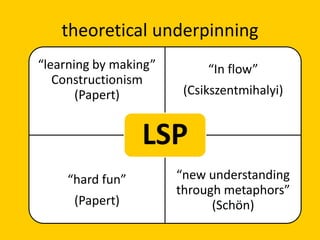
theoretical underpinning 
“learning by making” Constructionism (Papert) 
“In flow” 
(Csikszentmihalyi) 
“hard fun” 
(Papert) 
“new understanding through metaphors” (Schön) 
LSP
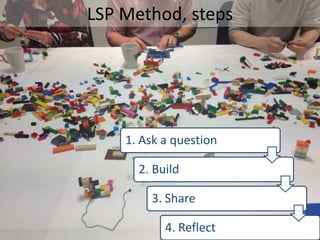
LSP Method, steps 
1. Ask a question 
2. Build 
3. Share 
4. Reflect
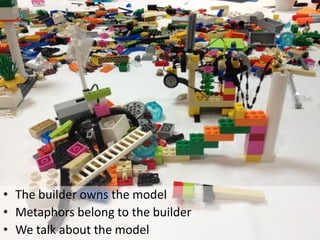
•The builder owns the model 
•Metaphors belong to the builder 
•We talk about the model
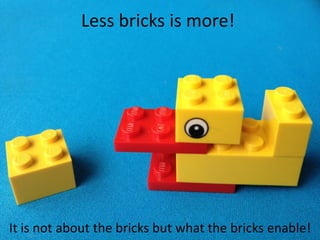
Less bricks is more! 
It is not about the bricks but what the bricks enable!
Task 1 (1 min): Build a tower Task 2 (3 mins): Build a little animal using up to 6 bricks. Task 4 (5 mins): Add something to this animal that says something about yourself. Share with others. 
LSP: Warm-up
Evaluating Nutrition21 
http://www.slideshare.net/chrissi/gaining-an-insight-into-the-student-experience- evaluating-a-unit-using-lsp-with-chrissi-nerantzi
https://farm8.staticflickr.com/7007/13463088623_2bfb319f8d_z.jpg 
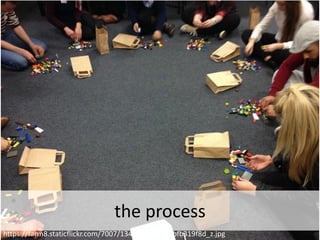
the process
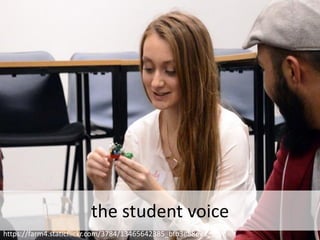
the student voice 
https://farm4.staticflickr.com/3784/13465642385_bfb3e88e7a_z.jpg
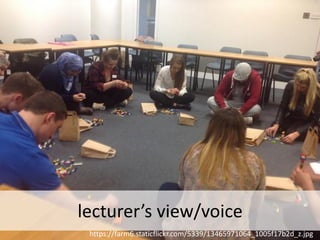
lecturer’s view/voice 
https://farm6.staticflickr.com/5339/13465971064_1005f17b2d_z.jpg
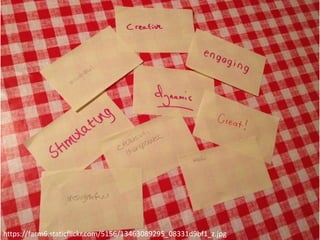
https://farm6.staticflickr.com/5156/13463089295_08331d9bf1_z.jpg
let’s try it
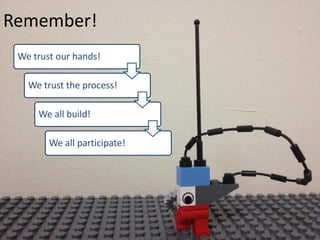
We trust our hands! 
We trust the process! 
We all build! 
We all participate! 
Remember!
Task 1(5 + 5 mins): Build a model that captures what you need as a learner. Share with others. Task 2 (5 mins): Cluster your models. Task 6 (5 mins): As a group, articulate and share a narrative which represents your needs as learners. 
LSP
extending creative evaluation
References 
•Braskamp, L. A., Brandenburg, D. C., Kohen, E., Ory, J. C. and Mayberry, P. W. (1983) Guidebook for evaluating teaching, NACTA Journal - December 1983, 72-76. 
•Brookfield, S. (1995) Becoming a critically reflective teacher. Jossey-Bass: San Francisco. 
•Brown, S. (2010) Play. How it shapes the brain, opens the imagination, and invigorates the soul, London: Avery, Penguin. 
•James, A. R. (2013) Lego Serious Play: a three-dimensional approach to learning development, in: Journal of Learning Development in Higher Education, No. 6 (2013), available at http://www.aldinhe.ac.uk/ojs/index.php?journal=jldhe&page=article&op=view&path%5B%5D=208&path%5B%5D=154 
•Gauntlett, D. (2011) Making is connecting. The social meaning of creativity, from DIY and knitting to YouTube and Web2.0, Cambridge: Polity Press. 
•Kristiansen, P. & Rasmussen, R. (2014) Building a better business using the LEGO® Serious Play® Method, Hooken: Wiley. 
•Nerantzi, C and Despard, C (i2014) Lego models to aid reflection. Enhancing the summative assessment experience in the context of Professional Discussions within accredited Academic Development provision, Journal Perspectives in Applied Academic Practice 
•Nerantzi, C and McCusker, S (2014) A taster of the LEGO(R) Serious Play(R) Method for Higher Education, OER14 Building Communities of Open Practice, Conference Proceedings, 28-29 April 2014, Centre for Life, Newcastle, available at http://www.medev.ac.uk/oer14/19/view/ 
•Porter, S. R., Whitcomb, M. E. and Weitzer, W. H. (2004) Multiple Surveys of Students and Survey Fatigue, in: NEW DIRECTIONS FOR INSTITUTIONAL RESEARCH, no. 121, Spring 2004, Wiley Periodicals, Inc, pp. 63-73. 
•Rasmussen, R. (2006). When you build in the world, you build in your mind. Design Management Review, 17(3), pp. 53-63. 
•Schön, D. (1983) The Reflective Practitioner, San Francisco: Jossey-Bass. 
•The LEGO Group (2010). Open-source/<Introduction to LEGO(R) Serious Play(R), available at http://seriousplaypro.com/docs/LSP_Open_Source_Brochure.pdf [accessed 29 December 2013]
Chrissi Nerantzi 
Academic Developer 
Manchester Metropolitan University, UK 
accredited LSP facilitator 
@chrissinerantzi 
Haleh Moravej 
Senior Lecturer in Nutrition Science 
Manchester Metropolitan University, UK 
@halehmoravej 
Floyd Johnson 
Second year Student in Nutrition Science 
Manchester Metropolitan University, UK 
@johnsonfondly 
If you would like to find out more, please get in touch with us!

Play brings openness openness or using a creative approach to evaluate an undergraduate unit and move forward together

  • 1.
    Play brings opennessor using a creative approach to evaluate an undergraduate unit and move forward together with Chrissi Nerantzi, Haleh Moravej and Floyd Johnson RAISE 2014 Conference, 11-12 September 14, Manchester https://farm8.staticflickr.com/7381/13463125553_51d503834e_z.jpg
  • 2.
    Intended learning outcomes During this workshop, you will be able to... •explore the benefits and challenges of evaluating and learning through making within Higher Education •discuss the LSP method used to evaluate an undergraduate unit at MMU •identify opportunities for evaluation and learning through forms of creative play in academic programmes and professional development
  • 3.
  • 4.
    Survey fatigue? “Willadministering multiple surveys to students eventually result in less cooperation? [...] Yes.” (Porter et al, 2004) •“The prospect of multiple surveys can reduce response rates. •Nonrespondents often cite time concerns as reasons for nonresponse, implying that as the amount of time spent participating in surveys increases, survey nonresponse will increase. •The effects of survey fatigue may be moderated by the salience of survey content.” (Porter et al, 2004, 66) Caution for researchers! (Porter et al,2004) Multiple perspectives are more effective! (Braskamp et al, 1983)
  • 5.
    Creative research methods “I was meant to be doing research about what people did, and why, but had always been uncomfortable with the idea of just speaking to them, taking them through an ‘interview’ for my own purposes, without giving them anything interesting to do. Therefore, for several years, I have been developing ‘creative research methods’ where people are asked to make something as part of the process. The idea is that going through the thoughtful, physical process of making something – such as a video, a drawing, a decorated box, or a Lego model – an individual is given the opportunity to reflect, and to make their thoughts, feelings or experiences manifest and tangible.” (Gauntlett, 2011, 4)
  • 6.
    “Building the intangibleinto physical models, and articulating and visualising data can help us see what we may otherwise be missing, and find the surprising patterns.” (Kristiansen & Rasmussen, 2014, 215)
  • 7.
    Reminder: 4 Lenses(Brookfield, 1995) self colleagues students scholarship
  • 8.
    LEGO® Serious Play® •Pan-participation, community > safe Rasmussen, 2006) •Learning through play (Brown, 2010) •Thinking with our hands & learning through making (Gauntlett, 2011); James, 2013) •Learning through metaphors (Schön, 1983) •Helps reflecting, opening up and sharing (Nerantzi & McCusker, 2014; Nerantzi & Despard, 2014) •Insight into complex situations, understanding self and others •Facilitated by trained LSP practitioner (The LEGO Group, 2010; James, 2013)
  • 9.
    theoretical underpinning “learningby making” Constructionism (Papert) “In flow” (Csikszentmihalyi) “hard fun” (Papert) “new understanding through metaphors” (Schön) LSP
  • 10.
    LSP Method, steps 1. Ask a question 2. Build 3. Share 4. Reflect
  • 11.
    •The builder ownsthe model •Metaphors belong to the builder •We talk about the model
  • 12.
    Less bricks ismore! It is not about the bricks but what the bricks enable!
  • 13.
    Task 1 (1min): Build a tower Task 2 (3 mins): Build a little animal using up to 6 bricks. Task 4 (5 mins): Add something to this animal that says something about yourself. Share with others. LSP: Warm-up
  • 14.
  • 15.
  • 16.
    the student voice https://farm4.staticflickr.com/3784/13465642385_bfb3e88e7a_z.jpg
  • 17.
  • 18.
  • 19.
  • 20.
    We trust ourhands! We trust the process! We all build! We all participate! Remember!
  • 21.
    Task 1(5 +5 mins): Build a model that captures what you need as a learner. Share with others. Task 2 (5 mins): Cluster your models. Task 6 (5 mins): As a group, articulate and share a narrative which represents your needs as learners. LSP
  • 22.
  • 23.
    References •Braskamp, L.A., Brandenburg, D. C., Kohen, E., Ory, J. C. and Mayberry, P. W. (1983) Guidebook for evaluating teaching, NACTA Journal - December 1983, 72-76. •Brookfield, S. (1995) Becoming a critically reflective teacher. Jossey-Bass: San Francisco. •Brown, S. (2010) Play. How it shapes the brain, opens the imagination, and invigorates the soul, London: Avery, Penguin. •James, A. R. (2013) Lego Serious Play: a three-dimensional approach to learning development, in: Journal of Learning Development in Higher Education, No. 6 (2013), available at http://www.aldinhe.ac.uk/ojs/index.php?journal=jldhe&page=article&op=view&path%5B%5D=208&path%5B%5D=154 •Gauntlett, D. (2011) Making is connecting. The social meaning of creativity, from DIY and knitting to YouTube and Web2.0, Cambridge: Polity Press. •Kristiansen, P. & Rasmussen, R. (2014) Building a better business using the LEGO® Serious Play® Method, Hooken: Wiley. •Nerantzi, C and Despard, C (i2014) Lego models to aid reflection. Enhancing the summative assessment experience in the context of Professional Discussions within accredited Academic Development provision, Journal Perspectives in Applied Academic Practice •Nerantzi, C and McCusker, S (2014) A taster of the LEGO(R) Serious Play(R) Method for Higher Education, OER14 Building Communities of Open Practice, Conference Proceedings, 28-29 April 2014, Centre for Life, Newcastle, available at http://www.medev.ac.uk/oer14/19/view/ •Porter, S. R., Whitcomb, M. E. and Weitzer, W. H. (2004) Multiple Surveys of Students and Survey Fatigue, in: NEW DIRECTIONS FOR INSTITUTIONAL RESEARCH, no. 121, Spring 2004, Wiley Periodicals, Inc, pp. 63-73. •Rasmussen, R. (2006). When you build in the world, you build in your mind. Design Management Review, 17(3), pp. 53-63. •Schön, D. (1983) The Reflective Practitioner, San Francisco: Jossey-Bass. •The LEGO Group (2010). Open-source/<Introduction to LEGO(R) Serious Play(R), available at http://seriousplaypro.com/docs/LSP_Open_Source_Brochure.pdf [accessed 29 December 2013]
  • 24.
    Chrissi Nerantzi AcademicDeveloper Manchester Metropolitan University, UK accredited LSP facilitator @chrissinerantzi Haleh Moravej Senior Lecturer in Nutrition Science Manchester Metropolitan University, UK @halehmoravej Floyd Johnson Second year Student in Nutrition Science Manchester Metropolitan University, UK @johnsonfondly If you would like to find out more, please get in touch with us!