Project-Based Learning (PBL) via
NAF Curriculum
Laura Fidler, Instructional Manager, NAF
laura@naf.org
#nafnext
Today‟s Objectives
• Understand what Project Based Learning is
and what’s involved
– Essential elements
• Understand how PBL is integrated into NAF
Curriculum and how you can support it in
your academy
• Steps involved leading to successful project-
based learning
#nafnext
What is Project Based Learning?
#nafnext
Lets take a look, shall we?
• While watching video, consider the following
questions:
 What are the students working on?
 What role is the teacher playing?
 How is learning taking place?
 What skills and knowledge do students need to
know in order to do this project?
 What preparation is needed in order to
implement this project?
#nafnext
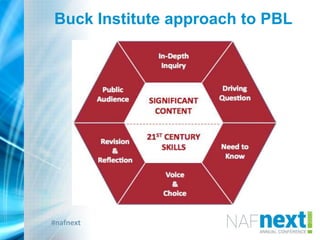
Buck Institute approach to PBL
#nafnext
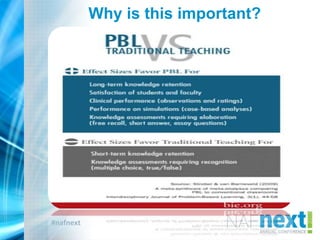
Why is this important?
#nafnext
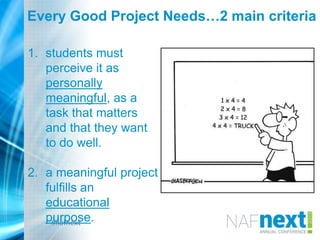
1. students must
perceive it as
personally
meaningful, as a
task that matters
and that they want
to do well.
2. a meaningful project
fulfills an
educational
purpose.
Every Good Project Needs…2 main criteria
#nafnext
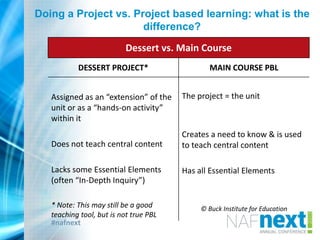
Dessert vs. Main Course
DESSERT PROJECT* MAIN COURSE PBL
Assigned as an “extension” of the
unit or as a “hands-on activity”
within it
Does not teach central content
Lacks some Essential Elements
(often “In-Depth Inquiry”)
* Note: This may still be a good
teaching tool, but is not true PBL
The project = the unit
Creates a need to know & is used
to teach central content
Has all Essential Elements
© Buck Institute for Education
Doing a Project vs. Project based learning: what is the
difference?
#nafnext
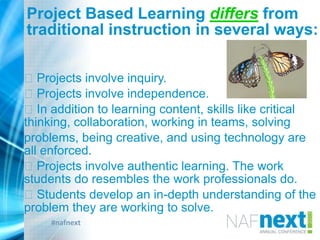
Project Based Learning differs from
traditional instruction in several ways:
Projects involve inquiry.
Projects involve independence.
In addition to learning content, skills like critical
thinking, collaboration, working in teams, solving
problems, being creative, and using technology are
all enforced.
Projects involve authentic learning. The work
students do resembles the work professionals do.
Students develop an in-depth understanding of the
problem they are working to solve.
#nafnext
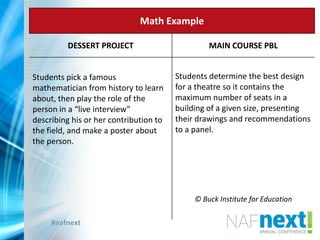
Math Example
DESSERT PROJECT MAIN COURSE PBL
Students pick a famous
mathematician from history to learn
about, then play the role of the
person in a “live interview”
describing his or her contribution to
the field, and make a poster about
the person.
Students determine the best design
for a theatre so it contains the
maximum number of seats in a
building of a given size, presenting
their drawings and recommendations
to a panel.
© Buck Institute for Education
#nafnext
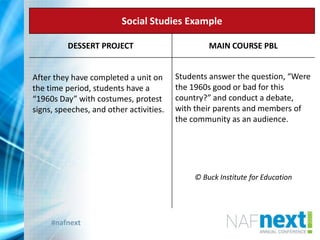
Social Studies Example
DESSERT PROJECT MAIN COURSE PBL
After they have completed a unit on
the time period, students have a
“1960s Day” with costumes, protest
signs, speeches, and other activities.
Students answer the question, “Were
the 1960s good or bad for this
country?” and conduct a debate,
with their parents and members of
the community as an audience.
© Buck Institute for Education
#nafnext
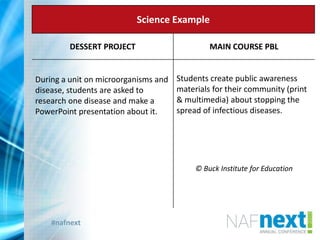
Science Example
DESSERT PROJECT MAIN COURSE PBL
During a unit on microorganisms and
disease, students are asked to
research one disease and make a
PowerPoint presentation about it.
Students create public awareness
materials for their community (print
& multimedia) about stopping the
spread of infectious diseases.
© Buck Institute for Education
#nafnext
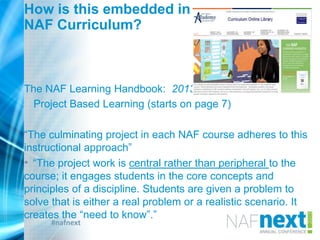
How is this embedded in
NAF Curriculum?
The NAF Learning Handbook: 2013
Project Based Learning (starts on page 7)
“The culminating project in each NAF course adheres to this
instructional approach”
• “The project work is central rather than peripheral to the
course; it engages students in the core concepts and
principles of a discipline. Students are given a problem to
solve that is either a real problem or a realistic scenario. It
creates the “need to know”.”
#nafnext
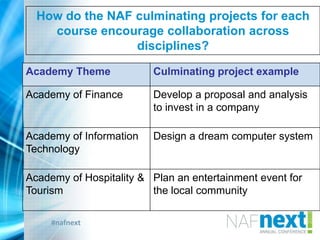
How do the NAF culminating projects for each
course encourage collaboration across
disciplines?
Academy Theme Culminating project example
Academy of Finance Develop a proposal and analysis
to invest in a company
Academy of Information
Technology
Design a dream computer system
Academy of Hospitality &
Tourism
Plan an entertainment event for
the local community
#nafnext
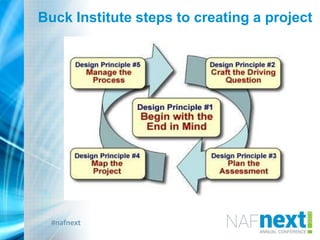
Buck Institute steps to creating a project
#nafnext
8 essential elements
1. Significant content
a. Teachers should plan a project to focus on important knowledge and
concepts
derived from standards
2. A Need to Know
a. Launching a project with an “entry event” that engages student intere
initiates questioning.
3. A Driving Question
a. A good driving question captures the heart of the project in clear, com
language, which gives students a sense of purpose and challenge.
4. Student Voice and Choice
a. Make a project feel meaningful to students, the more voice and choic
better.
#nafnext
8 essential
elements…cont’d
5. 21st Century Skills
a. Collaboration is key
a. Use role-playing and team-building activities, show students how
to use time and task organizers
6. Inquiry and Innovation
a. In real inquiry, students follow a trail that begins with their own
questions, which leads to innovation
7. Feedback and Revision
a. Students need to learn that most people’s first attempts don’t
result in high quality and that revision is a frequent feature of real-
world work.
8. Publicly Presented Product
a. When students present their work to a real audience, they care
more about its quality.
#nafnext
Lets try, shall we?
In groups, using the
templates in your
Buck Institute
workbooks, begin to either:
1. Support a NAF culminating
project
2. Brainstorm ways to create a
project based learning
environment in your
academy/classroom
#nafnext
Spend adequate time planning and preparing
involve people outside the classroom in project work
Familiarize yourself with the driving question for the project.
Show students an example project. (if possible)
Share rubrics!
Teach students how to work in a team
Let students play a role in planning how they might approach
a task, identifying what resources they need, and deciding
how they can demonstrate what they learn
Project launch is important!
Resist the urge to pre-teach the content or to direct
students every step of the way. Start the project first and
generate the “need to know”
Conclude projects with reflection on both process and content
Don‟t forget to celebrate what you and your students
accomplish
Tips to ‘make it work’
#nafnext
There is something about being a PBL
teacher that requires different work
• Collaborate with each other
• Give Power to Students
• Learning Environment
Designers
• Student-Centered
• Honor 21st Century Skills
• Really Plan, I mean
„REALLY‟ plan
#nafnext
Research studies have demonstrated that PBL
can:
 be more effective than
traditional instruction in
increasing academic
achievement on annual
state-administered
assessment tests.
be more effective than
traditional instruction for
teaching mathematics,
economics, science,
social science, clinical
medical skills and for
careers in the allied
health occupations and
teaching.
wwww.bie.org
 be more effective than
traditional instruction for long-
term retention, skill
development and satisfaction
of students and teachers
 be more effective than
traditional instruction for
preparing students to integrate
and explain concepts.
 improve students‟ mastery of
21st-century skills.
 be especially effective with
lower-achieving students.
provide an effective model for
whole school reform.
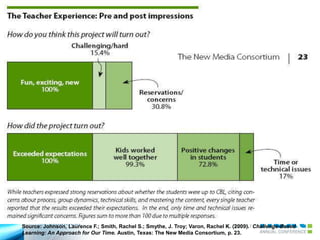
#nafnextSource: Johnson, Laurence F.; Smith, Rachel S.; Smythe, J. Troy; Varon, Rachel K. (2009). Challenge-Based
Learning: An Approach for Our Time. Austin, Texas: The New Media Consortium, p. 23.
#nafnext
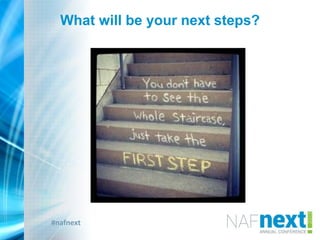
What will be your next steps?

PBL: Intensive Workshop

  • 2.
    Project-Based Learning (PBL)via NAF Curriculum Laura Fidler, Instructional Manager, NAF laura@naf.org
  • 3.
    #nafnext Today‟s Objectives • Understandwhat Project Based Learning is and what’s involved – Essential elements • Understand how PBL is integrated into NAF Curriculum and how you can support it in your academy • Steps involved leading to successful project- based learning
  • 4.
    #nafnext What is ProjectBased Learning?
  • 5.
    #nafnext Lets take alook, shall we? • While watching video, consider the following questions:  What are the students working on?  What role is the teacher playing?  How is learning taking place?  What skills and knowledge do students need to know in order to do this project?  What preparation is needed in order to implement this project?
  • 6.
  • 7.
  • 8.
    #nafnext 1. students must perceiveit as personally meaningful, as a task that matters and that they want to do well. 2. a meaningful project fulfills an educational purpose. Every Good Project Needs…2 main criteria
  • 9.
    #nafnext Dessert vs. MainCourse DESSERT PROJECT* MAIN COURSE PBL Assigned as an “extension” of the unit or as a “hands-on activity” within it Does not teach central content Lacks some Essential Elements (often “In-Depth Inquiry”) * Note: This may still be a good teaching tool, but is not true PBL The project = the unit Creates a need to know & is used to teach central content Has all Essential Elements © Buck Institute for Education Doing a Project vs. Project based learning: what is the difference?
  • 10.
    #nafnext Project Based Learningdiffers from traditional instruction in several ways: Projects involve inquiry. Projects involve independence. In addition to learning content, skills like critical thinking, collaboration, working in teams, solving problems, being creative, and using technology are all enforced. Projects involve authentic learning. The work students do resembles the work professionals do. Students develop an in-depth understanding of the problem they are working to solve.
  • 11.
    #nafnext Math Example DESSERT PROJECTMAIN COURSE PBL Students pick a famous mathematician from history to learn about, then play the role of the person in a “live interview” describing his or her contribution to the field, and make a poster about the person. Students determine the best design for a theatre so it contains the maximum number of seats in a building of a given size, presenting their drawings and recommendations to a panel. © Buck Institute for Education
  • 12.
    #nafnext Social Studies Example DESSERTPROJECT MAIN COURSE PBL After they have completed a unit on the time period, students have a “1960s Day” with costumes, protest signs, speeches, and other activities. Students answer the question, “Were the 1960s good or bad for this country?” and conduct a debate, with their parents and members of the community as an audience. © Buck Institute for Education
  • 13.
    #nafnext Science Example DESSERT PROJECTMAIN COURSE PBL During a unit on microorganisms and disease, students are asked to research one disease and make a PowerPoint presentation about it. Students create public awareness materials for their community (print & multimedia) about stopping the spread of infectious diseases. © Buck Institute for Education
  • 14.
    #nafnext How is thisembedded in NAF Curriculum? The NAF Learning Handbook: 2013 Project Based Learning (starts on page 7) “The culminating project in each NAF course adheres to this instructional approach” • “The project work is central rather than peripheral to the course; it engages students in the core concepts and principles of a discipline. Students are given a problem to solve that is either a real problem or a realistic scenario. It creates the “need to know”.”
  • 15.
    #nafnext How do theNAF culminating projects for each course encourage collaboration across disciplines? Academy Theme Culminating project example Academy of Finance Develop a proposal and analysis to invest in a company Academy of Information Technology Design a dream computer system Academy of Hospitality & Tourism Plan an entertainment event for the local community
  • 16.
    #nafnext Buck Institute stepsto creating a project
  • 17.
    #nafnext 8 essential elements 1.Significant content a. Teachers should plan a project to focus on important knowledge and concepts derived from standards 2. A Need to Know a. Launching a project with an “entry event” that engages student intere initiates questioning. 3. A Driving Question a. A good driving question captures the heart of the project in clear, com language, which gives students a sense of purpose and challenge. 4. Student Voice and Choice a. Make a project feel meaningful to students, the more voice and choic better.
  • 18.
    #nafnext 8 essential elements…cont’d 5. 21stCentury Skills a. Collaboration is key a. Use role-playing and team-building activities, show students how to use time and task organizers 6. Inquiry and Innovation a. In real inquiry, students follow a trail that begins with their own questions, which leads to innovation 7. Feedback and Revision a. Students need to learn that most people’s first attempts don’t result in high quality and that revision is a frequent feature of real- world work. 8. Publicly Presented Product a. When students present their work to a real audience, they care more about its quality.
  • 19.
    #nafnext Lets try, shallwe? In groups, using the templates in your Buck Institute workbooks, begin to either: 1. Support a NAF culminating project 2. Brainstorm ways to create a project based learning environment in your academy/classroom
  • 20.
    #nafnext Spend adequate timeplanning and preparing involve people outside the classroom in project work Familiarize yourself with the driving question for the project. Show students an example project. (if possible) Share rubrics! Teach students how to work in a team Let students play a role in planning how they might approach a task, identifying what resources they need, and deciding how they can demonstrate what they learn Project launch is important! Resist the urge to pre-teach the content or to direct students every step of the way. Start the project first and generate the “need to know” Conclude projects with reflection on both process and content Don‟t forget to celebrate what you and your students accomplish Tips to ‘make it work’
  • 21.
    #nafnext There is somethingabout being a PBL teacher that requires different work • Collaborate with each other • Give Power to Students • Learning Environment Designers • Student-Centered • Honor 21st Century Skills • Really Plan, I mean „REALLY‟ plan
  • 22.
    #nafnext Research studies havedemonstrated that PBL can:  be more effective than traditional instruction in increasing academic achievement on annual state-administered assessment tests. be more effective than traditional instruction for teaching mathematics, economics, science, social science, clinical medical skills and for careers in the allied health occupations and teaching. wwww.bie.org  be more effective than traditional instruction for long- term retention, skill development and satisfaction of students and teachers  be more effective than traditional instruction for preparing students to integrate and explain concepts.  improve students‟ mastery of 21st-century skills.  be especially effective with lower-achieving students. provide an effective model for whole school reform.
  • 23.
    #nafnextSource: Johnson, LaurenceF.; Smith, Rachel S.; Smythe, J. Troy; Varon, Rachel K. (2009). Challenge-Based Learning: An Approach for Our Time. Austin, Texas: The New Media Consortium, p. 23.
  • 24.
    #nafnext What will beyour next steps?

Editor's Notes

  • #6 Showing video
  • #7 hexagon
  • #17 Refer to books
  • #24 CBL = challenge based learningThe NMC (New Media Consortium) is an international community of experts in educational technology — from the practitioners who work with new technologies on campuses every day; to the visionaries who are shaping the future of learning at think tanks, labs, and research centers; to its staff and board of directors; to the advisory boards and others helping the NMC conduct cutting edge research.