

Fast Query Point Movement 
Techniques 
for Large CBIR Systems
TARGETJ SOLUTIONS 
REAL TIME PROJECTS 
IEEE BASED PROJECTS 
EMBEDDED SYSTEMS 
PAPER PUBLICATIONS 
MATLAB PROJECTS 
targetjsolutions@gmail.com 
(0)9611582234, (0)9945657526
Contents 
Introduction 
Purpose 
Scope 
Architecture 
Modules 
Class diagram 
Sequence diagrams 
Use case diagrams
Introduction 
Target search in content-based image retrieval (CBIR) systems refers to finding a 
specific (target) image such as a particular registered logo or a specific historical 
photograph. 
Existing techniques, designed around query refinement based on relevance feedback 
(RF), suffer from slow convergence, and do not guarantee to find intended targets. 
To address these limitations, we propose several efficient query point movement 
methods. 
 We prove that our approach is able to reach any given target image with fewer 
iterations in the worst and average cases. 
We propose a new index structure and query processing technique to improve 
retrieval effectiveness and efficiency. 
We also consider strategies to minimize the effects of users’ inaccurate RF.
Purpose 
 The main purpose of this document is to meet the requirements as 
mentioned in the SRS. 
 Develop a CBIR system that focuses on target search techniques, and 
faster than the existing CBIR system and which is not a victim to slow 
convergence, local maximum traps, minimizing the resource requirements. 
 CBIR system that can handle inefficient relevance feedback (RF). 
 The user is provided with a flexible user interface in which he/she has to 
login to the system to use the software. 
 After login process, the user presents the image of similarity to search, by 
browsing the local computer. 
 The users’ query is processed and a list of relevant images are produced.
Purpose 
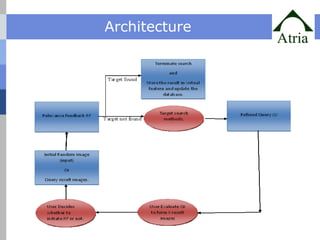
 The user picks the images as positive and negative and the positive images 
are considered for next round of retreival.
Scope 
 filtering and law enforcement markets . 
 Crime detection 
 Cencoring 
Some benefits 
1. User Feedback is included. 
2. Reduces the unrelated searches. 
3. The software is sensitive to inaccurate feedback. 
4. Future retrievals of images can be processed faster.
Scope 
5. Guarantees that the image is found. 
6. Can reach target image with fewer iterations. 
7. The scenario of local maximum traps and slow convergence is totally 
eradicated. 
8. The images are searched using image properties. 
9. The system is not sensitive to users’ inaccurate relevance feedback.
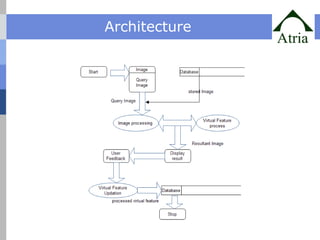
Architecture
Architecture
Architecture
Algorithm 
1) Naïve random scan (NRS) method 
I 
 The NRS method randomly retrieves k different images at a time until the user 
finds the target image or the remaining set is exhausted. 
 At each iteration, a set of k random images are retrieved from the candidate 
(i.e.unchecked) set S’ for relevance feedback , and S’ is then reduced by k . 
 In the best case, NRS takes one iteration Ω (1). 
 while the worst case requires S/K iterations. 
 At each iteration, a set of k random images are retrieved from the candidate 
(i.e.unchecked) set S’ for relevance feedback , and S’ is then reduced by k . 
 In the best case, NRS takes one iteration Ω (1). 
 while the worst case requires S/K iterations.
Algorithm 
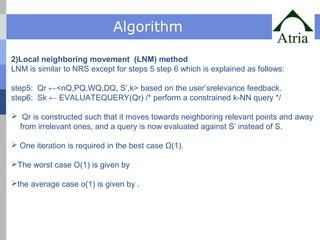
2)Local neighboring movement (LNM) method 
LNM is similar to NRS except for steps 5 step 6 which is explained as follows: 
step5: Qr ←<nQ,PQ,WQ,DQ, S’,k> based on the user’srelevance feedback. 
step6: Sk ← EVALUATEQUERY(Qr) /* perform a constrained k-NN query */ 
 Qr is constructed such that it moves towards neighboring relevant points and away 
from irrelevant ones, and a query is now evaluated against S’ instead of S. 
 One iteration is required in the best case Ω(1). 
The worst case O(1) is given by 
the average case o(1) is given by .
Algorithm 
3) Neighboring divide and conquer (NDS) method 
 Voronoi diagrams in NDC to reduce search space. 
The Voronoi diagram approach finds the nearest neighbors of a given query point 
by locating the Voronoi cell containing the query point. 
 NDC searches for the target as follows, from the starting query Qs, 
k points are randomly retrieved. 
Then the Voronoi region VRi is initially set to the minimum bounding box of S.
Algorithm 
 Instead of using a query point and its neighboring points to construct a Voronoi diagram, 
GDC uses the query point and k points randomly sampled from V Ri.
Modules 
1. Preprocessing (admin) 
2. Target search methods 
 Search without virtual process
Modules 
Search with virtual process
Modules 
3) Relevance feedback
Modules 
4) Virtual feature creation 
5) Virtual feature updation
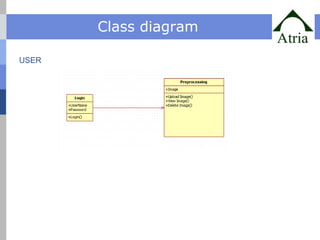
Class diagram 
USER
Class diagram 
ADMIN 
Regist at ion 
+Detail 
+registat ion() 
Sear ch Image 
+Image 
+Upload Image() 
+Search() 
+Give Feedback() 
upload Image 
+Image 
+upload() 
+claculate Histogram() 
Sear ch 
+Databsae image 
+Buf fer image 
+clac hostogram() 
+Calculate Distance() 
+compare Image() 
+virtualprocess() 
+displayResult () 
FeedBack 
+result 
+Give Result () 
+createVirtualFeature() 
+updateVirtualFeature() 
+uploadDatabase() 
User 
+details 
+Login() 
+Regist rat ion() 
User Login 
+UserName 
+Password 
+Login()
Sequence diagrams 
ADMIN
Sequence diagrams 
USER
Sequence diagrams 
VIRTUAL FEATURE
Sequence diagrams 
VIRTUAL FEATURE
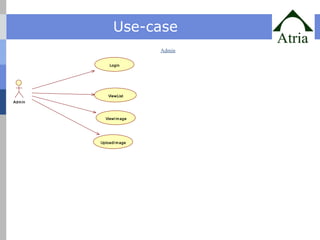
Use-case 
Admin 
Admin 
Login 
ViewList 
ViewImage 
UploadImage
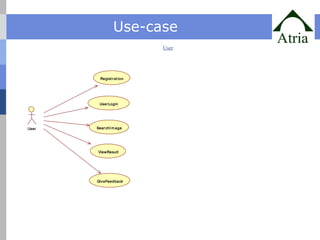
Use-case 
User 
User 
Regist rat ion 
UserLogin 
Sear chImage 
ViewResult 
GiveFeedback
No 6, 2 nd Floor , Gajanana Towers, 
11 th Main (Above Raymond Show Room), 
Land Mark : Near COOL JOIN, 
Jaya Nagar 4 th Block, 
Bangalore, KA-11 
9611582234, 9945657526

IEEE Projects 2014-2015

  • 1.
    Fast Query PointMovement Techniques for Large CBIR Systems
  • 2.
    TARGETJ SOLUTIONS REALTIME PROJECTS IEEE BASED PROJECTS EMBEDDED SYSTEMS PAPER PUBLICATIONS MATLAB PROJECTS targetjsolutions@gmail.com (0)9611582234, (0)9945657526
  • 3.
    Contents Introduction Purpose Scope Architecture Modules Class diagram Sequence diagrams Use case diagrams
  • 4.
    Introduction Target searchin content-based image retrieval (CBIR) systems refers to finding a specific (target) image such as a particular registered logo or a specific historical photograph. Existing techniques, designed around query refinement based on relevance feedback (RF), suffer from slow convergence, and do not guarantee to find intended targets. To address these limitations, we propose several efficient query point movement methods.  We prove that our approach is able to reach any given target image with fewer iterations in the worst and average cases. We propose a new index structure and query processing technique to improve retrieval effectiveness and efficiency. We also consider strategies to minimize the effects of users’ inaccurate RF.
  • 5.
    Purpose  Themain purpose of this document is to meet the requirements as mentioned in the SRS.  Develop a CBIR system that focuses on target search techniques, and faster than the existing CBIR system and which is not a victim to slow convergence, local maximum traps, minimizing the resource requirements.  CBIR system that can handle inefficient relevance feedback (RF).  The user is provided with a flexible user interface in which he/she has to login to the system to use the software.  After login process, the user presents the image of similarity to search, by browsing the local computer.  The users’ query is processed and a list of relevant images are produced.
  • 6.
    Purpose  Theuser picks the images as positive and negative and the positive images are considered for next round of retreival.
  • 7.
    Scope  filteringand law enforcement markets .  Crime detection  Cencoring Some benefits 1. User Feedback is included. 2. Reduces the unrelated searches. 3. The software is sensitive to inaccurate feedback. 4. Future retrievals of images can be processed faster.
  • 8.
    Scope 5. Guaranteesthat the image is found. 6. Can reach target image with fewer iterations. 7. The scenario of local maximum traps and slow convergence is totally eradicated. 8. The images are searched using image properties. 9. The system is not sensitive to users’ inaccurate relevance feedback.
  • 9.
  • 10.
  • 11.
  • 12.
    Algorithm 1) Naïverandom scan (NRS) method I  The NRS method randomly retrieves k different images at a time until the user finds the target image or the remaining set is exhausted.  At each iteration, a set of k random images are retrieved from the candidate (i.e.unchecked) set S’ for relevance feedback , and S’ is then reduced by k .  In the best case, NRS takes one iteration Ω (1).  while the worst case requires S/K iterations.  At each iteration, a set of k random images are retrieved from the candidate (i.e.unchecked) set S’ for relevance feedback , and S’ is then reduced by k .  In the best case, NRS takes one iteration Ω (1).  while the worst case requires S/K iterations.
  • 13.
    Algorithm 2)Local neighboringmovement (LNM) method LNM is similar to NRS except for steps 5 step 6 which is explained as follows: step5: Qr ←<nQ,PQ,WQ,DQ, S’,k> based on the user’srelevance feedback. step6: Sk ← EVALUATEQUERY(Qr) /* perform a constrained k-NN query */  Qr is constructed such that it moves towards neighboring relevant points and away from irrelevant ones, and a query is now evaluated against S’ instead of S.  One iteration is required in the best case Ω(1). The worst case O(1) is given by the average case o(1) is given by .
  • 14.
    Algorithm 3) Neighboringdivide and conquer (NDS) method  Voronoi diagrams in NDC to reduce search space. The Voronoi diagram approach finds the nearest neighbors of a given query point by locating the Voronoi cell containing the query point.  NDC searches for the target as follows, from the starting query Qs, k points are randomly retrieved. Then the Voronoi region VRi is initially set to the minimum bounding box of S.
  • 15.
    Algorithm  Insteadof using a query point and its neighboring points to construct a Voronoi diagram, GDC uses the query point and k points randomly sampled from V Ri.
  • 16.
    Modules 1. Preprocessing(admin) 2. Target search methods  Search without virtual process
  • 17.
    Modules Search withvirtual process
  • 18.
  • 19.
    Modules 4) Virtualfeature creation 5) Virtual feature updation
  • 20.
  • 21.
    Class diagram ADMIN Regist at ion +Detail +registat ion() Sear ch Image +Image +Upload Image() +Search() +Give Feedback() upload Image +Image +upload() +claculate Histogram() Sear ch +Databsae image +Buf fer image +clac hostogram() +Calculate Distance() +compare Image() +virtualprocess() +displayResult () FeedBack +result +Give Result () +createVirtualFeature() +updateVirtualFeature() +uploadDatabase() User +details +Login() +Regist rat ion() User Login +UserName +Password +Login()
  • 22.
  • 23.
  • 24.
  • 25.
  • 26.
    Use-case Admin Admin Login ViewList ViewImage UploadImage
  • 27.
    Use-case User User Regist rat ion UserLogin Sear chImage ViewResult GiveFeedback
  • 29.
    No 6, 2nd Floor , Gajanana Towers, 11 th Main (Above Raymond Show Room), Land Mark : Near COOL JOIN, Jaya Nagar 4 th Block, Bangalore, KA-11 9611582234, 9945657526