









Energy Efficient Reverse Skyline 
Query Processing over Wireless 
Sensor Networks 
Project Code : JNW 01
TARGETJ SOLUTIONS 
REAL TIME PROJECTS 
IEEE BASED PROJECTS 
EMBEDDED SYSTEMS 
PAPER PUBLICATIONS 
MATLAB PROJECTS 
targetjsolutions@gmail.com 
(0)9611582234, (0)9945657526
Abstract: 
Reverse skyline query plays an important role in many sensing 
applications, such as environmental monitoring, habitat monitoring, and 
battlefield monitoring. Due to the limited power supplies of wireless sensor 
nodes, the existing centralized approaches, which do not consider energy 
efficiency, cannot be directly applied to the distributed sensor environment. 
In this paper, we investigate how to process reverse skyline queries energy 
efficiently in wireless sensor networks. Initially, we theoretically analyzed 
the properties of reverse skyline query and proposed a skyband-based 
approach to tackle the problem of reverse skyline query answering over 
wireless sensor networks. Then, an energy-efficient approach is proposed 
to minimize the communication cost among sensor nodes of evaluating 
range reverse skyline query. Moreover, optimization mechanisms to 
improve the performance of multiple reverse skylines are also discussed. 
Extensive experiments on both real-world data and synthetic data have 
demonstrated the efficiency and effectiveness of our proposed approaches 
with various experimental settings
Introduction 
AS an important and popular query operator for multiple criteria 
decision making, skyline and its variants, such as constrained skyline 
dynamic skyline and reverse skyline have been applied in many 
applications. Given a data set P, a traditional skyline retrieves all the 
points in P that are not dominated by others. A point p1 dominates 
another point p2, if p1 is not worse than p2 for each dimension I nd p1 
is better than p2 for at least one dimension j. Fig. 1a shows an example 
of traditional skyline in 2D space and points p1, p2, and p6 are the 
skyline points In addition to traditional skyline, dynamic skyline with 
respect to qðdenoted as DSðq; PÞÞ has been proposed to retrieve all 
the points that are not dynamically dominated by others. For the sake 
of simplicity, we adopt the definition of dynamic attributes proposed 
in . A point p1 dynamically dominates p2 with respect to qðdenoted as 
p1 _q p2Þ, if it holds that: 1) jp1½i_ _ q½i_j _ jp2½i_ _ q½i_j, for each 
dimension i 2 D, and 2) there exists at least one dimension j 2 D, such 
that jp1½j_ _ q½j_j < jp2½j_ _ q½j_j.
Literature Survey 
Goal of Project 
 Our goal is to carefully and properly adjust the relation of semidominance, 
such that the modified relation becomes transitive (in turn, the query 
becomes decomposable). 
 After that, we are able to take the advantage of in-network aggregation 
techniques to efficiently get the query results. This way, the base station can 
calculate reverse skyline without introducing false dismissals. 
 In order to achieve the goal above, we introduce another novel concept, 
namely full dominance, between any two data points
Existing System: 
Recently it is found that wireless sensor networks (WSNs) offer a very economic 
and effective platform to monitor the environment. 
To satisfy different application demands, we conduct various types of queries over 
WSNs, for example min, max top-k, and skyline. The de facto limit to processing 
queries in WSNs is the energy constraint, since sensor nodes are generally battery 
powered, and in many WSNs (e.g., an unattended and hard-to-reach environment), 
it is impossible or at least very difficult to change their batteries. Wireless 
communication is the major energy consumer in WSNs, and therefore, if we can 
reduce the amount of communication during query processing, the energy 
consumption can be significantly reduced and the lifetime of the WSNs as a whole 
can be prolonged.
Dis-Advantage 
Almost all existing work has focused on reducing the 
communication cost for a specific type of query. 
As one of the important operators in WSN 
applications, the energy-efficiency of RS query 
processing also needs to be studied in depth. 
Therefore, in this work, we study energy-efficient 
approaches to answer reverse skyline (RS) queries 
over WSNs
Proposed System: 
We propose an energy-efficient approach to evaluate reverse skyline query in 
WSNs, based on the full skyband which contains all necessary information for the 
base station to reconstruct the reverse skyline. Then, the transmission of nonfull 
skyline points is avoided by pointing out which full skyline points belong to the 
reverse skyline. Furthermore, the proposed approaches are also extended to 
support range reverse skyline and multiple reverse skyline queries. 
2. We theoretically analyze the relationship between reverse skylines on different 
dimensional spaces or query ranges, and propose two optimization mechanisms, 
vertical and horizontal optimizations, to improve the performance of multiple reverse 
skyline evaluation in WSNs. 
3. Lastly, our extensive experimental studies using both real-world data and 
synthetic data show that the proposed approach can significantly reduce the 
communication cost among sensor nodes and save the energy consumption during 
the evaluation of RS queries in WSNs
Advantages of Proposed System: 
1. it is impossible or at least very difficult to change 
their batteries. Wireless communication is the major 
energy consumer in WSNs, and therefore, 
if we can reduce the amount of communication 
during query processing, the energy consumption can 
be significantly reduced and the lifetime of the WSNs 
as a whole can be prolonged
Requirement Analysis: 
Software Requirements : 
Operating System: Windows XP professional 
Front End : Microsoft Visual Studio .Net 2005 
Language : Visual C#.Net 
Back End : SQL Server 2000
Hardware Requirements : 
Processor : Pentium III / IV 
Hard Disk : 40 GB 
Ram : 
256 MB 
Monitor : 15VGA Color 
Mouse : 
Ball / Optical 
Keyboard : 102 Keys
System User & Admin 
login 
Design Details Access the 
database 
continuously 
Due to continuous 
access & more user 
access DB reaches 
critical limit 
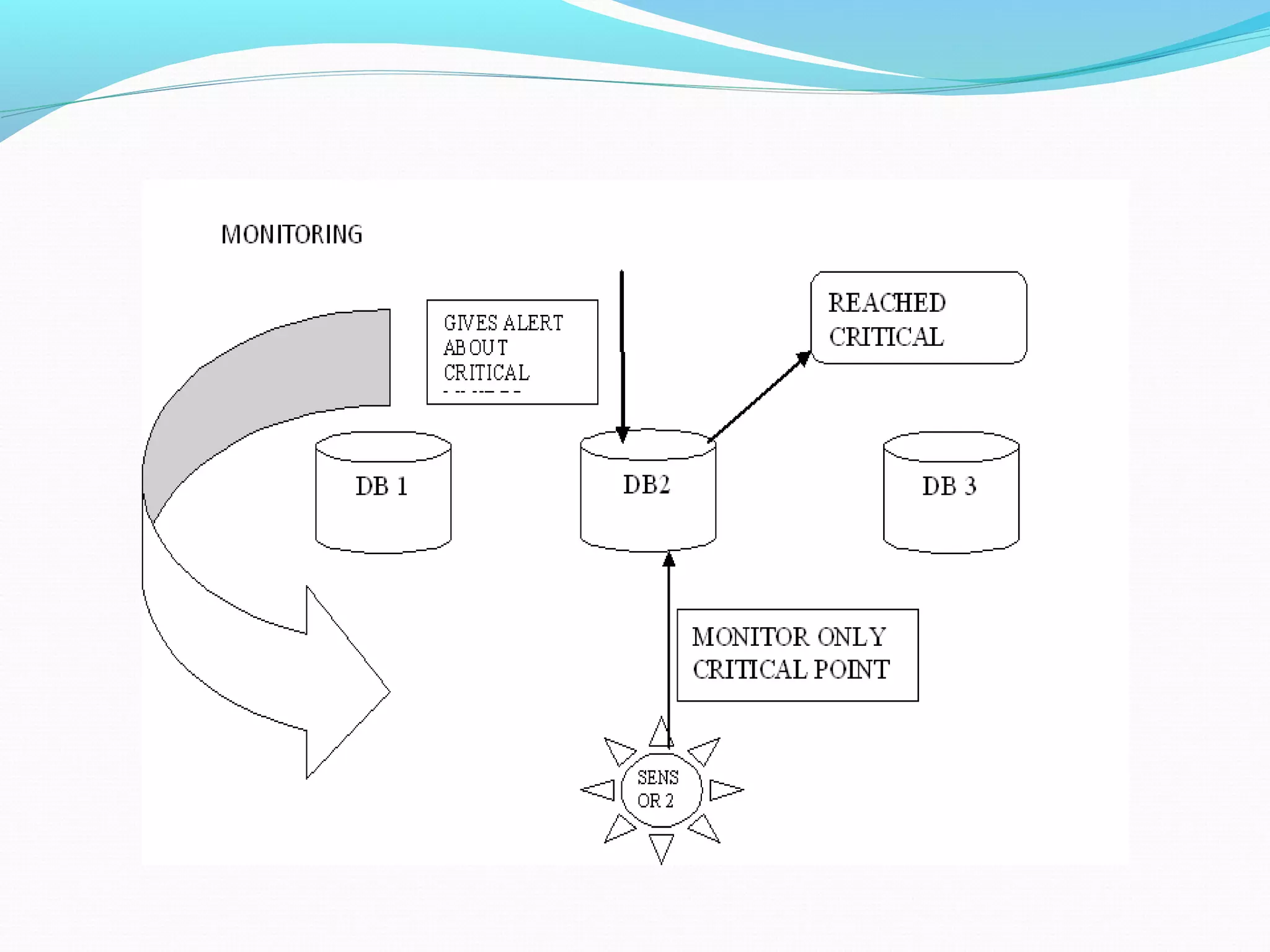
Sensor 1 will give 
alert signal for 
critical limit 
Sensor 2 will 
continuously 
monitor the critical 
limit point
MODULE DECRIPTION: 
Reverse Skyline Query: 
 In all kind of applications, different users may have different preferences, and 
it is quite common to have multiple queries in different subspaces which are posed into the WSN 
(Wireless Sensor Networks) simultaneously to gather interesting information. Skyline queries over 
databases have many important applications such as sensor data monitoring and business planning. 
Skyline queries accurately and efficiently over data has become increasingly important. Reverse 
skyline queries, which retrieve a set of objects whose dynamic skyline contains a given query point, 
are useful and valuable for many applications such as business location and environmental 
monitoring applications. Though there are several methods for processing reverse skyline queries, 
they are based on pre-processing. Since they waste time and space to pre-compute necessary data 
and to manage the pre-computed data, they are not feasible for some applications.
Optimization: 
We implement two kinds of Optimization here one is 
Vertical Optimization and another one is Horizontal 
Optimization.
Vertical Optimization: 
The Vertical Optimization technique is used for 
multiple queries by using the relationship between 
reverse skylines with respect to different subspaces 
but the same query range.
Horizontal Optimization: 
The Horizontal Optimization technique is used for 
the relationship between reverse skylines with the 
same subspace but different query ranges.
Trace the Database by using 
Sensors: 
The two sensors have been implemented to monitor the entire 
database activities. 
Out of this two sensors one sensor will monitor the entire 
databases, in real time applications simultaneously more 
number of users will access the databases, due to this problem 
there might have a chance for any database to get its critical 
point, to know the critical point alert one sensor is continuously 
monitoring the database. Once any database reaches the critical 
point it will give alert signal. The role of another sensor is to 
monitor the critical point limit databases due to this we can 
avoid major problems occurs in databases .

Energy efficient reverse skyline query processing over wireless sensor networks

  • 1.
    Energy Efficient ReverseSkyline Query Processing over Wireless Sensor Networks Project Code : JNW 01
  • 2.
    TARGETJ SOLUTIONS REALTIME PROJECTS IEEE BASED PROJECTS EMBEDDED SYSTEMS PAPER PUBLICATIONS MATLAB PROJECTS targetjsolutions@gmail.com (0)9611582234, (0)9945657526
  • 3.
    Abstract: Reverse skylinequery plays an important role in many sensing applications, such as environmental monitoring, habitat monitoring, and battlefield monitoring. Due to the limited power supplies of wireless sensor nodes, the existing centralized approaches, which do not consider energy efficiency, cannot be directly applied to the distributed sensor environment. In this paper, we investigate how to process reverse skyline queries energy efficiently in wireless sensor networks. Initially, we theoretically analyzed the properties of reverse skyline query and proposed a skyband-based approach to tackle the problem of reverse skyline query answering over wireless sensor networks. Then, an energy-efficient approach is proposed to minimize the communication cost among sensor nodes of evaluating range reverse skyline query. Moreover, optimization mechanisms to improve the performance of multiple reverse skylines are also discussed. Extensive experiments on both real-world data and synthetic data have demonstrated the efficiency and effectiveness of our proposed approaches with various experimental settings
  • 4.
    Introduction AS animportant and popular query operator for multiple criteria decision making, skyline and its variants, such as constrained skyline dynamic skyline and reverse skyline have been applied in many applications. Given a data set P, a traditional skyline retrieves all the points in P that are not dominated by others. A point p1 dominates another point p2, if p1 is not worse than p2 for each dimension I nd p1 is better than p2 for at least one dimension j. Fig. 1a shows an example of traditional skyline in 2D space and points p1, p2, and p6 are the skyline points In addition to traditional skyline, dynamic skyline with respect to qðdenoted as DSðq; PÞÞ has been proposed to retrieve all the points that are not dynamically dominated by others. For the sake of simplicity, we adopt the definition of dynamic attributes proposed in . A point p1 dynamically dominates p2 with respect to qðdenoted as p1 _q p2Þ, if it holds that: 1) jp1½i_ _ q½i_j _ jp2½i_ _ q½i_j, for each dimension i 2 D, and 2) there exists at least one dimension j 2 D, such that jp1½j_ _ q½j_j < jp2½j_ _ q½j_j.
  • 5.
    Literature Survey Goalof Project  Our goal is to carefully and properly adjust the relation of semidominance, such that the modified relation becomes transitive (in turn, the query becomes decomposable).  After that, we are able to take the advantage of in-network aggregation techniques to efficiently get the query results. This way, the base station can calculate reverse skyline without introducing false dismissals.  In order to achieve the goal above, we introduce another novel concept, namely full dominance, between any two data points
  • 6.
    Existing System: Recentlyit is found that wireless sensor networks (WSNs) offer a very economic and effective platform to monitor the environment. To satisfy different application demands, we conduct various types of queries over WSNs, for example min, max top-k, and skyline. The de facto limit to processing queries in WSNs is the energy constraint, since sensor nodes are generally battery powered, and in many WSNs (e.g., an unattended and hard-to-reach environment), it is impossible or at least very difficult to change their batteries. Wireless communication is the major energy consumer in WSNs, and therefore, if we can reduce the amount of communication during query processing, the energy consumption can be significantly reduced and the lifetime of the WSNs as a whole can be prolonged.
  • 7.
    Dis-Advantage Almost allexisting work has focused on reducing the communication cost for a specific type of query. As one of the important operators in WSN applications, the energy-efficiency of RS query processing also needs to be studied in depth. Therefore, in this work, we study energy-efficient approaches to answer reverse skyline (RS) queries over WSNs
  • 8.
    Proposed System: Wepropose an energy-efficient approach to evaluate reverse skyline query in WSNs, based on the full skyband which contains all necessary information for the base station to reconstruct the reverse skyline. Then, the transmission of nonfull skyline points is avoided by pointing out which full skyline points belong to the reverse skyline. Furthermore, the proposed approaches are also extended to support range reverse skyline and multiple reverse skyline queries. 2. We theoretically analyze the relationship between reverse skylines on different dimensional spaces or query ranges, and propose two optimization mechanisms, vertical and horizontal optimizations, to improve the performance of multiple reverse skyline evaluation in WSNs. 3. Lastly, our extensive experimental studies using both real-world data and synthetic data show that the proposed approach can significantly reduce the communication cost among sensor nodes and save the energy consumption during the evaluation of RS queries in WSNs
  • 9.
    Advantages of ProposedSystem: 1. it is impossible or at least very difficult to change their batteries. Wireless communication is the major energy consumer in WSNs, and therefore, if we can reduce the amount of communication during query processing, the energy consumption can be significantly reduced and the lifetime of the WSNs as a whole can be prolonged
  • 10.
    Requirement Analysis: SoftwareRequirements : Operating System: Windows XP professional Front End : Microsoft Visual Studio .Net 2005 Language : Visual C#.Net Back End : SQL Server 2000
  • 11.
    Hardware Requirements : Processor : Pentium III / IV Hard Disk : 40 GB Ram : 256 MB Monitor : 15VGA Color Mouse : Ball / Optical Keyboard : 102 Keys
  • 12.
    System User &Admin login Design Details Access the database continuously Due to continuous access & more user access DB reaches critical limit Sensor 1 will give alert signal for critical limit Sensor 2 will continuously monitor the critical limit point
  • 14.
    MODULE DECRIPTION: ReverseSkyline Query:  In all kind of applications, different users may have different preferences, and it is quite common to have multiple queries in different subspaces which are posed into the WSN (Wireless Sensor Networks) simultaneously to gather interesting information. Skyline queries over databases have many important applications such as sensor data monitoring and business planning. Skyline queries accurately and efficiently over data has become increasingly important. Reverse skyline queries, which retrieve a set of objects whose dynamic skyline contains a given query point, are useful and valuable for many applications such as business location and environmental monitoring applications. Though there are several methods for processing reverse skyline queries, they are based on pre-processing. Since they waste time and space to pre-compute necessary data and to manage the pre-computed data, they are not feasible for some applications.
  • 15.
    Optimization: We implementtwo kinds of Optimization here one is Vertical Optimization and another one is Horizontal Optimization.
  • 16.
    Vertical Optimization: TheVertical Optimization technique is used for multiple queries by using the relationship between reverse skylines with respect to different subspaces but the same query range.
  • 17.
    Horizontal Optimization: TheHorizontal Optimization technique is used for the relationship between reverse skylines with the same subspace but different query ranges.
  • 18.
    Trace the Databaseby using Sensors: The two sensors have been implemented to monitor the entire database activities. Out of this two sensors one sensor will monitor the entire databases, in real time applications simultaneously more number of users will access the databases, due to this problem there might have a chance for any database to get its critical point, to know the critical point alert one sensor is continuously monitoring the database. Once any database reaches the critical point it will give alert signal. The role of another sensor is to monitor the critical point limit databases due to this we can avoid major problems occurs in databases .