PROJECT MANAGEMENT
–
STAKEHOLDER MANAGEMENT
Project Management –
Stakeholder Framework
•Recap on Project management fundamentals
•Stakeholders
•Stakeholder Management
Stakeholder ‘Recognition’
1996 – Sub Section of 1 page and a technique (‘stakeholder analysis’)
2013 – Complete Dedicated Chapter (24 pages)
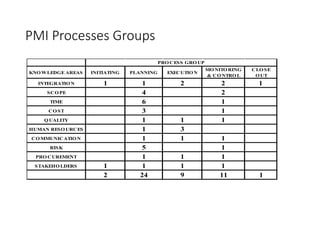
PMI Processes Groups
KNOWLEDGE AREAS INITIATING PLANNING EXECUTION
MONITORING
& CONTROL
CLOSE
OUT
INTEGRATION 1 1 2 2 1
SCOPE 4 2
TIME 6 1
COST 3 1
QUALITY 1 1 1
HUMAN RESOURCES 1 3
COMMUNICATION 1 1 1
RISK 5 1
PROCUREMENT 1 1 1
STAKEHOLDERS 1 1 1 1
2 24 9 11 1
PROCESS GROUP
Projects & Project Management
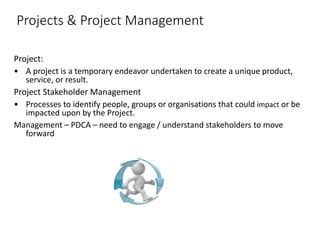
Project:
• A project is a temporary endeavor undertaken to create a unique product,
service, or result.
Project Stakeholder Management
• Processes to identify people, groups or organisations that could impact or be
impacted upon by the Project.
Management – PDCA – need to engage / understand stakeholders to move
forward
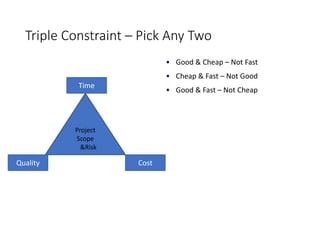
Triple Constraint – Pick Any Two
Project
Scope
&Risk
Time
CostQuality
• Good & Cheap – Not Fast
• Cheap & Fast – Not Good
• Good & Fast – Not Cheap
…but in who’s opinion?
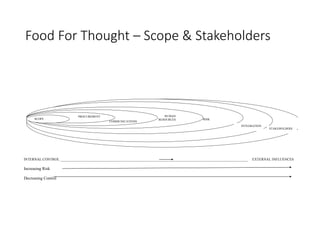
Food For Thought – Scope & Stakeholders
ELEMENTS OF PROJECT MANGEMENT (after PMBOK, 1996)
INTERNAL CONTROL _________________________________________________________________________________________________________ EXTERNAL INFLUENCES
Increasing Risk
Decreasing Control
RISK
HUMAN
RESOURCES
COMMUNICATIONS
PROCUREMENT
SCOPE
STAKEHOLDERS
INTEGRATION
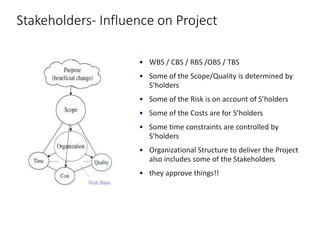
Stakeholders- Influence on Project
• WBS / CBS / RBS /OBS / TBS
• Some of the Scope/Quality is determined by
S’holders
• Some of the Risk is on account of S’holders
• Some of the Costs are for S’holders
• Some time constraints are controlled by
S’holders
• Organizational Structure to deliver the Project
also includes some of the Stakeholders
• they approve things!!
Risk Base
Stakeholder & Stakeholder Management
•Stakeholder
“an individual, group or organization who may affect, be affected by,
or perceive itself to be affected by a decision, activity or outcome of a
project”
“the projects and organizations, which may influence, or are influenced
by the Project.”
• Origins –
pioneering days when people would mark out their property with
stakes, as in "stake your claim” and the people who helped “‘hold’
those stakes”.
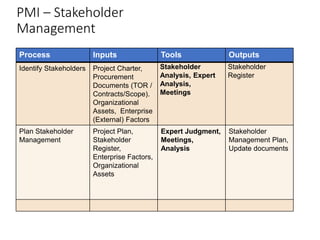
PMI – Stakeholder
Management
Process Inputs Tools Outputs
Identify Stakeholders Project Charter,
Procurement
Documents (TOR /
Contracts/Scope).
Organizational
Assets, Enterprise
(External) Factors
Stakeholder
Analysis, Expert
Analysis,
Meetings
Stakeholder
Register
Plan Stakeholder
Management
Project Plan,
Stakeholder
Register,
Enterprise Factors,
Organizational
Assets
Expert Judgment,
Meetings,
Analysis
Stakeholder
Management Plan,
Update documents
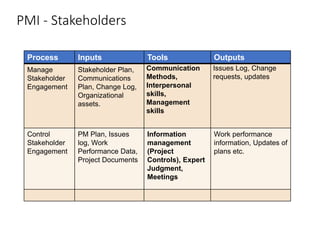
PMI - Stakeholders
Process Inputs Tools Outputs
Manage
Stakeholder
Engagement
Stakeholder Plan,
Communications
Plan, Change Log,
Organizational
assets.
Communication
Methods,
Interpersonal
skills,
Management
skills
Issues Log, Change
requests, updates
Control
Stakeholder
Engagement
PM Plan, Issues
log, Work
Performance Data,
Project Documents
Information
management
(Project
Controls), Expert
Judgment,
Meetings
Work performance
information, Updates of
plans etc.
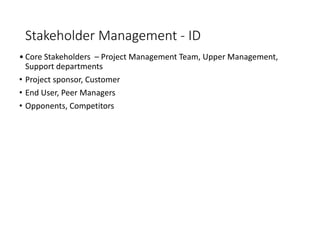
Stakeholder Management - ID
• Core Stakeholders – Project Management Team, Upper Management,
Support departments
• Project sponsor, Customer
• End User, Peer Managers
• Opponents, Competitors
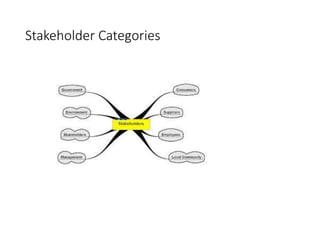
Stakeholder Categories
Alternatively 
• Zealots
• Passives
• Moaners
• Opponents
• Mutineers
• Heretics / Dissidents
• Waverers
“You can fool some of the people all of the time
all of the people some of the time
BUT you can’t fool all of the people all of the time”
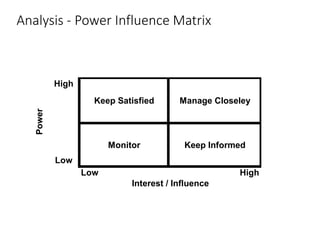
Analysis - Power Influence Matrix
High
Keep Satisfied Manage Closeley
Low
Monitor Keep Informed
Low High
Interest / Influence
Power
Analysis
•Unaware
•Resistant
•Neutral
•Supportive
•Leading
Need to consider how to engage, and if it is necessary based on the
power influence / interest matrix.
Stakeholders – Classification
•Principal: Key corporate personnel/departments and external players
(Ministers / Regulatory Authorities)
•Primary: Project specific stakeholders that include key opinion makers,
interested organisations and influential individuals.
•Important (Secondary) :Those directly affected, for example residents
or landowners. Those indirectly affected, for example the wider
community surrounding the construction zone. Those that are affected
at a National level.
•Tertiary – nobody likes to be third – it can make them feel unwanted or
alienated!!!
Stakeholder Engagement (Doing)
•Contacting the right people in the right way
•Meetings & Introductions
•Information to be exchanged & sources
•Stakeholder view (+ve / -ve; asset protector/developer)
•Process of interacting
•Escalation Process
Requires interpersonal skills, resolving conflict, handling change,
listening, building trust, negotiating.
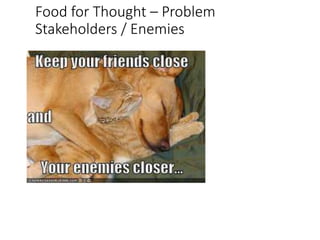
Food for Thought – Problem
Stakeholders / Enemies
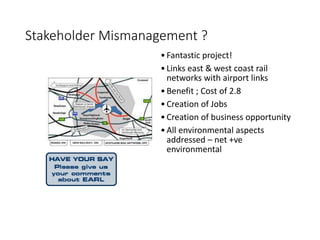
Stakeholder Mismanagement ?
•Fantastic project!
•Links east & west coast rail
networks with airport links
•Benefit ; Cost of 2.8
•Creation of Jobs
•Creation of business opportunity
•All environmental aspects
addressed – net +ve
environmental
Scottish Railway Project
Extensive Stakeholder Recognition Program
Town / Village / School Meetings
National Rail and Airport Interface Meetings / Reviews
Advertising campaign promoting business / jobs
BUT
Minority Political Party who were anti project had been identified but
ignored
AND
They were elected and cancelled the Project!
AND
GBP 30 million spent!!
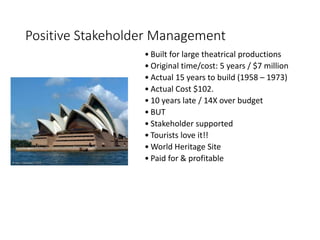
Positive Stakeholder Management
• Built for large theatrical productions
• Original time/cost: 5 years / $7 million
• Actual 15 years to build (1958 – 1973)
• Actual Cost $102.
• 10 years late / 14X over budget
• BUT
• Stakeholder supported
• Tourists love it!!
• World Heritage Site
• Paid for & profitable
Control Stakeholder Engagement
(Check/Action)
•Is appropriate information being obtained?
•Are stakeholder processes visible?
•Are there conflicts (technical, physical, interpersonal)?
•Can Stakeholder views/ideas be incorporated?
•Are issues being raised and closed?
If not then some escalation is required and ‘power’ needs to be used
or requirements accepted with corresponding adjustments/changes
to the project.
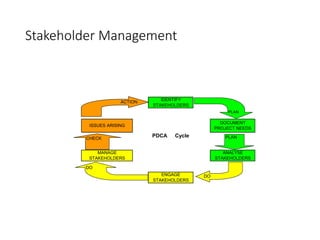
Stakeholder Management
PDCA Cycle
ANALYSE
STAKEHOLDERS
ENGAGE
STAKEHOLDERS
ISSUES ARISING
MANAGE
STAKEHOLDERS
IDENTIFY
STAKEHOLDERS
DOCUMENT
PROJECT NEEDS
PLAN
ACTION
DO
DO
CHECK PLAN
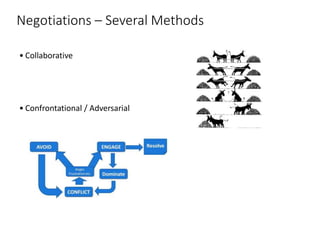
Negotiations – Several Methods
• Collaborative
• Confrontational / Adversarial
Conclusions
•Stakeholders can be almost anybody or everbody at an individual or
organisational level
•Stakeholders can have a positive or negative effect on the outcome of
a project (perception)
•Stakeholder requirements are often essential to a Project’s
development (end users)
•Stakeholder engagement is a soft skill and may need to be escalated.
(Influential land owners)
•Stakeholders cannot be ignored and they and their
inputs/requirements need to be actively involved / managed.
Remember
• Stakeholders influence all aspects of the project.
• Influence can be +ve or –ve, subjective or
objective.
• It’s not just the big ‘issues’ or big and powerful
organisations or individuals that are
stakeholders…
…one person can change many things (Mandela,
Gandhi, etc).
Questions / Discussion

Project management stakeholder feb 2018

  • 1.
  • 2.
    Project Management – StakeholderFramework •Recap on Project management fundamentals •Stakeholders •Stakeholder Management Stakeholder ‘Recognition’ 1996 – Sub Section of 1 page and a technique (‘stakeholder analysis’) 2013 – Complete Dedicated Chapter (24 pages)
  • 3.
    PMI Processes Groups KNOWLEDGEAREAS INITIATING PLANNING EXECUTION MONITORING & CONTROL CLOSE OUT INTEGRATION 1 1 2 2 1 SCOPE 4 2 TIME 6 1 COST 3 1 QUALITY 1 1 1 HUMAN RESOURCES 1 3 COMMUNICATION 1 1 1 RISK 5 1 PROCUREMENT 1 1 1 STAKEHOLDERS 1 1 1 1 2 24 9 11 1 PROCESS GROUP
  • 4.
    Projects & ProjectManagement Project: • A project is a temporary endeavor undertaken to create a unique product, service, or result. Project Stakeholder Management • Processes to identify people, groups or organisations that could impact or be impacted upon by the Project. Management – PDCA – need to engage / understand stakeholders to move forward
  • 5.
    Triple Constraint –Pick Any Two Project Scope &Risk Time CostQuality • Good & Cheap – Not Fast • Cheap & Fast – Not Good • Good & Fast – Not Cheap …but in who’s opinion?
  • 6.
    Food For Thought– Scope & Stakeholders ELEMENTS OF PROJECT MANGEMENT (after PMBOK, 1996) INTERNAL CONTROL _________________________________________________________________________________________________________ EXTERNAL INFLUENCES Increasing Risk Decreasing Control RISK HUMAN RESOURCES COMMUNICATIONS PROCUREMENT SCOPE STAKEHOLDERS INTEGRATION
  • 7.
    Stakeholders- Influence onProject • WBS / CBS / RBS /OBS / TBS • Some of the Scope/Quality is determined by S’holders • Some of the Risk is on account of S’holders • Some of the Costs are for S’holders • Some time constraints are controlled by S’holders • Organizational Structure to deliver the Project also includes some of the Stakeholders • they approve things!! Risk Base
  • 8.
    Stakeholder & StakeholderManagement •Stakeholder “an individual, group or organization who may affect, be affected by, or perceive itself to be affected by a decision, activity or outcome of a project” “the projects and organizations, which may influence, or are influenced by the Project.” • Origins – pioneering days when people would mark out their property with stakes, as in "stake your claim” and the people who helped “‘hold’ those stakes”.
  • 9.
    PMI – Stakeholder Management ProcessInputs Tools Outputs Identify Stakeholders Project Charter, Procurement Documents (TOR / Contracts/Scope). Organizational Assets, Enterprise (External) Factors Stakeholder Analysis, Expert Analysis, Meetings Stakeholder Register Plan Stakeholder Management Project Plan, Stakeholder Register, Enterprise Factors, Organizational Assets Expert Judgment, Meetings, Analysis Stakeholder Management Plan, Update documents
  • 10.
    PMI - Stakeholders ProcessInputs Tools Outputs Manage Stakeholder Engagement Stakeholder Plan, Communications Plan, Change Log, Organizational assets. Communication Methods, Interpersonal skills, Management skills Issues Log, Change requests, updates Control Stakeholder Engagement PM Plan, Issues log, Work Performance Data, Project Documents Information management (Project Controls), Expert Judgment, Meetings Work performance information, Updates of plans etc.
  • 11.
    Stakeholder Management -ID • Core Stakeholders – Project Management Team, Upper Management, Support departments • Project sponsor, Customer • End User, Peer Managers • Opponents, Competitors
  • 12.
  • 13.
    Alternatively  • Zealots •Passives • Moaners • Opponents • Mutineers • Heretics / Dissidents • Waverers “You can fool some of the people all of the time all of the people some of the time BUT you can’t fool all of the people all of the time”
  • 14.
    Analysis - PowerInfluence Matrix High Keep Satisfied Manage Closeley Low Monitor Keep Informed Low High Interest / Influence Power
  • 15.
    Analysis •Unaware •Resistant •Neutral •Supportive •Leading Need to considerhow to engage, and if it is necessary based on the power influence / interest matrix.
  • 16.
    Stakeholders – Classification •Principal:Key corporate personnel/departments and external players (Ministers / Regulatory Authorities) •Primary: Project specific stakeholders that include key opinion makers, interested organisations and influential individuals. •Important (Secondary) :Those directly affected, for example residents or landowners. Those indirectly affected, for example the wider community surrounding the construction zone. Those that are affected at a National level. •Tertiary – nobody likes to be third – it can make them feel unwanted or alienated!!!
  • 17.
    Stakeholder Engagement (Doing) •Contactingthe right people in the right way •Meetings & Introductions •Information to be exchanged & sources •Stakeholder view (+ve / -ve; asset protector/developer) •Process of interacting •Escalation Process Requires interpersonal skills, resolving conflict, handling change, listening, building trust, negotiating.
  • 18.
    Food for Thought– Problem Stakeholders / Enemies
  • 19.
    Stakeholder Mismanagement ? •Fantasticproject! •Links east & west coast rail networks with airport links •Benefit ; Cost of 2.8 •Creation of Jobs •Creation of business opportunity •All environmental aspects addressed – net +ve environmental
  • 20.
    Scottish Railway Project ExtensiveStakeholder Recognition Program Town / Village / School Meetings National Rail and Airport Interface Meetings / Reviews Advertising campaign promoting business / jobs BUT Minority Political Party who were anti project had been identified but ignored AND They were elected and cancelled the Project! AND GBP 30 million spent!!
  • 21.
    Positive Stakeholder Management •Built for large theatrical productions • Original time/cost: 5 years / $7 million • Actual 15 years to build (1958 – 1973) • Actual Cost $102. • 10 years late / 14X over budget • BUT • Stakeholder supported • Tourists love it!! • World Heritage Site • Paid for & profitable
  • 22.
    Control Stakeholder Engagement (Check/Action) •Isappropriate information being obtained? •Are stakeholder processes visible? •Are there conflicts (technical, physical, interpersonal)? •Can Stakeholder views/ideas be incorporated? •Are issues being raised and closed? If not then some escalation is required and ‘power’ needs to be used or requirements accepted with corresponding adjustments/changes to the project.
  • 23.
    Stakeholder Management PDCA Cycle ANALYSE STAKEHOLDERS ENGAGE STAKEHOLDERS ISSUESARISING MANAGE STAKEHOLDERS IDENTIFY STAKEHOLDERS DOCUMENT PROJECT NEEDS PLAN ACTION DO DO CHECK PLAN
  • 24.
    Negotiations – SeveralMethods • Collaborative • Confrontational / Adversarial
  • 25.
    Conclusions •Stakeholders can bealmost anybody or everbody at an individual or organisational level •Stakeholders can have a positive or negative effect on the outcome of a project (perception) •Stakeholder requirements are often essential to a Project’s development (end users) •Stakeholder engagement is a soft skill and may need to be escalated. (Influential land owners) •Stakeholders cannot be ignored and they and their inputs/requirements need to be actively involved / managed.
  • 26.
    Remember • Stakeholders influenceall aspects of the project. • Influence can be +ve or –ve, subjective or objective. • It’s not just the big ‘issues’ or big and powerful organisations or individuals that are stakeholders… …one person can change many things (Mandela, Gandhi, etc).
  • 27.