PPROJECTROJECT MMANAGEMENTANAGEMENT
PPROFESSIONALROFESSIONAL
PMBOKPMBOK
66thth EEditiondition Hisham Haridy, MBA, PMP, PMI-RMP, PMI-SP
Copyright © 2018 by Knowledge valley Company. All rights reserved.
IINTRODUCTIONNTRODUCTION
PMBOKPMBOK
66thth EEditiondition Hisham Haridy, MBA, PMP, PMI-RMP, PMI-SP
Copyright © 2018 by Knowledge valley Company. All rights reserved.
Who Am I?
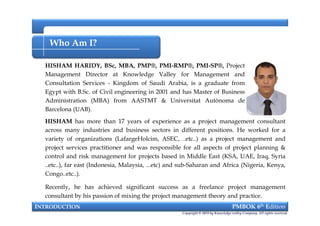
HISHAM HARIDY, BSc, MBA, PMP®, PMI-RMP®, PMI-SP®, Project
Management Director at Knowledge Valley for Management and
Consultation Services - Kingdom of Saudi Arabia, is a graduate from
Egypt with B.Sc. of Civil engineering in 2001 and has Master of Business
Administration (MBA) from AASTMT & Universitat Autònoma de
Barcelona (UAB).
INTRODUCTION PMBOK 6th Edition
HISHAM HARIDY, BSc, MBA, PMP®, PMI-RMP®, PMI-SP®, Project
Management Director at Knowledge Valley for Management and
Consultation Services - Kingdom of Saudi Arabia, is a graduate from
Egypt with B.Sc. of Civil engineering in 2001 and has Master of Business
Administration (MBA) from AASTMT & Universitat Autònoma de
Barcelona (UAB).
HISHAM has more than 17 years of experience as a project management consultant
across many industries and business sectors in different positions. He worked for a
variety of organizations (LafargeHolcim, ASEC, ..etc..) as a project management and
project services practitioner and was responsible for all aspects of project planning &
control and risk management for projects based in Middle East (KSA, UAE, Iraq, Syria
..etc..), far east (Indonesia, Malaysia, ...etc) and sub-Saharan and Africa (Nigeria, Kenya,
Congo..etc..).
Recently, he has achieved significant success as a freelance project management
consultant by his passion of mixing the project management theory and practice.
Copyright © 2018 by Knowledge valley Company. All rights reserved.
Who Are You?
INTRODUCTION PMBOK 6th Edition
Copyright © 2018 by Knowledge valley Company. All rights reserved.
What’s Your Expectations?
INTRODUCTION PMBOK 6th Edition
Copyright © 2018 by Knowledge valley Company. All rights reserved.
Who Should Attend?
 Project managers
 Project team members
 Professionals from various industries, such as IT,
construction, etc.,
 Who are interested to become PMP certified.
INTRODUCTION PMBOK 6th Edition
 Project managers
 Project team members
 Professionals from various industries, such as IT,
construction, etc.,
 Who are interested to become PMP certified.
Copyright © 2018 by Knowledge valley Company. All rights reserved.
What Will You Get?
 Recognize the value of Project Management and clearly describe the project
objectives and how the Logical Framework technique can help the overall
management of a project.
 Initiate, plan, and carry out a project that accomplishes objectives and
satisfies stakeholders.
 Manage a project through each stage of the project management lifecycle.
INTRODUCTION PMBOK 6th Edition
 Recognize the value of Project Management and clearly describe the project
objectives and how the Logical Framework technique can help the overall
management of a project.
 Initiate, plan, and carry out a project that accomplishes objectives and
satisfies stakeholders.
 Manage a project through each stage of the project management lifecycle.
Copyright © 2018 by Knowledge valley Company. All rights reserved.
 Apply the methodologies and the recognized
practices of formal project management in
alignment with the Guide to the Project
Management Body of Knowledge, (PMBOK®
Guide) Sixth Edition.
Course Content
Introduction
The Environment in Which Projects Operate and PM Role
Project Management Processes
Project Scope management
Project Schedule Management
Project Cost Management
INTRODUCTION PMBOK 6th Edition
Project Cost Management
Project Quality Management
Project Resource Management
Project Communication Management
Project Risk Management
Project Procurement Management
Project Stakeholder Management
Project Integration Management
Copyright © 2018 by Knowledge valley Company. All rights reserved.
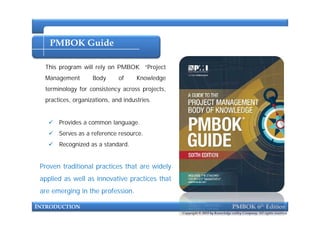
PMBOK Guide
This program will rely on PMBOK “Project
Management Body of Knowledge
terminology for consistency across projects,
practices, organizations, and industries.
INTRODUCTION PMBOK 6th Edition
 Provides a common language.
 Serves as a reference resource.
 Recognized as a standard.
Proven traditional practices that are widely
applied as well as innovative practices that
are emerging in the profession.
Copyright © 2018 by Knowledge valley Company. All rights reserved.
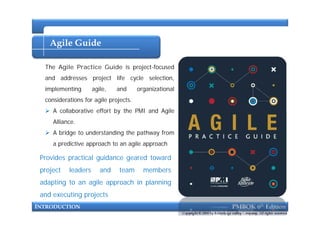
Agile Guide
The Agile Practice Guide is project-focused
and addresses project life cycle selection,
implementing agile, and organizational
considerations for agile projects.
 A collaborative effort by the PMI and Agile
Alliance.
 A bridge to understanding the pathway from
a predictive approach to an agile approach
INTRODUCTION PMBOK 6th Edition
The Agile Practice Guide is project-focused
and addresses project life cycle selection,
implementing agile, and organizational
considerations for agile projects.
 A collaborative effort by the PMI and Agile
Alliance.
 A bridge to understanding the pathway from
a predictive approach to an agile approach
Provides practical guidance geared toward
project leaders and team members
adapting to an agile approach in planning
and executing projects
Copyright © 2018 by Knowledge valley Company. All rights reserved.
Exam RequirementsExam Requirements
1. 35 Contact Hours
 You will get these at the end of this course.
2. Education
 Bachelors Degree
– 4500 hours of PM Experience
• Three years within the last eight years
 High School Graduate
– 7500 hours of PM Experience
• Five years within the last eight years
INTRODUCTION PMBOK 6th Edition
1. 35 Contact Hours
 You will get these at the end of this course.
2. Education
 Bachelors Degree
– 4500 hours of PM Experience
• Three years within the last eight years
 High School Graduate
– 7500 hours of PM Experience
• Five years within the last eight years
Copyright © 2018 by Knowledge valley Company. All rights reserved.
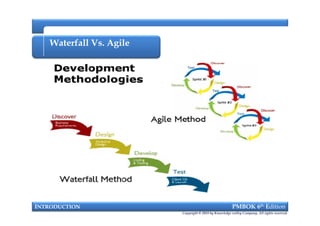
Waterfall Vs. Agile
INTRODUCTION PMBOK 6th Edition
Copyright © 2018 by Knowledge valley Company. All rights reserved.
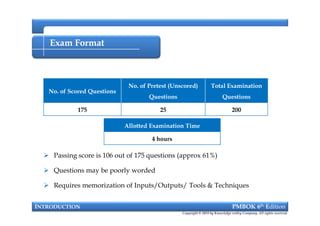
Exam FormatExam Format
 Passing score is 106 out of 175 questions (approx 61%)
 Questions may be poorly worded
 Requires memorization of Inputs/Outputs/ Tools & Techniques
No. of Scored Questions
No. of Pretest (Unscored)
Questions
Total Examination
Questions
175 25 200
INTRODUCTION PMBOK 6th Edition
 Passing score is 106 out of 175 questions (approx 61%)
 Questions may be poorly worded
 Requires memorization of Inputs/Outputs/ Tools & Techniques
175 25 200
Allotted Examination Time
4 hours
Copyright © 2018 by Knowledge valley Company. All rights reserved.
 Projects are temporary.
 Has definite beginning and end, the end is reached when the project’s objective
have been achieved.
 Projects are unique.
 Projects are undertaken to fulfill objectives by producing deliverables.
 Every project creates a unique product, service, or results.
 Project Initiation Context.
 Organizational leaders initiate projects in response to factors acting upon their
organizations.
A project is a temporary endeavor undertaken to create a unique product, service or
result.
ProjectsProjects
 Projects are temporary.
 Has definite beginning and end, the end is reached when the project’s objective
have been achieved.
 Projects are unique.
 Projects are undertaken to fulfill objectives by producing deliverables.
 Every project creates a unique product, service, or results.
 Project Initiation Context.
 Organizational leaders initiate projects in response to factors acting upon their
organizations.
INTRODUCTION PMBOK 6th Edition
Copyright © 2018 by Knowledge valley Company. All rights reserved.
 Projects enable business value creation.
 The net quantifiable benefit derived from a
business endeavor.
 Projects drive change.
 Projects drive change in organizations.
INTRODUCTION PMBOK 6th Edition
Copyright © 2018 by Knowledge valley Company. All rights reserved.
INTRODUCTION PMBOK 6th Edition
Copyright © 2018 by Knowledge valley Company. All rights reserved.
INTRODUCTION PMBOK 6th Edition
Copyright © 2018 by Knowledge valley Company. All rights reserved.
INTRODUCTION PMBOK 6th Edition
Copyright © 2018 by Knowledge valley Company. All rights reserved.
INTRODUCTION PMBOK 6th Edition
Copyright © 2018 by Knowledge valley Company. All rights reserved.
INTRODUCTION PMBOK 6th Edition
Copyright © 2018 by Knowledge valley Company. All rights reserved.
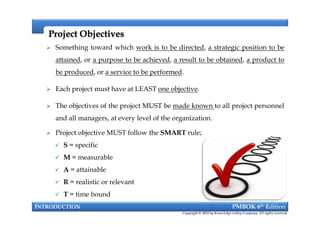
Project ObjectivesProject Objectives
 Something toward which work is to be directed, a strategic position to be
attained, or a purpose to be achieved, a result to be obtained, a product to
be produced, or a service to be performed.
 Each project must have at LEAST one objective.
 The objectives of the project MUST be made known to all project personnel
and all managers, at every level of the organization.
 Project objective MUST follow the SMART rule;
 S = specific
 M = measurable
 A = attainable
 R = realistic or relevant
 T = time bound
INTRODUCTION PMBOK 6th Edition
Copyright © 2018 by Knowledge valley Company. All rights reserved.
 Something toward which work is to be directed, a strategic position to be
attained, or a purpose to be achieved, a result to be obtained, a product to
be produced, or a service to be performed.
 Each project must have at LEAST one objective.
 The objectives of the project MUST be made known to all project personnel
and all managers, at every level of the organization.
 Project objective MUST follow the SMART rule;
 S = specific
 M = measurable
 A = attainable
 R = realistic or relevant
 T = time bound
Why do we need ProjectWhy do we need Project
Management?Management?
Why do we need ProjectWhy do we need Project
Management?Management?
INTRODUCTION PMBOK 6th Edition
Copyright © 2018 by Knowledge valley Company. All rights reserved.
It is the application of knowledge, skills, tools, and techniques to project
activities to meet the project requirements.
 Effective project management helps to:
 Meet business objectives
 Satisfy stakeholder expectations
 Be more predictable
 Increase chances of success
 Balance the influence of constraints on the project
 Deliver the right products at the right time
 Resolve problems and issues
 Respond to risks in a timely manner
 Optimize the use of organizational resources
 Identify, recover, or terminate failing projects
 Manage constraints
 Manage change in a better manner.
Project ManagementProject Management
It is the application of knowledge, skills, tools, and techniques to project
activities to meet the project requirements.
 Effective project management helps to:
 Meet business objectives
 Satisfy stakeholder expectations
 Be more predictable
 Increase chances of success
 Balance the influence of constraints on the project
 Deliver the right products at the right time
 Resolve problems and issues
 Respond to risks in a timely manner
 Optimize the use of organizational resources
 Identify, recover, or terminate failing projects
 Manage constraints
 Manage change in a better manner.
INTRODUCTION PMBOK 6th Edition
Copyright © 2018 by Knowledge valley Company. All rights reserved.
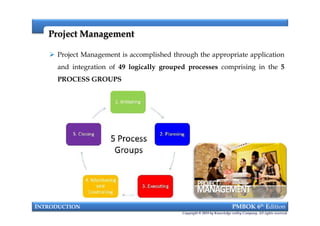
 Project Management is accomplished through the appropriate application
and integration of 49 logically grouped processes comprising in the 5
PROCESS GROUPS
Project ManagementProject Management
INTRODUCTION PMBOK 6th Edition
Copyright © 2018 by Knowledge valley Company. All rights reserved.
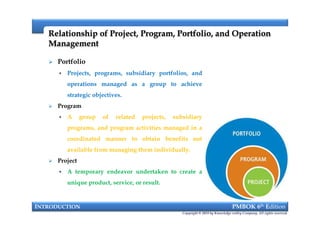
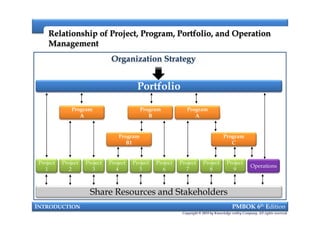
 Portfolio
 Projects, programs, subsidiary portfolios, and
operations managed as a group to achieve
strategic objectives.
 Program
 A group of related projects, subsidiary
programs, and program activities managed in a
coordinated manner to obtain benefits not
available from managing them individually.
 Project
 A temporary endeavor undertaken to create a
unique product, service, or result.
Relationship of Project, Program, Portfolio, and OperationRelationship of Project, Program, Portfolio, and Operation
ManagementManagement
 Portfolio
 Projects, programs, subsidiary portfolios, and
operations managed as a group to achieve
strategic objectives.
 Program
 A group of related projects, subsidiary
programs, and program activities managed in a
coordinated manner to obtain benefits not
available from managing them individually.
 Project
 A temporary endeavor undertaken to create a
unique product, service, or result.
INTRODUCTION PMBOK 6th Edition
Copyright © 2018 by Knowledge valley Company. All rights reserved.
Relationship of Project, Program, Portfolio, and OperationRelationship of Project, Program, Portfolio, and Operation
ManagementManagement
Portfolio
Program
A
Program
B
Program
A
Organization Strategy
INTRODUCTION PMBOK 6th Edition
Copyright © 2018 by Knowledge valley Company. All rights reserved.
Share Resources and Stakeholders
Project
1
Project
2
Project
3
Project
4
Project
5
Project
6
Project
7
Project
8
Project
9
Operations
Program
A
Program
B
Program
A
Program
B1
Program
C
Program Management
It is the application of knowledge, skills, and
principles to a program to achieve the
program objectives and to obtain benefits and
control not available by managing program
components individually.
Program and Portfolio ManagementProgram and Portfolio Management
Program Management
It is the application of knowledge, skills, and
principles to a program to achieve the
program objectives and to obtain benefits and
control not available by managing program
components individually.
INTRODUCTION PMBOK 6th Edition
Copyright © 2018 by Knowledge valley Company. All rights reserved.
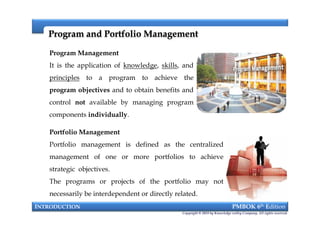
Portfolio Management
Portfolio management is defined as the centralized
management of one or more portfolios to achieve
strategic objectives.
The programs or projects of the portfolio may not
necessarily be interdependent or directly related.
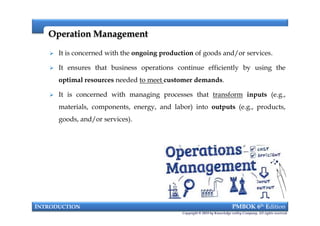
 It is concerned with the ongoing production of goods and/or services.
 It ensures that business operations continue efficiently by using the
optimal resources needed to meet customer demands.
 It is concerned with managing processes that transform inputs (e.g.,
materials, components, energy, and labor) into outputs (e.g., products,
goods, and/or services).
Operation ManagementOperation Management
 It is concerned with the ongoing production of goods and/or services.
 It ensures that business operations continue efficiently by using the
optimal resources needed to meet customer demands.
 It is concerned with managing processes that transform inputs (e.g.,
materials, components, energy, and labor) into outputs (e.g., products,
goods, and/or services).
INTRODUCTION PMBOK 6th Edition
Copyright © 2018 by Knowledge valley Company. All rights reserved.
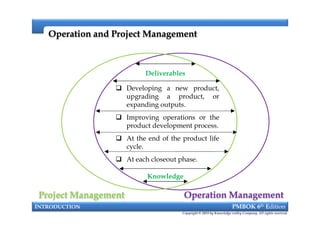
 Developing a new product,
upgrading a product, or
expanding outputs.
 Improving operations or the
product development process.
 At the end of the product life
cycle.
 At each closeout phase.
Operation and Project ManagementOperation and Project Management
Deliverables
INTRODUCTION PMBOK 6th Edition
Copyright © 2018 by Knowledge valley Company. All rights reserved.
Project ManagementProject Management Operation ManagementOperation Management
 Developing a new product,
upgrading a product, or
expanding outputs.
 Improving operations or the
product development process.
 At the end of the product life
cycle.
 At each closeout phase.
Knowledge
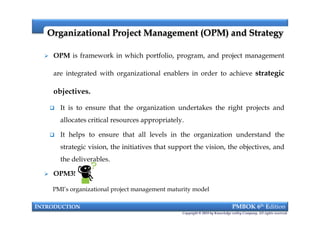
 OPM is framework in which portfolio, program, and project management
are integrated with organizational enablers in order to achieve strategic
objectives.
 It is to ensure that the organization undertakes the right projects and
allocates critical resources appropriately.
 It helps to ensure that all levels in the organization understand the
strategic vision, the initiatives that support the vision, the objectives, and
the deliverables.
Organizational Project Management (OPM) and StrategyOrganizational Project Management (OPM) and Strategy
INTRODUCTION PMBOK 6th Edition
Copyright © 2018 by Knowledge valley Company. All rights reserved.
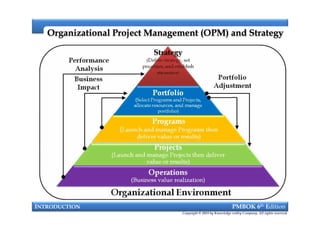
 OPM is framework in which portfolio, program, and project management
are integrated with organizational enablers in order to achieve strategic
objectives.
 It is to ensure that the organization undertakes the right projects and
allocates critical resources appropriately.
 It helps to ensure that all levels in the organization understand the
strategic vision, the initiatives that support the vision, the objectives, and
the deliverables.
 OPM3!
PMI’s organizational project management maturity model
Organizational Project Management (OPM) and StrategyOrganizational Project Management (OPM) and Strategy
INTRODUCTION PMBOK 6th Edition
Copyright © 2018 by Knowledge valley Company. All rights reserved.
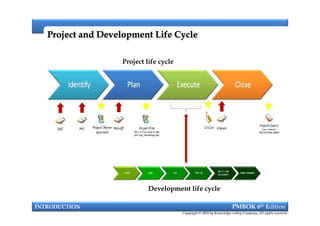
Project and Development Life CycleProject and Development Life Cycle
Project life cycle
INTRODUCTION PMBOK 6th Edition
Copyright © 2018 by Knowledge valley Company. All rights reserved.
Development life cycle
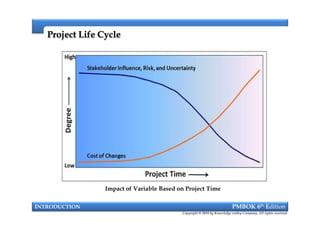
ProjectProject Life CycleLife Cycle
INTRODUCTION PMBOK 6th Edition
Copyright © 2018 by Knowledge valley Company. All rights reserved.
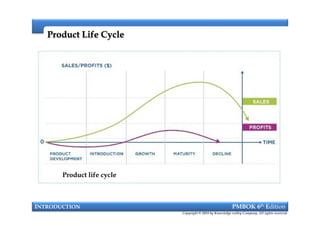
Impact of Variable Based on Project Time
Product Life CycleProduct Life Cycle
INTRODUCTION PMBOK 6th Edition
Copyright © 2018 by Knowledge valley Company. All rights reserved.
Product life cycle
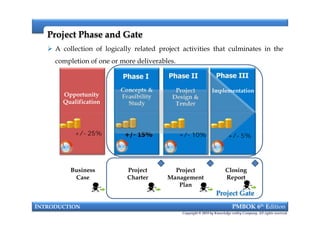
ProjectProject Phase and GatePhase and Gate
 A collection of logically related project activities that culminates in the
completion of one or more deliverables.
Phase I Phase II Phase III
Opportunity
Qualification
Concepts &
Feasibility
Study
Project
Design &
Tender
Implementation
INTRODUCTION PMBOK 6th Edition
Copyright © 2018 by Knowledge valley Company. All rights reserved.
Business
Case
Project
Charter
Project
Management
Plan
+/- 25% +/- 15%
Closing
Report
+/- 10% +/- 5%
Project Gate
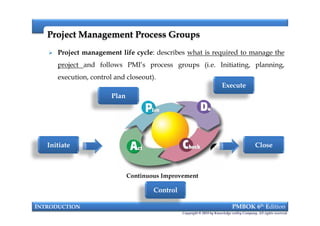
Project Management Process GroupsProject Management Process Groups
 Project management life cycle: describes what is required to manage the
project and follows PMI’s process groups (i.e. Initiating, planning,
execution, control and closeout).
Plan
Execute
INTRODUCTION PMBOK 6th Edition
Copyright © 2018 by Knowledge valley Company. All rights reserved.
Control
CloseInitiate
Continuous Improvement
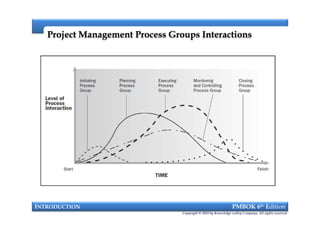
Project Management Process Groups InteractionsProject Management Process Groups Interactions
INTRODUCTION PMBOK 6th Edition
Copyright © 2018 by Knowledge valley Company. All rights reserved.
Project Management Process GroupsProject Management Process Groups
•Defines and
authorizes
the project or
a project
phase.
•Defines and
refines
objectives, and
the course of
action required
to attain the
scope of the
project.
Planning •Integrates
people and
other
resources to
implement
the project
management
plan.
•Measures
project
progress to
identify
variances
from the
plan.
Monitoring
and Control
•Formalizes
the
acceptance of
a project,
project phase,
or
termination
of the project.
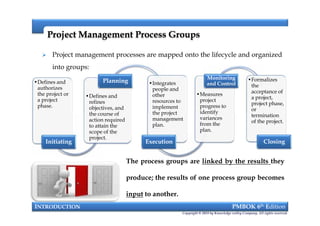
 Project management processes are mapped onto the lifecycle and organized
into groups:
INTRODUCTION PMBOK 6th Edition
Copyright © 2018 by Knowledge valley Company. All rights reserved.
Initiating
•Defines and
refines
objectives, and
the course of
action required
to attain the
scope of the
project.
•Integrates
people and
other
resources to
implement
the project
management
plan.
Execution
•Measures
project
progress to
identify
variances
from the
plan.
•Formalizes
the
acceptance of
a project,
project phase,
or
termination
of the project.
Closing
The process groups are linked by the results they
produce; the results of one process group becomes
input to another.
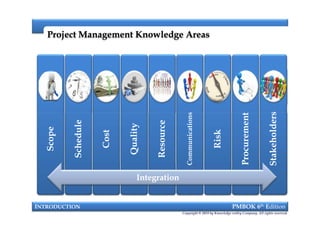
Project Management Knowledge AreasProject Management Knowledge Areas
Communications
Procurement
Stakeholders
INTRODUCTION PMBOK 6th Edition
Copyright © 2018 by Knowledge valley Company. All rights reserved.
Scope
Schedule
Cost
Quality
Resource
Communications
Risk
Procurement
Stakeholders
IntegrationIntegration
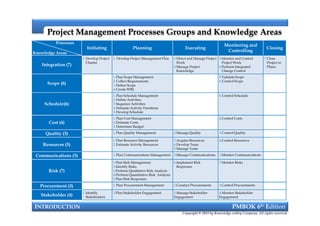
Project Management Processes Groups and Knowledge AreasProject Management Processes Groups and Knowledge Areas
Processes
Knowledge Areas
Initiating Planning Executing
Monitoring and
Controlling
Closing
Integration (7)
1.Develop Project
Charter
2. Develop Project Management Plan 3.Direct and Manage Project
Work
4.Manage Project
Knowledge
5.Monitor and Control
Project Work
6.Perform Integrated
Change Control
7.Close
Project or
Phase
Scope (6)
1.Plan Scope Management
2.Collect Requirements
3.Define Scope
4.Create WBS
5.Validate Scope
6.Control Scope
Schedule(6)
1.Plan Schedule Management
2.Define Activities
3.Sequence Activities
4.Estimate Activity Durations
5.Develop Schedule
6.Control Schedule
INTRODUCTION PMBOK 6th Edition
Copyright © 2018 by Knowledge valley Company. All rights reserved.
1.Plan Schedule Management
2.Define Activities
3.Sequence Activities
4.Estimate Activity Durations
5.Develop Schedule
Cost (4)
1.Plan Cost Management
2.Estimate Costs
3.Determine Budget
4.Control Costs
Quality (3) 1.Plan Quality Management 2.Manage Quality 3.Control Quality
Resources (5)
1.Plan Resource Management
2.Estimate Activity Resources
3.Acquire Resources
4.Develop Team
5.Manage Team
6.Control Resources
Communications (3) 1.Plan Communications Management 2.Manage Communications 3.Monitor Communications
Risk (7)
1.Plan Risk Management
2.Identify Risks
3.Perform Qualitative Risk Analysis
4.Perform Quantitative Risk Analysis
5.Plan Risk Responses
6.Implement Risk
Responses
7.Monitor Risks
Procurement (3) 1.Plan Procurement Management 2.Conduct Procurements 3.Control Procurements
Stakeholder (4)
1.Identify
Stakeholders
2.Plan Stakeholder Engagement 3.Manage Stakeholder
Engagement
4.Monitor Stakeholder
Engagement
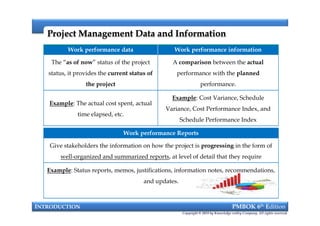
Project Management Data and InformationProject Management Data and Information
Work performance data Work performance information
The “as of now” status of the project
status, it provides the current status of
the project
A comparison between the actual
performance with the planned
performance.
Example: The actual cost spent, actual
time elapsed, etc.
Example: Cost Variance, Schedule
Variance, Cost Performance Index, and
Schedule Performance Index
INTRODUCTION PMBOK 6th Edition
Copyright © 2018 by Knowledge valley Company. All rights reserved.
Example: The actual cost spent, actual
time elapsed, etc.
Example: Cost Variance, Schedule
Variance, Cost Performance Index, and
Schedule Performance Index
Work performance Reports
Give stakeholders the information on how the project is progressing in the form of
well-organized and summarized reports, at level of detail that they require
Example: Status reports, memos, justifications, information notes, recommendations,
and updates.
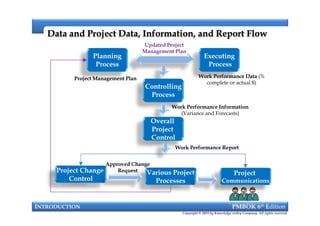
Data and Project Data, Information, and Report FlowData and Project Data, Information, and Report Flow
Planning
Process
Executing
Process
Project Management PlanProject Management Plan Work Performance DataWork Performance Data (%
complete or actual $)
Controlling
Process
Work Performance InformationWork Performance Information
(Variance and Forecasts)
Updated ProjectUpdated Project
Management PlanManagement Plan
INTRODUCTION PMBOK 6th Edition
Copyright © 2018 by Knowledge valley Company. All rights reserved.
Work Performance InformationWork Performance Information
(Variance and Forecasts)
Overall
Project
Control
Work Performance ReportWork Performance Report
Project Change
Control
Various Project
Processes
Project
Communications
Approved ChangeApproved Change
RequestRequest
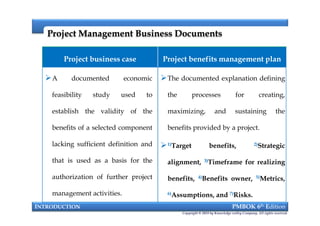
Project Management Business DocumentsProject Management Business Documents
Project business case Project benefits management plan
A documented economic
feasibility study used to
establish the validity of the
benefits of a selected component
lacking sufficient definition and
that is used as a basis for the
authorization of further project
management activities.
The documented explanation defining
the processes for creating,
maximizing, and sustaining the
benefits provided by a project.
1)Target benefits, 2)Strategic
alignment, 3)Timeframe for realizing
benefits, 4)Benefits owner, 5)Metrics,
6)Assumptions, and 7)Risks.
INTRODUCTION PMBOK 6th Edition
Copyright © 2018 by Knowledge valley Company. All rights reserved.
A documented economic
feasibility study used to
establish the validity of the
benefits of a selected component
lacking sufficient definition and
that is used as a basis for the
authorization of further project
management activities.
The documented explanation defining
the processes for creating,
maximizing, and sustaining the
benefits provided by a project.
1)Target benefits, 2)Strategic
alignment, 3)Timeframe for realizing
benefits, 4)Benefits owner, 5)Metrics,
6)Assumptions, and 7)Risks.
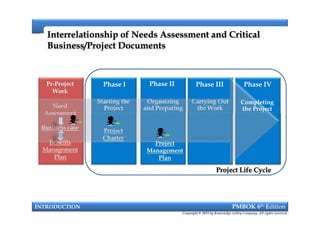
Interrelationship of Needs Assessment and CriticalInterrelationship of Needs Assessment and Critical
Business/Project DocumentsBusiness/Project Documents
Carrying Out
the Work
Pr-Project
Work
Need
Assessment
Business case
Benefits
Management
Plan
Starting the
Project
Organizing
and Preparing
Completing
the Project
Phase I Phase II Phase III Phase IV
INTRODUCTION PMBOK 6th Edition
Copyright © 2018 by Knowledge valley Company. All rights reserved.
Pr-Project
Work
Need
Assessment
Business case
Benefits
Management
Plan
Project
Charter
Project
Management
Plan
Project Life CycleProject Life Cycle
Project CharterProject Charter
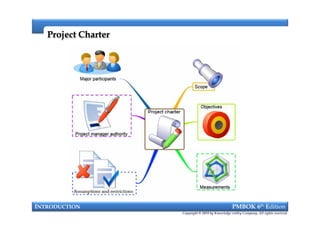
 A document issued by the project sponsor that formally authorizes the
existence of a project.
 It provides the project manager with the authority to apply
organizational resources to project activities.
 It provides the high – level requirements for the project.
 It links the project to the ongoing work of the organization.
INTRODUCTION PMBOK 6th Edition
Copyright © 2018 by Knowledge valley Company. All rights reserved.
 A document issued by the project sponsor that formally authorizes the
existence of a project.
 It provides the project manager with the authority to apply
organizational resources to project activities.
 It provides the high – level requirements for the project.
 It links the project to the ongoing work of the organization.
 It is abroad enough so it does NOT NEED to change
as the project progresses.
 The project charter is such an important document
that project CAN NOT be started without one.
Project CharterProject Charter
INTRODUCTION PMBOK 6th Edition
Copyright © 2018 by Knowledge valley Company. All rights reserved.
Project Management PlanProject Management Plan
 A project management plan is an integration function-it integrates all the
knowledge area management plans into a cohesive whole.
 This plan includes the baselines for the project (Scope, Schedule, Cost) and
also it called performance measurement baselines.
 The project management plan includes:
 How the project will be executed, monitored, and controlled.
 Subsidiary plans for scope, schedule, cost, quality, human resources,
communications, risk, procurement, and stakeholders.
 A requirements management plan.
 A change management plan.
 A configuration management plan. Latest version!
 A process improvement plan.
INTRODUCTION PMBOK 6th Edition
Copyright © 2018 by Knowledge valley Company. All rights reserved.
 A project management plan is an integration function-it integrates all the
knowledge area management plans into a cohesive whole.
 This plan includes the baselines for the project (Scope, Schedule, Cost) and
also it called performance measurement baselines.
 The project management plan includes:
 How the project will be executed, monitored, and controlled.
 Subsidiary plans for scope, schedule, cost, quality, human resources,
communications, risk, procurement, and stakeholders.
 A requirements management plan.
 A change management plan.
 A configuration management plan. Latest version!
 A process improvement plan.
RefreshmentsRefreshments
Q1. You are managing a project in which you intend to respond to high
levels of change and ongoing stakeholder involvement. The most suitable
project life cycle for your project is the:
A. Predictive life cycle.
B. Adaptive life cycle.
C. Waterfall life cycle.
D. Configuration management life cycle.
Q2. Project tailoring is an important consideration for most projects. Which
of the following is the least likely project consideration?
A. Project manager’s skills and competency.
B. Each project is unique.
C. Addressing competing constraints.
D. Level of project governance varies.
INTRODUCTION PMBOK 6th Edition
Copyright © 2018 by Knowledge valley Company. All rights reserved.
Q1. You are managing a project in which you intend to respond to high
levels of change and ongoing stakeholder involvement. The most suitable
project life cycle for your project is the:
A. Predictive life cycle.
B. Adaptive life cycle.
C. Waterfall life cycle.
D. Configuration management life cycle.
Q2. Project tailoring is an important consideration for most projects. Which
of the following is the least likely project consideration?
A. Project manager’s skills and competency.
B. Each project is unique.
C. Addressing competing constraints.
D. Level of project governance varies.
RefreshmentsRefreshments
Q3. Your job responsibility is to align components (projects, programs, or related
operations) to the organizational strategy, organized into portfolios or subsidiary
portfolios to optimize project or program objectives, dependencies, costs,
timelines, benefits, resources, and risks. This is known as:
A. Components management.
B. Process management.
C. Program management.
D. Portfolio management.
Q4. All of the following are questions that the key stakeholders and project
managers should answer to develop the project success measures EXCEPT:
A. What does success look like for the project?
B. How will success be measured?
C. What are the communication requirements?
D. What factors may impact success?
INTRODUCTION PMBOK 6th Edition
Copyright © 2018 by Knowledge valley Company. All rights reserved.
Q3. Your job responsibility is to align components (projects, programs, or related
operations) to the organizational strategy, organized into portfolios or subsidiary
portfolios to optimize project or program objectives, dependencies, costs,
timelines, benefits, resources, and risks. This is known as:
A. Components management.
B. Process management.
C. Program management.
D. Portfolio management.
Q4. All of the following are questions that the key stakeholders and project
managers should answer to develop the project success measures EXCEPT:
A. What does success look like for the project?
B. How will success be measured?
C. What are the communication requirements?
D. What factors may impact success?
RefreshmentsRefreshments
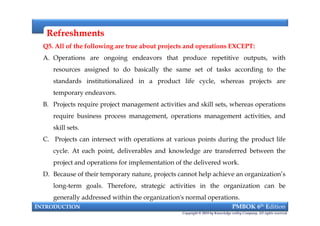
Q5. All of the following are true about projects and operations EXCEPT:
A. Operations are ongoing endeavors that produce repetitive outputs, with
resources assigned to do basically the same set of tasks according to the
standards institutionalized in a product life cycle, whereas projects are
temporary endeavors.
B. Projects require project management activities and skill sets, whereas operations
require business process management, operations management activities, and
skill sets.
C. Projects can intersect with operations at various points during the product life
cycle. At each point, deliverables and knowledge are transferred between the
project and operations for implementation of the delivered work.
D. Because of their temporary nature, projects cannot help achieve an organization’s
long-term goals. Therefore, strategic activities in the organization can be
generally addressed within the organization's normal operations.
INTRODUCTION PMBOK 6th Edition
Copyright © 2018 by Knowledge valley Company. All rights reserved.
Q5. All of the following are true about projects and operations EXCEPT:
A. Operations are ongoing endeavors that produce repetitive outputs, with
resources assigned to do basically the same set of tasks according to the
standards institutionalized in a product life cycle, whereas projects are
temporary endeavors.
B. Projects require project management activities and skill sets, whereas operations
require business process management, operations management activities, and
skill sets.
C. Projects can intersect with operations at various points during the product life
cycle. At each point, deliverables and knowledge are transferred between the
project and operations for implementation of the delivered work.
D. Because of their temporary nature, projects cannot help achieve an organization’s
long-term goals. Therefore, strategic activities in the organization can be
generally addressed within the organization's normal operations.
TTHEHE EENVIRONMENT INNVIRONMENT IN WWHICHHICH
PPROJECTSROJECTS OOPERATPERAT
PMBOKPMBOK
66thth EEditiondition
Copyright © 2018 by Knowledge valley Company. All rights reserved.
Hisham Haridy, MBA, PMP, PMI-RMP, PMI-SP
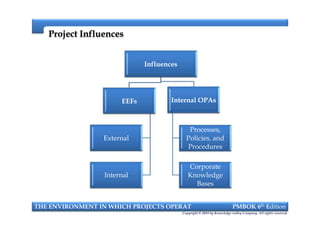
Project InfluencesProject Influences
Influences
EEFs Internal OPAs
THE ENVIRONMENT IN WHICH PROJECTS OPERAT PMBOK 6th Edition
Copyright © 2018 by Knowledge valley Company. All rights reserved.
External
Internal
Processes,
Policies, and
Procedures
Corporate
Knowledge
Bases
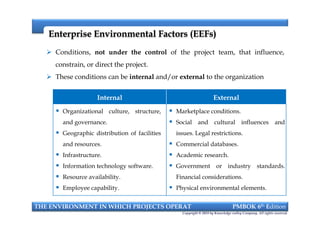
Enterprise Environmental Factors (EEFs)Enterprise Environmental Factors (EEFs)
 Conditions, not under the control of the project team, that influence,
constrain, or direct the project.
 These conditions can be internal and/or external to the organization
Internal External
 Organizational culture, structure,
and governance.
 Geographic distribution of facilities
and resources.
 Infrastructure.
 Information technology software.
 Resource availability.
 Employee capability.
 Marketplace conditions.
 Social and cultural influences and
issues. Legal restrictions.
 Commercial databases.
 Academic research.
 Government or industry standards.
Financial considerations.
 Physical environmental elements.
THE ENVIRONMENT IN WHICH PROJECTS OPERAT PMBOK 6th Edition
Copyright © 2018 by Knowledge valley Company. All rights reserved.
 Organizational culture, structure,
and governance.
 Geographic distribution of facilities
and resources.
 Infrastructure.
 Information technology software.
 Resource availability.
 Employee capability.
 Marketplace conditions.
 Social and cultural influences and
issues. Legal restrictions.
 Commercial databases.
 Academic research.
 Government or industry standards.
Financial considerations.
 Physical environmental elements.
 Information, tools, documents, or knowledge your organization possess
that can help you plan for your project:
 Anything that your organization owns or has developed that can help you
on a current or future project.
 Organizational process assets may be grouped into two categories;
1. Processes, Policies, and Procedures
2. Corporate Knowledge Bases
Organizational Process Assets (OPAs)Organizational Process Assets (OPAs)
THE ENVIRONMENT IN WHICH PROJECTS OPERAT PMBOK 6th Edition
Copyright © 2018 by Knowledge valley Company. All rights reserved.
 Information, tools, documents, or knowledge your organization possess
that can help you plan for your project:
 Anything that your organization owns or has developed that can help you
on a current or future project.
 Organizational process assets may be grouped into two categories;
1. Processes, Policies, and Procedures
2. Corporate Knowledge Bases
Organizational Process Assets (OPAs)Organizational Process Assets (OPAs)
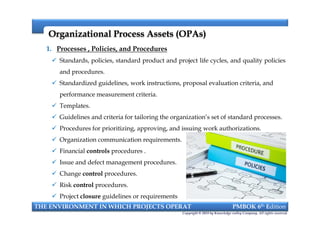
1. Processes , Policies, and Procedures
 Standards, policies, standard product and project life cycles, and quality policies
and procedures.
 Standardized guidelines, work instructions, proposal evaluation criteria, and
performance measurement criteria.
 Templates.
 Guidelines and criteria for tailoring the organization’s set of standard processes.
 Procedures for prioritizing, approving, and issuing work authorizations.
 Organization communication requirements.
 Financial controls procedures .
 Issue and defect management procedures.
 Change control procedures.
 Risk control procedures.
 Project closure guidelines or requirements
THE ENVIRONMENT IN WHICH PROJECTS OPERAT PMBOK 6th Edition
Copyright © 2018 by Knowledge valley Company. All rights reserved.
1. Processes , Policies, and Procedures
 Standards, policies, standard product and project life cycles, and quality policies
and procedures.
 Standardized guidelines, work instructions, proposal evaluation criteria, and
performance measurement criteria.
 Templates.
 Guidelines and criteria for tailoring the organization’s set of standard processes.
 Procedures for prioritizing, approving, and issuing work authorizations.
 Organization communication requirements.
 Financial controls procedures .
 Issue and defect management procedures.
 Change control procedures.
 Risk control procedures.
 Project closure guidelines or requirements
Organizational Process Assets (OPAs)Organizational Process Assets (OPAs)
2. Corporate Knowledge Bases
The organizational knowledge repositories for storing and retrieving
information include:
 Process measurement databases used to collect and make available
measurement data on processes and products.
 Project files.
 Historical information and lessons learned knowledge bases.
 Issue and defect management databases containing issue and defect status,
control information, issue and defect resolution, and action item results.
 Configuration management knowledge bases containing the versions and
baselines of all official company standards, policies, procedures, and any
project documents.
 Financial databases containing information such as labor hours, incurred costs,
budgets and any project cost overruns.
THE ENVIRONMENT IN WHICH PROJECTS OPERAT PMBOK 6th Edition
Copyright © 2018 by Knowledge valley Company. All rights reserved.
2. Corporate Knowledge Bases
The organizational knowledge repositories for storing and retrieving
information include:
 Process measurement databases used to collect and make available
measurement data on processes and products.
 Project files.
 Historical information and lessons learned knowledge bases.
 Issue and defect management databases containing issue and defect status,
control information, issue and defect resolution, and action item results.
 Configuration management knowledge bases containing the versions and
baselines of all official company standards, policies, procedures, and any
project documents.
 Financial databases containing information such as labor hours, incurred costs,
budgets and any project cost overruns.
Organizational SystemsOrganizational Systems
 The interaction of multiple factors within an individual organization creates
a unique system that impacts the project operating in that system.
 The resulting organizational system determines the power, influence,
interests, competence, and political capabilities of the people who are able
to act within the system.
 The system factors include:
1. Management elements
2. Governance frameworks
3. Organizational structure types
THE ENVIRONMENT IN WHICH PROJECTS OPERAT PMBOK 6th Edition
Copyright © 2018 by Knowledge valley Company. All rights reserved.
 The interaction of multiple factors within an individual organization creates
a unique system that impacts the project operating in that system.
 The resulting organizational system determines the power, influence,
interests, competence, and political capabilities of the people who are able
to act within the system.
 The system factors include:
1. Management elements
2. Governance frameworks
3. Organizational structure types
Management ElementsManagement Elements
 The components that comprise the key functions or principles of general
management in the organization.
 The general management elements are allocated within the organization
according to its 1) governance framework and the 2) organizational structure
type selected.
 Performance of these management elements are assigned to selected
individuals within the organization.
THE ENVIRONMENT IN WHICH PROJECTS OPERAT PMBOK 6th Edition
Copyright © 2018 by Knowledge valley Company. All rights reserved.
 The components that comprise the key functions or principles of general
management in the organization.
 The general management elements are allocated within the organization
according to its 1) governance framework and the 2) organizational structure
type selected.
 Performance of these management elements are assigned to selected
individuals within the organization.
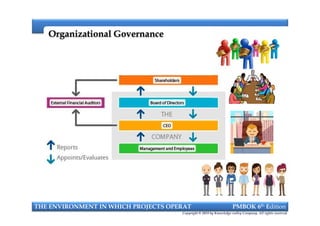
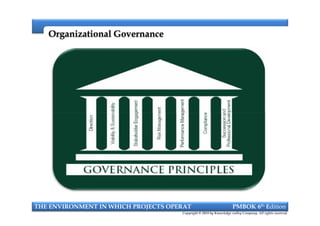
Organizational GovernanceOrganizational Governance
1. A structured way to provide direction and control through policies, and
processes, to meet strategic and operational goals.
2. Typically conducted by a board of directors to ensure accountability,
fairness, and transparency to its stakeholders.
3. Its principles, decisions, and processes may influence and impact the
governance of portfolios, programs, and projects in the following ways:
 Enforcing legal, regulatory, standards, and compliance requirements.
 Defining ethical, social, and environmental responsibilities.
 Specifying operational, legal, and risk policies.
 Types of governance
 Organizational governance.
 Organizational project management (OPM) governance.
 Portfolio, Program, and Project governance.
THE ENVIRONMENT IN WHICH PROJECTS OPERAT PMBOK 6th Edition
Copyright © 2018 by Knowledge valley Company. All rights reserved.
1. A structured way to provide direction and control through policies, and
processes, to meet strategic and operational goals.
2. Typically conducted by a board of directors to ensure accountability,
fairness, and transparency to its stakeholders.
3. Its principles, decisions, and processes may influence and impact the
governance of portfolios, programs, and projects in the following ways:
 Enforcing legal, regulatory, standards, and compliance requirements.
 Defining ethical, social, and environmental responsibilities.
 Specifying operational, legal, and risk policies.
 Types of governance
 Organizational governance.
 Organizational project management (OPM) governance.
 Portfolio, Program, and Project governance.
Organizational GovernanceOrganizational Governance
If management is about
running the business,
corporatecorporate governancegovernance is
about seeing that it is runrun
properlyproperly..
Framework within which authority is
exercised in organizations.
THE ENVIRONMENT IN WHICH PROJECTS OPERAT PMBOK 6th Edition
Copyright © 2018 by Knowledge valley Company. All rights reserved.
If management is about
running the business,
corporatecorporate governancegovernance is
about seeing that it is runrun
properlyproperly..
All companies need managing and governingAll companies need managing and governing
Organizational GovernanceOrganizational Governance
THE ENVIRONMENT IN WHICH PROJECTS OPERAT PMBOK 6th Edition
Copyright © 2018 by Knowledge valley Company. All rights reserved.
Organizational GovernanceOrganizational Governance
THE ENVIRONMENT IN WHICH PROJECTS OPERAT PMBOK 6th Edition
Copyright © 2018 by Knowledge valley Company. All rights reserved.
Project GovernanceProject Governance
1. The framework, functions, and processes that guide project management
activities in order to create a unique product, service, or result to meet
organizational, strategic, and operational GOALS.
2. It provides the project stakeholders with structure, processes, roles,
responsibilities, accountabilities, and decision-making models for
managing the project.
3. Elements of a project governance framework:
 Stage gate or phase reviews.
 Identifying, escalating, and resolving risks and issues.
 Defining roles, responsibilities, and authorities.
 Process for project knowledge management and capturing lessons learned.
 Decision making, problem solving and escalating topics.
 Reviewing and approving changes to project, and product changes.
THE ENVIRONMENT IN WHICH PROJECTS OPERAT PMBOK 6th Edition
Copyright © 2018 by Knowledge valley Company. All rights reserved.
1. The framework, functions, and processes that guide project management
activities in order to create a unique product, service, or result to meet
organizational, strategic, and operational GOALS.
2. It provides the project stakeholders with structure, processes, roles,
responsibilities, accountabilities, and decision-making models for
managing the project.
3. Elements of a project governance framework:
 Stage gate or phase reviews.
 Identifying, escalating, and resolving risks and issues.
 Defining roles, responsibilities, and authorities.
 Process for project knowledge management and capturing lessons learned.
 Decision making, problem solving and escalating topics.
 Reviewing and approving changes to project, and product changes.
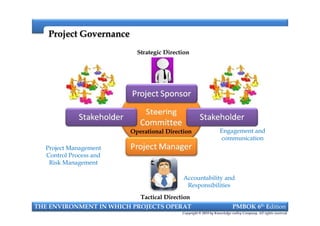
Project GovernanceProject Governance
Strategic DirectionStrategic Direction
THE ENVIRONMENT IN WHICH PROJECTS OPERAT PMBOK 6th Edition
Copyright © 2018 by Knowledge valley Company. All rights reserved.
Operational DirectionOperational Direction
Tactical DirectionTactical Direction
Engagement and
communication
Accountability and
Responsibilities
Project Management
Control Process and
Risk Management
Project GovernanceProject Governance
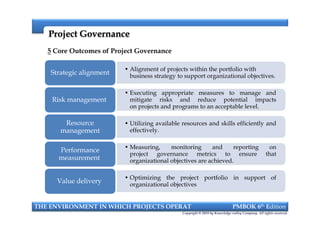
5 Core Outcomes of Project Governance
• Alignment of projects within the portfolio with
business strategy to support organizational objectives.
Strategic alignment
• Executing appropriate measures to manage and
mitigate risks and reduce potential impacts
on projects and programs to an acceptable level.
Risk management
THE ENVIRONMENT IN WHICH PROJECTS OPERAT PMBOK 6th Edition
Copyright © 2018 by Knowledge valley Company. All rights reserved.
• Utilizing available resources and skills efficiently and
effectively.
Resource
management
• Measuring, monitoring and reporting on
project governance metrics to ensure that
organizational objectives are achieved.
Performance
measurement
• Optimizing the project portfolio in support of
organizational objectives
Value delivery
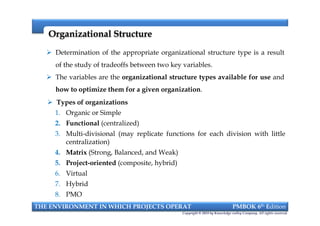
Organizational StructureOrganizational Structure
 Determination of the appropriate organizational structure type is a result
of the study of tradeoffs between two key variables.
 The variables are the organizational structure types available for use and
how to optimize them for a given organization.
 Types of organizations
1. Organic or Simple
2. Functional (centralized)
3. Multi-divisional (may replicate functions for each division with little
centralization)
4. Matrix (Strong, Balanced, and Weak)
5. Project-oriented (composite, hybrid)
6. Virtual
7. Hybrid
8. PMO
THE ENVIRONMENT IN WHICH PROJECTS OPERAT PMBOK 6th Edition
Copyright © 2018 by Knowledge valley Company. All rights reserved.
 Types of organizations
1. Organic or Simple
2. Functional (centralized)
3. Multi-divisional (may replicate functions for each division with little
centralization)
4. Matrix (Strong, Balanced, and Weak)
5. Project-oriented (composite, hybrid)
6. Virtual
7. Hybrid
8. PMO
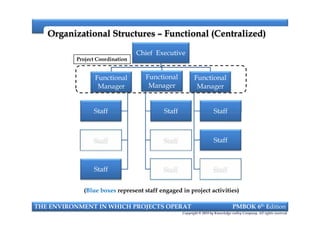
Organizational StructuresOrganizational Structures –– Functional (Centralized)Functional (Centralized)
Chief Executive
Functional
Manager
Staff
Functional
Manager
Staff
Functional
Manager
Staff
Project Coordination
THE ENVIRONMENT IN WHICH PROJECTS OPERAT PMBOK 6th Edition
Copyright © 2018 by Knowledge valley Company. All rights reserved.
(Blue boxes represent staff engaged in project activities)
Staff
Staff
Staff
Staff
Staff
Staff
Staff
Staff
Staff
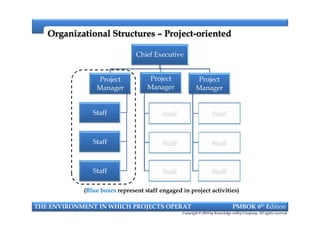
Organizational StructuresOrganizational Structures –– ProjectProject--orientedoriented
Chief Executive
Project
Manager
Staff
Project
Manager
Staff
Project
Manager
Staff
THE ENVIRONMENT IN WHICH PROJECTS OPERAT PMBOK 6th Edition
Copyright © 2018 by Knowledge valley Company. All rights reserved.
Staff
Staff
Staff
Staff
Staff
Staff
Staff
Staff
Staff
(Blue boxes represent staff engaged in project activities)
Chief Executive
Functional
Manager
Staff
Functional
Manager
Staff
Functional
Manager
Staff
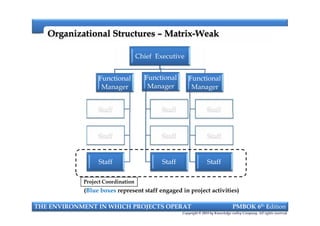
Organizational StructuresOrganizational Structures –– MatrixMatrix--WeakWeak
Staff
Staff
Staff
Staff
Staff
Staff
Staff
Staff
Staff
THE ENVIRONMENT IN WHICH PROJECTS OPERAT PMBOK 6th Edition
Copyright © 2018 by Knowledge valley Company. All rights reserved.
(Blue boxes represent staff engaged in project activities)
Project Coordination
Chief Executive
Functional
Manager
Staff
Functional
Manager
Staff
Functional
Manager
Staff
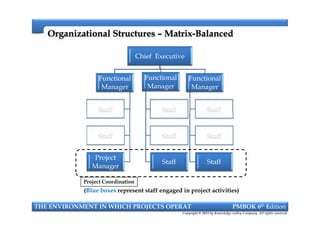
Organizational StructuresOrganizational Structures –– MatrixMatrix--BalancedBalanced
Staff
Staff
Project
Manager
Staff
Staff
Staff
Staff
Staff
Staff
THE ENVIRONMENT IN WHICH PROJECTS OPERAT PMBOK 6th Edition
Copyright © 2018 by Knowledge valley Company. All rights reserved.
(Blue boxes represent staff engaged in project activities)
Project Coordination
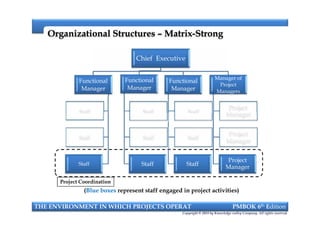
Organizational StructuresOrganizational Structures –– MatrixMatrix--StrongStrong
Chief Executive
Functional
Manager
Staff
Functional
Manager
Staff
Functional
Manager
Staff
Manager of
Project
Managers
Project
Manager
THE ENVIRONMENT IN WHICH PROJECTS OPERAT PMBOK 6th Edition
Copyright © 2018 by Knowledge valley Company. All rights reserved.
(Blue boxes represent staff engaged in project activities)
Project Coordination
Staff
Staff
Staff
Staff
Staff
Staff
Staff
Staff
Staff
Project
Manager
Project
Manager
Project
Manager
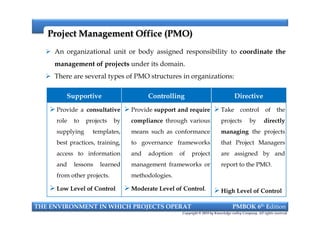
Project Management Office (PMO)Project Management Office (PMO)
 An organizational unit or body assigned responsibility to coordinate the
management of projects under its domain.
 There are several types of PMO structures in organizations:
Supportive Controlling Directive
 Provide a consultative
role to projects by
supplying templates,
best practices, training,
access to information
and lessons learned
from other projects.
 Low Level of Control
 Provide support and require
compliance through various
means such as conformance
to governance frameworks
and adoption of project
management frameworks or
methodologies.
 Moderate Level of Control.
 Take control of the
projects by directly
managing the projects
that Project Managers
are assigned by and
report to the PMO.
 High Level of Control
THE ENVIRONMENT IN WHICH PROJECTS OPERAT PMBOK 6th Edition
Copyright © 2018 by Knowledge valley Company. All rights reserved.
 Provide a consultative
role to projects by
supplying templates,
best practices, training,
access to information
and lessons learned
from other projects.
 Low Level of Control
 Provide support and require
compliance through various
means such as conformance
to governance frameworks
and adoption of project
management frameworks or
methodologies.
 Moderate Level of Control.
 Take control of the
projects by directly
managing the projects
that Project Managers
are assigned by and
report to the PMO.
 High Level of Control
RefreshmentsRefreshments
Q1: All of the following are external environmental factors EXCEPT:
A. Legal restrictions.
B. Organizational values and principles.
C. Competitive movements.
D. Economic conditions .
Q2. A primary function of a project management office (PMO) is to support
project managers in a variety of ways, which may include all of the
following EXCEPT:
A. A. Intervening in project execution directly and without involving the
project manager.
B. Managing shared resources across all projects administered by the PMO.
C. Identifying and developing project management methodology, best
practices, and standards.
D. Coaching, mentoring, training, and oversight .
Q1: All of the following are external environmental factors EXCEPT:
A. Legal restrictions.
B. Organizational values and principles.
C. Competitive movements.
D. Economic conditions .
Q2. A primary function of a project management office (PMO) is to support
project managers in a variety of ways, which may include all of the
following EXCEPT:
A. A. Intervening in project execution directly and without involving the
project manager.
B. Managing shared resources across all projects administered by the PMO.
C. Identifying and developing project management methodology, best
practices, and standards.
D. Coaching, mentoring, training, and oversight .
THE ENVIRONMENT IN WHICH PROJECTS OPERAT PMBOK 6th Edition
Copyright © 2018 by Knowledge valley Company. All rights reserved.
RefreshmentsRefreshments
Q3. Which of the following best describe management elements?
A. Management elements are the components that comprise the key
functions or principles of general management in the organization.
B. Management elements are the project management principles that guide
how projects are executed in the organization.
C. Management elements are established by PMOs to guide project
implementation.
D. Management elements are influenced by the governance framework,
established for effective implementation of projects.
Q3. Which of the following best describe management elements?
A. Management elements are the components that comprise the key
functions or principles of general management in the organization.
B. Management elements are the project management principles that guide
how projects are executed in the organization.
C. Management elements are established by PMOs to guide project
implementation.
D. Management elements are influenced by the governance framework,
established for effective implementation of projects.
THE ENVIRONMENT IN WHICH PROJECTS OPERAT PMBOK 6th Edition
Copyright © 2018 by Knowledge valley Company. All rights reserved.
RefreshmentsRefreshments
Q4. Governance is the framework within which authority is exercised in
organizations. This framework includes all of the following components
EXCEPT:
A. Rules.
B. Policies.
C. Techniques.
D. Relationships .
Q5. Organizational process assets (OPAs) influence the management of
projects. Which one of the following best describes the important categories
of OPAs?
A. Organizational knowledge bases and processes
B. Processes, policies, procedures, tools, and techniques.
C. Organizational knowledge bases, processes, policies, and procedures.
D. Organizational knowledge bases, tools, and techniques.
Q4. Governance is the framework within which authority is exercised in
organizations. This framework includes all of the following components
EXCEPT:
A. Rules.
B. Policies.
C. Techniques.
D. Relationships .
Q5. Organizational process assets (OPAs) influence the management of
projects. Which one of the following best describes the important categories
of OPAs?
A. Organizational knowledge bases and processes
B. Processes, policies, procedures, tools, and techniques.
C. Organizational knowledge bases, processes, policies, and procedures.
D. Organizational knowledge bases, tools, and techniques.
THE ENVIRONMENT IN WHICH PROJECTS OPERAT PMBOK 6th Edition
Copyright © 2018 by Knowledge valley Company. All rights reserved.
TTHEHE RROLE OFOLE OF TTHEHE PPROJECTROJECT
MMANAGERANAGER
PMBOKPMBOK
66thth EEditiondition
Copyright © 2018 by Knowledge valley Company. All rights reserved.
Hisham Haridy, MBA, PMP, PMI-RMP, PMI-SP
Project StakeholdersProject Stakeholders
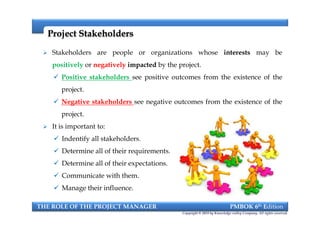
 Stakeholders are people or organizations whose interests may be
positively or negatively impacted by the project.
 Positive stakeholders see positive outcomes from the existence of the
project.
 Negative stakeholders see negative outcomes from the existence of the
project.
 It is important to:
 Indentify all stakeholders.
 Determine all of their requirements.
 Determine all of their expectations.
 Communicate with them.
 Manage their influence.
THE ROLE OF THE PROJECT MANAGER PMBOK 6th Edition
Copyright © 2018 by Knowledge valley Company. All rights reserved.
 Stakeholders are people or organizations whose interests may be
positively or negatively impacted by the project.
 Positive stakeholders see positive outcomes from the existence of the
project.
 Negative stakeholders see negative outcomes from the existence of the
project.
 It is important to:
 Indentify all stakeholders.
 Determine all of their requirements.
 Determine all of their expectations.
 Communicate with them.
 Manage their influence.
Project StakeholdersProject Stakeholders
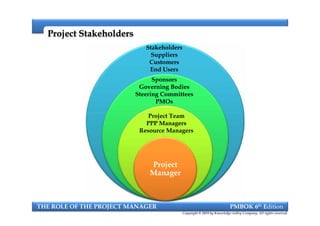
Sponsors
Governing Bodies
Steering Committees
PMOs
Project Team
PPP Managers
Resource Managers
Stakeholders
Suppliers
Customers
End Users
THE ROLE OF THE PROJECT MANAGER PMBOK 6th Edition
Copyright © 2018 by Knowledge valley Company. All rights reserved.
Project
Manager
Project Team
PPP Managers
Resource Managers
Project ManagerProject Manager
 The person ultimately responsible for
the outcome of the project –
deliverables.
 Not required to be a technical expert.
 Formally empowered to use
organizational resources in control of
the project.
 Authorized to make decisions and
spend the project's budget.
 Found in a matrix or projectized
organization.
THE ROLE OF THE PROJECT MANAGER PMBOK 6th Edition
Copyright © 2018 by Knowledge valley Company. All rights reserved.
 The person ultimately responsible for
the outcome of the project –
deliverables.
 Not required to be a technical expert.
 Formally empowered to use
organizational resources in control of
the project.
 Authorized to make decisions and
spend the project's budget.
 Found in a matrix or projectized
organization.
Project Manager Interpersonal SkillsProject Manager Interpersonal Skills
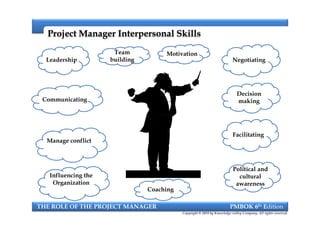
Negotiating
Communicating
Leadership
Team
building
Motivation
Decision
making
THE ROLE OF THE PROJECT MANAGER PMBOK 6th Edition
Copyright © 2018 by Knowledge valley Company. All rights reserved.
Manage conflict
Facilitating
Political and
cultural
awareness
Influencing the
Organization
Coaching
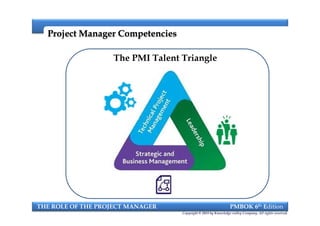
Project Manager CompetenciesProject Manager Competencies
The PMI Talent Triangle
THE ROLE OF THE PROJECT MANAGER PMBOK 6th Edition
Copyright © 2018 by Knowledge valley Company. All rights reserved.
Technical Project Management SkillsTechnical Project Management Skills
 The skills to effectively apply project management knowledge to deliver
the desired outcomes for programs or projects.
 The Knowledge Areas in this guide describe many of these necessary
project management skills.
 frequently rely on expert judgment to perform well.
 The top PM consistently demonstrated several key skills
including,
 Focus on the critical technical project management elements.
 Tailor both traditional and agile tools, techniques, and methods for each
project.
 Make time to plan thoroughly and prioritize diligently.
 Manage project elements, such as schedule, cost, resources, and risks.
THE ROLE OF THE PROJECT MANAGER PMBOK 6th Edition
Copyright © 2018 by Knowledge valley Company. All rights reserved.
 The skills to effectively apply project management knowledge to deliver
the desired outcomes for programs or projects.
 The Knowledge Areas in this guide describe many of these necessary
project management skills.
 frequently rely on expert judgment to perform well.
 The top PM consistently demonstrated several key skills
including,
 Focus on the critical technical project management elements.
 Tailor both traditional and agile tools, techniques, and methods for each
project.
 Make time to plan thoroughly and prioritize diligently.
 Manage project elements, such as schedule, cost, resources, and risks.
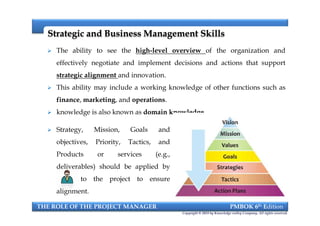
Strategic and Business Management SkillsStrategic and Business Management Skills
 The ability to see the high-level overview of the organization and
effectively negotiate and implement decisions and actions that support
strategic alignment and innovation.
 This ability may include a working knowledge of other functions such as
finance, marketing, and operations.
 knowledge is also known as domain knowledge.
THE ROLE OF THE PROJECT MANAGER PMBOK 6th Edition
Copyright © 2018 by Knowledge valley Company. All rights reserved.
 The ability to see the high-level overview of the organization and
effectively negotiate and implement decisions and actions that support
strategic alignment and innovation.
 This ability may include a working knowledge of other functions such as
finance, marketing, and operations.
 knowledge is also known as domain knowledge.
 Strategy, Mission, Goals and
objectives, Priority, Tactics, and
Products or services (e.g.,
deliverables) should be applied by
PM to the project to ensure
alignment.
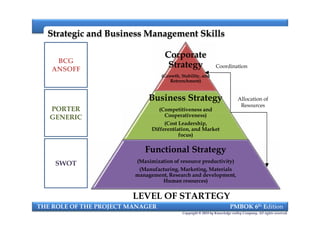
Strategic and Business Management SkillsStrategic and Business Management Skills
Corporate
Strategy
(Growth, Stability, and
Retrenchment)
Business Strategy
(Competitiveness and
Cooperativeness)
(Cost Leadership,
Differentiation, and Market
focus)
BCG
ANSOFF
PORTER
GENERIC
Allocation of
Resources
Coordination
THE ROLE OF THE PROJECT MANAGER PMBOK 6th Edition
Copyright © 2018 by Knowledge valley Company. All rights reserved.
Business Strategy
(Competitiveness and
Cooperativeness)
(Cost Leadership,
Differentiation, and Market
focus)
Functional Strategy
(Maximization of resource productivity)
(Manufacturing, Marketing, Materials
management, Research and development,
Human resources)
PORTER
GENERIC
SWOT
LEVEL OF STARTEGY
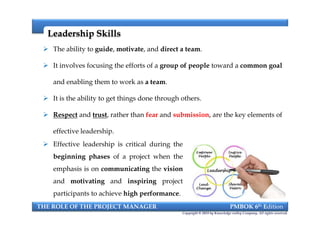
 The ability to guide, motivate, and direct a team.
 It involves focusing the efforts of a group of people toward a common goal
and enabling them to work as a team.
 It is the ability to get things done through others.
 Respect and trust, rather than fear and submission, are the key elements of
effective leadership.
Leadership SkillsLeadership Skills
THE ROLE OF THE PROJECT MANAGER PMBOK 6th Edition
Copyright © 2018 by Knowledge valley Company. All rights reserved.
 The ability to guide, motivate, and direct a team.
 It involves focusing the efforts of a group of people toward a common goal
and enabling them to work as a team.
 It is the ability to get things done through others.

 Respect and trust, rather than fear and submission, are the key elements of
effective leadership.
 Effective leadership is critical during the
beginning phases of a project when the
emphasis is on communicating the vision
and motivating and inspiring project
participants to achieve high performance.
Leadership SkillsLeadership Skills
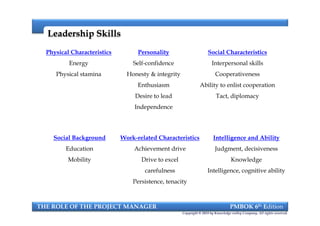
Physical Characteristics
Energy
Physical stamina
Personality
Self-confidence
Honesty & integrity
Enthusiasm
Desire to lead
Independence
Social Characteristics
Interpersonal skills
Cooperativeness
Ability to enlist cooperation
Tact, diplomacy
THE ROLE OF THE PROJECT MANAGER PMBOK 6th Edition
Copyright © 2018 by Knowledge valley Company. All rights reserved.
Social Background
Education
Mobility
Intelligence and Ability
Judgment, decisiveness
Knowledge
Intelligence, cognitive ability
Work-related Characteristics
Achievement drive
Drive to excel
carefulness
Persistence, tenacity
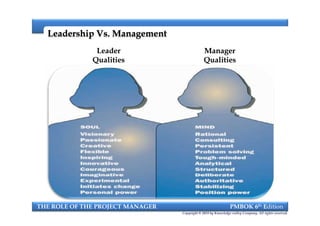
Leadership Vs. ManagementLeadership Vs. Management
LeaderLeader
QualitiesQualities
ManagerManager
QualitiesQualities
THE ROLE OF THE PROJECT MANAGER PMBOK 6th Edition
Copyright © 2018 by Knowledge valley Company. All rights reserved.
 The style a PM selects may be a personal preference, or the result of the
combination of multiple factors associated with the project.
 The style a PM uses may change over time based on the factors in play such as:
 Leader characteristics (attitudes, moods, needs, values, ethics);
 Team member characteristics (attitudes, moods, needs, values, ethics);
 Organizational characteristics (its purpose, structure, and type of work performed)
Leadership StylesLeadership Styles
THE ROLE OF THE PROJECT MANAGER PMBOK 6th Edition
Copyright © 2018 by Knowledge valley Company. All rights reserved.
 The style a PM selects may be a personal preference, or the result of the
combination of multiple factors associated with the project.
 The style a PM uses may change over time based on the factors in play such as:
 Leader characteristics (attitudes, moods, needs, values, ethics);
 Team member characteristics (attitudes, moods, needs, values, ethics);
 Organizational characteristics (its purpose, structure, and type of work performed)
 Environmental characteristics (social
situation, economic state, and political
elements).
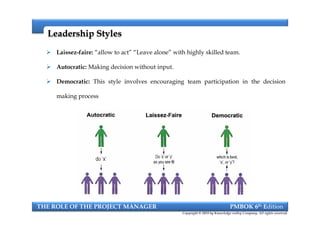
 Laissez-faire: “allow to act” “Leave alone” with highly skilled team.
 Autocratic: Making decision without input.
 Democratic: This style involves encouraging team participation in the decision
making process
Leadership StylesLeadership Styles
THE ROLE OF THE PROJECT MANAGER PMBOK 6th Edition
Copyright © 2018 by Knowledge valley Company. All rights reserved.
 Transactional: Focus on goals, feedback, and accomplishment to determine rewards.
 Transformational: Empowering through idealized attributes and behaviors,
inspirational motivation, and encouragement for innovation and creativity.
 Charismatic Able to inspire; is high-energy, enthusiastic, self-confident; holds strong
convictions.
 Interactional: A combination of transactional, transformational, and charismatic.
 Servant leader: Demonstrates commitment to serve and put other people first;
focuses on other people’s growth, learning, development, autonomy, and well-being;
concentrates on relationships, community and collaboration.
Leadership StylesLeadership Styles
THE ROLE OF THE PROJECT MANAGER PMBOK 6th Edition
Copyright © 2018 by Knowledge valley Company. All rights reserved.
 Transactional: Focus on goals, feedback, and accomplishment to determine rewards.
 Transformational: Empowering through idealized attributes and behaviors,
inspirational motivation, and encouragement for innovation and creativity.
 Charismatic Able to inspire; is high-energy, enthusiastic, self-confident; holds strong
convictions.
 Interactional: A combination of transactional, transformational, and charismatic.
 Servant leader: Demonstrates commitment to serve and put other people first;
focuses on other people’s growth, learning, development, autonomy, and well-being;
concentrates on relationships, community and collaboration.
 The individual differences in characteristic patterns of thinking, feeling, and
behaving.
 An effective PM will have some level of ability with each of these characteristics
in order to be successful.
 Personality characteristics or traits include but are not limited to:
 Authentic
 Courteous
 Creative
 Cultural
 Emotional
 Intellectual
 Managerial);
 Political
 Service-oriented
 Social
 Systemic
PersonalityPersonality
THE ROLE OF THE PROJECT MANAGER PMBOK 6th Edition
Copyright © 2018 by Knowledge valley Company. All rights reserved.
 The individual differences in characteristic patterns of thinking, feeling, and
behaving.
 An effective PM will have some level of ability with each of these characteristics
in order to be successful.
 Personality characteristics or traits include but are not limited to:
 Authentic
 Courteous
 Creative
 Cultural
 Emotional
 Intellectual
 Managerial);
 Political
 Service-oriented
 Social
 Systemic
Performing IntegrationPerforming Integration
 The main role of PM :
1. Understand the strategic objectives and ensure the
alignment of the project objectives and results with
those of the portfolio, program, and business areas.
2. Put all the pieces of the project together into one
cohesive whole that gets the project done faster,
cheaper, and with fewer resources, while meeting
the project objectives.
THE ROLE OF THE PROJECT MANAGER PMBOK 6th Edition
Copyright © 2018 by Knowledge valley Company. All rights reserved.
 The main role of PM :
1. Understand the strategic objectives and ensure the
alignment of the project objectives and results with
those of the portfolio, program, and business areas.
2. Put all the pieces of the project together into one
cohesive whole that gets the project done faster,
cheaper, and with fewer resources, while meeting
the project objectives.
 The PM ’ existence in an organization and on a
project is to manage integration.
Project managersProject managers
contribute to thecontribute to the
integration andintegration and
execution of theexecution of the
strategystrategy
Performing IntegrationPerforming Integration
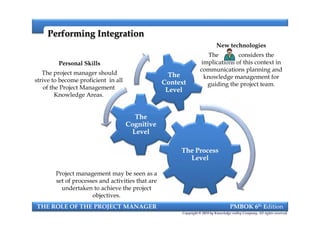
TheThe
CognitiveCognitive
LevelLevel
TheThe
ContextContext
LevelLevel
New technologies
The PM considers the
implications of this context in
communications planning and
knowledge management for
guiding the project team.
Personal Skills
The project manager should
strive to become proficient in all
of the Project Management
Knowledge Areas.
THE ROLE OF THE PROJECT MANAGER PMBOK 6th Edition
Copyright © 2018 by Knowledge valley Company. All rights reserved.
The ProcessThe Process
LevelLevel
TheThe
CognitiveCognitive
LevelLevel
Project management may be seen as a
set of processes and activities that are
undertaken to achieve the project
objectives.
Integration and ComplexityIntegration and Complexity
AmbiguityAmbiguity
Uncertainty of emerging
issues and lack of
understanding or
confusion
THE ROLE OF THE PROJECT MANAGER PMBOK 6th Edition
Copyright © 2018 by Knowledge valley Company. All rights reserved.
Human behaviorHuman behavior
The interplay between
diverse individuals and
groups
System behaviorSystem behavior
The interdependencies of
components and systems
RefreshmentsRefreshments
Q1. Performing integration is a cornerstone skill for all project managers;
the following describe the three different levels of performing integration
EXCEPT:
A. Cognitive level.
B. Process level.
C. Complexity level.
D. Context level.
Q2. All of the following are components of culture EXCEPT:
A. Values.
B. Norms.
C. Intelligence.
D. Beliefs.
Q1. Performing integration is a cornerstone skill for all project managers;
the following describe the three different levels of performing integration
EXCEPT:
A. Cognitive level.
B. Process level.
C. Complexity level.
D. Context level.
Q2. All of the following are components of culture EXCEPT:
A. Values.
B. Norms.
C. Intelligence.
D. Beliefs.
THE ROLE OF THE PROJECT MANAGER PMBOK 6th Edition
Copyright © 2018 by Knowledge valley Company. All rights reserved.
RefreshmentsRefreshments
Q3. Complexity within projects is a result of many different organizational
behaviors; the dimensions of complexity include all of the following
EXCEPT:
A. System behavior.
B. Human behavior.
C. Ambiguity.
D. Process behavior .
Q4. Which of the following is least likely to be within the project manager's
sphere of influence?
A. Government.
B. Project team.
C. Sponsors.
D. Customers.
Q3. Complexity within projects is a result of many different organizational
behaviors; the dimensions of complexity include all of the following
EXCEPT:
A. System behavior.
B. Human behavior.
C. Ambiguity.
D. Process behavior .
Q4. Which of the following is least likely to be within the project manager's
sphere of influence?
A. Government.
B. Project team.
C. Sponsors.
D. Customers.
THE ROLE OF THE PROJECT MANAGER PMBOK 6th Edition
Copyright © 2018 by Knowledge valley Company. All rights reserved.
RefreshmentsRefreshments
Q5. Project managers spend the majority of their time communicating with
team members and other project stakeholders. To communicate effectively,
the project manager should generally perform all of the following EXCEPT:
A. Calculating the potential number of communication channels accurately.
B. Developing finely tuned skills using multiple methods of communication.
C. Incorporating feedback channels.
D. Seeking to understand project stakeholders' communication needs .
Q5. Project managers spend the majority of their time communicating with
team members and other project stakeholders. To communicate effectively,
the project manager should generally perform all of the following EXCEPT:
A. Calculating the potential number of communication channels accurately.
B. Developing finely tuned skills using multiple methods of communication.
C. Incorporating feedback channels.
D. Seeking to understand project stakeholders' communication needs .
THE ROLE OF THE PROJECT MANAGER PMBOK 6th Edition
Copyright © 2018 by Knowledge valley Company. All rights reserved.
PMBOK GUIDE SEXTH EDITION
Copyright © 2018 by Knowledge valley Company. All rights reserved.
PMBOK GUIDE SEXTH EDITION
Copyright © 2018 by Knowledge valley Company. All rights reserved.

1_Project Management Foundation

  • 1.
    PPROJECTROJECT MMANAGEMENTANAGEMENT PPROFESSIONALROFESSIONAL PMBOKPMBOK 66thth EEditionditionHisham Haridy, MBA, PMP, PMI-RMP, PMI-SP Copyright © 2018 by Knowledge valley Company. All rights reserved.
  • 2.
    IINTRODUCTIONNTRODUCTION PMBOKPMBOK 66thth EEditiondition HishamHaridy, MBA, PMP, PMI-RMP, PMI-SP Copyright © 2018 by Knowledge valley Company. All rights reserved.
  • 3.
    Who Am I? HISHAMHARIDY, BSc, MBA, PMP®, PMI-RMP®, PMI-SP®, Project Management Director at Knowledge Valley for Management and Consultation Services - Kingdom of Saudi Arabia, is a graduate from Egypt with B.Sc. of Civil engineering in 2001 and has Master of Business Administration (MBA) from AASTMT & Universitat Autònoma de Barcelona (UAB). INTRODUCTION PMBOK 6th Edition HISHAM HARIDY, BSc, MBA, PMP®, PMI-RMP®, PMI-SP®, Project Management Director at Knowledge Valley for Management and Consultation Services - Kingdom of Saudi Arabia, is a graduate from Egypt with B.Sc. of Civil engineering in 2001 and has Master of Business Administration (MBA) from AASTMT & Universitat Autònoma de Barcelona (UAB). HISHAM has more than 17 years of experience as a project management consultant across many industries and business sectors in different positions. He worked for a variety of organizations (LafargeHolcim, ASEC, ..etc..) as a project management and project services practitioner and was responsible for all aspects of project planning & control and risk management for projects based in Middle East (KSA, UAE, Iraq, Syria ..etc..), far east (Indonesia, Malaysia, ...etc) and sub-Saharan and Africa (Nigeria, Kenya, Congo..etc..). Recently, he has achieved significant success as a freelance project management consultant by his passion of mixing the project management theory and practice. Copyright © 2018 by Knowledge valley Company. All rights reserved.
  • 4.
    Who Are You? INTRODUCTIONPMBOK 6th Edition Copyright © 2018 by Knowledge valley Company. All rights reserved.
  • 5.
    What’s Your Expectations? INTRODUCTIONPMBOK 6th Edition Copyright © 2018 by Knowledge valley Company. All rights reserved.
  • 6.
    Who Should Attend? Project managers  Project team members  Professionals from various industries, such as IT, construction, etc.,  Who are interested to become PMP certified. INTRODUCTION PMBOK 6th Edition  Project managers  Project team members  Professionals from various industries, such as IT, construction, etc.,  Who are interested to become PMP certified. Copyright © 2018 by Knowledge valley Company. All rights reserved.
  • 7.
    What Will YouGet?  Recognize the value of Project Management and clearly describe the project objectives and how the Logical Framework technique can help the overall management of a project.  Initiate, plan, and carry out a project that accomplishes objectives and satisfies stakeholders.  Manage a project through each stage of the project management lifecycle. INTRODUCTION PMBOK 6th Edition  Recognize the value of Project Management and clearly describe the project objectives and how the Logical Framework technique can help the overall management of a project.  Initiate, plan, and carry out a project that accomplishes objectives and satisfies stakeholders.  Manage a project through each stage of the project management lifecycle. Copyright © 2018 by Knowledge valley Company. All rights reserved.  Apply the methodologies and the recognized practices of formal project management in alignment with the Guide to the Project Management Body of Knowledge, (PMBOK® Guide) Sixth Edition.
  • 8.
    Course Content Introduction The Environmentin Which Projects Operate and PM Role Project Management Processes Project Scope management Project Schedule Management Project Cost Management INTRODUCTION PMBOK 6th Edition Project Cost Management Project Quality Management Project Resource Management Project Communication Management Project Risk Management Project Procurement Management Project Stakeholder Management Project Integration Management Copyright © 2018 by Knowledge valley Company. All rights reserved.
  • 9.
    PMBOK Guide This programwill rely on PMBOK “Project Management Body of Knowledge terminology for consistency across projects, practices, organizations, and industries. INTRODUCTION PMBOK 6th Edition  Provides a common language.  Serves as a reference resource.  Recognized as a standard. Proven traditional practices that are widely applied as well as innovative practices that are emerging in the profession. Copyright © 2018 by Knowledge valley Company. All rights reserved.
  • 10.
    Agile Guide The AgilePractice Guide is project-focused and addresses project life cycle selection, implementing agile, and organizational considerations for agile projects.  A collaborative effort by the PMI and Agile Alliance.  A bridge to understanding the pathway from a predictive approach to an agile approach INTRODUCTION PMBOK 6th Edition The Agile Practice Guide is project-focused and addresses project life cycle selection, implementing agile, and organizational considerations for agile projects.  A collaborative effort by the PMI and Agile Alliance.  A bridge to understanding the pathway from a predictive approach to an agile approach Provides practical guidance geared toward project leaders and team members adapting to an agile approach in planning and executing projects Copyright © 2018 by Knowledge valley Company. All rights reserved.
  • 11.
    Exam RequirementsExam Requirements 1.35 Contact Hours  You will get these at the end of this course. 2. Education  Bachelors Degree – 4500 hours of PM Experience • Three years within the last eight years  High School Graduate – 7500 hours of PM Experience • Five years within the last eight years INTRODUCTION PMBOK 6th Edition 1. 35 Contact Hours  You will get these at the end of this course. 2. Education  Bachelors Degree – 4500 hours of PM Experience • Three years within the last eight years  High School Graduate – 7500 hours of PM Experience • Five years within the last eight years Copyright © 2018 by Knowledge valley Company. All rights reserved.
  • 12.
    Waterfall Vs. Agile INTRODUCTIONPMBOK 6th Edition Copyright © 2018 by Knowledge valley Company. All rights reserved.
  • 13.
    Exam FormatExam Format Passing score is 106 out of 175 questions (approx 61%)  Questions may be poorly worded  Requires memorization of Inputs/Outputs/ Tools & Techniques No. of Scored Questions No. of Pretest (Unscored) Questions Total Examination Questions 175 25 200 INTRODUCTION PMBOK 6th Edition  Passing score is 106 out of 175 questions (approx 61%)  Questions may be poorly worded  Requires memorization of Inputs/Outputs/ Tools & Techniques 175 25 200 Allotted Examination Time 4 hours Copyright © 2018 by Knowledge valley Company. All rights reserved.
  • 14.
     Projects aretemporary.  Has definite beginning and end, the end is reached when the project’s objective have been achieved.  Projects are unique.  Projects are undertaken to fulfill objectives by producing deliverables.  Every project creates a unique product, service, or results.  Project Initiation Context.  Organizational leaders initiate projects in response to factors acting upon their organizations. A project is a temporary endeavor undertaken to create a unique product, service or result. ProjectsProjects  Projects are temporary.  Has definite beginning and end, the end is reached when the project’s objective have been achieved.  Projects are unique.  Projects are undertaken to fulfill objectives by producing deliverables.  Every project creates a unique product, service, or results.  Project Initiation Context.  Organizational leaders initiate projects in response to factors acting upon their organizations. INTRODUCTION PMBOK 6th Edition Copyright © 2018 by Knowledge valley Company. All rights reserved.  Projects enable business value creation.  The net quantifiable benefit derived from a business endeavor.  Projects drive change.  Projects drive change in organizations.
  • 15.
    INTRODUCTION PMBOK 6thEdition Copyright © 2018 by Knowledge valley Company. All rights reserved.
  • 16.
    INTRODUCTION PMBOK 6thEdition Copyright © 2018 by Knowledge valley Company. All rights reserved.
  • 17.
    INTRODUCTION PMBOK 6thEdition Copyright © 2018 by Knowledge valley Company. All rights reserved.
  • 18.
    INTRODUCTION PMBOK 6thEdition Copyright © 2018 by Knowledge valley Company. All rights reserved.
  • 19.
    INTRODUCTION PMBOK 6thEdition Copyright © 2018 by Knowledge valley Company. All rights reserved.
  • 20.
    INTRODUCTION PMBOK 6thEdition Copyright © 2018 by Knowledge valley Company. All rights reserved.
  • 21.
    Project ObjectivesProject Objectives Something toward which work is to be directed, a strategic position to be attained, or a purpose to be achieved, a result to be obtained, a product to be produced, or a service to be performed.  Each project must have at LEAST one objective.  The objectives of the project MUST be made known to all project personnel and all managers, at every level of the organization.  Project objective MUST follow the SMART rule;  S = specific  M = measurable  A = attainable  R = realistic or relevant  T = time bound INTRODUCTION PMBOK 6th Edition Copyright © 2018 by Knowledge valley Company. All rights reserved.  Something toward which work is to be directed, a strategic position to be attained, or a purpose to be achieved, a result to be obtained, a product to be produced, or a service to be performed.  Each project must have at LEAST one objective.  The objectives of the project MUST be made known to all project personnel and all managers, at every level of the organization.  Project objective MUST follow the SMART rule;  S = specific  M = measurable  A = attainable  R = realistic or relevant  T = time bound
  • 22.
    Why do weneed ProjectWhy do we need Project Management?Management? Why do we need ProjectWhy do we need Project Management?Management? INTRODUCTION PMBOK 6th Edition Copyright © 2018 by Knowledge valley Company. All rights reserved.
  • 23.
    It is theapplication of knowledge, skills, tools, and techniques to project activities to meet the project requirements.  Effective project management helps to:  Meet business objectives  Satisfy stakeholder expectations  Be more predictable  Increase chances of success  Balance the influence of constraints on the project  Deliver the right products at the right time  Resolve problems and issues  Respond to risks in a timely manner  Optimize the use of organizational resources  Identify, recover, or terminate failing projects  Manage constraints  Manage change in a better manner. Project ManagementProject Management It is the application of knowledge, skills, tools, and techniques to project activities to meet the project requirements.  Effective project management helps to:  Meet business objectives  Satisfy stakeholder expectations  Be more predictable  Increase chances of success  Balance the influence of constraints on the project  Deliver the right products at the right time  Resolve problems and issues  Respond to risks in a timely manner  Optimize the use of organizational resources  Identify, recover, or terminate failing projects  Manage constraints  Manage change in a better manner. INTRODUCTION PMBOK 6th Edition Copyright © 2018 by Knowledge valley Company. All rights reserved.
  • 24.
     Project Managementis accomplished through the appropriate application and integration of 49 logically grouped processes comprising in the 5 PROCESS GROUPS Project ManagementProject Management INTRODUCTION PMBOK 6th Edition Copyright © 2018 by Knowledge valley Company. All rights reserved.
  • 25.
     Portfolio  Projects,programs, subsidiary portfolios, and operations managed as a group to achieve strategic objectives.  Program  A group of related projects, subsidiary programs, and program activities managed in a coordinated manner to obtain benefits not available from managing them individually.  Project  A temporary endeavor undertaken to create a unique product, service, or result. Relationship of Project, Program, Portfolio, and OperationRelationship of Project, Program, Portfolio, and Operation ManagementManagement  Portfolio  Projects, programs, subsidiary portfolios, and operations managed as a group to achieve strategic objectives.  Program  A group of related projects, subsidiary programs, and program activities managed in a coordinated manner to obtain benefits not available from managing them individually.  Project  A temporary endeavor undertaken to create a unique product, service, or result. INTRODUCTION PMBOK 6th Edition Copyright © 2018 by Knowledge valley Company. All rights reserved.
  • 26.
    Relationship of Project,Program, Portfolio, and OperationRelationship of Project, Program, Portfolio, and Operation ManagementManagement Portfolio Program A Program B Program A Organization Strategy INTRODUCTION PMBOK 6th Edition Copyright © 2018 by Knowledge valley Company. All rights reserved. Share Resources and Stakeholders Project 1 Project 2 Project 3 Project 4 Project 5 Project 6 Project 7 Project 8 Project 9 Operations Program A Program B Program A Program B1 Program C
  • 27.
    Program Management It isthe application of knowledge, skills, and principles to a program to achieve the program objectives and to obtain benefits and control not available by managing program components individually. Program and Portfolio ManagementProgram and Portfolio Management Program Management It is the application of knowledge, skills, and principles to a program to achieve the program objectives and to obtain benefits and control not available by managing program components individually. INTRODUCTION PMBOK 6th Edition Copyright © 2018 by Knowledge valley Company. All rights reserved. Portfolio Management Portfolio management is defined as the centralized management of one or more portfolios to achieve strategic objectives. The programs or projects of the portfolio may not necessarily be interdependent or directly related.
  • 28.
     It isconcerned with the ongoing production of goods and/or services.  It ensures that business operations continue efficiently by using the optimal resources needed to meet customer demands.  It is concerned with managing processes that transform inputs (e.g., materials, components, energy, and labor) into outputs (e.g., products, goods, and/or services). Operation ManagementOperation Management  It is concerned with the ongoing production of goods and/or services.  It ensures that business operations continue efficiently by using the optimal resources needed to meet customer demands.  It is concerned with managing processes that transform inputs (e.g., materials, components, energy, and labor) into outputs (e.g., products, goods, and/or services). INTRODUCTION PMBOK 6th Edition Copyright © 2018 by Knowledge valley Company. All rights reserved.
  • 29.
     Developing anew product, upgrading a product, or expanding outputs.  Improving operations or the product development process.  At the end of the product life cycle.  At each closeout phase. Operation and Project ManagementOperation and Project Management Deliverables INTRODUCTION PMBOK 6th Edition Copyright © 2018 by Knowledge valley Company. All rights reserved. Project ManagementProject Management Operation ManagementOperation Management  Developing a new product, upgrading a product, or expanding outputs.  Improving operations or the product development process.  At the end of the product life cycle.  At each closeout phase. Knowledge
  • 30.
     OPM isframework in which portfolio, program, and project management are integrated with organizational enablers in order to achieve strategic objectives.  It is to ensure that the organization undertakes the right projects and allocates critical resources appropriately.  It helps to ensure that all levels in the organization understand the strategic vision, the initiatives that support the vision, the objectives, and the deliverables. Organizational Project Management (OPM) and StrategyOrganizational Project Management (OPM) and Strategy INTRODUCTION PMBOK 6th Edition Copyright © 2018 by Knowledge valley Company. All rights reserved.  OPM is framework in which portfolio, program, and project management are integrated with organizational enablers in order to achieve strategic objectives.  It is to ensure that the organization undertakes the right projects and allocates critical resources appropriately.  It helps to ensure that all levels in the organization understand the strategic vision, the initiatives that support the vision, the objectives, and the deliverables.  OPM3! PMI’s organizational project management maturity model
  • 31.
    Organizational Project Management(OPM) and StrategyOrganizational Project Management (OPM) and Strategy INTRODUCTION PMBOK 6th Edition Copyright © 2018 by Knowledge valley Company. All rights reserved.
  • 32.
    Project and DevelopmentLife CycleProject and Development Life Cycle Project life cycle INTRODUCTION PMBOK 6th Edition Copyright © 2018 by Knowledge valley Company. All rights reserved. Development life cycle
  • 33.
    ProjectProject Life CycleLifeCycle INTRODUCTION PMBOK 6th Edition Copyright © 2018 by Knowledge valley Company. All rights reserved. Impact of Variable Based on Project Time
  • 34.
    Product Life CycleProductLife Cycle INTRODUCTION PMBOK 6th Edition Copyright © 2018 by Knowledge valley Company. All rights reserved. Product life cycle
  • 35.
    ProjectProject Phase andGatePhase and Gate  A collection of logically related project activities that culminates in the completion of one or more deliverables. Phase I Phase II Phase III Opportunity Qualification Concepts & Feasibility Study Project Design & Tender Implementation INTRODUCTION PMBOK 6th Edition Copyright © 2018 by Knowledge valley Company. All rights reserved. Business Case Project Charter Project Management Plan +/- 25% +/- 15% Closing Report +/- 10% +/- 5% Project Gate
  • 36.
    Project Management ProcessGroupsProject Management Process Groups  Project management life cycle: describes what is required to manage the project and follows PMI’s process groups (i.e. Initiating, planning, execution, control and closeout). Plan Execute INTRODUCTION PMBOK 6th Edition Copyright © 2018 by Knowledge valley Company. All rights reserved. Control CloseInitiate Continuous Improvement
  • 37.
    Project Management ProcessGroups InteractionsProject Management Process Groups Interactions INTRODUCTION PMBOK 6th Edition Copyright © 2018 by Knowledge valley Company. All rights reserved.
  • 38.
    Project Management ProcessGroupsProject Management Process Groups •Defines and authorizes the project or a project phase. •Defines and refines objectives, and the course of action required to attain the scope of the project. Planning •Integrates people and other resources to implement the project management plan. •Measures project progress to identify variances from the plan. Monitoring and Control •Formalizes the acceptance of a project, project phase, or termination of the project.  Project management processes are mapped onto the lifecycle and organized into groups: INTRODUCTION PMBOK 6th Edition Copyright © 2018 by Knowledge valley Company. All rights reserved. Initiating •Defines and refines objectives, and the course of action required to attain the scope of the project. •Integrates people and other resources to implement the project management plan. Execution •Measures project progress to identify variances from the plan. •Formalizes the acceptance of a project, project phase, or termination of the project. Closing The process groups are linked by the results they produce; the results of one process group becomes input to another.
  • 39.
    Project Management KnowledgeAreasProject Management Knowledge Areas Communications Procurement Stakeholders INTRODUCTION PMBOK 6th Edition Copyright © 2018 by Knowledge valley Company. All rights reserved. Scope Schedule Cost Quality Resource Communications Risk Procurement Stakeholders IntegrationIntegration
  • 40.
    Project Management ProcessesGroups and Knowledge AreasProject Management Processes Groups and Knowledge Areas Processes Knowledge Areas Initiating Planning Executing Monitoring and Controlling Closing Integration (7) 1.Develop Project Charter 2. Develop Project Management Plan 3.Direct and Manage Project Work 4.Manage Project Knowledge 5.Monitor and Control Project Work 6.Perform Integrated Change Control 7.Close Project or Phase Scope (6) 1.Plan Scope Management 2.Collect Requirements 3.Define Scope 4.Create WBS 5.Validate Scope 6.Control Scope Schedule(6) 1.Plan Schedule Management 2.Define Activities 3.Sequence Activities 4.Estimate Activity Durations 5.Develop Schedule 6.Control Schedule INTRODUCTION PMBOK 6th Edition Copyright © 2018 by Knowledge valley Company. All rights reserved. 1.Plan Schedule Management 2.Define Activities 3.Sequence Activities 4.Estimate Activity Durations 5.Develop Schedule Cost (4) 1.Plan Cost Management 2.Estimate Costs 3.Determine Budget 4.Control Costs Quality (3) 1.Plan Quality Management 2.Manage Quality 3.Control Quality Resources (5) 1.Plan Resource Management 2.Estimate Activity Resources 3.Acquire Resources 4.Develop Team 5.Manage Team 6.Control Resources Communications (3) 1.Plan Communications Management 2.Manage Communications 3.Monitor Communications Risk (7) 1.Plan Risk Management 2.Identify Risks 3.Perform Qualitative Risk Analysis 4.Perform Quantitative Risk Analysis 5.Plan Risk Responses 6.Implement Risk Responses 7.Monitor Risks Procurement (3) 1.Plan Procurement Management 2.Conduct Procurements 3.Control Procurements Stakeholder (4) 1.Identify Stakeholders 2.Plan Stakeholder Engagement 3.Manage Stakeholder Engagement 4.Monitor Stakeholder Engagement
  • 41.
    Project Management Dataand InformationProject Management Data and Information Work performance data Work performance information The “as of now” status of the project status, it provides the current status of the project A comparison between the actual performance with the planned performance. Example: The actual cost spent, actual time elapsed, etc. Example: Cost Variance, Schedule Variance, Cost Performance Index, and Schedule Performance Index INTRODUCTION PMBOK 6th Edition Copyright © 2018 by Knowledge valley Company. All rights reserved. Example: The actual cost spent, actual time elapsed, etc. Example: Cost Variance, Schedule Variance, Cost Performance Index, and Schedule Performance Index Work performance Reports Give stakeholders the information on how the project is progressing in the form of well-organized and summarized reports, at level of detail that they require Example: Status reports, memos, justifications, information notes, recommendations, and updates.
  • 42.
    Data and ProjectData, Information, and Report FlowData and Project Data, Information, and Report Flow Planning Process Executing Process Project Management PlanProject Management Plan Work Performance DataWork Performance Data (% complete or actual $) Controlling Process Work Performance InformationWork Performance Information (Variance and Forecasts) Updated ProjectUpdated Project Management PlanManagement Plan INTRODUCTION PMBOK 6th Edition Copyright © 2018 by Knowledge valley Company. All rights reserved. Work Performance InformationWork Performance Information (Variance and Forecasts) Overall Project Control Work Performance ReportWork Performance Report Project Change Control Various Project Processes Project Communications Approved ChangeApproved Change RequestRequest
  • 43.
    Project Management BusinessDocumentsProject Management Business Documents Project business case Project benefits management plan A documented economic feasibility study used to establish the validity of the benefits of a selected component lacking sufficient definition and that is used as a basis for the authorization of further project management activities. The documented explanation defining the processes for creating, maximizing, and sustaining the benefits provided by a project. 1)Target benefits, 2)Strategic alignment, 3)Timeframe for realizing benefits, 4)Benefits owner, 5)Metrics, 6)Assumptions, and 7)Risks. INTRODUCTION PMBOK 6th Edition Copyright © 2018 by Knowledge valley Company. All rights reserved. A documented economic feasibility study used to establish the validity of the benefits of a selected component lacking sufficient definition and that is used as a basis for the authorization of further project management activities. The documented explanation defining the processes for creating, maximizing, and sustaining the benefits provided by a project. 1)Target benefits, 2)Strategic alignment, 3)Timeframe for realizing benefits, 4)Benefits owner, 5)Metrics, 6)Assumptions, and 7)Risks.
  • 44.
    Interrelationship of NeedsAssessment and CriticalInterrelationship of Needs Assessment and Critical Business/Project DocumentsBusiness/Project Documents Carrying Out the Work Pr-Project Work Need Assessment Business case Benefits Management Plan Starting the Project Organizing and Preparing Completing the Project Phase I Phase II Phase III Phase IV INTRODUCTION PMBOK 6th Edition Copyright © 2018 by Knowledge valley Company. All rights reserved. Pr-Project Work Need Assessment Business case Benefits Management Plan Project Charter Project Management Plan Project Life CycleProject Life Cycle
  • 45.
    Project CharterProject Charter A document issued by the project sponsor that formally authorizes the existence of a project.  It provides the project manager with the authority to apply organizational resources to project activities.  It provides the high – level requirements for the project.  It links the project to the ongoing work of the organization. INTRODUCTION PMBOK 6th Edition Copyright © 2018 by Knowledge valley Company. All rights reserved.  A document issued by the project sponsor that formally authorizes the existence of a project.  It provides the project manager with the authority to apply organizational resources to project activities.  It provides the high – level requirements for the project.  It links the project to the ongoing work of the organization.  It is abroad enough so it does NOT NEED to change as the project progresses.  The project charter is such an important document that project CAN NOT be started without one.
  • 46.
    Project CharterProject Charter INTRODUCTIONPMBOK 6th Edition Copyright © 2018 by Knowledge valley Company. All rights reserved.
  • 47.
    Project Management PlanProjectManagement Plan  A project management plan is an integration function-it integrates all the knowledge area management plans into a cohesive whole.  This plan includes the baselines for the project (Scope, Schedule, Cost) and also it called performance measurement baselines.  The project management plan includes:  How the project will be executed, monitored, and controlled.  Subsidiary plans for scope, schedule, cost, quality, human resources, communications, risk, procurement, and stakeholders.  A requirements management plan.  A change management plan.  A configuration management plan. Latest version!  A process improvement plan. INTRODUCTION PMBOK 6th Edition Copyright © 2018 by Knowledge valley Company. All rights reserved.  A project management plan is an integration function-it integrates all the knowledge area management plans into a cohesive whole.  This plan includes the baselines for the project (Scope, Schedule, Cost) and also it called performance measurement baselines.  The project management plan includes:  How the project will be executed, monitored, and controlled.  Subsidiary plans for scope, schedule, cost, quality, human resources, communications, risk, procurement, and stakeholders.  A requirements management plan.  A change management plan.  A configuration management plan. Latest version!  A process improvement plan.
  • 48.
    RefreshmentsRefreshments Q1. You aremanaging a project in which you intend to respond to high levels of change and ongoing stakeholder involvement. The most suitable project life cycle for your project is the: A. Predictive life cycle. B. Adaptive life cycle. C. Waterfall life cycle. D. Configuration management life cycle. Q2. Project tailoring is an important consideration for most projects. Which of the following is the least likely project consideration? A. Project manager’s skills and competency. B. Each project is unique. C. Addressing competing constraints. D. Level of project governance varies. INTRODUCTION PMBOK 6th Edition Copyright © 2018 by Knowledge valley Company. All rights reserved. Q1. You are managing a project in which you intend to respond to high levels of change and ongoing stakeholder involvement. The most suitable project life cycle for your project is the: A. Predictive life cycle. B. Adaptive life cycle. C. Waterfall life cycle. D. Configuration management life cycle. Q2. Project tailoring is an important consideration for most projects. Which of the following is the least likely project consideration? A. Project manager’s skills and competency. B. Each project is unique. C. Addressing competing constraints. D. Level of project governance varies.
  • 49.
    RefreshmentsRefreshments Q3. Your jobresponsibility is to align components (projects, programs, or related operations) to the organizational strategy, organized into portfolios or subsidiary portfolios to optimize project or program objectives, dependencies, costs, timelines, benefits, resources, and risks. This is known as: A. Components management. B. Process management. C. Program management. D. Portfolio management. Q4. All of the following are questions that the key stakeholders and project managers should answer to develop the project success measures EXCEPT: A. What does success look like for the project? B. How will success be measured? C. What are the communication requirements? D. What factors may impact success? INTRODUCTION PMBOK 6th Edition Copyright © 2018 by Knowledge valley Company. All rights reserved. Q3. Your job responsibility is to align components (projects, programs, or related operations) to the organizational strategy, organized into portfolios or subsidiary portfolios to optimize project or program objectives, dependencies, costs, timelines, benefits, resources, and risks. This is known as: A. Components management. B. Process management. C. Program management. D. Portfolio management. Q4. All of the following are questions that the key stakeholders and project managers should answer to develop the project success measures EXCEPT: A. What does success look like for the project? B. How will success be measured? C. What are the communication requirements? D. What factors may impact success?
  • 50.
    RefreshmentsRefreshments Q5. All ofthe following are true about projects and operations EXCEPT: A. Operations are ongoing endeavors that produce repetitive outputs, with resources assigned to do basically the same set of tasks according to the standards institutionalized in a product life cycle, whereas projects are temporary endeavors. B. Projects require project management activities and skill sets, whereas operations require business process management, operations management activities, and skill sets. C. Projects can intersect with operations at various points during the product life cycle. At each point, deliverables and knowledge are transferred between the project and operations for implementation of the delivered work. D. Because of their temporary nature, projects cannot help achieve an organization’s long-term goals. Therefore, strategic activities in the organization can be generally addressed within the organization's normal operations. INTRODUCTION PMBOK 6th Edition Copyright © 2018 by Knowledge valley Company. All rights reserved. Q5. All of the following are true about projects and operations EXCEPT: A. Operations are ongoing endeavors that produce repetitive outputs, with resources assigned to do basically the same set of tasks according to the standards institutionalized in a product life cycle, whereas projects are temporary endeavors. B. Projects require project management activities and skill sets, whereas operations require business process management, operations management activities, and skill sets. C. Projects can intersect with operations at various points during the product life cycle. At each point, deliverables and knowledge are transferred between the project and operations for implementation of the delivered work. D. Because of their temporary nature, projects cannot help achieve an organization’s long-term goals. Therefore, strategic activities in the organization can be generally addressed within the organization's normal operations.
  • 51.
    TTHEHE EENVIRONMENT INNVIRONMENTIN WWHICHHICH PPROJECTSROJECTS OOPERATPERAT PMBOKPMBOK 66thth EEditiondition Copyright © 2018 by Knowledge valley Company. All rights reserved. Hisham Haridy, MBA, PMP, PMI-RMP, PMI-SP
  • 52.
    Project InfluencesProject Influences Influences EEFsInternal OPAs THE ENVIRONMENT IN WHICH PROJECTS OPERAT PMBOK 6th Edition Copyright © 2018 by Knowledge valley Company. All rights reserved. External Internal Processes, Policies, and Procedures Corporate Knowledge Bases
  • 53.
    Enterprise Environmental Factors(EEFs)Enterprise Environmental Factors (EEFs)  Conditions, not under the control of the project team, that influence, constrain, or direct the project.  These conditions can be internal and/or external to the organization Internal External  Organizational culture, structure, and governance.  Geographic distribution of facilities and resources.  Infrastructure.  Information technology software.  Resource availability.  Employee capability.  Marketplace conditions.  Social and cultural influences and issues. Legal restrictions.  Commercial databases.  Academic research.  Government or industry standards. Financial considerations.  Physical environmental elements. THE ENVIRONMENT IN WHICH PROJECTS OPERAT PMBOK 6th Edition Copyright © 2018 by Knowledge valley Company. All rights reserved.  Organizational culture, structure, and governance.  Geographic distribution of facilities and resources.  Infrastructure.  Information technology software.  Resource availability.  Employee capability.  Marketplace conditions.  Social and cultural influences and issues. Legal restrictions.  Commercial databases.  Academic research.  Government or industry standards. Financial considerations.  Physical environmental elements.
  • 54.
     Information, tools,documents, or knowledge your organization possess that can help you plan for your project:  Anything that your organization owns or has developed that can help you on a current or future project.  Organizational process assets may be grouped into two categories; 1. Processes, Policies, and Procedures 2. Corporate Knowledge Bases Organizational Process Assets (OPAs)Organizational Process Assets (OPAs) THE ENVIRONMENT IN WHICH PROJECTS OPERAT PMBOK 6th Edition Copyright © 2018 by Knowledge valley Company. All rights reserved.  Information, tools, documents, or knowledge your organization possess that can help you plan for your project:  Anything that your organization owns or has developed that can help you on a current or future project.  Organizational process assets may be grouped into two categories; 1. Processes, Policies, and Procedures 2. Corporate Knowledge Bases
  • 55.
    Organizational Process Assets(OPAs)Organizational Process Assets (OPAs) 1. Processes , Policies, and Procedures  Standards, policies, standard product and project life cycles, and quality policies and procedures.  Standardized guidelines, work instructions, proposal evaluation criteria, and performance measurement criteria.  Templates.  Guidelines and criteria for tailoring the organization’s set of standard processes.  Procedures for prioritizing, approving, and issuing work authorizations.  Organization communication requirements.  Financial controls procedures .  Issue and defect management procedures.  Change control procedures.  Risk control procedures.  Project closure guidelines or requirements THE ENVIRONMENT IN WHICH PROJECTS OPERAT PMBOK 6th Edition Copyright © 2018 by Knowledge valley Company. All rights reserved. 1. Processes , Policies, and Procedures  Standards, policies, standard product and project life cycles, and quality policies and procedures.  Standardized guidelines, work instructions, proposal evaluation criteria, and performance measurement criteria.  Templates.  Guidelines and criteria for tailoring the organization’s set of standard processes.  Procedures for prioritizing, approving, and issuing work authorizations.  Organization communication requirements.  Financial controls procedures .  Issue and defect management procedures.  Change control procedures.  Risk control procedures.  Project closure guidelines or requirements
  • 56.
    Organizational Process Assets(OPAs)Organizational Process Assets (OPAs) 2. Corporate Knowledge Bases The organizational knowledge repositories for storing and retrieving information include:  Process measurement databases used to collect and make available measurement data on processes and products.  Project files.  Historical information and lessons learned knowledge bases.  Issue and defect management databases containing issue and defect status, control information, issue and defect resolution, and action item results.  Configuration management knowledge bases containing the versions and baselines of all official company standards, policies, procedures, and any project documents.  Financial databases containing information such as labor hours, incurred costs, budgets and any project cost overruns. THE ENVIRONMENT IN WHICH PROJECTS OPERAT PMBOK 6th Edition Copyright © 2018 by Knowledge valley Company. All rights reserved. 2. Corporate Knowledge Bases The organizational knowledge repositories for storing and retrieving information include:  Process measurement databases used to collect and make available measurement data on processes and products.  Project files.  Historical information and lessons learned knowledge bases.  Issue and defect management databases containing issue and defect status, control information, issue and defect resolution, and action item results.  Configuration management knowledge bases containing the versions and baselines of all official company standards, policies, procedures, and any project documents.  Financial databases containing information such as labor hours, incurred costs, budgets and any project cost overruns.
  • 57.
    Organizational SystemsOrganizational Systems The interaction of multiple factors within an individual organization creates a unique system that impacts the project operating in that system.  The resulting organizational system determines the power, influence, interests, competence, and political capabilities of the people who are able to act within the system.  The system factors include: 1. Management elements 2. Governance frameworks 3. Organizational structure types THE ENVIRONMENT IN WHICH PROJECTS OPERAT PMBOK 6th Edition Copyright © 2018 by Knowledge valley Company. All rights reserved.  The interaction of multiple factors within an individual organization creates a unique system that impacts the project operating in that system.  The resulting organizational system determines the power, influence, interests, competence, and political capabilities of the people who are able to act within the system.  The system factors include: 1. Management elements 2. Governance frameworks 3. Organizational structure types
  • 58.
    Management ElementsManagement Elements The components that comprise the key functions or principles of general management in the organization.  The general management elements are allocated within the organization according to its 1) governance framework and the 2) organizational structure type selected.  Performance of these management elements are assigned to selected individuals within the organization. THE ENVIRONMENT IN WHICH PROJECTS OPERAT PMBOK 6th Edition Copyright © 2018 by Knowledge valley Company. All rights reserved.  The components that comprise the key functions or principles of general management in the organization.  The general management elements are allocated within the organization according to its 1) governance framework and the 2) organizational structure type selected.  Performance of these management elements are assigned to selected individuals within the organization.
  • 59.
    Organizational GovernanceOrganizational Governance 1.A structured way to provide direction and control through policies, and processes, to meet strategic and operational goals. 2. Typically conducted by a board of directors to ensure accountability, fairness, and transparency to its stakeholders. 3. Its principles, decisions, and processes may influence and impact the governance of portfolios, programs, and projects in the following ways:  Enforcing legal, regulatory, standards, and compliance requirements.  Defining ethical, social, and environmental responsibilities.  Specifying operational, legal, and risk policies.  Types of governance  Organizational governance.  Organizational project management (OPM) governance.  Portfolio, Program, and Project governance. THE ENVIRONMENT IN WHICH PROJECTS OPERAT PMBOK 6th Edition Copyright © 2018 by Knowledge valley Company. All rights reserved. 1. A structured way to provide direction and control through policies, and processes, to meet strategic and operational goals. 2. Typically conducted by a board of directors to ensure accountability, fairness, and transparency to its stakeholders. 3. Its principles, decisions, and processes may influence and impact the governance of portfolios, programs, and projects in the following ways:  Enforcing legal, regulatory, standards, and compliance requirements.  Defining ethical, social, and environmental responsibilities.  Specifying operational, legal, and risk policies.  Types of governance  Organizational governance.  Organizational project management (OPM) governance.  Portfolio, Program, and Project governance.
  • 60.
    Organizational GovernanceOrganizational Governance Ifmanagement is about running the business, corporatecorporate governancegovernance is about seeing that it is runrun properlyproperly.. Framework within which authority is exercised in organizations. THE ENVIRONMENT IN WHICH PROJECTS OPERAT PMBOK 6th Edition Copyright © 2018 by Knowledge valley Company. All rights reserved. If management is about running the business, corporatecorporate governancegovernance is about seeing that it is runrun properlyproperly.. All companies need managing and governingAll companies need managing and governing
  • 61.
    Organizational GovernanceOrganizational Governance THEENVIRONMENT IN WHICH PROJECTS OPERAT PMBOK 6th Edition Copyright © 2018 by Knowledge valley Company. All rights reserved.
  • 62.
    Organizational GovernanceOrganizational Governance THEENVIRONMENT IN WHICH PROJECTS OPERAT PMBOK 6th Edition Copyright © 2018 by Knowledge valley Company. All rights reserved.
  • 63.
    Project GovernanceProject Governance 1.The framework, functions, and processes that guide project management activities in order to create a unique product, service, or result to meet organizational, strategic, and operational GOALS. 2. It provides the project stakeholders with structure, processes, roles, responsibilities, accountabilities, and decision-making models for managing the project. 3. Elements of a project governance framework:  Stage gate or phase reviews.  Identifying, escalating, and resolving risks and issues.  Defining roles, responsibilities, and authorities.  Process for project knowledge management and capturing lessons learned.  Decision making, problem solving and escalating topics.  Reviewing and approving changes to project, and product changes. THE ENVIRONMENT IN WHICH PROJECTS OPERAT PMBOK 6th Edition Copyright © 2018 by Knowledge valley Company. All rights reserved. 1. The framework, functions, and processes that guide project management activities in order to create a unique product, service, or result to meet organizational, strategic, and operational GOALS. 2. It provides the project stakeholders with structure, processes, roles, responsibilities, accountabilities, and decision-making models for managing the project. 3. Elements of a project governance framework:  Stage gate or phase reviews.  Identifying, escalating, and resolving risks and issues.  Defining roles, responsibilities, and authorities.  Process for project knowledge management and capturing lessons learned.  Decision making, problem solving and escalating topics.  Reviewing and approving changes to project, and product changes.
  • 64.
    Project GovernanceProject Governance StrategicDirectionStrategic Direction THE ENVIRONMENT IN WHICH PROJECTS OPERAT PMBOK 6th Edition Copyright © 2018 by Knowledge valley Company. All rights reserved. Operational DirectionOperational Direction Tactical DirectionTactical Direction Engagement and communication Accountability and Responsibilities Project Management Control Process and Risk Management
  • 65.
    Project GovernanceProject Governance 5Core Outcomes of Project Governance • Alignment of projects within the portfolio with business strategy to support organizational objectives. Strategic alignment • Executing appropriate measures to manage and mitigate risks and reduce potential impacts on projects and programs to an acceptable level. Risk management THE ENVIRONMENT IN WHICH PROJECTS OPERAT PMBOK 6th Edition Copyright © 2018 by Knowledge valley Company. All rights reserved. • Utilizing available resources and skills efficiently and effectively. Resource management • Measuring, monitoring and reporting on project governance metrics to ensure that organizational objectives are achieved. Performance measurement • Optimizing the project portfolio in support of organizational objectives Value delivery
  • 66.
    Organizational StructureOrganizational Structure Determination of the appropriate organizational structure type is a result of the study of tradeoffs between two key variables.  The variables are the organizational structure types available for use and how to optimize them for a given organization.  Types of organizations 1. Organic or Simple 2. Functional (centralized) 3. Multi-divisional (may replicate functions for each division with little centralization) 4. Matrix (Strong, Balanced, and Weak) 5. Project-oriented (composite, hybrid) 6. Virtual 7. Hybrid 8. PMO THE ENVIRONMENT IN WHICH PROJECTS OPERAT PMBOK 6th Edition Copyright © 2018 by Knowledge valley Company. All rights reserved.  Types of organizations 1. Organic or Simple 2. Functional (centralized) 3. Multi-divisional (may replicate functions for each division with little centralization) 4. Matrix (Strong, Balanced, and Weak) 5. Project-oriented (composite, hybrid) 6. Virtual 7. Hybrid 8. PMO
  • 67.
    Organizational StructuresOrganizational Structures–– Functional (Centralized)Functional (Centralized) Chief Executive Functional Manager Staff Functional Manager Staff Functional Manager Staff Project Coordination THE ENVIRONMENT IN WHICH PROJECTS OPERAT PMBOK 6th Edition Copyright © 2018 by Knowledge valley Company. All rights reserved. (Blue boxes represent staff engaged in project activities) Staff Staff Staff Staff Staff Staff Staff Staff Staff
  • 68.
    Organizational StructuresOrganizational Structures–– ProjectProject--orientedoriented Chief Executive Project Manager Staff Project Manager Staff Project Manager Staff THE ENVIRONMENT IN WHICH PROJECTS OPERAT PMBOK 6th Edition Copyright © 2018 by Knowledge valley Company. All rights reserved. Staff Staff Staff Staff Staff Staff Staff Staff Staff (Blue boxes represent staff engaged in project activities)
  • 69.
    Chief Executive Functional Manager Staff Functional Manager Staff Functional Manager Staff Organizational StructuresOrganizationalStructures –– MatrixMatrix--WeakWeak Staff Staff Staff Staff Staff Staff Staff Staff Staff THE ENVIRONMENT IN WHICH PROJECTS OPERAT PMBOK 6th Edition Copyright © 2018 by Knowledge valley Company. All rights reserved. (Blue boxes represent staff engaged in project activities) Project Coordination
  • 70.
    Chief Executive Functional Manager Staff Functional Manager Staff Functional Manager Staff Organizational StructuresOrganizationalStructures –– MatrixMatrix--BalancedBalanced Staff Staff Project Manager Staff Staff Staff Staff Staff Staff THE ENVIRONMENT IN WHICH PROJECTS OPERAT PMBOK 6th Edition Copyright © 2018 by Knowledge valley Company. All rights reserved. (Blue boxes represent staff engaged in project activities) Project Coordination
  • 71.
    Organizational StructuresOrganizational Structures–– MatrixMatrix--StrongStrong Chief Executive Functional Manager Staff Functional Manager Staff Functional Manager Staff Manager of Project Managers Project Manager THE ENVIRONMENT IN WHICH PROJECTS OPERAT PMBOK 6th Edition Copyright © 2018 by Knowledge valley Company. All rights reserved. (Blue boxes represent staff engaged in project activities) Project Coordination Staff Staff Staff Staff Staff Staff Staff Staff Staff Project Manager Project Manager Project Manager
  • 72.
    Project Management Office(PMO)Project Management Office (PMO)  An organizational unit or body assigned responsibility to coordinate the management of projects under its domain.  There are several types of PMO structures in organizations: Supportive Controlling Directive  Provide a consultative role to projects by supplying templates, best practices, training, access to information and lessons learned from other projects.  Low Level of Control  Provide support and require compliance through various means such as conformance to governance frameworks and adoption of project management frameworks or methodologies.  Moderate Level of Control.  Take control of the projects by directly managing the projects that Project Managers are assigned by and report to the PMO.  High Level of Control THE ENVIRONMENT IN WHICH PROJECTS OPERAT PMBOK 6th Edition Copyright © 2018 by Knowledge valley Company. All rights reserved.  Provide a consultative role to projects by supplying templates, best practices, training, access to information and lessons learned from other projects.  Low Level of Control  Provide support and require compliance through various means such as conformance to governance frameworks and adoption of project management frameworks or methodologies.  Moderate Level of Control.  Take control of the projects by directly managing the projects that Project Managers are assigned by and report to the PMO.  High Level of Control
  • 73.
    RefreshmentsRefreshments Q1: All ofthe following are external environmental factors EXCEPT: A. Legal restrictions. B. Organizational values and principles. C. Competitive movements. D. Economic conditions . Q2. A primary function of a project management office (PMO) is to support project managers in a variety of ways, which may include all of the following EXCEPT: A. A. Intervening in project execution directly and without involving the project manager. B. Managing shared resources across all projects administered by the PMO. C. Identifying and developing project management methodology, best practices, and standards. D. Coaching, mentoring, training, and oversight . Q1: All of the following are external environmental factors EXCEPT: A. Legal restrictions. B. Organizational values and principles. C. Competitive movements. D. Economic conditions . Q2. A primary function of a project management office (PMO) is to support project managers in a variety of ways, which may include all of the following EXCEPT: A. A. Intervening in project execution directly and without involving the project manager. B. Managing shared resources across all projects administered by the PMO. C. Identifying and developing project management methodology, best practices, and standards. D. Coaching, mentoring, training, and oversight . THE ENVIRONMENT IN WHICH PROJECTS OPERAT PMBOK 6th Edition Copyright © 2018 by Knowledge valley Company. All rights reserved.
  • 74.
    RefreshmentsRefreshments Q3. Which ofthe following best describe management elements? A. Management elements are the components that comprise the key functions or principles of general management in the organization. B. Management elements are the project management principles that guide how projects are executed in the organization. C. Management elements are established by PMOs to guide project implementation. D. Management elements are influenced by the governance framework, established for effective implementation of projects. Q3. Which of the following best describe management elements? A. Management elements are the components that comprise the key functions or principles of general management in the organization. B. Management elements are the project management principles that guide how projects are executed in the organization. C. Management elements are established by PMOs to guide project implementation. D. Management elements are influenced by the governance framework, established for effective implementation of projects. THE ENVIRONMENT IN WHICH PROJECTS OPERAT PMBOK 6th Edition Copyright © 2018 by Knowledge valley Company. All rights reserved.
  • 75.
    RefreshmentsRefreshments Q4. Governance isthe framework within which authority is exercised in organizations. This framework includes all of the following components EXCEPT: A. Rules. B. Policies. C. Techniques. D. Relationships . Q5. Organizational process assets (OPAs) influence the management of projects. Which one of the following best describes the important categories of OPAs? A. Organizational knowledge bases and processes B. Processes, policies, procedures, tools, and techniques. C. Organizational knowledge bases, processes, policies, and procedures. D. Organizational knowledge bases, tools, and techniques. Q4. Governance is the framework within which authority is exercised in organizations. This framework includes all of the following components EXCEPT: A. Rules. B. Policies. C. Techniques. D. Relationships . Q5. Organizational process assets (OPAs) influence the management of projects. Which one of the following best describes the important categories of OPAs? A. Organizational knowledge bases and processes B. Processes, policies, procedures, tools, and techniques. C. Organizational knowledge bases, processes, policies, and procedures. D. Organizational knowledge bases, tools, and techniques. THE ENVIRONMENT IN WHICH PROJECTS OPERAT PMBOK 6th Edition Copyright © 2018 by Knowledge valley Company. All rights reserved.
  • 76.
    TTHEHE RROLE OFOLEOF TTHEHE PPROJECTROJECT MMANAGERANAGER PMBOKPMBOK 66thth EEditiondition Copyright © 2018 by Knowledge valley Company. All rights reserved. Hisham Haridy, MBA, PMP, PMI-RMP, PMI-SP
  • 77.
    Project StakeholdersProject Stakeholders Stakeholders are people or organizations whose interests may be positively or negatively impacted by the project.  Positive stakeholders see positive outcomes from the existence of the project.  Negative stakeholders see negative outcomes from the existence of the project.  It is important to:  Indentify all stakeholders.  Determine all of their requirements.  Determine all of their expectations.  Communicate with them.  Manage their influence. THE ROLE OF THE PROJECT MANAGER PMBOK 6th Edition Copyright © 2018 by Knowledge valley Company. All rights reserved.  Stakeholders are people or organizations whose interests may be positively or negatively impacted by the project.  Positive stakeholders see positive outcomes from the existence of the project.  Negative stakeholders see negative outcomes from the existence of the project.  It is important to:  Indentify all stakeholders.  Determine all of their requirements.  Determine all of their expectations.  Communicate with them.  Manage their influence.
  • 78.
    Project StakeholdersProject Stakeholders Sponsors GoverningBodies Steering Committees PMOs Project Team PPP Managers Resource Managers Stakeholders Suppliers Customers End Users THE ROLE OF THE PROJECT MANAGER PMBOK 6th Edition Copyright © 2018 by Knowledge valley Company. All rights reserved. Project Manager Project Team PPP Managers Resource Managers
  • 79.
    Project ManagerProject Manager The person ultimately responsible for the outcome of the project – deliverables.  Not required to be a technical expert.  Formally empowered to use organizational resources in control of the project.  Authorized to make decisions and spend the project's budget.  Found in a matrix or projectized organization. THE ROLE OF THE PROJECT MANAGER PMBOK 6th Edition Copyright © 2018 by Knowledge valley Company. All rights reserved.  The person ultimately responsible for the outcome of the project – deliverables.  Not required to be a technical expert.  Formally empowered to use organizational resources in control of the project.  Authorized to make decisions and spend the project's budget.  Found in a matrix or projectized organization.
  • 80.
    Project Manager InterpersonalSkillsProject Manager Interpersonal Skills Negotiating Communicating Leadership Team building Motivation Decision making THE ROLE OF THE PROJECT MANAGER PMBOK 6th Edition Copyright © 2018 by Knowledge valley Company. All rights reserved. Manage conflict Facilitating Political and cultural awareness Influencing the Organization Coaching
  • 81.
    Project Manager CompetenciesProjectManager Competencies The PMI Talent Triangle THE ROLE OF THE PROJECT MANAGER PMBOK 6th Edition Copyright © 2018 by Knowledge valley Company. All rights reserved.
  • 82.
    Technical Project ManagementSkillsTechnical Project Management Skills  The skills to effectively apply project management knowledge to deliver the desired outcomes for programs or projects.  The Knowledge Areas in this guide describe many of these necessary project management skills.  frequently rely on expert judgment to perform well.  The top PM consistently demonstrated several key skills including,  Focus on the critical technical project management elements.  Tailor both traditional and agile tools, techniques, and methods for each project.  Make time to plan thoroughly and prioritize diligently.  Manage project elements, such as schedule, cost, resources, and risks. THE ROLE OF THE PROJECT MANAGER PMBOK 6th Edition Copyright © 2018 by Knowledge valley Company. All rights reserved.  The skills to effectively apply project management knowledge to deliver the desired outcomes for programs or projects.  The Knowledge Areas in this guide describe many of these necessary project management skills.  frequently rely on expert judgment to perform well.  The top PM consistently demonstrated several key skills including,  Focus on the critical technical project management elements.  Tailor both traditional and agile tools, techniques, and methods for each project.  Make time to plan thoroughly and prioritize diligently.  Manage project elements, such as schedule, cost, resources, and risks.
  • 83.
    Strategic and BusinessManagement SkillsStrategic and Business Management Skills  The ability to see the high-level overview of the organization and effectively negotiate and implement decisions and actions that support strategic alignment and innovation.  This ability may include a working knowledge of other functions such as finance, marketing, and operations.  knowledge is also known as domain knowledge. THE ROLE OF THE PROJECT MANAGER PMBOK 6th Edition Copyright © 2018 by Knowledge valley Company. All rights reserved.  The ability to see the high-level overview of the organization and effectively negotiate and implement decisions and actions that support strategic alignment and innovation.  This ability may include a working knowledge of other functions such as finance, marketing, and operations.  knowledge is also known as domain knowledge.  Strategy, Mission, Goals and objectives, Priority, Tactics, and Products or services (e.g., deliverables) should be applied by PM to the project to ensure alignment.
  • 84.
    Strategic and BusinessManagement SkillsStrategic and Business Management Skills Corporate Strategy (Growth, Stability, and Retrenchment) Business Strategy (Competitiveness and Cooperativeness) (Cost Leadership, Differentiation, and Market focus) BCG ANSOFF PORTER GENERIC Allocation of Resources Coordination THE ROLE OF THE PROJECT MANAGER PMBOK 6th Edition Copyright © 2018 by Knowledge valley Company. All rights reserved. Business Strategy (Competitiveness and Cooperativeness) (Cost Leadership, Differentiation, and Market focus) Functional Strategy (Maximization of resource productivity) (Manufacturing, Marketing, Materials management, Research and development, Human resources) PORTER GENERIC SWOT LEVEL OF STARTEGY
  • 85.
     The abilityto guide, motivate, and direct a team.  It involves focusing the efforts of a group of people toward a common goal and enabling them to work as a team.  It is the ability to get things done through others.  Respect and trust, rather than fear and submission, are the key elements of effective leadership. Leadership SkillsLeadership Skills THE ROLE OF THE PROJECT MANAGER PMBOK 6th Edition Copyright © 2018 by Knowledge valley Company. All rights reserved.  The ability to guide, motivate, and direct a team.  It involves focusing the efforts of a group of people toward a common goal and enabling them to work as a team.  It is the ability to get things done through others.  Respect and trust, rather than fear and submission, are the key elements of effective leadership.  Effective leadership is critical during the beginning phases of a project when the emphasis is on communicating the vision and motivating and inspiring project participants to achieve high performance.
  • 86.
    Leadership SkillsLeadership Skills PhysicalCharacteristics Energy Physical stamina Personality Self-confidence Honesty & integrity Enthusiasm Desire to lead Independence Social Characteristics Interpersonal skills Cooperativeness Ability to enlist cooperation Tact, diplomacy THE ROLE OF THE PROJECT MANAGER PMBOK 6th Edition Copyright © 2018 by Knowledge valley Company. All rights reserved. Social Background Education Mobility Intelligence and Ability Judgment, decisiveness Knowledge Intelligence, cognitive ability Work-related Characteristics Achievement drive Drive to excel carefulness Persistence, tenacity
  • 87.
    Leadership Vs. ManagementLeadershipVs. Management LeaderLeader QualitiesQualities ManagerManager QualitiesQualities THE ROLE OF THE PROJECT MANAGER PMBOK 6th Edition Copyright © 2018 by Knowledge valley Company. All rights reserved.
  • 88.
     The stylea PM selects may be a personal preference, or the result of the combination of multiple factors associated with the project.  The style a PM uses may change over time based on the factors in play such as:  Leader characteristics (attitudes, moods, needs, values, ethics);  Team member characteristics (attitudes, moods, needs, values, ethics);  Organizational characteristics (its purpose, structure, and type of work performed) Leadership StylesLeadership Styles THE ROLE OF THE PROJECT MANAGER PMBOK 6th Edition Copyright © 2018 by Knowledge valley Company. All rights reserved.  The style a PM selects may be a personal preference, or the result of the combination of multiple factors associated with the project.  The style a PM uses may change over time based on the factors in play such as:  Leader characteristics (attitudes, moods, needs, values, ethics);  Team member characteristics (attitudes, moods, needs, values, ethics);  Organizational characteristics (its purpose, structure, and type of work performed)  Environmental characteristics (social situation, economic state, and political elements).
  • 89.
     Laissez-faire: “allowto act” “Leave alone” with highly skilled team.  Autocratic: Making decision without input.  Democratic: This style involves encouraging team participation in the decision making process Leadership StylesLeadership Styles THE ROLE OF THE PROJECT MANAGER PMBOK 6th Edition Copyright © 2018 by Knowledge valley Company. All rights reserved.
  • 90.
     Transactional: Focuson goals, feedback, and accomplishment to determine rewards.  Transformational: Empowering through idealized attributes and behaviors, inspirational motivation, and encouragement for innovation and creativity.  Charismatic Able to inspire; is high-energy, enthusiastic, self-confident; holds strong convictions.  Interactional: A combination of transactional, transformational, and charismatic.  Servant leader: Demonstrates commitment to serve and put other people first; focuses on other people’s growth, learning, development, autonomy, and well-being; concentrates on relationships, community and collaboration. Leadership StylesLeadership Styles THE ROLE OF THE PROJECT MANAGER PMBOK 6th Edition Copyright © 2018 by Knowledge valley Company. All rights reserved.  Transactional: Focus on goals, feedback, and accomplishment to determine rewards.  Transformational: Empowering through idealized attributes and behaviors, inspirational motivation, and encouragement for innovation and creativity.  Charismatic Able to inspire; is high-energy, enthusiastic, self-confident; holds strong convictions.  Interactional: A combination of transactional, transformational, and charismatic.  Servant leader: Demonstrates commitment to serve and put other people first; focuses on other people’s growth, learning, development, autonomy, and well-being; concentrates on relationships, community and collaboration.
  • 91.
     The individualdifferences in characteristic patterns of thinking, feeling, and behaving.  An effective PM will have some level of ability with each of these characteristics in order to be successful.  Personality characteristics or traits include but are not limited to:  Authentic  Courteous  Creative  Cultural  Emotional  Intellectual  Managerial);  Political  Service-oriented  Social  Systemic PersonalityPersonality THE ROLE OF THE PROJECT MANAGER PMBOK 6th Edition Copyright © 2018 by Knowledge valley Company. All rights reserved.  The individual differences in characteristic patterns of thinking, feeling, and behaving.  An effective PM will have some level of ability with each of these characteristics in order to be successful.  Personality characteristics or traits include but are not limited to:  Authentic  Courteous  Creative  Cultural  Emotional  Intellectual  Managerial);  Political  Service-oriented  Social  Systemic
  • 92.
    Performing IntegrationPerforming Integration The main role of PM : 1. Understand the strategic objectives and ensure the alignment of the project objectives and results with those of the portfolio, program, and business areas. 2. Put all the pieces of the project together into one cohesive whole that gets the project done faster, cheaper, and with fewer resources, while meeting the project objectives. THE ROLE OF THE PROJECT MANAGER PMBOK 6th Edition Copyright © 2018 by Knowledge valley Company. All rights reserved.  The main role of PM : 1. Understand the strategic objectives and ensure the alignment of the project objectives and results with those of the portfolio, program, and business areas. 2. Put all the pieces of the project together into one cohesive whole that gets the project done faster, cheaper, and with fewer resources, while meeting the project objectives.  The PM ’ existence in an organization and on a project is to manage integration. Project managersProject managers contribute to thecontribute to the integration andintegration and execution of theexecution of the strategystrategy
  • 93.
    Performing IntegrationPerforming Integration TheThe CognitiveCognitive LevelLevel TheThe ContextContext LevelLevel Newtechnologies The PM considers the implications of this context in communications planning and knowledge management for guiding the project team. Personal Skills The project manager should strive to become proficient in all of the Project Management Knowledge Areas. THE ROLE OF THE PROJECT MANAGER PMBOK 6th Edition Copyright © 2018 by Knowledge valley Company. All rights reserved. The ProcessThe Process LevelLevel TheThe CognitiveCognitive LevelLevel Project management may be seen as a set of processes and activities that are undertaken to achieve the project objectives.
  • 94.
    Integration and ComplexityIntegrationand Complexity AmbiguityAmbiguity Uncertainty of emerging issues and lack of understanding or confusion THE ROLE OF THE PROJECT MANAGER PMBOK 6th Edition Copyright © 2018 by Knowledge valley Company. All rights reserved. Human behaviorHuman behavior The interplay between diverse individuals and groups System behaviorSystem behavior The interdependencies of components and systems
  • 95.
    RefreshmentsRefreshments Q1. Performing integrationis a cornerstone skill for all project managers; the following describe the three different levels of performing integration EXCEPT: A. Cognitive level. B. Process level. C. Complexity level. D. Context level. Q2. All of the following are components of culture EXCEPT: A. Values. B. Norms. C. Intelligence. D. Beliefs. Q1. Performing integration is a cornerstone skill for all project managers; the following describe the three different levels of performing integration EXCEPT: A. Cognitive level. B. Process level. C. Complexity level. D. Context level. Q2. All of the following are components of culture EXCEPT: A. Values. B. Norms. C. Intelligence. D. Beliefs. THE ROLE OF THE PROJECT MANAGER PMBOK 6th Edition Copyright © 2018 by Knowledge valley Company. All rights reserved.
  • 96.
    RefreshmentsRefreshments Q3. Complexity withinprojects is a result of many different organizational behaviors; the dimensions of complexity include all of the following EXCEPT: A. System behavior. B. Human behavior. C. Ambiguity. D. Process behavior . Q4. Which of the following is least likely to be within the project manager's sphere of influence? A. Government. B. Project team. C. Sponsors. D. Customers. Q3. Complexity within projects is a result of many different organizational behaviors; the dimensions of complexity include all of the following EXCEPT: A. System behavior. B. Human behavior. C. Ambiguity. D. Process behavior . Q4. Which of the following is least likely to be within the project manager's sphere of influence? A. Government. B. Project team. C. Sponsors. D. Customers. THE ROLE OF THE PROJECT MANAGER PMBOK 6th Edition Copyright © 2018 by Knowledge valley Company. All rights reserved.
  • 97.
    RefreshmentsRefreshments Q5. Project managersspend the majority of their time communicating with team members and other project stakeholders. To communicate effectively, the project manager should generally perform all of the following EXCEPT: A. Calculating the potential number of communication channels accurately. B. Developing finely tuned skills using multiple methods of communication. C. Incorporating feedback channels. D. Seeking to understand project stakeholders' communication needs . Q5. Project managers spend the majority of their time communicating with team members and other project stakeholders. To communicate effectively, the project manager should generally perform all of the following EXCEPT: A. Calculating the potential number of communication channels accurately. B. Developing finely tuned skills using multiple methods of communication. C. Incorporating feedback channels. D. Seeking to understand project stakeholders' communication needs . THE ROLE OF THE PROJECT MANAGER PMBOK 6th Edition Copyright © 2018 by Knowledge valley Company. All rights reserved.
  • 98.
    PMBOK GUIDE SEXTHEDITION Copyright © 2018 by Knowledge valley Company. All rights reserved.
  • 99.
    PMBOK GUIDE SEXTHEDITION Copyright © 2018 by Knowledge valley Company. All rights reserved.