Based on PMBOK® Guide – Fifth Edition
Project Management Body of Knowledge
PMBOK is a registered mark of the Project Management Institute, Inc.
Agenda
 Definition of a project
 What is project management
 What is program management
 What is portfolio management
 Project management office (PMO)
 Project constraints
 Stakeholder management
 Organization structure
 Project life cycle vs. product life cycle
 Quiz
What is a Project
 “A project is a temporary endeavor undertaken to create a
unique product, service, or result.”
 Temporary does not necessarily mean short in duration.
 Temporary means that a project has a definite start and end
date.
 A project comes to an end either when its objectives are
met or when the sponsor decides to terminate the project
(for instance, if it becomes apparent that the objectives can
either not be met or are no longer required).
 Project work is different from operational work. Operations
consists of ongoing, repetitive work. For example, the work
of an office receptionist can be classified as operational.
What is a Project
 A project can be considered any series of activities and
tasks that:
 Have a specific objectives (unique)to be completed
within certain specifications
 Have defined start and end dates
 Have funding limits (If applicable)
 Consumes human and non human resources i.e. money.
People, equipment)
 Are multifunctional
What is a Project
 Every project creates a unique product, service, or result.
 Although repetitive elements may be present in some
project deliverables and activities, which does not change
the fundamental, unique characteristics of the project
work.
 For example, office buildings can be constructed with the
same or similar materials and by the same or different
teams.
 However, each building project remains unique with a
different location, different design, different circumstances
and situations, different stakeholders, and so on.
What is a Project
 Examples of projects include, but are not limited to:
 Developing a new product, or service;
 Developing or acquiring a new or modified information
system (hardware or software);
 Constructing a building, industrial plant, or
infrastructure; or
 Implementing, improving, or enhancing existing
business processes and procedures.
What is Project Management
Project management is comprised of the knowledge,
skills, tools, and techniques applied to project
activities to meet project requirements.
Project management is performed by applying and
integrating project management processes, which are
logically grouped into five process groups, namely:
1. Project initiation
2. Project planning
3. Project execution
4. Project Monitoring and control
5. Project closure
Managing a project typically requires:
 Identifying project requirements;
 Managing stakeholders;
 Balancing project constraints (i.e., cost, time, quality,
scope, risk, etc.).
What is Program Management
 Program – A group of related projects managed in a coordinated
way to obtain benefits and control not available from managing
them individually.
 For a group of projects to be classified as a program, there must
be some value added in managing them together as a program.
 A project need not belong to a program; a program will always
have projects.
 A program is designed to deliver some strategic “benefits” value
to the organization; the benefits could be tangible (e.g., growing
the operating margin) or intangible (e.g., improving the morale
of the team).
 A program manager focuses on “delivery of benefits” to the
organization; whereas a project manager focuses on “fulfilling
the requirements” of a project.
What is Portfolio Management
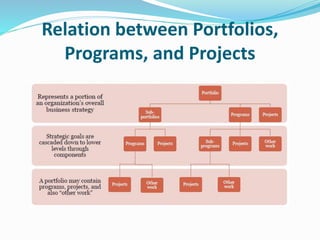
 Portfolio – A collection of projects, programs, sub-portfolios, and
operations managed as a group to achieve strategic objectives.
 The projects or programs of the portfolio may not necessarily be
interdependent or directly related.
 A typical example of a portfolio may be “Japanese Projects”,
where a company puts all its projects from Japan in one portfolio
to give more focus and attention to its Japanese projects and
grow its business in Japan.
 Portfolio management is the centralized management of one or
more portfolios. This includes identifying, prioritizing,
authorizing, managing, and controlling projects, programs, and
other related work to achieve strategic business objectives.
Relation between Portfolios,
Programs, and Projects
Project Management Office (PMO)
A PMO is a specific type of body, or department, within an organization.
The PMO usually has one of, or a combination of the three primary roles
mentioned below:
 Provide the policies, methodologies, and tools and templates for
managing projects within the organization.
 Provide support and training to others in the organization on how to
manage projects.
 Provide project managers for ongoing projects in the organization.
Other areas where a PMO may help are:
 Managing interdependencies between projects.
 Selecting, managing, and deploying shared or dedicated project
resources.
 Terminating projects.
 Coordinating communication across projects.
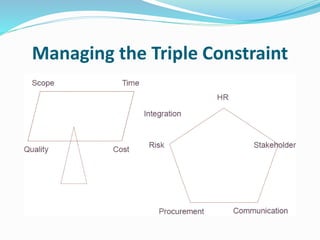
Managing the Triple Constraint
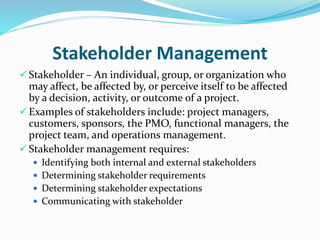
Stakeholder Management
 Stakeholder – An individual, group, or organization who
may affect, be affected by, or perceive itself to be affected
by a decision, activity, or outcome of a project.
 Examples of stakeholders include: project managers,
customers, sponsors, the PMO, functional managers, the
project team, and operations management.
 Stakeholder management requires:
 Identifying both internal and external stakeholders
 Determining stakeholder requirements
 Determining stakeholder expectations
 Communicating with stakeholder
Organizational Structures
The most common organizational structures are:
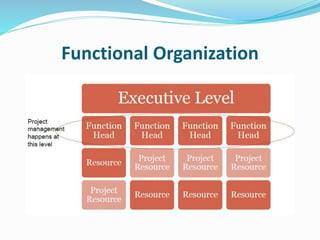
 Functional: The organization is grouped by areas of
specialization within different functional areas (e.g., marketing,
accounting, engineering, etc.). Each employee typically reports
to a functional manager.
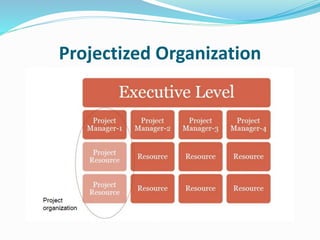
 Projectized: The organization’s resources mostly work on
projects. The project manager has almost complete control over
the resources.
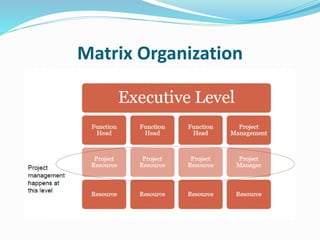
 Matrix: This organization is a blend of both the above types. The
resources report into the functions, but may also work on
projects.
 Within matrix, there may be weak matrix, strong matrix, and
balanced matrix organizations.
 Do not confuse them with the term “tight matrix” which stands for
co-located teams.
Functional Organization
Projectized Organization
Matrix Organization
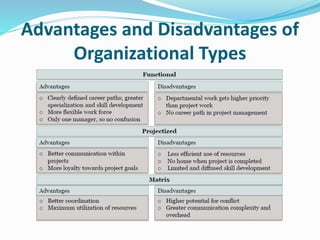
Advantages and Disadvantages of
Organizational Types
Project Life Cycle vs. Product Life Cycle
 A typical product life cycle starts with the conception of the
product and goes until its withdrawal from the market or
when it becomes obsolete.
 A product can require or spawn many projects over its life.
For example, a project during the product conception
phase could be “determine customer’s need” and a project
during the product maturity phase could be “perform
competitive analysis.”
 A project has its own life cycle. The life cycle depends upon
the control needs of the performing organization or the
organization’s preference defined in their project execution
methodology.
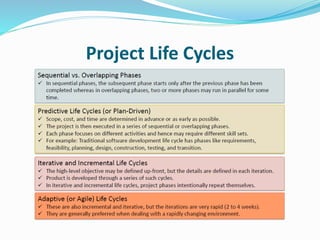
Project Life Cycles
Summary
Topics covered so far:
Definitions of projects, programs, and portfolios
Role of PMO
Project constraints
Managing stakeholders
Advantages and disadvantages of organization
structure
Different product life cycles
Quiz – 1
1. A project manager is working on a project to construct a new
bridge. The resources report to the functional manager and are
mainly occupied with operational related work. The project
manager has no authority to properly assign resources. What
type of organizational structure is the project manager in?
A. Functional
B. Projectized
C. Strong Matrix
D. Weak Matrix
 Answer 1: The correct answer is A. In a functional organization,
team members are more concerned with their daily functional
activities than with the project activities.
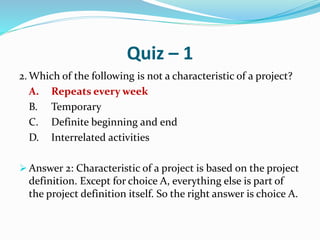
Quiz – 1
2. Which of the following is not a characteristic of a project?
A. Repeats every week
B. Temporary
C. Definite beginning and end
D. Interrelated activities
 Answer 2: Characteristic of a project is based on the project
definition. Except for choice A, everything else is part of
the project definition itself. So the right answer is choice A.
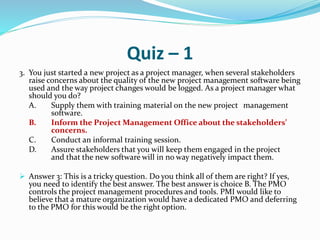
Quiz – 1
3. You just started a new project as a project manager, when several stakeholders
raise concerns about the quality of the new project management software being
used and the way project changes would be logged. As a project manager what
should you do?
A. Supply them with training material on the new project management
software.
B. Inform the Project Management Office about the stakeholders’
concerns.
C. Conduct an informal training session.
D. Assure stakeholders that you will keep them engaged in the project
and that the new software will in no way negatively impact them.
 Answer 3: This is a tricky question. Do you think all of them are right? If yes,
you need to identify the best answer. The best answer is choice B. The PMO
controls the project management procedures and tools. PMI would like to
believe that a mature organization would have a dedicated PMO and deferring
to the PMO for this would be the right option.
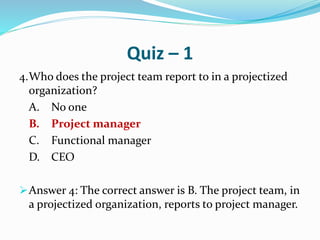
Quiz – 1
4.Who does the project team report to in a projectized
organization?
A. No one
B. Project manager
C. Functional manager
D. CEO
Answer 4: The correct answer is B. The project team, in
a projectized organization, reports to project manager.
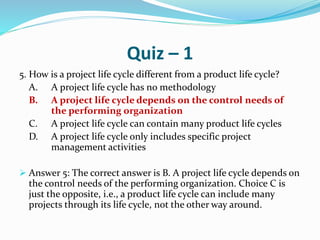
Quiz – 1
5. How is a project life cycle different from a product life cycle?
A. A project life cycle has no methodology
B. A project life cycle depends on the control needs of
the performing organization
C. A project life cycle can contain many product life cycles
D. A project life cycle only includes specific project
management activities
 Answer 5: The correct answer is B. A project life cycle depends on
the control needs of the performing organization. Choice C is
just the opposite, i.e., a product life cycle can include many
projects through its life cycle, not the other way around.
Quiz – 1
6. Identify the least important stakeholder from the given options.
A. The project manager who is responsible for building the
project
B. A project team member who will work on the project
C. Customer who will use the end product or service
D. Competitor whose organization will be affected by the
new product release
 Answer 6: The correct answer is D. Stakeholders are persons or
organizations that are actively involved in the project or who may
be positively or negatively affected by the performance or
completion of the project. The project manager has to manage
the expectations of the stakeholders.
Thank You
Project success:
 The completion of an activity within constraints of
time, cost, and performance.
 The definition of project success has been modified to
include completion;
1. Within the allocated time period
2. Within the budgeted cost
3. At the proper performance or specification level
4. While utilizing the assigned resources effectively and
efficiently
5. With acceptance by customer/user

Project management framework 01

  • 1.
    Based on PMBOK®Guide – Fifth Edition Project Management Body of Knowledge PMBOK is a registered mark of the Project Management Institute, Inc.
  • 2.
    Agenda  Definition ofa project  What is project management  What is program management  What is portfolio management  Project management office (PMO)  Project constraints  Stakeholder management  Organization structure  Project life cycle vs. product life cycle  Quiz
  • 3.
    What is aProject  “A project is a temporary endeavor undertaken to create a unique product, service, or result.”  Temporary does not necessarily mean short in duration.  Temporary means that a project has a definite start and end date.  A project comes to an end either when its objectives are met or when the sponsor decides to terminate the project (for instance, if it becomes apparent that the objectives can either not be met or are no longer required).  Project work is different from operational work. Operations consists of ongoing, repetitive work. For example, the work of an office receptionist can be classified as operational.
  • 4.
    What is aProject  A project can be considered any series of activities and tasks that:  Have a specific objectives (unique)to be completed within certain specifications  Have defined start and end dates  Have funding limits (If applicable)  Consumes human and non human resources i.e. money. People, equipment)  Are multifunctional
  • 5.
    What is aProject  Every project creates a unique product, service, or result.  Although repetitive elements may be present in some project deliverables and activities, which does not change the fundamental, unique characteristics of the project work.  For example, office buildings can be constructed with the same or similar materials and by the same or different teams.  However, each building project remains unique with a different location, different design, different circumstances and situations, different stakeholders, and so on.
  • 6.
    What is aProject  Examples of projects include, but are not limited to:  Developing a new product, or service;  Developing or acquiring a new or modified information system (hardware or software);  Constructing a building, industrial plant, or infrastructure; or  Implementing, improving, or enhancing existing business processes and procedures.
  • 7.
    What is ProjectManagement Project management is comprised of the knowledge, skills, tools, and techniques applied to project activities to meet project requirements. Project management is performed by applying and integrating project management processes, which are logically grouped into five process groups, namely: 1. Project initiation 2. Project planning 3. Project execution 4. Project Monitoring and control 5. Project closure
  • 8.
    Managing a projecttypically requires:  Identifying project requirements;  Managing stakeholders;  Balancing project constraints (i.e., cost, time, quality, scope, risk, etc.).
  • 9.
    What is ProgramManagement  Program – A group of related projects managed in a coordinated way to obtain benefits and control not available from managing them individually.  For a group of projects to be classified as a program, there must be some value added in managing them together as a program.  A project need not belong to a program; a program will always have projects.  A program is designed to deliver some strategic “benefits” value to the organization; the benefits could be tangible (e.g., growing the operating margin) or intangible (e.g., improving the morale of the team).  A program manager focuses on “delivery of benefits” to the organization; whereas a project manager focuses on “fulfilling the requirements” of a project.
  • 10.
    What is PortfolioManagement  Portfolio – A collection of projects, programs, sub-portfolios, and operations managed as a group to achieve strategic objectives.  The projects or programs of the portfolio may not necessarily be interdependent or directly related.  A typical example of a portfolio may be “Japanese Projects”, where a company puts all its projects from Japan in one portfolio to give more focus and attention to its Japanese projects and grow its business in Japan.  Portfolio management is the centralized management of one or more portfolios. This includes identifying, prioritizing, authorizing, managing, and controlling projects, programs, and other related work to achieve strategic business objectives.
  • 11.
  • 12.
    Project Management Office(PMO) A PMO is a specific type of body, or department, within an organization. The PMO usually has one of, or a combination of the three primary roles mentioned below:  Provide the policies, methodologies, and tools and templates for managing projects within the organization.  Provide support and training to others in the organization on how to manage projects.  Provide project managers for ongoing projects in the organization. Other areas where a PMO may help are:  Managing interdependencies between projects.  Selecting, managing, and deploying shared or dedicated project resources.  Terminating projects.  Coordinating communication across projects.
  • 13.
  • 14.
    Stakeholder Management  Stakeholder– An individual, group, or organization who may affect, be affected by, or perceive itself to be affected by a decision, activity, or outcome of a project.  Examples of stakeholders include: project managers, customers, sponsors, the PMO, functional managers, the project team, and operations management.  Stakeholder management requires:  Identifying both internal and external stakeholders  Determining stakeholder requirements  Determining stakeholder expectations  Communicating with stakeholder
  • 15.
    Organizational Structures The mostcommon organizational structures are:  Functional: The organization is grouped by areas of specialization within different functional areas (e.g., marketing, accounting, engineering, etc.). Each employee typically reports to a functional manager.  Projectized: The organization’s resources mostly work on projects. The project manager has almost complete control over the resources.  Matrix: This organization is a blend of both the above types. The resources report into the functions, but may also work on projects.  Within matrix, there may be weak matrix, strong matrix, and balanced matrix organizations.  Do not confuse them with the term “tight matrix” which stands for co-located teams.
  • 16.
  • 17.
  • 18.
  • 19.
    Advantages and Disadvantagesof Organizational Types
  • 20.
    Project Life Cyclevs. Product Life Cycle  A typical product life cycle starts with the conception of the product and goes until its withdrawal from the market or when it becomes obsolete.  A product can require or spawn many projects over its life. For example, a project during the product conception phase could be “determine customer’s need” and a project during the product maturity phase could be “perform competitive analysis.”  A project has its own life cycle. The life cycle depends upon the control needs of the performing organization or the organization’s preference defined in their project execution methodology.
  • 21.
  • 22.
    Summary Topics covered sofar: Definitions of projects, programs, and portfolios Role of PMO Project constraints Managing stakeholders Advantages and disadvantages of organization structure Different product life cycles
  • 23.
    Quiz – 1 1.A project manager is working on a project to construct a new bridge. The resources report to the functional manager and are mainly occupied with operational related work. The project manager has no authority to properly assign resources. What type of organizational structure is the project manager in? A. Functional B. Projectized C. Strong Matrix D. Weak Matrix  Answer 1: The correct answer is A. In a functional organization, team members are more concerned with their daily functional activities than with the project activities.
  • 24.
    Quiz – 1 2.Which of the following is not a characteristic of a project? A. Repeats every week B. Temporary C. Definite beginning and end D. Interrelated activities  Answer 2: Characteristic of a project is based on the project definition. Except for choice A, everything else is part of the project definition itself. So the right answer is choice A.
  • 25.
    Quiz – 1 3.You just started a new project as a project manager, when several stakeholders raise concerns about the quality of the new project management software being used and the way project changes would be logged. As a project manager what should you do? A. Supply them with training material on the new project management software. B. Inform the Project Management Office about the stakeholders’ concerns. C. Conduct an informal training session. D. Assure stakeholders that you will keep them engaged in the project and that the new software will in no way negatively impact them.  Answer 3: This is a tricky question. Do you think all of them are right? If yes, you need to identify the best answer. The best answer is choice B. The PMO controls the project management procedures and tools. PMI would like to believe that a mature organization would have a dedicated PMO and deferring to the PMO for this would be the right option.
  • 26.
    Quiz – 1 4.Whodoes the project team report to in a projectized organization? A. No one B. Project manager C. Functional manager D. CEO Answer 4: The correct answer is B. The project team, in a projectized organization, reports to project manager.
  • 27.
    Quiz – 1 5.How is a project life cycle different from a product life cycle? A. A project life cycle has no methodology B. A project life cycle depends on the control needs of the performing organization C. A project life cycle can contain many product life cycles D. A project life cycle only includes specific project management activities  Answer 5: The correct answer is B. A project life cycle depends on the control needs of the performing organization. Choice C is just the opposite, i.e., a product life cycle can include many projects through its life cycle, not the other way around.
  • 28.
    Quiz – 1 6.Identify the least important stakeholder from the given options. A. The project manager who is responsible for building the project B. A project team member who will work on the project C. Customer who will use the end product or service D. Competitor whose organization will be affected by the new product release  Answer 6: The correct answer is D. Stakeholders are persons or organizations that are actively involved in the project or who may be positively or negatively affected by the performance or completion of the project. The project manager has to manage the expectations of the stakeholders.
  • 29.
  • 30.
    Project success:  Thecompletion of an activity within constraints of time, cost, and performance.  The definition of project success has been modified to include completion; 1. Within the allocated time period 2. Within the budgeted cost 3. At the proper performance or specification level 4. While utilizing the assigned resources effectively and efficiently 5. With acceptance by customer/user