BY: Sherif Moftah,PMP,
PRMG
Project Management
Fundamentals
(Based on Guide to PMBOK 6th Edition)
About Sherif Moftah
1- Certified PRMG 2007 From AUC in the Following subject
Project Bids and Contracts
Management of Project Resources
Project Budget and Financial Control
Project Planning and Control Techniques
Project Feasibility study
Maintenance Planning
2- Certified PMP from 2010 From PMI
3- Certified OSHA General & Construction
4- Experience about 15 years in the Construction & Project Management
5- PMI Member Ship
INTRODUCTION
(Chapter 1)
WHAT IS THE PROJECT?
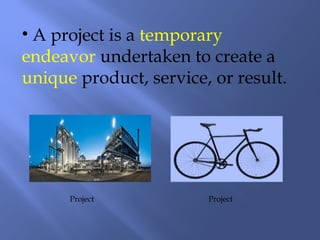
• A project is a temporary
endeavor undertaken to create a
unique product, service, or result.
Project Project
We Reached The End of Project when ?
The project’s objectives have been achieved;
The objectives will not or cannot be met;
Funding is exhausted or no longer available for
allocation to the project;
The human or physical resources are no longer
available;
The project is terminated for legal cause or
convenience.
The need for the project no longer exists (e.g., the
customer no longer wants the project completed, a
change in strategy or priority ends the project, the
organizational management provides direction to end
the project);
Project Objectives May Produce One or More of
The Following Deliverables
• A unique product that can be either a component of
another item, an enhancement or correction to an item,
• A unique service or a capability to perform a service
• A unique result, such as an outcome or document
• A unique combination of one or more products, services,
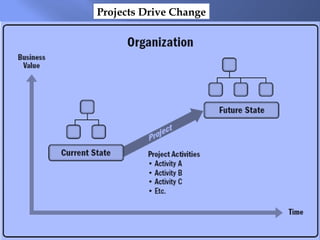
Projects Drive Change
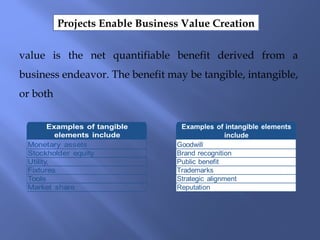
Projects Enable Business Value Creation
value is the net quantifiable benefit derived from a
business endeavor. The benefit may be tangible, intangible,
or both
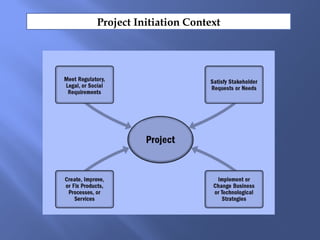
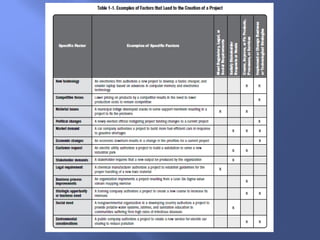
Project Initiation Context
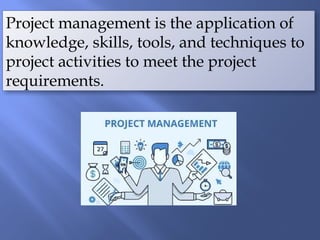
What is Project Management?
Project management is the application of
knowledge, skills, tools, and techniques to
project activities to meet the project
requirements.
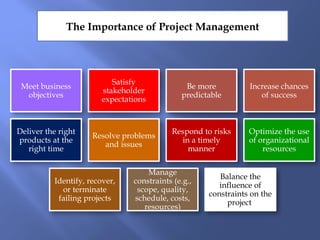
The Importance of Project Management
Meet business
objectives
Satisfy
stakeholder
expectations
Be more
predictable
Increase chances
of success
Deliver the right
products at the
right time
Resolve problems
and issues
Respond to risks
in a timely
manner
Optimize the use
of organizational
resources
Identify, recover,
or terminate
failing projects
Manage
constraints (e.g.,
scope, quality,
schedule, costs,
resources)
Balance the
influence of
constraints on the
project
Effective project management helps individuals, groups, and
public and private organizations to:
Meet business objectives, Satisfy stakeholder expectations, Be more
predictable; Increase chances of success; Deliver the right products at the right
time; cost or schedule);
Poorly or absence of project management may result in:
Missed deadlines, Cost overruns, Poor quality , Rework , Uncontrolled
expansion of the project , Loss of reputation for the organization,
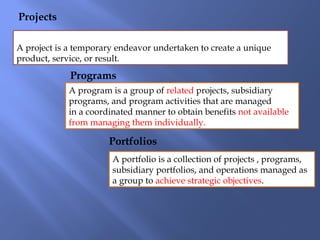
A project is a temporary endeavor undertaken to create a unique
product, service, or result.
Programs
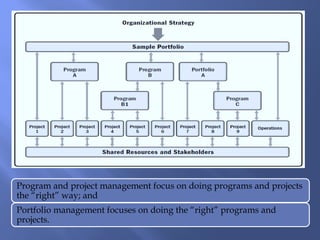
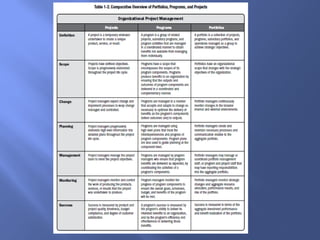
A program is a group of related projects, subsidiary
programs, and program activities that are managed
in a coordinated manner to obtain benefits not available
from managing them individually.
Portfolios
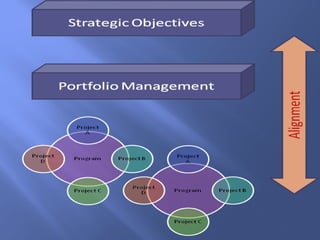
A portfolio is a collection of projects , programs,
subsidiary portfolios, and operations managed as
a group to achieve strategic objectives.
Projects
Program and project management focus on doing programs and projects
the “right” way; and
Portfolio management focuses on doing the “right” programs and
projects.
 Portfolio Management
 Program Management
defined as the centralized management of one or more
portfolios to achieve strategic objectives. The programs
or projects of the portfolio may not necessarily be
interdependent or directly related.
Program management is defined as the application of
knowledge, skills, and principles to a program to
achieve the program objectives
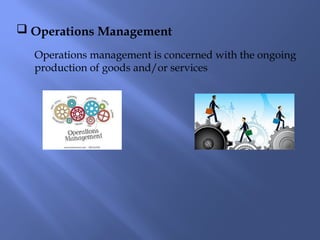
 Operations Management
Operations management is concerned with the ongoing
production of goods and/or services
When developing a new product, upgrading a product, or expanding
outputs;
While improving operations or the product development process;
At the end of the product life cycle; and
At each closeout phase.
Projects can intersect with operations at various points
during the product life cycle, such as;
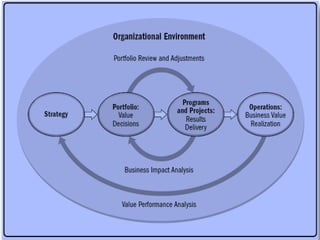
ORGANIZATIONAL PROJECT MANAGEMENT
(OPM) AND STRATEGIES
• Portfolio management aligns portfolios with
organizational strategies by selecting the right
programs or projects , prioritizing the work, and
providing the needed resources.
• Program management harmonizes its program
components and controls interdependencies in order to
realize specified benefits.
• Project management enables the achievement of
organizational goals and objectives
OPM is defined as a framework in which portfolio, program, and
project management are integrated with organizational enablers in
order to achieve strategic objectives.
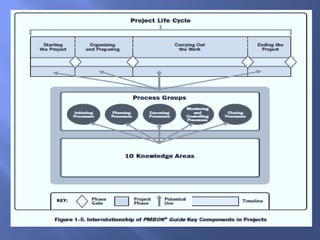
PMBOK® Guide Key Component
Project Life Cycle
The series of phases that a project passes through from its
start to its completion
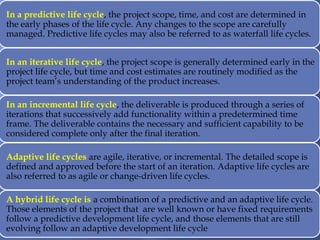
In a predictive life cycle, the project scope, time, and cost are determined in
the early phases of the life cycle. Any changes to the scope are carefully
managed. Predictive life cycles may also be referred to as waterfall life cycles.
In an iterative life cycle, the project scope is generally determined early in the
project life cycle, but time and cost estimates are routinely modified as the
project team’s understanding of the product increases.
In an incremental life cycle, the deliverable is produced through a series of
iterations that successively add functionality within a predetermined time
frame. The deliverable contains the necessary and sufficient capability to be
considered complete only after the final iteration.
Adaptive life cycles are agile, iterative, or incremental. The detailed scope is
defined and approved before the start of an iteration. Adaptive life cycles are
also referred to as agile or change-driven life cycles.
A hybrid life cycle is a combination of a predictive and an adaptive life cycle.
Those elements of the project that are well known or have fixed requirements
follow a predictive development life cycle, and those elements that are still
evolving follow an adaptive development life cycle
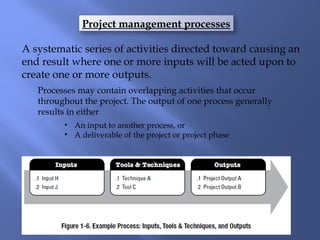
Project management processes
A systematic series of activities directed toward causing an
end result where one or more inputs will be acted upon to
create one or more outputs.
Processes may contain overlapping activities that occur
throughout the project. The output of one process generally
results in either
• An input to another process, or
• A deliverable of the project or project phase
The number of process iterations and interactions between processes
varies based on the needs of the project . Processes generally fall into
one of three categories:
• Processes used once or at predefined points in the project. The
processes Develop Project Charter and Close Project or Phase are
examples.
• Processes that are performed periodically as needed. The process
Acquire Resources is performed as resources are needed. The process
Conduct Procurements is performed prior to needing the procured
item.
• Processes that are performed continuously throughout the project.
The process Define Activities may occur throughout the project life
cycle, especially if the project uses rolling wave planning or an
adaptive development approach. Many of the monitoring and control
processes are ongoing from the start of the project, until it is closed
out.
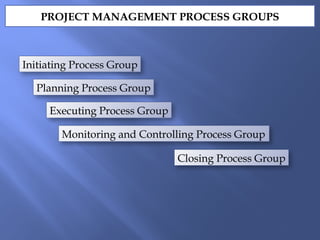
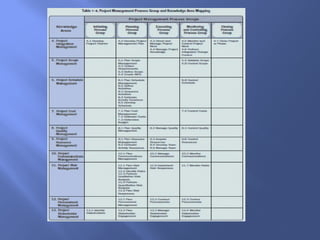
PROJECT MANAGEMENT PROCESS GROUPS
Initiating Process Group
Planning Process Group
Executing Process Group
Monitoring and Controlling Process Group
Closing Process Group
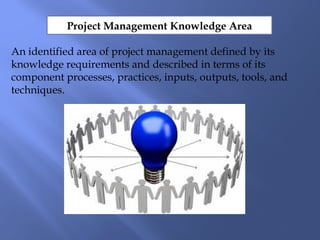
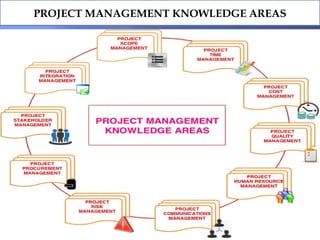
Project Management Knowledge Area
An identified area of project management defined by its
knowledge requirements and described in terms of its
component processes, practices, inputs, outputs, tools, and
techniques.
PROJECT MANAGEMENT KNOWLEDGE AREAS
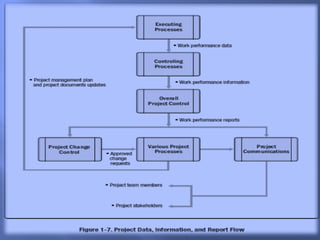
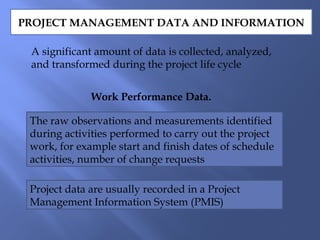
PROJECT MANAGEMENT DATA AND INFORMATION
A significant amount of data is collected, analyzed,
and transformed during the project life cycle
Work Performance Data.
The raw observations and measurements identified
during activities performed to carry out the project
work, for example start and finish dates of schedule
activities, number of change requests
Project data are usually recorded in a Project
Management Information System (PMIS)
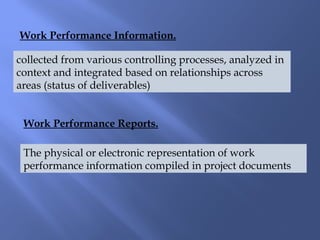
Work Performance Reports.
Work Performance Information.
collected from various controlling processes, analyzed in
context and integrated based on relationships across
areas (status of deliverables)
The physical or electronic representation of work
performance information compiled in project documents
5-TAILORING
The appropriate project management processes, inputs, tools,
techniques, outputs, and life cycle phases should be selected
to manage a project. This selection activity is known as
tailoring project management to the project
Project management methodologies may be:
• Developed by experts within the organization,
• Purchased from vendors,
• Obtained from professional associations, or
• Acquired from government agencies.
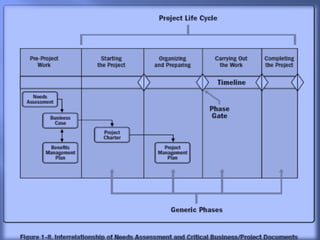
1.2.6 PROJECT MANAGEMENT BUSINESS DOCUMENTS
Project Business Case Project Benefits Management Plan
A documented economic
feasibility study used to establish
the validity of the benefits of a
selected component lacking
sufficient definition and that is
used as a basis for the
authorization of further project
management activities.
The documented explanation
defining the processes for
creating, maximizing, and
sustaining the benefits provided
by a project.
A business case may include but is not limited to
documenting the following:
Business needs:
• Determination of what is prompting the need for action;
• Situational statement documenting the business problem or opportunity to
be addressed including the value to be delivered to the organization;
• Identification of stakeholders affected; and
• Identification of the scope.
Analysis of the situation:
• Identification of organizational strategies, goals, and objectives;
• Identification of root cause(s) of the problem or main contributors of an
opportunity;
• Gap analysis of capabilities needed for the project versus existing
capabilities of the organization;
• Identification of known risks;
• Identification of critical success factors;
• Identification of decision criteria by which the various courses of action may
be assessed;
Recommendation:
1. A statement of the recommended option to pursue in the project;
2. Items to include in the statement may include but are not limited to:
• Analysis results for the potential option;
• Constraints, assumptions, risks, and dependencies for the potential options; and
• Success measures (see Section 1.2.6.4).
3. An implementation approach that may include but is not limited to:
• Milestones,
• Dependencies, and
• Roles and responsibilities.
•Evaluation:
• Statement describing the plan for measuring benefits the project will deliver. This
should include any ongoing operational aspects of the recommended option beyond
initial implementation.
PROJECT BENEFITS MANAGEMENT PLAN
The project benefits management plan is the document that
describes how and when the benefits of the project will be
delivered, and describes the mechanisms that should be in
place to measure those benefits.
The benefits management plan describes key elements of the
benefits and may include but is not limited to documenting the
following:
• Target benefits (e.g., the expected tangible and intangible
value to be gained by the implementation of the project;
financial value is expressed as net present value);
• Strategic alignment (e.g., how well the project benefits align to
the business strategies of the organization);
• Timeframe for realizing benefits (e.g., benefits by phase,
short-term, long-term, and ongoing);
• Benefits owner (e.g., the accountable person to monitor,
record, and report realized benefits throughout the timeframe
established in the plan);
• Metrics (e.g., the measures to be used to show benefits
realized, direct measures, and indirect measures);
• Assumptions (e.g., factors expected to be in place or to be in
evidence); and
• Risks (e.g., risks for realization of benefits).
PROJECT CHARTER
The document issued by the project sponsor that formally
authorizes the existence of a project and provides the
project manager with the authority to apply organizational
resources to project activities.
Project Management Plan
document that describes how the project will be executed,
monitored, and controlled.
PROJECT SUCCESS MEASURES
• What does success look like for this project?
• How will success be measured?
• What factors may impact success?
• Completing the project benefits management plan;
• Meeting the agreed-upon financial measures documented
in the business case.
These financial measures may include but are not limited to:
• Net present value (NPV), Internal rate of return (IRR),
• Payback period (PBP), and
• Benefit-cost ratio (BCR).Return on investment (ROI),
Three questions that the key stakeholders and the project manager
should answer are
Project success may include additional criteria linked to the
organizational strategy and to the delivery of business results.
These project objectives may include but are not limited to:
• Meeting business case nonfinancial objectives;
• Completing movement of an organization from its current state
to the desired future state;
• Fulfilling contract terms and conditions;
• Meeting organizational strategy, goals, and objectives;
• Achieving stakeholder satisfaction;
• Acceptable customer/end-user adoption;
• Integration of deliverables into the organization’s operating
environment;
• Achieving agreed-upon quality of delivery;
• Meeting governance criteria; and
• Achieving other agreed-upon success measures or criteria (e.g.,
process throughput).
Thanks

Project Management basics PMBOK 6 (1).pptx

  • 1.
    BY: Sherif Moftah,PMP, PRMG ProjectManagement Fundamentals (Based on Guide to PMBOK 6th Edition)
  • 2.
    About Sherif Moftah 1-Certified PRMG 2007 From AUC in the Following subject Project Bids and Contracts Management of Project Resources Project Budget and Financial Control Project Planning and Control Techniques Project Feasibility study Maintenance Planning 2- Certified PMP from 2010 From PMI 3- Certified OSHA General & Construction 4- Experience about 15 years in the Construction & Project Management 5- PMI Member Ship
  • 3.
  • 4.
    WHAT IS THEPROJECT?
  • 5.
    • A projectis a temporary endeavor undertaken to create a unique product, service, or result. Project Project
  • 6.
    We Reached TheEnd of Project when ? The project’s objectives have been achieved; The objectives will not or cannot be met; Funding is exhausted or no longer available for allocation to the project; The human or physical resources are no longer available; The project is terminated for legal cause or convenience. The need for the project no longer exists (e.g., the customer no longer wants the project completed, a change in strategy or priority ends the project, the organizational management provides direction to end the project);
  • 7.
    Project Objectives MayProduce One or More of The Following Deliverables • A unique product that can be either a component of another item, an enhancement or correction to an item, • A unique service or a capability to perform a service • A unique result, such as an outcome or document • A unique combination of one or more products, services,
  • 8.
  • 9.
    Projects Enable BusinessValue Creation value is the net quantifiable benefit derived from a business endeavor. The benefit may be tangible, intangible, or both
  • 10.
  • 12.
    What is ProjectManagement?
  • 13.
    Project management isthe application of knowledge, skills, tools, and techniques to project activities to meet the project requirements.
  • 14.
    The Importance ofProject Management Meet business objectives Satisfy stakeholder expectations Be more predictable Increase chances of success Deliver the right products at the right time Resolve problems and issues Respond to risks in a timely manner Optimize the use of organizational resources Identify, recover, or terminate failing projects Manage constraints (e.g., scope, quality, schedule, costs, resources) Balance the influence of constraints on the project
  • 15.
    Effective project managementhelps individuals, groups, and public and private organizations to: Meet business objectives, Satisfy stakeholder expectations, Be more predictable; Increase chances of success; Deliver the right products at the right time; cost or schedule); Poorly or absence of project management may result in: Missed deadlines, Cost overruns, Poor quality , Rework , Uncontrolled expansion of the project , Loss of reputation for the organization,
  • 16.
    A project isa temporary endeavor undertaken to create a unique product, service, or result. Programs A program is a group of related projects, subsidiary programs, and program activities that are managed in a coordinated manner to obtain benefits not available from managing them individually. Portfolios A portfolio is a collection of projects , programs, subsidiary portfolios, and operations managed as a group to achieve strategic objectives. Projects
  • 18.
    Program and projectmanagement focus on doing programs and projects the “right” way; and Portfolio management focuses on doing the “right” programs and projects.
  • 20.
     Portfolio Management Program Management defined as the centralized management of one or more portfolios to achieve strategic objectives. The programs or projects of the portfolio may not necessarily be interdependent or directly related. Program management is defined as the application of knowledge, skills, and principles to a program to achieve the program objectives
  • 21.
     Operations Management Operationsmanagement is concerned with the ongoing production of goods and/or services
  • 22.
    When developing anew product, upgrading a product, or expanding outputs; While improving operations or the product development process; At the end of the product life cycle; and At each closeout phase. Projects can intersect with operations at various points during the product life cycle, such as;
  • 23.
    ORGANIZATIONAL PROJECT MANAGEMENT (OPM)AND STRATEGIES • Portfolio management aligns portfolios with organizational strategies by selecting the right programs or projects , prioritizing the work, and providing the needed resources. • Program management harmonizes its program components and controls interdependencies in order to realize specified benefits. • Project management enables the achievement of organizational goals and objectives OPM is defined as a framework in which portfolio, program, and project management are integrated with organizational enablers in order to achieve strategic objectives.
  • 25.
  • 26.
    Project Life Cycle Theseries of phases that a project passes through from its start to its completion
  • 27.
    In a predictivelife cycle, the project scope, time, and cost are determined in the early phases of the life cycle. Any changes to the scope are carefully managed. Predictive life cycles may also be referred to as waterfall life cycles. In an iterative life cycle, the project scope is generally determined early in the project life cycle, but time and cost estimates are routinely modified as the project team’s understanding of the product increases. In an incremental life cycle, the deliverable is produced through a series of iterations that successively add functionality within a predetermined time frame. The deliverable contains the necessary and sufficient capability to be considered complete only after the final iteration. Adaptive life cycles are agile, iterative, or incremental. The detailed scope is defined and approved before the start of an iteration. Adaptive life cycles are also referred to as agile or change-driven life cycles. A hybrid life cycle is a combination of a predictive and an adaptive life cycle. Those elements of the project that are well known or have fixed requirements follow a predictive development life cycle, and those elements that are still evolving follow an adaptive development life cycle
  • 29.
    Project management processes Asystematic series of activities directed toward causing an end result where one or more inputs will be acted upon to create one or more outputs. Processes may contain overlapping activities that occur throughout the project. The output of one process generally results in either • An input to another process, or • A deliverable of the project or project phase
  • 30.
    The number ofprocess iterations and interactions between processes varies based on the needs of the project . Processes generally fall into one of three categories: • Processes used once or at predefined points in the project. The processes Develop Project Charter and Close Project or Phase are examples. • Processes that are performed periodically as needed. The process Acquire Resources is performed as resources are needed. The process Conduct Procurements is performed prior to needing the procured item. • Processes that are performed continuously throughout the project. The process Define Activities may occur throughout the project life cycle, especially if the project uses rolling wave planning or an adaptive development approach. Many of the monitoring and control processes are ongoing from the start of the project, until it is closed out.
  • 32.
    PROJECT MANAGEMENT PROCESSGROUPS Initiating Process Group Planning Process Group Executing Process Group Monitoring and Controlling Process Group Closing Process Group
  • 33.
    Project Management KnowledgeArea An identified area of project management defined by its knowledge requirements and described in terms of its component processes, practices, inputs, outputs, tools, and techniques.
  • 35.
  • 37.
    PROJECT MANAGEMENT DATAAND INFORMATION A significant amount of data is collected, analyzed, and transformed during the project life cycle Work Performance Data. The raw observations and measurements identified during activities performed to carry out the project work, for example start and finish dates of schedule activities, number of change requests Project data are usually recorded in a Project Management Information System (PMIS)
  • 38.
    Work Performance Reports. WorkPerformance Information. collected from various controlling processes, analyzed in context and integrated based on relationships across areas (status of deliverables) The physical or electronic representation of work performance information compiled in project documents
  • 40.
    5-TAILORING The appropriate projectmanagement processes, inputs, tools, techniques, outputs, and life cycle phases should be selected to manage a project. This selection activity is known as tailoring project management to the project Project management methodologies may be: • Developed by experts within the organization, • Purchased from vendors, • Obtained from professional associations, or • Acquired from government agencies.
  • 41.
    1.2.6 PROJECT MANAGEMENTBUSINESS DOCUMENTS Project Business Case Project Benefits Management Plan A documented economic feasibility study used to establish the validity of the benefits of a selected component lacking sufficient definition and that is used as a basis for the authorization of further project management activities. The documented explanation defining the processes for creating, maximizing, and sustaining the benefits provided by a project.
  • 42.
    A business casemay include but is not limited to documenting the following: Business needs: • Determination of what is prompting the need for action; • Situational statement documenting the business problem or opportunity to be addressed including the value to be delivered to the organization; • Identification of stakeholders affected; and • Identification of the scope. Analysis of the situation: • Identification of organizational strategies, goals, and objectives; • Identification of root cause(s) of the problem or main contributors of an opportunity; • Gap analysis of capabilities needed for the project versus existing capabilities of the organization; • Identification of known risks; • Identification of critical success factors; • Identification of decision criteria by which the various courses of action may be assessed;
  • 43.
    Recommendation: 1. A statementof the recommended option to pursue in the project; 2. Items to include in the statement may include but are not limited to: • Analysis results for the potential option; • Constraints, assumptions, risks, and dependencies for the potential options; and • Success measures (see Section 1.2.6.4). 3. An implementation approach that may include but is not limited to: • Milestones, • Dependencies, and • Roles and responsibilities. •Evaluation: • Statement describing the plan for measuring benefits the project will deliver. This should include any ongoing operational aspects of the recommended option beyond initial implementation.
  • 45.
    PROJECT BENEFITS MANAGEMENTPLAN The project benefits management plan is the document that describes how and when the benefits of the project will be delivered, and describes the mechanisms that should be in place to measure those benefits. The benefits management plan describes key elements of the benefits and may include but is not limited to documenting the following:
  • 46.
    • Target benefits(e.g., the expected tangible and intangible value to be gained by the implementation of the project; financial value is expressed as net present value); • Strategic alignment (e.g., how well the project benefits align to the business strategies of the organization); • Timeframe for realizing benefits (e.g., benefits by phase, short-term, long-term, and ongoing); • Benefits owner (e.g., the accountable person to monitor, record, and report realized benefits throughout the timeframe established in the plan); • Metrics (e.g., the measures to be used to show benefits realized, direct measures, and indirect measures); • Assumptions (e.g., factors expected to be in place or to be in evidence); and • Risks (e.g., risks for realization of benefits).
  • 47.
    PROJECT CHARTER The documentissued by the project sponsor that formally authorizes the existence of a project and provides the project manager with the authority to apply organizational resources to project activities. Project Management Plan document that describes how the project will be executed, monitored, and controlled.
  • 48.
    PROJECT SUCCESS MEASURES •What does success look like for this project? • How will success be measured? • What factors may impact success? • Completing the project benefits management plan; • Meeting the agreed-upon financial measures documented in the business case. These financial measures may include but are not limited to: • Net present value (NPV), Internal rate of return (IRR), • Payback period (PBP), and • Benefit-cost ratio (BCR).Return on investment (ROI), Three questions that the key stakeholders and the project manager should answer are Project success may include additional criteria linked to the organizational strategy and to the delivery of business results. These project objectives may include but are not limited to:
  • 49.
    • Meeting businesscase nonfinancial objectives; • Completing movement of an organization from its current state to the desired future state; • Fulfilling contract terms and conditions; • Meeting organizational strategy, goals, and objectives; • Achieving stakeholder satisfaction; • Acceptable customer/end-user adoption; • Integration of deliverables into the organization’s operating environment; • Achieving agreed-upon quality of delivery; • Meeting governance criteria; and • Achieving other agreed-upon success measures or criteria (e.g., process throughput).
  • 50.