COURSE CODE:
ICT 302
A Guide to the Project Management Body of
Knowledge
(PMBOK® Guide) – Fifth Edition
By- Project Management Institute
The Principles of Project Management
By MERI WILLIAMS
Publishers: Sitepoint.com
What is a project?
A project is any temporary endeavour undertaken to
create a unique product, service or result.
(P.M.B.O.K 5).
 Examples of projects include, but are not
limited to:
 Developing an online Registration System for
CAUC by the third year students;
 Installing a cell site to strengthen the signal
strength of mobile users at Kwadaso;
 Developing or acquiring a new or modified
information system (hardware or software);
 Temporary-nature of projects indicates that a project
has a definite beginning and end. Eg 2years, 40 years
 The end is reached when the project’s objectives have
been:
◦ Achieved
◦ Terminated because its objectives will not or cannot be
met.
◦ When the need for the project no longer exists.
A project may also be terminated if the client
(customer, sponsor, or champion) wishes to
terminate the project.
Temporary does not necessarily mean the
duration of the project is short. It refers to the
project’s engagement and its longevity.
No of people:
A project can involve:
 Single individual
 Multiple individuals,
 Single organizational unit,
 Multiple organizational units from multiple
organizations.
:
A product that can be either a component of:
 Another item,
 An enhancement of an item,
 An end item in itself;
 EXAMPLES OF PROJECTS
 Conducting a research effort for an organisation;
 Constructing a building, industrial plant, or
infrastructure; or
 Implementing, improving, or enhancing existing
business processes and procedures.
 IT projects involve using hardware, software, and
networks to create a product, service, or result:
 A team of students creates a smartphone application
and sells it online.
 A company develops a driverless car.
 A small software development team adds a new
feature to an internal software
 OTHER FORMS OF PROJECTS (NON IT PROJECTS)
 Building class rooms for students.
 Collect health data for analysis by the Ministry of Health.
 A college upgrades its technology infrastructure to provide
wireless Internet access across the whole campus.
 A company develops a new system to increase sales force
productivity
 Customer relationship management that will work on various
laptops, smart phones, and tablets
 PROJECT ATTRIBUTES
 PURPOSE: A project has a unique purpose. Every project should
have a well-defined objective.
 TEMPORARY: A project is temporary. A project has a definite
beginning and end.
 RESOURCES: Resources include people, hardware, software,
and other assets. Many projects cross departmental or other
boundaries to achieve their unique purposes.
 SPONSOR: The project sponsor usually provides the direction and funding for
the project
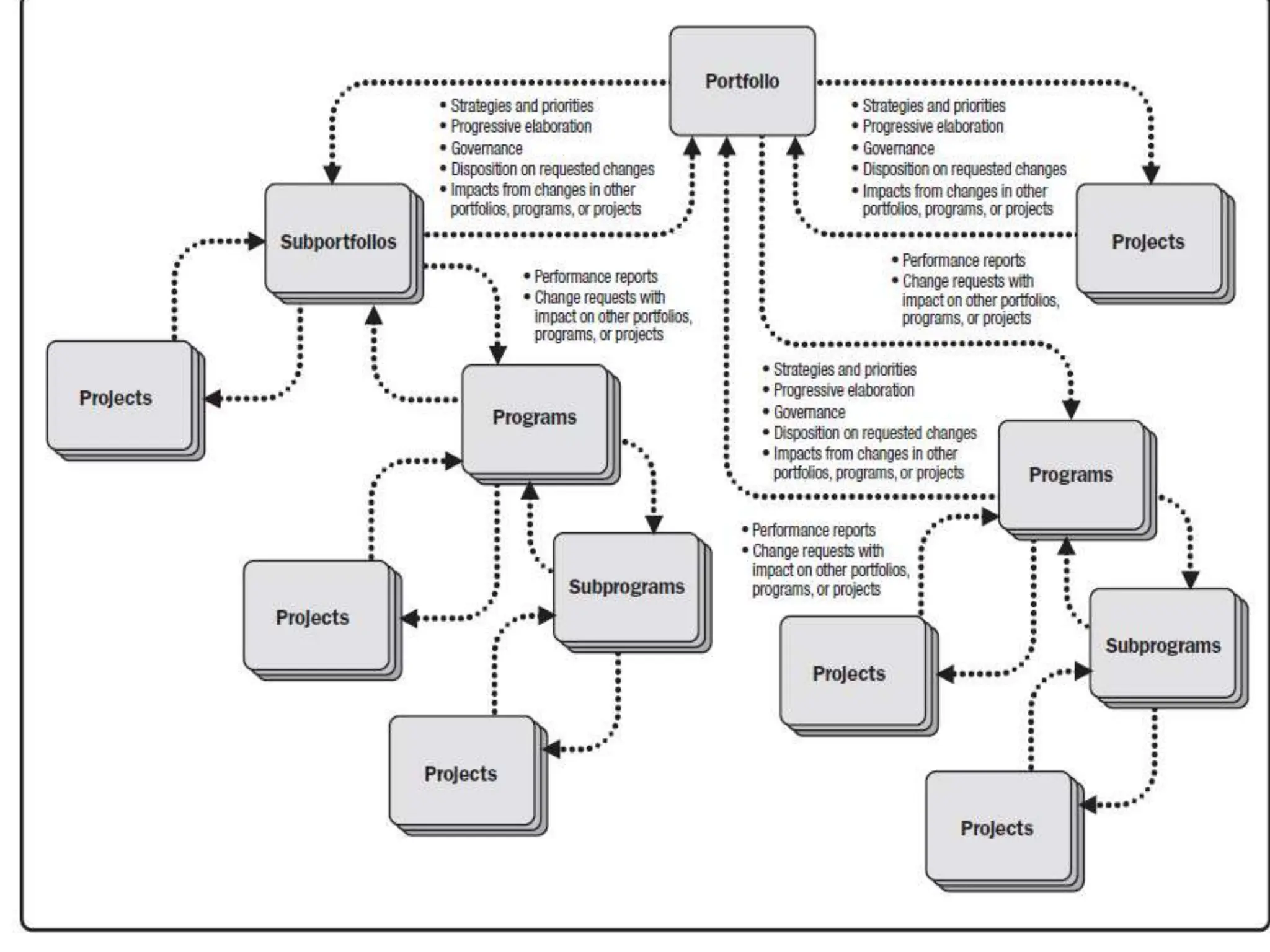
The Relationships Among Portfolios, Programs, and
Projects
 PORTFOLIO-
 portfolio refers to a collection of projects,
programs, sub portfolios, and operations
managed as a group to achieve strategic
objectives.
 PROGRAMS-
 Programs are grouped within a portfolio and are
comprised of subprograms, projects, or other
work that are managed in a coordinated fashion
in support of the portfolio.
Program Management
A program is defined as a group of related
projects, subprograms, and program activities
managed in a coordinated way to obtain
benefits not available from managing them
individually.
Programs may include elements of related
work outside the scope of the discrete
projects in the program.
 Individual projects that are either within or
outside of a program are still considered part
of a portfolio.
 Although the projects or programs within the
portfolio may not necessarily be
interdependent or directly related, they are
linked to the organization’s strategic plan by
means of the organization’s portfolio.
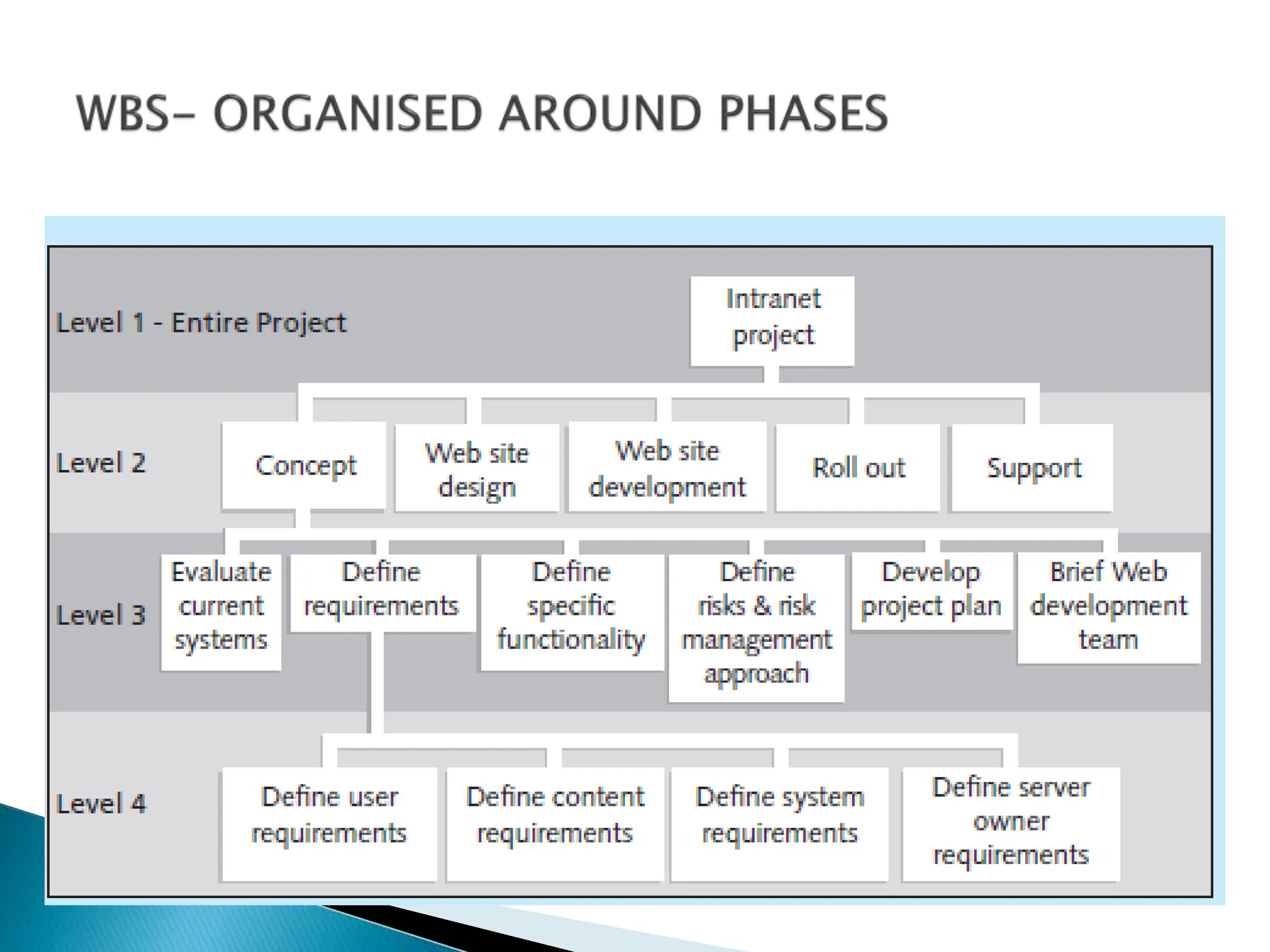
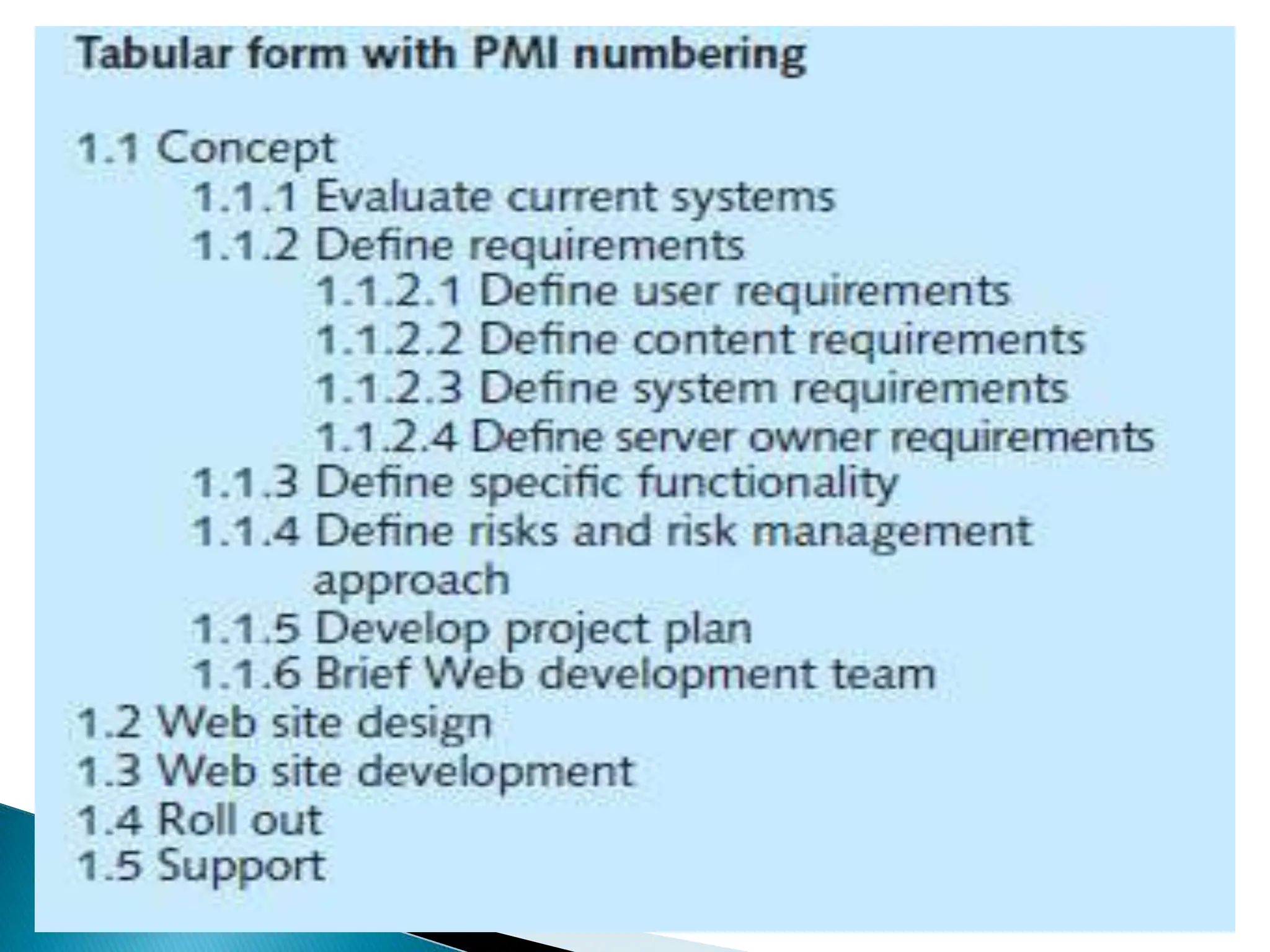
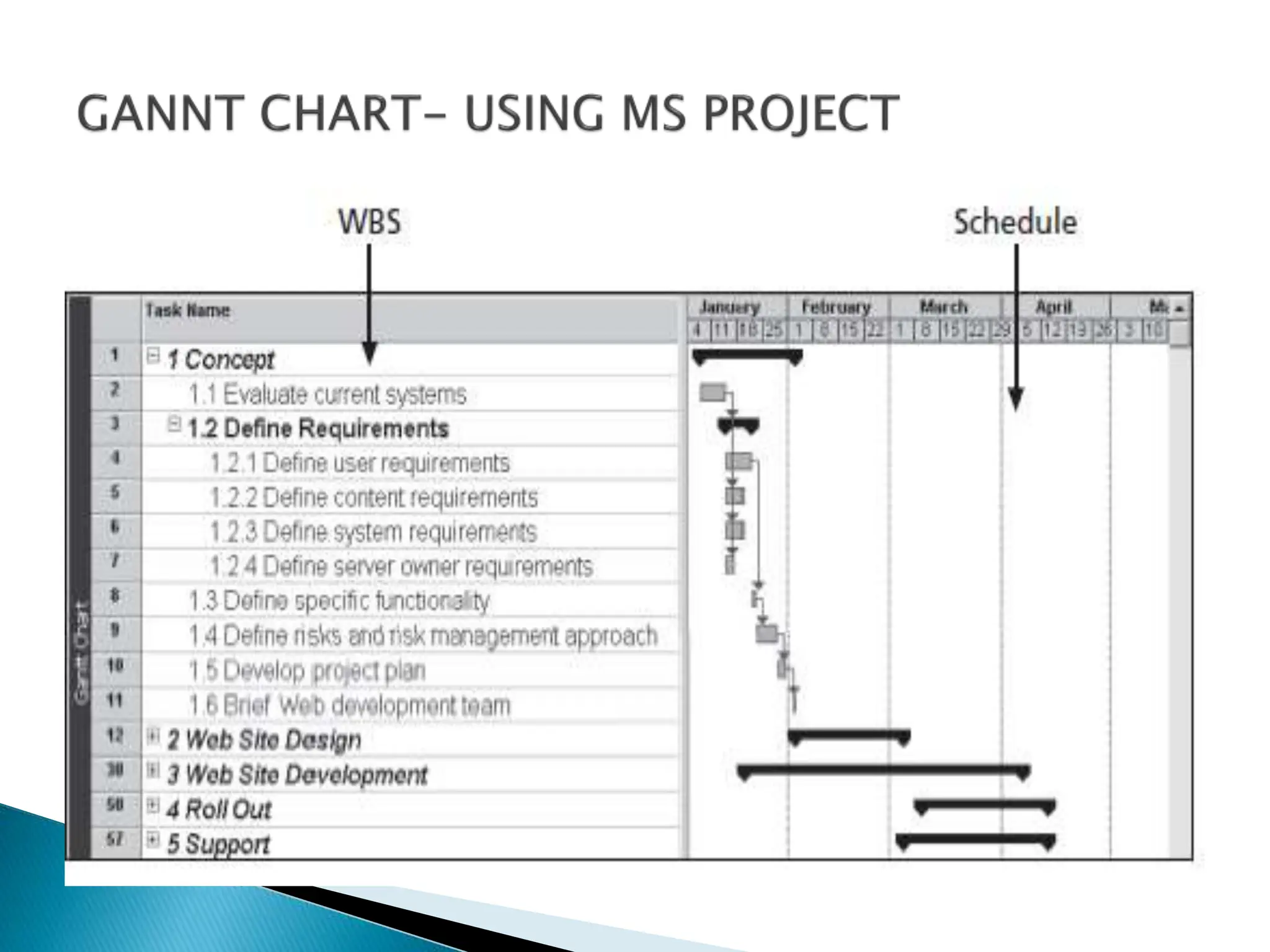
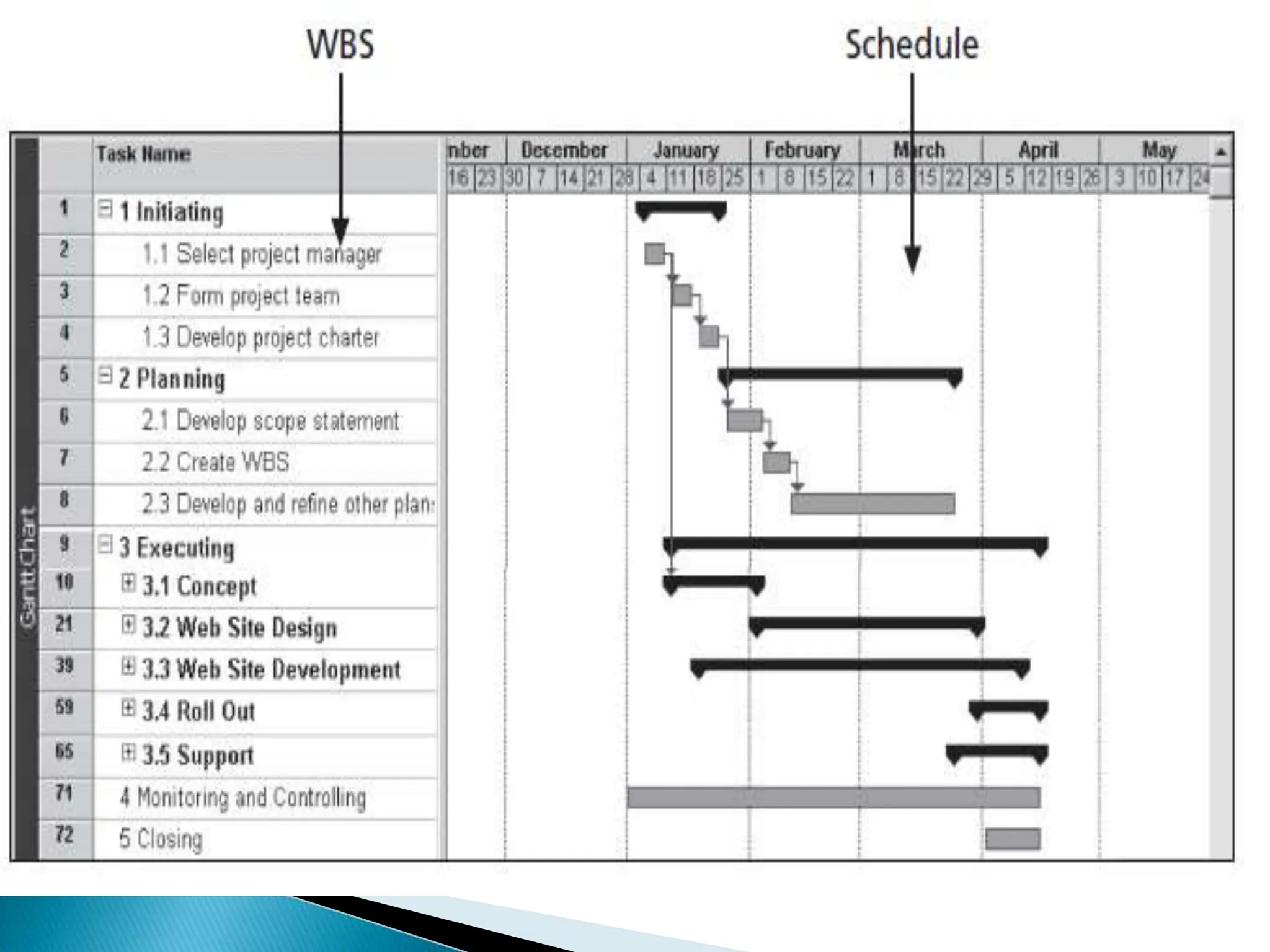
 TRIPPLE CONSTRAINT
 Scope:
 What work will be done as part of the project?
 What unique product, service, or result does the
customer or sponsor expect from the project?
 How will the scope be verified?
 Time:
 How long should it take to complete the project?
 What is the project’s schedule?
 How will the team track actual schedule
performance?
 Who can approve changes to the schedule?
 Cost:
 What should it cost to complete the project?
 What is the project’s budget?
 How will costs be tracked?
 Who can authorize changes to the budget?
 THE BALANCE QUADRANT
What is Project Management?
 Project management is the application of knowledge,
skills, tools, and techniques to project activities to
meet the project requirements.
 Project management is accomplished through the
appropriate application and integration of the 47
logically grouped project management processes,
which are categorized into five Process Groups.
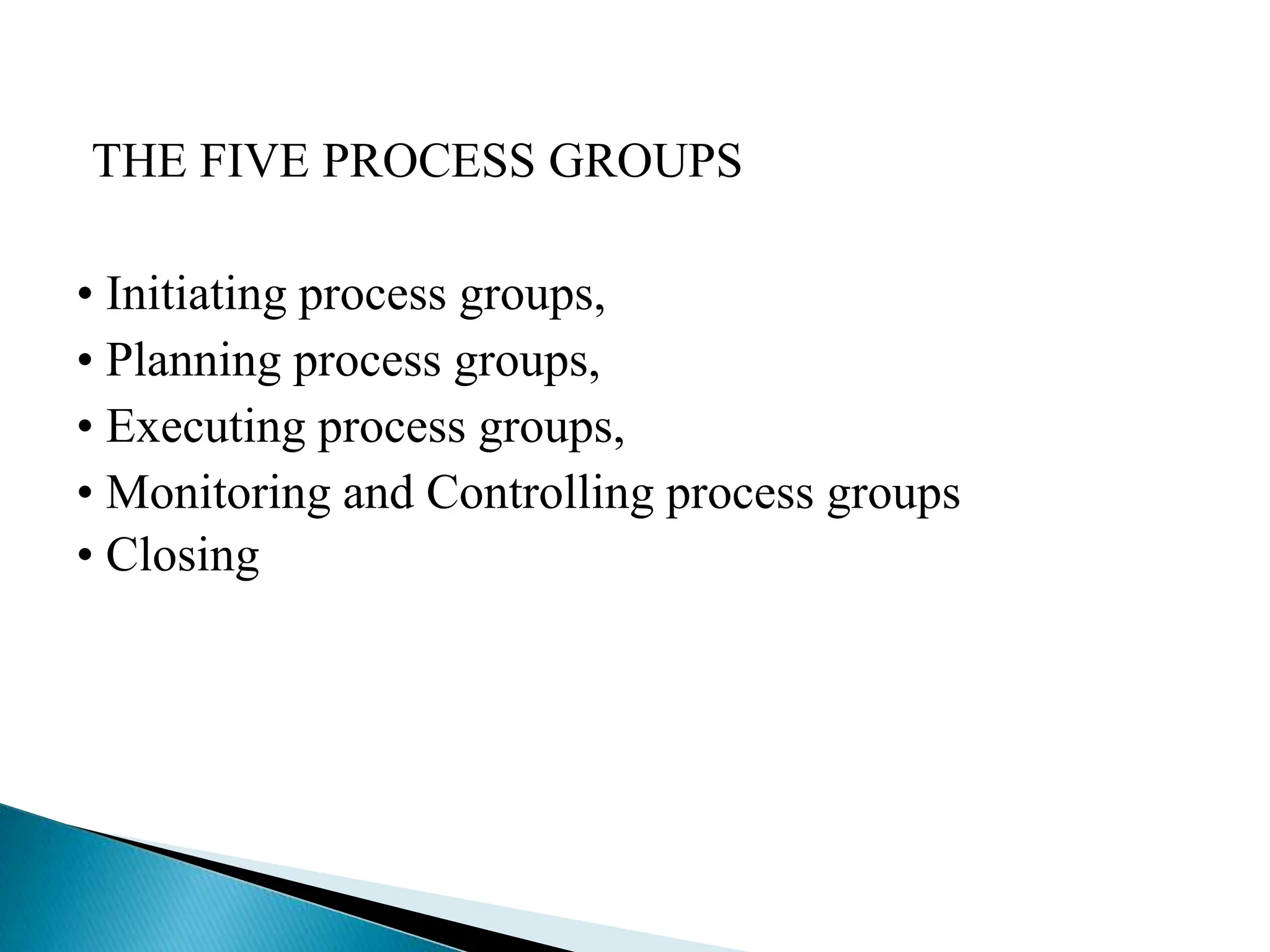
THE FIVE PROCESS GROUPS
• Initiating process groups,
• Planning process groups,
• Executing process groups,
• Monitoring and Controlling process groups
• Closing
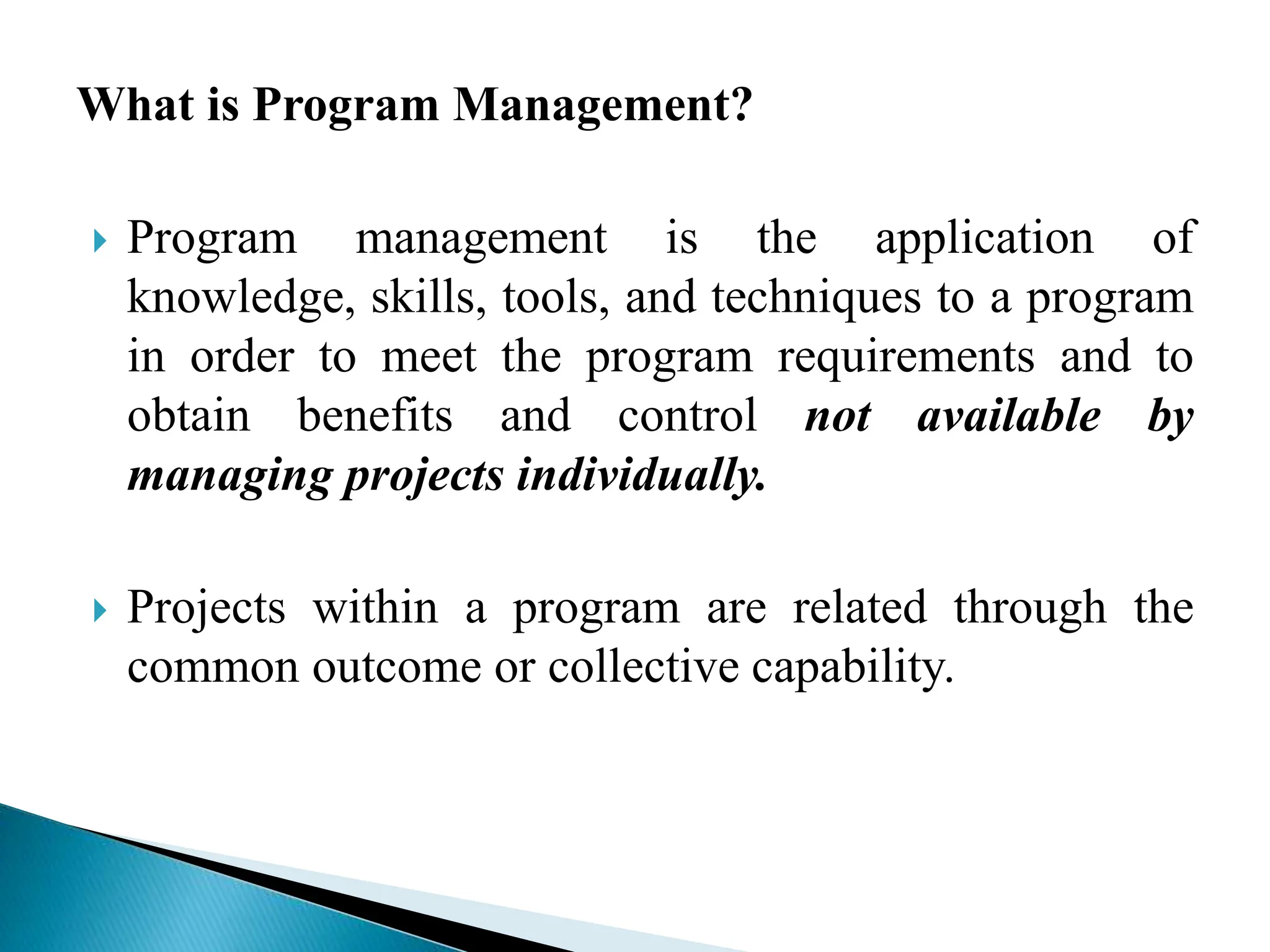
What is Program Management?
 Program management is the application of
knowledge, skills, tools, and techniques to a program
in order to meet the program requirements and to
obtain benefits and control not available by
managing projects individually.
 Projects within a program are related through the
common outcome or collective capability.
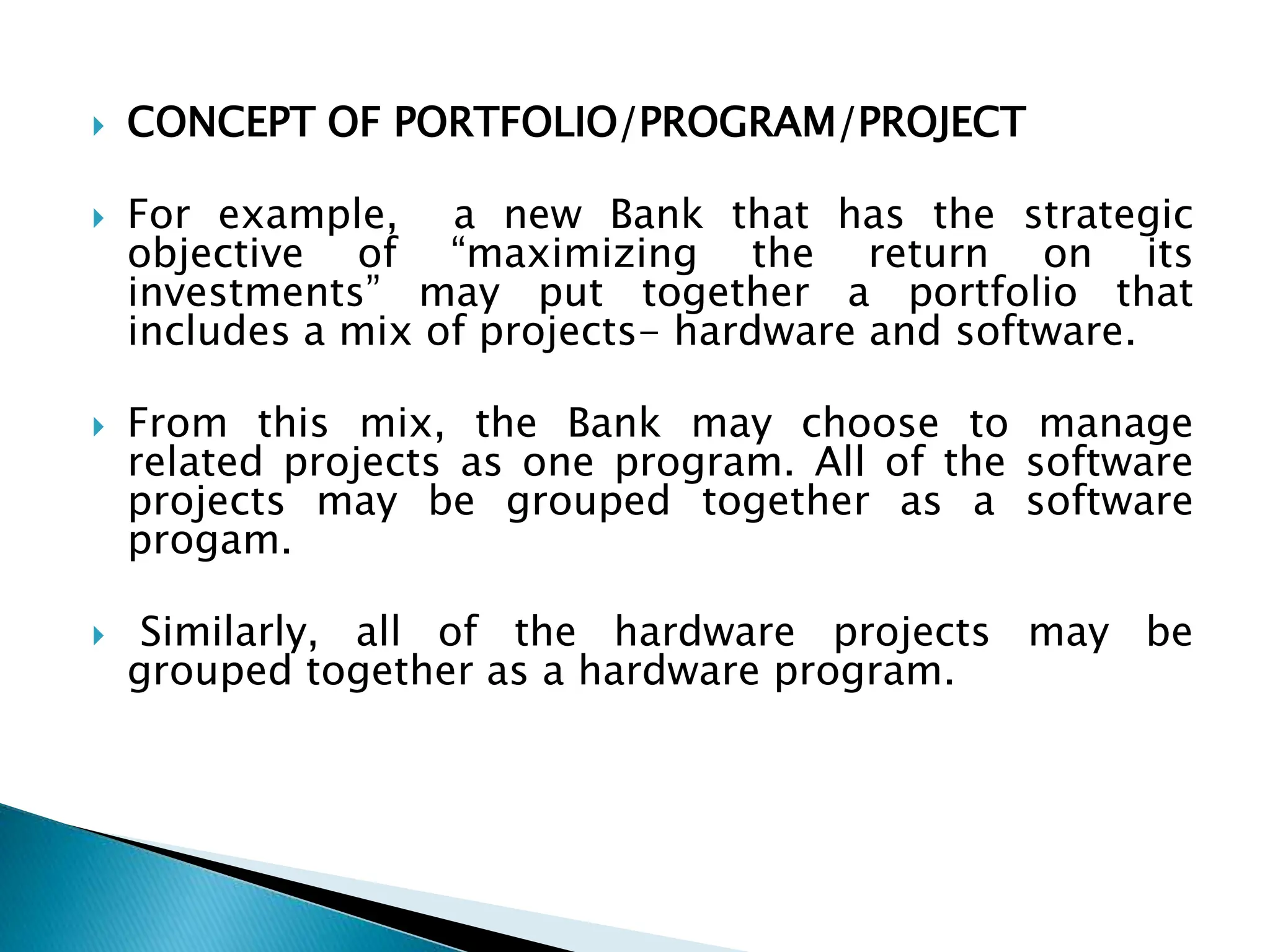
 CONCEPT OF PORTFOLIO/PROGRAM/PROJECT
 For example, a new Bank that has the strategic
objective of “maximizing the return on its
investments” may put together a portfolio that
includes a mix of projects- hardware and software.
 From this mix, the Bank may choose to manage
related projects as one program. All of the software
projects may be grouped together as a software
progam.
 Similarly, all of the hardware projects may be
grouped together as a hardware program.
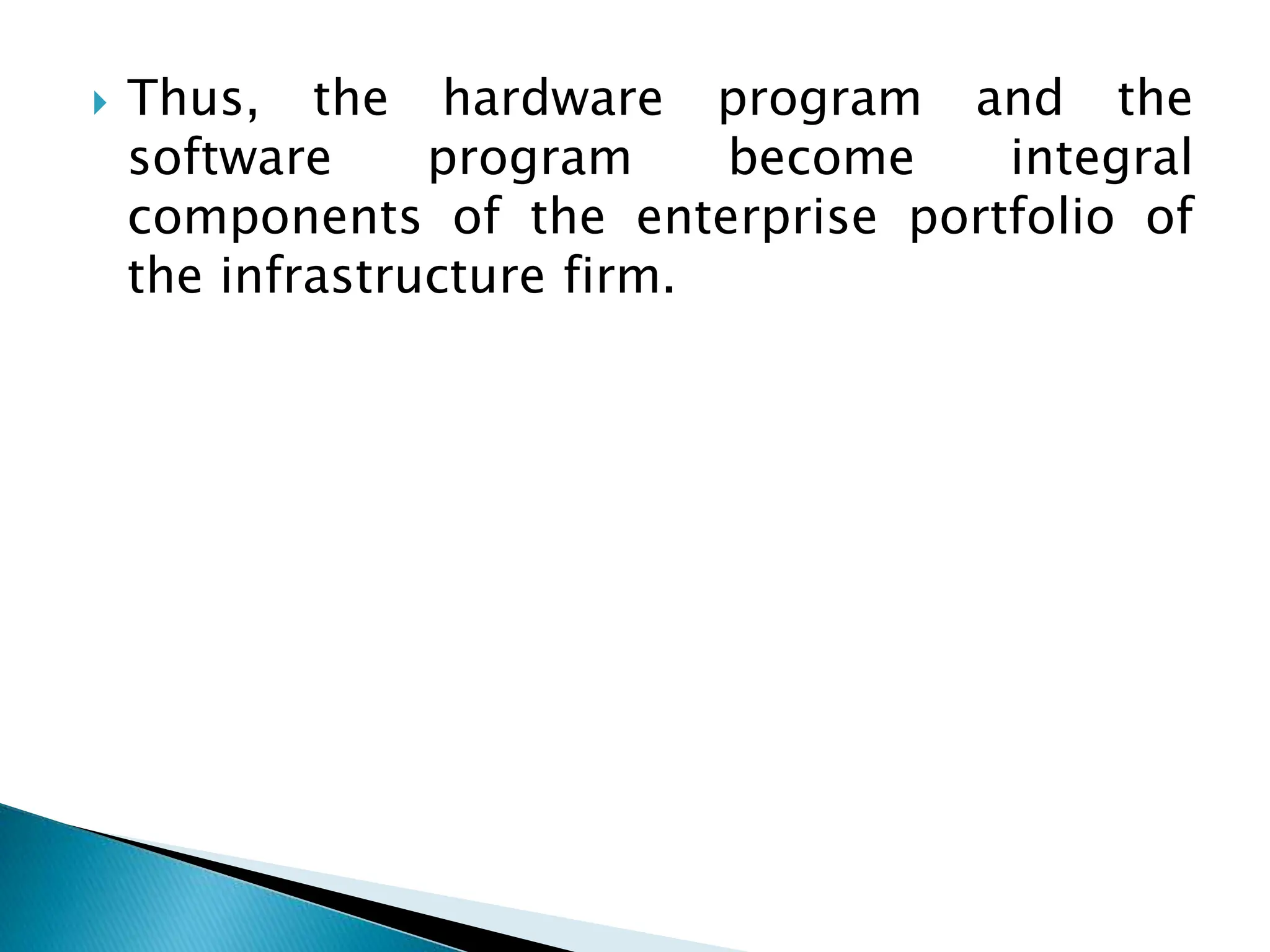
 Thus, the hardware program and the
software program become integral
components of the enterprise portfolio of
the infrastructure firm.
PROJECT MANAGEMENT AREAS
1. Project scope management involves defining and
managing all the work required to complete the project
successfully.
2. Project time management includes estimating how
long it will take to complete the work, developing an
acceptable project schedule, and ensuring timely
completion of the project.
3. Project cost management consists of preparing and
managing the budget for the project.
4. Project quality management ensures that the
project will satisfy the stated or implied needs for
which it was undertaken.
5. Project human resource management is concerned
with making effective use of the people involved with
the project.
6. Project communications management involves
generating, collecting, disseminating, and storing
project information.
7. Project risk management includes identifying,
analyzing, and responding to risks related to the project
8. Project procurement management involves acquiring
or procuring goods and services for a project from outside
the performing organization.
9. Project stakeholder management includes identifying
and analyzing stakeholder needs while managing and
controlling their engagement throughout the life of the
project
10. Project integration management is an overarching
function that affects and is affected by all of the other
knowledge areas.


 Business Value
 Delivering value is the only reason to undertake a
project.
 Business value is a concept that is unique to each
organization.
 Business value is defined as the entire value of the
business; the total sum of all tangible and intangible
elements.
 Project Manager. Who is he/she?
 The project manager is the person assigned by the
performing organization to lead the team that is
responsible for achieving the project objectives.
 The role of a project manager is distinct from a
functional manager or operations manager.
 .

 Typically the functional manager is focused on
providing management oversight for a functional or a
business unit, and operations managers are
responsible for ensuring that business operations are
efficient
 Depending on the organizational structure, a project
manager may report to a functional manager.
 In other cases, a project manager may be one of
several project managers who report to a program or
portfolio manager who is ultimately responsible for
enterprise-wide projects.
In this type of structure, the project manager works
closely with the program or portfolio manager to
achieve the project objectives and to ensure the project
management plan aligns with the overarching program
plan.
Interpersonal Skills of a Project Manager
Project managers accomplish work through the project
team and other stakeholders.
Effective project managers require a balance of ethical,
interpersonal, and conceptual skills that help them
analyse situations and interact appropriately.
• Leadership,
• Team building,
• Motivation,
• Communication,
• Influencing,
• Decision making,
• Political and cultural awareness,
.
• Negotiation,
• Trust building,
• Conflict management, and
• Coaching
ORGANISATIONAL INFLUENCE AND PROJECT
LIFE CYCLE
INTRODUCTION
Projects and project management take place in an
environment that is broader than that of the project
itself.
Understanding this broader context helps ensure that
work is carried out in alignment with the organization’s
goals and managed in accordance with the
organization’s established practices.
 An organization’s culture, style, and structure
influence how its projects are performed.
 The organization’s level of project management
maturity and its project management systems can also
influence the project.
NOTE
When a project involves external entities such as those
that are part of a joint venture or partnering agreement,
the project will be influenced by more than one
organization.
What are Organizations?
They are systematic arrangements of entities (persons
and/or departments) that is aimed at accomplishing a
purpose, which may involve undertaking projects.
An organization’s culture and style affect how it
conducts projects
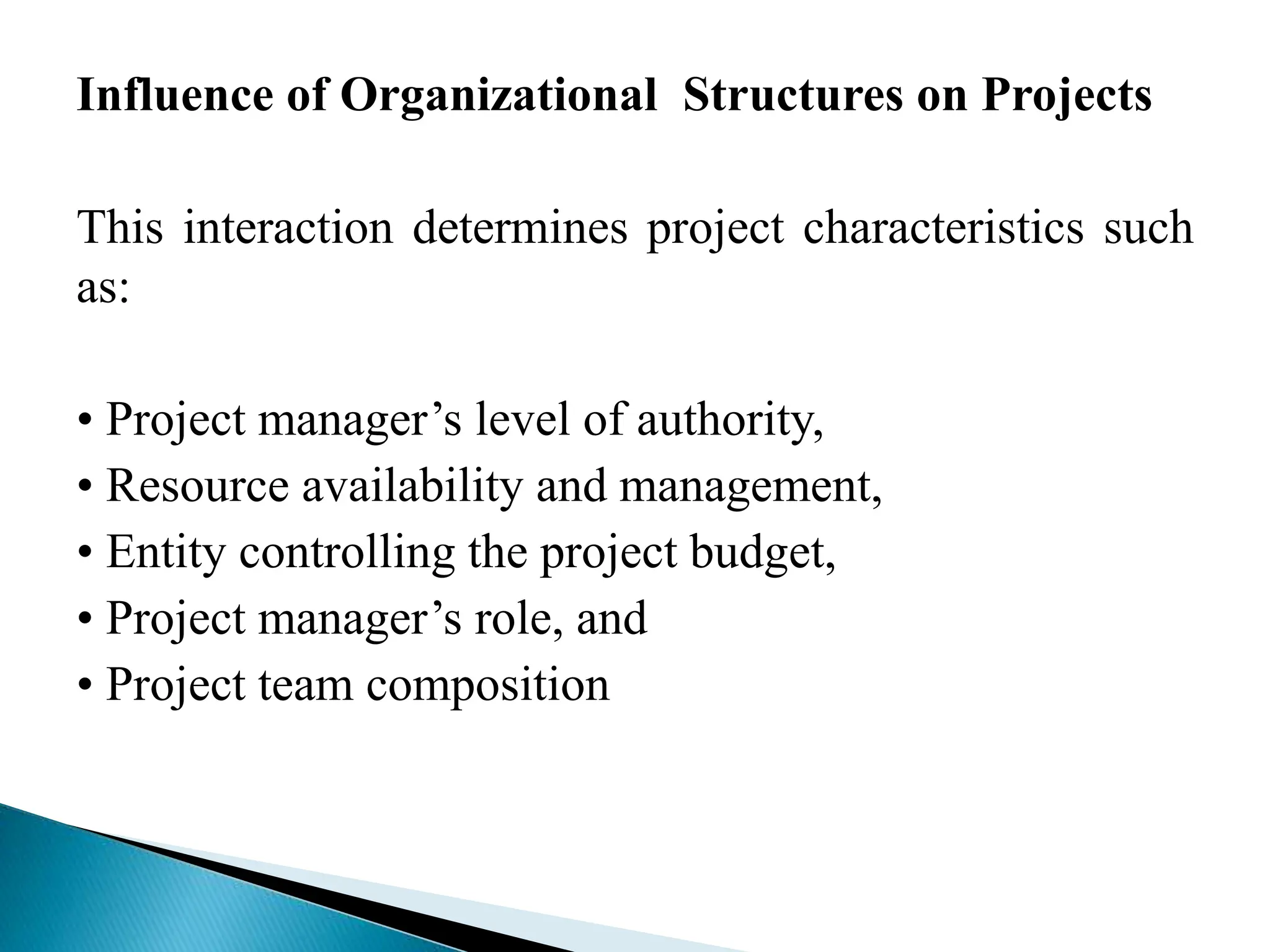
COMMON EXPERIENCES•
• Shared visions, mission, values, beliefs, and expectations;
• Regulations, policies, methods, and procedures;
• Motivation and reward systems;
• Risk tolerance;
• View of leadership, hierarchy, and authority relationships;
• Code of conduct, work ethic, and work hours; and
• Operating environments.
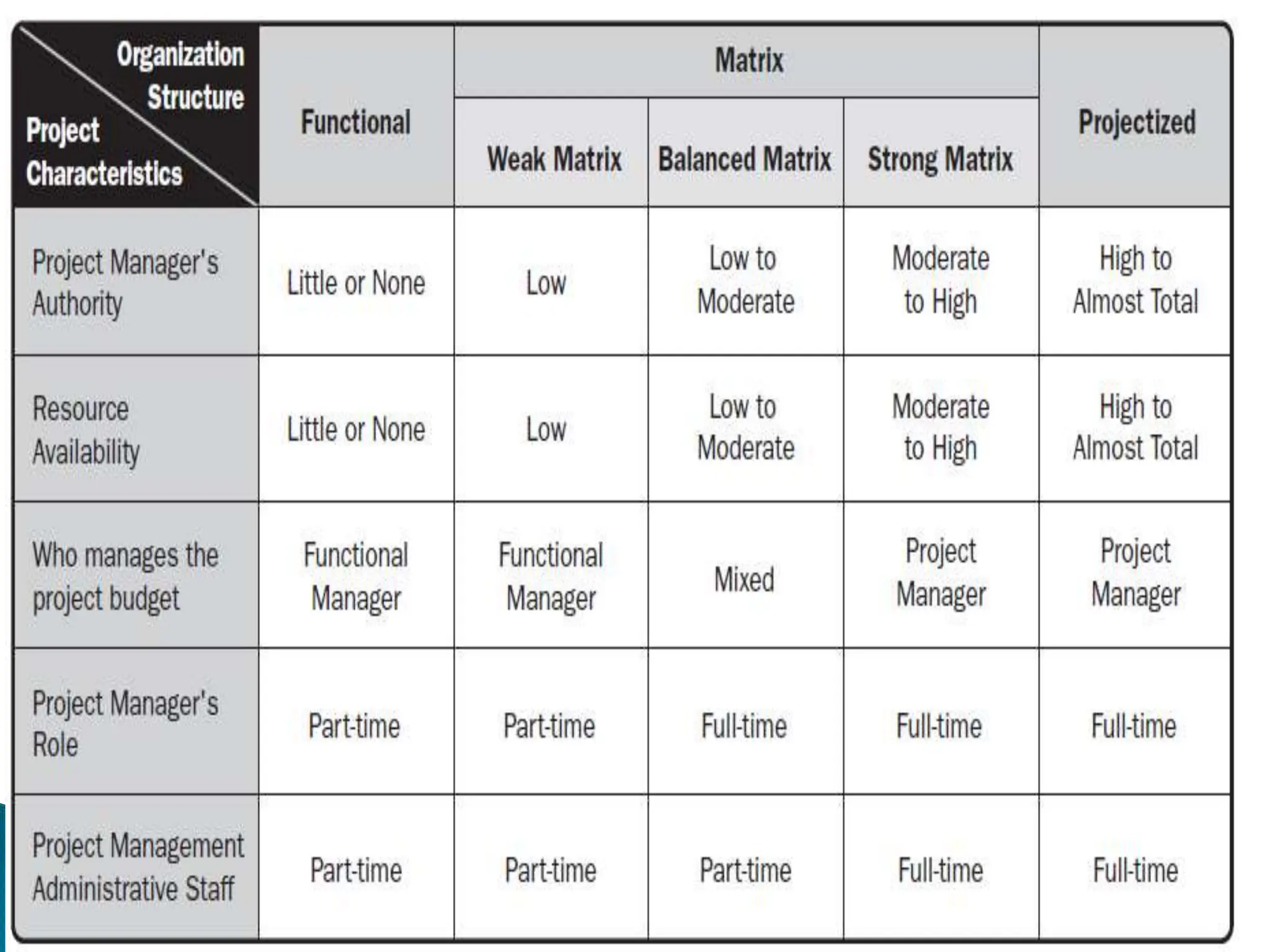
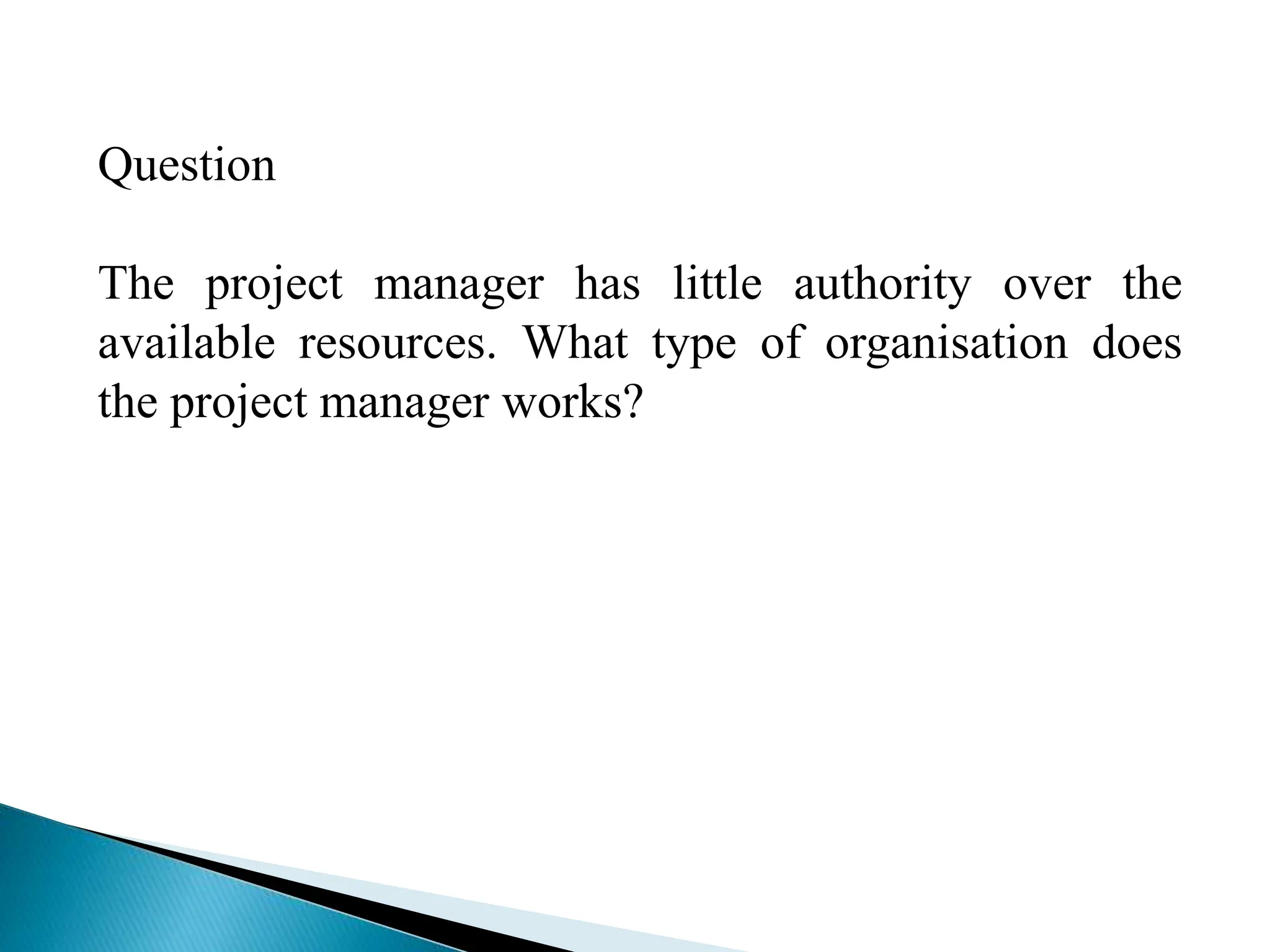
Influence of Organizational Structures on Projects
This interaction determines project characteristics such
as:
• Project manager’s level of authority,
• Resource availability and management,
• Entity controlling the project budget,
• Project manager’s role, and
• Project team composition
Question
The project manager has little authority over the
available resources. What type of organisation does
the project manager works?
STAKEHOLDERS
A stakeholder is an individual, group, or organisation
who may affect, be affected by, or perceived itself to be
affected by a decision, activity or outcome of a project.
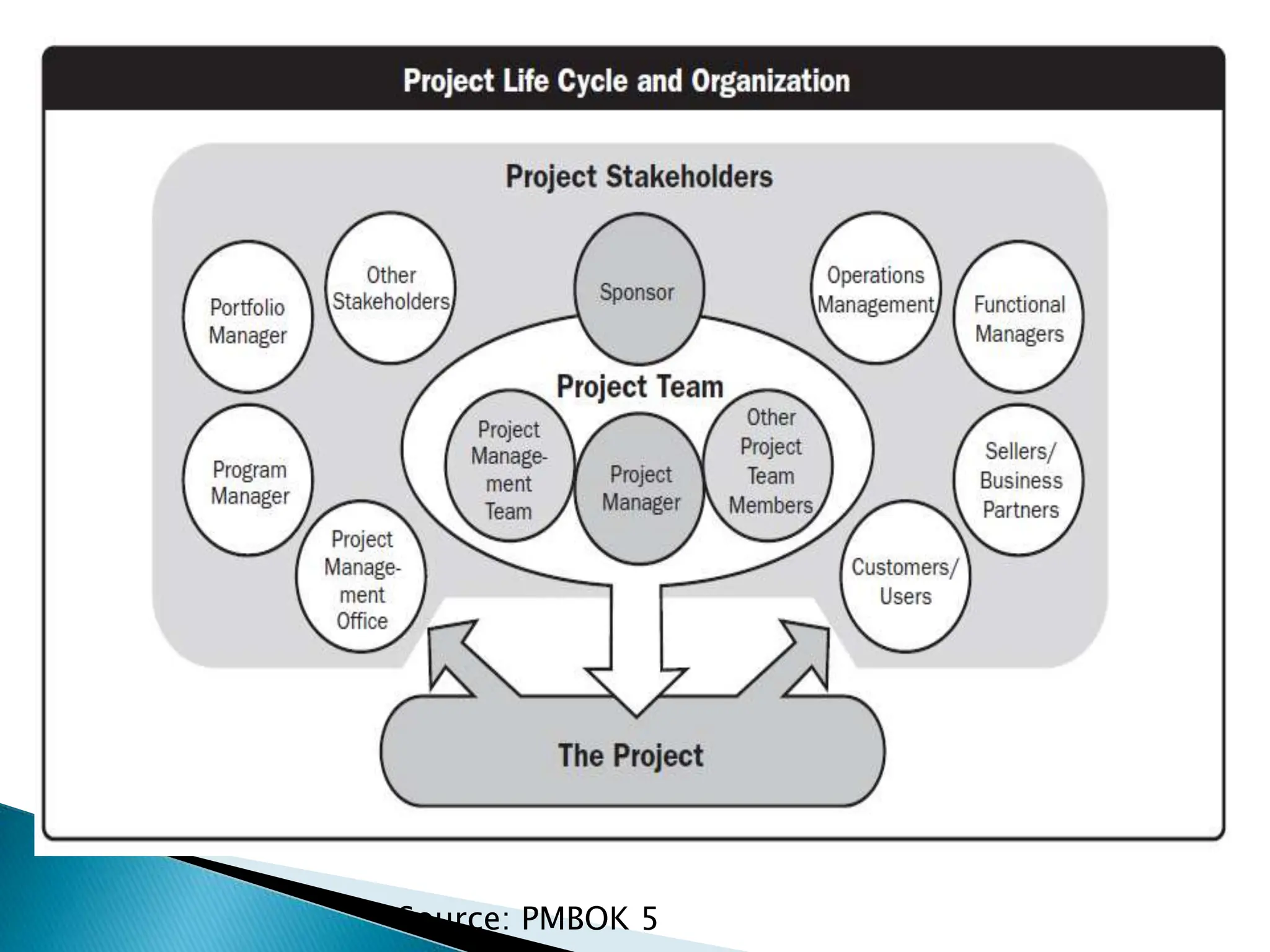
Project Stakeholders
Stakeholders include all members of the project team as
well as all interested entities that are internal or external
to the organization
Stakeholders may be actively involved in the project or
have interests that may positively or negatively be
affected by the performance or completion of the
project.
The project manager should manage the influences of
these various stakeholders in relation to the project
requirements to ensure a successful outcome.
Source: PMBOK 5
SPECIAL GROUP OF STAKEHOLDERS
PROJECT BOARD: is a small group of people whose
main responsibility is to make the really big project
decision.
o Technical and Business Advisor-
Are the people to provide technical and business
perspective advice to the project sponsor.
The sponsor may not understand the full technical or
business process implication of certain decisions that
need to be made through the project.
STAKEHOLDERS
Customers and users. Customers are the persons or
organizations who will approve and manage the
project’s product, service, or result. Users are the
persons or organizations who will use the project’s
product, service, or result.
Sellers. Sellers, also called vendors, suppliers, or
contractors, are external companies that enter into a
contractual agreement to provide components or
services necessary for the project.
Business partners. Business partners are external
organizations that have a special relationship with the
enterprise.
Business partners provide specialized expertise or fill a
specified role such as installation, customization,
training, or support.
Organizational groups. Organizational groups are
internal stakeholders who are affected by the activities
of the project team.
Functional managers. Functional managers are key
individuals who play a management role within an
administrative or functional area of the business, such as
human resources, finance, accounting, or
procurement.
Other stakeholders. Additional stakeholders, such as
procurement entities, financial institutions, government
regulators, subject matter experts. etc
PROJECT TEAM
The project team includes the project manager and the
group of individuals who act together in performing the
work of the project to achieve its objectives.
The project team includes the project manager, project
management staff, and other team members who carry
out the work but who are not necessarily involved with
management of the project.
Composition of Project Teams
• Dedicated. In a dedicated team, all or a majority of the
project team members are assigned to work full-time on the
project. The project team may be colocated or virtual and
usually reports directly to the project manager
• Part-Time. Some projects are established as temporary
additional work, with the project manager and team
members working on the project while remaining in their
existing organizations and continuing to carry out their
normal functions
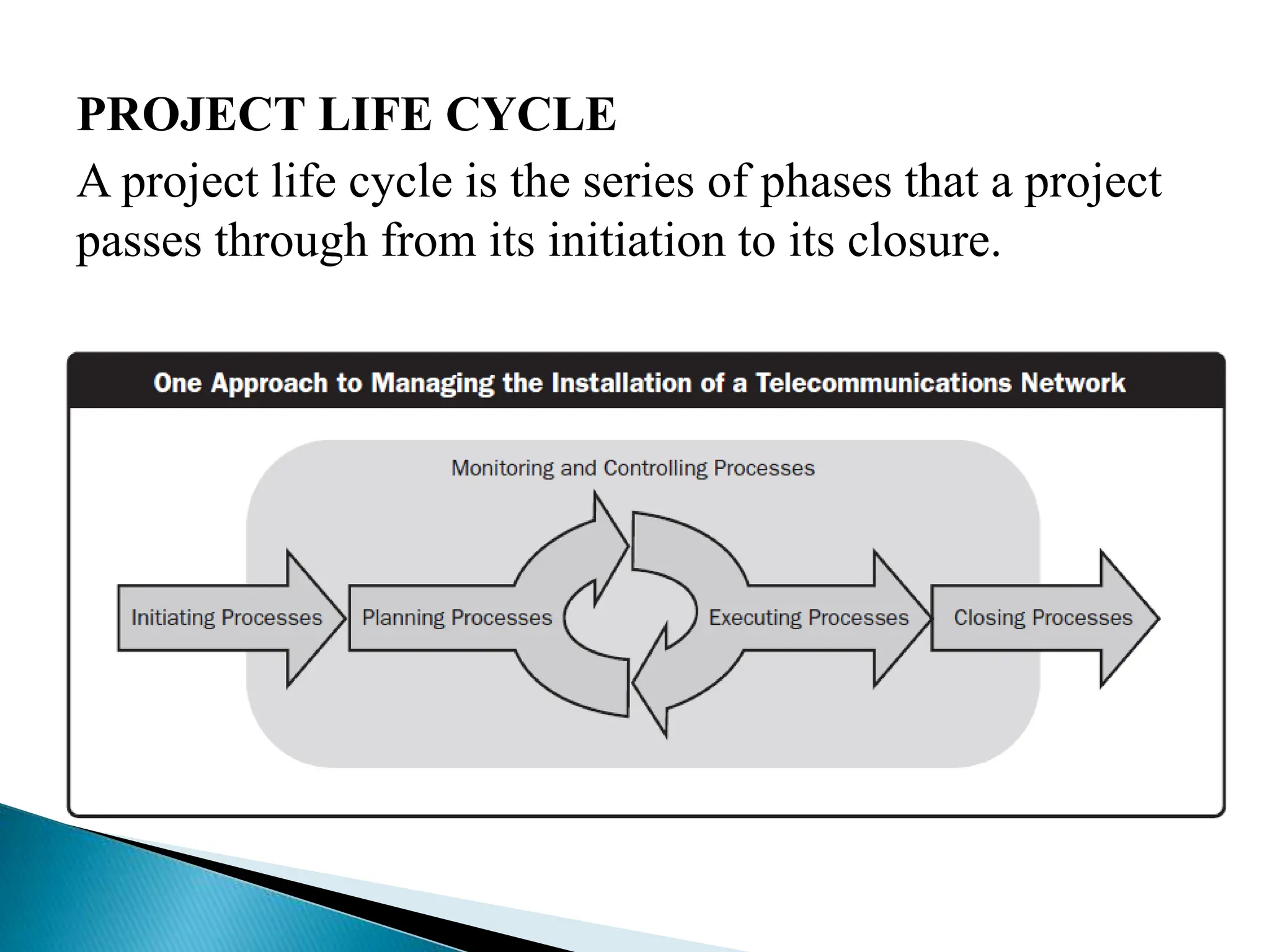
PROJECT LIFE CYCLE
A project life cycle is the series of phases that a project
passes through from its initiation to its closure.
Project Phases
A project may be divided into any number of phases.
A project phase is a collection of logically related
project activities that culminates in the completion of
one or more deliverables.
Eg.
Doing Feasibility studies and Project Initiation
Document- Deliverable (Phase1)
Designing the Database & Designing GUI -
Deliverable(Phase 2)
 Phase-to-Phase Relationships
 Predictive ,
 Adaptive,
 Iterative and Incremental Life Cycles
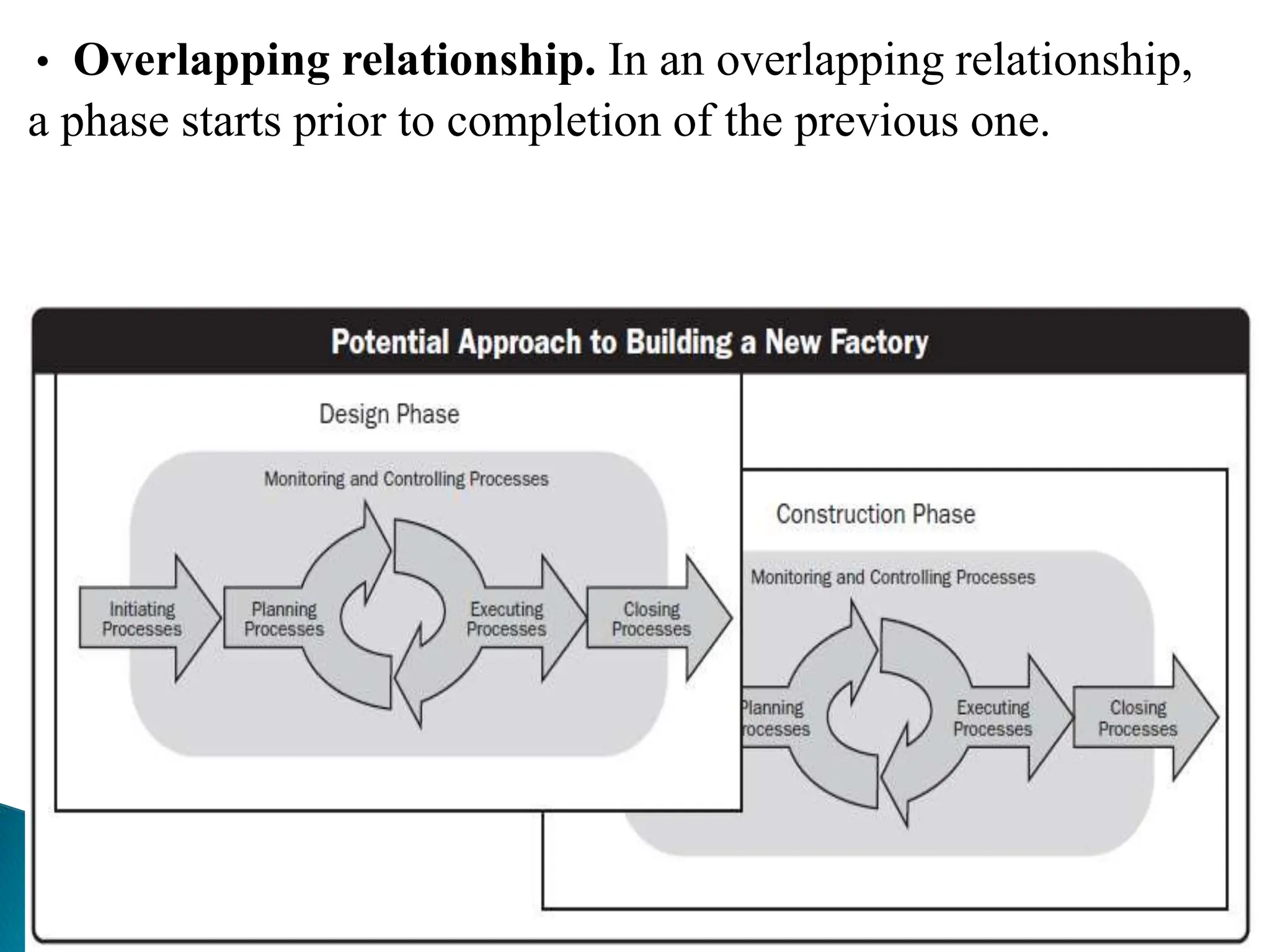
Phase-to-Phase Relationships
• Sequential relationship. In a sequential
relationship, a phase starts only when the previous
phase is complete.
• Overlapping relationship. In an overlapping
relationship, a phase starts prior to completion of the
previous one
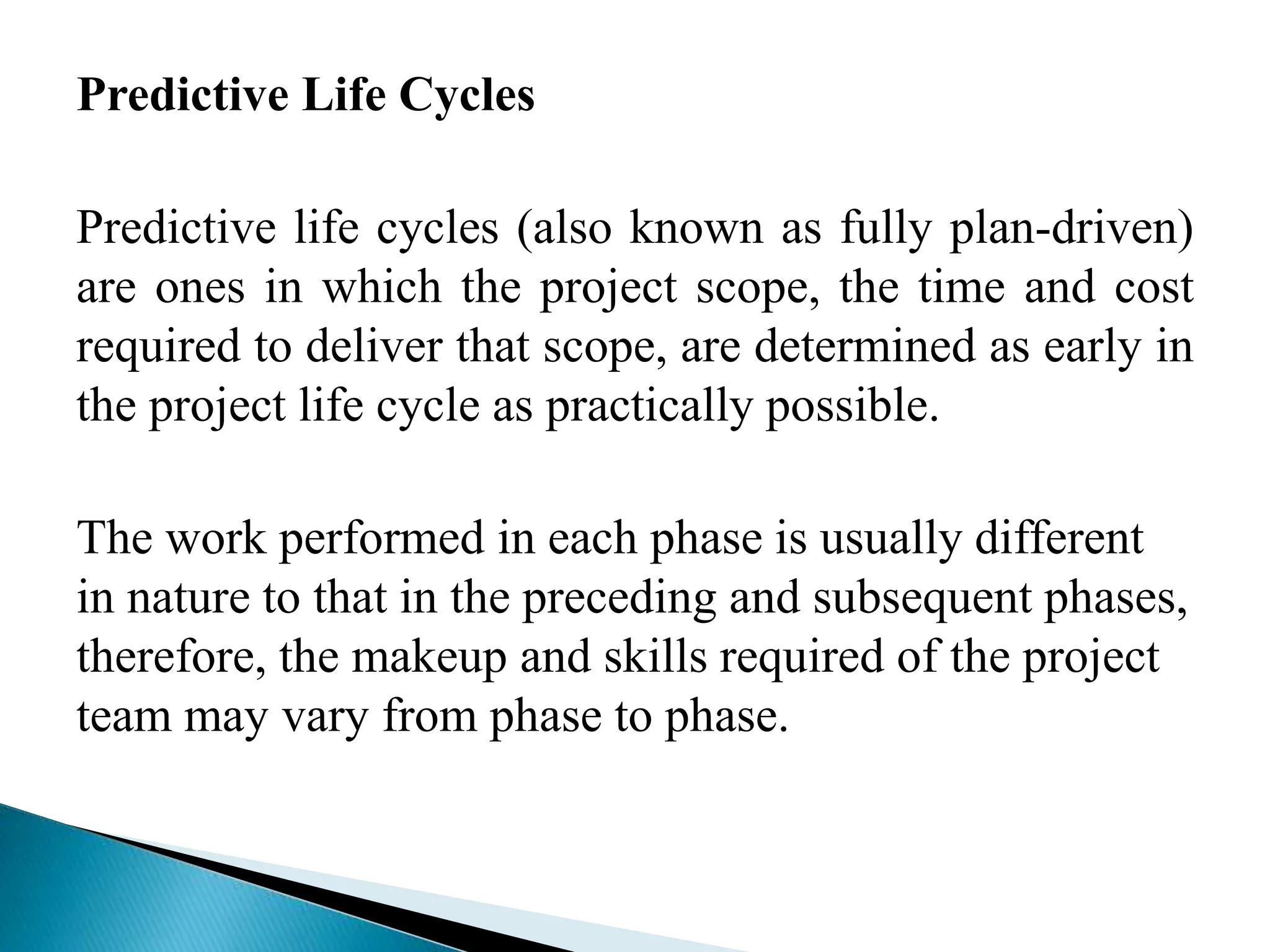
• Overlapping relationship. In an overlapping relationship,
a phase starts prior to completion of the previous one.
Predictive Life Cycles
Predictive life cycles (also known as fully plan-driven)
are ones in which the project scope, the time and cost
required to deliver that scope, are determined as early in
the project life cycle as practically possible.
The work performed in each phase is usually different
in nature to that in the preceding and subsequent phases,
therefore, the makeup and skills required of the project
team may vary from phase to phase.
Iterative and Incremental Life Cycles
Iterative and incremental life cycles are ones in which
project phases (also called iterations) intentionally
repeat one or more project activities as the project
team’s understanding of the product increases.
Eg. Coding in the software project
Adaptive Life Cycles
Adaptive life cycles (also known as change-driven or
agile methods) are intended to respond to high levels
of change and on-going stakeholder involvement.
Adaptive methods are also iterative and incremental,
but differ in that iterations are very rapid (usually with a
duration of 2 to 4 weeks) and are fixed in time and cost.
 Iterations develop the product through a series of
repeated cycles, while increments successively add to
the functionality of the product.
 These life cycles develop the product both iteratively
and incrementally
UNIT THREE
L E A R N I N G O B J E C T I V E S
After reading this chapter, you will be able to:
• Describe the five project management process groups,
the typical level of activity for each, and the interactions
among them.
• Understand how the project management process
groups relate to the project management knowledge
areas
What is project management?
 Project management is the application of knowledge,
skills, tools, and techniques to project activities to
meet the project requirements.
 This application of knowledge requires the effective
management of the project management processes.
What is a process?
A process is a set of interrelated actions and activities
performed to create a pre-specified product, service, or
result.
Each process is characterized by its inputs, the tools and
techniques that can be applied, and the resulting outputs.
In order for a project to be successful, the
project team should:
 Select appropriate processes required to
meet the project objectives;
 Use a defined approach that can be
adapted to meet requirements;
 Establish and maintain appropriate
communication and engagement with
stakeholders;
 Comply with requirements to meet stakeholder needs
and expectations; and
 Balance the competing constraints of scope,
schedule, budget, quality, resources, and risk to
produce the specified product, service, or result.
PROJECT PROCESS
The project processes are performed by the project team
with stakeholder interaction and generally fall into one
of two major categories:
• Project management processes. These processes
ensure the effective flow of the project throughout its
life cycle.
These processes encompass the tools and techniques
involved in applying the skills and capabilities
described in the Knowledge Areas.
Product-oriented processes. These processes specify
and create the project’s product.
Product oriented processes are typically defined by the
project life cycle and vary by application area as well as
the phase of the product life cycle.
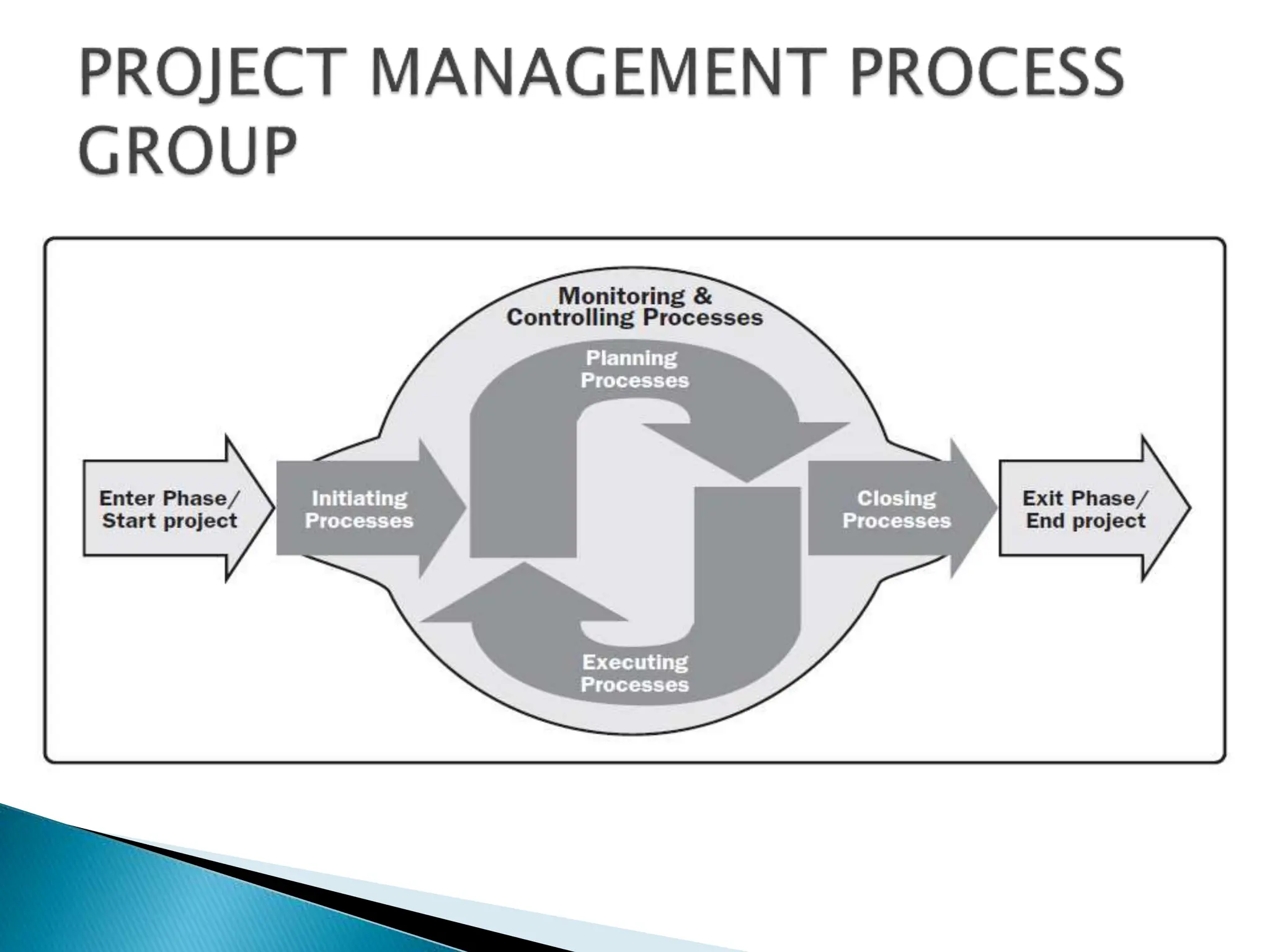
THE FIVE PROJECT MANAGEMENT
PROCESSES
Project management processes are grouped into five
categories known as Project Management Process
Groups (or Process Groups):
• Initiating Process Group. Those processes performed
to define a new project or a new phase of an existing
project by obtaining authorization to start the project or
phase.
• Planning Process Group. Those processes required to
establish the scope of the project, refine the objectives,
and define the course of action required to attain the
objectives that the project was undertaken to achieve.
• Executing Process Group. Those processes
performed to complete the work defined in the project
management plan to satisfy the project specifications.
• Monitoring and Controlling Process Group. Those
processes required to track, review, and regulate the
progress and performance of the project; identify any
areas in which changes to the plan are required; and
initiate the corresponding changes.
• Closing Process Group.
Those processes performed to finalize all activities
across all Process Groups to formally close the project
or phase.
ACTIVITIES DONE AT EACH OF THE
MANAGEMENT PROCESS
INITIATION PROCESS
Develop Project Charter—
The process of developing a document that formally
authorizes the existence of a project and provides the
project manager with the authority to apply
organizational resources to project activities.
HOW TO DEVELOPA PROJECT CHARTER
 Project Statement of Work
The project statement of work (SOW) is a narrative
description of products, services, or results to be
delivered by a project.
For internal projects, the project initiator or sponsor
provides the statement of work based on business
needs, product, or service requirements.
• Business need. An organization’s business need may
be based on a market demand, technological advance,
legal requirement, government regulation, or
environmental consideration.
• Product scope description. The product scope
description documents the characteristics of the product,
service, or results that the project will be undertaken to
create.
• Strategic plan.
The strategic plan documents the organization’s
strategic vision, goals, and objectives and may contain a
high-level mission statement.
All projects should be aligned with their organization’s
strategic plan.
PLANNING PROCESS GROUP
Develop Project Management Plan—
The process of defining, preparing, and coordinating
all subsidiary plans and integrating them into a
comprehensive project Management plan.
The project’s integrated baselines and subsidiary
plans may be included within the project
management plan.
.
 Project Management Plan
The project management plan contains subsidiary
plans concerning all aspects of the project.
Those subsidiary plans related to project work
include, but are not limited to:
• Scope management plan
• Requirements management plan
• Schedule management plan
• Cost management plan
• Stakeholder management plan
Direct and Manage Project Work—The process of
leading and performing the work defined in the project
management plan and implementing approved changes
to achieve the project’s objectives.
 Project Management Plan
 Approved changes
Monitor and Control Project Work—The process of
tracking, reviewing, and reporting project progress against
the performance objectives defined in the project
management plan.
Perform Integrated Change Control—The process of
reviewing all change requests; approving
changes and managing changes to deliverables,
organizational process assets, project documents,
and the project management plan; and communicating
their disposition.
Close Project or Phase—The process of finalizing all
activities across all of the Project Management Process
Groups to formally complete the phase or project.
Strategic plan. The strategic plan documents the
organization’s strategic vision, goals, and objectives and
may contain a high-level mission statement.
All projects should be aligned with their organization’s
strategic plan.
• Other units within the organization,
• Consultants,
• Stakeholders, including customers or
sponsors,
• Professional and technical associations,
• Industry groups,
• Subject matter experts (SME), and
• Project management office (PMO).
 Look for a sample Project Charter online. ….
UNIT FOUR
“If you fail to plan, you
plan to fail”
 Is everything about a project-work content as
well as expected outcomes.
 It consist of naming all activities to be
performed, the resources, consumed and the
end product that results including standards
Definition
Project scope management includes the processes
required to ensure that the project includes all the work
required, and only the work required to complete the
project. (PMBOK 5)
It ensures that the project team and stakeholders have
the same understanding of what products the project
will produce and what processes the project team will
use to produce them.
There are six main process to help in determining the
scope of a project.
 Planning scope management
 Collecting requirements
 Defining scope
 Creating the WBS
 Validating scope
 Controlling the scope
 The six main process are:
1. Planning scope management- involves determining
how the project’s scope and requirements will be
managed.
The project team works with appropriate stakeholders to
create a scope management plan and requirements
management plan.
2. Collecting requirements -involves defining and documenting
the features and functions of the products for the project as well
as the processes used for creating them
3. Defining scope - involves reviewing the scope
management plan, project charter, requirements
documents, and organizational process assets to create a
scope statement, adding more information as
requirements are developed and change requests are
approved.
4. Creating the WBS- involves subdividing the major
project deliverables into smaller, more manageable
components.
5. Validating scope- involves formalizing acceptance of
the project deliverables.
Key project stakeholders, such as the customer and
sponsor for the project, inspect and then formally accept
the deliverables during this process.
If the deliverables are not acceptable, the customer or
sponsor usually requests changes.
6. Controlling scope- involves controlling changes to
project scope throughout the life of the project—a
challenge on many IT projects.
 Interviewing
 Focus groups and facilitated workshops
 Using group creativity and decision-making
techniques
 Questionnaires and surveys
 Observation
 Prototyping
 Software tools
THE NATURE OF INFORMATION TO BE
COLLECTED
The project’s size, complexity, importance, and other
factors affect how much effort is spent on collecting
requirements.
DOCUMENTING REQUIREMENTS
A requirements management plan describes how
project requirements will be analysed, documented, and
managed
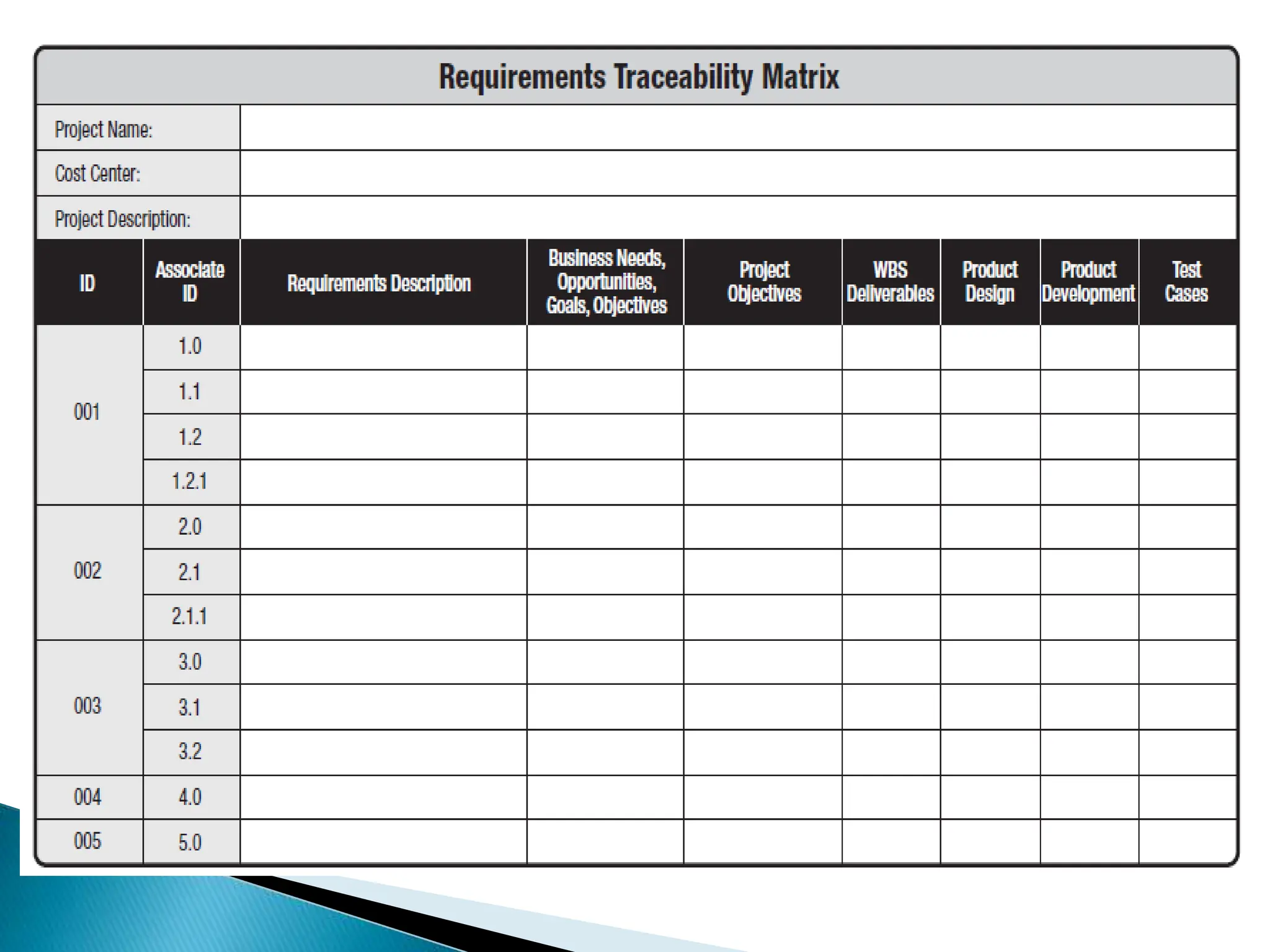
A requirements traceability matrix (RTM) is a table
that lists requirements, various attributes of each
requirement, and the status of the requirements to
ensure that all requirements are addressed
3. DEFINING SCOPE
The next step in project scope management is to provide
a detailed definition of the work required for the project.
Good scope definition is very important to project
success because it helps improve the accuracy of time,
cost, and resource estimates, it defines a baseline for
performance measurement and project control, and it
aids in communicating clear work responsibilities
TOOLS AND TECHNIQUES IN DEFINING SCOPE
Expert judgment,
Product analysis,
Alternatives generation,
and facilitated workshops.
4- CREATING THE WORK BREAKDOWN
STRUCTURE(WBS)
After collecting requirements and defining scope, the next
step in project scope management is to create a work
breakdown structure.
A work breakdown structure (WBS) is a deliverable
oriented grouping of the work involved in a project that
defines its total scope.
Decomposition- is subdividing project deliverables into
smaller pieces
Work package- is a task at the lowest level of the WBS
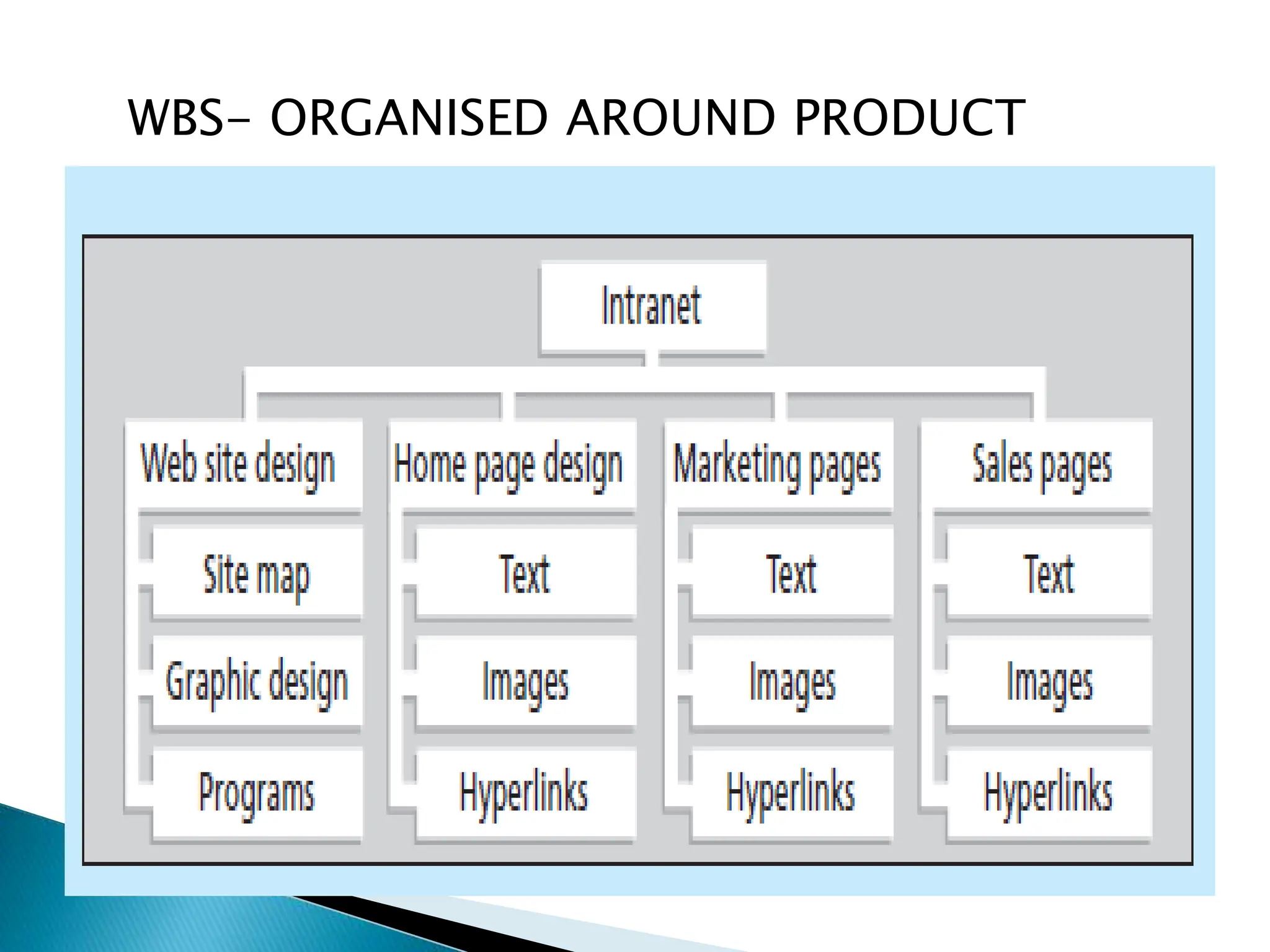
DIFFERENT WAYS OR FORMS OF
ORGANISING/REPRESENTING WBS
A project team often organizes the WBS around
 project products,
 project phases,
 the project management process groups.
WBS- ORGANISED AROUND PRODUCT
 APPROACHES TO DEVELOPING THE WBS
 Analogy approach- reviews WBS of similar projects
and tailor to your project.
 Top-down approach- start with largest items of the
project and break them down
 Bottom-up approach- start with the specific tasks and
roll them up
WBS DICTIONARY AND SCOPE BASELINE
Many WBS tasks are vague and must be explained
more so people know what to do and can estimate how
long it will take and what it will cost to do the work
A WBS dictionary is a document that describes
detailed information about each WBS item.
The approved project scope statement and its WBS
and WBS dictionary form the scope baseline , which is
used to measure performance in meeting project scope
goals
VERIFYING/VALIDATING SCOPE
Scope verification involves formal acceptance of the
completed project scope by the stakeholders.
Acceptance is often achieved by a customer inspection
and then sign-off on key deliverables.
CONTROLLING THE SCOPE
Scope control involves controlling changes to the
project scope.
Goals of scope control are to:
 Influence the factors that cause scope changes
 Assure changes are processed according to
procedures developed as part of integrated change
control
 Manage changes when they occur
SUMMARY
Project scope management includes the processes required
to ensure that the project addresses all the work required,
and only the work required, to complete the project
successfully
Main processes include:
Planning
Collect requirements
Define scope
Create WBS
Verify scope
Control scope
Question:
Vodacom has secured a contract from Ghana
Gov’t to provide I.T solutions to Ghanaian
students to study at home. The project is titled
‘stay at home, study at home’
As the project manager of ‘stay at home, study
at home’ write a one page essay on how to
manage the scope of this project.

IT PROJECT MANAGEMENT COURSE for Tertiary.pptx

  • 1.
  • 2.
    A Guide tothe Project Management Body of Knowledge (PMBOK® Guide) – Fifth Edition By- Project Management Institute The Principles of Project Management By MERI WILLIAMS Publishers: Sitepoint.com
  • 3.
    What is aproject? A project is any temporary endeavour undertaken to create a unique product, service or result. (P.M.B.O.K 5).
  • 4.
     Examples ofprojects include, but are not limited to:  Developing an online Registration System for CAUC by the third year students;  Installing a cell site to strengthen the signal strength of mobile users at Kwadaso;  Developing or acquiring a new or modified information system (hardware or software);
  • 5.
     Temporary-nature ofprojects indicates that a project has a definite beginning and end. Eg 2years, 40 years  The end is reached when the project’s objectives have been: ◦ Achieved ◦ Terminated because its objectives will not or cannot be met. ◦ When the need for the project no longer exists.
  • 6.
    A project mayalso be terminated if the client (customer, sponsor, or champion) wishes to terminate the project. Temporary does not necessarily mean the duration of the project is short. It refers to the project’s engagement and its longevity.
  • 7.
    No of people: Aproject can involve:  Single individual  Multiple individuals,  Single organizational unit,  Multiple organizational units from multiple organizations.
  • 8.
    : A product thatcan be either a component of:  Another item,  An enhancement of an item,  An end item in itself;
  • 9.
     EXAMPLES OFPROJECTS  Conducting a research effort for an organisation;  Constructing a building, industrial plant, or infrastructure; or  Implementing, improving, or enhancing existing business processes and procedures.
  • 10.
     IT projectsinvolve using hardware, software, and networks to create a product, service, or result:  A team of students creates a smartphone application and sells it online.  A company develops a driverless car.  A small software development team adds a new feature to an internal software
  • 11.
     OTHER FORMSOF PROJECTS (NON IT PROJECTS)  Building class rooms for students.  Collect health data for analysis by the Ministry of Health.  A college upgrades its technology infrastructure to provide wireless Internet access across the whole campus.  A company develops a new system to increase sales force productivity  Customer relationship management that will work on various laptops, smart phones, and tablets
  • 12.
     PROJECT ATTRIBUTES PURPOSE: A project has a unique purpose. Every project should have a well-defined objective.  TEMPORARY: A project is temporary. A project has a definite beginning and end.  RESOURCES: Resources include people, hardware, software, and other assets. Many projects cross departmental or other boundaries to achieve their unique purposes.  SPONSOR: The project sponsor usually provides the direction and funding for the project
  • 13.
    The Relationships AmongPortfolios, Programs, and Projects  PORTFOLIO-  portfolio refers to a collection of projects, programs, sub portfolios, and operations managed as a group to achieve strategic objectives.  PROGRAMS-  Programs are grouped within a portfolio and are comprised of subprograms, projects, or other work that are managed in a coordinated fashion in support of the portfolio.
  • 14.
    Program Management A programis defined as a group of related projects, subprograms, and program activities managed in a coordinated way to obtain benefits not available from managing them individually. Programs may include elements of related work outside the scope of the discrete projects in the program.
  • 15.
     Individual projectsthat are either within or outside of a program are still considered part of a portfolio.  Although the projects or programs within the portfolio may not necessarily be interdependent or directly related, they are linked to the organization’s strategic plan by means of the organization’s portfolio.
  • 16.
     TRIPPLE CONSTRAINT Scope:  What work will be done as part of the project?  What unique product, service, or result does the customer or sponsor expect from the project?  How will the scope be verified?
  • 17.
     Time:  Howlong should it take to complete the project?  What is the project’s schedule?  How will the team track actual schedule performance?  Who can approve changes to the schedule?
  • 18.
     Cost:  Whatshould it cost to complete the project?  What is the project’s budget?  How will costs be tracked?  Who can authorize changes to the budget?
  • 19.
  • 20.
    What is ProjectManagement?  Project management is the application of knowledge, skills, tools, and techniques to project activities to meet the project requirements.  Project management is accomplished through the appropriate application and integration of the 47 logically grouped project management processes, which are categorized into five Process Groups.
  • 21.
    THE FIVE PROCESSGROUPS • Initiating process groups, • Planning process groups, • Executing process groups, • Monitoring and Controlling process groups • Closing
  • 22.
    What is ProgramManagement?  Program management is the application of knowledge, skills, tools, and techniques to a program in order to meet the program requirements and to obtain benefits and control not available by managing projects individually.  Projects within a program are related through the common outcome or collective capability.
  • 23.
     CONCEPT OFPORTFOLIO/PROGRAM/PROJECT  For example, a new Bank that has the strategic objective of “maximizing the return on its investments” may put together a portfolio that includes a mix of projects- hardware and software.  From this mix, the Bank may choose to manage related projects as one program. All of the software projects may be grouped together as a software progam.  Similarly, all of the hardware projects may be grouped together as a hardware program.
  • 24.
     Thus, thehardware program and the software program become integral components of the enterprise portfolio of the infrastructure firm.
  • 26.
    PROJECT MANAGEMENT AREAS 1.Project scope management involves defining and managing all the work required to complete the project successfully. 2. Project time management includes estimating how long it will take to complete the work, developing an acceptable project schedule, and ensuring timely completion of the project.
  • 27.
    3. Project costmanagement consists of preparing and managing the budget for the project. 4. Project quality management ensures that the project will satisfy the stated or implied needs for which it was undertaken. 5. Project human resource management is concerned with making effective use of the people involved with the project.
  • 28.
    6. Project communicationsmanagement involves generating, collecting, disseminating, and storing project information. 7. Project risk management includes identifying, analyzing, and responding to risks related to the project
  • 29.
    8. Project procurementmanagement involves acquiring or procuring goods and services for a project from outside the performing organization. 9. Project stakeholder management includes identifying and analyzing stakeholder needs while managing and controlling their engagement throughout the life of the project 10. Project integration management is an overarching function that affects and is affected by all of the other knowledge areas.  
  • 30.
     Business Value Delivering value is the only reason to undertake a project.  Business value is a concept that is unique to each organization.  Business value is defined as the entire value of the business; the total sum of all tangible and intangible elements.
  • 31.
     Project Manager.Who is he/she?  The project manager is the person assigned by the performing organization to lead the team that is responsible for achieving the project objectives.  The role of a project manager is distinct from a functional manager or operations manager.  . 
  • 32.
     Typically thefunctional manager is focused on providing management oversight for a functional or a business unit, and operations managers are responsible for ensuring that business operations are efficient
  • 33.
     Depending onthe organizational structure, a project manager may report to a functional manager.  In other cases, a project manager may be one of several project managers who report to a program or portfolio manager who is ultimately responsible for enterprise-wide projects.
  • 34.
    In this typeof structure, the project manager works closely with the program or portfolio manager to achieve the project objectives and to ensure the project management plan aligns with the overarching program plan.
  • 35.
    Interpersonal Skills ofa Project Manager Project managers accomplish work through the project team and other stakeholders. Effective project managers require a balance of ethical, interpersonal, and conceptual skills that help them analyse situations and interact appropriately.
  • 36.
    • Leadership, • Teambuilding, • Motivation, • Communication, • Influencing, • Decision making, • Political and cultural awareness, .
  • 37.
    • Negotiation, • Trustbuilding, • Conflict management, and • Coaching
  • 38.
    ORGANISATIONAL INFLUENCE ANDPROJECT LIFE CYCLE
  • 39.
    INTRODUCTION Projects and projectmanagement take place in an environment that is broader than that of the project itself. Understanding this broader context helps ensure that work is carried out in alignment with the organization’s goals and managed in accordance with the organization’s established practices.
  • 40.
     An organization’sculture, style, and structure influence how its projects are performed.  The organization’s level of project management maturity and its project management systems can also influence the project.
  • 41.
    NOTE When a projectinvolves external entities such as those that are part of a joint venture or partnering agreement, the project will be influenced by more than one organization.
  • 42.
    What are Organizations? Theyare systematic arrangements of entities (persons and/or departments) that is aimed at accomplishing a purpose, which may involve undertaking projects. An organization’s culture and style affect how it conducts projects
  • 43.
    COMMON EXPERIENCES• • Sharedvisions, mission, values, beliefs, and expectations; • Regulations, policies, methods, and procedures; • Motivation and reward systems; • Risk tolerance; • View of leadership, hierarchy, and authority relationships; • Code of conduct, work ethic, and work hours; and • Operating environments.
  • 44.
    Influence of OrganizationalStructures on Projects This interaction determines project characteristics such as: • Project manager’s level of authority, • Resource availability and management, • Entity controlling the project budget, • Project manager’s role, and • Project team composition
  • 46.
    Question The project managerhas little authority over the available resources. What type of organisation does the project manager works?
  • 47.
    STAKEHOLDERS A stakeholder isan individual, group, or organisation who may affect, be affected by, or perceived itself to be affected by a decision, activity or outcome of a project. Project Stakeholders Stakeholders include all members of the project team as well as all interested entities that are internal or external to the organization
  • 48.
    Stakeholders may beactively involved in the project or have interests that may positively or negatively be affected by the performance or completion of the project. The project manager should manage the influences of these various stakeholders in relation to the project requirements to ensure a successful outcome.
  • 49.
  • 50.
    SPECIAL GROUP OFSTAKEHOLDERS PROJECT BOARD: is a small group of people whose main responsibility is to make the really big project decision.
  • 51.
    o Technical andBusiness Advisor- Are the people to provide technical and business perspective advice to the project sponsor. The sponsor may not understand the full technical or business process implication of certain decisions that need to be made through the project.
  • 52.
    STAKEHOLDERS Customers and users.Customers are the persons or organizations who will approve and manage the project’s product, service, or result. Users are the persons or organizations who will use the project’s product, service, or result. Sellers. Sellers, also called vendors, suppliers, or contractors, are external companies that enter into a contractual agreement to provide components or services necessary for the project.
  • 53.
    Business partners. Businesspartners are external organizations that have a special relationship with the enterprise. Business partners provide specialized expertise or fill a specified role such as installation, customization, training, or support. Organizational groups. Organizational groups are internal stakeholders who are affected by the activities of the project team.
  • 54.
    Functional managers. Functionalmanagers are key individuals who play a management role within an administrative or functional area of the business, such as human resources, finance, accounting, or procurement. Other stakeholders. Additional stakeholders, such as procurement entities, financial institutions, government regulators, subject matter experts. etc
  • 55.
    PROJECT TEAM The projectteam includes the project manager and the group of individuals who act together in performing the work of the project to achieve its objectives. The project team includes the project manager, project management staff, and other team members who carry out the work but who are not necessarily involved with management of the project.
  • 56.
    Composition of ProjectTeams • Dedicated. In a dedicated team, all or a majority of the project team members are assigned to work full-time on the project. The project team may be colocated or virtual and usually reports directly to the project manager • Part-Time. Some projects are established as temporary additional work, with the project manager and team members working on the project while remaining in their existing organizations and continuing to carry out their normal functions
  • 57.
    PROJECT LIFE CYCLE Aproject life cycle is the series of phases that a project passes through from its initiation to its closure.
  • 58.
    Project Phases A projectmay be divided into any number of phases. A project phase is a collection of logically related project activities that culminates in the completion of one or more deliverables. Eg. Doing Feasibility studies and Project Initiation Document- Deliverable (Phase1) Designing the Database & Designing GUI - Deliverable(Phase 2)
  • 59.
     Phase-to-Phase Relationships Predictive ,  Adaptive,  Iterative and Incremental Life Cycles
  • 60.
    Phase-to-Phase Relationships • Sequentialrelationship. In a sequential relationship, a phase starts only when the previous phase is complete. • Overlapping relationship. In an overlapping relationship, a phase starts prior to completion of the previous one
  • 61.
    • Overlapping relationship.In an overlapping relationship, a phase starts prior to completion of the previous one.
  • 62.
    Predictive Life Cycles Predictivelife cycles (also known as fully plan-driven) are ones in which the project scope, the time and cost required to deliver that scope, are determined as early in the project life cycle as practically possible. The work performed in each phase is usually different in nature to that in the preceding and subsequent phases, therefore, the makeup and skills required of the project team may vary from phase to phase.
  • 63.
    Iterative and IncrementalLife Cycles Iterative and incremental life cycles are ones in which project phases (also called iterations) intentionally repeat one or more project activities as the project team’s understanding of the product increases. Eg. Coding in the software project
  • 64.
    Adaptive Life Cycles Adaptivelife cycles (also known as change-driven or agile methods) are intended to respond to high levels of change and on-going stakeholder involvement. Adaptive methods are also iterative and incremental, but differ in that iterations are very rapid (usually with a duration of 2 to 4 weeks) and are fixed in time and cost.
  • 65.
     Iterations developthe product through a series of repeated cycles, while increments successively add to the functionality of the product.  These life cycles develop the product both iteratively and incrementally
  • 66.
  • 67.
    L E AR N I N G O B J E C T I V E S After reading this chapter, you will be able to: • Describe the five project management process groups, the typical level of activity for each, and the interactions among them. • Understand how the project management process groups relate to the project management knowledge areas
  • 68.
    What is projectmanagement?  Project management is the application of knowledge, skills, tools, and techniques to project activities to meet the project requirements.  This application of knowledge requires the effective management of the project management processes.
  • 69.
    What is aprocess? A process is a set of interrelated actions and activities performed to create a pre-specified product, service, or result. Each process is characterized by its inputs, the tools and techniques that can be applied, and the resulting outputs.
  • 70.
    In order fora project to be successful, the project team should:  Select appropriate processes required to meet the project objectives;  Use a defined approach that can be adapted to meet requirements;  Establish and maintain appropriate communication and engagement with stakeholders;
  • 71.
     Comply withrequirements to meet stakeholder needs and expectations; and  Balance the competing constraints of scope, schedule, budget, quality, resources, and risk to produce the specified product, service, or result.
  • 72.
    PROJECT PROCESS The projectprocesses are performed by the project team with stakeholder interaction and generally fall into one of two major categories: • Project management processes. These processes ensure the effective flow of the project throughout its life cycle. These processes encompass the tools and techniques involved in applying the skills and capabilities described in the Knowledge Areas.
  • 73.
    Product-oriented processes. Theseprocesses specify and create the project’s product. Product oriented processes are typically defined by the project life cycle and vary by application area as well as the phase of the product life cycle.
  • 74.
    THE FIVE PROJECTMANAGEMENT PROCESSES Project management processes are grouped into five categories known as Project Management Process Groups (or Process Groups):
  • 75.
    • Initiating ProcessGroup. Those processes performed to define a new project or a new phase of an existing project by obtaining authorization to start the project or phase. • Planning Process Group. Those processes required to establish the scope of the project, refine the objectives, and define the course of action required to attain the objectives that the project was undertaken to achieve.
  • 76.
    • Executing ProcessGroup. Those processes performed to complete the work defined in the project management plan to satisfy the project specifications. • Monitoring and Controlling Process Group. Those processes required to track, review, and regulate the progress and performance of the project; identify any areas in which changes to the plan are required; and initiate the corresponding changes.
  • 77.
    • Closing ProcessGroup. Those processes performed to finalize all activities across all Process Groups to formally close the project or phase.
  • 79.
    ACTIVITIES DONE ATEACH OF THE MANAGEMENT PROCESS INITIATION PROCESS Develop Project Charter— The process of developing a document that formally authorizes the existence of a project and provides the project manager with the authority to apply organizational resources to project activities.
  • 80.
    HOW TO DEVELOPAPROJECT CHARTER  Project Statement of Work The project statement of work (SOW) is a narrative description of products, services, or results to be delivered by a project. For internal projects, the project initiator or sponsor provides the statement of work based on business needs, product, or service requirements.
  • 81.
    • Business need.An organization’s business need may be based on a market demand, technological advance, legal requirement, government regulation, or environmental consideration. • Product scope description. The product scope description documents the characteristics of the product, service, or results that the project will be undertaken to create.
  • 82.
    • Strategic plan. Thestrategic plan documents the organization’s strategic vision, goals, and objectives and may contain a high-level mission statement. All projects should be aligned with their organization’s strategic plan.
  • 83.
    PLANNING PROCESS GROUP DevelopProject Management Plan— The process of defining, preparing, and coordinating all subsidiary plans and integrating them into a comprehensive project Management plan. The project’s integrated baselines and subsidiary plans may be included within the project management plan. .
  • 84.
     Project ManagementPlan The project management plan contains subsidiary plans concerning all aspects of the project. Those subsidiary plans related to project work include, but are not limited to: • Scope management plan • Requirements management plan • Schedule management plan • Cost management plan • Stakeholder management plan
  • 85.
    Direct and ManageProject Work—The process of leading and performing the work defined in the project management plan and implementing approved changes to achieve the project’s objectives.  Project Management Plan  Approved changes
  • 86.
    Monitor and ControlProject Work—The process of tracking, reviewing, and reporting project progress against the performance objectives defined in the project management plan. Perform Integrated Change Control—The process of reviewing all change requests; approving changes and managing changes to deliverables, organizational process assets, project documents, and the project management plan; and communicating their disposition.
  • 87.
    Close Project orPhase—The process of finalizing all activities across all of the Project Management Process Groups to formally complete the phase or project.
  • 88.
    Strategic plan. Thestrategic plan documents the organization’s strategic vision, goals, and objectives and may contain a high-level mission statement. All projects should be aligned with their organization’s strategic plan.
  • 89.
    • Other unitswithin the organization, • Consultants, • Stakeholders, including customers or sponsors, • Professional and technical associations, • Industry groups, • Subject matter experts (SME), and • Project management office (PMO).
  • 90.
     Look fora sample Project Charter online. ….
  • 91.
  • 92.
    “If you failto plan, you plan to fail”
  • 93.
     Is everythingabout a project-work content as well as expected outcomes.  It consist of naming all activities to be performed, the resources, consumed and the end product that results including standards
  • 94.
    Definition Project scope managementincludes the processes required to ensure that the project includes all the work required, and only the work required to complete the project. (PMBOK 5)
  • 95.
    It ensures thatthe project team and stakeholders have the same understanding of what products the project will produce and what processes the project team will use to produce them.
  • 96.
    There are sixmain process to help in determining the scope of a project.  Planning scope management  Collecting requirements  Defining scope  Creating the WBS  Validating scope  Controlling the scope
  • 97.
     The sixmain process are: 1. Planning scope management- involves determining how the project’s scope and requirements will be managed. The project team works with appropriate stakeholders to create a scope management plan and requirements management plan.
  • 98.
    2. Collecting requirements-involves defining and documenting the features and functions of the products for the project as well as the processes used for creating them
  • 99.
    3. Defining scope- involves reviewing the scope management plan, project charter, requirements documents, and organizational process assets to create a scope statement, adding more information as requirements are developed and change requests are approved. 4. Creating the WBS- involves subdividing the major project deliverables into smaller, more manageable components.
  • 100.
    5. Validating scope-involves formalizing acceptance of the project deliverables. Key project stakeholders, such as the customer and sponsor for the project, inspect and then formally accept the deliverables during this process. If the deliverables are not acceptable, the customer or sponsor usually requests changes. 6. Controlling scope- involves controlling changes to project scope throughout the life of the project—a challenge on many IT projects.
  • 101.
     Interviewing  Focusgroups and facilitated workshops  Using group creativity and decision-making techniques  Questionnaires and surveys  Observation  Prototyping  Software tools
  • 102.
    THE NATURE OFINFORMATION TO BE COLLECTED The project’s size, complexity, importance, and other factors affect how much effort is spent on collecting requirements.
  • 103.
    DOCUMENTING REQUIREMENTS A requirementsmanagement plan describes how project requirements will be analysed, documented, and managed A requirements traceability matrix (RTM) is a table that lists requirements, various attributes of each requirement, and the status of the requirements to ensure that all requirements are addressed
  • 105.
    3. DEFINING SCOPE Thenext step in project scope management is to provide a detailed definition of the work required for the project. Good scope definition is very important to project success because it helps improve the accuracy of time, cost, and resource estimates, it defines a baseline for performance measurement and project control, and it aids in communicating clear work responsibilities
  • 106.
    TOOLS AND TECHNIQUESIN DEFINING SCOPE Expert judgment, Product analysis, Alternatives generation, and facilitated workshops.
  • 107.
    4- CREATING THEWORK BREAKDOWN STRUCTURE(WBS) After collecting requirements and defining scope, the next step in project scope management is to create a work breakdown structure. A work breakdown structure (WBS) is a deliverable oriented grouping of the work involved in a project that defines its total scope. Decomposition- is subdividing project deliverables into smaller pieces Work package- is a task at the lowest level of the WBS
  • 108.
    DIFFERENT WAYS ORFORMS OF ORGANISING/REPRESENTING WBS A project team often organizes the WBS around  project products,  project phases,  the project management process groups.
  • 109.
  • 114.
     APPROACHES TODEVELOPING THE WBS  Analogy approach- reviews WBS of similar projects and tailor to your project.  Top-down approach- start with largest items of the project and break them down  Bottom-up approach- start with the specific tasks and roll them up
  • 115.
    WBS DICTIONARY ANDSCOPE BASELINE Many WBS tasks are vague and must be explained more so people know what to do and can estimate how long it will take and what it will cost to do the work A WBS dictionary is a document that describes detailed information about each WBS item. The approved project scope statement and its WBS and WBS dictionary form the scope baseline , which is used to measure performance in meeting project scope goals
  • 116.
    VERIFYING/VALIDATING SCOPE Scope verificationinvolves formal acceptance of the completed project scope by the stakeholders. Acceptance is often achieved by a customer inspection and then sign-off on key deliverables.
  • 117.
    CONTROLLING THE SCOPE Scopecontrol involves controlling changes to the project scope. Goals of scope control are to:  Influence the factors that cause scope changes  Assure changes are processed according to procedures developed as part of integrated change control  Manage changes when they occur
  • 118.
    SUMMARY Project scope managementincludes the processes required to ensure that the project addresses all the work required, and only the work required, to complete the project successfully Main processes include: Planning Collect requirements Define scope Create WBS Verify scope Control scope
  • 119.
    Question: Vodacom has secureda contract from Ghana Gov’t to provide I.T solutions to Ghanaian students to study at home. The project is titled ‘stay at home, study at home’ As the project manager of ‘stay at home, study at home’ write a one page essay on how to manage the scope of this project.