Thermal Energy Conversion Control Lab. Chonbuk Nat’I Univ.
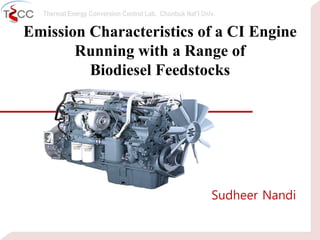
Emission Characteristics of a CI Engine
Running with a Range of
Biodiesel Feedstocks
Sudheer Nandi
Thermal Energy Conversion Control Lab. Chonbuk Nat’I Univ.
• The objective of this study is to investigate the effects of biodiesel types and biodiesel fraction on the
emission characteristics of a CI engine.
• The experimental work was carried out on a four-cylinder, four-stroke, direct injection (DI) and
turbocharged diesel engine by using biodiesel made from waste oil, rapeseed oil, corn oil and comparing th
em to normal diesel.
• The fuels used in the analyses are B10, B20, B50, B100 and neat diesel. Based on the measured parameters,
detailed analyses were carried out on major regulated emissions such as NOx, CO, CO2, and THC.
• The results also clearly indicate that the engine running with biodiesel and blends have higher NOx emissio
n by up to 20%. However, the emissions of the CI engine running on neat biodiesel (B100) were reduced by
up to 15%, 40% and 30% for CO, CO2 and THC emissions respectively, as compared to diesel fuel at
various operating conditions.
Keywords: compression engine; biodiesel blend; nitrogen oxides; carbon dioxide;
carbon monoxide; total hydrocarbon.
A b s t r a c t
Thermal Energy Conversion Control Lab. Chonbuk Nat’I Univ.
Why biodiesel …! Facing problem
3
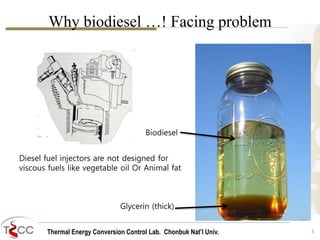
Biodiesel
Glycerin (thick)
Diesel fuel injectors are not designed for
viscous fuels like vegetable oil Or Animal fat
Thermal Energy Conversion Control Lab. Chonbuk Nat’I Univ.
WHAT MAKE BIODIESEL TO USE..!
• Current and future emission regulations are, and will become, more
stringent and as a consequence.
• The major alternative fuels being used in automotive transport are et
hanol, hydrogen and biodiesel. Ethanol technology is successfully
established and commercialized in both developing and developed c
ountries.
• diesel engines are expected to remain in use for high-power
applications, such as rail road locomotives, ships and over land trans
port trucks .
4
Thermal Energy Conversion Control Lab. Chonbuk Nat’I Univ. 5
History of Vegetable Oil Based Fuels
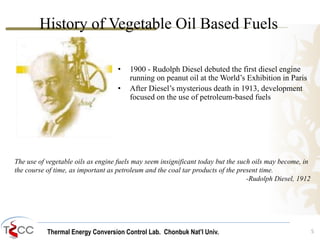
The use of vegetable oils as engine fuels may seem insignificant today but the such oils may become, in
the course of time, as important as petroleum and the coal tar products of the present time.
-Rudolph Diesel, 1912
• 1900 - Rudolph Diesel debuted the first diesel engine
running on peanut oil at the World’s Exhibition in Paris
• After Diesel’s mysterious death in 1913, development
focused on the use of petroleum-based fuels
Thermal Energy Conversion Control Lab. Chonbuk Nat’I Univ.
What is Biodiesel?
• Biodiesel is a petroleum diesel replacement fuel used in
CI engines.
• It can be produced from any plant or animal based lipids.
– Plant Based Oils:
• Soybean oil; cotton seeds oil; sunflower oil.
– Animal Fats:
• Beef tallow; pork lard; poultry fat.
– Recycled Cooking Grease:
• Yellow grease.
Thermal Energy Conversion Control Lab. Chonbuk Nat’I Univ.
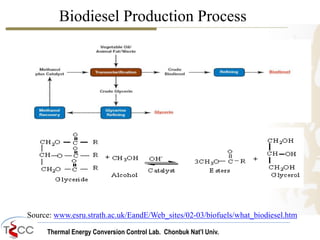
Biodiesel Production Process
Source: www.esru.strath.ac.uk/EandE/Web_sites/02-03/biofuels/what_biodiesel.htm
Thermal Energy Conversion Control Lab. Chonbuk Nat’I Univ.
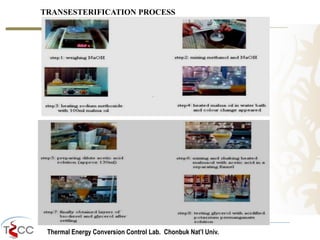
TRANSESTERIFICATION PROCESS
Thermal Energy Conversion Control Lab. Chonbuk Nat’I Univ.
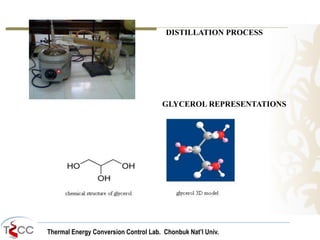
DISTILLATION PROCESS
GLYCEROL REPRESENTATIONS
Thermal Energy Conversion Control Lab. Chonbuk Nat’I Univ.
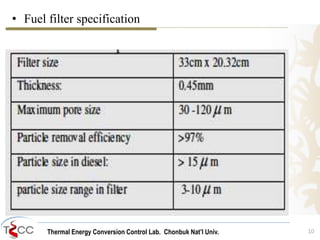
• Fuel filter specification
10
Thermal Energy Conversion Control Lab. Chonbuk Nat’I Univ.
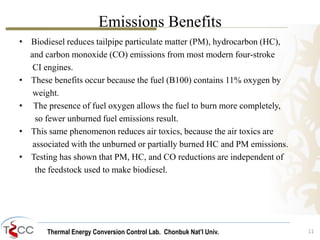
• Biodiesel reduces tailpipe particulate matter (PM), hydrocarbon (HC),
and carbon monoxide (CO) emissions from most modern four-stroke
CI engines.
• These benefits occur because the fuel (B100) contains 11% oxygen by
weight.
• The presence of fuel oxygen allows the fuel to burn more completely,
so fewer unburned fuel emissions result.
• This same phenomenon reduces air toxics, because the air toxics are
associated with the unburned or partially burned HC and PM emissions.
• Testing has shown that PM, HC, and CO reductions are independent of
the feedstock used to make biodiesel.
11
Emissions Benefits
Thermal Energy Conversion Control Lab. Chonbuk Nat’I Univ.
Table 1. Estimated share of literature (in % number of publications)on effect
of pure biodiesel on engine performance and emission in comparison with
diesel [12,13].
Thermal Energy Conversion Control Lab. Chonbuk Nat’I Univ. 13
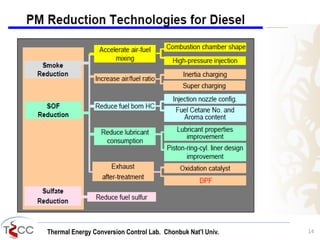
Thermal Energy Conversion Control Lab. Chonbuk Nat’I Univ. 14
Thermal Energy Conversion Control Lab. Chonbuk Nat’I Univ.
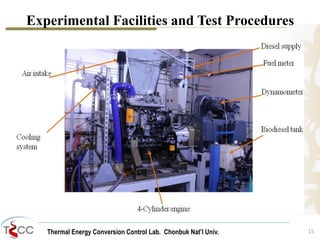
Experimental Facilities and Test Procedures
15
Thermal Energy Conversion Control Lab. Chonbuk Nat’I Univ. 16
Figure 2. Engine test facilities layout [37].
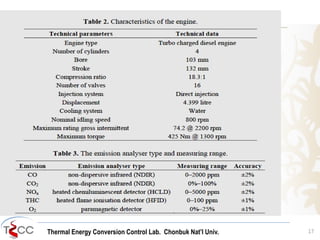
Thermal Energy Conversion Control Lab. Chonbuk Nat’I Univ. 17
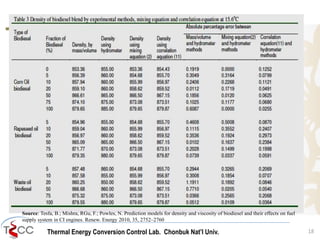
Thermal Energy Conversion Control Lab. Chonbuk Nat’I Univ. 18
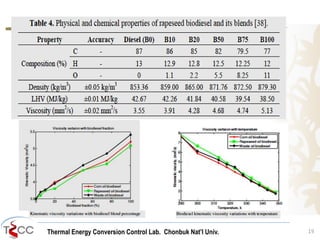
Source: Tesfa, B.; Mishra, RGu, F.; Powles, N. Prediction models for density and viscosity of biodiesel and their effects on fuel
supply system in CI engines. Renew. Energy 2010, 35, 2752–2760
Thermal Energy Conversion Control Lab. Chonbuk Nat’I Univ. 19
Thermal Energy Conversion Control Lab. Chonbuk Nat’I Univ. 20
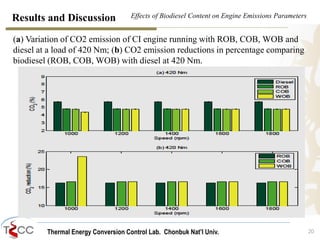
Results and Discussion
(a) Variation of CO2 emission of CI engine running with ROB, COB, WOB and
diesel at a load of 420 Nm; (b) CO2 emission reductions in percentage comparing
biodiesel (ROB, COB, WOB) with diesel at 420 Nm.
Effects of Biodiesel Content on Engine Emissions Parameters
Thermal Energy Conversion Control Lab. Chonbuk Nat’I Univ. 21
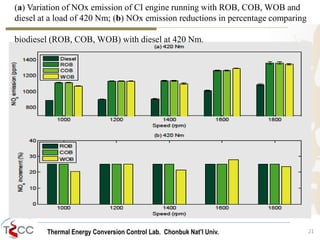
(a) Variation of NOx emission of CI engine running with ROB, COB, WOB and
diesel at a load of 420 Nm; (b) NOx emission reductions in percentage comparing
biodiesel (ROB, COB, WOB) with diesel at 420 Nm.
Thermal Energy Conversion Control Lab. Chonbuk Nat’I Univ. 22
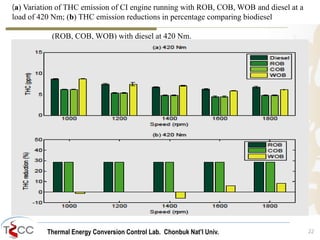
(a) Variation of THC emission of CI engine running with ROB, COB, WOB and diesel at a
load of 420 Nm; (b) THC emission reductions in percentage comparing biodiesel
(ROB, COB, WOB) with diesel at 420 Nm.
Thermal Energy Conversion Control Lab. Chonbuk Nat’I Univ. 23
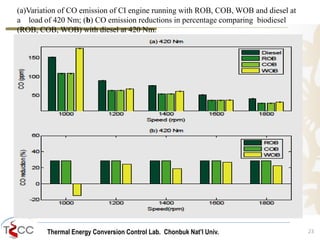
(a)Variation of CO emission of CI engine running with ROB, COB, WOB and diesel at
a load of 420 Nm; (b) CO emission reductions in percentage comparing biodiesel
(ROB, COB, WOB) with diesel at 420 Nm.
Thermal Energy Conversion Control Lab. Chonbuk Nat’I Univ. 24
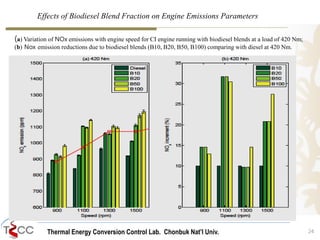
Effects of Biodiesel Blend Fraction on Engine Emissions Parameters
(a) Variation of NOx emissions with engine speed for CI engine running with biodiesel blends at a load of 420 Nm;
(b) Nox emission reductions due to biodiesel blends (B10, B20, B50, B100) comparing with diesel at 420 Nm.
Thermal Energy Conversion Control Lab. Chonbuk Nat’I Univ. 25
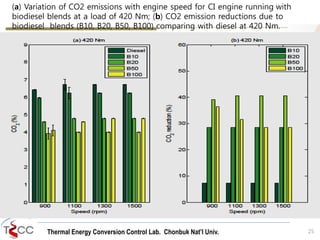
(a) Variation of CO2 emissions with engine speed for CI engine running with
biodiesel blends at a load of 420 Nm; (b) CO2 emission reductions due to
biodiesel blends (B10, B20, B50, B100) comparing with diesel at 420 Nm.
Thermal Energy Conversion Control Lab. Chonbuk Nat’I Univ. 26
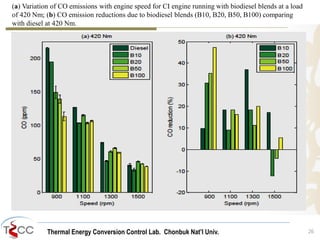
(a) Variation of CO emissions with engine speed for CI engine running with biodiesel blends at a load
of 420 Nm; (b) CO emission reductions due to biodiesel blends (B10, B20, B50, B100) comparing
with diesel at 420 Nm.
Thermal Energy Conversion Control Lab. Chonbuk Nat’I Univ. 27
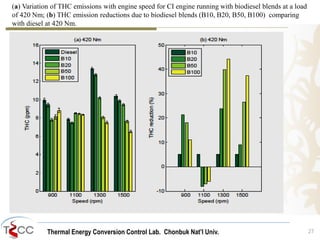
(a) Variation of THC emissions with engine speed for CI engine running with biodiesel blends at a load
of 420 Nm; (b) THC emission reductions due to biodiesel blends (B10, B20, B50, B100) comparing
with diesel at 420 Nm.
Thermal Energy Conversion Control Lab. Chonbuk Nat’I Univ.
Conclusions
28
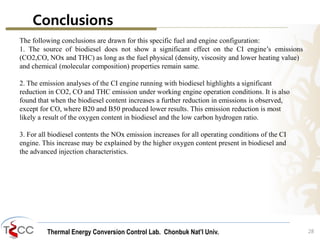
The following conclusions are drawn for this specific fuel and engine configuration:
1. The source of biodiesel does not show a significant effect on the CI engine’s emissions
(CO2,CO, NOx and THC) as long as the fuel physical (density, viscosity and lower heating value)
and chemical (molecular composition) properties remain same.
2. The emission analyses of the CI engine running with biodiesel highlights a significant
reduction in CO2, CO and THC emission under working engine operation conditions. It is also
found that when the biodiesel content increases a further reduction in emissions is observed,
except for CO, where B20 and B50 produced lower results. This emission reduction is most
likely a result of the oxygen content in biodiesel and the low carbon hydrogen ratio.
3. For all biodiesel contents the NOx emission increases for all operating conditions of the CI
engine. This increase may be explained by the higher oxygen content present in biodiesel and
the advanced injection characteristics.
Thermal Energy Conversion Control Lab. Chonbuk Nat’I Univ.
References
1. Nabi, M.N.; Hustad, J.E. Influence of biodiesel addition to Fischer-Tropsch fuel on diesel engine performance and exhaust emiss
ions. Energy Fuels 2010, 24, 2868–2874.
2. Tauzia, X.; Maiboom, A.; Shah, S.R. Experimental study of inlet manifold water injection on combustion and emissions of an au
tomotive direct injection diesel engine. Energy 2010, 35,3628–3639.
3. Bayraktar, H. Experimental and theoretical investigation of using gasoline–ethanol blends in
spark-ignition engines. Renew. Energy 2005, 30, 1733–1747. 4. MacKenzie, J.J. Oil as a finite resource. Nonrenew. Resour. 1998, 7
, 97–100.
5. Ramadhas, A.S.; Muraleedharan, C.; Jayaraj, S. Performance and emission evaluation of a diesel engine fueled with
methyl esters of rubber seed oil. Renew. Energy 2005, 30, 1789–1800.
6. Hammond, G.P.; Kallu, S.; McManus, M.C. Development of biofuels for the UK automotive market. Appl. Energy 2008,
85, 506–515.
7. Lapuerta, M.; Armas, O.; Ballesteros, R.; Fernandez, J. Diesel emissions from biofuels derived from Spanish potential vegetable
oils. Fuel 2005, 84, 773–780
8. Durbin, T.D.; Collins, J.R.; Norbeck, J.M.; Smith, M.R. Effects of biodiesel, biodiesel blends, and a synthetic diesel on emission
s from light heavy-duty diesel vehicles. Environ. Sci. Technol. 2000,34, 349–355.
9. Puppan, D. Environmeental Evaluation of Biofules. Available online: http://www.pp.bme.hu/ so/2002_1/pdf/so2002_1_08.pdf (a
ccessed on 16 June 2008).
10. Dorado, M.P.; Ballesteros, E.; Arnal, J.M.; Gomez, J.; Lopez, F.J. Exhaust emissions from a Diesel engine fueled with transeste
rified waste olive oil. Fuel 2003, 82, 1311–1315.
11. Utlu, Z.; Kocak, M.S. The effect of biodiesel fuel obtained from waste frying oil on direct injection diesel engine performance
and exhaust emissions. Renew. Energy 2008, 33, 1936–1941.
12. Lapuerta, M.; Armas, O.; Rodríguez-Fernández, J. Effect of biodiesel fuels on diesel engine emissions. Prog. Energy Combust.
Sci. 2008, 34, 198–223.
13. Xue, J.; Grift, T.E.; Hansen, A.C. Effect of biodiesel on engine performances and emissions. Renew. Sustain. Energy Rev. 2011,
15, 1098–1116.
Thermal Energy Conversion Control Lab. Chonbuk Nat’I Univ.
14. Bhale, P.V.; Deshpande, N.V.; Thombre, S.B. Improving the low temperature properties of biodiesel fuel. Renew. Energy 2009,
34, 794–800.
15. Krisnangkura, K. Estimation of heat of combustion of triglycerides and fatty acid methyl esters. J. Am. Oil Chem. Soc. 1991,
68, 56–58.
16. Carraretto, C.; Macor, A.; Mirandola, A.; Stoppato, A.; Tonon, S. Biodiesel as alternative fuel: Experimental analysis and energ
etic evaluations. Energy 2004, 29, 2195–2211.
17. Murillo, S.; Míguez, J.L.; Porteiro, J., Granada, E.; Morán, J.C. Performance and exhaust emissions in the use of biodiesel in ou
tboard diesel engines. Fuel 2007, 86, 1765–1771.
18. Cardone, M.; Prati, M.V.; Rocco, V.; Seggiani, M.; Senatore, A.; Vitolo, S. Brassica carinata as an alternative oil crop for the pr
oduction of biodiesel in Italy: Engine performance and regulated and unregulated exhaust emissions. Environ. Sci. Technol. 2002, 3
6, 4656–4662.
19. Yamane, K.; Ueta, A.; Shimamoto, Y. Influence of physical and chemical properties of biodiesel fuels on injection, combustin a
nd exhaust emission characteristics in a direct injection compression ignition engine. Int. J. Engine Res. 2001, 2, 249–261.
20. Monyem, A.; Van Gerpen, J.H. The effect of biodiesel oxidation on engine performance and emissions. Biomass Bioenergy 200
1, 20, 317–325.
21. Qi, D.H., Geng, L.M.; Chen, H.; Bian, Y.Z.; Liu, J.; Ren, X.C. Combustion and performance evaluation of a diesel engine fuele
d with biodiesel produced from soybean crude oil. Renew. Energy 2009, 34, 2706–2713
22. Armas, O.; Yehliu, K.; Boehman, A.L. Effect of alternative fuels on exhaust emissions during diesel engine operation with matc
hed combustion phasing. Fuel 2010, 89, 438–456.
23. Pala-En, N.; Sattler, M.; Dennis, B.H.; Chen Victoria, C.P.; Muncrief, R.L. On-road measurement of NOx and CO2 emissions f
rom biodiesel produced from different feedstocks. J. Environ. Prot. 2013, 4, 74–82.
24. Usta, N.; Öztürk, E.; Can, Ö.; Conkur, E.S.; Nas, S.; Çon, A.H.; Can, A.Ç.; Topcu, M. Combustion of biodiesel fuel produced fr
om hazelnut soapstock/waste sunflower oil mixture in a diesel engine. Energy Convers. Manag. 2005, 46, 741–755.
25. Al-Widyan, M.I.; Tashtoush, G.; Abu-Qudais, M. Utilization of ethyl ester of waste vegetable oils as fuel in diesel engines. Fue
l Process. Technol. 2002, 76, 91–103
30
Thermal Energy Conversion Control Lab. Chonbuk Nat’I Univ.
26. Puhan, S.; Vedaraman, N.; Sankaranarayanan, G.; Ram, B.V.B. Performance and emission study of Mahua oil (madhuca indica
oil) ethyl ester in a 4-stroke natural aspirated direct injection diesel engine. Renew. Energy 2005, 30, 1269–1278.
27. Canakci, M. Combustion characteristics of a turbocharged DI compression ignition engine fueled with petroleum diesel fuels a
nd biodiesel. Bioresour. Technol. 2007, 98, 1167–1175.
28. Kaplan, C.; Arslan, R.; Surmen, A. Performance characteristics of sunflower methyl esters as biodiesel. Energy Sources Part A
Recovery Util. Environ. Eff. 2006, 28, 751–755.
29. Krahl, J.; Munack, A.; Bahadir, M.; Schumacher, L.; Elser, N. Review: Utilization of Rapeseed Oil, Rapeseed Oil Methyl Ester
or Diesel Fuel: Exhaust Gas Emissions and Estimation of Environmental Effects. In Proceedings of the International Fall Fuels and
Lubricant Meeting, San Antonio, TX , USA, 1996; doi:10.4271/962096.
30. Nabi, M.N.; Akhter, M.S.; Zaglul Shahadat, M.M. Improvement of engine emissions with conventional diesel fuel and diesel-bi
odiesel blends. Bioresour. Technol. 2006, 97, 372–378.
31. Karavalakis, G.; Stournas, S.; Bakeas, E. Light vehicle regulated and unregulated emissions from different biodiesels. Sci. Total
Environ. 2009, 407, 3338–3346.
32. Peterson, C.L.; Taberski, J.S.; Thompson, J.C.; Chase, C.L. The effect of biodiesel feedstock on regulated emissions in chassis
dynamometer tests of a pickup truck. Trans. Am. Soc. Agric. Eng. 2000, 43, 1371–1381.
33. Rakopoulous, C.D.; Antonopoulos, K.A.; Rakopoulos, D.C.; Hountalas, D.T.; Giakoumis, E.G. Comparative performance and e
missions study of a direct injection diesel engine using blends of diesel fuel with vegetable oils or bio-diesels of various origins. En
ergy Convers. Manag. 2006, 47, 3272–3287.
34. Muncrief, R.L.; Rooks, C.W.; Cruz, M.; Michael, P.H. Combining biodiesel and exhaust gas recirculation for reduction in NOx
and particulate emissions. Energy Fuels 2008, 22, 1285–1296.
35. Fontaras, G.; Karavalakis, G.; Kousoulidou, M.; Tzamkiozis, T.; Ntziachristos, L.; Bakeas, E.; Stournas, S.; Samaras, Z. Effects
of biodiesel on passenger car fuel consumption, regulated and non-regulated pollutant emissions over legislated and real-world driv
ing cycles. Fuel 2009, 88, 1608–1617.
36. Lin, Y.; Wu, Y.G.; Chang, C. Combustion characteristics of waste-oil produced biodiesel/diesel fuel blends. Fuel 2007, 86, 281
0–2816.
37. Tesfa, B.; Mishra, R.; Zhang, C.; Gu, F.; Ball, A.D. Combustion and performance characteristics of CI (compression ignition)
engine running with biodiesel. Energy 2013, 51, 101–115.
31
Thermal Energy Conversion Control Lab. Chonbuk Nat’I Univ.
38. Tesfa, B.; Mishra, R.; Gu, F.; Powles, N. Prediction models for density and viscosity of biodiesel and their effects on fuel
supply system in CI engines. Renew. Energy 2010, 35, 2752–2760.
39. Lin, B.F.; Huang, J.H.; Huang, D.Y. Experimental study of the effects of vegetable oil methyl ester on DI diesel engine perform
ance characteristics and pollutant emissions. Fuel 2009, 88, 1779–1785.
40. Ulusoy, Y.; Tekin, Y.; Cetinkaya, M.; Karaosmanoglu, F. The engine tests of biodiesel from used frying oil. Energy Sources 200
4, 26, 927–932.
41. Song, J.T.; Zhang, C.H. An experimental study on the performance and exhaust emissions of a diesel engine fuelled with soybe
an oil methyl ester. Proc. Inst. Mech. Eng. Part D J. Automob. Eng. 2008, 222, 2487–2496.
42. Lin, C.Y.; Lin, H.A. Diesel engine performance and emission characteristics of biodiesel produced by the peroxidation process.
Fuel 2006, 85, 298–305.
43. Labeckas, G.; Slavinskas, S. The effect of rapeseed oil methyl ester on direct injection Diesel engine performance and exhaust
emissions. Energy Convers. Manag. 2006, 47, 1954–1967.
44. Srivastava, A.; Prasad, R. Triglycerides-based diesel fuels. Renew. Sustain. Energy Rev. 2000, 4, 111–133.
45. Lin, C.Y.; Chen, L.-W. Engine performance and emission characteristics of three-phase diesel emulsions prepared by an ultraso
nic emulsification method. Fuel 2006, 85, 593–600.
46. Bazari, Z. Diesel Exhaust Emissions Prediction under Transient Operating Conditions. In Proceedings of the SAE International
Congress and Exposition, 28 February–3 March 1994, Detroit, MI, USA; doi:10.4271/940666.
47. Raveendran, K.; Ganesh, A. Heating value of biomass and biomass pyrolysis products. Fuel 1996,75, 1715–1720.
48. Raheman, H.; Phadatare, A.G. Diesel engine emissions and performance from blends of karanja methyl ester and diesel.
Biomass Bioenergy 2004, 27, 393–397.
© 2014 by the authors; licensee MDPI, Basel, Switzerland. This article is an open access article
distributed under the terms and conditions of the Creative Commons Attribution license
(http://creativecommons.org/licenses/by/3.0/).
32
Thermal Energy Conversion Control Lab. Chonbuk Nat’I Univ.
Thank you for listening
33

June 2014 11

  • 1.
    Thermal Energy ConversionControl Lab. Chonbuk Nat’I Univ. Emission Characteristics of a CI Engine Running with a Range of Biodiesel Feedstocks Sudheer Nandi
  • 2.
    Thermal Energy ConversionControl Lab. Chonbuk Nat’I Univ. • The objective of this study is to investigate the effects of biodiesel types and biodiesel fraction on the emission characteristics of a CI engine. • The experimental work was carried out on a four-cylinder, four-stroke, direct injection (DI) and turbocharged diesel engine by using biodiesel made from waste oil, rapeseed oil, corn oil and comparing th em to normal diesel. • The fuels used in the analyses are B10, B20, B50, B100 and neat diesel. Based on the measured parameters, detailed analyses were carried out on major regulated emissions such as NOx, CO, CO2, and THC. • The results also clearly indicate that the engine running with biodiesel and blends have higher NOx emissio n by up to 20%. However, the emissions of the CI engine running on neat biodiesel (B100) were reduced by up to 15%, 40% and 30% for CO, CO2 and THC emissions respectively, as compared to diesel fuel at various operating conditions. Keywords: compression engine; biodiesel blend; nitrogen oxides; carbon dioxide; carbon monoxide; total hydrocarbon. A b s t r a c t
  • 3.
    Thermal Energy ConversionControl Lab. Chonbuk Nat’I Univ. Why biodiesel …! Facing problem 3 Biodiesel Glycerin (thick) Diesel fuel injectors are not designed for viscous fuels like vegetable oil Or Animal fat
  • 4.
    Thermal Energy ConversionControl Lab. Chonbuk Nat’I Univ. WHAT MAKE BIODIESEL TO USE..! • Current and future emission regulations are, and will become, more stringent and as a consequence. • The major alternative fuels being used in automotive transport are et hanol, hydrogen and biodiesel. Ethanol technology is successfully established and commercialized in both developing and developed c ountries. • diesel engines are expected to remain in use for high-power applications, such as rail road locomotives, ships and over land trans port trucks . 4
  • 5.
    Thermal Energy ConversionControl Lab. Chonbuk Nat’I Univ. 5 History of Vegetable Oil Based Fuels The use of vegetable oils as engine fuels may seem insignificant today but the such oils may become, in the course of time, as important as petroleum and the coal tar products of the present time. -Rudolph Diesel, 1912 • 1900 - Rudolph Diesel debuted the first diesel engine running on peanut oil at the World’s Exhibition in Paris • After Diesel’s mysterious death in 1913, development focused on the use of petroleum-based fuels
  • 6.
    Thermal Energy ConversionControl Lab. Chonbuk Nat’I Univ. What is Biodiesel? • Biodiesel is a petroleum diesel replacement fuel used in CI engines. • It can be produced from any plant or animal based lipids. – Plant Based Oils: • Soybean oil; cotton seeds oil; sunflower oil. – Animal Fats: • Beef tallow; pork lard; poultry fat. – Recycled Cooking Grease: • Yellow grease.
  • 7.
    Thermal Energy ConversionControl Lab. Chonbuk Nat’I Univ. Biodiesel Production Process Source: www.esru.strath.ac.uk/EandE/Web_sites/02-03/biofuels/what_biodiesel.htm
  • 8.
    Thermal Energy ConversionControl Lab. Chonbuk Nat’I Univ. TRANSESTERIFICATION PROCESS
  • 9.
    Thermal Energy ConversionControl Lab. Chonbuk Nat’I Univ. DISTILLATION PROCESS GLYCEROL REPRESENTATIONS
  • 10.
    Thermal Energy ConversionControl Lab. Chonbuk Nat’I Univ. • Fuel filter specification 10
  • 11.
    Thermal Energy ConversionControl Lab. Chonbuk Nat’I Univ. • Biodiesel reduces tailpipe particulate matter (PM), hydrocarbon (HC), and carbon monoxide (CO) emissions from most modern four-stroke CI engines. • These benefits occur because the fuel (B100) contains 11% oxygen by weight. • The presence of fuel oxygen allows the fuel to burn more completely, so fewer unburned fuel emissions result. • This same phenomenon reduces air toxics, because the air toxics are associated with the unburned or partially burned HC and PM emissions. • Testing has shown that PM, HC, and CO reductions are independent of the feedstock used to make biodiesel. 11 Emissions Benefits
  • 12.
    Thermal Energy ConversionControl Lab. Chonbuk Nat’I Univ. Table 1. Estimated share of literature (in % number of publications)on effect of pure biodiesel on engine performance and emission in comparison with diesel [12,13].
  • 13.
    Thermal Energy ConversionControl Lab. Chonbuk Nat’I Univ. 13
  • 14.
    Thermal Energy ConversionControl Lab. Chonbuk Nat’I Univ. 14
  • 15.
    Thermal Energy ConversionControl Lab. Chonbuk Nat’I Univ. Experimental Facilities and Test Procedures 15
  • 16.
    Thermal Energy ConversionControl Lab. Chonbuk Nat’I Univ. 16 Figure 2. Engine test facilities layout [37].
  • 17.
    Thermal Energy ConversionControl Lab. Chonbuk Nat’I Univ. 17
  • 18.
    Thermal Energy ConversionControl Lab. Chonbuk Nat’I Univ. 18 Source: Tesfa, B.; Mishra, RGu, F.; Powles, N. Prediction models for density and viscosity of biodiesel and their effects on fuel supply system in CI engines. Renew. Energy 2010, 35, 2752–2760
  • 19.
    Thermal Energy ConversionControl Lab. Chonbuk Nat’I Univ. 19
  • 20.
    Thermal Energy ConversionControl Lab. Chonbuk Nat’I Univ. 20 Results and Discussion (a) Variation of CO2 emission of CI engine running with ROB, COB, WOB and diesel at a load of 420 Nm; (b) CO2 emission reductions in percentage comparing biodiesel (ROB, COB, WOB) with diesel at 420 Nm. Effects of Biodiesel Content on Engine Emissions Parameters
  • 21.
    Thermal Energy ConversionControl Lab. Chonbuk Nat’I Univ. 21 (a) Variation of NOx emission of CI engine running with ROB, COB, WOB and diesel at a load of 420 Nm; (b) NOx emission reductions in percentage comparing biodiesel (ROB, COB, WOB) with diesel at 420 Nm.
  • 22.
    Thermal Energy ConversionControl Lab. Chonbuk Nat’I Univ. 22 (a) Variation of THC emission of CI engine running with ROB, COB, WOB and diesel at a load of 420 Nm; (b) THC emission reductions in percentage comparing biodiesel (ROB, COB, WOB) with diesel at 420 Nm.
  • 23.
    Thermal Energy ConversionControl Lab. Chonbuk Nat’I Univ. 23 (a)Variation of CO emission of CI engine running with ROB, COB, WOB and diesel at a load of 420 Nm; (b) CO emission reductions in percentage comparing biodiesel (ROB, COB, WOB) with diesel at 420 Nm.
  • 24.
    Thermal Energy ConversionControl Lab. Chonbuk Nat’I Univ. 24 Effects of Biodiesel Blend Fraction on Engine Emissions Parameters (a) Variation of NOx emissions with engine speed for CI engine running with biodiesel blends at a load of 420 Nm; (b) Nox emission reductions due to biodiesel blends (B10, B20, B50, B100) comparing with diesel at 420 Nm.
  • 25.
    Thermal Energy ConversionControl Lab. Chonbuk Nat’I Univ. 25 (a) Variation of CO2 emissions with engine speed for CI engine running with biodiesel blends at a load of 420 Nm; (b) CO2 emission reductions due to biodiesel blends (B10, B20, B50, B100) comparing with diesel at 420 Nm.
  • 26.
    Thermal Energy ConversionControl Lab. Chonbuk Nat’I Univ. 26 (a) Variation of CO emissions with engine speed for CI engine running with biodiesel blends at a load of 420 Nm; (b) CO emission reductions due to biodiesel blends (B10, B20, B50, B100) comparing with diesel at 420 Nm.
  • 27.
    Thermal Energy ConversionControl Lab. Chonbuk Nat’I Univ. 27 (a) Variation of THC emissions with engine speed for CI engine running with biodiesel blends at a load of 420 Nm; (b) THC emission reductions due to biodiesel blends (B10, B20, B50, B100) comparing with diesel at 420 Nm.
  • 28.
    Thermal Energy ConversionControl Lab. Chonbuk Nat’I Univ. Conclusions 28 The following conclusions are drawn for this specific fuel and engine configuration: 1. The source of biodiesel does not show a significant effect on the CI engine’s emissions (CO2,CO, NOx and THC) as long as the fuel physical (density, viscosity and lower heating value) and chemical (molecular composition) properties remain same. 2. The emission analyses of the CI engine running with biodiesel highlights a significant reduction in CO2, CO and THC emission under working engine operation conditions. It is also found that when the biodiesel content increases a further reduction in emissions is observed, except for CO, where B20 and B50 produced lower results. This emission reduction is most likely a result of the oxygen content in biodiesel and the low carbon hydrogen ratio. 3. For all biodiesel contents the NOx emission increases for all operating conditions of the CI engine. This increase may be explained by the higher oxygen content present in biodiesel and the advanced injection characteristics.
  • 29.
    Thermal Energy ConversionControl Lab. Chonbuk Nat’I Univ. References 1. Nabi, M.N.; Hustad, J.E. Influence of biodiesel addition to Fischer-Tropsch fuel on diesel engine performance and exhaust emiss ions. Energy Fuels 2010, 24, 2868–2874. 2. Tauzia, X.; Maiboom, A.; Shah, S.R. Experimental study of inlet manifold water injection on combustion and emissions of an au tomotive direct injection diesel engine. Energy 2010, 35,3628–3639. 3. Bayraktar, H. Experimental and theoretical investigation of using gasoline–ethanol blends in spark-ignition engines. Renew. Energy 2005, 30, 1733–1747. 4. MacKenzie, J.J. Oil as a finite resource. Nonrenew. Resour. 1998, 7 , 97–100. 5. Ramadhas, A.S.; Muraleedharan, C.; Jayaraj, S. Performance and emission evaluation of a diesel engine fueled with methyl esters of rubber seed oil. Renew. Energy 2005, 30, 1789–1800. 6. Hammond, G.P.; Kallu, S.; McManus, M.C. Development of biofuels for the UK automotive market. Appl. Energy 2008, 85, 506–515. 7. Lapuerta, M.; Armas, O.; Ballesteros, R.; Fernandez, J. Diesel emissions from biofuels derived from Spanish potential vegetable oils. Fuel 2005, 84, 773–780 8. Durbin, T.D.; Collins, J.R.; Norbeck, J.M.; Smith, M.R. Effects of biodiesel, biodiesel blends, and a synthetic diesel on emission s from light heavy-duty diesel vehicles. Environ. Sci. Technol. 2000,34, 349–355. 9. Puppan, D. Environmeental Evaluation of Biofules. Available online: http://www.pp.bme.hu/ so/2002_1/pdf/so2002_1_08.pdf (a ccessed on 16 June 2008). 10. Dorado, M.P.; Ballesteros, E.; Arnal, J.M.; Gomez, J.; Lopez, F.J. Exhaust emissions from a Diesel engine fueled with transeste rified waste olive oil. Fuel 2003, 82, 1311–1315. 11. Utlu, Z.; Kocak, M.S. The effect of biodiesel fuel obtained from waste frying oil on direct injection diesel engine performance and exhaust emissions. Renew. Energy 2008, 33, 1936–1941. 12. Lapuerta, M.; Armas, O.; Rodríguez-Fernández, J. Effect of biodiesel fuels on diesel engine emissions. Prog. Energy Combust. Sci. 2008, 34, 198–223. 13. Xue, J.; Grift, T.E.; Hansen, A.C. Effect of biodiesel on engine performances and emissions. Renew. Sustain. Energy Rev. 2011, 15, 1098–1116.
  • 30.
    Thermal Energy ConversionControl Lab. Chonbuk Nat’I Univ. 14. Bhale, P.V.; Deshpande, N.V.; Thombre, S.B. Improving the low temperature properties of biodiesel fuel. Renew. Energy 2009, 34, 794–800. 15. Krisnangkura, K. Estimation of heat of combustion of triglycerides and fatty acid methyl esters. J. Am. Oil Chem. Soc. 1991, 68, 56–58. 16. Carraretto, C.; Macor, A.; Mirandola, A.; Stoppato, A.; Tonon, S. Biodiesel as alternative fuel: Experimental analysis and energ etic evaluations. Energy 2004, 29, 2195–2211. 17. Murillo, S.; Míguez, J.L.; Porteiro, J., Granada, E.; Morán, J.C. Performance and exhaust emissions in the use of biodiesel in ou tboard diesel engines. Fuel 2007, 86, 1765–1771. 18. Cardone, M.; Prati, M.V.; Rocco, V.; Seggiani, M.; Senatore, A.; Vitolo, S. Brassica carinata as an alternative oil crop for the pr oduction of biodiesel in Italy: Engine performance and regulated and unregulated exhaust emissions. Environ. Sci. Technol. 2002, 3 6, 4656–4662. 19. Yamane, K.; Ueta, A.; Shimamoto, Y. Influence of physical and chemical properties of biodiesel fuels on injection, combustin a nd exhaust emission characteristics in a direct injection compression ignition engine. Int. J. Engine Res. 2001, 2, 249–261. 20. Monyem, A.; Van Gerpen, J.H. The effect of biodiesel oxidation on engine performance and emissions. Biomass Bioenergy 200 1, 20, 317–325. 21. Qi, D.H., Geng, L.M.; Chen, H.; Bian, Y.Z.; Liu, J.; Ren, X.C. Combustion and performance evaluation of a diesel engine fuele d with biodiesel produced from soybean crude oil. Renew. Energy 2009, 34, 2706–2713 22. Armas, O.; Yehliu, K.; Boehman, A.L. Effect of alternative fuels on exhaust emissions during diesel engine operation with matc hed combustion phasing. Fuel 2010, 89, 438–456. 23. Pala-En, N.; Sattler, M.; Dennis, B.H.; Chen Victoria, C.P.; Muncrief, R.L. On-road measurement of NOx and CO2 emissions f rom biodiesel produced from different feedstocks. J. Environ. Prot. 2013, 4, 74–82. 24. Usta, N.; Öztürk, E.; Can, Ö.; Conkur, E.S.; Nas, S.; Çon, A.H.; Can, A.Ç.; Topcu, M. Combustion of biodiesel fuel produced fr om hazelnut soapstock/waste sunflower oil mixture in a diesel engine. Energy Convers. Manag. 2005, 46, 741–755. 25. Al-Widyan, M.I.; Tashtoush, G.; Abu-Qudais, M. Utilization of ethyl ester of waste vegetable oils as fuel in diesel engines. Fue l Process. Technol. 2002, 76, 91–103 30
  • 31.
    Thermal Energy ConversionControl Lab. Chonbuk Nat’I Univ. 26. Puhan, S.; Vedaraman, N.; Sankaranarayanan, G.; Ram, B.V.B. Performance and emission study of Mahua oil (madhuca indica oil) ethyl ester in a 4-stroke natural aspirated direct injection diesel engine. Renew. Energy 2005, 30, 1269–1278. 27. Canakci, M. Combustion characteristics of a turbocharged DI compression ignition engine fueled with petroleum diesel fuels a nd biodiesel. Bioresour. Technol. 2007, 98, 1167–1175. 28. Kaplan, C.; Arslan, R.; Surmen, A. Performance characteristics of sunflower methyl esters as biodiesel. Energy Sources Part A Recovery Util. Environ. Eff. 2006, 28, 751–755. 29. Krahl, J.; Munack, A.; Bahadir, M.; Schumacher, L.; Elser, N. Review: Utilization of Rapeseed Oil, Rapeseed Oil Methyl Ester or Diesel Fuel: Exhaust Gas Emissions and Estimation of Environmental Effects. In Proceedings of the International Fall Fuels and Lubricant Meeting, San Antonio, TX , USA, 1996; doi:10.4271/962096. 30. Nabi, M.N.; Akhter, M.S.; Zaglul Shahadat, M.M. Improvement of engine emissions with conventional diesel fuel and diesel-bi odiesel blends. Bioresour. Technol. 2006, 97, 372–378. 31. Karavalakis, G.; Stournas, S.; Bakeas, E. Light vehicle regulated and unregulated emissions from different biodiesels. Sci. Total Environ. 2009, 407, 3338–3346. 32. Peterson, C.L.; Taberski, J.S.; Thompson, J.C.; Chase, C.L. The effect of biodiesel feedstock on regulated emissions in chassis dynamometer tests of a pickup truck. Trans. Am. Soc. Agric. Eng. 2000, 43, 1371–1381. 33. Rakopoulous, C.D.; Antonopoulos, K.A.; Rakopoulos, D.C.; Hountalas, D.T.; Giakoumis, E.G. Comparative performance and e missions study of a direct injection diesel engine using blends of diesel fuel with vegetable oils or bio-diesels of various origins. En ergy Convers. Manag. 2006, 47, 3272–3287. 34. Muncrief, R.L.; Rooks, C.W.; Cruz, M.; Michael, P.H. Combining biodiesel and exhaust gas recirculation for reduction in NOx and particulate emissions. Energy Fuels 2008, 22, 1285–1296. 35. Fontaras, G.; Karavalakis, G.; Kousoulidou, M.; Tzamkiozis, T.; Ntziachristos, L.; Bakeas, E.; Stournas, S.; Samaras, Z. Effects of biodiesel on passenger car fuel consumption, regulated and non-regulated pollutant emissions over legislated and real-world driv ing cycles. Fuel 2009, 88, 1608–1617. 36. Lin, Y.; Wu, Y.G.; Chang, C. Combustion characteristics of waste-oil produced biodiesel/diesel fuel blends. Fuel 2007, 86, 281 0–2816. 37. Tesfa, B.; Mishra, R.; Zhang, C.; Gu, F.; Ball, A.D. Combustion and performance characteristics of CI (compression ignition) engine running with biodiesel. Energy 2013, 51, 101–115. 31
  • 32.
    Thermal Energy ConversionControl Lab. Chonbuk Nat’I Univ. 38. Tesfa, B.; Mishra, R.; Gu, F.; Powles, N. Prediction models for density and viscosity of biodiesel and their effects on fuel supply system in CI engines. Renew. Energy 2010, 35, 2752–2760. 39. Lin, B.F.; Huang, J.H.; Huang, D.Y. Experimental study of the effects of vegetable oil methyl ester on DI diesel engine perform ance characteristics and pollutant emissions. Fuel 2009, 88, 1779–1785. 40. Ulusoy, Y.; Tekin, Y.; Cetinkaya, M.; Karaosmanoglu, F. The engine tests of biodiesel from used frying oil. Energy Sources 200 4, 26, 927–932. 41. Song, J.T.; Zhang, C.H. An experimental study on the performance and exhaust emissions of a diesel engine fuelled with soybe an oil methyl ester. Proc. Inst. Mech. Eng. Part D J. Automob. Eng. 2008, 222, 2487–2496. 42. Lin, C.Y.; Lin, H.A. Diesel engine performance and emission characteristics of biodiesel produced by the peroxidation process. Fuel 2006, 85, 298–305. 43. Labeckas, G.; Slavinskas, S. The effect of rapeseed oil methyl ester on direct injection Diesel engine performance and exhaust emissions. Energy Convers. Manag. 2006, 47, 1954–1967. 44. Srivastava, A.; Prasad, R. Triglycerides-based diesel fuels. Renew. Sustain. Energy Rev. 2000, 4, 111–133. 45. Lin, C.Y.; Chen, L.-W. Engine performance and emission characteristics of three-phase diesel emulsions prepared by an ultraso nic emulsification method. Fuel 2006, 85, 593–600. 46. Bazari, Z. Diesel Exhaust Emissions Prediction under Transient Operating Conditions. In Proceedings of the SAE International Congress and Exposition, 28 February–3 March 1994, Detroit, MI, USA; doi:10.4271/940666. 47. Raveendran, K.; Ganesh, A. Heating value of biomass and biomass pyrolysis products. Fuel 1996,75, 1715–1720. 48. Raheman, H.; Phadatare, A.G. Diesel engine emissions and performance from blends of karanja methyl ester and diesel. Biomass Bioenergy 2004, 27, 393–397. © 2014 by the authors; licensee MDPI, Basel, Switzerland. This article is an open access article distributed under the terms and conditions of the Creative Commons Attribution license (http://creativecommons.org/licenses/by/3.0/). 32
  • 33.
    Thermal Energy ConversionControl Lab. Chonbuk Nat’I Univ. Thank you for listening 33