Thermal Energy Conversion Control Lab. Chonbuk Nat’I Univ. 
Experimental study of the performances of a modified 
diesel engine operating in homogeneous charge 
compression ignition (HCCI) combustion mode 
versus the original diesel combustion mode 
Thermal PowerGroup,DepartmentofEnergyEngineering,UniversityofSeville,EscuelaTe´cnica Superiorde Ingenieros 
deSevilla, Camino delos Descubrimientos,s/n41092Sevilla,Spain 
Energy 34 (2009) 159–171 
Nandi Sudheer 
201455278
Abstract 
 Homogeneous charge compression ignition(HCCI)combustion mode provides very low NOx and soot emissions; 
however , it has some challenges associated with hydrocarbon(HC) emissions, fuel consumption, difficult 
control of start of ignition and bad behavior to high loads. 
 Cooled exhaust gas recirculation(EGR) is a common way to control in-cylinder NOx production in diesel and 
HCCI combustion mode. 
 This work is intended to characterize an engine that has been modified from the base diesel engine 
(FL1906DEUTZ-DITER) to work in HCCI combustion mode. 
 It shows the experimental results for the modified diesel engine in HCCI combustion mode fueled with 
commercial diesel fuel compared to the diesel engine mode. 
 An experimental installation , in conjunction with systematic tests to determine the optimum crank angle of 
fuel injection, has been used to measure the evolution of the cylinder pressure and to get an estimate of the heat 
release rate from a single-zone numerical model. From these the angle of start of combustion has been obtained. 
 The performances and emissions of HC, CO and the huge reduction of NOx and smoke emissions of the engine 
are presented. 
 These results have allowed a deeper analysis of the effects of external EGR on the HCCI operation mode, on 
some engine design parameter sandal soon NOx emission reduction. 
Thermal Energy Conversion Control Lab. Chonbuk Nat’I Univ. 2
Introduction 
Thermal Energy Conversion Control Lab. Chonbuk Nat’I Univ. 
3 
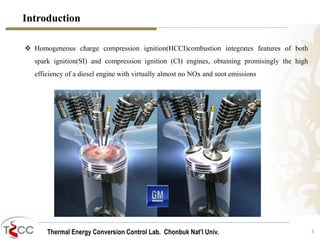
 Homogeneous charge compression ignition(HCCI)combustion integrates features of both 
spark ignition(SI) and compression ignition (CI) engines, obtaining promisingly the high 
efficiency of a diesel engine with virtually almost no NOx and soot emissions
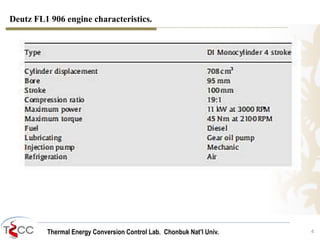
Deutz FL1 906 engine characteristics. 
Thermal Energy Conversion Control Lab. Chonbuk Nat’I Univ. 4
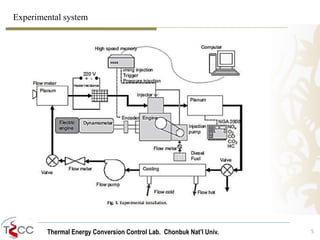
Experimental system 
Thermal Energy Conversion Control Lab. Chonbuk Nat’I Univ. 5
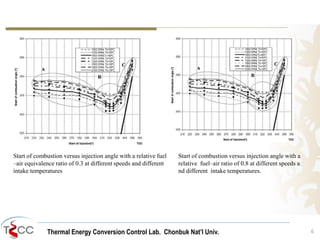
Start of combustion versus injection angle with a relative fuel 
–air equivalence ratio of 0.3 at different speeds and different 
intake temperatures 
Start of combustion versus injection angle with a 
relative fuel–air ratio of 0.8 at different speeds a 
nd different intake temperatures. 
Thermal Energy Conversion Control Lab. Chonbuk Nat’I Univ. 6
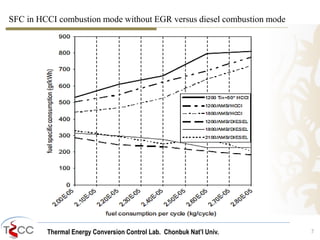
SFC in HCCI combustion mode without EGR versus diesel combustion mode 
Thermal Energy Conversion Control Lab. Chonbuk Nat’I Univ. 7
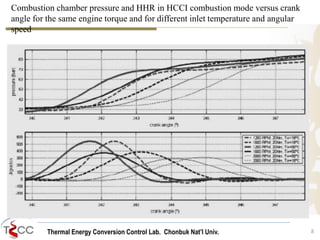
Combustion chamber pressure and HHR in HCCI combustion mode versus crank 
angle for the same engine torque and for different inlet temperature and angular 
speed 
Thermal Energy Conversion Control Lab. Chonbuk Nat’I Univ. 8
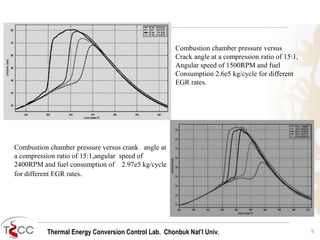
Combustion chamber pressure versus 
Crack angle at a compression ratio of 15:1, 
Angular speed of 1500RPM and fuel 
Consumption 2.6e5 kg/cycle for different 
EGR rates. 
Combustion chamber pressure versus crank angle at 
a compression ratio of 15:1,angular speed of 
2400RPM and fuel consumption of 2.97e5 kg/cycle 
for different EGR rates. 
Thermal Energy Conversion Control Lab. Chonbuk Nat’I Univ. 9
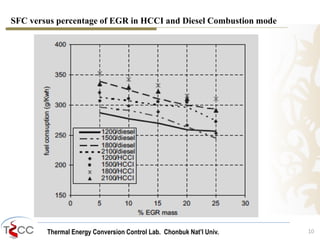
SFC versus percentage of EGR in HCCI and Diesel Combustion mode 
Thermal Energy Conversion Control Lab. Chonbuk Nat’I Univ. 10
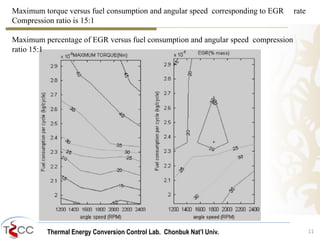
Maximum torque versus fuel consumption and angular speed corresponding to EGR rate 
Compression ratio is 15:1 
Maximum percentage of EGR versus fuel consumption and angular speed compression 
ratio 15:1 
Thermal Energy Conversion Control Lab. Chonbuk Nat’I Univ. 11
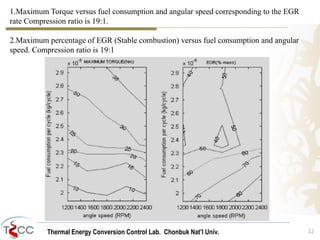
1.Maximum Torque versus fuel consumption and angular speed corresponding to the EGR 
rate Compression ratio is 19:1. 
2.Maximum percentage of EGR (Stable combustion) versus fuel consumption and angular 
speed. Compression ratio is 19:1 
Thermal Energy Conversion Control Lab. Chonbuk Nat’I Univ. 12
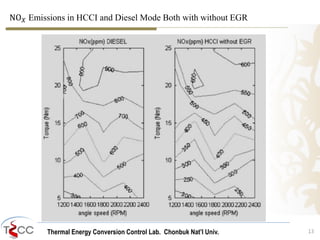
NO푋 Emissions in HCCI and Diesel Mode Both with without EGR 
Thermal Energy Conversion Control Lab. Chonbuk Nat’I Univ. 13
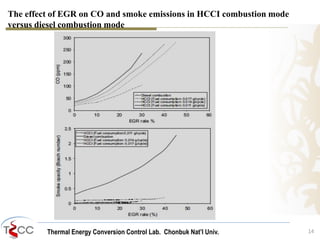
The effect of EGR on CO and smoke emissions in HCCI combustion mode 
versus diesel combustion mode 
Thermal Energy Conversion Control Lab. Chonbuk Nat’I Univ. 14
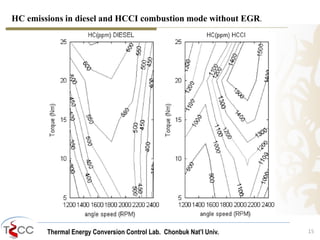
HC emissions in diesel and HCCI combustion mode without EGR. 
Thermal Energy Conversion Control Lab. Chonbuk Nat’I Univ. 15
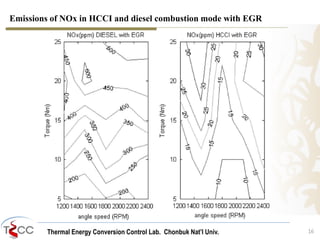
Emissions of NOx in HCCI and diesel combustion mode with EGR 
Thermal Energy Conversion Control Lab. Chonbuk Nat’I Univ. 16
Conclusions 
The effects of EGR and operating conditions on HCCI combustion mode and NOx–HC–soot emissions were 
studied by different strategies. The main conclusions are as follows: 
1.TheignitiontiminginHCCIcombustionmodeatlargeengine loads can be delayed to an optimum timing by cold EGR. 
At the same time, smoother HCCI combustion is obtained.Thebest crack angle for injection in the HCCI combustion 
mode for this modified engine has been established as 45° BTDC. 
2. An increase of inlet temperature at constant EGR rate has a large effect on the start of combustion in HCCI 
mode, and advances it. 
3. An increase of angular speed produces a decrease in the angle of start of combustion. This has a positive effect 
during engine power because of diminished pressure during compression stroke. 
4. The air–fuel equivalence ratio has a direct effect on HCCI timing, advancing the start of combustion when the 
air–fuel equivalence ratio diminishes. This has a negative effect on engine power because the pressure increases 
during compression stroke. 
5. Soot emissions are negligible in the HCCI combustion mode, and are independent of the EGR rate. 
6. Engines running in the HCCI combustion mode with EGR reach ultra-low NOx emissions. 
7. In general the CO and HC are higher in the HCCI combustion mode than in the diesel mode due to early injection 
and fuel adhering to the cylinder walls. 
Thermal Energy Conversion Control Lab. Chonbuk Nat’I Univ. 17
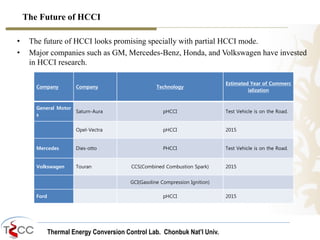
The Future of HCCI 
• The future of HCCI looks promising specially with partial HCCI mode. 
• Major companies such as GM, Mercedes-Benz, Honda, and Volkswagen have invested 
in HCCI research. 
Company Company Technology 
Thermal Energy Conversion Control Lab. Chonbuk Nat’I Univ. 
Estimated Year of Commerc 
ialization 
General Motor 
s 
Saturn-Aura pHCCI Test Vehicle is on the Road. 
Opel-Vectra pHCCI 2015 
Mercedes Dies-otto PHCCI Test Vehicle is on the Road. 
Volkswagen Touran CCS(Combined Combustion Spark) 2015 
GCI(Gasoline Compression Ignition) 
Ford pHCCI 2015
References 
[1] Kimura S, Aoki O, Ogawa H, Muranaka S, Enomoto Y. New combustion concept for ultra-clean and 
high-efficiency small DI diesel engines. SAE paper 1999- 01-3681, 1999. 
[2] Ogink R, Golovitchev V. Gasoline HCCI modelling: computer program combining detailed 
chemistry and gas exchange process. SAE 2001-01-3614, 2001. 
[3] Zhao H, Peng Z, Ladommatos N. Understanding of controlled autoignition combustion in four-stroke 
gasoline engine. Proc Inst Mech Eng 2001; 215(Part D):1297–310. 
[4] Palomar JM, Cruz F, Ortega A, Jime´nez-Espadafor FJ, Martinez G, Dorado MP. Development of a 
computer model to simulate the injection process in a rotary injection pump. Energy Fuels 2005; 
19:1526–35. 
[5] Thring RH. Homogeneous charge compression ignition (HCCI) engines. SAE paper no. 
892068, 1989. 
[6] Christensen M, Johanson B, Ammeus P, Mauss F. Supercharged homogeneous charge compression ig 
nition. SAE paper no. 980787, 1998. 
[7] Nebjosa Milovanovic, Rui Chen. A review of experimental and simulation studies on controlled auto-ignition 
Thermal Energy Conversion Control Lab. Chonbuk Nat’I Univ. 
19 
combustion. SAE paper 2001-01-1890, 2001. 
[8] Lu¨ Xingcai, ChenWei, Ji Libin, Huang Zhen. The effects of external exhaust gas recirculation and 
cetane number improver on the gasoline homogeneous charge compression ignition engines. Combust 
Sci Technol 2006;178: 1237–49. 
[9] Aceves SM, Flowers DL, Westbrook CK, Smith JR, Pitz WJ, Dibble R. HCCI combustion and 
emissions. Paper no. 2000-01-0327.
[10] Yoshiaki Nishijima, Yasou Asaumi, Yuzo Aoyagi. Premixed lean diesel combustion (PREDIC) 
using impingement spray system. SAE paper no. 2001-01-1892, New ACE Institute Co, Ltd. 
[11] Hashimoto K, et al. Evaluation of ignition quality of LPG with cetane number improver. SAE 
technical paper no. 2002-01-0870, 2002. 
[12] Shimazaki N, Akagaka H, Tsijimura K. An experimental study of premixed lean diesel combustion. 
SAE technical paper no. 1999-01-0181, 1999. 
[13] Heywood JB. Internal combustion engine fundamentals. Singapore: McGraw- Hill Book Company 
; 1998. 
[14] Taylor Charles. The internal combustion engine in theory and practice. Cambridge, MA: 
Massachusetts Institute of Technology; 1966. 
[15] Maiboom A, Tauzia X, He´ tet JF. Experimental study of various effects of exhaust gas 
recirculation (EGR) on combustion and emission of an automotive direct injection diesel engine. Energy 
2008;33: 22–34. 
[16] Torres Garcı´a M, Chacartegui Ramı´rez R, Jime´nez-Espadafor Aguilar FJ, Sa´nchez Lencero T. 
Analysis of the start of combustion of a diesel fuel in a HCCI process through an integral chemical 
kinetic model and experimenta- tion. Energy Fuels; 2008; ASAP article; DOI:10.1021/ef700541z. 
[17] Lei Shi, et al. Study of low emission homogeneous charge compression ignition (HCCI) engine 
using combined internal and external exhaust gas recirculation (EGR). Energy 2006;31:2665–76. 
[18] Egnell R. The influence of EGR on heat released rate and NO formation in a DI diesel engine. SAE 
paper no. 2000-01-1807, Society of automotive Engineers Inc., Warrendale, PA, 2000. 
[19] Yoshiaki Nishijima, Yasou Asaumi, Yuzo Aoyagi. Premixed lean diesel combustion (PREDIC) 
using impingement spray system. SAE paper no. 2001-01-1892, New ACE Institute Co, Ltd. 
Thermal Energy Conversion Control Lab. Chonbuk Nat’I Univ. 20
Thank you for listening 
Thermal Energy Conversion Control Lab. Chonbuk Nat’I Univ. 21

20141203

  • 1.
    Thermal Energy ConversionControl Lab. Chonbuk Nat’I Univ. Experimental study of the performances of a modified diesel engine operating in homogeneous charge compression ignition (HCCI) combustion mode versus the original diesel combustion mode Thermal PowerGroup,DepartmentofEnergyEngineering,UniversityofSeville,EscuelaTe´cnica Superiorde Ingenieros deSevilla, Camino delos Descubrimientos,s/n41092Sevilla,Spain Energy 34 (2009) 159–171 Nandi Sudheer 201455278
  • 2.
    Abstract  Homogeneouscharge compression ignition(HCCI)combustion mode provides very low NOx and soot emissions; however , it has some challenges associated with hydrocarbon(HC) emissions, fuel consumption, difficult control of start of ignition and bad behavior to high loads.  Cooled exhaust gas recirculation(EGR) is a common way to control in-cylinder NOx production in diesel and HCCI combustion mode.  This work is intended to characterize an engine that has been modified from the base diesel engine (FL1906DEUTZ-DITER) to work in HCCI combustion mode.  It shows the experimental results for the modified diesel engine in HCCI combustion mode fueled with commercial diesel fuel compared to the diesel engine mode.  An experimental installation , in conjunction with systematic tests to determine the optimum crank angle of fuel injection, has been used to measure the evolution of the cylinder pressure and to get an estimate of the heat release rate from a single-zone numerical model. From these the angle of start of combustion has been obtained.  The performances and emissions of HC, CO and the huge reduction of NOx and smoke emissions of the engine are presented.  These results have allowed a deeper analysis of the effects of external EGR on the HCCI operation mode, on some engine design parameter sandal soon NOx emission reduction. Thermal Energy Conversion Control Lab. Chonbuk Nat’I Univ. 2
  • 3.
    Introduction Thermal EnergyConversion Control Lab. Chonbuk Nat’I Univ. 3  Homogeneous charge compression ignition(HCCI)combustion integrates features of both spark ignition(SI) and compression ignition (CI) engines, obtaining promisingly the high efficiency of a diesel engine with virtually almost no NOx and soot emissions
  • 4.
    Deutz FL1 906engine characteristics. Thermal Energy Conversion Control Lab. Chonbuk Nat’I Univ. 4
  • 5.
    Experimental system ThermalEnergy Conversion Control Lab. Chonbuk Nat’I Univ. 5
  • 6.
    Start of combustionversus injection angle with a relative fuel –air equivalence ratio of 0.3 at different speeds and different intake temperatures Start of combustion versus injection angle with a relative fuel–air ratio of 0.8 at different speeds a nd different intake temperatures. Thermal Energy Conversion Control Lab. Chonbuk Nat’I Univ. 6
  • 7.
    SFC in HCCIcombustion mode without EGR versus diesel combustion mode Thermal Energy Conversion Control Lab. Chonbuk Nat’I Univ. 7
  • 8.
    Combustion chamber pressureand HHR in HCCI combustion mode versus crank angle for the same engine torque and for different inlet temperature and angular speed Thermal Energy Conversion Control Lab. Chonbuk Nat’I Univ. 8
  • 9.
    Combustion chamber pressureversus Crack angle at a compression ratio of 15:1, Angular speed of 1500RPM and fuel Consumption 2.6e5 kg/cycle for different EGR rates. Combustion chamber pressure versus crank angle at a compression ratio of 15:1,angular speed of 2400RPM and fuel consumption of 2.97e5 kg/cycle for different EGR rates. Thermal Energy Conversion Control Lab. Chonbuk Nat’I Univ. 9
  • 10.
    SFC versus percentageof EGR in HCCI and Diesel Combustion mode Thermal Energy Conversion Control Lab. Chonbuk Nat’I Univ. 10
  • 11.
    Maximum torque versusfuel consumption and angular speed corresponding to EGR rate Compression ratio is 15:1 Maximum percentage of EGR versus fuel consumption and angular speed compression ratio 15:1 Thermal Energy Conversion Control Lab. Chonbuk Nat’I Univ. 11
  • 12.
    1.Maximum Torque versusfuel consumption and angular speed corresponding to the EGR rate Compression ratio is 19:1. 2.Maximum percentage of EGR (Stable combustion) versus fuel consumption and angular speed. Compression ratio is 19:1 Thermal Energy Conversion Control Lab. Chonbuk Nat’I Univ. 12
  • 13.
    NO푋 Emissions inHCCI and Diesel Mode Both with without EGR Thermal Energy Conversion Control Lab. Chonbuk Nat’I Univ. 13
  • 14.
    The effect ofEGR on CO and smoke emissions in HCCI combustion mode versus diesel combustion mode Thermal Energy Conversion Control Lab. Chonbuk Nat’I Univ. 14
  • 15.
    HC emissions indiesel and HCCI combustion mode without EGR. Thermal Energy Conversion Control Lab. Chonbuk Nat’I Univ. 15
  • 16.
    Emissions of NOxin HCCI and diesel combustion mode with EGR Thermal Energy Conversion Control Lab. Chonbuk Nat’I Univ. 16
  • 17.
    Conclusions The effectsof EGR and operating conditions on HCCI combustion mode and NOx–HC–soot emissions were studied by different strategies. The main conclusions are as follows: 1.TheignitiontiminginHCCIcombustionmodeatlargeengine loads can be delayed to an optimum timing by cold EGR. At the same time, smoother HCCI combustion is obtained.Thebest crack angle for injection in the HCCI combustion mode for this modified engine has been established as 45° BTDC. 2. An increase of inlet temperature at constant EGR rate has a large effect on the start of combustion in HCCI mode, and advances it. 3. An increase of angular speed produces a decrease in the angle of start of combustion. This has a positive effect during engine power because of diminished pressure during compression stroke. 4. The air–fuel equivalence ratio has a direct effect on HCCI timing, advancing the start of combustion when the air–fuel equivalence ratio diminishes. This has a negative effect on engine power because the pressure increases during compression stroke. 5. Soot emissions are negligible in the HCCI combustion mode, and are independent of the EGR rate. 6. Engines running in the HCCI combustion mode with EGR reach ultra-low NOx emissions. 7. In general the CO and HC are higher in the HCCI combustion mode than in the diesel mode due to early injection and fuel adhering to the cylinder walls. Thermal Energy Conversion Control Lab. Chonbuk Nat’I Univ. 17
  • 18.
    The Future ofHCCI • The future of HCCI looks promising specially with partial HCCI mode. • Major companies such as GM, Mercedes-Benz, Honda, and Volkswagen have invested in HCCI research. Company Company Technology Thermal Energy Conversion Control Lab. Chonbuk Nat’I Univ. Estimated Year of Commerc ialization General Motor s Saturn-Aura pHCCI Test Vehicle is on the Road. Opel-Vectra pHCCI 2015 Mercedes Dies-otto PHCCI Test Vehicle is on the Road. Volkswagen Touran CCS(Combined Combustion Spark) 2015 GCI(Gasoline Compression Ignition) Ford pHCCI 2015
  • 19.
    References [1] KimuraS, Aoki O, Ogawa H, Muranaka S, Enomoto Y. New combustion concept for ultra-clean and high-efficiency small DI diesel engines. SAE paper 1999- 01-3681, 1999. [2] Ogink R, Golovitchev V. Gasoline HCCI modelling: computer program combining detailed chemistry and gas exchange process. SAE 2001-01-3614, 2001. [3] Zhao H, Peng Z, Ladommatos N. Understanding of controlled autoignition combustion in four-stroke gasoline engine. Proc Inst Mech Eng 2001; 215(Part D):1297–310. [4] Palomar JM, Cruz F, Ortega A, Jime´nez-Espadafor FJ, Martinez G, Dorado MP. Development of a computer model to simulate the injection process in a rotary injection pump. Energy Fuels 2005; 19:1526–35. [5] Thring RH. Homogeneous charge compression ignition (HCCI) engines. SAE paper no. 892068, 1989. [6] Christensen M, Johanson B, Ammeus P, Mauss F. Supercharged homogeneous charge compression ig nition. SAE paper no. 980787, 1998. [7] Nebjosa Milovanovic, Rui Chen. A review of experimental and simulation studies on controlled auto-ignition Thermal Energy Conversion Control Lab. Chonbuk Nat’I Univ. 19 combustion. SAE paper 2001-01-1890, 2001. [8] Lu¨ Xingcai, ChenWei, Ji Libin, Huang Zhen. The effects of external exhaust gas recirculation and cetane number improver on the gasoline homogeneous charge compression ignition engines. Combust Sci Technol 2006;178: 1237–49. [9] Aceves SM, Flowers DL, Westbrook CK, Smith JR, Pitz WJ, Dibble R. HCCI combustion and emissions. Paper no. 2000-01-0327.
  • 20.
    [10] Yoshiaki Nishijima,Yasou Asaumi, Yuzo Aoyagi. Premixed lean diesel combustion (PREDIC) using impingement spray system. SAE paper no. 2001-01-1892, New ACE Institute Co, Ltd. [11] Hashimoto K, et al. Evaluation of ignition quality of LPG with cetane number improver. SAE technical paper no. 2002-01-0870, 2002. [12] Shimazaki N, Akagaka H, Tsijimura K. An experimental study of premixed lean diesel combustion. SAE technical paper no. 1999-01-0181, 1999. [13] Heywood JB. Internal combustion engine fundamentals. Singapore: McGraw- Hill Book Company ; 1998. [14] Taylor Charles. The internal combustion engine in theory and practice. Cambridge, MA: Massachusetts Institute of Technology; 1966. [15] Maiboom A, Tauzia X, He´ tet JF. Experimental study of various effects of exhaust gas recirculation (EGR) on combustion and emission of an automotive direct injection diesel engine. Energy 2008;33: 22–34. [16] Torres Garcı´a M, Chacartegui Ramı´rez R, Jime´nez-Espadafor Aguilar FJ, Sa´nchez Lencero T. Analysis of the start of combustion of a diesel fuel in a HCCI process through an integral chemical kinetic model and experimenta- tion. Energy Fuels; 2008; ASAP article; DOI:10.1021/ef700541z. [17] Lei Shi, et al. Study of low emission homogeneous charge compression ignition (HCCI) engine using combined internal and external exhaust gas recirculation (EGR). Energy 2006;31:2665–76. [18] Egnell R. The influence of EGR on heat released rate and NO formation in a DI diesel engine. SAE paper no. 2000-01-1807, Society of automotive Engineers Inc., Warrendale, PA, 2000. [19] Yoshiaki Nishijima, Yasou Asaumi, Yuzo Aoyagi. Premixed lean diesel combustion (PREDIC) using impingement spray system. SAE paper no. 2001-01-1892, New ACE Institute Co, Ltd. Thermal Energy Conversion Control Lab. Chonbuk Nat’I Univ. 20
  • 21.
    Thank you forlistening Thermal Energy Conversion Control Lab. Chonbuk Nat’I Univ. 21