Program Management
       Skills
                 Tathagat Varma
  Sr Director, Strategic Programs and Biz Ops
                Yahoo! India R&D
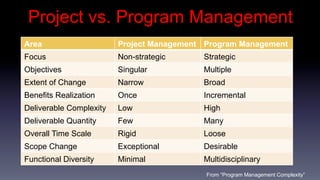
Project vs. Program Management
Area                     Project Management Program Management
Focus                    Non-strategic     Strategic
Objectives               Singular          Multiple
Extent of Change         Narrow            Broad
Benefits Realization     Once              Incremental
Deliverable Complexity   Low               High
Deliverable Quantity     Few               Many
Overall Time Scale       Rigid             Loose
Scope Change             Exceptional       Desirable
Functional Diversity     Minimal           Multidisciplinary
                                            From “Program Management Complexity”
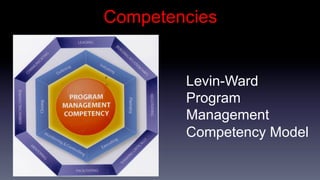
Competencies


        Levin-Ward
        Program
        Management
        Competency Model
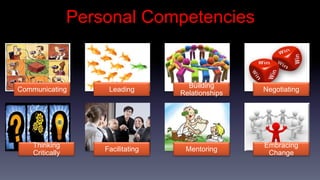
Personal Competencies


                                      Building
Communicating         Leading                       Negotiating
                                    Relationships


    Thinking                                        Embracing
                     Facilitating    Mentoring
    Critically                                       Change
Communicating
•  Actively listens, understands, and responds to
   stakeholders
•  Uses the key channels of communication
•  Ensures the quality of the information that is
   communicated
•  Tailors the information to the audience
•  Effectively uses each of the different communications
   dimensions
Leading

•  Implements the program’s vision
•  Establishes the program’s direction
•  Recognizes the interdependencies within the
   program
•  Takes calculated risks; is venturesome
•  Assumes ownership of the program
Building Relationships
•  Builds trust among stakeholders, clients, and team members
•  Leverages the organization’ political dynamics to promote
   program goals
•  Advocates for diversity and treats others with courtesy and
   respect
•  Establishes and demonstrated high standards for personal
   and team member performance
•  Promotes and demonstrated ethics, integrity, and adherence
   to corporate values in all interactions
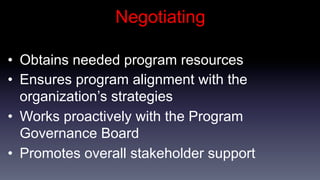
Negotiating

•  Obtains needed program resources
•  Ensures program alignment with the
   organization’s strategies
•  Works proactively with the Program
   Governance Board
•  Promotes overall stakeholder support
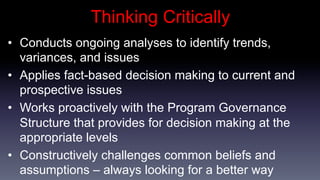
Thinking Critically
•  Conducts ongoing analyses to identify trends,
   variances, and issues
•  Applies fact-based decision making to current and
   prospective issues
•  Works proactively with the Program Governance
   Structure that provides for decision making at the
   appropriate levels
•  Constructively challenges common beliefs and
   assumptions – always looking for a better way
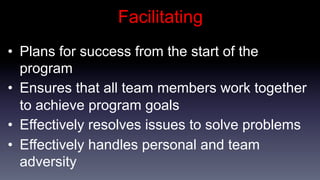
Facilitating
•  Plans for success from the start of the
   program
•  Ensures that all team members work together
   to achieve program goals
•  Effectively resolves issues to solve problems
•  Effectively handles personal and team
   adversity
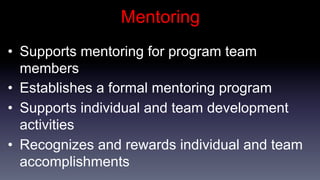
Mentoring
•  Supports mentoring for program team
   members
•  Establishes a formal mentoring program
•  Supports individual and team development
   activities
•  Recognizes and rewards individual and team
   accomplishments
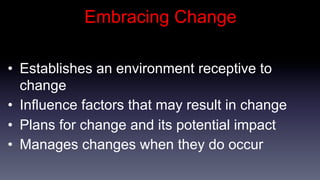
Embracing Change

•  Establishes an environment receptive to
   change
•  Influence factors that may result in change
•  Plans for change and its potential impact
•  Manages changes when they do occur
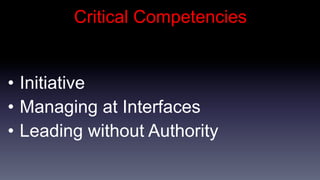
Critical Competencies


•  Initiative
•  Managing at Interfaces
•  Leading without Authority
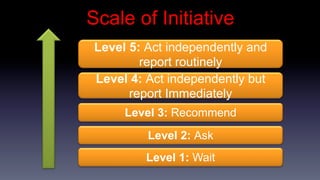
Scale of Initiative
Level 5: Act independently and
        report routinely
Level 4: Act independently but
      report Immediately
     Level 3: Recommend
         Level 2: Ask
         Level 1: Wait
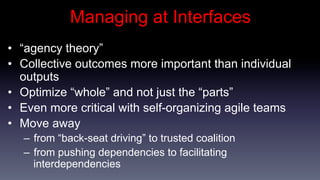
Managing at Interfaces
•  “agency theory”
•  Collective outcomes more important than individual
   outputs
•  Optimize “whole” and not just the “parts”
•  Even more critical with self-organizing agile teams
•  Move away
   –  from “back-seat driving” to trusted coalition
   –  from pushing dependencies to facilitating
      interdependencies
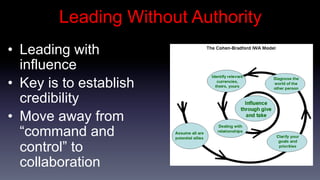
Leading Without Authority
•  Leading with
   influence
•  Key is to establish
   credibility
•  Move away from
   “command and
   control” to
   collaboration
Conclusions

•  Program management is all about leading
   without authority to create collaboration
   among component teams by managing at
   interfaces to maximize program benefits
   realization
•  Skills are far more important than any
   process
Further Reading
•    Manage It! – Johanna Rothman
•    Program Management Complexity: A Competency Model – Ginger Levin and J. LeRoy
     Ward
•    The Agile PMO – Adrian Quinney
•    An Agile PMO – Mike Griffiths
•    PM at Microsoft – Steven Sinofsky
•    Agile Program Management Best Practices – Pete Behrens
•    Agile Program Management: Another Approach to Large Project – Johanna Rothman
•    Project Management vs. Program Management – Tathagat Varma
•    What are the Program Management Competencies – Tathagat Varma
Connect


           Twitter: @tathagatvarma
         Blog: http://managewell.net
     Email: tathagat.varma@gmail.com
Presentation: http://slideshare.net/managewell

Program management skills

  • 1.
    Program Management Skills Tathagat Varma Sr Director, Strategic Programs and Biz Ops Yahoo! India R&D
  • 2.
    Project vs. ProgramManagement Area Project Management Program Management Focus Non-strategic Strategic Objectives Singular Multiple Extent of Change Narrow Broad Benefits Realization Once Incremental Deliverable Complexity Low High Deliverable Quantity Few Many Overall Time Scale Rigid Loose Scope Change Exceptional Desirable Functional Diversity Minimal Multidisciplinary From “Program Management Complexity”
  • 3.
    Competencies Levin-Ward Program Management Competency Model
  • 4.
    Personal Competencies Building Communicating Leading Negotiating Relationships Thinking Embracing Facilitating Mentoring Critically Change
  • 5.
    Communicating •  Actively listens,understands, and responds to stakeholders •  Uses the key channels of communication •  Ensures the quality of the information that is communicated •  Tailors the information to the audience •  Effectively uses each of the different communications dimensions
  • 6.
    Leading •  Implements theprogram’s vision •  Establishes the program’s direction •  Recognizes the interdependencies within the program •  Takes calculated risks; is venturesome •  Assumes ownership of the program
  • 7.
    Building Relationships •  Buildstrust among stakeholders, clients, and team members •  Leverages the organization’ political dynamics to promote program goals •  Advocates for diversity and treats others with courtesy and respect •  Establishes and demonstrated high standards for personal and team member performance •  Promotes and demonstrated ethics, integrity, and adherence to corporate values in all interactions
  • 8.
    Negotiating •  Obtains neededprogram resources •  Ensures program alignment with the organization’s strategies •  Works proactively with the Program Governance Board •  Promotes overall stakeholder support
  • 9.
    Thinking Critically •  Conductsongoing analyses to identify trends, variances, and issues •  Applies fact-based decision making to current and prospective issues •  Works proactively with the Program Governance Structure that provides for decision making at the appropriate levels •  Constructively challenges common beliefs and assumptions – always looking for a better way
  • 10.
    Facilitating •  Plans forsuccess from the start of the program •  Ensures that all team members work together to achieve program goals •  Effectively resolves issues to solve problems •  Effectively handles personal and team adversity
  • 11.
    Mentoring •  Supports mentoringfor program team members •  Establishes a formal mentoring program •  Supports individual and team development activities •  Recognizes and rewards individual and team accomplishments
  • 12.
    Embracing Change •  Establishesan environment receptive to change •  Influence factors that may result in change •  Plans for change and its potential impact •  Manages changes when they do occur
  • 13.
    Critical Competencies •  Initiative • Managing at Interfaces •  Leading without Authority
  • 14.
    Scale of Initiative Level5: Act independently and report routinely Level 4: Act independently but report Immediately Level 3: Recommend Level 2: Ask Level 1: Wait
  • 15.
    Managing at Interfaces • “agency theory” •  Collective outcomes more important than individual outputs •  Optimize “whole” and not just the “parts” •  Even more critical with self-organizing agile teams •  Move away –  from “back-seat driving” to trusted coalition –  from pushing dependencies to facilitating interdependencies
  • 16.
    Leading Without Authority • Leading with influence •  Key is to establish credibility •  Move away from “command and control” to collaboration
  • 17.
    Conclusions •  Program managementis all about leading without authority to create collaboration among component teams by managing at interfaces to maximize program benefits realization •  Skills are far more important than any process
  • 18.
    Further Reading •  Manage It! – Johanna Rothman •  Program Management Complexity: A Competency Model – Ginger Levin and J. LeRoy Ward •  The Agile PMO – Adrian Quinney •  An Agile PMO – Mike Griffiths •  PM at Microsoft – Steven Sinofsky •  Agile Program Management Best Practices – Pete Behrens •  Agile Program Management: Another Approach to Large Project – Johanna Rothman •  Project Management vs. Program Management – Tathagat Varma •  What are the Program Management Competencies – Tathagat Varma
  • 19.
    Connect Twitter: @tathagatvarma Blog: http://managewell.net Email: tathagat.varma@gmail.com Presentation: http://slideshare.net/managewell