Generative Artificial Intelligence (GenAI) in Business
My talk for the Indian School of Business (ISB) Emerging Leaders Program Cohort 9. In this talk, I discussed key issues around adoption of GenAI in business - benefits, opportunities and limitations. I also discussed how my research on Theory of Cognitive Chasms helps address some of these issues
GenAI: The New
ShinyPenny?
Several Trillion $$$s of
economic impact
projected.
30% growth expected in
2024: Over $20bn VC
funding in the first three
quarters.
Capex of $1tn+
expected in the coming
years!
4.
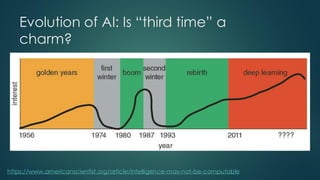
Evolution of AI:Is “third time” a
charm?
https://www.americanscientist.org/article/intelligence-may-not-be-computable
5.
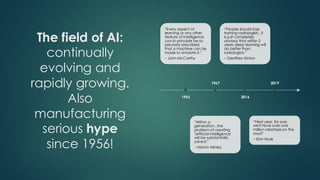
The field ofAI:
continually
evolving and
rapidly growing.
Also
manufacturing
serious hype
since 1956!
1956
“Every aspect of
learning or any other
feature of intelligence
can in principle be so
precisely described
that a machine can be
made to simulate it.”
– John McCarthy
1967
“Within a
generation...the
problem of creating
'artificial intelligence'
will be substantially
solved.”
– Marvin Minsky
2016
“People should stop
training radiologists...it
is just completely
obvious that within 5
years deep learning will
do better than
radiologists.”
– Geoffrey Hinton
2019
“Next year, for sure,
we'll have over one
million robotaxis on the
road”
– Elon Musk
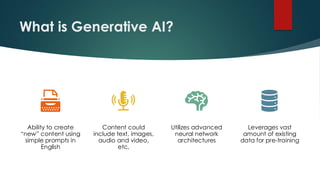
What is GenerativeAI?
Ability to create
“new” content using
simple prompts in
English
Content could
include text, images,
audio and video,
etc.
Utilizes advanced
neural network
architectures
Leverages vast
amount of existing
data for pre-training
12.
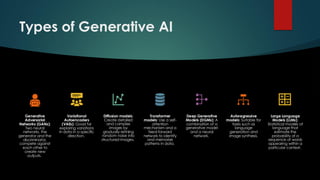
Types of GenerativeAI
Generative
Adversarial
Networks (GANs):
Two neural
networks, the
generator and the
discriminator,
compete against
each other to
create new
outputs.
Variational
Autoencoders
(VAEs): Good for
exploring variations
in data in a specific
direction.
Diffusion models:
Create detailed
and complex
images by
gradually refining
random noise into
structured images.
Transformer
models: Use a self-
attention
mechanism and a
feed-forward
network to identify
and memorize
patterns in data.
Deep Generative
Models (DGMs): A
combination of a
generative model
and a neural
network.
Autoregressive
models: Suitable for
tasks such as
language
generation and
image synthesis.
Large Language
Models (LLMs):
Statistical models of
language that
estimate the
probability of a
sequence of words
appearing within a
particular context.
13.
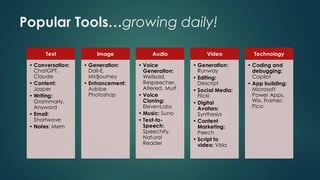
Popular Tools…growing daily!
Text
•Conversation:
ChatGPT,
Claude
• Content:
Jasper
• Writing:
Grammarly,
Anyword
• Email:
Shortwave
• Notes: Mem
Image
• Generation:
Dall-E,
Midjourney
• Enhancement:
Adobe
Photoshop
Audio
• Voice
Generation:
Wellsaid,
Respeecher,
Altered, Murf
• Voice
Cloning:
ElevenLabs
• Music: Suno
• Text-to-
Speech:
Speechify,
Natural
Reader
Video
• Generation:
Runway
• Editing:
Descript
• Social Media:
Flicki
• Digital
Avatars:
Synthesia
• Content
Marketing:
Peech
• Script to
video: Visla
Technology
• Coding and
debugging:
Copilot
• App building:
Microsoft
Power Apps,
Wix, Framer,
Pico
14.
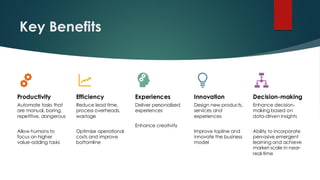
Key Benefits
Productivity
Automate tasksthat
are manual, boring,
repetitive, dangerous
Allow humans to
focus on higher
value-adding tasks
Efficiency
Reduce lead time,
process overheads,
wastage
Optimize operational
costs and improve
bottomline
Experiences
Deliver personalized
experiences
Enhance creativity
Innovation
Design new products,
services and
experiences
Improve topline and
innovate the business
model
Decision-making
Enhance decision-
making based on
data-driven insights
Ability to incorporate
pervasive emergent
learning and achieve
market-scale in near-
real-time
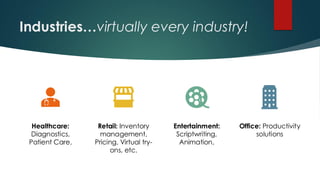
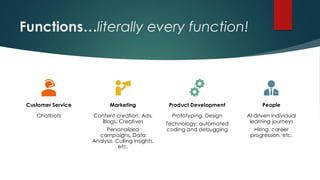
Functions…literally every function!
CustomerService
Chatbots
Marketing
Content creation: Ads,
Blogs, Creatives
Personalized
campaigns, Data
Analysis, Culling insights,
etc.
Product Development
Prototyping, Design
Technology: automated
coding and debugging
People
AI-driven individual
learning journeys
Hiring, career
progression, etc.
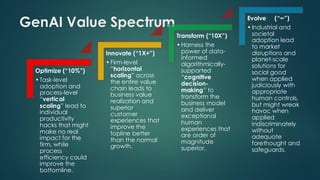
GenAI Value Spectrum
Optimize(“10%”)
•Task-level
adoption and
process-level
“vertical
scaling” lead to
individual
productivity
hacks that might
make no real
impact for the
firm, while
process
efficiency could
improve the
bottomline.
Innovate (“1X+”)
•Firm-level
“horizontal
scaling” across
the entire value
chain leads to
business value
realization and
superior
customer
experiences that
improve the
topline better
than the normal
growth.
Transform (“10X”)
•Harness the
power of data-
informed
algorithmically-
supported
“cognitive
decision-
making” to
transform the
business model
and deliver
exceptional
human
experiences that
are order of
magnitude
superior.
Evolve (“∞”)
•Industrial and
societal
adoption lead
to market
disruptions and
planet-scale
solutions for
social good
when applied
judiciously with
appropriate
human controls,
but might wreak
havoc when
applied
indiscriminately
without
adequate
forethought and
safeguards.
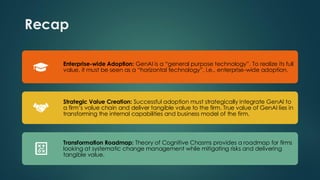
Recap
Enterprise-wide Adoption: GenAIis a “general purpose technology”. To realize its full
value, it must be seen as a “horizontal technology”, i.e., enterprise-wide adoption.
Strategic Value Creation: Successful adoption must strategically integrate GenAI to
a firm’s value chain and deliver tangible value to the firm. True value of GenAI lies in
transforming the internal capabilities and business model of the firm.
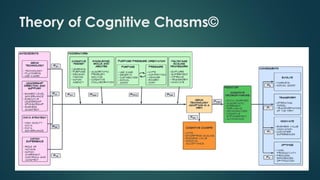
Transformation Roadmap: Theory of Cognitive Chasms provides a roadmap for firms
looking at systematic change management while mitigating risks and delivering
tangible value.