
Intrusion Detection Using Data
Mining Approach
Submitted By:
Suraj Singh Chauhan
Enroll. No.:9911103578
Submitted To:
Ms. Kritika Mehta
Outline
 Introduction
 A Frame for Intrusion Detection System
 Intrusion Detection Techniques
What is the Intrusion Detection
 Intrusions are the activities that violate the
security policy of system.
 Intrusion Detection is the process used to
identify intrusions.
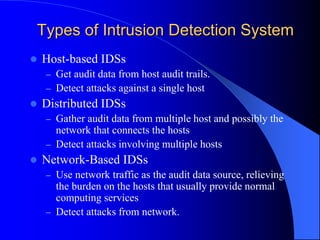
Types of Intrusion Detection System
Based on the sources of the audit information
used by each IDS, the IDSs may be classified
into
– Host-base IDSs
– Distributed IDSs
– Network-based IDSs
 Host-based IDSs
– Get audit data from host audit trails.
– Detect attacks against a single host
 Distributed IDSs
– Gather audit data from multiple host and possibly the
network that connects the hosts
– Detect attacks involving multiple hosts
 Network-Based IDSs
– Use network traffic as the audit data source, relieving
the burden on the hosts that usually provide normal
computing services
– Detect attacks from network.
Types of Intrusion Detection System
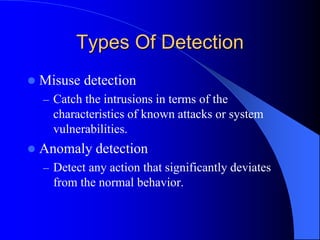
Types Of Detection
 Misuse detection
– Catch the intrusions in terms of the
characteristics of known attacks or system
vulnerabilities.
 Anomaly detection
– Detect any action that significantly deviates
from the normal behavior.
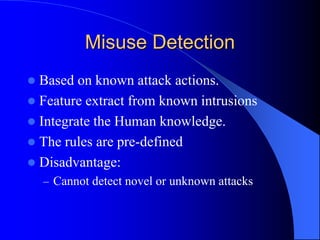
Misuse Detection
 Based on known attack actions.
 Feature extract from known intrusions
 Integrate the Human knowledge.
 The rules are pre-defined
 Disadvantage:
– Cannot detect novel or unknown attacks
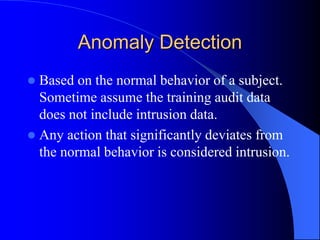
Anomaly Detection
 Based on the normal behavior of a subject.
Sometime assume the training audit data
does not include intrusion data.
 Any action that significantly deviates from
the normal behavior is considered intrusion.
The Frame for Intrusion
Detection
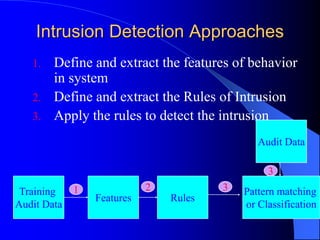
Intrusion Detection Approaches
1. Define and extract the features of behavior
in system
2. Define and extract the Rules of Intrusion
3. Apply the rules to detect the intrusion
Training
Audit Data
Features Rules
Audit Data
Pattern matching
or Classification
1
3
32
Intrusion Detection Techniques
 Pattern Matching
 Measure Based method
 Data Mining method
 Machine Learning Method
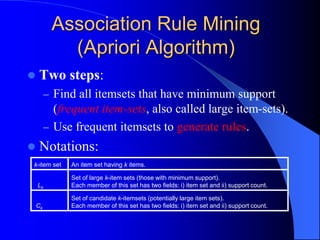
Association Rule Mining
(Apriori Algorithm)
 Two steps:
– Find all itemsets that have minimum support
(frequent item-sets, also called large item-sets).
– Use frequent itemsets to generate rules.
 Notations:
k-item set An item set having k items.
Lk
Set of large k-item sets (those with minimum support).
Each member of this set has two fields: i) item set and ii) support count.
Ck
Set of candidate k-itemsets (potentially large item sets).
Each member of this set has two fields: i) item set and ii) support count.
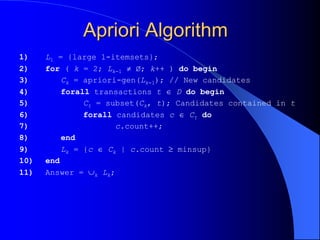
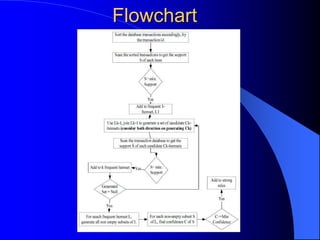
Apriori Algorithm
1) L1 = {large 1-itemsets};
2) for ( k = 2; Lk-1  Ø; k++ ) do begin
3) Ck = apriori-gen(Lk-1); // New candidates
4) forall transactions t  D do begin
5) Ct = subset(Ck, t); Candidates contained in t
6) forall candidates c  Ct do
7) c.count++;
8) end
9) Lk = {c  Ck | c.count  minsup}
10) end
11) Answer = k Lk;
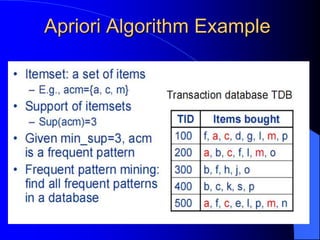
Apriori Algorithm Example
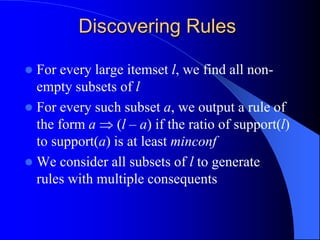
Discovering Rules
 For every large itemset l, we find all non-
empty subsets of l
 For every such subset a, we output a rule of
the form a  (l – a) if the ratio of support(l)
to support(a) is at least minconf
 We consider all subsets of l to generate
rules with multiple consequents
Flowchart
Reference
 Liu Hong (Liaoning Jianzhu Vocational University), “Based on the user
behavior characteristics of mining database anomaly detection model design”,
6th International Conference on Information Management, Innovation
Management and Industrial Engineering, 978-1-4799-6594-6/14/$31.00 ©2014
IEEE.
 P.E. Elaziz, M. sobh and HK. Mohamed, “Database Intrusion Detection Using
Sequential Data Mining Approaches”, 978-1-4799-6594-6/14/$31.00 ©2014
IEEE.
 S. M. Darwish, S. K. Guirguis and M. Ghozlan, “Intrusion Detection in Role
Administrated Database:Transaction-Based Approach”,978-1-4799-0080-
0/13/$31.00 ©2013 IEEE.
 A.C. Pathan and M. A. Potey ,“Detection Of Malicious Transaction In
Database Using Log Mining Approach”, 2014 International Conference on
Electronic Systems, Signal Processing and Computing Technologies, 978-1-
4799-2102-7/14 $31.00 © 2014 IEEE.
 R Shrivastava1, J Bhattacharyji, R.Soni,“ Recognition and Deterrence of SQL
injection attacks in database using web service”, IJSWS 12-204, © 2012.
Thank you!

Databse Intrusion Detection Using Data Mining Approach

  • 1.
    Intrusion Detection UsingData Mining Approach Submitted By: Suraj Singh Chauhan Enroll. No.:9911103578 Submitted To: Ms. Kritika Mehta
  • 2.
    Outline  Introduction  AFrame for Intrusion Detection System  Intrusion Detection Techniques
  • 3.
    What is theIntrusion Detection  Intrusions are the activities that violate the security policy of system.  Intrusion Detection is the process used to identify intrusions.
  • 4.
    Types of IntrusionDetection System Based on the sources of the audit information used by each IDS, the IDSs may be classified into – Host-base IDSs – Distributed IDSs – Network-based IDSs
  • 5.
     Host-based IDSs –Get audit data from host audit trails. – Detect attacks against a single host  Distributed IDSs – Gather audit data from multiple host and possibly the network that connects the hosts – Detect attacks involving multiple hosts  Network-Based IDSs – Use network traffic as the audit data source, relieving the burden on the hosts that usually provide normal computing services – Detect attacks from network. Types of Intrusion Detection System
  • 6.
    Types Of Detection Misuse detection – Catch the intrusions in terms of the characteristics of known attacks or system vulnerabilities.  Anomaly detection – Detect any action that significantly deviates from the normal behavior.
  • 7.
    Misuse Detection  Basedon known attack actions.  Feature extract from known intrusions  Integrate the Human knowledge.  The rules are pre-defined  Disadvantage: – Cannot detect novel or unknown attacks
  • 8.
    Anomaly Detection  Basedon the normal behavior of a subject. Sometime assume the training audit data does not include intrusion data.  Any action that significantly deviates from the normal behavior is considered intrusion.
  • 9.
    The Frame forIntrusion Detection
  • 10.
    Intrusion Detection Approaches 1.Define and extract the features of behavior in system 2. Define and extract the Rules of Intrusion 3. Apply the rules to detect the intrusion Training Audit Data Features Rules Audit Data Pattern matching or Classification 1 3 32
  • 11.
  • 12.
    Intrusion Detection Techniques Pattern Matching  Measure Based method  Data Mining method  Machine Learning Method
  • 13.
    Association Rule Mining (AprioriAlgorithm)  Two steps: – Find all itemsets that have minimum support (frequent item-sets, also called large item-sets). – Use frequent itemsets to generate rules.  Notations: k-item set An item set having k items. Lk Set of large k-item sets (those with minimum support). Each member of this set has two fields: i) item set and ii) support count. Ck Set of candidate k-itemsets (potentially large item sets). Each member of this set has two fields: i) item set and ii) support count.
  • 14.
    Apriori Algorithm 1) L1= {large 1-itemsets}; 2) for ( k = 2; Lk-1  Ø; k++ ) do begin 3) Ck = apriori-gen(Lk-1); // New candidates 4) forall transactions t  D do begin 5) Ct = subset(Ck, t); Candidates contained in t 6) forall candidates c  Ct do 7) c.count++; 8) end 9) Lk = {c  Ck | c.count  minsup} 10) end 11) Answer = k Lk;
  • 15.
  • 16.
    Discovering Rules  Forevery large itemset l, we find all non- empty subsets of l  For every such subset a, we output a rule of the form a  (l – a) if the ratio of support(l) to support(a) is at least minconf  We consider all subsets of l to generate rules with multiple consequents
  • 17.
  • 18.
    Reference  Liu Hong(Liaoning Jianzhu Vocational University), “Based on the user behavior characteristics of mining database anomaly detection model design”, 6th International Conference on Information Management, Innovation Management and Industrial Engineering, 978-1-4799-6594-6/14/$31.00 ©2014 IEEE.  P.E. Elaziz, M. sobh and HK. Mohamed, “Database Intrusion Detection Using Sequential Data Mining Approaches”, 978-1-4799-6594-6/14/$31.00 ©2014 IEEE.  S. M. Darwish, S. K. Guirguis and M. Ghozlan, “Intrusion Detection in Role Administrated Database:Transaction-Based Approach”,978-1-4799-0080- 0/13/$31.00 ©2013 IEEE.  A.C. Pathan and M. A. Potey ,“Detection Of Malicious Transaction In Database Using Log Mining Approach”, 2014 International Conference on Electronic Systems, Signal Processing and Computing Technologies, 978-1- 4799-2102-7/14 $31.00 © 2014 IEEE.  R Shrivastava1, J Bhattacharyji, R.Soni,“ Recognition and Deterrence of SQL injection attacks in database using web service”, IJSWS 12-204, © 2012.
  • 19.