1
INTRUSION DETECTION
SYSTEM FOR WSN: A REVIEW
Nikhil Singh
M.Tech Student, AMU, Aligarh
2
• Introduction
• Attacks in WSN
• Analysis of Recent Intrusion Detection System
• Conclusion
• References
Outline
Introduction
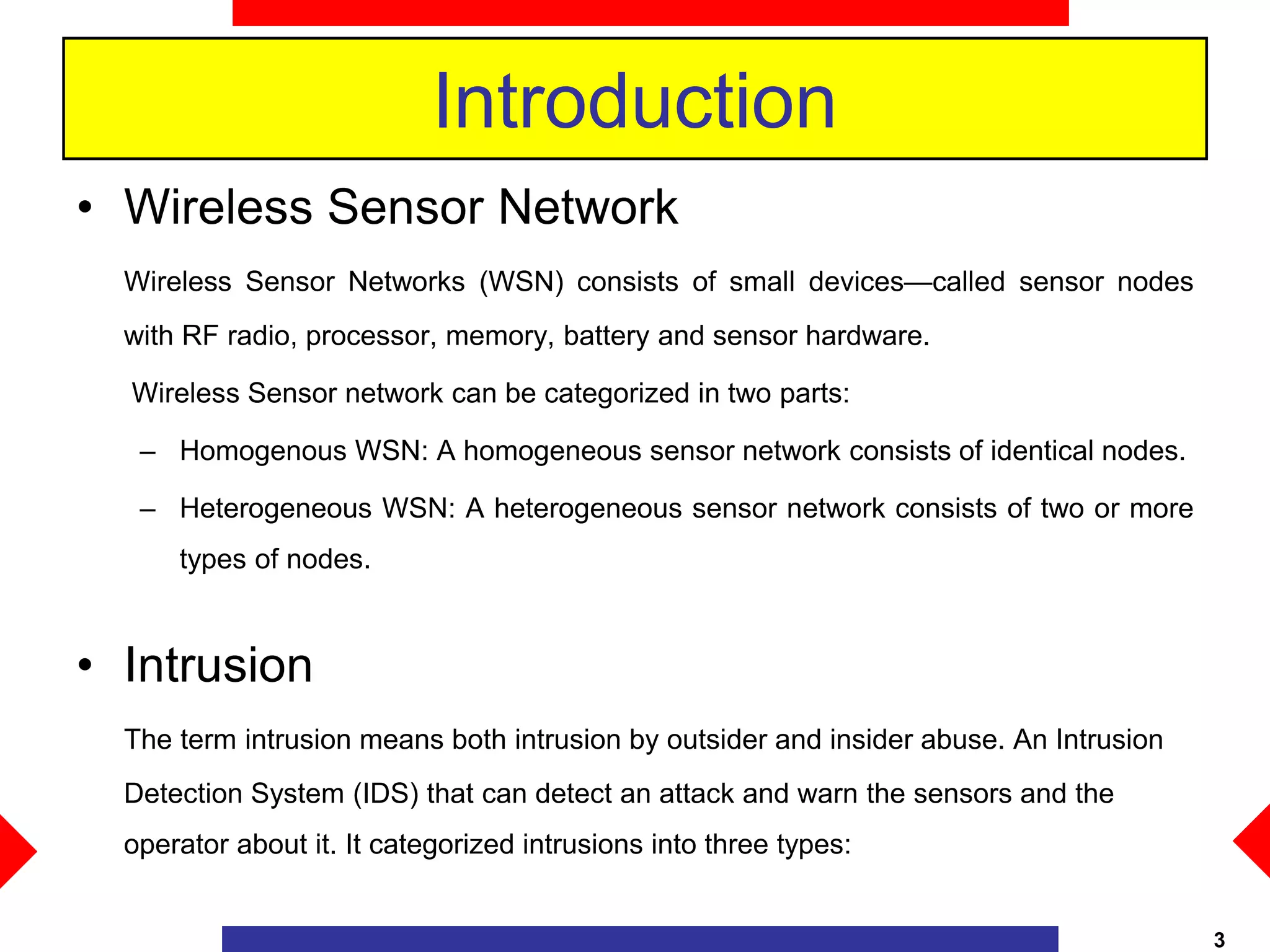
• Wireless Sensor Network
Wireless Sensor Networks (WSN) consists of small devices—called sensor nodes
with RF radio, processor, memory, battery and sensor hardware.
Wireless Sensor network can be categorized in two parts:
– Homogenous WSN: A homogeneous sensor network consists of identical nodes.
– Heterogeneous WSN: A heterogeneous sensor network consists of two or more
types of nodes.
• Intrusion
The term intrusion means both intrusion by outsider and insider abuse. An Intrusion
Detection System (IDS) that can detect an attack and warn the sensors and the
operator about it. It categorized intrusions into three types:
3
Introduction
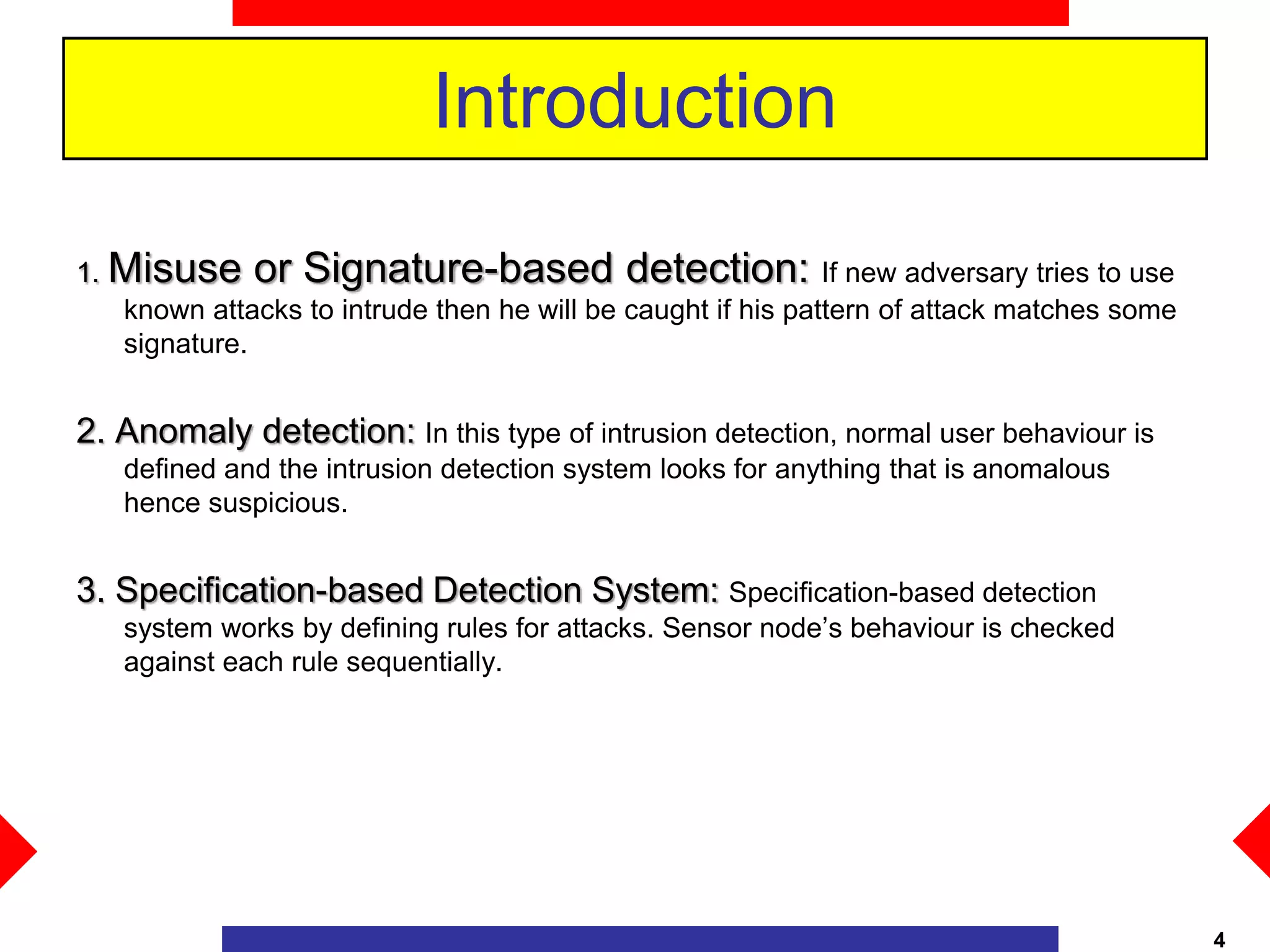
1. Misuse or Signature-based detection: If new adversary tries to use
known attacks to intrude then he will be caught if his pattern of attack matches some
signature.
2. Anomaly detection: In this type of intrusion detection, normal user behaviour is
defined and the intrusion detection system looks for anything that is anomalous
hence suspicious.
3. Specification-based Detection System: Specification-based detection
system works by defining rules for attacks. Sensor node’s behaviour is checked
against each rule sequentially.
4
Attacks in WSN
We focus on active external and internal attackers (insiders) as they
are able to run more convenient attacks and the intrusion detection
system is deployed to defend against these attack. Some of major
attacks such as
1. Active Attacks
2. Passive Attacks
3. Jamming attack
4. Hello flood attack
5. Selective forwarding
5
Attacks in WSN
6.Sinkhole attack
7.Packet alteration
8.Denial of service Attack (DoS)
9.Worm holes
10.Looping
6
Analysis of Recent IDS in WSN
7
S.No. Intruder Detection System Advantage Disadvantage Future Scope
1. Semantic IDS[7],[22] Energy Efficient Not Specific
Decision Making
Functions
Use more complex
semantics for
security
2. Simple Learning Automata
IDS[8],[24]
a. Energy efficient
b. Optimized
efficient packet
sample.
Increased
computational
complexity
Can be used by
more application
which uses WSN
3. Location Aware Trust based
IDS[9]
a. Monitoring on
the basis of
Reputation
b. enhance integrity
c. Efficiently detect
Malicious node.
Not Energy
efficient
Verification and
Trusted Protocol
can be used for
future research
Analysis of Recent IDS in WSN
8
S.No. Intruder Detection System Advantage Disadvantage Future Scope
4. Isolation table based IDS[10] a. Accurate
transmission
b.More effective in
case of live node.
Unreliable in case
of less sensor
nodes.
Isolation technique
can be extended.
5. Ranger based IDS[11] Energy efficient in
light weight model
Focuses only Sybil
attack.
Can be used by
many other
protocol to evaluate
performance
6. Hierarchical overlay design
based IDS[12]
a. Fast
b. effective
c. energy efficient
d. reliable
Cost increased
depends on
policies.
Voting and election
policy will be used.
Analysis of Recent IDS in WSN
9
S.No. Intruder Detection System Advantage Disadvantage Future Scope
7. Hybrid IDS[13],[23] a. More accurate
b. high detection
rate
c. Increased
network lifetime
Simulation is not
used for
performance
evaluation
Rule based
approach will be
extended according
to data mining.
8. Weighted Trust Evaluation based
IDS[14]
a. Little overhead
in light weight
model.
b. easily nodes
detection the basis
of behaviour
High misdetection
rate.
Performance
evaluation research
is going on
9. Dynamic model of IDS[15] More secure, stable
and robust compare
with static IDS
a. Time consuming
b. not energy
efficient
Can be applying on
real application.
Analysis of Recent IDS in WSN
10
S.No. Intruder Detection System Advantage Disadvantage Future Scope
10. Novel anomaly IDS[17],[25] a. Low memory usage
b. High detection
accuracy
c. low false alarm
probability
a. Doesn’t require a
specification file for
behaviour
b. define only for
small to middle size
WSN
Can be extended for
specification anomaly
11. Embedded system based IDS
(community IDS)[18]
a. lower power usage
b. lower cost
c. improved security
defence ability of
system.
d. lower computer
node
Depend only image
processing arithmetic
for analyzing the
information
Sensing range can be
extended using ranger
IDS
12. Immunity based IDS[19] a. more robust,
adaptive
b. high accuracy in
attack detection
c. use co-stimulation
for reducing no. of
false positive.
Accurate high only
with the immune
algorithm.
Other beaconing
protocol can be used
Conclusion
11
• We present a brief review of recent attacks and recent works on
different approach of IDS for wireless Sensor Network.
• The need of the day is an IDS for detecting intrusion accurately in an
energy- efficient manner.
• Scope for future is to make one IDS which utilizes less resource
(energy) and provide better security. This paper helps to make an
efficient Intruder detector system.
References
[7]. Yuxin Mao, “A Semantic-based Intrusion Detection Framework for Wireless Sensor Network”, Proceeding of sixth
International Conference on Networked Computing (INC),pp. 28-36, June 2010.
[8]. Sudip Misra, P. Venkata Krishna and Kiran Isaac Abraham, “Energy Efficient Learning Solution for Intrusion
Detection in Wireless Sensor Networks”, Proceedings of the 2nd international conference on Communication
systems and Networks, pp. 36-42, September 2010.
[9]. Garth V. Crosby, Lance Hester, and Niki Pissinou, “Location-aware, Trust-based Detection and Isolation of
Compromised Nodes in Wireless Sensor Networks”, Proceeding of International Journal of Network Security,
pp.107- 117,March 2011.
[10]. Rung-Ching Chen, Chia-Fen Hsieh and Yung-Fa Huang, “An Isolation Intrusion Detection System for Hierarchical
Wireless Sensor Network”, Proceeding of Journal of Networks, pp.29-37, March 2010.
[11]. Rung-Ching Chen, Yung-Fa Huang, Chia-Fen Hsieh, “Ranger Intrusion Detection System for Wireless Sensor
Networks with Sybil Attack Based on Ontology”, Proceeding of New Aspects of Applied Informatics, Biomedical
Electronics and Informatics and Communications ,pp. 219-227, April 2010.
[12]. Mohammad Saiful Islam Mamun, A.F.M. Sultanul Kabir, “Hierarchical Design Based Intrusion Detection System
For Wireless Ad Hoc Sensor Network”, Proceeding of International Journal of Network Security & Its Applications
(IJNSA), pp. 113-121, July 2010.
[13]. K.Q. Yan, S.C. Wang, C.W. Liu, “A Hybrid Intrusion Detection System of Cluster-based Wireless Sensor
Networks”, Proceedings of the International Multi Conference of Engineers and Computer Scientists, pp. 67-71,
March 2009.
[14]. Idris M. Atakli , Hongbing Hu, Yu Chen, Wei-Shinn Ku, Zhou Su “Malicious Node Detection in Wireless Sensor
Networks using Weighted Trust Evaluation”, The Symposium on Simulation of Systems Security (SSSS’08) ,April
2008
[15]. Guangcheng Huo, Xiaodong Wang, “DIDS: A Dynamic Model of Intrusion Detection System in Wireless Sensor
Networks”, IEEE, International Conference on Information and Automation, pp. 56-64, June 2008.
[16]. A.H. Farooqi, F.A. Khan, “Intrusion Detection Systems for Wireless Sensor Networks: A Survey”, Proceeding of
Communication and Networking International Conference, FGCN/ACN, pp. 234-241,December 2009.
12
References
[17]. Chun-ming Rong , Skjalg Eggen , Hong-bing Cheng, “A Novel Intrusion Detection Algorithm for Wireless Sensor
networks” Proceeding of 2nd International Conference on Wireless Communication, Vehicular Technology,
Information Theory and Aerospace & Electronics Systems Technology (Wireless VITAE), pp. 1 – 7 , March 2011.
[18]. Meijuan Gao, Kai Li, Jingwen Tian, “ Wireless Sensor Network for Community Intrusion Detection System based
on Embedded System” Proceeding of Control and Decision Conference, pp. 4696 - 4699 , July 2008.
[19]. Yang Liu and Fengqi Yu,“ Immunity-Based Intrusion Detection for Wireless Sensor Networks” Proceeding of IEEE
International Joint Conference on Neural Networks, pp. 439 - 444, June 2008.
[20]. S.V.Patel, Kamlendu Pandey and Dr V R Rathod , “A Decentralised Clustered and Hash based Intrusion Detection
System for Wireless Sensor Networks” Proceeding of Fourth International Conference on Wireless
Communication and Sensor Networks, pp. 27 - 30 , December 2008.
[21]. Mounib Khanafer, Mouhcine Guennoun, Hussein T. Mouftah, “Intrusion Detection System for WSN-based
Intelligent Transportation Systems” Proceeding of IEEE Global Telecommunications Conference, pp. 1 - 6 ,
December 2010.
[22]. M. Poorani, V. Vaidehi, M. Rajesh, Bharghavi, Mr. Balamuralidhar and Dr.Girish Chandra, “Semantic Intruder
Detection System in WSN” Proceeding of second International Conference on Advanced Computing (ICoAC), pp.
26 - 32 , December 2010.
[23]. Abror Abduvaliyev, Sungyoung Lee, Young-Koo Lee, “Energy Efficient Hybrid Intrusion Detection System for
Wireless Sensor Networks” Proceeding of International Conference On Electronics and Information Engineering
(ICEIE), pp. V2-25 - V2-29 , August 2010.
[24]. Zhenwei Yu, Jeffrey J.P. Tsai,“A Framework of Machine Learning Based Intrusion Detection for Wireless Sensor
Networks” Proceeding of IEEE International Conference on Sensor Networks, Ubiquitous and Trustworthy
Computing, pp. 272 - 279 , June 2008.
[25]. Ilkar Onat, Ali Miri,“ An Intrusion Detection system for wireless sensor networks”, Proceedings of IEEE
International Conference on wireless and mobile computing networking and communication, pp.253-259,August
2005.
13
THANK YOU
14

Intrusion detection system

  • 1.
    1 INTRUSION DETECTION SYSTEM FORWSN: A REVIEW Nikhil Singh M.Tech Student, AMU, Aligarh
  • 2.
    2 • Introduction • Attacksin WSN • Analysis of Recent Intrusion Detection System • Conclusion • References Outline
  • 3.
    Introduction • Wireless SensorNetwork Wireless Sensor Networks (WSN) consists of small devices—called sensor nodes with RF radio, processor, memory, battery and sensor hardware. Wireless Sensor network can be categorized in two parts: – Homogenous WSN: A homogeneous sensor network consists of identical nodes. – Heterogeneous WSN: A heterogeneous sensor network consists of two or more types of nodes. • Intrusion The term intrusion means both intrusion by outsider and insider abuse. An Intrusion Detection System (IDS) that can detect an attack and warn the sensors and the operator about it. It categorized intrusions into three types: 3
  • 4.
    Introduction 1. Misuse orSignature-based detection: If new adversary tries to use known attacks to intrude then he will be caught if his pattern of attack matches some signature. 2. Anomaly detection: In this type of intrusion detection, normal user behaviour is defined and the intrusion detection system looks for anything that is anomalous hence suspicious. 3. Specification-based Detection System: Specification-based detection system works by defining rules for attacks. Sensor node’s behaviour is checked against each rule sequentially. 4
  • 5.
    Attacks in WSN Wefocus on active external and internal attackers (insiders) as they are able to run more convenient attacks and the intrusion detection system is deployed to defend against these attack. Some of major attacks such as 1. Active Attacks 2. Passive Attacks 3. Jamming attack 4. Hello flood attack 5. Selective forwarding 5
  • 6.
    Attacks in WSN 6.Sinkholeattack 7.Packet alteration 8.Denial of service Attack (DoS) 9.Worm holes 10.Looping 6
  • 7.
    Analysis of RecentIDS in WSN 7 S.No. Intruder Detection System Advantage Disadvantage Future Scope 1. Semantic IDS[7],[22] Energy Efficient Not Specific Decision Making Functions Use more complex semantics for security 2. Simple Learning Automata IDS[8],[24] a. Energy efficient b. Optimized efficient packet sample. Increased computational complexity Can be used by more application which uses WSN 3. Location Aware Trust based IDS[9] a. Monitoring on the basis of Reputation b. enhance integrity c. Efficiently detect Malicious node. Not Energy efficient Verification and Trusted Protocol can be used for future research
  • 8.
    Analysis of RecentIDS in WSN 8 S.No. Intruder Detection System Advantage Disadvantage Future Scope 4. Isolation table based IDS[10] a. Accurate transmission b.More effective in case of live node. Unreliable in case of less sensor nodes. Isolation technique can be extended. 5. Ranger based IDS[11] Energy efficient in light weight model Focuses only Sybil attack. Can be used by many other protocol to evaluate performance 6. Hierarchical overlay design based IDS[12] a. Fast b. effective c. energy efficient d. reliable Cost increased depends on policies. Voting and election policy will be used.
  • 9.
    Analysis of RecentIDS in WSN 9 S.No. Intruder Detection System Advantage Disadvantage Future Scope 7. Hybrid IDS[13],[23] a. More accurate b. high detection rate c. Increased network lifetime Simulation is not used for performance evaluation Rule based approach will be extended according to data mining. 8. Weighted Trust Evaluation based IDS[14] a. Little overhead in light weight model. b. easily nodes detection the basis of behaviour High misdetection rate. Performance evaluation research is going on 9. Dynamic model of IDS[15] More secure, stable and robust compare with static IDS a. Time consuming b. not energy efficient Can be applying on real application.
  • 10.
    Analysis of RecentIDS in WSN 10 S.No. Intruder Detection System Advantage Disadvantage Future Scope 10. Novel anomaly IDS[17],[25] a. Low memory usage b. High detection accuracy c. low false alarm probability a. Doesn’t require a specification file for behaviour b. define only for small to middle size WSN Can be extended for specification anomaly 11. Embedded system based IDS (community IDS)[18] a. lower power usage b. lower cost c. improved security defence ability of system. d. lower computer node Depend only image processing arithmetic for analyzing the information Sensing range can be extended using ranger IDS 12. Immunity based IDS[19] a. more robust, adaptive b. high accuracy in attack detection c. use co-stimulation for reducing no. of false positive. Accurate high only with the immune algorithm. Other beaconing protocol can be used
  • 11.
    Conclusion 11 • We presenta brief review of recent attacks and recent works on different approach of IDS for wireless Sensor Network. • The need of the day is an IDS for detecting intrusion accurately in an energy- efficient manner. • Scope for future is to make one IDS which utilizes less resource (energy) and provide better security. This paper helps to make an efficient Intruder detector system.
  • 12.
    References [7]. Yuxin Mao,“A Semantic-based Intrusion Detection Framework for Wireless Sensor Network”, Proceeding of sixth International Conference on Networked Computing (INC),pp. 28-36, June 2010. [8]. Sudip Misra, P. Venkata Krishna and Kiran Isaac Abraham, “Energy Efficient Learning Solution for Intrusion Detection in Wireless Sensor Networks”, Proceedings of the 2nd international conference on Communication systems and Networks, pp. 36-42, September 2010. [9]. Garth V. Crosby, Lance Hester, and Niki Pissinou, “Location-aware, Trust-based Detection and Isolation of Compromised Nodes in Wireless Sensor Networks”, Proceeding of International Journal of Network Security, pp.107- 117,March 2011. [10]. Rung-Ching Chen, Chia-Fen Hsieh and Yung-Fa Huang, “An Isolation Intrusion Detection System for Hierarchical Wireless Sensor Network”, Proceeding of Journal of Networks, pp.29-37, March 2010. [11]. Rung-Ching Chen, Yung-Fa Huang, Chia-Fen Hsieh, “Ranger Intrusion Detection System for Wireless Sensor Networks with Sybil Attack Based on Ontology”, Proceeding of New Aspects of Applied Informatics, Biomedical Electronics and Informatics and Communications ,pp. 219-227, April 2010. [12]. Mohammad Saiful Islam Mamun, A.F.M. Sultanul Kabir, “Hierarchical Design Based Intrusion Detection System For Wireless Ad Hoc Sensor Network”, Proceeding of International Journal of Network Security & Its Applications (IJNSA), pp. 113-121, July 2010. [13]. K.Q. Yan, S.C. Wang, C.W. Liu, “A Hybrid Intrusion Detection System of Cluster-based Wireless Sensor Networks”, Proceedings of the International Multi Conference of Engineers and Computer Scientists, pp. 67-71, March 2009. [14]. Idris M. Atakli , Hongbing Hu, Yu Chen, Wei-Shinn Ku, Zhou Su “Malicious Node Detection in Wireless Sensor Networks using Weighted Trust Evaluation”, The Symposium on Simulation of Systems Security (SSSS’08) ,April 2008 [15]. Guangcheng Huo, Xiaodong Wang, “DIDS: A Dynamic Model of Intrusion Detection System in Wireless Sensor Networks”, IEEE, International Conference on Information and Automation, pp. 56-64, June 2008. [16]. A.H. Farooqi, F.A. Khan, “Intrusion Detection Systems for Wireless Sensor Networks: A Survey”, Proceeding of Communication and Networking International Conference, FGCN/ACN, pp. 234-241,December 2009. 12
  • 13.
    References [17]. Chun-ming Rong, Skjalg Eggen , Hong-bing Cheng, “A Novel Intrusion Detection Algorithm for Wireless Sensor networks” Proceeding of 2nd International Conference on Wireless Communication, Vehicular Technology, Information Theory and Aerospace & Electronics Systems Technology (Wireless VITAE), pp. 1 – 7 , March 2011. [18]. Meijuan Gao, Kai Li, Jingwen Tian, “ Wireless Sensor Network for Community Intrusion Detection System based on Embedded System” Proceeding of Control and Decision Conference, pp. 4696 - 4699 , July 2008. [19]. Yang Liu and Fengqi Yu,“ Immunity-Based Intrusion Detection for Wireless Sensor Networks” Proceeding of IEEE International Joint Conference on Neural Networks, pp. 439 - 444, June 2008. [20]. S.V.Patel, Kamlendu Pandey and Dr V R Rathod , “A Decentralised Clustered and Hash based Intrusion Detection System for Wireless Sensor Networks” Proceeding of Fourth International Conference on Wireless Communication and Sensor Networks, pp. 27 - 30 , December 2008. [21]. Mounib Khanafer, Mouhcine Guennoun, Hussein T. Mouftah, “Intrusion Detection System for WSN-based Intelligent Transportation Systems” Proceeding of IEEE Global Telecommunications Conference, pp. 1 - 6 , December 2010. [22]. M. Poorani, V. Vaidehi, M. Rajesh, Bharghavi, Mr. Balamuralidhar and Dr.Girish Chandra, “Semantic Intruder Detection System in WSN” Proceeding of second International Conference on Advanced Computing (ICoAC), pp. 26 - 32 , December 2010. [23]. Abror Abduvaliyev, Sungyoung Lee, Young-Koo Lee, “Energy Efficient Hybrid Intrusion Detection System for Wireless Sensor Networks” Proceeding of International Conference On Electronics and Information Engineering (ICEIE), pp. V2-25 - V2-29 , August 2010. [24]. Zhenwei Yu, Jeffrey J.P. Tsai,“A Framework of Machine Learning Based Intrusion Detection for Wireless Sensor Networks” Proceeding of IEEE International Conference on Sensor Networks, Ubiquitous and Trustworthy Computing, pp. 272 - 279 , June 2008. [25]. Ilkar Onat, Ali Miri,“ An Intrusion Detection system for wireless sensor networks”, Proceedings of IEEE International Conference on wireless and mobile computing networking and communication, pp.253-259,August 2005. 13
  • 14.