3.1.1 Project
identification
(conception)
Projectidentification, or
conception, is the initial phase
of a project lifecycle where the
idea is developed and defined.
This stage is crucial as it lays the
foundation for all subsequent
planning and execution.
4.
Key steps involved:
1.Identify Needs and Opportunities:
Problem Statement: Understand and
articulate the problem or need that
the project aims to address. This can
come from various sources like
customer feedback, market analysis,
or internal observations.
Opportunities: Explore potential
opportunities for innovation or
improvement that could be leveraged.
5.
Key steps involved:
2.Define Objectives:
Project Goals: Clearly define what the
project aims to achieve. Goals should
be specific, measurable, achievable,
relevant, and time-bound (SMART).
Scope: Determine the boundaries of
the project, including what is included
and what is not.
6.
Breakdown of thekey
steps involved:
3. Conduct Feasibility Analysis:
Technical Feasibility: Assess whether
the project can be accomplished with
the current technology and resources.
Economic Feasibility: Evaluate the
financial aspects, including cost
estimates and potential return on
investment (ROI).
7.
Key steps involved:
3.Conduct Feasibility Analysis:
Legal and Regulatory Feasibility:
Ensure the project complies with
relevant laws and regulations.
Operational Feasibility: Determine
if the organization has the capability
to implement and sustain the project.
8.
Key steps involved:
4.Stakeholder Analysis:
Identify Stakeholders: Recognize all
parties who have an interest or stake
in the project, including customers,
employees, and investors.
Engage Stakeholders: Gather input
and feedback from stakeholders to
ensure their needs and expectations
are considered.
9.
Key steps involved:
5.Develop a Project Charter:
Project Overview: Provide a high-
level description of the project,
including its purpose and goals.
Scope Statement: Outline the
project’s scope and deliverables.
Roles and Responsibilities: Define
the key roles and responsibilities
within the project.
Timeline: Draft a preliminary timeline
10.
Key steps involved:
6.Create a Business Case:
Value Proposition: Explain the value
or benefit the project will provide.
Cost-Benefit Analysis: Compare the
costs of the project against the
expected benefits.
Risk Assessment: Identify potential
risks and develop strategies to
mitigate them.
11.
Key steps involved:
7.Approval and Authorization:
Review: Present the project idea and
business case to decision-makers for
review.
Approval: Obtain formal approval to
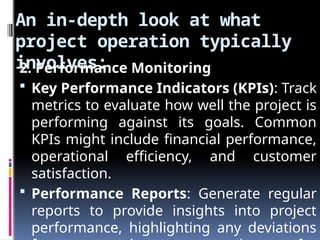
move forward with detailed planning
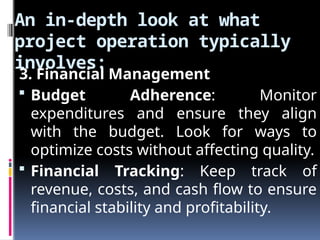
and execution.
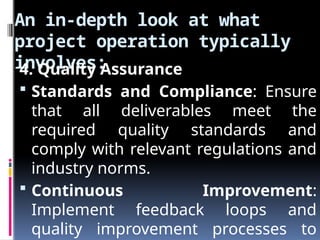
12.
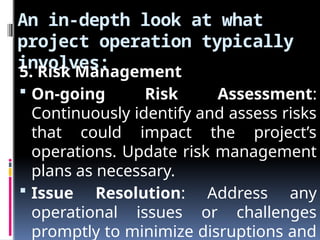
Key steps involved:
7.Approval and Authorization:
Review: Present the project idea and
business case to decision-makers for
review.
Approval: Obtain formal approval to
move forward with detailed planning
and execution.
13.
3.1.2 PROJECT FORMULATION
ORPREPARATION
(FEASIBILITY STUDY)
• Project formulation or preparation
involves a detailed feasibility study
to ensure that the project can be
successfully executed and delivered.
This stage refines the initial idea and
assesses its practicality in depth.
14.
1.Detailed Feasibility
Analysis
Technical Feasibility:
Technology Assessment: Evaluate
the technology required for the
project. Determine if existing
technology can meet the project's
needs or if new technology needs to
be developed or acquired.
Expert Consultation: Engage
technical experts to assess the
15.
1.Detailed Feasibility
Analysis
EconomicFeasibility:
Cost Estimates: Develop detailed cost
estimates for resources, labor, materials,
and other project components.
Budgeting: Create a comprehensive
budget, including initial capital investment
and ongoing operational costs.
Financial Projections: Analyze projected
revenues, cost savings, or other financial
benefits.
ROI Analysis: Calculate the return on
investment and payback period to
16.
1.Detailed Feasibility
Analysis
Legal andRegulatory Feasibility:
Compliance Check: Ensure the project
complies with all relevant laws,
regulations, and industry standards.
Permits and Approvals: Identify any
necessary permits or approvals
required and plan for their acquisition.
17.
1.Detailed Feasibility
Analysis
Operational Feasibility:
Resource Availability: Assess the
availability of necessary resources,
including personnel, equipment, and
materials.
Organizational Impact: Evaluate the
impact on organizational processes
and operations.
Sustainability: Determine if the
project can be maintained and
18.
1.Detailed Feasibility
Analysis
Environmental andSocial
Feasibility:
Environmental Impact: Assess the
potential environmental impact of the
project and identify any required
mitigation measures.
Social Impact: Evaluate how the
project will affect the community and
stakeholders.
19.
2. Develop aProject Plan
Scope Definition: Clearly define the
project scope, including deliverables,
milestones, and boundaries.
Work Breakdown Structure (WBS):
Break down the project into
manageable components and tasks.
Schedule: Develop a detailed project
schedule, including timelines for
each task and milestone.
20.
3. Risk Assessmentand
Management
Risk Identification: Identify
potential risks and uncertainties that
could impact the project.
Risk Analysis: Evaluate the likelihood
and impact of each risk.
Risk Mitigation Strategies: Develop
strategies to manage and mitigate
identified risks.
21.
4. Stakeholder Analysis
andEngagement
Stakeholder Mapping: Identify and
categorize stakeholders based on
their interest and influence.
Engagement Plan: Develop a plan
for engaging stakeholders
throughout the project, including
communication and feedback
mechanisms.
22.
5. Business Case
Development
Value Proposition: Clearly articulate
the benefits and value of the project
to stakeholders and decision-makers.
Cost-Benefit Analysis: Provide a
detailed comparison of costs and
expected benefits to support the
project’s justification.
Funding Requirements: Identify
funding sources and develop a plan
for securing financial resources.
23.
6. Approval andGo/No-Go
Decision
Review Findings: Present the
feasibility study findings, project
plan, and business case to
stakeholders and decision-makers.
Decision Making: Obtain approval to
proceed with detailed planning and
execution, or make adjustments
based on feedback.
24.
7. Documentation and
Communication
Feasibility Study Report: Prepare a
comprehensive report summarizing the
findings of the feasibility study, including
technical, economic, legal, operational,
and environmental aspects.
Communication Plan: Develop a plan
for communicating key information to
stakeholders and keeping them
informed throughout the project.
25.
Project design isa crucial
phase in the project development
cycle where the concepts and
plans developed during the
formulation stage are
transformed into detailed,
actionable plans. this stage
involves outlining how the
project will be executed, how it
will achieve its objectives, and
how its various components will
3.1.3 PROJECT DESIGN
26.
1. Design Planning
Design Objectives: Define the
specific objectives and deliverables of
the project design, ensuring
alignment with overall project goals.
Design Scope: Clearly outline what
the design will cover, including the
boundaries and constraints of the
design phase.
Design Team: Assemble a team with
the necessary skills and expertise to
27.
2. Requirements Gathering
andAnalysis
User Requirements: Gather detailed
requirements from stakeholders, end-
users, and other relevant parties to ensure
the design meets their needs and
expectations.
Functional Requirements: Define the
functional specifications that the design
must satisfy, including performance,
usability, & features.
Non-Functional Requirements: Address
28.
3. Conceptual Design
High-Level Design: Develop a high-level
conceptual design that outlines the
overall structure and key components of
the project.
Design Models: Create models or
diagrams to illustrate the major elements
and their interactions. Examples include
flowcharts, wireframes, and system
architecture diagrams.
29.
4. Detailed Design
Detailed Specifications: Produce
detailed design documents that describe
how each component or feature will be
implemented. Design Prototypes:
Develop prototypes or mock ups to
visualize and test design concepts before
full-scale implementation.
Design Review: Conduct reviews of the
detailed design with stakeholders and
team members to ensure it meets
requirements and standards.
30.
5. Design Integration
Component Integration: Plan and
design how different components of
the project will work together. Ensure
that interfaces between components
are well-defined and functional.
System Integration: For complex
projects, ensure that the design
integrates with existing systems or
infrastructure as required.
31.
6. Design Validation
Validation Testing: Perform testing to
validate that the design meets the
specified requirements and performs as
expected. This may include simulations,
prototypes testing, or beta releases.
Feedback Loop: Gather feedback from
testing and validation activities to
identify any issues or areas for
improvement.
32.
7. Design Documentation
Design Documents: Prepare
comprehensive design documentation
that details all aspects of the design.
This includes technical specifications,
user manuals, and implementation
guidelines.
Change Management: Implement a
change management process to handle
any design changes or updates that
arise during the development phase.
33.
8. Approval andSign-off
Review and Approval: Present the
final design to stakeholders and
decision-makers for review. Obtain
formal approval or sign-off to
proceed with implementation.
Design Handover: Provide the design
documentation and any necessary
training or support to the
implementation team.
34.
9. Implementation
Planning
ImplementationPlan: Develop a
detailed plan for executing the
design, including timelines, resource
allocation, and responsibilities.
Risk Management: Identify and plan
for potential risks associated with the
implementation of the design.
35.
10. Monitoring and
Control
Design Monitoring: Monitor the
implementation process to ensure
that the design is being executed as
planned.
Design Adjustments: Make any
necessary adjustments to the design
based on feedback or issues
encountered during implementation.
36.
3.1.4 Project appraisal
andfinancing
Project appraisal and financing are
critical components of the project
development cycle, ensuring that a
project is not only feasible and well-
planned but also has the financial
backing required for successful
execution.
37.
1. Project Appraisal
1.1. Financial Appraisal
Cost Estimation: Develop detailed estimates
of all project costs, including direct costs
(labor, materials, equipment) and indirect
costs (overheads, administrative expenses).
Budgeting: Create a comprehensive budget,
including contingency funds for unexpected
costs.
Financial Projections: Analyse projected
revenues, cost savings, or other financial
benefits.
Profitability Analysis: Calculate key financial
metrics such as return on investment (ROI),
38.
1. Project Appraisal
1.2.Economic Appraisal
Cost-Benefit Analysis: Evaluate the
total expected benefits against the
total costs of the project. Consider
both tangible and intangible benefits.
Economic Impact Analysis: Assess
the broader economic impact of the
project on the community, economy,
or sector.
39.
1. Project Appraisal
1.3.Technical Appraisal
Technical Feasibility: Verify that the
project design and technology are
feasible and can be implemented
successfully.
Resource Assessment: Ensure that
the necessary resources, including
technology and expertise, are
available.
40.
1. Project Appraisal
1.4.Environmental and Social
Appraisal
Environmental Impact Assessment:
Identify and assess potential
environmental impacts and develop
mitigation strategies.
Social Impact Assessment: Evaluate
how the project will affect local
communities and stakeholders, and
plan for positive engagement and
41.
1. Project Appraisal
1.5.Risk Appraisal
Risk Identification: Identify
potential risks that could affect the
project’s success.
Risk Analysis: Analyze the likelihood
and impact of each risk.
Risk Management Plan: Develop
strategies to mitigate or manage
identified risks.
42.
2. Financing
2.1. FinancingStrategy
Funding Sources: Identify potential
sources of financing, including
equity, debt, grants, and subsidies.
Consider internal sources (e.g.,
retained earnings) and external
sources (e.g., investors, banks).
Funding Structure: Determine the
optimal mix of funding sources,
balancing equity and debt to
43.
2. Financing
2.2. FinancialPlan
Capital Requirements: Define the total
amount of capital required for the
project, including initial investment and
working capital.
Funding Plan: Outline the plan for
securing the necessary funds, including
timelines and responsibilities.
Cash Flow Management: Develop a
cash flow projection to ensure that there
will be sufficient liquidity to cover project
costs throughout its lifecycle.
44.
2. Financing
2.3. FinancialModeling
Financial Models: Create detailed
financial models to simulate different
scenarios and their impact on the
project’s financial performance.
Sensitivity Analysis: Assess how
changes in key assumptions (e.g.,
costs, revenues, interest rates) affect
the financial outcomes.
45.
2. Financing
2.4. InvestmentAnalysis
Investor Pitch: Prepare materials and
presentations to attract and convince
investors or lenders of the project’s
viability and return potential.
Due Diligence: Provide detailed
information and documentation to
potential investors or lenders to
facilitate their decision-making process.
46.
2. Financing
2.5. SecuringFinancing
Funding Proposals: Prepare and submit
funding proposals or loan applications
to potential investors or financial
institutions.
Negotiation: Negotiate terms and
conditions of financing agreements,
including interest rates, repayment
schedules, and equity stakes.
Legal Documentation: Finalize and
execute legal agreements related to
47.
2. Financing
2.6. Monitoringand Reporting
Financial Monitoring: Continuously
monitor the financial performance of
the project against the budget and
financial projections.
Reporting: Provide regular financial
reports to stakeholders, including
investors and financial institutions, to
keep them informed of the project’s
financial status.
48.
3. Approval and
Finalization
Approval Process: Obtain necessary
approvals from stakeholders, including
investors, lenders, and regulatory
bodies, to proceed with financing and
project implementation.
Final Documentation: Complete all
documentation related to project
financing and secure final agreements.
3.2.1 Detailed project
engineering
The detailed project engineering
phase, often part of the investment
phase, is where the project's design is
translated into actionable plans for
implementation. This phase ensures
that all technical, operational, and
logistical aspects are meticulously
planned and prepared before moving
into the actual execution.
51.
1. Detailed Designand
Engineering
1.1. Finalize Design Specifications
Detailed Drawings: Create precise
engineering drawings and schematics,
including architectural, structural,
mechanical, electrical, and plumbing plans.
Technical Specifications: Develop detailed
specifications for materials, equipment,
and systems to be used in the project.
Integration Details: Ensure all systems
and components are designed to integrate
seamlessly, including interfaces between
different systems and subsystems.
52.
1. Detailed Designand
Engineering
1.2. Engineering Calculations
Load Calculations: Perform structural
and mechanical load calculations to
ensure the design can withstand
expected loads and stresses.
System Analysis: Analyze and simulate
the performance of systems and
processes to confirm they meet project
requirements.
53.
1. Detailed Designand
Engineering
1.3. Prototyping and Testing
Prototype Development: Build
prototypes or mock-ups to validate
design concepts and functionality.
Testing and Validation: Conduct
tests to ensure prototypes meet
design specifications and
performance criteria.
54.
2. Procurement Planning
2.1.Define Procurement
Requirements
Material Specifications: Identify and
document the specifications for
materials and equipment needed for
the project.
Vendor Selection: Determine criteria
for selecting suppliers and vendors.
55.
2. Procurement Planning
2.2.Prepare Procurement Documents
Request for Proposals (RFP):
Develop RFPs or requests for
quotations (RFQ) for materials,
equipment, and services.
Tendering Process: Issue tenders
and manage the bidding process to
select suppliers and contractors.
56.
2. Procurement Planning
2.3.Contracting
Contract Drafting: Draft contracts
with selected vendors and
contractors, outlining terms,
deliverables, timelines, and payment
conditions.
Negotiations: Negotiate terms and
conditions to finalize contracts.
57.
3. Detailed Scheduling
andPlanning
3.1. Develop a Detailed Project
Schedule
Work Breakdown Structure (WBS):
Refine the WBS to include detailed
tasks and subtasks.
Gantt Chart: Create or update a Gantt
chart to visualize the project schedule,
including dependencies and critical
path.
58.
3. Detailed Scheduling
andPlanning
3.2. Resource Planning
Resource Allocation: Plan for the
allocation of personnel, equipment,
and materials throughout the project
lifecycle.
Staffing Plan: Develop a detailed
staffing plan, including roles,
responsibilities, and timelines.
59.
4. Risk Management
4.1.Risk Identification and
Assessment
Risk Register: Update the risk
register with identified risks related
to detailed engineering and
procurement.
Risk Analysis: Assess the impact and
likelihood of each risk.
60.
4. Risk Management
4.2.Mitigation Strategies
Mitigation Plans: Develop and
implement strategies to mitigate
identified risks.
Contingency Planning: Create
contingency plans for managing
unforeseen issues that may arise
during the investment phase.
61.
5. Regulatory Compliance
andPermits
5.1. Obtain Permits
Permit Applications: Apply for
necessary permits and approvals
from regulatory authorities.
Compliance Checks: Ensure that all
aspects of the detailed design and
procurement comply with local
regulations and standards.
62.
5. Regulatory Compliance
andPermits
5.2. Safety and Quality Assurance
Safety Plans: Develop safety plans
and procedures to ensure a safe
working environment during project
execution.
Quality Assurance: Establish quality
assurance processes and standards
for materials and workmanship.
63.
6. Implementation
Preparation
6.1. ConstructionPlanning
Construction Plan: Develop a detailed
construction plan, including site
preparation, construction sequences,
and resource coordination.
Logistics Planning: Plan for the
logistics of material delivery, equipment
mobilization, and site management.
64.
6. Implementation
Preparation
6.2. ContractorMobilization
Contractor Coordination: Coordinate
with contractors to ensure they are
prepared for project execution.
Kick-off Meetings: Conduct kick-off
meetings to review project plans,
schedules, and expectations with all
contractors and stakeholders.
65.
7. Financial Management
7.1. Budget Finalization
Cost Tracking: Finalize the budget
and implement cost tracking
mechanisms to monitor expenditures
against the planned budget.
Financial Controls: Establish
financial controls and reporting
procedures.
66.
7. Financial Management
7.2. Payment Management
Payment Schedules: Develop
schedules for payments to
contractors and suppliers based on
project milestones.
Invoice Management: Implement
procedures for managing and
processing invoices.
67.
8. Documentation and
Reporting
8.1. Documentation
Engineering Documents: Compile and
organize all detailed engineering
documents, including design
specifications, drawings, and
calculations.
Procurement Records: Maintain records
of procurement activities, including
contracts, bids, and purchase orders.
68.
8. Documentation and
Reporting
8.2.Reporting
Progress Reports: Prepare regular
progress reports to update
stakeholders on the status of
detailed engineering and
procurement activities.
Status Meetings: Conduct status
meetings with the project team and
stakeholders to review progress and
address any issues.
69.
9. Approval and
Finalization
9.1.Review and Approval
Design and Procurement Review:
Obtain final approval for detailed
design and procurement plans from
stakeholders and decision-makers.
Final Adjustments: Make any
necessary adjustments based on
feedback before moving into the
implementation phase.
70.
9. Approval and
Finalization
9.2.Handover
Project Handover: Handover
detailed design and procurement
documents to the
implementation team, ensuring
they have all necessary
information to proceed.
71.
The detailedproject engineering
phase, often part of the investment
phase, is where the project's design
is translated into actionable plans for
implementation. this phase ensures
that all technical, operational, and
logistical aspects are meticulously
planned and prepared before
moving into the actual execution.
3.2.1 Project implementation
72.
1. Pre-Implementation
Preparation
1.1. FinalizeProject Readiness
Review Plans and Documents:
Ensure all design, procurement, and
project management plans are
finalized and approved.
Mobilize Resources: Confirm that all
necessary resources, including
personnel, equipment, and
materials, are in place and ready for
deployment.
73.
1. Pre-Implementation
Preparation
1.2. StakeholderCommunication
Kick-off Meetings: Conduct project
kick-off meetings with stakeholders,
team members, and contractors to
review project objectives, scope, and
execution plans.
Communication Plan: Implement a
communication plan to keep all
stakeholders informed of progress,
changes, and issues.
74.
2. Construction and
Execution
2.1.Site Preparation
Site Setup: Prepare the site for
construction or implementation,
including clearing, grading, and
establishing temporary facilities.
Safety Measures: Implement safety
measures and protocols to ensure a
safe working environment.
75.
2. Construction and
Execution
2.2.Construction/Installation
Construction Activities: Execute
construction activities according to the
detailed design plans and
specifications. This may include
building structures, installing systems,
or implementing processes.
Quality Control: Implement quality
control procedures to ensure that
76.
2. Construction and
Execution
2.3.Equipment and Material
Installation
Delivery and Handling: Manage the
delivery, storage, and handling of
materials and equipment.
Installation: Install equipment,
systems, and materials as per the
design specifications. Ensure proper
alignment and integration.
77.
3. Project Monitoringand
Control
3.1. Progress Monitoring
Track Progress: Monitor project
progress against the project
schedule and milestones.
Performance Metrics: Measure
performance using key performance
indicators (KPIs) and other relevant
metrics.
78.
3. Project Monitoringand
Control
3.2. Issue and Change Management
Issue Resolution: Identify and
address issues or obstacles that arise
during implementation.
Change Management: Manage
changes to scope, schedule, or
budget, including obtaining necessary
approvals and updating plans.
79.
3. Project Monitoringand
Control
3.3. Risk Management
Risk Monitoring: Continuously
monitor risks and their mitigation
strategies.
Contingency Actions: Implement
contingency plans as needed to
address unforeseen risks or
challenges.
80.
4. Testing and
Commissioning
4.1.System Testing
Pre-Operational Testing: Conduct
tests to verify that systems and
components function as intended
before full-scale operation.
Performance Testing: Perform tests
to ensure systems meet performance
requirements and specifications.
81.
4. Testing and
Commissioning
4.2.Commissioning
System Commissioning: Officially
bring systems and components into
operational use. This includes final
adjustments and calibration.
User Training: Provide training for
end-users and operators on how to
use and maintain the new systems or
facilities.
82.
5. Quality Assuranceand
Control
5.1. Inspection and Testing
Inspection: Conduct inspections to
ensure that construction or
installation meets all design and
quality standards.
Quality Assurance: Perform
additional quality assurance checks to
verify compliance with project
specifications and standards.
83.
5. Quality Assuranceand
Control
5.2. Documentation
As-Built Documentation: Prepare as-
built drawings and documentation
that reflect any changes made during
implementation.
Compliance Records: Maintain
records of compliance with
regulations, standards, and project
requirements.
84.
6. Project Handover
6.1.Handover Preparation
Finalize Documentation: Complete
and organize all project
documentation, including design
documents, operation manuals, and
maintenance guides.
Complete Deficiencies: Address any
remaining deficiencies or punch list
items before handover.
85.
6. Project Handover
6.2.Handover Process
Formal Handover: Conduct a formal
handover of the project to the client or
end-users. This typically involves a
final inspection and sign-off.
Training and Support: Provide
training and support to ensure the
client or end-users can effectively
operate and maintain the project
deliverables.
86.
6. Project Handover
7.1.Performance Evaluation
Evaluate Outcomes: Assess the
performance of the project against
its objectives and goals. Review how
well the project meets the expected
outcomes.
Lessons Learned: Conduct a lessons
learned session to capture insights
and experiences that can improve
future projects.
87.
7. Post-Implementation
Review
7.2. ProjectClosure
Close Contracts: Finalize and close
any remaining contracts and
agreements with suppliers,
contractors, and other stakeholders.
Final Reporting: Prepare and submit
final project reports, including
performance evaluations, financial
summaries, and compliance
88.
8. Ongoing Maintenance
andSupport
8.1. Maintenance Planning
Maintenance Schedule: Develop and
implement a maintenance schedule
for ongoing upkeep and service.
Support Services: Provide support
services as needed to address any
issues that arise after
implementation.
89.
8. On-going Maintenance
andSupport
8.2. Performance Monitoring
Monitor Performance: Continue to
monitor the performance of the
implemented systems or facilities to
ensure they function as intended.
3.3.1 Project operation
Projectoperation refers to the phase of
a project where the focus shifts from
planning and execution to maintaining
and managing the project's outputs and
deliverables.
This phase involves running the project
according to its operational plan,
ensuring that it continues to meet its
objectives and deliver value over time.
92.
An in-depth lookat what
project operation typically
involves:
1. Operational Management
Daily Operations: Oversee the routine
tasks required to keep the project
running smoothly. This could include
managing production, service delivery,
or other key activities.
Resource Allocation: Ensure that
resources (human, financial,
technological) are appropriately
93.
An in-depth lookat what
project operation typically
involves:
2. Performance Monitoring
Key Performance Indicators (KPIs): Track
metrics to evaluate how well the project is
performing against its goals. Common
KPIs might include financial performance,
operational efficiency, and customer
satisfaction.
Performance Reports: Generate regular
reports to provide insights into project
performance, highlighting any deviations
94.
An in-depth lookat what
project operation typically
involves:
3. Financial Management
Budget Adherence: Monitor
expenditures and ensure they align
with the budget. Look for ways to
optimize costs without affecting quality.
Financial Tracking: Keep track of
revenue, costs, and cash flow to ensure
financial stability and profitability.
95.
An in-depth lookat what
project operation typically
involves:
4. Quality Assurance
Standards and Compliance: Ensure
that all deliverables meet the
required quality standards and
comply with relevant regulations and
industry norms.
Continuous Improvement:
Implement feedback loops and
quality improvement processes to
96.
An in-depth lookat what
project operation typically
involves:
5. Risk Management
On-going Risk Assessment:
Continuously identify and assess risks
that could impact the project’s
operations. Update risk management
plans as necessary.
Issue Resolution: Address any
operational issues or challenges
promptly to minimize disruptions and
97.
An in-depth lookat what
project operation typically
involves:
6. Stakeholder Engagement
Communication: Maintain regular
communication with stakeholders,
including clients, team members,
investors, and partners. Provide updates
and address concerns effectively.
Feedback Mechanisms: Collect feedback
from stakeholders to understand their
needs and expectations and to make
necessary adjustments.
98.
An in-depth lookat what
project operation typically
involves:
7. Compliance and Governance
Regulatory Compliance: Ensure
adherence to legal and regulatory
requirements throughout the
project’s operational phase.
Governance: Maintain strong
governance practices to ensure
transparency, accountability, and
99.
An in-depth lookat what
project operation typically
involves:
8. Process Optimization
Efficiency Improvements: Identify
opportunities for improving
processes and increasing operational
efficiency. This might involve
adopting new technologies or
refining existing procedures.
Best Practices: Implement best
practices for operational efficiency
100.
An in-depth lookat what
project operation typically
involves:
9. Employee Management
Training and Development: Provide
ongoing training and development
opportunities for staff to keep them
updated on skills and best practices.
Performance Management:
Conduct regular performance reviews
and provide feedback to ensure
alignment with project goals and
101.
An in-depth lookat what
project operation typically
involves:
10. Sustainability and Long-Term
Planning
Sustainability Initiatives:
Incorporate practices that support
long-term sustainability, considering
environmental, social, and economic
factors.
Future Planning: Develop strategies
for the future based on operational
102.
An in-depth lookat what
project operation typically
involves:
11. End-of-Life and Transition
Project Closure: When the project reaches
its end or transitions to a new phase, plan
for an organized closure. This includes
finalizing deliverables, wrapping up
contracts, and conducting a post-project
review.
Knowledge Transfer: Document and
transfer lessons learned, best practices,
and critical knowledge to ensure
Editor's Notes
#12 This initial phase is critical for setting the project up for success. It ensures that the project is aligned with strategic goals, feasible, and has the necessary support from stakeholders.
#24 Effective project formulation and preparation ensure that the project is well-planned, financially viable, and aligned with organizational goals. This stage sets the stage for successful execution and delivery, minimizing the risk of failure and maximizing the chances of achieving project objectives.
#29 - This includes technical specifications, materials, and methodologies.
-This is especially important for user interface and product design.
#35 The project design phase is vital as it translates the initial project concept into a workable plan and blueprint for execution. Effective design ensures that the project’s objectives are met, stakeholders' needs are addressed, and potential issues are identified and resolved early in the development cycle.
#48 Project appraisal and financing ensure that a project is not only feasible from a technical and operational perspective but also financially viable and sustainable. This phase helps to confirm that the project can be successfully funded and managed, reducing the risk of financial shortfalls or failure.
#70 The detailed project engineering phase is pivotal in preparing for the actual execution of the project. It involves thorough planning, design refinement, procurement, and risk management to ensure that the project is well-prepared to move forward successfully.
#89 The project implementation phase is where all the planning and preparation work comes to fruition. It involves executing the project as per the detailed plans, ensuring quality and performance, and transitioning the project to operational use. Effective implementation is crucial for achieving project objectives and delivering value to stakeholders.
#102 In summary, project operation is about managing the day-to-day activities that keep the project running smoothly and ensuring that it continues to achieve its goals effectively. This phase requires ongoing attention to performance, financial management, stakeholder engagement, and process optimization to maintain and enhance the project's success.