Chapter 3
Entrepreneurship and human resources
Introduction
 One of the main characteristics of the small industrial business
sector is the decisive role the entrepreneur has with regard to the
success of the enterprise which means that the feasibility of an
investment depends very much on the entrepreneur and managerial
capabilities of the person or persons responsible for a business.
Entrepreneurial and management requirements
 Entrepreneurial and managerial talents, apart from professions, technical and
commercial skills and experience, are essential for the success of any business
venture, whether undertaken alone or with a partner.
 . This holds true for small industrial business in developing as well as
industrialized countries. When preparing an opportunity study it is necessary to
identify such subsector-typically requirements as a basis for assessing the
entrepreneur and managerial qualifications of individual investors.
 These subsector- dependent and most probably also country-individual persons
and their projects applying the concept presented in part three of the manual.
Types of entrepreneurs
 Four types:
 The all rounder with both strengths creative or executive
 The pioneer with dynamic creative strengths
 The organizer with administrative executive strengths
 The routinier with no special strenghts
Enterpenural qualification and abilities
 Various concept have been proposed to assess entrepreneur qualification and
abilities. The most recent approach also adopted here, is based on correlation
between entrepreneur values and success in business as applied by the
STTRATOS and INTERSTRATOS projects in Europe.
 A more pragmatic approach than the typification described above is used by
Austrian bankers for assessing the strengths and weaknesses of entrepreneur and
leadership behavior in persons applying for business start-up credits Emphasis is
put on manager-employee relations, which if excellent represent an essential
strength in small industrial concentrates on the assessment of entrepreneur self-
image and staff relations.
Several qualifications and abilities are assessed;
 Entrepreneur skills and involvement such as the following:
 The ability to consider in involvement in advance the consequences of actions for the
whole enterprise and to include cost-benefits considerations when setting up business
objectives.

 The readiness to act in the interest of the whole enterprise and to make personal skills
available to the firm at any time
 Staff development
 Employment of staff according to talents and skills
 Motivation of staff
 Formulation of objective
 Staff information and communication
 Readiness and ability to coordinate and supervise
 Staff assessment recognition and critique
 Staff relation and cooperation
. Assessment of human success factors
 on entrepreneurial values and attitudes, is based on the correlation
between personal orientation as represented by values and success
 as an entrepreneurial result obtain from empirical research suggest
that personal entrepreneurial characteristics also depend on the
social and cultural environment,
 therefore it is important to assess subsector typical data for a
country or region before using a value and behavior profiles to
evaluate individual projects.
Assessment of entrepreneurial behavior
 typical profiles for entrepreneurial talents and behavior (creative-dynamic vs.
administrative-executive) in accordance with the typification of entrepreneurial
behavior will be assed for the opportunity study this profile of entrepreneurial
behavior will be assessed for comparable
 enterprises to obtain a good understanding of the talents and behavior of typical of
successful entrepreneurs these profile s will then be the basis for assessing
individual entrepreneurs as outline in part of three of the manual. The data will
also serve to give a better understanding of the entrepreneur’s requirements that
are typical for subsector.
Assessment of personal profession background
 When used in relation to subsector analysis,, on the personal
background and general qualifications of entrepreneurs, will provide
statistical data on the correlation between professional experience,
family involvement and business success.
 Once sufficiently accurate data are available from a representative
sample, the use of this questionnaire will add to the reliability of the
evaluation of an individual’s entrepreneurial potential and the
probability of business success.
Sociocultural differences in entrepreneurial
characteristics
 It is not surprising that the characteristics of successful
entrepreneurs are not the same in different sociocultural
environments, although some fundamental talents and behavior are
probably very much alike.
 The differences have to be taken into account when comparing
entrepreneurial profiles drawn up in different countries or regions.
Entrepreneurial profiles differ, for example, from the US to
Continental Europe.
Comparison of entrepreneurial profiles in
Continental Europe and the United States
 In Europe, the small-scale entrepreneur typically has a dominating
attitude and strongly identifies himself or herself as the owner of the
business.
 A strong family orientation can be observed, combined with an
emphasis on tradition and continually the firm is the entrepreneur’s
“castle”.
 The European type of entrepreneur, particularly in small business,
largely represents the “center of gravity” in a comprehensive sense.
Table 4. Comparison of entrepreneurial
characteristic in Europe and the United States
 Europe:
 Strong ownership identification with emphasis on continuity and long
term perspective
 Particularly in small business the entrepreneur is the center activity
 Few if any link between small business entrepreneur and universities or
related institutions with concomitant underutilization of potential
innovative resources and know how.
 Banking services and related consulting and advice more substantial
comprehensive and readily accessible legal arrangements and procedures
relatively straight forward less complex and cumbersome.
Cont.
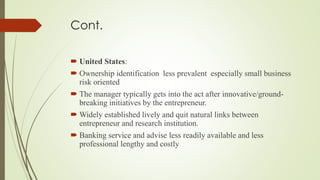
 United States:
 Ownership identification less prevalent especially small business
risk oriented
 The manager typically gets into the act after innovative/ground-
breaking initiatives by the entrepreneur.
 Widely established lively and quit natural links between
entrepreneur and research institution.
 Banking service and advise less readily available and less
professional lengthy and costly
Entrepreneurial attitude and behavior
 When comparing Entrepreneurial attitude and behavior of a personal
coming from or working in different sociocultural environments it is first
of all important to differentiate between entrepreneurial and managerial
functions as such and the entrepreneurial and managerial attitudes and
behavior that are typically successful
 in a given sociocultural environment and in the subsector under
investigations here again the typification by entrepreneurial creative and
administrative talents will be useful for identifying the entrepreneurial
profiles best suited for given sociocultural environments.


Management principles
 When comparing the application of management principle and instruments
researches usually distinguish between the technical or operational aspect of these
principle and instrument on the one hand and their social aspect on the other. The
social aspect of management comprises of personal attitudes motivation and
leader ship behavior.
 The technical aspect of management principle and instrument are in general
invariable and valid for different sociocultural environment. Management
principle and instrument may have to be adapted to different social environment
 ( urban-rural, highlands –lowlands)

Human resource requirements
Assessing human resource needs, particularly
entreprenencurian or management requirements is very
important for small business because for them qualified
staff and workers are the main resources in contrast to
large industrial business which are typically characterized
by higher capital intensity.
Entrepreneurial attitude and behavior
 When comparing Entrepreneurial attitude and behavior of a personal coming from
or working in different sociocultural environments it is first of all important to
differentiate between entrepreneurial and managerial functions as such and the
entrepreneurial and managerial attitudes and behavior that are typically successful
 in a given sociocultural environment and in the subsector under investigations
here again the typification by entrepreneurial creative and administrative talents
will be useful for identifying the entrepreneurial profiles best suited for given
sociocultural environments.

Management principles
 When comparing the application of management principle and
instruments researches usually distinguish between the technical or
operational aspect of these principle and instrument on the one hand
and their social aspect on the other.
 The social aspect of management comprises of personal attitudes
motivation and leader ship behavior. The technical aspect of
management principle and instrument are in general invariable and
valid for different sociocultural environment.
 . Management principle and instrument may have to be adapted to
different social environment ( urban-rural, highlands –lowlands)
Human resource requirements
 Assessing human resource needs, particularly entreprenencurian or
management requirements is very important for small business
because for them qualified staff
 and workers are the main resources in contrast to large industrial
business which are typically characterized by higher capital
intensity.
Key personal and manpower
 The problem of availability of skilled workers can usually be solved
in time for example by making the subsector more attractive to
young people after primary and secondary school to assess the
availability of key personal and manpower population forecast data
are needed
 The statistics should be differentiated by region and by age group.
Short term availability in most countries can be determined from
unemployment statics.
. Foreign personal
 3. Foregin personal
 When certain skills and foreign professional experience are required in
subsector it is the most likely for these to be acquired through employment
or training abroad it should be mentioned that person with higher
professional qualification and experience also belong to the group of
persons with entrepreneurial potential.
 These enterprises are as experience shows the basis of the development of
the so called ”missing middle” in developing countries that is medium scale
enterprises that employ 20-100 people.


Project Appraisal chapter 3

  • 1.
  • 2.
    Introduction  One ofthe main characteristics of the small industrial business sector is the decisive role the entrepreneur has with regard to the success of the enterprise which means that the feasibility of an investment depends very much on the entrepreneur and managerial capabilities of the person or persons responsible for a business.
  • 3.
    Entrepreneurial and managementrequirements  Entrepreneurial and managerial talents, apart from professions, technical and commercial skills and experience, are essential for the success of any business venture, whether undertaken alone or with a partner.  . This holds true for small industrial business in developing as well as industrialized countries. When preparing an opportunity study it is necessary to identify such subsector-typically requirements as a basis for assessing the entrepreneur and managerial qualifications of individual investors.  These subsector- dependent and most probably also country-individual persons and their projects applying the concept presented in part three of the manual.
  • 4.
    Types of entrepreneurs Four types:  The all rounder with both strengths creative or executive  The pioneer with dynamic creative strengths  The organizer with administrative executive strengths  The routinier with no special strenghts
  • 5.
    Enterpenural qualification andabilities  Various concept have been proposed to assess entrepreneur qualification and abilities. The most recent approach also adopted here, is based on correlation between entrepreneur values and success in business as applied by the STTRATOS and INTERSTRATOS projects in Europe.  A more pragmatic approach than the typification described above is used by Austrian bankers for assessing the strengths and weaknesses of entrepreneur and leadership behavior in persons applying for business start-up credits Emphasis is put on manager-employee relations, which if excellent represent an essential strength in small industrial concentrates on the assessment of entrepreneur self- image and staff relations.
  • 6.
    Several qualifications andabilities are assessed;  Entrepreneur skills and involvement such as the following:  The ability to consider in involvement in advance the consequences of actions for the whole enterprise and to include cost-benefits considerations when setting up business objectives.   The readiness to act in the interest of the whole enterprise and to make personal skills available to the firm at any time  Staff development  Employment of staff according to talents and skills  Motivation of staff  Formulation of objective  Staff information and communication  Readiness and ability to coordinate and supervise  Staff assessment recognition and critique  Staff relation and cooperation
  • 7.
    . Assessment ofhuman success factors  on entrepreneurial values and attitudes, is based on the correlation between personal orientation as represented by values and success  as an entrepreneurial result obtain from empirical research suggest that personal entrepreneurial characteristics also depend on the social and cultural environment,  therefore it is important to assess subsector typical data for a country or region before using a value and behavior profiles to evaluate individual projects.
  • 8.
    Assessment of entrepreneurialbehavior  typical profiles for entrepreneurial talents and behavior (creative-dynamic vs. administrative-executive) in accordance with the typification of entrepreneurial behavior will be assed for the opportunity study this profile of entrepreneurial behavior will be assessed for comparable  enterprises to obtain a good understanding of the talents and behavior of typical of successful entrepreneurs these profile s will then be the basis for assessing individual entrepreneurs as outline in part of three of the manual. The data will also serve to give a better understanding of the entrepreneur’s requirements that are typical for subsector.
  • 9.
    Assessment of personalprofession background  When used in relation to subsector analysis,, on the personal background and general qualifications of entrepreneurs, will provide statistical data on the correlation between professional experience, family involvement and business success.  Once sufficiently accurate data are available from a representative sample, the use of this questionnaire will add to the reliability of the evaluation of an individual’s entrepreneurial potential and the probability of business success.
  • 10.
    Sociocultural differences inentrepreneurial characteristics  It is not surprising that the characteristics of successful entrepreneurs are not the same in different sociocultural environments, although some fundamental talents and behavior are probably very much alike.  The differences have to be taken into account when comparing entrepreneurial profiles drawn up in different countries or regions. Entrepreneurial profiles differ, for example, from the US to Continental Europe.
  • 11.
    Comparison of entrepreneurialprofiles in Continental Europe and the United States  In Europe, the small-scale entrepreneur typically has a dominating attitude and strongly identifies himself or herself as the owner of the business.  A strong family orientation can be observed, combined with an emphasis on tradition and continually the firm is the entrepreneur’s “castle”.  The European type of entrepreneur, particularly in small business, largely represents the “center of gravity” in a comprehensive sense.
  • 12.
    Table 4. Comparisonof entrepreneurial characteristic in Europe and the United States  Europe:  Strong ownership identification with emphasis on continuity and long term perspective  Particularly in small business the entrepreneur is the center activity  Few if any link between small business entrepreneur and universities or related institutions with concomitant underutilization of potential innovative resources and know how.  Banking services and related consulting and advice more substantial comprehensive and readily accessible legal arrangements and procedures relatively straight forward less complex and cumbersome.
  • 13.
    Cont.  United States: Ownership identification less prevalent especially small business risk oriented  The manager typically gets into the act after innovative/ground- breaking initiatives by the entrepreneur.  Widely established lively and quit natural links between entrepreneur and research institution.  Banking service and advise less readily available and less professional lengthy and costly
  • 14.
    Entrepreneurial attitude andbehavior  When comparing Entrepreneurial attitude and behavior of a personal coming from or working in different sociocultural environments it is first of all important to differentiate between entrepreneurial and managerial functions as such and the entrepreneurial and managerial attitudes and behavior that are typically successful  in a given sociocultural environment and in the subsector under investigations here again the typification by entrepreneurial creative and administrative talents will be useful for identifying the entrepreneurial profiles best suited for given sociocultural environments.  
  • 15.
    Management principles  Whencomparing the application of management principle and instruments researches usually distinguish between the technical or operational aspect of these principle and instrument on the one hand and their social aspect on the other. The social aspect of management comprises of personal attitudes motivation and leader ship behavior.  The technical aspect of management principle and instrument are in general invariable and valid for different sociocultural environment. Management principle and instrument may have to be adapted to different social environment  ( urban-rural, highlands –lowlands) 
  • 16.
    Human resource requirements Assessinghuman resource needs, particularly entreprenencurian or management requirements is very important for small business because for them qualified staff and workers are the main resources in contrast to large industrial business which are typically characterized by higher capital intensity.
  • 17.
    Entrepreneurial attitude andbehavior  When comparing Entrepreneurial attitude and behavior of a personal coming from or working in different sociocultural environments it is first of all important to differentiate between entrepreneurial and managerial functions as such and the entrepreneurial and managerial attitudes and behavior that are typically successful  in a given sociocultural environment and in the subsector under investigations here again the typification by entrepreneurial creative and administrative talents will be useful for identifying the entrepreneurial profiles best suited for given sociocultural environments. 
  • 18.
    Management principles  Whencomparing the application of management principle and instruments researches usually distinguish between the technical or operational aspect of these principle and instrument on the one hand and their social aspect on the other.  The social aspect of management comprises of personal attitudes motivation and leader ship behavior. The technical aspect of management principle and instrument are in general invariable and valid for different sociocultural environment.  . Management principle and instrument may have to be adapted to different social environment ( urban-rural, highlands –lowlands)
  • 19.
    Human resource requirements Assessing human resource needs, particularly entreprenencurian or management requirements is very important for small business because for them qualified staff  and workers are the main resources in contrast to large industrial business which are typically characterized by higher capital intensity.
  • 20.
    Key personal andmanpower  The problem of availability of skilled workers can usually be solved in time for example by making the subsector more attractive to young people after primary and secondary school to assess the availability of key personal and manpower population forecast data are needed  The statistics should be differentiated by region and by age group. Short term availability in most countries can be determined from unemployment statics.
  • 21.
    . Foreign personal 3. Foregin personal  When certain skills and foreign professional experience are required in subsector it is the most likely for these to be acquired through employment or training abroad it should be mentioned that person with higher professional qualification and experience also belong to the group of persons with entrepreneurial potential.  These enterprises are as experience shows the basis of the development of the so called ”missing middle” in developing countries that is medium scale enterprises that employ 20-100 people. 