Introduction to Small Business
Chapter Two
Concept of Business
• The term business denotes activities related to
trade, commerce, profession, occupation and
industry carried out to make profit.
• It is engaged in the production and marketing
of products to make profit through customer
satisfaction.
• The primary beneficiaries of a business are its
owners.
Products
• Products are the focus of all business
activities.
• A product is anything that satisfies the needs
of customers.
Types of Products
• Goods
• Services
• Ideas
• Events
• Information
• Properties
Definition of Business
• A business represents organized efforts of
enterprises to produce and market products
to make profits through customer need
satisfaction.
Characteristics of Business
• Activities
• Profit
• Customers
• Competition
• Diversification
• Change
Goals of Business are Many
• Profit
• Growth
• Survival
• Leadership
• Efficiency
• Social Responsibility
• Corporate Citizenship
Meaning of Small Business
• It is just like business discussed earlier.
• The small business owner establishes and
manages the business to attain personal
objectives.
• The business is an extension of the owner’s
needs, objectives and personality.
• More than the growth of the business, the
aim is to continue operations over a period of
time.
Characteristics of Small Business
• Management is independent
• Closely held ownership
• Local operations
• Small size
– Number of employees
– Fixed assets
– Annual sales volume
– Capital investment
Definition of Small Business
• US definition: “A small business is one that is
independently owned and operated and not
dominant in its field of operation”
• Nicholos Siropolis: “Typically, a small business
is … mom-and-pop stores. Businesses … may
be looked upon as big or small, depending on
the yardstick and cut-off point used”
Types of Small Business Activities
• Manufacturing
• Wholesaling
• Retailing
• Service
– Professional service
– Financial service
– Transport service
– Repair service
– Construction service
Differences between Entrepreneurial
Venture and Small Business
• Goals
• Practices
• Size
Large versus Small Business
• Size
• Ownership
• Impact on industry
• Flexibility
• Economies of scale
• Innovation
• Quality
• Customer relationship
• Life
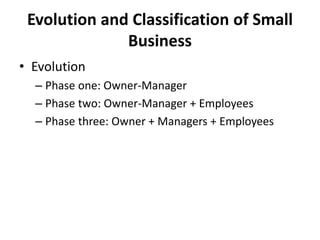
Evolution and Classification of Small
Business
• Evolution
– Phase one: Owner-Manager
– Phase two: Owner-Manager + Employees
– Phase three: Owner + Managers + Employees
Evolution and Classification of Small
Business
• Classification of Small Business
– Manufacturing
– Merchandising
– Services
Features of Small Business in
Developed and Developing Countries
• Similar Features
– Independent management
– Closely held ownership
– Local operations
– Small size
Features of Small Business in
Developed and Developing Countries
• Dissimilar features
– Definition differences
– Activities
– Facilities
Importance of Small Business
• Encourages innovation and entrepreneurship
• Complementary to large business
• Flexibility in operations
• Job creation
• Maintains close relation with customers and
community
• Simulates competition
• Higher financial rewards
Strengths of Small Business
• Independence
• Innovation
• Responsiveness
• Employment creation
• Financial performance
Indicators for measuring success in
Small Business
• Profit
• Competitive advantage
• Flexibility
• Innovation
• Quality
• Customer relationship
Weaknesses of Small Business
• Risk of failure
• Lack of homework
• Financial loss
• Economic downturn
• Inadequate management
• Laws and regulations
• Marketing problems
• Technology
• Poor financial management
Challenges of Small Business
• Serving a well-defined market
• Acquiring sufficient capital
• Acquiring and using human resources
• Staying informed
• Managerial know-how
• Time management
• Coping with government regulations
Opportunities for Small Business
• Technology
• Knowledge
• Women and ethnic groups
• Occupational and industry shifts
Small Business in Nepalese Economy
• Small businesses are backbone of Nepalese
economy.
• Ancient and medieval Nepal witnessed the
growth of small businesses related to art, craft
and cottage industries.
• During the Rana Rule, their growth was slow
and haphazard.
• The era of planned growth since 1956
facilitated their growth in various activities.
Small Business in Nepalese Economy
• Definition of small business in the context of
Nepal
• 2001/2002 census: 86% establishments had
capital in fixed assets not exceeding Rs. 10
million.
• These establishments accounted for 56% of
employment.
• More than 75% of economically active population
is self-employed in agriculture and small
business.
Small Business in Nepalese Economy
• The number of registered cottage and small
industries increased from 5727 in 1992 to
7572 in 2003.
• This indicates important role of small
businesses in creating employment.
Importance of Small Business in
Nepalese Economy
• Economic backbone
• Employment creation
• Entrepreneurship development
• Complementary
• Exports
Problems of Small Business in Nepal
• Management
• Employees
• Technology
• Market
• Finance
• Information
• Strategic alliances
• Government policies
• Sickness
Reasons for Survival of Small
Businesses in Nepal
• Large number
• Simplicity
• Market
• Flexibility
• Quality
• Inter-relationships
• State patronage
• Low operating costs
CASE STUDY
• Case 1: Namuna Tailoring
• Case 2: Mangale Sarki

Introduction to small business

  • 1.
    Introduction to SmallBusiness Chapter Two
  • 2.
    Concept of Business •The term business denotes activities related to trade, commerce, profession, occupation and industry carried out to make profit. • It is engaged in the production and marketing of products to make profit through customer satisfaction. • The primary beneficiaries of a business are its owners.
  • 3.
    Products • Products arethe focus of all business activities. • A product is anything that satisfies the needs of customers.
  • 4.
    Types of Products •Goods • Services • Ideas • Events • Information • Properties
  • 5.
    Definition of Business •A business represents organized efforts of enterprises to produce and market products to make profits through customer need satisfaction.
  • 6.
    Characteristics of Business •Activities • Profit • Customers • Competition • Diversification • Change
  • 7.
    Goals of Businessare Many • Profit • Growth • Survival • Leadership • Efficiency • Social Responsibility • Corporate Citizenship
  • 8.
    Meaning of SmallBusiness • It is just like business discussed earlier. • The small business owner establishes and manages the business to attain personal objectives. • The business is an extension of the owner’s needs, objectives and personality. • More than the growth of the business, the aim is to continue operations over a period of time.
  • 9.
    Characteristics of SmallBusiness • Management is independent • Closely held ownership • Local operations • Small size – Number of employees – Fixed assets – Annual sales volume – Capital investment
  • 10.
    Definition of SmallBusiness • US definition: “A small business is one that is independently owned and operated and not dominant in its field of operation” • Nicholos Siropolis: “Typically, a small business is … mom-and-pop stores. Businesses … may be looked upon as big or small, depending on the yardstick and cut-off point used”
  • 11.
    Types of SmallBusiness Activities • Manufacturing • Wholesaling • Retailing • Service – Professional service – Financial service – Transport service – Repair service – Construction service
  • 12.
    Differences between Entrepreneurial Ventureand Small Business • Goals • Practices • Size
  • 13.
    Large versus SmallBusiness • Size • Ownership • Impact on industry • Flexibility • Economies of scale • Innovation • Quality • Customer relationship • Life
  • 14.
    Evolution and Classificationof Small Business • Evolution – Phase one: Owner-Manager – Phase two: Owner-Manager + Employees – Phase three: Owner + Managers + Employees
  • 15.
    Evolution and Classificationof Small Business • Classification of Small Business – Manufacturing – Merchandising – Services
  • 16.
    Features of SmallBusiness in Developed and Developing Countries • Similar Features – Independent management – Closely held ownership – Local operations – Small size
  • 17.
    Features of SmallBusiness in Developed and Developing Countries • Dissimilar features – Definition differences – Activities – Facilities
  • 18.
    Importance of SmallBusiness • Encourages innovation and entrepreneurship • Complementary to large business • Flexibility in operations • Job creation • Maintains close relation with customers and community • Simulates competition • Higher financial rewards
  • 19.
    Strengths of SmallBusiness • Independence • Innovation • Responsiveness • Employment creation • Financial performance
  • 20.
    Indicators for measuringsuccess in Small Business • Profit • Competitive advantage • Flexibility • Innovation • Quality • Customer relationship
  • 21.
    Weaknesses of SmallBusiness • Risk of failure • Lack of homework • Financial loss • Economic downturn • Inadequate management • Laws and regulations • Marketing problems • Technology • Poor financial management
  • 22.
    Challenges of SmallBusiness • Serving a well-defined market • Acquiring sufficient capital • Acquiring and using human resources • Staying informed • Managerial know-how • Time management • Coping with government regulations
  • 23.
    Opportunities for SmallBusiness • Technology • Knowledge • Women and ethnic groups • Occupational and industry shifts
  • 24.
    Small Business inNepalese Economy • Small businesses are backbone of Nepalese economy. • Ancient and medieval Nepal witnessed the growth of small businesses related to art, craft and cottage industries. • During the Rana Rule, their growth was slow and haphazard. • The era of planned growth since 1956 facilitated their growth in various activities.
  • 25.
    Small Business inNepalese Economy • Definition of small business in the context of Nepal • 2001/2002 census: 86% establishments had capital in fixed assets not exceeding Rs. 10 million. • These establishments accounted for 56% of employment. • More than 75% of economically active population is self-employed in agriculture and small business.
  • 26.
    Small Business inNepalese Economy • The number of registered cottage and small industries increased from 5727 in 1992 to 7572 in 2003. • This indicates important role of small businesses in creating employment.
  • 27.
    Importance of SmallBusiness in Nepalese Economy • Economic backbone • Employment creation • Entrepreneurship development • Complementary • Exports
  • 28.
    Problems of SmallBusiness in Nepal • Management • Employees • Technology • Market • Finance • Information • Strategic alliances • Government policies • Sickness
  • 29.
    Reasons for Survivalof Small Businesses in Nepal • Large number • Simplicity • Market • Flexibility • Quality • Inter-relationships • State patronage • Low operating costs
  • 30.
    CASE STUDY • Case1: Namuna Tailoring • Case 2: Mangale Sarki