
Chapter-2
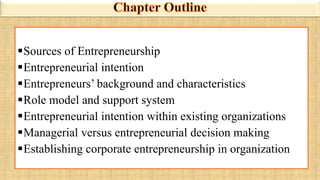
Chapter Outline
Sources of Entrepreneurship
Entrepreneurial intention
Entrepreneurs’ background and characteristics
Role model and support system
Entrepreneurial intention within existing organizations
Managerial versus entrepreneurial decision making
Establishing corporate entrepreneurship in organization
Sources of Entrepreneurship
A. Entrepreneurial intention
B. Entrepreneurs’ background and characteristics
C. Role model and support system
A. Entrepreneurial Intention
 Motivational factors that influence individuals to pursue entrepreneurial
outcomes.
 Entrepreneurs intend to pursue certain opportunities, enter new market and offer
new product- and that is rarely the process of unintentional behavior.
Entrepreneurial intention actually includes those motivational factors which
influence individuals to pursue entrepreneurial outcomes.
 They are indications of how people are willing to try, of how much of an effort
they are planning to exert to perform the behavior.
 As the general rule, the stronger the intention to engage in behavior, the more
likely should be its performance.
 Individuals have stronger intentions to act when taking action is perceived
to be feasible and desirable.
 Factors that influence entrepreneurial intention:
I. Entrepreneurial self-efficacy: The conviction that one can successfully
execute entrepreneurial process.
High self-efficacy: The people who believe they have the capacity
to perform tend to perform well. It leads to increased initiative and
persistence. People with high self efficacy think differently and
behave differently.
Low self-efficacy: Low self efficacy reduces effort and thus
performance.
II. Perceived desirability: The degree to which individual has a favorable or
unfavorable evaluation of the potential entrepreneurial outcome.
Promising demand of product and service
Availability of factors of production (land, capital, labor)
Government assistance and support
I. Education
II. Age
III.Work history
I. Education
Provides a background about starting a business.
Helps in the development of communication skills and problem-
solving skills.
Provides individuals with a larger opportunity set.
Does not determine whether an entrepreneur will create a new
business to exploit the discovered opportunity.
II. Age
Most entrepreneurs initiate their entrepreneurial careers between
the ages of 22 and 45.
Individuals are more inclined to start an entrepreneurial career at
milestone ages every five years (25, 30, 35, 40, and 45).
Male entrepreneurs tend to start their ventures in their early 30s,
while women entrepreneurs do so in their middle 30s.
III. Work History
The decision to launch a new venture can be influenced by:
Dissatisfaction with one’s job.
Previous technical and industry experience.
Managerial skills and entrepreneurial experiences are also important
once the venture starts growing.
Previous start-up experience is a relatively good predictor of starting
subsequent businesses.
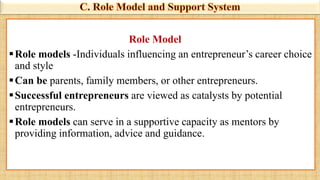
Role Model
Role models -Individuals influencing an entrepreneur’s career choice
and style
Can be parents, family members, or other entrepreneurs.
Successful entrepreneurs are viewed as catalysts by potential
entrepreneurs.
Role models can serve in a supportive capacity as mentors by
providing information, advice and guidance.
Support system
I. Moral-Support Network
II. Professional support network
I. Moral-Support Network
It is important for entrepreneurs to have a cheering squad—
individuals who provide psychological support.
Friends can provide honest advice, encouragement, understanding,
and assistance.
Relatives can be strong sources of moral support, particularly if they
are also entrepreneurs.
II. Professional support network
Entrepreneurs need advice and counsel throughout the
establishment of the new venture which can be obtained
from:
Mentors(counsellors).
Business associates(links/contact).
Suppliers.
Trade associations.
Entrepreneurial activity is rooted in networks of interpersonal
relationships.
Entrepreneurial Intention Within Existing Organizations
Existing companies also can pursue opportunities. For this
happen,
*Top management must create an environment that
encourages employees to think and act
entrepreneurially.
*Employees should realize that entrepreneurial
action within the firm is both personally desirable
and feasible.
Managerial Versus Entrepreneurial Decision Making
Establishing Corporate Entrepreneurship in Organization
Step one:
Secure a commitment to corporate entrepreneurship in the
organization by top, upper, and middle management levels.
Identify, select, and train corporate entrepreneurs.
Step two:
Identify ideas and areas that top management is interested in
supporting.
Establish overall program expectations and target results of each
corporate venture.
Establishing Corporate Entrepreneurship in Organization
Step three:
Use of technology to ensure organizational flexibility.
Step four:
Identify interested managers to train employees and share their
experiences.
Step five:
Develop ways for the organization to get closer to its customers.
Step six:
Learn to be more productive with fewer resources.
Establishing Corporate Entrepreneurship in Organization
Step seven:
Establish a strong support structure for corporate entrepreneurship.
Step eight:
Tie rewards to the performance of the entrepreneurial unit.
Finally:
Implement an evaluation system that allows successful
entrepreneurial units to expand and unsuccessful ones to be
eliminated.
Home Assignment (Chapter-1)
1. What do you mean by entrepreneurship? Explain the entrepreneurial process.
2. Briefly describe the importance of entrepreneurship for the countries like
Nepal.
3. What do you mean by ethics and responsibilities ? What sorts of ethical values
should be followed by the entrepreneurs to get success in entrepreneurship.
4. “It is said that promoting entrepreneurship in Nepal is of grate importance.”
Do you agree or disagree ? What strategies should be taken for the promotion
of entrepreneurship in Nepal and who is primarily responsible for that.

Chaper 2....enterpreneurial-intentions

  • 1.
  • 2.
    Chapter Outline Sources ofEntrepreneurship Entrepreneurial intention Entrepreneurs’ background and characteristics Role model and support system Entrepreneurial intention within existing organizations Managerial versus entrepreneurial decision making Establishing corporate entrepreneurship in organization
  • 3.
    Sources of Entrepreneurship A.Entrepreneurial intention B. Entrepreneurs’ background and characteristics C. Role model and support system
  • 4.
    A. Entrepreneurial Intention Motivational factors that influence individuals to pursue entrepreneurial outcomes.  Entrepreneurs intend to pursue certain opportunities, enter new market and offer new product- and that is rarely the process of unintentional behavior. Entrepreneurial intention actually includes those motivational factors which influence individuals to pursue entrepreneurial outcomes.  They are indications of how people are willing to try, of how much of an effort they are planning to exert to perform the behavior.  As the general rule, the stronger the intention to engage in behavior, the more likely should be its performance.  Individuals have stronger intentions to act when taking action is perceived to be feasible and desirable.
  • 5.
     Factors thatinfluence entrepreneurial intention: I. Entrepreneurial self-efficacy: The conviction that one can successfully execute entrepreneurial process. High self-efficacy: The people who believe they have the capacity to perform tend to perform well. It leads to increased initiative and persistence. People with high self efficacy think differently and behave differently. Low self-efficacy: Low self efficacy reduces effort and thus performance. II. Perceived desirability: The degree to which individual has a favorable or unfavorable evaluation of the potential entrepreneurial outcome. Promising demand of product and service Availability of factors of production (land, capital, labor) Government assistance and support
  • 6.
  • 7.
    I. Education Provides abackground about starting a business. Helps in the development of communication skills and problem- solving skills. Provides individuals with a larger opportunity set. Does not determine whether an entrepreneur will create a new business to exploit the discovered opportunity.
  • 8.
    II. Age Most entrepreneursinitiate their entrepreneurial careers between the ages of 22 and 45. Individuals are more inclined to start an entrepreneurial career at milestone ages every five years (25, 30, 35, 40, and 45). Male entrepreneurs tend to start their ventures in their early 30s, while women entrepreneurs do so in their middle 30s.
  • 9.
    III. Work History Thedecision to launch a new venture can be influenced by: Dissatisfaction with one’s job. Previous technical and industry experience. Managerial skills and entrepreneurial experiences are also important once the venture starts growing. Previous start-up experience is a relatively good predictor of starting subsequent businesses.
  • 10.
    Role Model Role models-Individuals influencing an entrepreneur’s career choice and style Can be parents, family members, or other entrepreneurs. Successful entrepreneurs are viewed as catalysts by potential entrepreneurs. Role models can serve in a supportive capacity as mentors by providing information, advice and guidance.
  • 11.
    Support system I. Moral-SupportNetwork II. Professional support network I. Moral-Support Network It is important for entrepreneurs to have a cheering squad— individuals who provide psychological support. Friends can provide honest advice, encouragement, understanding, and assistance. Relatives can be strong sources of moral support, particularly if they are also entrepreneurs.
  • 12.
    II. Professional supportnetwork Entrepreneurs need advice and counsel throughout the establishment of the new venture which can be obtained from: Mentors(counsellors). Business associates(links/contact). Suppliers. Trade associations. Entrepreneurial activity is rooted in networks of interpersonal relationships.
  • 13.
    Entrepreneurial Intention WithinExisting Organizations Existing companies also can pursue opportunities. For this happen, *Top management must create an environment that encourages employees to think and act entrepreneurially. *Employees should realize that entrepreneurial action within the firm is both personally desirable and feasible.
  • 14.
  • 15.
    Establishing Corporate Entrepreneurshipin Organization Step one: Secure a commitment to corporate entrepreneurship in the organization by top, upper, and middle management levels. Identify, select, and train corporate entrepreneurs. Step two: Identify ideas and areas that top management is interested in supporting. Establish overall program expectations and target results of each corporate venture.
  • 16.
    Establishing Corporate Entrepreneurshipin Organization Step three: Use of technology to ensure organizational flexibility. Step four: Identify interested managers to train employees and share their experiences. Step five: Develop ways for the organization to get closer to its customers. Step six: Learn to be more productive with fewer resources.
  • 17.
    Establishing Corporate Entrepreneurshipin Organization Step seven: Establish a strong support structure for corporate entrepreneurship. Step eight: Tie rewards to the performance of the entrepreneurial unit. Finally: Implement an evaluation system that allows successful entrepreneurial units to expand and unsuccessful ones to be eliminated.
  • 18.
    Home Assignment (Chapter-1) 1.What do you mean by entrepreneurship? Explain the entrepreneurial process. 2. Briefly describe the importance of entrepreneurship for the countries like Nepal. 3. What do you mean by ethics and responsibilities ? What sorts of ethical values should be followed by the entrepreneurs to get success in entrepreneurship. 4. “It is said that promoting entrepreneurship in Nepal is of grate importance.” Do you agree or disagree ? What strategies should be taken for the promotion of entrepreneurship in Nepal and who is primarily responsible for that.