PROJECT 2: PLASTIC 
MATERIALS 
-Elena Garijo 
-Daniel Navarro 
-Cristina Puerta 
-Renata Szabo
STUDENT 1: 
*Sourcing of raw materials: 
Raw materials can be of: 
-Vegetal origin from tropical tres line, cotton, wood… 
-Animal origin wool, fur and leather 
-Mineral origin plastics are composed of pretoleum, carbón and fossil fuel gold, 
plastics, iron…
*Synthesis of monomers: 
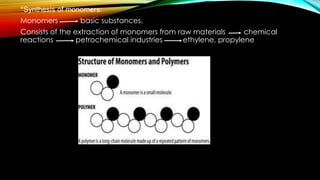
Monomers basic substances. 
Consists of the extraction of monomers from raw materials chemical 
reactions petrochemical industries ethylene, propylene
*Methods of shaping and fishing plastics: 
-Thermocompression thermosetting plastic products
STUDENT 2: 
*Synthesis of basic polymers: 
Plastics are prepared by mixing components 
When they are mixed together subjected to chemical processes (polymerization, 
polycondensation, polyaddition) modifies their properties, making new materials in 
grains, resins, flakes…
*Additives: 
These are chemical products added in the precise proportions to give the polymer 
properties like thermal and electrical conductivity, resistance to fire, rigidity, flexibility, etc. 
-Dyes or pigments: give it color. 
plasticity 
-Plasticizers: improves 
the shine on the surface. 
-Antistatic agents: Reduce static electric charge in order to the dust and dirty not 
to stick 
-Fireproof or fire-retardant agents: delay formation of flames. 
UV radiations 
-UV stabilizers: Protect it decomposition 
atmospheric phenomena
-Fillers, reinforcements, and lubricants: improve and facilitate 
-Mold release agents: make the piece come out of the mold easily. 
-Antioxidants: prevent reactions with oxygen. 
mechanical properties 
manufacturing process
*Methods of shaping and finishing plastics: 
-Injection molding is used to make objects with complex shapes. 
-Foam molding is used to make packaging, pillows, and sponges. 
-Vacuum forming is used to make glasses, packaging, and boxes. 
-Commercial shapes is used for commercial use, plastics are presented in bars. 
Injection molding Vacuum 
molding 
Foam Calendaring 
Molding
STUDENT 3: 
physical 
mechanical 
4 types of properties: 
chemical 
biological
*Physical properties: 
-Electrical conductivity: let current flow through it. 
plastic low conductivity 
A. Heeger, A. McDiarmid, H. Shirakawa Nobel prize in 2000 developed polymers that 
conduct electricity
-Thermal conductivity: let hit pass through it. 
Plastics low thermal conductivity 
-Density: amount of material mass per unit of volume plastic is low 
low weight
-Expansion: relative variation in the dimensions of a material because of temperature. 
SOLID LIQUID LIQUID SOLID 
Plastics High coefficient of expansion 
Reinforced plastics low coefficient of expansión 
-Melting Point: temperature when a solid becomes a liquid 
200ºC later 
-Fusibility: amount of heat needed to melt materials
*Mechanical properties: 
traction 
compression 
-Types of stresses: bending 
shearing 
torsión 
-Traction: a material is subjucted by two opposing forces that pull on it. 
It gets broken if it 
is very strong
-Compression: two opposite forces that push on it. 
it can be broken 
-Bending: subjected by two forces trying to bend it. 
-Shearing: subjected by two opposite forces acting in different pints close to each other and try 
to cut the material.
shearing 
-Torsion: subjected by two forces, twisting it by an axis
Elasticity: is the ability of a material to deform when it goes under the force of a stress 
Limit point yield point 
Plasticity: ability of a material to remain deformed by a stress when it is removed.
-Malleability: ability of a material to be permanently deformed under compression. 
-Ductility: ability of a material to be permanently deformed under traction. 
Used to make bars 
and wires
-Resistance: ability of a material to undergo stress without breaking. 
-Hardness: ability of a material to resist being scratched or punctured. 
-Weldeability: ability of a material to join solidly with another when heated. 
Weldability Hardness
*Chemical properties: 
-Permeability: ability of a material to let fluids to flow throw them. 
Normally plastics are impermeable 
-Solubility: ability of a material to mix homogeneously with 
another substance solvent 
-Combustibility: ability of a material to burn. 
Plastics burn easily but is polluting
*Biological properties: 
-Recyclability: ability to produce from a used product a new one. 
Recycle separate different materials 
-Toxicity: ability of a material to produce 
negative effects on 
living organisms. 
-Biodegradability: ability of 
a material to decompose.
STUDENT 4: 
*Plastic materials are classified in three groups: 
-Thermosetting : They are petroquemical materials and they can´t deform easily , it 
can only deform with heat and if it is at 170 °C.
*Thermosetting they are divided in five groups: 
-Phenolic resins: They are hard, insoluble, resistant to very high temperatures. 
You can use it to buttons, switches, handles, and kitchen utensil handles.
-Ureic resins impermeable to liquids. 
You can use it for electrical accessories, handles, door and drawer knobs,bottle caps, plates, 
cups, and pans. 
-Melamine resins impermeable to liquids and elastic. 
You can used it for household furniture. 
Polyester resins they are good electrical and thermal insulators ,also mixed with a 
catalyst. Mixed with fiberglass, they are used in tanks, bodywork of vehicles.
-Epoxy resins They are good 
electrical insulators, resistant to humidity and high temperatures. 
We can used it in varnishes, coatings for word, plastics, and electrical and electronic 
systems.
-Thermoplastics: They are soft and you can deformed with heat 
They are divided in some groups: 
transparent, tough, resistant to mechanical stress and oils 
Polyethylene terephthalate Uses for carbonated beverages, oils, water, chemical products 
Objects made of polyethylene terephthalate are marked with 
these symbol 
Tough and resistant to mechanical stress and chemical agents. 
Polycarbonate Fabrics, household utensils, bearings, gears, screws, household appliance 
parts, and electrical connectors. 
Objects made of polyamide do not have a specific symbol
It is fireproof, and resistant to chemical products 
and high temperatures. 
Teflon or Polytetrafluoroethylene 
Nonstick coatings, joints, and insulation for high-temperature 
cables
*Elastomers: They are materials that are very elastic. 
They are impermeable and a good electrical and acoustic insulator. 
We use them for natural rubber products. 
-Elastomers is divided in several groups: 
It is resistant to organic liquids is impermeable 
and a good electrical and acoustic insulator. 
Synthetic rubber Tires, solid wheels…etc 
In 1887 John Boyd Dunlop,he was an Scottish veterinarian, and he 
invented the first air chambers for bicycles of the time and these is 
how tires were invented.
John Boyd Dunlop first air chambers for bicycles.

Project 2

  • 1.
    PROJECT 2: PLASTIC MATERIALS -Elena Garijo -Daniel Navarro -Cristina Puerta -Renata Szabo
  • 2.
    STUDENT 1: *Sourcingof raw materials: Raw materials can be of: -Vegetal origin from tropical tres line, cotton, wood… -Animal origin wool, fur and leather -Mineral origin plastics are composed of pretoleum, carbón and fossil fuel gold, plastics, iron…
  • 3.
    *Synthesis of monomers: Monomers basic substances. Consists of the extraction of monomers from raw materials chemical reactions petrochemical industries ethylene, propylene
  • 4.
    *Methods of shapingand fishing plastics: -Thermocompression thermosetting plastic products
  • 5.
    STUDENT 2: *Synthesisof basic polymers: Plastics are prepared by mixing components When they are mixed together subjected to chemical processes (polymerization, polycondensation, polyaddition) modifies their properties, making new materials in grains, resins, flakes…
  • 6.
    *Additives: These arechemical products added in the precise proportions to give the polymer properties like thermal and electrical conductivity, resistance to fire, rigidity, flexibility, etc. -Dyes or pigments: give it color. plasticity -Plasticizers: improves the shine on the surface. -Antistatic agents: Reduce static electric charge in order to the dust and dirty not to stick -Fireproof or fire-retardant agents: delay formation of flames. UV radiations -UV stabilizers: Protect it decomposition atmospheric phenomena
  • 7.
    -Fillers, reinforcements, andlubricants: improve and facilitate -Mold release agents: make the piece come out of the mold easily. -Antioxidants: prevent reactions with oxygen. mechanical properties manufacturing process
  • 8.
    *Methods of shapingand finishing plastics: -Injection molding is used to make objects with complex shapes. -Foam molding is used to make packaging, pillows, and sponges. -Vacuum forming is used to make glasses, packaging, and boxes. -Commercial shapes is used for commercial use, plastics are presented in bars. Injection molding Vacuum molding Foam Calendaring Molding
  • 9.
    STUDENT 3: physical mechanical 4 types of properties: chemical biological
  • 10.
    *Physical properties: -Electricalconductivity: let current flow through it. plastic low conductivity A. Heeger, A. McDiarmid, H. Shirakawa Nobel prize in 2000 developed polymers that conduct electricity
  • 11.
    -Thermal conductivity: lethit pass through it. Plastics low thermal conductivity -Density: amount of material mass per unit of volume plastic is low low weight
  • 12.
    -Expansion: relative variationin the dimensions of a material because of temperature. SOLID LIQUID LIQUID SOLID Plastics High coefficient of expansion Reinforced plastics low coefficient of expansión -Melting Point: temperature when a solid becomes a liquid 200ºC later -Fusibility: amount of heat needed to melt materials
  • 13.
    *Mechanical properties: traction compression -Types of stresses: bending shearing torsión -Traction: a material is subjucted by two opposing forces that pull on it. It gets broken if it is very strong
  • 14.
    -Compression: two oppositeforces that push on it. it can be broken -Bending: subjected by two forces trying to bend it. -Shearing: subjected by two opposite forces acting in different pints close to each other and try to cut the material.
  • 15.
    shearing -Torsion: subjectedby two forces, twisting it by an axis
  • 16.
    Elasticity: is theability of a material to deform when it goes under the force of a stress Limit point yield point Plasticity: ability of a material to remain deformed by a stress when it is removed.
  • 17.
    -Malleability: ability ofa material to be permanently deformed under compression. -Ductility: ability of a material to be permanently deformed under traction. Used to make bars and wires
  • 18.
    -Resistance: ability ofa material to undergo stress without breaking. -Hardness: ability of a material to resist being scratched or punctured. -Weldeability: ability of a material to join solidly with another when heated. Weldability Hardness
  • 19.
    *Chemical properties: -Permeability:ability of a material to let fluids to flow throw them. Normally plastics are impermeable -Solubility: ability of a material to mix homogeneously with another substance solvent -Combustibility: ability of a material to burn. Plastics burn easily but is polluting
  • 20.
    *Biological properties: -Recyclability:ability to produce from a used product a new one. Recycle separate different materials -Toxicity: ability of a material to produce negative effects on living organisms. -Biodegradability: ability of a material to decompose.
  • 21.
    STUDENT 4: *Plasticmaterials are classified in three groups: -Thermosetting : They are petroquemical materials and they can´t deform easily , it can only deform with heat and if it is at 170 °C.
  • 22.
    *Thermosetting they aredivided in five groups: -Phenolic resins: They are hard, insoluble, resistant to very high temperatures. You can use it to buttons, switches, handles, and kitchen utensil handles.
  • 23.
    -Ureic resins impermeableto liquids. You can use it for electrical accessories, handles, door and drawer knobs,bottle caps, plates, cups, and pans. -Melamine resins impermeable to liquids and elastic. You can used it for household furniture. Polyester resins they are good electrical and thermal insulators ,also mixed with a catalyst. Mixed with fiberglass, they are used in tanks, bodywork of vehicles.
  • 24.
    -Epoxy resins Theyare good electrical insulators, resistant to humidity and high temperatures. We can used it in varnishes, coatings for word, plastics, and electrical and electronic systems.
  • 25.
    -Thermoplastics: They aresoft and you can deformed with heat They are divided in some groups: transparent, tough, resistant to mechanical stress and oils Polyethylene terephthalate Uses for carbonated beverages, oils, water, chemical products Objects made of polyethylene terephthalate are marked with these symbol Tough and resistant to mechanical stress and chemical agents. Polycarbonate Fabrics, household utensils, bearings, gears, screws, household appliance parts, and electrical connectors. Objects made of polyamide do not have a specific symbol
  • 26.
    It is fireproof,and resistant to chemical products and high temperatures. Teflon or Polytetrafluoroethylene Nonstick coatings, joints, and insulation for high-temperature cables
  • 27.
    *Elastomers: They arematerials that are very elastic. They are impermeable and a good electrical and acoustic insulator. We use them for natural rubber products. -Elastomers is divided in several groups: It is resistant to organic liquids is impermeable and a good electrical and acoustic insulator. Synthetic rubber Tires, solid wheels…etc In 1887 John Boyd Dunlop,he was an Scottish veterinarian, and he invented the first air chambers for bicycles of the time and these is how tires were invented.
  • 28.
    John Boyd Dunlopfirst air chambers for bicycles.