PROGRESSIVE 
SLENDERIZING 
TECHNIQUE 
Presenter : Zia Ul Islam
Definition 
๏‚ง Mechanical reduction of the dental 
interproximal enamel layer, which is 
carried out in order to re-shape the 
contact area and decrease the 
mesiodistal diameter of the teeth to 
facilitate alignment.
The objectives of slenderizing 
include: 
โ€ข Correction of dentoalveolar discrepancies 
โ€ข Treatment of tooth size discrepancy (Bolton 
discrepancy) 
โ€ข Adjustment of interdental contact point to the papilla 
shape 
โ€ข Increasing the interdental contact surface in order to 
contribute to better stability of corrected rotations 
โ€ข Correction of asymmetries in order to improve 
aesthetics.
Indications 
1. Crowding 
Slenderizing is a technique for the treatment 
of minor crowding, but an 
experienced orthodontist also can treat 
moderate crowding cases. 
2. Bolton discrepancies 
The upper and lower canine-to-canine and 
upper and lower molar-to-molar Bolton 
indices indicate where slenderizing might be 
undertaken to improve the occlusion.
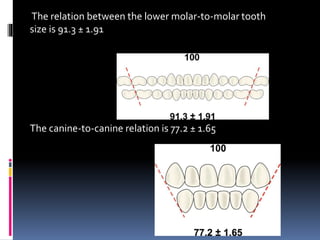
The relation between the lower molar-to-molar tooth 
size is 91.3 ยฑ 1.91 
The canine-to-canine relation is 77.2 ยฑ 1.65
If a โ€˜12โ€™ Bolton index is achieved, a 
molar Class I relationship is obtained 
and 
if the โ€˜6โ€™ Bolton index is achieved, a 
canine Class I relationship is obtained.
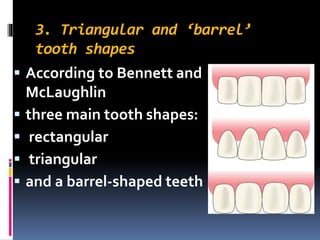
3. Triangular and โ€˜barrelโ€™ 
tooth shapes 
๏‚ง According to Bennett and 
McLaughlin 
๏‚ง three main tooth shapes: 
๏‚ง rectangular 
๏‚ง triangular 
๏‚ง and a barrel-shaped teeth
Tooth shape has great importance in 
orthodontic treatment. 
The rectangular shape allows a wide and stable 
contact point without visible interdental spaces. 
The triangular shape allows a reduced and very 
occlusal or incisal contact point with BLACK 
GINGIVAL TRIANGLES. 
Barrel shaped teeth have a reduced contact point in 
the middle with apparent embrasures at the incisal 
level.
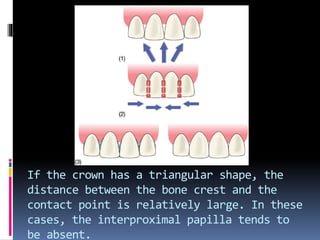
If the crown has a triangular shape, the 
distance between the bone crest and the 
contact point is relatively large. In these 
cases, the interproximal papilla tends to 
be absent.
๏‚ง 4. Macrodontia 
๏‚ง Dental shape does not have any influence 
on the enamel thickness but it is 
aesthetically more advisable to perform 
slenderizing on macrodontic rather than 
on microdontic teeth.
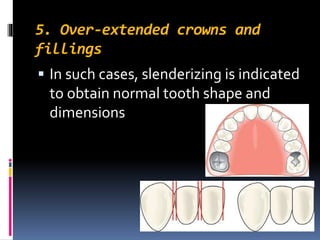
5. Over-extended crowns and 
fillings 
๏‚ง In such cases, slenderizing is indicated 
to obtain normal tooth shape and 
dimensions
6. Bilateral dental asymmetries 
๏‚ง Slenderizing, veneers or crowns are often 
indicated in order to compensate for 
dental asymmetries, upper anterior 
region. 
7. Adult patient (narrowed pulp chambers) 
๏‚ง Adults have narrower pulp chambers, so 
slenderizing can be carried out with less 
risk of compromising dental sensibility 
than in young patients.
8. Low caries index 
๏‚ง Slenderizing should only be carried out in 
patients with a low caries index, in order to 
avoid increase in susceptibility. 
9. Multiple rotations, in order to achieve 
better stability 
๏‚ง In patients who present with multiple 
rotations, slenderizing can result in wider 
interproximal contact areas, which makes 
the tooth position more stable with respect 
to the risk of relapse
Contraindications 
โ€ข Patients who do not consent to slenderizing.. 
โ€ข High caries index 
โ€ข Poor oral hygiene: high bacterial plaque 
index 
โ€ข Rectangular-shaped teeth 
โ€ข Young patient (large pulpal chambers) 
โ€ข Enamel hypoplasia, dentine hypoplasia, etc. 
โ€ข Interproximally abraded teeth
Advantages of slenderizing 
--Minimizing the need for extractions and 
their consequences 
The consequences of extraction 
orthodontic therapy are: 
โ€ข Difficulties in extraction space closure due 
to loss of archwire control 
โ€ข Difficulties in root paralleling next to 
extraction sites 
โ€ข Possibility of the space re-opening 
(relapse), especially in adult patients.
--Less loss of tooth material 
Slenderizing causes less tooth volume loss than 
extractions. 
--Smaller tooth movements 
With the progressive slenderizing technique, tooth 
movements required are smaller than in extraction 
cases. 
--Less root resorption risk 
With smaller tooth movements and shorter 
treatment times, the risk of root resorption is 
reduced.
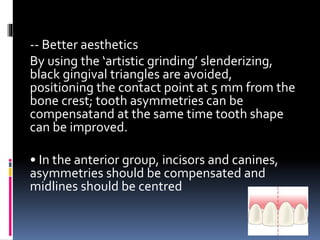
-- Better aesthetics 
By using the โ€˜artistic grindingโ€™ slenderizing, 
black gingival triangles are avoided, 
positioning the contact point at 5 mm from the 
bone crest; tooth asymmetries can be 
compensatand at the same time tooth shape 
can be improved. 
โ€ข In the anterior group, incisors and canines, 
asymmetries should be compensated and 
midlines should be centred
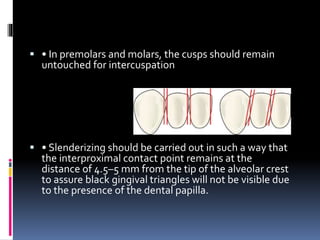
๏‚ง โ€ข In premolars and molars, the cusps should remain 
untouched for intercuspation 
๏‚ง โ€ข Slenderizing should be carried out in such a way that 
the interproximal contact point remains at the 
distance of 4.5โ€“5 mm from the tip of the alveolar crest 
to assure black gingival triangles will not be visible due 
to the presence of the dental papilla.
How much enamel can be 
stripped? 
The enamel layer at the level of the 
contact points has a minimum 1 mm 
thickness, except the lower incisors, 
where it is 0.6 mm. This allows the 
orthodontist to grind half layer: 0.5 mm 
on mesial or distal surface of all teeth, 
except of the the lower incisors where 
0.3 mm can be removed.
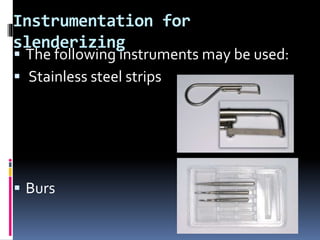
Instrumentation for 
slenderizing ๏‚ง The following instruments may be used: 
๏‚ง Stainless steel strips 
๏‚ง Burs
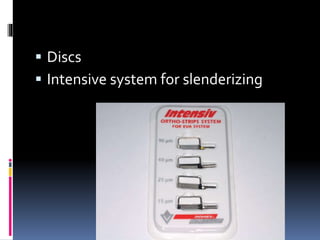
๏‚ง Discs 
๏‚ง Intensive system for slenderizing
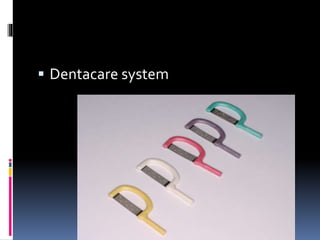
๏‚ง Dentacare system
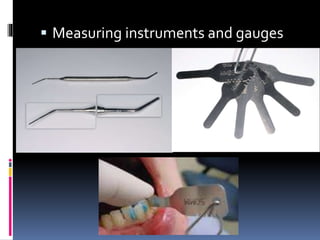
๏‚ง Measuring instruments and gauges
THANK YOU

Progressive slenderizing technique

  • 1.
    PROGRESSIVE SLENDERIZING TECHNIQUE Presenter : Zia Ul Islam
  • 2.
    Definition ๏‚ง Mechanicalreduction of the dental interproximal enamel layer, which is carried out in order to re-shape the contact area and decrease the mesiodistal diameter of the teeth to facilitate alignment.
  • 3.
    The objectives ofslenderizing include: โ€ข Correction of dentoalveolar discrepancies โ€ข Treatment of tooth size discrepancy (Bolton discrepancy) โ€ข Adjustment of interdental contact point to the papilla shape โ€ข Increasing the interdental contact surface in order to contribute to better stability of corrected rotations โ€ข Correction of asymmetries in order to improve aesthetics.
  • 4.
    Indications 1. Crowding Slenderizing is a technique for the treatment of minor crowding, but an experienced orthodontist also can treat moderate crowding cases. 2. Bolton discrepancies The upper and lower canine-to-canine and upper and lower molar-to-molar Bolton indices indicate where slenderizing might be undertaken to improve the occlusion.
  • 5.
    The relation betweenthe lower molar-to-molar tooth size is 91.3 ยฑ 1.91 The canine-to-canine relation is 77.2 ยฑ 1.65
  • 6.
    If a โ€˜12โ€™Bolton index is achieved, a molar Class I relationship is obtained and if the โ€˜6โ€™ Bolton index is achieved, a canine Class I relationship is obtained.
  • 7.
    3. Triangular andโ€˜barrelโ€™ tooth shapes ๏‚ง According to Bennett and McLaughlin ๏‚ง three main tooth shapes: ๏‚ง rectangular ๏‚ง triangular ๏‚ง and a barrel-shaped teeth
  • 8.
    Tooth shape hasgreat importance in orthodontic treatment. The rectangular shape allows a wide and stable contact point without visible interdental spaces. The triangular shape allows a reduced and very occlusal or incisal contact point with BLACK GINGIVAL TRIANGLES. Barrel shaped teeth have a reduced contact point in the middle with apparent embrasures at the incisal level.
  • 9.
    If the crownhas a triangular shape, the distance between the bone crest and the contact point is relatively large. In these cases, the interproximal papilla tends to be absent.
  • 10.
    ๏‚ง 4. Macrodontia ๏‚ง Dental shape does not have any influence on the enamel thickness but it is aesthetically more advisable to perform slenderizing on macrodontic rather than on microdontic teeth.
  • 11.
    5. Over-extended crownsand fillings ๏‚ง In such cases, slenderizing is indicated to obtain normal tooth shape and dimensions
  • 12.
    6. Bilateral dentalasymmetries ๏‚ง Slenderizing, veneers or crowns are often indicated in order to compensate for dental asymmetries, upper anterior region. 7. Adult patient (narrowed pulp chambers) ๏‚ง Adults have narrower pulp chambers, so slenderizing can be carried out with less risk of compromising dental sensibility than in young patients.
  • 13.
    8. Low cariesindex ๏‚ง Slenderizing should only be carried out in patients with a low caries index, in order to avoid increase in susceptibility. 9. Multiple rotations, in order to achieve better stability ๏‚ง In patients who present with multiple rotations, slenderizing can result in wider interproximal contact areas, which makes the tooth position more stable with respect to the risk of relapse
  • 14.
    Contraindications โ€ข Patientswho do not consent to slenderizing.. โ€ข High caries index โ€ข Poor oral hygiene: high bacterial plaque index โ€ข Rectangular-shaped teeth โ€ข Young patient (large pulpal chambers) โ€ข Enamel hypoplasia, dentine hypoplasia, etc. โ€ข Interproximally abraded teeth
  • 15.
    Advantages of slenderizing --Minimizing the need for extractions and their consequences The consequences of extraction orthodontic therapy are: โ€ข Difficulties in extraction space closure due to loss of archwire control โ€ข Difficulties in root paralleling next to extraction sites โ€ข Possibility of the space re-opening (relapse), especially in adult patients.
  • 16.
    --Less loss oftooth material Slenderizing causes less tooth volume loss than extractions. --Smaller tooth movements With the progressive slenderizing technique, tooth movements required are smaller than in extraction cases. --Less root resorption risk With smaller tooth movements and shorter treatment times, the risk of root resorption is reduced.
  • 17.
    -- Better aesthetics By using the โ€˜artistic grindingโ€™ slenderizing, black gingival triangles are avoided, positioning the contact point at 5 mm from the bone crest; tooth asymmetries can be compensatand at the same time tooth shape can be improved. โ€ข In the anterior group, incisors and canines, asymmetries should be compensated and midlines should be centred
  • 18.
    ๏‚ง โ€ข Inpremolars and molars, the cusps should remain untouched for intercuspation ๏‚ง โ€ข Slenderizing should be carried out in such a way that the interproximal contact point remains at the distance of 4.5โ€“5 mm from the tip of the alveolar crest to assure black gingival triangles will not be visible due to the presence of the dental papilla.
  • 19.
    How much enamelcan be stripped? The enamel layer at the level of the contact points has a minimum 1 mm thickness, except the lower incisors, where it is 0.6 mm. This allows the orthodontist to grind half layer: 0.5 mm on mesial or distal surface of all teeth, except of the the lower incisors where 0.3 mm can be removed.
  • 20.
    Instrumentation for slenderizing๏‚ง The following instruments may be used: ๏‚ง Stainless steel strips ๏‚ง Burs
  • 21.
    ๏‚ง Discs ๏‚งIntensive system for slenderizing
  • 22.
  • 23.
  • 24.