B.RAMA PRABHA,
ASSISTANT PROFESSOR,
DEPARTMENT OF COMPUTER SCIENCE,
K.C.S.KASI NADAR COLLEGE OF ARTS & SCIENCE,
CHENNAI-21
Programing Techniques:
Looping
Counting
Indexing
Looping :
The programming technique used to instruct the
microprocessor to repeat tasks is called looping.
A loop is set up by instructing the microprocessor to
change the sequence of execution and perform the task
again.
This process is accomplished by using Jump
instructions.
In addition, techniques such as counting and indexing
are used in setting up a loop.
Loops can be classified into two groups
1. Continuous loop: Repeats a task continuously
2. Conditional loop: Repeats a task until certain data
conditions are met.
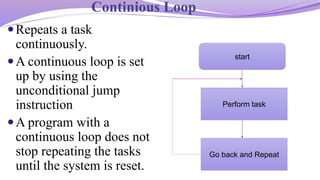
Continious Loop
Repeats a task
continuously.
A continuous loop is set
up by using the
unconditional jump
instruction
A program with a
continuous loop does not
stop repeating the tasks
until the system is reset.
start
Perform task
Go back and Repeat
CONDITIONAL LOOP
 A conditional loop is set up by a conditional jump
instructions.
 These instructions check flags(Z,CY,P,S) and repeat the
tasks if the conditions are satisfied.
 These loops include counting and indexing.
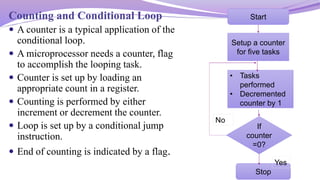
Counting and Conditional Loop
 A counter is a typical application of the
conditional loop.
 A microprocessor needs a counter, flag
to accomplish the looping task.
 Counter is set up by loading an
appropriate count in a register.
 Counting is performed by either
increment or decrement the counter.
 Loop is set up by a conditional jump
instruction.
 End of counting is indicated by a flag.
Start
Setup a counter
for five tasks
• Tasks
performed
• Decremented
counter by 1
If
counter
=0?
Stop
No
Yes
Indexing
 Another type of loop includes indexing with counter.
Indexing means pointing or referencing objects with
sequential numbers.
Similarly data bytes are stored in memory location
and those data bytes are referred to by their memory
location
Example:
Steps to add ten bytes of data stored in memory locations starting
Data given location and display the sum.
The microprocessor needs a counter to count 10 data bytes.
An index or a memory pointer to locate where data bytes are stored.
To transfer data from a memory location to the icroprocessor(ALU)to
perform addition.
Registers for temporary storage of partial answers a flag to indicate
the completion of the stack to store or output the result.
programming techniques

programming techniques

  • 1.
    B.RAMA PRABHA, ASSISTANT PROFESSOR, DEPARTMENTOF COMPUTER SCIENCE, K.C.S.KASI NADAR COLLEGE OF ARTS & SCIENCE, CHENNAI-21
  • 2.
  • 3.
    Looping : The programmingtechnique used to instruct the microprocessor to repeat tasks is called looping. A loop is set up by instructing the microprocessor to change the sequence of execution and perform the task again. This process is accomplished by using Jump instructions. In addition, techniques such as counting and indexing are used in setting up a loop.
  • 4.
    Loops can beclassified into two groups 1. Continuous loop: Repeats a task continuously 2. Conditional loop: Repeats a task until certain data conditions are met.
  • 5.
    Continious Loop Repeats atask continuously. A continuous loop is set up by using the unconditional jump instruction A program with a continuous loop does not stop repeating the tasks until the system is reset. start Perform task Go back and Repeat
  • 6.
    CONDITIONAL LOOP  Aconditional loop is set up by a conditional jump instructions.  These instructions check flags(Z,CY,P,S) and repeat the tasks if the conditions are satisfied.  These loops include counting and indexing.
  • 7.
    Counting and ConditionalLoop  A counter is a typical application of the conditional loop.  A microprocessor needs a counter, flag to accomplish the looping task.  Counter is set up by loading an appropriate count in a register.  Counting is performed by either increment or decrement the counter.  Loop is set up by a conditional jump instruction.  End of counting is indicated by a flag. Start Setup a counter for five tasks • Tasks performed • Decremented counter by 1 If counter =0? Stop No Yes
  • 8.
    Indexing  Another typeof loop includes indexing with counter. Indexing means pointing or referencing objects with sequential numbers. Similarly data bytes are stored in memory location and those data bytes are referred to by their memory location
  • 9.
    Example: Steps to addten bytes of data stored in memory locations starting Data given location and display the sum. The microprocessor needs a counter to count 10 data bytes. An index or a memory pointer to locate where data bytes are stored. To transfer data from a memory location to the icroprocessor(ALU)to perform addition. Registers for temporary storage of partial answers a flag to indicate the completion of the stack to store or output the result.