Jump & Call
Jump & Call
Chapter 3
Chapter 3
Sepehr Naimi
www.NicerLand.com
www.MicroDigitalEd.com
2
Topics
Topics
 Introduction to jump and call
 Jump
 Call
 Stack
 Calling a function
 Time Delay
3
Jump and Call
Jump and Call
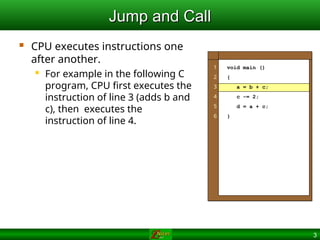
 CPU executes instructions one
after another.
 For example in the following C
program, CPU first executes the
instruction of line 3 (adds b and
c), then executes the
instruction of line 4.
1
2
3
4
5
6
void main ()
{
a = b + c;
c -= 2;
d = a + c;
}
4
Jump and Call (Continued)
 But sometimes we need the CPU to execute,
an instruction other than the next instruction.
For example:
 When we use a conditional instruction (if)
 When we make a loop
 When we call a function
5
Jump and Call (Continued)
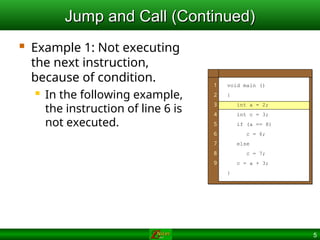
 Example 1: Not executing
the next instruction,
because of condition.
 In the following example,
the instruction of line 6 is
not executed.
1
2
3
4
5
6
7
8
9
void main ()
{
int a = 2;
int c = 3;
if (a == 8)
c = 6;
else
c = 7;
c = a + 3;
}
6
Jump and Call (Continued)
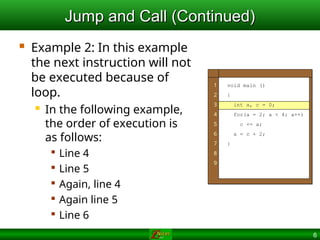
 Example 2: In this example
the next instruction will not
be executed because of
loop.
 In the following example,
the order of execution is
as follows:

Line 4

Line 5

Again, line 4

Again line 5

Line 6
1
2
3
4
5
6
7
8
9
void main ()
{
int a, c = 0;
for(a = 2; a < 4; a++)
c += a;
a = c + 2;
}
7
Jump and Call (Continued)
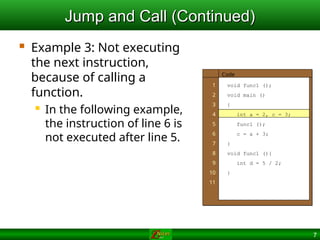
 Example 3: Not executing
the next instruction,
because of calling a
function.
 In the following example,
the instruction of line 6 is
not executed after line 5.
1
2
3
4
5
6
7
8
9
10
11
void func1 ();
void main ()
{
int a = 2, c = 3;
func1 ();
c = a + 3;
}
void func1 (){
int d = 5 / 2;
}
Code
8
Jump and Call (Continued)
 In the assembly language, there are 2 groups
of instructions that make the CPU execute an
instruction other than the next instruction.
The instructions are:
 Jump: used for making loop and condition
 Call: used for making function calls
9
Jump
Jump
 Jump changes the Program Counter (PC)
and causes the CPU to execute an
instruction other than the next instruction.
10
Jump
Jump
There are 2 kinds of Jump
 Unconditional Jump: When CPU executes an
unconditional jump, it jumps unconditionally (without
checking any condition) to the target location.

Example: RJMP and JMP instructions
 Conditional Jump: When CPU executes a conditional
jump, it checks a condition, if the condition is true then
it jumps to the target location; otherwise, it executes the
next instruction.
11
Unconditional Jump in AVR
 There are 3 unconditional
jump instructions in AVR:
RJMP, JMP, and IJMP
 We label the location where
we want to jump, using a
unique name, followed by ‘:’
 Then, in front of the jump
instruction we mention the
name of the label.
 This causes the CPU to jump
to the location we have
labeled, instead of executing
the next instruction.
1
2
3
4
5
LDI R16, 0
LDI R17, 2
L1: ADD R16, R17
RJMP L1
SUB R10,R15
Code
L1:
L1
12
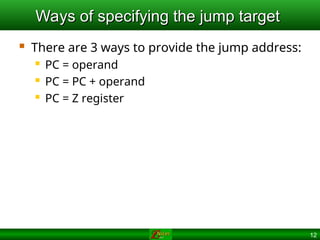
Ways of specifying the jump target
 There are 3 ways to provide the jump address:
 PC = operand
 PC = PC + operand
 PC = Z register
13
JMP
JMP
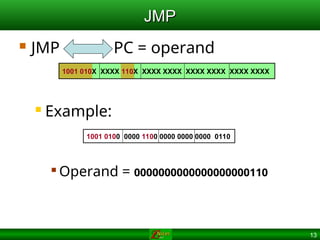
 JMP PC = operand
 Example:

Operand = 0000000000000000000110
1001 0100 0000 1100 0000 0000 0000 0110
1001 010X XXXX 110X XXXX XXXX XXXX XXXX XXXX XXXX
14
JMP
JMP
0000
0000
0001
0002
0004
0005
0006
0006
0007
0009
.ORG 0
LDI R16, 15
LDI R17, 5
JMP LBL_NAME
LDI R18, 4
ADD R18, R17
LBL_NAME:
ADD R16,R17
JMP LBL_NAME
Code
Address
0006
opCode operand
940C 0006
Machine code:
PC: 0000
0001
0002
0006
0007
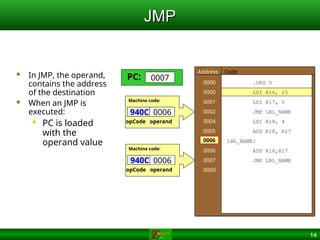
 In JMP, the operand,
contains the address
of the destination
 When an JMP is
executed:
 PC is loaded
with the
operand value
opCode operand
940C 0006
Machine code:
0006
15
RJMP (Relative jump)
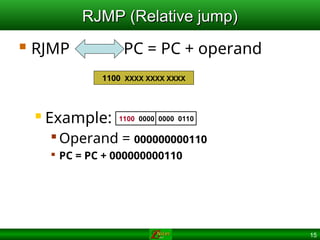
 RJMP PC = PC + operand
 Example:

Operand = 000000000110

PC = PC + 000000000110
1100 0000 0000 0110
1100 XXXX XXXX XXXX
16
RJMP
RJMP
0000
0000
0001
0002
0003
0004
0005
0005
0006
0007
.ORG 0
LDI R16, 15
LDI R17, 5
RJMP LBL_NAME
LDI R18, 4
ADD R18, R17
LBL_NAME:
ADD R16,R17
RJMP LBL_NAME
Code
Address
0005
opCode operand
C002
Machine code:
PC: 0000
0001
0002
002
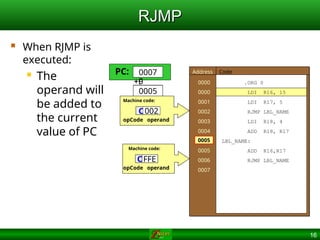
 When RJMP is
executed:
 The
operand will
be added to
the current
value of PC
opCode operand
CFFE
Machine code:
FFE
+F
+0
0003
0005
0006
0007
0005
17
IJMP (Indirect jump)
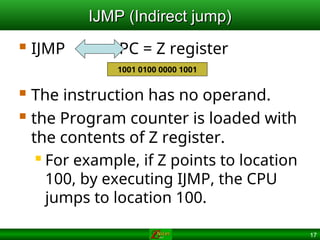
 IJMP PC = Z register
 The instruction has no operand.
 the Program counter is loaded with
the contents of Z register.
 For example, if Z points to location
100, by executing IJMP, the CPU
jumps to location 100.
1001 0100 0000 1001
18
Conditional Jump in AVR
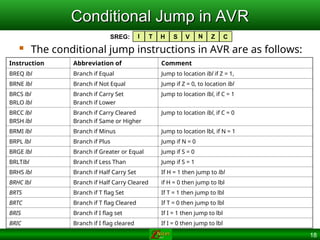
 The conditional jump instructions in AVR are as follows:
Instruction Abbreviation of Comment
BREQ lbl Branch if Equal Jump to location lbl if Z = 1,
BRNE lbl Branch if Not Equal Jump if Z = 0, to location lbl
BRCS lbl
BRLO lbl
Branch if Carry Set
Branch if Lower
Jump to location lbl, if C = 1
BRCC lbl
BRSH lbl
Branch if Carry Cleared
Branch if Same or Higher
Jump to location lbl, if C = 0
BRMI lbl Branch if Minus Jump to location lbl, if N = 1
BRPL lbl Branch if Plus Jump if N = 0
BRGE lbl Branch if Greater or Equal Jump if S = 0
BRLTlbl Branch if Less Than Jump if S = 1
BRHS lbl Branch if Half Carry Set If H = 1 then jump to lbl
BRHC lbl Branch if Half Carry Cleared if H = 0 then jump to lbl
BRTS Branch if T flag Set If T = 1 then jump to lbl
BRTC Branch if T flag Cleared If T = 0 then jump to lbl
BRIS Branch if I flag set If I = 1 then jump to lbl
BRIC Branch if I flag cleared If I = 0 then jump to lbl
SREG: H S V N C
Z
T
I
19
Usages of Conditional jump
 Conditions
 Loop
20
Conditions
Conditions
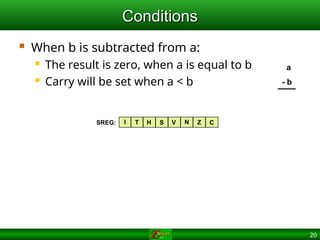
 When b is subtracted from a:
 The result is zero, when a is equal to b
 Carry will be set when a < b
a
- b
SREG: H S V N C
Z
T
I
21
Example 1
Example 1
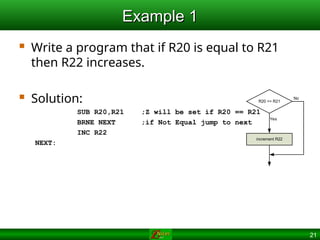
 Write a program that if R20 is equal to R21
then R22 increases.
 Solution:
SUB R20,R21 ;Z will be set if R20 == R21
BRNE NEXT ;if Not Equal jump to next
INC R22
NEXT:
R20 == R21
increment R22
No
Yes
22
Example 2
Example 2
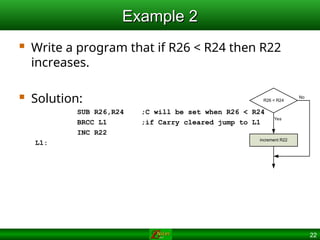
 Write a program that if R26 < R24 then R22
increases.
 Solution:
SUB R26,R24 ;C will be set when R26 < R24
BRCC L1 ;if Carry cleared jump to L1
INC R22
L1:
R26 < R24
increment R22
No
Yes
23
Example 3
Example 3
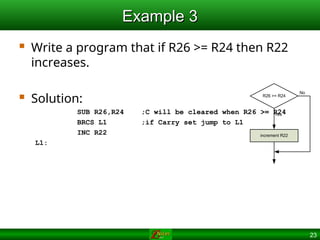
 Write a program that if R26 >= R24 then R22
increases.
 Solution:
SUB R26,R24 ;C will be cleared when R26 >= R24
BRCS L1 ;if Carry set jump to L1
INC R22
L1:
R26 >= R24
increment R22
No
Yes
24
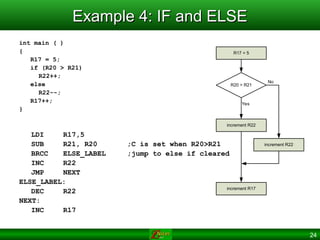
Example 4: IF and ELSE
int main ( )
{
R17 = 5;
if (R20 > R21)
R22++;
else
R22--;
R17++;
}
LDI R17,5
SUB R21, R20 ;C is set when R20>R21
BRCC ELSE_LABEL ;jump to else if cleared
INC R22
JMP NEXT
ELSE_LABEL:
DEC R22
NEXT:
INC R17
R20 > R21
increment R22
No
Yes
R17 = 5
increment R22
increment R17
25
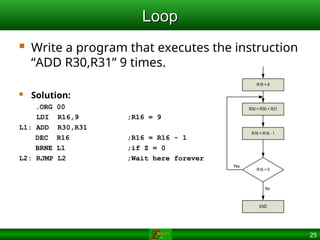
Loop
Loop
 Write a program that executes the instruction
“ADD R30,R31” 9 times.
 Solution:
.ORG 00
LDI R16,9 ;R16 = 9
L1: ADD R30,R31
DEC R16 ;R16 = R16 - 1
BRNE L1 ;if Z = 0
L2: RJMP L2 ;Wait here forever
R16 > 0
R30 = R30 + R31
No
Yes
R16 = 9
R16 = R16 - 1
END
26
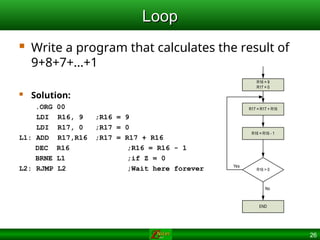
Loop
Loop
 Write a program that calculates the result of
9+8+7+…+1
 Solution:
.ORG 00
LDI R16, 9 ;R16 = 9
LDI R17, 0 ;R17 = 0
L1: ADD R17,R16 ;R17 = R17 + R16
DEC R16 ;R16 = R16 - 1
BRNE L1 ;if Z = 0
L2: RJMP L2 ;Wait here forever R16 > 0
R17 = R17 + R16
No
Yes
R16 = 9
R17 = 0
R16 = R16 - 1
END
27
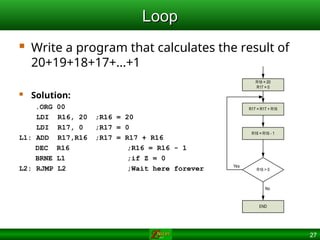
Loop
Loop
 Write a program that calculates the result of
20+19+18+17+…+1
 Solution:
.ORG 00
LDI R16, 20 ;R16 = 20
LDI R17, 0 ;R17 = 0
L1: ADD R17,R16 ;R17 = R17 + R16
DEC R16 ;R16 = R16 - 1
BRNE L1 ;if Z = 0
L2: RJMP L2 ;Wait here forever R16 > 0
R17 = R17 + R16
No
Yes
R16 = 20
R17 = 0
R16 = R16 - 1
END

28
Loop
Loop
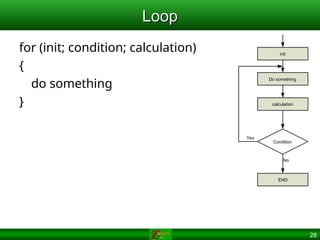
for (init; condition; calculation)
{
do something
}
END
calculation
Do something
Condition
No
Yes
init
29
Loop
Loop
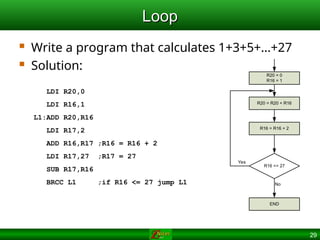
 Write a program that calculates 1+3+5+…+27
 Solution:
R16 <= 27
R20 = R20 + R16
No
Yes
R20 = 0
R16 = 1
R16 = R16 + 2
END
LDI R20,0
LDI R16,1
L1:ADD R20,R16
LDI R17,2
ADD R16,R17 ;R16 = R16 + 2
LDI R17,27 ;R17 = 27
SUB R17,R16
BRCC L1 ;if R16 <= 27 jump L1
30
Call Topics
Call Topics
 Stack, Push and Pop
 Calling a function
31
Stack
Stack
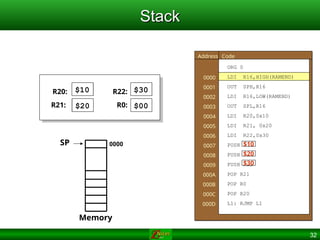
 PUSH Rr
[SP] = Rr
SP = SP - 1
 POP Rd
SP = SP + 1
Rd = [SP]
SP
Stack
32
Stack
Stack
0000
0001
0002
0003
0004
0005
0006
0007
0008
0009
000A
000B
000C
000D
ORG 0
LDI R16,HIGH(RAMEND)
OUT SPH,R16
LDI R16,LOW(RAMEND)
OUT SPL,R16
LDI R20,0x10
LDI R21, 0x20
LDI R22,0x30
PUSH R20
PUSH R21
PUSH R22
POP R21
POP R0
POP R20
L1: RJMP L1
Address Code
SP
Memory
R20:
R21:
$00
$10
$00
$20
$00
$00
$30
R22:
R0:
$10
$20
$30
0000
33
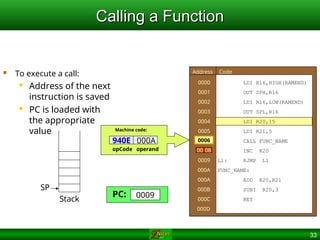
Calling a Function
Calling a Function
0000
0001
0002
0003
0004
0005
0006
0008
0009
000A
000A
000B
000C
000D
LDI R16,HIGH(RAMEND)
OUT SPH,R16
LDI R16,LOW(RAMEND)
OUT SPL,R16
LDI R20,15
LDI R21,5
CALL FUNC_NAME
INC R20
L1: RJMP L1
FUNC_NAME:
ADD R20,R21
SUBI R20,3
RET
Code
Address
0006
opCode operand
940E 000A
Machine code:
SP
Stack
PC: 0004
0005
0006
0008
000A
000B
000C
08
00
0008
0009
 To execute a call:
 Address of the next
instruction is saved
 PC is loaded with
the appropriate
value
34
Time delay
Time delay
PROGRAM
Flash ROM
Ports
OSC
CPU
Timers
Other
Peripherals
Program
Bus
Data
Bus
RAM
I/O
PINS
EEPROM
Interrupt
Unit
28 pin
10
11
1
2
3
4
5
6
7
8
9
12
13
14
(PCINT14/RESET) PC6
(PCINT16/RXD) PD0
(PCINT17/TXD) PD1
(PCINT18/INT0) PD2
(PCINT19/OC2B/INT1) PD3
(PCINT20/XCK/T0) PD4
VCC
GND
(PCINT6/XTAL1/TOSC1) PB6
(PCINT7/XTAL2/TOSC2) PB7
(PCINT22/OC0A/AIN0) PD6
(PCINT21/OC0B) PD5
(PCINT23/AIN1) PD7
(PCINT0/CLKO/ICP1) PB0
MEGA328
19
18
28
27
26
25
24
23
22
21
20
17
16
15
PC5 (ADC5/SCL/PCINT13)
PC4 (ADC4/SDA/PCINT12)
PC3 (ADC3/PCINT11)
PC2 (ADC2/PCINT10)
PC1 (ADC1/PCINT9)
PC0 (ADC0/PCINT8)
GND
AREF
AVCC
PB5 (SCK/PCINT5)
PB3 (MOSI/OC2A/PCINT3)
PB4 (MISO/PCINT4)
PB2 (SS/OC1B/PCINT2)
PB1 (OC1A/PCINT1)
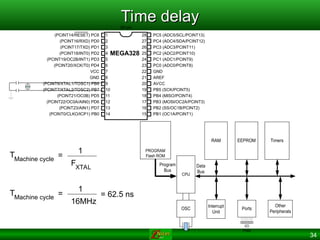
TMachine cycle
=
1
FXTAL
TMachine cycle
=
1
16MHz
= 62.5 ns
35
Time delay
Time delay
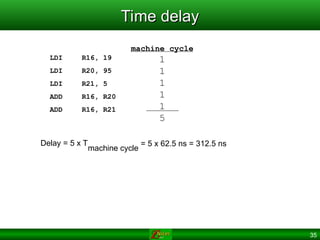
LDI R16, 19
LDI R20, 95
LDI R21, 5
ADD R16, R20
ADD R16, R21
machine cycle
1
1
1
1
1
5
Delay = 5 x T
machine cycle
= 5 x 62.5 ns = 312.5 ns
36
Time delay
Time delay
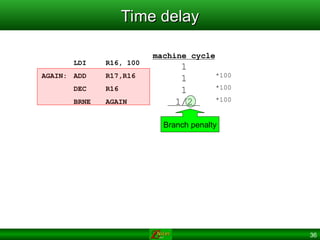
LDI R16, 100
AGAIN: ADD R17,R16
DEC R16
BRNE AGAIN
machine cycle
1
1
1
1/2
*100
*100
*100
Branch penalty
37
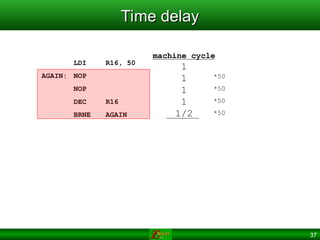
Time delay
Time delay
LDI R16, 50
AGAIN: NOP
NOP
DEC R16
BRNE AGAIN
machine cycle
1
1
1
1
1/2
*50
*50
*50
*50
38
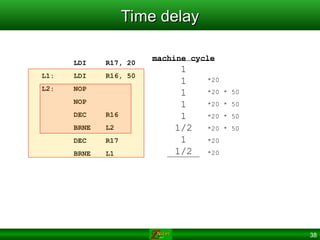
Time delay
Time delay
LDI R17, 20
L1: LDI R16, 50
L2: NOP
NOP
DEC R16
BRNE L2
DEC R17
BRNE L1
machine cycle
1
1
1
1
1
1/2
1
1/2
*20
*20 * 50
*20 * 50
*20 * 50
*20 * 50
*20
*20

3_JumpAndCall_v21_presenatationb also.ppt

  • 1.
    Jump & Call Jump& Call Chapter 3 Chapter 3 Sepehr Naimi www.NicerLand.com www.MicroDigitalEd.com
  • 2.
    2 Topics Topics  Introduction tojump and call  Jump  Call  Stack  Calling a function  Time Delay
  • 3.
    3 Jump and Call Jumpand Call  CPU executes instructions one after another.  For example in the following C program, CPU first executes the instruction of line 3 (adds b and c), then executes the instruction of line 4. 1 2 3 4 5 6 void main () { a = b + c; c -= 2; d = a + c; }
  • 4.
    4 Jump and Call(Continued) Jump and Call (Continued)  But sometimes we need the CPU to execute, an instruction other than the next instruction. For example:  When we use a conditional instruction (if)  When we make a loop  When we call a function
  • 5.
    5 Jump and Call(Continued) Jump and Call (Continued)  Example 1: Not executing the next instruction, because of condition.  In the following example, the instruction of line 6 is not executed. 1 2 3 4 5 6 7 8 9 void main () { int a = 2; int c = 3; if (a == 8) c = 6; else c = 7; c = a + 3; }
  • 6.
    6 Jump and Call(Continued) Jump and Call (Continued)  Example 2: In this example the next instruction will not be executed because of loop.  In the following example, the order of execution is as follows:  Line 4  Line 5  Again, line 4  Again line 5  Line 6 1 2 3 4 5 6 7 8 9 void main () { int a, c = 0; for(a = 2; a < 4; a++) c += a; a = c + 2; }
  • 7.
    7 Jump and Call(Continued) Jump and Call (Continued)  Example 3: Not executing the next instruction, because of calling a function.  In the following example, the instruction of line 6 is not executed after line 5. 1 2 3 4 5 6 7 8 9 10 11 void func1 (); void main () { int a = 2, c = 3; func1 (); c = a + 3; } void func1 (){ int d = 5 / 2; } Code
  • 8.
    8 Jump and Call(Continued) Jump and Call (Continued)  In the assembly language, there are 2 groups of instructions that make the CPU execute an instruction other than the next instruction. The instructions are:  Jump: used for making loop and condition  Call: used for making function calls
  • 9.
    9 Jump Jump  Jump changesthe Program Counter (PC) and causes the CPU to execute an instruction other than the next instruction.
  • 10.
    10 Jump Jump There are 2kinds of Jump  Unconditional Jump: When CPU executes an unconditional jump, it jumps unconditionally (without checking any condition) to the target location.  Example: RJMP and JMP instructions  Conditional Jump: When CPU executes a conditional jump, it checks a condition, if the condition is true then it jumps to the target location; otherwise, it executes the next instruction.
  • 11.
    11 Unconditional Jump inAVR Unconditional Jump in AVR  There are 3 unconditional jump instructions in AVR: RJMP, JMP, and IJMP  We label the location where we want to jump, using a unique name, followed by ‘:’  Then, in front of the jump instruction we mention the name of the label.  This causes the CPU to jump to the location we have labeled, instead of executing the next instruction. 1 2 3 4 5 LDI R16, 0 LDI R17, 2 L1: ADD R16, R17 RJMP L1 SUB R10,R15 Code L1: L1
  • 12.
    12 Ways of specifyingthe jump target Ways of specifying the jump target  There are 3 ways to provide the jump address:  PC = operand  PC = PC + operand  PC = Z register
  • 13.
    13 JMP JMP  JMP PC= operand  Example:  Operand = 0000000000000000000110 1001 0100 0000 1100 0000 0000 0000 0110 1001 010X XXXX 110X XXXX XXXX XXXX XXXX XXXX XXXX
  • 14.
    14 JMP JMP 0000 0000 0001 0002 0004 0005 0006 0006 0007 0009 .ORG 0 LDI R16,15 LDI R17, 5 JMP LBL_NAME LDI R18, 4 ADD R18, R17 LBL_NAME: ADD R16,R17 JMP LBL_NAME Code Address 0006 opCode operand 940C 0006 Machine code: PC: 0000 0001 0002 0006 0007  In JMP, the operand, contains the address of the destination  When an JMP is executed:  PC is loaded with the operand value opCode operand 940C 0006 Machine code: 0006
  • 15.
    15 RJMP (Relative jump) RJMP(Relative jump)  RJMP PC = PC + operand  Example:  Operand = 000000000110  PC = PC + 000000000110 1100 0000 0000 0110 1100 XXXX XXXX XXXX
  • 16.
    16 RJMP RJMP 0000 0000 0001 0002 0003 0004 0005 0005 0006 0007 .ORG 0 LDI R16,15 LDI R17, 5 RJMP LBL_NAME LDI R18, 4 ADD R18, R17 LBL_NAME: ADD R16,R17 RJMP LBL_NAME Code Address 0005 opCode operand C002 Machine code: PC: 0000 0001 0002 002  When RJMP is executed:  The operand will be added to the current value of PC opCode operand CFFE Machine code: FFE +F +0 0003 0005 0006 0007 0005
  • 17.
    17 IJMP (Indirect jump) IJMP(Indirect jump)  IJMP PC = Z register  The instruction has no operand.  the Program counter is loaded with the contents of Z register.  For example, if Z points to location 100, by executing IJMP, the CPU jumps to location 100. 1001 0100 0000 1001
  • 18.
    18 Conditional Jump inAVR Conditional Jump in AVR  The conditional jump instructions in AVR are as follows: Instruction Abbreviation of Comment BREQ lbl Branch if Equal Jump to location lbl if Z = 1, BRNE lbl Branch if Not Equal Jump if Z = 0, to location lbl BRCS lbl BRLO lbl Branch if Carry Set Branch if Lower Jump to location lbl, if C = 1 BRCC lbl BRSH lbl Branch if Carry Cleared Branch if Same or Higher Jump to location lbl, if C = 0 BRMI lbl Branch if Minus Jump to location lbl, if N = 1 BRPL lbl Branch if Plus Jump if N = 0 BRGE lbl Branch if Greater or Equal Jump if S = 0 BRLTlbl Branch if Less Than Jump if S = 1 BRHS lbl Branch if Half Carry Set If H = 1 then jump to lbl BRHC lbl Branch if Half Carry Cleared if H = 0 then jump to lbl BRTS Branch if T flag Set If T = 1 then jump to lbl BRTC Branch if T flag Cleared If T = 0 then jump to lbl BRIS Branch if I flag set If I = 1 then jump to lbl BRIC Branch if I flag cleared If I = 0 then jump to lbl SREG: H S V N C Z T I
  • 19.
    19 Usages of Conditionaljump Usages of Conditional jump  Conditions  Loop
  • 20.
    20 Conditions Conditions  When bis subtracted from a:  The result is zero, when a is equal to b  Carry will be set when a < b a - b SREG: H S V N C Z T I
  • 21.
    21 Example 1 Example 1 Write a program that if R20 is equal to R21 then R22 increases.  Solution: SUB R20,R21 ;Z will be set if R20 == R21 BRNE NEXT ;if Not Equal jump to next INC R22 NEXT: R20 == R21 increment R22 No Yes
  • 22.
    22 Example 2 Example 2 Write a program that if R26 < R24 then R22 increases.  Solution: SUB R26,R24 ;C will be set when R26 < R24 BRCC L1 ;if Carry cleared jump to L1 INC R22 L1: R26 < R24 increment R22 No Yes
  • 23.
    23 Example 3 Example 3 Write a program that if R26 >= R24 then R22 increases.  Solution: SUB R26,R24 ;C will be cleared when R26 >= R24 BRCS L1 ;if Carry set jump to L1 INC R22 L1: R26 >= R24 increment R22 No Yes
  • 24.
    24 Example 4: IFand ELSE Example 4: IF and ELSE int main ( ) { R17 = 5; if (R20 > R21) R22++; else R22--; R17++; } LDI R17,5 SUB R21, R20 ;C is set when R20>R21 BRCC ELSE_LABEL ;jump to else if cleared INC R22 JMP NEXT ELSE_LABEL: DEC R22 NEXT: INC R17 R20 > R21 increment R22 No Yes R17 = 5 increment R22 increment R17
  • 25.
    25 Loop Loop  Write aprogram that executes the instruction “ADD R30,R31” 9 times.  Solution: .ORG 00 LDI R16,9 ;R16 = 9 L1: ADD R30,R31 DEC R16 ;R16 = R16 - 1 BRNE L1 ;if Z = 0 L2: RJMP L2 ;Wait here forever R16 > 0 R30 = R30 + R31 No Yes R16 = 9 R16 = R16 - 1 END
  • 26.
    26 Loop Loop  Write aprogram that calculates the result of 9+8+7+…+1  Solution: .ORG 00 LDI R16, 9 ;R16 = 9 LDI R17, 0 ;R17 = 0 L1: ADD R17,R16 ;R17 = R17 + R16 DEC R16 ;R16 = R16 - 1 BRNE L1 ;if Z = 0 L2: RJMP L2 ;Wait here forever R16 > 0 R17 = R17 + R16 No Yes R16 = 9 R17 = 0 R16 = R16 - 1 END
  • 27.
    27 Loop Loop  Write aprogram that calculates the result of 20+19+18+17+…+1  Solution: .ORG 00 LDI R16, 20 ;R16 = 20 LDI R17, 0 ;R17 = 0 L1: ADD R17,R16 ;R17 = R17 + R16 DEC R16 ;R16 = R16 - 1 BRNE L1 ;if Z = 0 L2: RJMP L2 ;Wait here forever R16 > 0 R17 = R17 + R16 No Yes R16 = 20 R17 = 0 R16 = R16 - 1 END
  • 28.
    28 Loop Loop for (init; condition;calculation) { do something } END calculation Do something Condition No Yes init
  • 29.
    29 Loop Loop  Write aprogram that calculates 1+3+5+…+27  Solution: R16 <= 27 R20 = R20 + R16 No Yes R20 = 0 R16 = 1 R16 = R16 + 2 END LDI R20,0 LDI R16,1 L1:ADD R20,R16 LDI R17,2 ADD R16,R17 ;R16 = R16 + 2 LDI R17,27 ;R17 = 27 SUB R17,R16 BRCC L1 ;if R16 <= 27 jump L1
  • 30.
    30 Call Topics Call Topics Stack, Push and Pop  Calling a function
  • 31.
    31 Stack Stack  PUSH Rr [SP]= Rr SP = SP - 1  POP Rd SP = SP + 1 Rd = [SP] SP Stack
  • 32.
    32 Stack Stack 0000 0001 0002 0003 0004 0005 0006 0007 0008 0009 000A 000B 000C 000D ORG 0 LDI R16,HIGH(RAMEND) OUTSPH,R16 LDI R16,LOW(RAMEND) OUT SPL,R16 LDI R20,0x10 LDI R21, 0x20 LDI R22,0x30 PUSH R20 PUSH R21 PUSH R22 POP R21 POP R0 POP R20 L1: RJMP L1 Address Code SP Memory R20: R21: $00 $10 $00 $20 $00 $00 $30 R22: R0: $10 $20 $30 0000
  • 33.
    33 Calling a Function Callinga Function 0000 0001 0002 0003 0004 0005 0006 0008 0009 000A 000A 000B 000C 000D LDI R16,HIGH(RAMEND) OUT SPH,R16 LDI R16,LOW(RAMEND) OUT SPL,R16 LDI R20,15 LDI R21,5 CALL FUNC_NAME INC R20 L1: RJMP L1 FUNC_NAME: ADD R20,R21 SUBI R20,3 RET Code Address 0006 opCode operand 940E 000A Machine code: SP Stack PC: 0004 0005 0006 0008 000A 000B 000C 08 00 0008 0009  To execute a call:  Address of the next instruction is saved  PC is loaded with the appropriate value
  • 34.
    34 Time delay Time delay PROGRAM FlashROM Ports OSC CPU Timers Other Peripherals Program Bus Data Bus RAM I/O PINS EEPROM Interrupt Unit 28 pin 10 11 1 2 3 4 5 6 7 8 9 12 13 14 (PCINT14/RESET) PC6 (PCINT16/RXD) PD0 (PCINT17/TXD) PD1 (PCINT18/INT0) PD2 (PCINT19/OC2B/INT1) PD3 (PCINT20/XCK/T0) PD4 VCC GND (PCINT6/XTAL1/TOSC1) PB6 (PCINT7/XTAL2/TOSC2) PB7 (PCINT22/OC0A/AIN0) PD6 (PCINT21/OC0B) PD5 (PCINT23/AIN1) PD7 (PCINT0/CLKO/ICP1) PB0 MEGA328 19 18 28 27 26 25 24 23 22 21 20 17 16 15 PC5 (ADC5/SCL/PCINT13) PC4 (ADC4/SDA/PCINT12) PC3 (ADC3/PCINT11) PC2 (ADC2/PCINT10) PC1 (ADC1/PCINT9) PC0 (ADC0/PCINT8) GND AREF AVCC PB5 (SCK/PCINT5) PB3 (MOSI/OC2A/PCINT3) PB4 (MISO/PCINT4) PB2 (SS/OC1B/PCINT2) PB1 (OC1A/PCINT1) TMachine cycle = 1 FXTAL TMachine cycle = 1 16MHz = 62.5 ns
  • 35.
    35 Time delay Time delay LDIR16, 19 LDI R20, 95 LDI R21, 5 ADD R16, R20 ADD R16, R21 machine cycle 1 1 1 1 1 5 Delay = 5 x T machine cycle = 5 x 62.5 ns = 312.5 ns
  • 36.
    36 Time delay Time delay LDIR16, 100 AGAIN: ADD R17,R16 DEC R16 BRNE AGAIN machine cycle 1 1 1 1/2 *100 *100 *100 Branch penalty
  • 37.
    37 Time delay Time delay LDIR16, 50 AGAIN: NOP NOP DEC R16 BRNE AGAIN machine cycle 1 1 1 1 1/2 *50 *50 *50 *50
  • 38.
    38 Time delay Time delay LDIR17, 20 L1: LDI R16, 50 L2: NOP NOP DEC R16 BRNE L2 DEC R17 BRNE L1 machine cycle 1 1 1 1 1 1/2 1 1/2 *20 *20 * 50 *20 * 50 *20 * 50 *20 * 50 *20 *20