Discussant:
Evelyn Gabatin Acosta
MPA Student
Josefina B. Bitonio, DPA
Professor
PROGRAM
- “group of related projects managed in a coordinated way to obtain benefits
and control not available from managing them individually. (The Standard for
Program Management—Second edition; PMI, 2008b, p. 312).
- “a portfolio of projects and activities that are coordinated and managed as
a unit such that they achieve outcomes and realize benefits” (Office of
Government Commerce, 2003, p. 126).
PROJECT
- temporary endeavor undertaken to create a unique product, service or
result.” (PMBOK® Guide—Fourth edition:PMI, 2008a, p. 434)
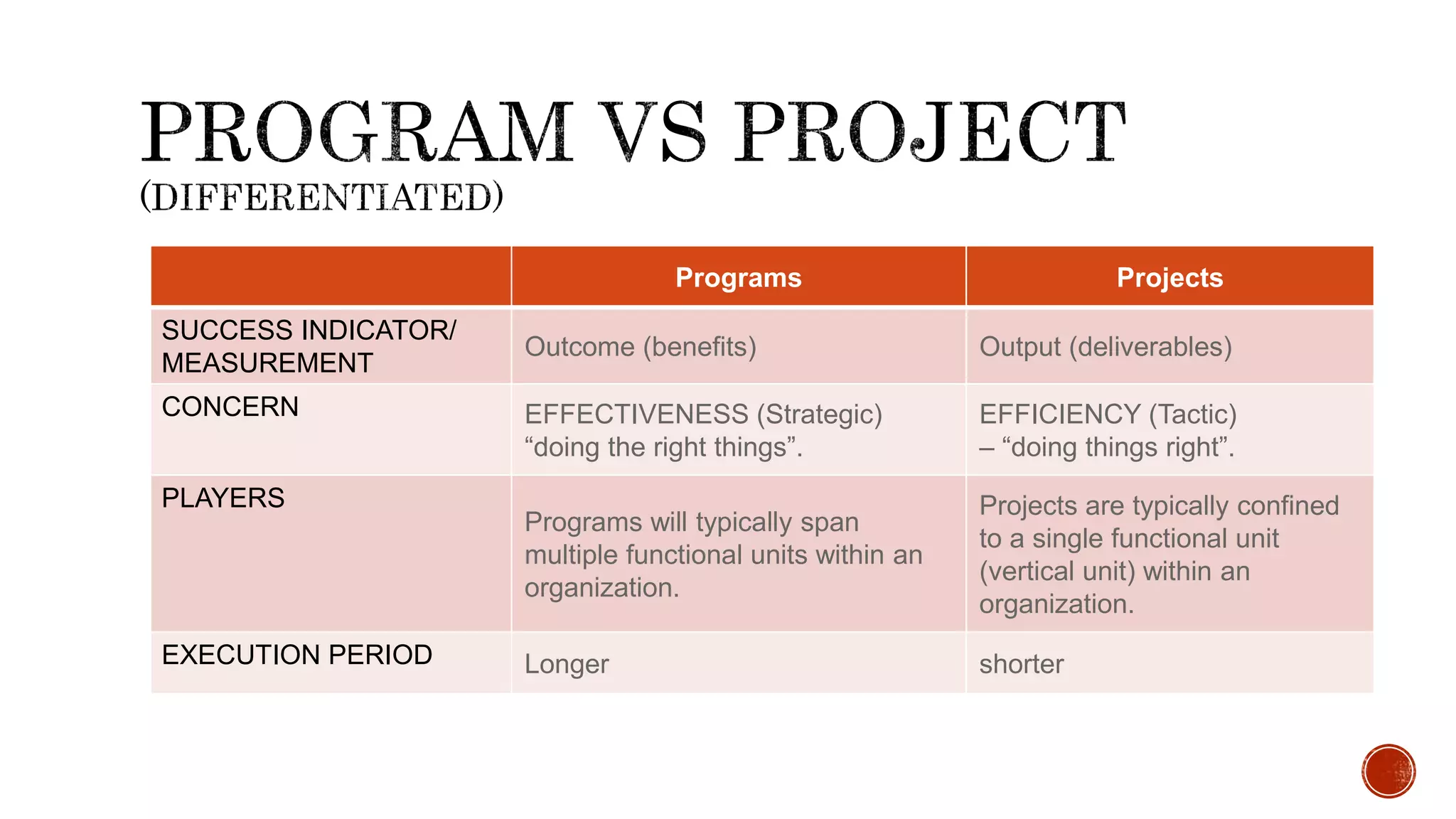
Programs Projects
SUCCESS INDICATOR/
MEASUREMENT
Outcome (benefits) Output (deliverables)
CONCERN EFFECTIVENESS (Strategic)
“doing the right things”.
EFFICIENCY (Tactic)
– “doing things right”.
PLAYERS
Programs will typically span
multiple functional units within an
organization.
Projects are typically confined
to a single functional unit
(vertical unit) within an
organization.
EXECUTION PERIOD Longer shorter
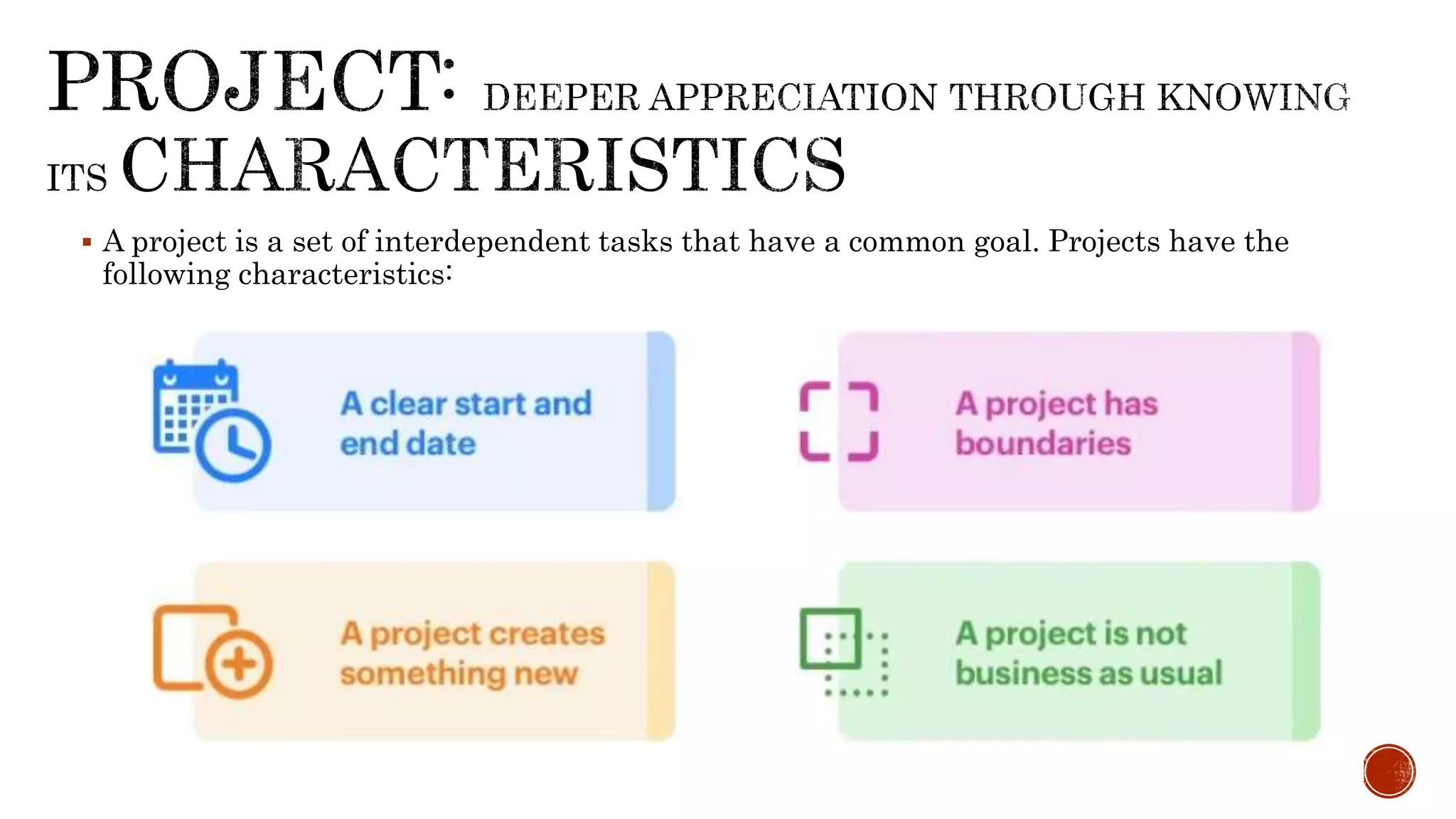
 A project is a set of interdependent tasks that have a common goal. Projects have the
following characteristics:
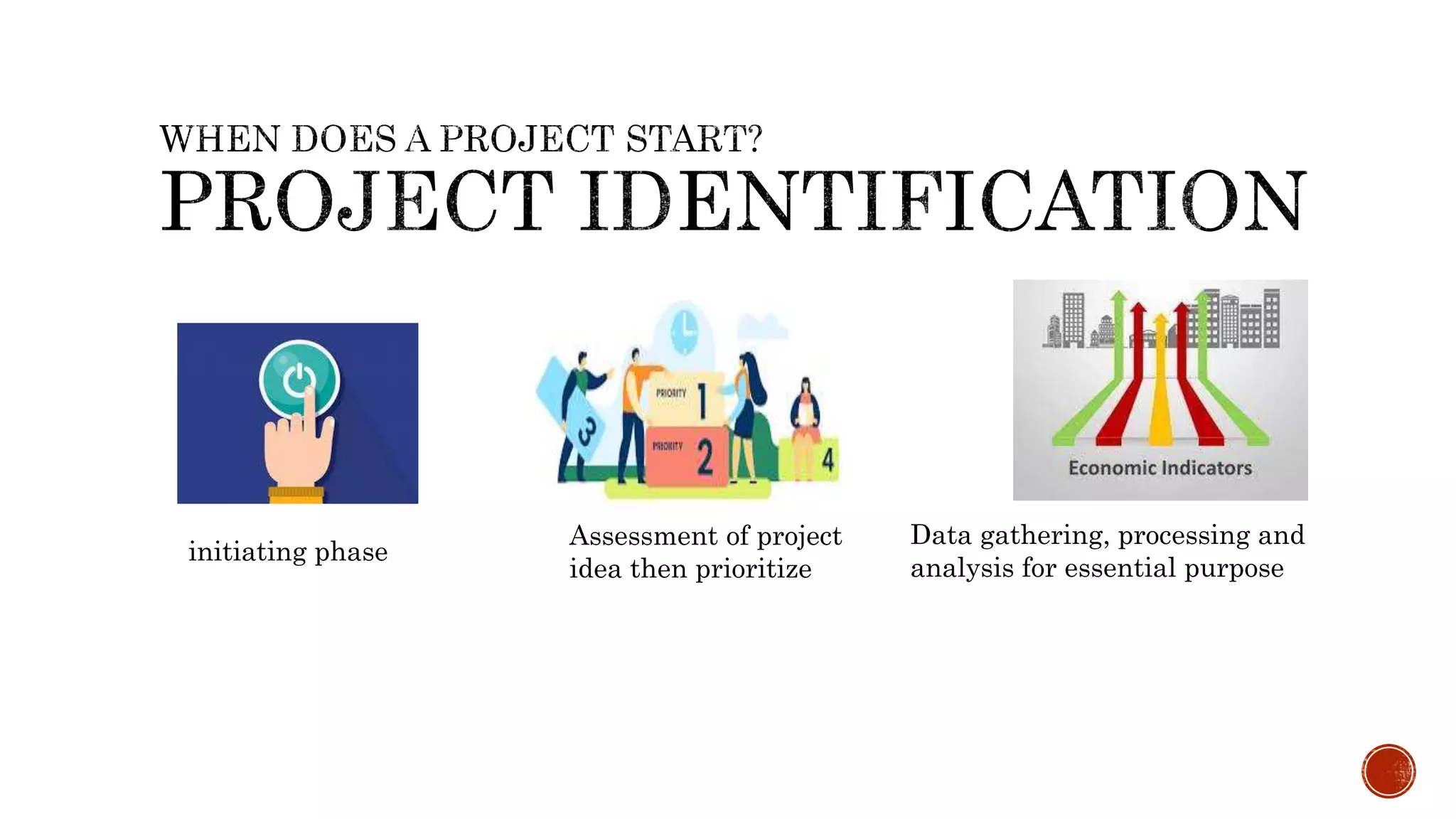
initiating phase
Assessment of project
idea then prioritize
Data gathering, processing and
analysis for essential purpose
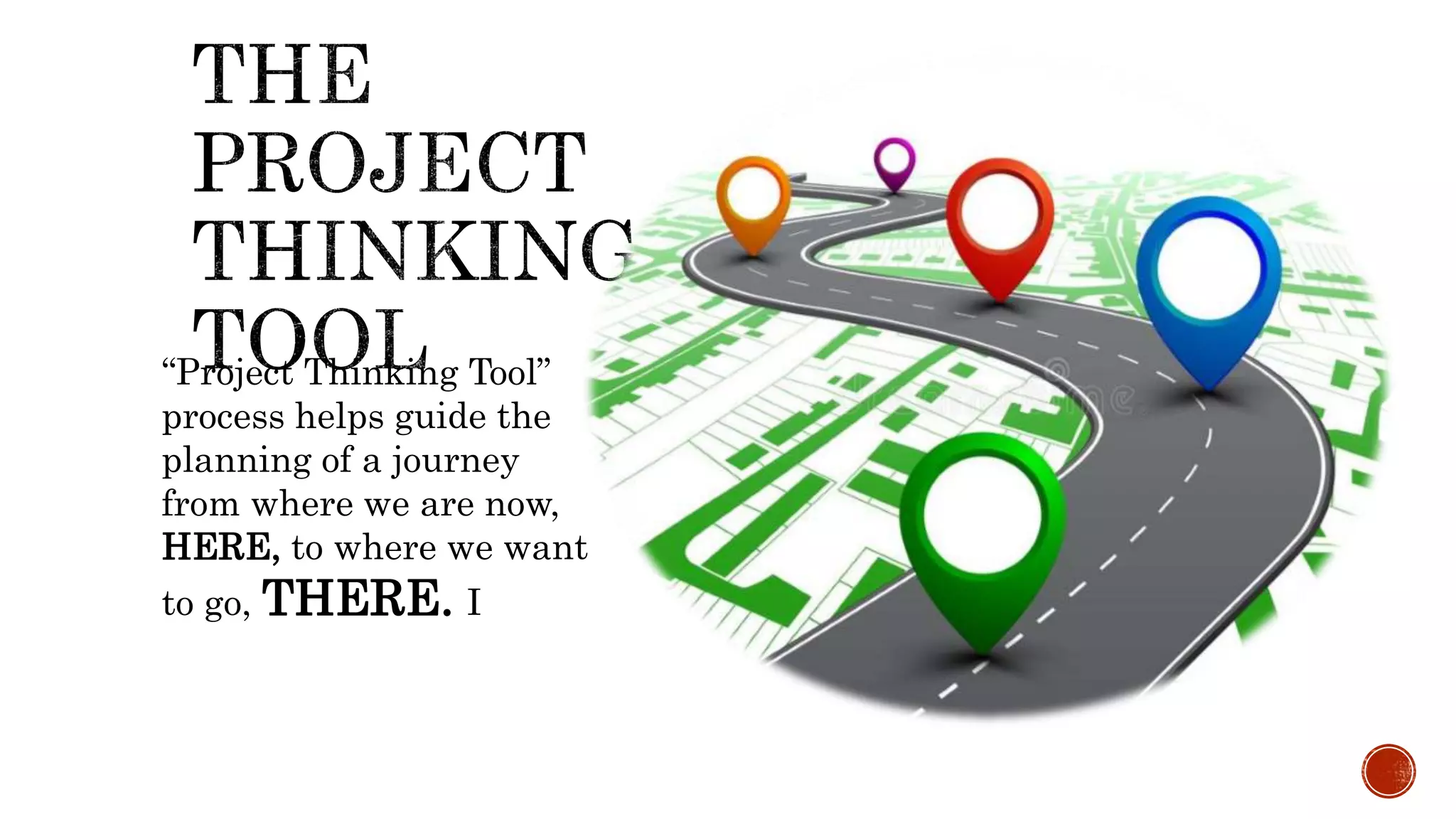
“Project Thinking Tool”
process helps guide the
planning of a journey
from where we are now,
HERE, to where we want
to go, THERE. I
-Who do we need to involve?
-Why do we need to involve them?
-What are their requirements and
expectations?
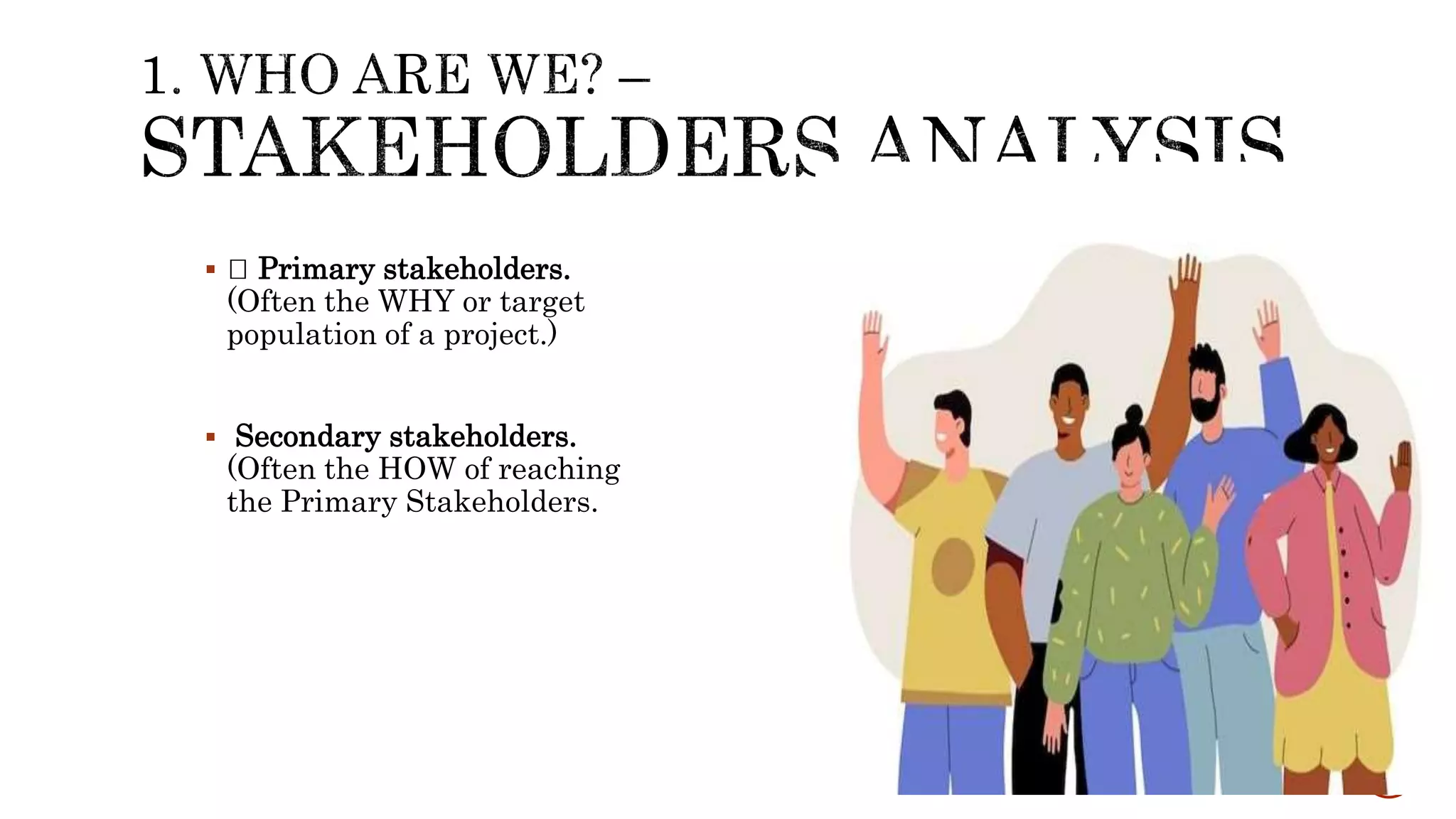
 Primary stakeholders.
(Often the WHY or target
population of a project.)
 Secondary stakeholders.
(Often the HOW of reaching
the Primary Stakeholders.
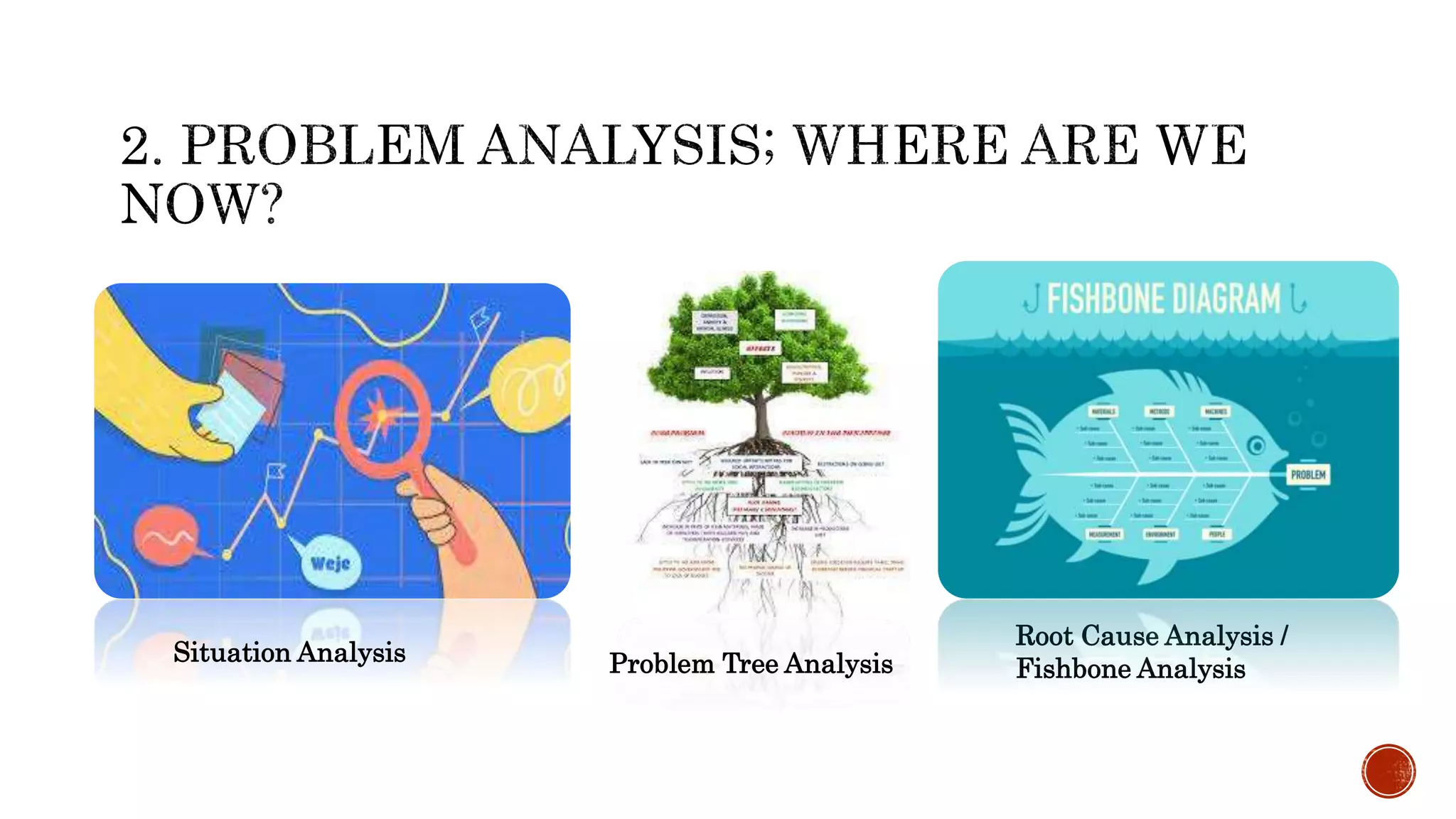
Situation Analysis Problem Tree Analysis
Root Cause Analysis /
Fishbone Analysis
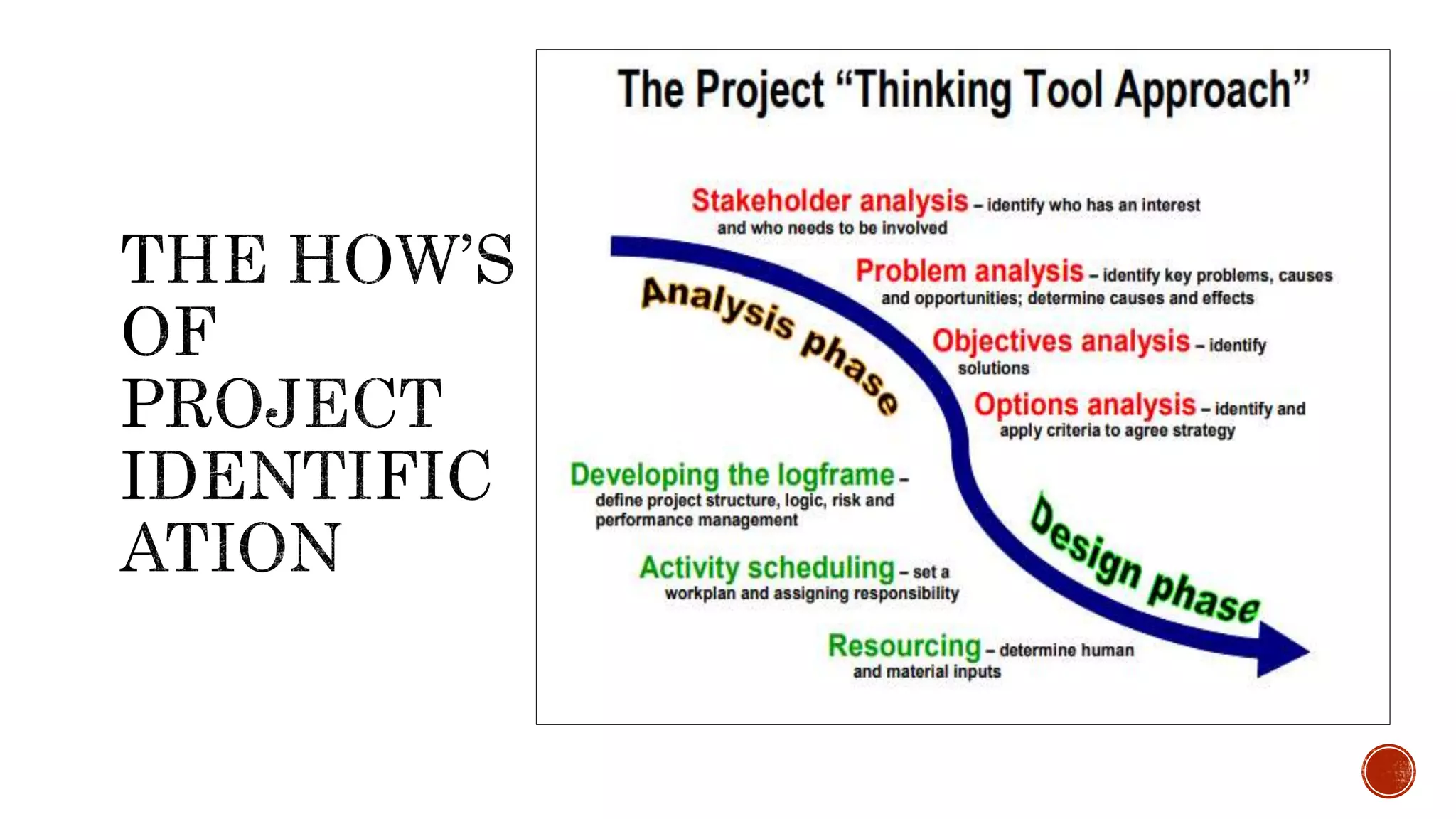
1. Develop objectives:
What then are the objectives of the projects to
transform the problem into its desirable
condition?
2. Choosing between options
What options can we undertake with less
resources needed but yielding same
output/outcome?
- Define the Impact or Goal;
- Define the purpose or Outcome,
- Describing the outputs;
- defining the activities;
- test the logical framework;
5. What may stop us from
getting there?
6. How will we know if we’ve
got there?
7. Work and resource planning;
What do we need to get there?
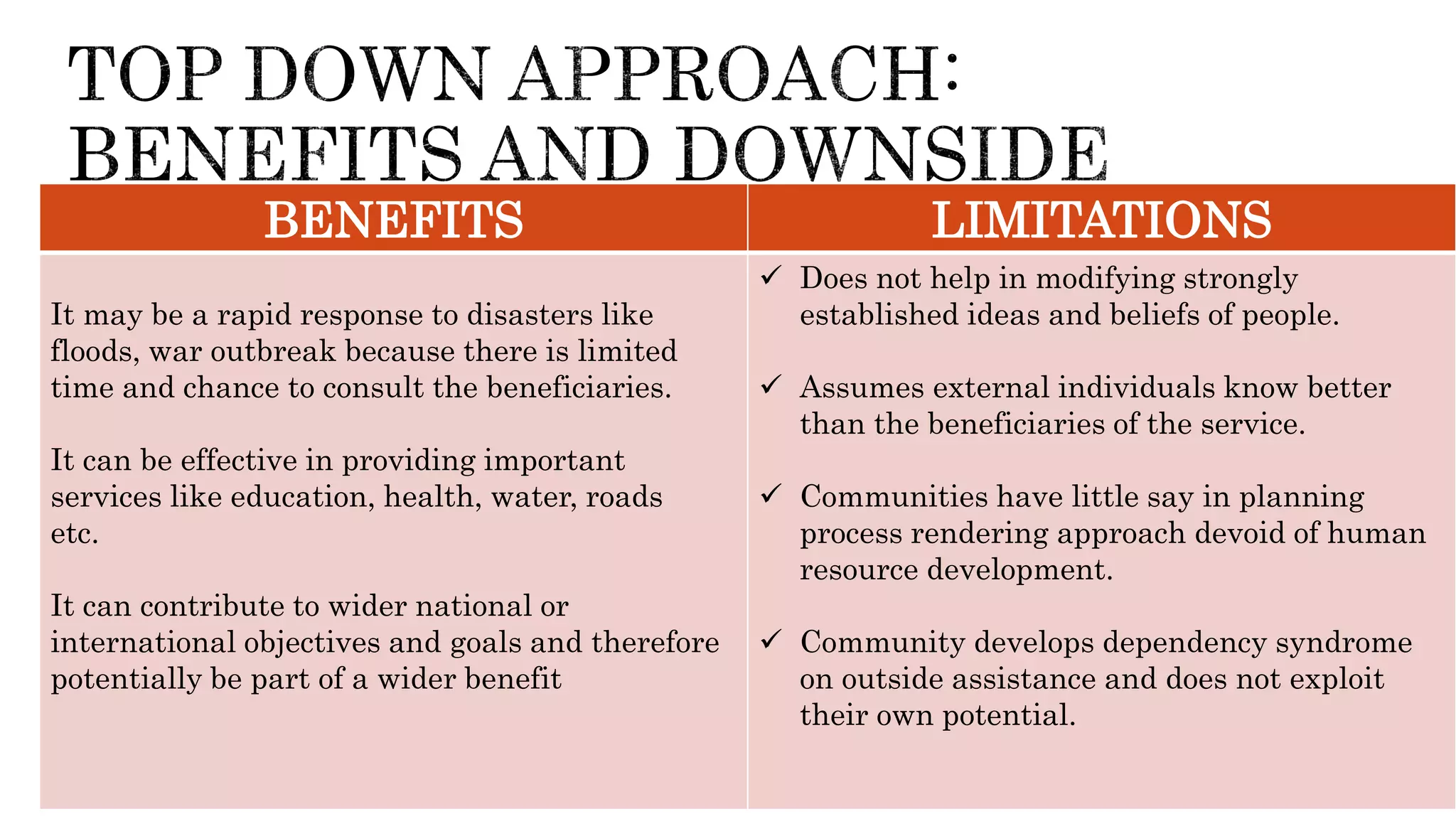
BENEFITS LIMITATIONS
It may be a rapid response to disasters like
floods, war outbreak because there is limited
time and chance to consult the beneficiaries.
It can be effective in providing important
services like education, health, water, roads
etc.
It can contribute to wider national or
international objectives and goals and therefore
potentially be part of a wider benefit
 Does not help in modifying strongly
established ideas and beliefs of people.
 Assumes external individuals know better
than the beneficiaries of the service.
 Communities have little say in planning
process rendering approach devoid of human
resource development.
 Community develops dependency syndrome
on outside assistance and does not exploit
their own potential.
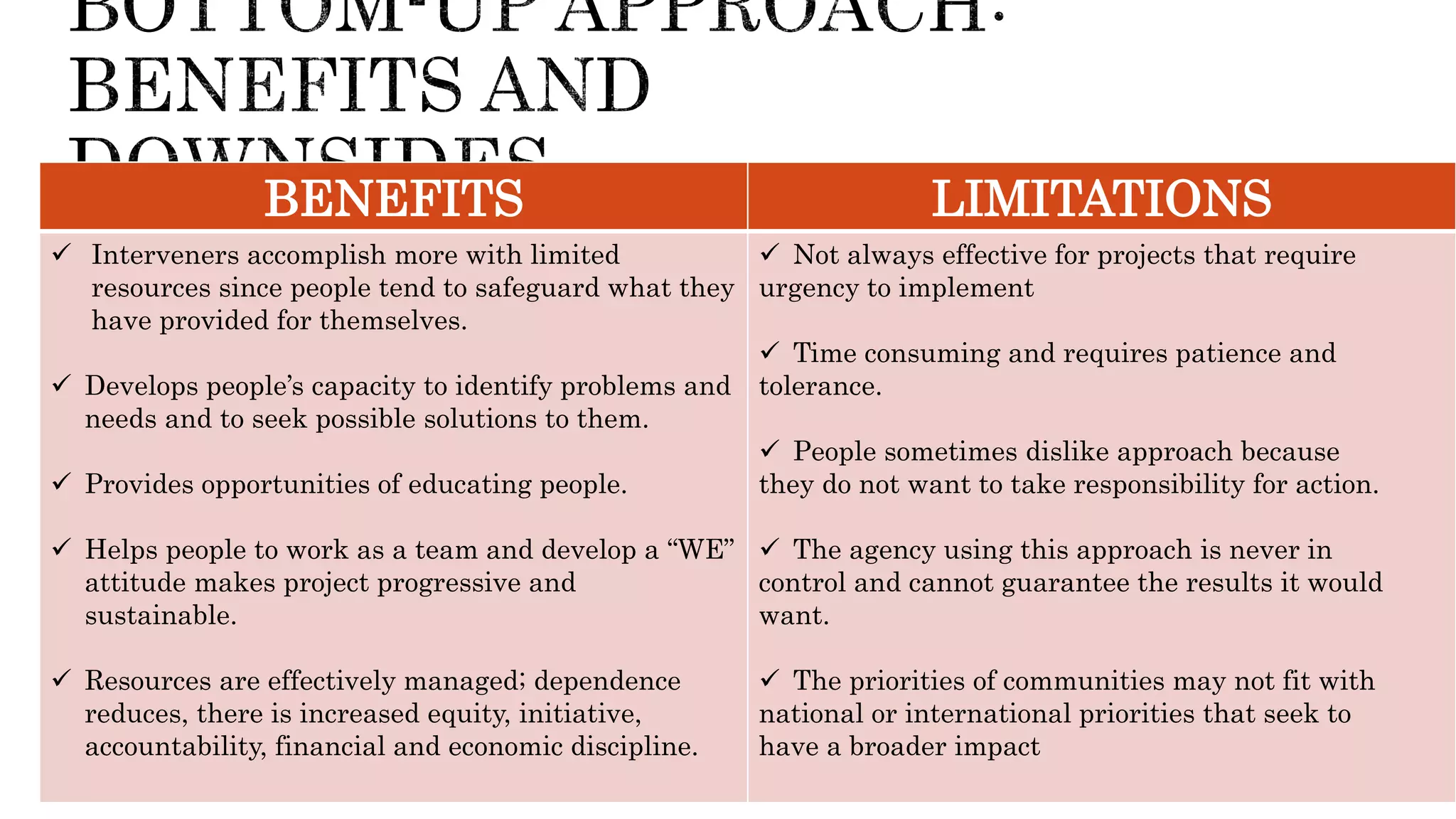
BENEFITS LIMITATIONS
 Interveners accomplish more with limited
resources since people tend to safeguard what they
have provided for themselves.
 Develops people’s capacity to identify problems and
needs and to seek possible solutions to them.
 Provides opportunities of educating people.
 Helps people to work as a team and develop a “WE”
attitude makes project progressive and
sustainable.
 Resources are effectively managed; dependence
reduces, there is increased equity, initiative,
accountability, financial and economic discipline.
 Not always effective for projects that require
urgency to implement
 Time consuming and requires patience and
tolerance.
 People sometimes dislike approach because
they do not want to take responsibility for action.
 The agency using this approach is never in
control and cannot guarantee the results it would
want.
 The priorities of communities may not fit with
national or international priorities that seek to
have a broader impact
 Weaver, P. (2010). Understanding Programs and Projects
 https://expertprogrammanagement.com/2009/05/difference-between-projects-and-
programs/
 https://standardsfacility.org/sites/default/files/EIF_HandbookProjectDesign_Feb-
12.pdf
 https://studylib.net/doc/9678965/project-identification

PROGRAM and PROJECT IDENTIFICATION.pptx

  • 1.
    Discussant: Evelyn Gabatin Acosta MPAStudent Josefina B. Bitonio, DPA Professor
  • 2.
    PROGRAM - “group ofrelated projects managed in a coordinated way to obtain benefits and control not available from managing them individually. (The Standard for Program Management—Second edition; PMI, 2008b, p. 312). - “a portfolio of projects and activities that are coordinated and managed as a unit such that they achieve outcomes and realize benefits” (Office of Government Commerce, 2003, p. 126). PROJECT - temporary endeavor undertaken to create a unique product, service or result.” (PMBOK® Guide—Fourth edition:PMI, 2008a, p. 434)
  • 3.
    Programs Projects SUCCESS INDICATOR/ MEASUREMENT Outcome(benefits) Output (deliverables) CONCERN EFFECTIVENESS (Strategic) “doing the right things”. EFFICIENCY (Tactic) – “doing things right”. PLAYERS Programs will typically span multiple functional units within an organization. Projects are typically confined to a single functional unit (vertical unit) within an organization. EXECUTION PERIOD Longer shorter
  • 4.
     A projectis a set of interdependent tasks that have a common goal. Projects have the following characteristics:
  • 5.
    initiating phase Assessment ofproject idea then prioritize Data gathering, processing and analysis for essential purpose
  • 7.
    “Project Thinking Tool” processhelps guide the planning of a journey from where we are now, HERE, to where we want to go, THERE. I
  • 8.
    -Who do weneed to involve? -Why do we need to involve them? -What are their requirements and expectations?
  • 9.
     Primary stakeholders. (Oftenthe WHY or target population of a project.)  Secondary stakeholders. (Often the HOW of reaching the Primary Stakeholders.
  • 10.
    Situation Analysis ProblemTree Analysis Root Cause Analysis / Fishbone Analysis
  • 11.
    1. Develop objectives: Whatthen are the objectives of the projects to transform the problem into its desirable condition? 2. Choosing between options What options can we undertake with less resources needed but yielding same output/outcome?
  • 12.
    - Define theImpact or Goal; - Define the purpose or Outcome, - Describing the outputs; - defining the activities; - test the logical framework;
  • 13.
    5. What maystop us from getting there? 6. How will we know if we’ve got there? 7. Work and resource planning; What do we need to get there?
  • 15.
    BENEFITS LIMITATIONS It maybe a rapid response to disasters like floods, war outbreak because there is limited time and chance to consult the beneficiaries. It can be effective in providing important services like education, health, water, roads etc. It can contribute to wider national or international objectives and goals and therefore potentially be part of a wider benefit  Does not help in modifying strongly established ideas and beliefs of people.  Assumes external individuals know better than the beneficiaries of the service.  Communities have little say in planning process rendering approach devoid of human resource development.  Community develops dependency syndrome on outside assistance and does not exploit their own potential.
  • 16.
    BENEFITS LIMITATIONS  Intervenersaccomplish more with limited resources since people tend to safeguard what they have provided for themselves.  Develops people’s capacity to identify problems and needs and to seek possible solutions to them.  Provides opportunities of educating people.  Helps people to work as a team and develop a “WE” attitude makes project progressive and sustainable.  Resources are effectively managed; dependence reduces, there is increased equity, initiative, accountability, financial and economic discipline.  Not always effective for projects that require urgency to implement  Time consuming and requires patience and tolerance.  People sometimes dislike approach because they do not want to take responsibility for action.  The agency using this approach is never in control and cannot guarantee the results it would want.  The priorities of communities may not fit with national or international priorities that seek to have a broader impact
  • 17.
     Weaver, P.(2010). Understanding Programs and Projects  https://expertprogrammanagement.com/2009/05/difference-between-projects-and- programs/  https://standardsfacility.org/sites/default/files/EIF_HandbookProjectDesign_Feb- 12.pdf  https://studylib.net/doc/9678965/project-identification

Editor's Notes

  • #5 A clear start and end date – There are projects that last several years but a project cannot go on forever. It needs to have a clear beginning, a definite end, and an overview of what happens in between. A project creates something new – Every project is unique, producing something that did not previously exist. A project is a one-time, once-off activity, never to be repeated exactly the same way again. A project has boundaries – A project operates within certain constraints of time, money, quality, and functionality. We’ll see more about this in later sections. A project is not business as usual – Projects are often confused with processes. A Process is a series of routine, predefined steps to perform a particular function, say, expense reimbursement approvals. It’s not a one-off activity. It determines how a specific function is performed every single time.
  • #7 The “Project Thinking Tools” introduced thru the Enhanced Integrated Framework for Trade-Related Assistance for the Least Developed Countries (commonly abbreviated as EIF) is a global development program with the objective of supporting least developed countries (LDCs) to better integrate into the global trading system and to make trade a driver for development. The “Project Thinking Tools” can be applied at different levels of planning and decision-making. Essentially they can be used, with a relatively small project, a higher-level programmed or indeed a whole organization.
  • #9 Who do we need to involve? Analyzing the stakeholders who need to be involved is one of the most crucial elements of any multi-agency project planning. Stakeholder analysis is a useful tool or process for identifying stakeholder groups and describing the nature of their stake, roles and interests. Doing a stakeholder analysis can help us to: identify who we believe should be encouraged and helped to participate identify winners and losers, those with rights, interests, resources, skills and abilities to take part or influence the course of a project improve the project sensitivity to perceived needs of those affected reduce or hopefully remove negative impacts on vulnerable and disadvantaged groups enable useful alliances which can be built upon identify and reduce risks; for example identifying areas of possible conflicts of interest and expectation between stakeholders so that real conflict is avoided before it happens disaggregate groups with divergent interests.