
Typology of Planning
Models
& Strategic Planning
Process Models
Professor: Jo B. Bitonio, DPA
MPA 210 Strategic Planning Management
Strategic Planning is a process to find a strategy that will
achieve certain organizational purposes that can be
broken down into steps and learned and the activities
associated with it ingrained into the culture and life of the
organization)
However, even with increasing use
making these difficult decisions never
becomes easier, because the future is still
the future – uncertain and ambiguous, the
data needs are seldom available and
unforeseen events still happens
(Abraham, 2012)
It is clear that frenetic pace of change and
changing circumstances require the constant
renewing of one’s business models, defining a
unique market position and occupying it
otherwise the value will flow away from the
organization to the competitors
Abraham, 2012
Strategy at its heart is about
positioning for future competitive
advantage. Any strategic thinking
must reflect this essence. It is
purpose is a driven strategy,
determining their impacts on
markets today and tomorrow and
developing new business models.
Abraham, 2012
Strategy is a handful of decisions that drive or
shape most of the organization’s subsequent
actions and have the greatest impact on whether
the organization meet its strategic objectives.
This handful decisions consist of selecting the
organization’s strategic posture (Abraham,
2012).
Strategic Posture
)
- first scholar to develop a typology of planning
models.
- used the acronym SITAR for the five planning in
his topology.
S – Synoptic Model
I – Incremental Model
T – Transactive Model
A – Advocacy Model
R – Radical Model
Hudson (1974)
Synoptic Model
- Identical to the popular rational model
- includes 4 classical elements
 Goal Setting
 Identification of alternatives
 Evaluation of means against ends
Implementation of design
Incremental Model
- suggests that planning is contained more
by available means than by the definition
of the goals
- planned change at any level – institutional,
sectoral and national – typically represents
small adjustments from the past.
Transactive Model
- emphasizes interaction and interpersonal
dialogue and the process of mutual
learning in planning.
Advocacy Model
- underscores the confrontational
characteristics of decision-making.
Radical Model
- has two versions
 Spontaneous activism is guided by
self-reliance and mutual aid.
 Focuses on situational
characteristics of nations or systems
that inhibit the equitable distribution
of goods and services.
Wilson (1989)
- Introduced three other alternative models in
addition to the rational and
incremental models.
1. Mixed Scanning
2. Learning Adaptive
3. General System Models
Mixed Scanning
- more realistic that the
rational model and was
passive than the
incremental model
Learning Adaptive
- treats planning as a process of social
learning built on individual psychological
development that is best realized in small,
non-hierarchical groups
General System Models
- attempts to use the idea of a system
as a unifying scientific paradigm
Adams (1991)
- group and classified into two groups the typologies developed by
Hudson and Wilson as well as other theorists.
Rational Interactive
Synoptic Political System
Resource Allocation Incremental
Resource Allocation Organizational Development
Manpower Advocacy
Rate of Return Learning Adaptive
Satisficing Mixed Scanning
- presents the most popular rational model in educational planning
literature and practice which calls it as the technicist model.
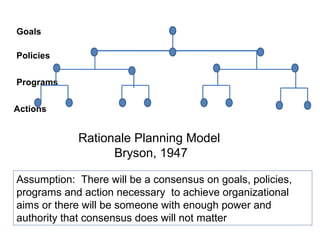
Actions
Programs
Policies
Goals
Rationale Planning Model
Bryson, 1947
Assumption: There will be a consensus on goals, policies,
programs and action necessary to achieve organizational
aims or there will be someone with enough power and
authority that consensus does will not matter
Technicist Planning Model
- expert-driven, assumes a linear process of
decision-making , levels to treat the
organization as a “black box” and severely
limits the numbers of variables examined to
quantifiable indicators of educations effects.
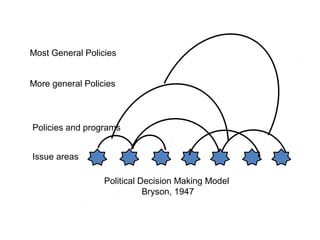
Political Model
- views planning as a dynamic, shifting process
of interaction and exchange.
- it rejects the assumption of rational
decision- making
Issue areas
Policies and programs
More general Policies
Most General Policies
Political Decision Making Model
Bryson, 1947
This model is inductive. It begins with
issues which almost by definition involve
conflict, not consensus. The conflicts maybe
over end, means, timing, locations, political
advantage, reasons fro change, or philosophy
or values and the conflicts maybe sever. As
efforts to resolve these conflicts and learn how
to move ahead, policies and programs emerge
that Address the issues that are politically
rationale and politically acceptable to involved
or affected parties.
Consensual Model
- recognizes education as an open human
system located in a social environment too
indefinite and inconstant to allow easy
generalizations.
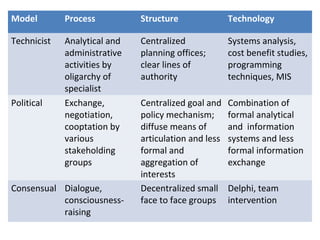
Table 1
Comparison of Three Planning Models
Model Process Structure Technology
Technicist Analytical and
administrative
activities by
oligarchy of
specialist
Centralized
planning offices;
clear lines of
authority
Systems analysis,
cost benefit studies,
programming
techniques, MIS
Political Exchange,
negotiation,
cooptation by
various
stakeholding
groups
Centralized goal and
policy mechanism;
diffuse means of
articulation and less
formal and
aggregation of
interests
Combination of
formal analytical
and information
systems and less
formal information
exchange
Consensual Dialogue,
consciousness-
raising
Decentralized small
face to face groups
Delphi, team
intervention
Module 4
Strategic Planning Process
Models
Planning Model
- a set of variables classified as
endogenous and exogenous, cause effect
relationships among these variables and
the consistency of these relations.
Phenomenon
- it is explained when a model of its
endogenous variables can be determined,
given those of the exogenous variables.
Endogenous and Exogenous Variables
These are terms to describe internal and external
factors respectively affecting the organization’s
business production, efficiency, growth and
profitability. You are not able to control all endogenous
business factors. Likewise, you can't control but
should be able to see the exogenous economy
influence to your organization. It is important to digest
how these factors affect your unique organization
situation so you can implement strategies and
changes building a stronger organization
Planning Model
• Modeling provides a logical, abstract template
to help organize the analyst's thoughts. The
model helps the planners logically isolate and
sort out complicated chains of cause and
effect and influence between the numerous
interacting elements in a situation.
Process
- defined as the series of steps or phases of
procedures and activities undertaken or
followed in doing a particular activity.
- can be reflected or drawn in illustration,
graphical or symbolic terms atypical of a
model.
Planning Process Model
- provides proper guidance in what ought
to be done in practice.
- also dictate explicitly what people ought
to do in order for them to act
accordingly and behave rationally so as
to ascertain the successful completion
of the step or process of activities.
Socioeconomic Planning Model
- the process of determining in advance the best
possible way of achieving specified development
objectives within given time period at the least
possible cost
Development Planning
- the process of determining
in advance the best possible
way of achieving specified
development objectives within
given time period at the
least cost
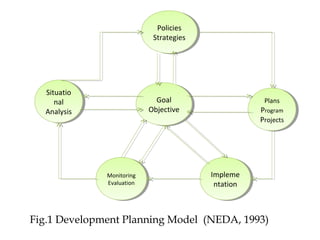
Development Planning model
NEDA, 1993
Plans
Program
Projects
Plans
Program
Projects
Fig.1 Development Planning Model (NEDA, 1993)
Policies
Strategies
Policies
Strategies
Impleme
ntation
Impleme
ntation
Monitoring
Evaluation
Monitoring
Evaluation
Situatio
nal
Analysis
Situatio
nal
Analysis
Goal
Objective
Goal
Objective
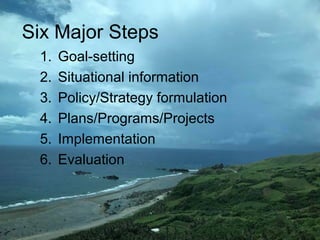
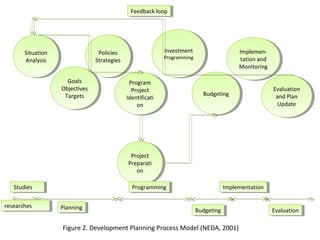
Six Major Steps
1. Goal-setting
2. Situational information
3. Policy/Strategy formulation
4. Plans/Programs/Projects
5. Implementation
6. Evaluation
Development Planning
Process Model
NEDA, 2001
Situation
Analysis
Situation
Analysis
Project
Preparati
on
Project
Preparati
on
Goals
Objectives
Targets
Goals
Objectives
Targets
Policies
Strategies
Policies
Strategies
Program
Project
Identificati
on
Program
Project
Identificati
on
Investment
Programming
Investment
Programming
BudgetingBudgeting
Implemen-
tation and
Monitoring
Implemen-
tation and
Monitoring
Evaluation
and Plan
Update
Evaluation
and Plan
Update
Feedback loopFeedback loop
Figure 2. Development Planning Process Model (NEDA, 2001)
StudiesStudies
PlanningPlanning
ProgrammingProgramming
BudgetingBudgeting
ImplementationImplementation
EvaluationEvaluation
researchesresearches
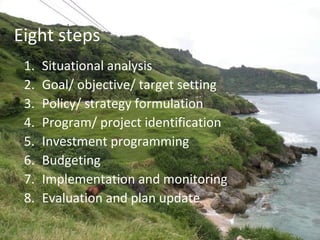
Eight steps
1. Situational analysis
2. Goal/ objective/ target setting
3. Policy/ strategy formulation
4. Program/ project identification
5. Investment programming
6. Budgeting
7. Implementation and monitoring
8. Evaluation and plan update
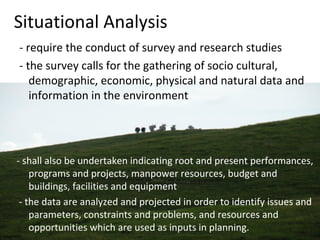
Situational Analysis
- require the conduct of survey and research studies
- the survey calls for the gathering of socio cultural,
demographic, economic, physical and natural data and
information in the environment
- shall also be undertaken indicating root and present performances,
programs and projects, manpower resources, budget and
buildings, facilities and equipment
- the data are analyzed and projected in order to identify issues and
parameters, constraints and problems, and resources and
opportunities which are used as inputs in planning.
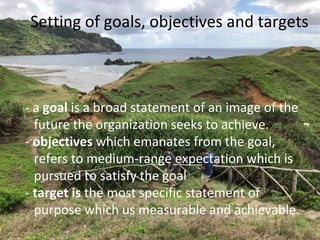
Setting of goals, objectives and targets
- a goal is a broad statement of an image of the
future the organization seeks to achieve.
- objectives which emanates from the goal,
refers to medium-range expectation which is
pursued to satisfy the goal
- target is the most specific statement of
purpose which us measurable and achievable.
Policies and Strategies
- framed, more specific policy statements and
strategies formulated for each area of concern
to as social, economic, physical, political and
developmental administrative aspects for a
particular period.
Program and Project Identification
- in order to effectively channel resources to
development programs and projects
considered strategic in the over all
attainment of goal.
- prioritization of program and project is done
through the conduct of feasibility studies to a
listing of priorities viewed as responsive to
the development needs of the people.
Budgeting
- the costing of
identified priority
program and
projects.
Implementation
Actual carrying out of
funded priority programs
and projects by concerned
offices and individuals of
the organization or the
sectoral agency of
government
Corporate Business
Planning Models
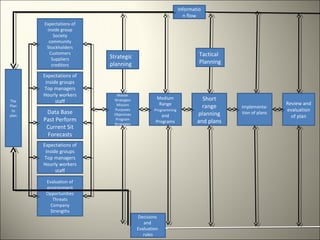
Steiner, 1997
- devised and used extensively
by a number of business
companies in the US
providing different products.
Informatio
n flow
Expectations of
inside group
Society
community
Stockholders
Customers
Suppliers
creditors
The
Plan
to
plan
Decisions
and
Evaluation
rules
Evaluation of
environment
Opportunities
Threats
Company
Strengths
Expectations of
inside groups
Top managers
Hourly workers
staff
Data Base
Past Perform
Current Sit
Forecasts
Expectations of
inside groups
Top managers
Hourly workers
staff
Master
Strategies
Mission
Purposes
Objectives
Program
Strategies
Medium
Range
Programming
and
Programs
Short
range
planning
and plans
Implementa-
tion of plans
Review and
evaluation
of plan
Strategic
planning
Tactical
Planning
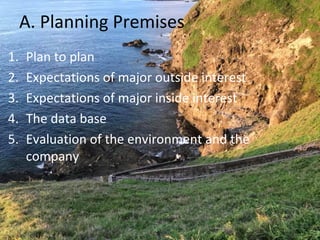
A. Planning Premises
1. Plan to plan
2. Expectations of major outside interest
3. Expectations of major inside interest
4. The data base
5. Evaluation of the environment and the
company
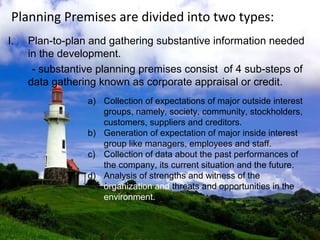
Planning Premises are divided into two types:
I. Plan-to-plan and gathering substantive information needed
in the development.
- substantive planning premises consist of 4 sub-steps of
data gathering known as corporate appraisal or credit.
a) Collection of expectations of major outside interest
groups, namely, society, community, stockholders,
customers, suppliers and creditors.
b) Generation of expectation of major inside interest
group like managers, employees and staff.
c) Collection of data about the past performances of
the company, its current situation and the future.
d) Analysis of strengths and witness of the
organization and threats and opportunities in the
environment.
B. Formulating Plans
6. Master and program strategies
7. Medium-range programming and programs
8. Short-range planning and plans
C. Implementation and Review
9. Implementation of plans
10. Review and evaluation of plans
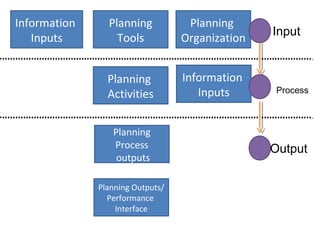
Strategic Planning Model
(Capon et al, 1987)
Information
Inputs
Planning
Tools
Planning
Organization
Planning
Activities
Information
Inputs
Planning
Process
outputs
Planning Outputs/
Performance
Interface
Process
Input
Output
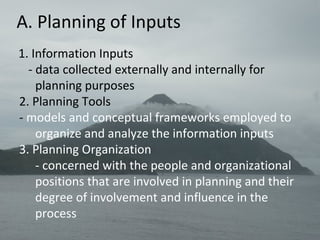
A. Planning of Inputs
1. Information Inputs
- data collected externally and internally for
planning purposes
2. Planning Tools
- models and conceptual frameworks employed to
organize and analyze the information inputs
3. Planning Organization
- concerned with the people and organizational
positions that are involved in planning and their
degree of involvement and influence in the
process
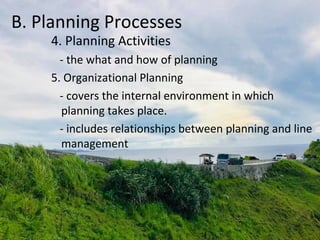
B. Planning Processes
4. Planning Activities
- the what and how of planning
5. Organizational Planning
- covers the internal environment in which
planning takes place.
- includes relationships between planning and line
management
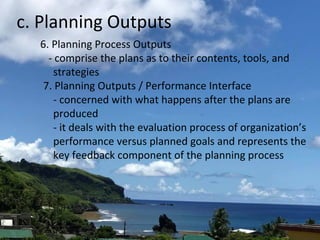
c. Planning Outputs
6. Planning Process Outputs
- comprise the plans as to their contents, tools, and
strategies
7. Planning Outputs / Performance Interface
- concerned with what happens after the plans are
produced
- it deals with the evaluation process of organization’s
performance versus planned goals and represents the
key feedback component of the planning process
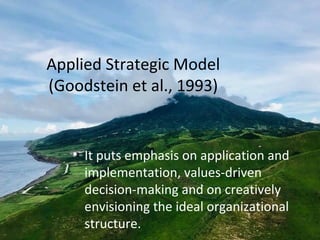
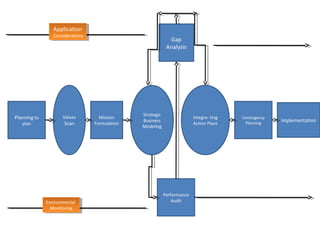
Applied Strategic Model
(Goodstein et al., 1993)
• It puts emphasis on application and
implementation, values-driven
decision-making and on creatively
envisioning the ideal organizational
structure.
Planning to
plan
Mission
Formulation
Contingency
Planning
Implementation
Performance
Audit
Gap
Analysis
Values
Scan
Integra- ting
Action Plans
Strategic
Business
Modeling
Application
Considerations
Application
Considerations
Environmental
Monitoring
Environmental
Monitoring
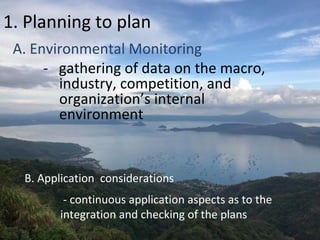
1. Planning to plan
A. Environmental Monitoring
- gathering of data on the macro,
industry, competition, and
organization’s internal
environment
B. Application considerations
- continuous application aspects as to the
integration and checking of the plans
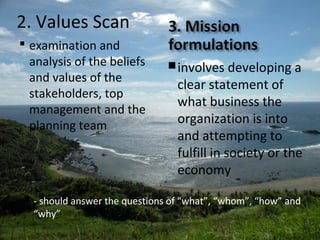
2. Values Scan
 examination and
analysis of the beliefs
and values of the
stakeholders, top
management and the
planning team
involves developing a
clear statement of
what business the
organization is into
and attempting to
fulfill in society or the
economy
 - should answer the questions of “what”, “whom”, “how” and
“why”
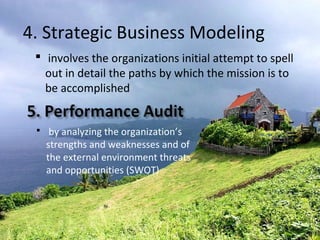
4. Strategic Business Modeling
 involves the organizations initial attempt to spell
out in detail the paths by which the mission is to
be accomplished
 by analyzing the organization’s
strengths and weaknesses and of
the external environment threats
and opportunities (SWOT)
6. Gap Analysis
 identification of gaps between the current
organizational performance and the desired
future
 to facilitate allocation of resources and
identify possible trouble spots
8. Contingency Planning
 developed as a response to
unanticipated factors in the planning
process
 initiation of several tactical and
operational plans
Educational Planning Models
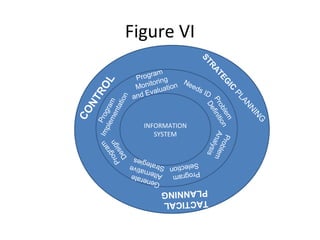
1. Circular Model (Bell et al, 1989)
• developed by the Northwest
Regional Educational Laboratory in
cooperation with the Oregon
Education Coordinating Council to
increase both intra-system and inter-
system planning effectiveness in the
state.
Figure VI
INFORMATION
SYSTEM
STRATEG
IC
PLANNING
CONTROL
TACTICAL
PLANNING
Program
Monitoring
and Evaluation
Needs ID
Problem
Definition
ProblemAnalysis
Program
Selection
Generate Alternative Strategies
Program
Design
Program
Implementation
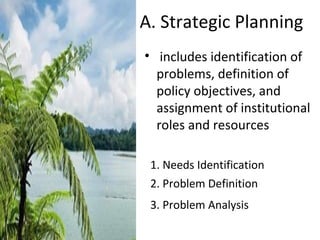
A. Strategic Planning
• includes identification of
problems, definition of
policy objectives, and
assignment of institutional
roles and resources
 1. Needs Identification
 2. Problem Definition
 3. Problem Analysis
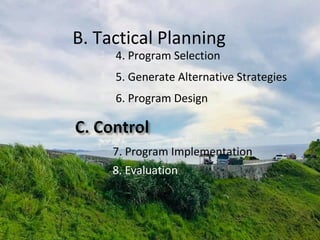
B. Tactical Planning
 4. Program Selection
 5. Generate Alternative Strategies
 6. Program Design
7. Program Implementation
8. Evaluation
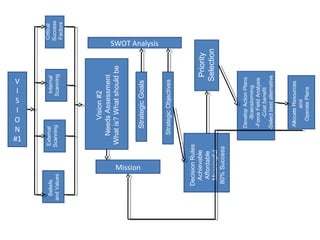
Herman and Herman Model (1994)
• focuses on a school or school district as the
frame of planning reference
Mission
SWOT Analysis
V
I
S
I
O
N
#1
Critical
Success
Factors
Internal
Scanning
External
Scanning
Beliefs
andValues
Vision#2
NeedsAssessment
Whatis?Whatshouldbe
StrategicGoals
StrategicObjectives
Priority
Selection
DecisionRules
Achievable
Affordable
Meaningful
80%Success
DevelopActionPlans
-Brainstorming
-ForceFieldAnalysis
-Costbenefit
-Selectbestalternative
AllocateResources
and
OperatePlans
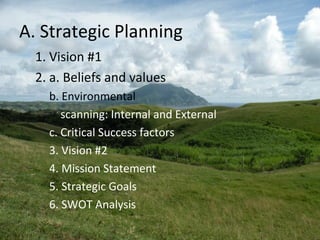
A. Strategic Planning
1. Vision #1
2. a. Beliefs and values
b. Environmental
scanning: Internal and External
c. Critical Success factors
3. Vision #2
4. Mission Statement
5. Strategic Goals
6. SWOT Analysis
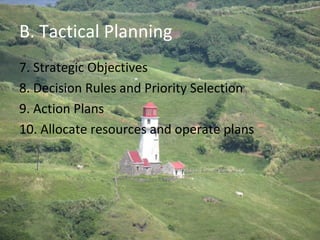
B. Tactical Planning
7. Strategic Objectives
8. Decision Rules and Priority Selection
9. Action Plans
10. Allocate resources and operate plans
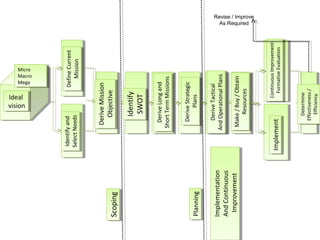
Kaufman and Associates Model 2002
Micro
Macro
Mega
Micro
Macro
Mega
Ideal
vision
Ideal
vision
DefineCurrent
Mission
DefineCurrent
Mission
Identifyand
SelectNeeds
Identifyand
SelectNeeds
DeriveMission
Objective
DeriveMission
Objective
Identify
SWOT
Identify
SWOT
DeriveLongand
ShortTermMissions
DeriveLongand
ShortTermMissions
DeriveStrategic
Plans
DeriveStrategic
Plans
DeriveTactical
AndOperationalPlans
DeriveTactical
AndOperationalPlans
Make/Buy/Obtain
Resources
Make/Buy/Obtain
Resources
ImplementImplementContinuousImprovement
FormativeEvaluation
ContinuousImprovement
FormativeEvaluation
Determine
Effectiveness/
Efficiency
Determine
Effectiveness/
Efficiency
Revise / Improve
As Required
ScopingScoping
PlanningPlanning
Implementation
AndContinuous
Improvement
Implementation
AndContinuous
Improvement
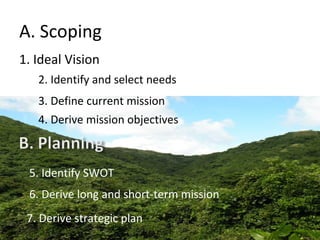
A. Scoping
1. Ideal Vision
 2. Identify and select needs
 4. Derive mission objectives
 3. Define current mission
5. Identify SWOT
6. Derive long and short-term mission
7. Derive strategic plan
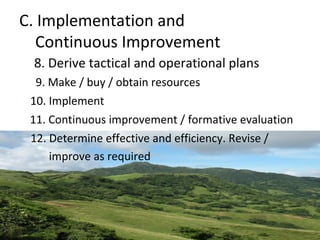
C. Implementation and
Continuous Improvement
8. Derive tactical and operational plans
 9. Make / buy / obtain resources
 10. Implement
11. Continuous improvement / formative evaluation
12. Determine effective and efficiency. Revise /
 improve as required
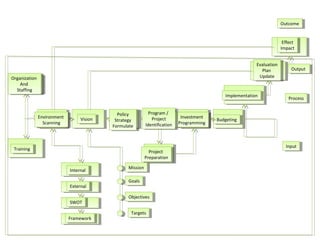
Strategic Planning process model
Effect
Impact
Effect
Impact
Evaluation
Plan
Update
Evaluation
Plan
Update
ImplementationImplementation
BudgetingBudgetingInvestment
Programming
Investment
Programming
Program /
Project
Identification
Program /
Project
Identification
Policy
Strategy
Formulate
Policy
Strategy
Formulate
VisionVisionEnvironment
Scanning
Environment
Scanning
Organization
And
Staffing
Organization
And
Staffing
TrainingTraining
Project
Preparation
Project
Preparation
InternalInternal
ExternalExternal
SWOTSWOT
FrameworkFramework
MissionMission
GoalsGoals
ObjectivesObjectives
TargetsTargets
InputInput
ProcessProcess
OutputOutput
OutcomeOutcome
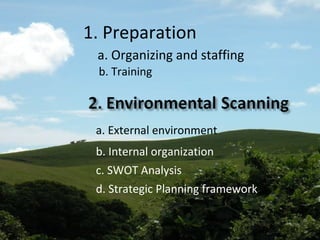
1. Preparation
a. Organizing and staffing
b. Training
a. External environment
b. Internal organization
d. Strategic Planning framework
c. SWOT Analysis
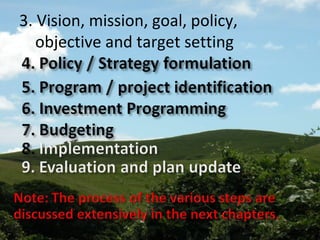
3. Vision, mission, goal, policy,
objective and target setting
Sources
• Stanley Charles Abraham (2012). Strategic Planning: A
Practical Guide for Competitive Success Emerald
Group Publishing
• Eusebio F. Miclat (2005) Strategic Planning in
Education: Making Change Happen. Rex Bookstore
• Stanley Charles Abraham (2012) Strategic Planning: A
Practical Guide for Competitive Success. h
ttps://books.google.com.ph/books?isbn=1780525214
• John M. Bryson 2004. Strategic Planning for Public and
Non Profit Organization. Jossey-Bass A Wiley Imprint.
Photo Credit
Leiglany S. Cariaso

Strategic Planning Typology and Process Models