• Your job?

•?

• Hacking is fun

• The community is FUN

•Learning

•Beer and Pizza, hang out
• Basics
    •Why?TF
        •Why do we do Security Testing?
    •VM’s/Labs
    •Networking Knowledge
    • Attack Concepts
    • The Methodology(s)

• Intermediate Stuff
     •Practical Penetration Testing
     •Current Techniques

   Most importantly…
Have fun

Participate*

Learn

Eventually we will be learning together
Definition #1


          A Vulnerability is defined as a
          weakness which allows an
          attacker to reduce a computer
          system's security.
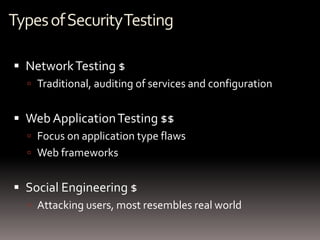
Types of Security Testing

 Network Testing $
   Traditional, auditing of services and configuration


 Web Application Testing $$
   Focus on application type flaws
   Web frameworks


 Social Engineering $
   Attacking users, most resembles real world
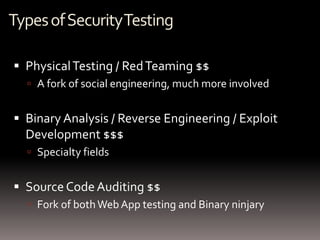
Types of Security Testing

 Physical Testing / Red Teaming $$
   A fork of social engineering, much more involved


 Binary Analysis / Reverse Engineering / Exploit
  Development $$$
   Specialty fields


 Source Code Auditing $$
   Fork of both Web App testing and Binary ninjary
3 Types of Tests

 Confusing? A bit…

 Audit
   Usually network testing, based around some agencies
    expectation of what security is. The biggest one is a standard
    called PCI.
   Usually boring, but bring in lots of money. Usually same skill
    sets used.
   Very Structured, Sometimes checklist and vulnerability scan
    driven.
   Can include IT services (Firewall config review, vlan review,
    etc)
3 Types of Tests

 Assessment
   More broad than an audit, doesn’t have to comply with
    any agencies expectation of security.
   Mile wide, less in depth
   Identify as many vulnerabilities as possible
   Can include IT services (Firewall config review, vlan
    review, etc)
3 Types of Tests

 Penetration Test
   With all these definitions, tends to get confused
   “Pentests” actually test the security controls themselves and
      exploit the vulnerabilities.
     More goal oriented, prove real threats, get real data as
      success factor.
     Harder, more expectation of pwnage, most of the time you
      have to “get” something.
     Usually does NOT include IT services.
     We will focus mostly on pentesting… because I think it’s the
      most fun but, the skills map across all domains.
Ethics

 Difference between hacking and a
  audit/assessment/pentest is….


 PERMISSION
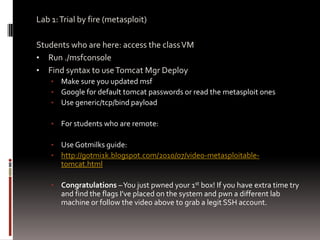
Lab 1: Trial by fire (metasploit)

Students who are here: access the class VM
• Run ./msfconsole
• Find syntax to use Tomcat Mgr Deploy
    •   Make sure you updated msf
    •   Google for default tomcat passwords or read the metasploit ones
    •   Use generic/tcp/bind payload

    •   For students who are remote:

    •   Use Gotmilks guide:
    •   http://g0tmi1k.blogspot.com/2010/07/video-metasploitable-
        tomcat.html

    •   Congratulations – You just pwned your 1st box! If you have extra time try
        and find the flags I’ve placed on the system and pwn a different lab
        machine or follow the video above to grab a legit SSH account.
A bit about hacking history…

 4 Time Periods
 Period 1 - In the not so distant past hacking and
  attack vectors were largely external.
   Core external services were rife with overflows
   Password complexity was non existent
   Trust relationship vulnerabilities were numerous
   Firewalls sucked or were non-existent
   The big web vulns were just beginning to be exploited
A bit about hacking history…

 Period 2 – Things got a bit better, then got worse
   External services started to shape up, no more ./’ing the
      world.
     Passwords got a bit better
     Firewalls were big baddies
     BUT…
     Web Vulns took off… SQL Injection was EVERYWHERE,
      Session Fixation, Logic flaws, etc…
     Internal software was Swiss Cheese - Attackers
      migrated to client-side vectors
A bit about hacking history…

 Period 3 – Attackers got smart(er)
   External services were pretty hard, death of external
      hacking and security assessment.
     With the death of externals, companies focus on internal
      pentests.
     Web vulns still prevalent but getting better with
      initiatives like OWASP
     Internal software was still bad but OS mitigations put a
      band aid on some exploits.
     Attackers created smarter ways to infect insiders
      through web malware
A bit about hacking history…

 Period 4 – The Current State
    External services are very rarely vulnerable.
    Web is still around, less in your face though.
    Internal software continues to fail, but developing exploits are 2-9
     months of research for an 0-day. Much more work.
    Focus on internal pentesting assumes the attacker got access somehow.
     Internal pentesting is a lot of beating up on the windows domain model,
     popping unpatched boxes, abusing current password schemes, using
     man-in-the-middle attacks, and internal password fail.
    On the client side attackers sometimes use no exploits: javascript
     malware, java applet reverse shells, crazy embedding tricks, etc… We are
     just beginning to emulate this.
    Mobile phones are making the mistakes of yester-year, hot topic right
     now
So What?

 What you’ll see a lot of still being sold in the
  industry are:
   Web Assessments
   Internal Pentests
   Source Code Review
   Mobile Assessments
   The new “External” Pentests which are really Client-Side
    Penetration Tests / Social Engineering Assessments /
    Web Pentest hybrids
• Next Time:


  • OSINT

Professional Hacking in 2011

  • 2.
    • Your job? •? •Hacking is fun • The community is FUN •Learning •Beer and Pizza, hang out
  • 3.
    • Basics •Why?TF •Why do we do Security Testing? •VM’s/Labs •Networking Knowledge • Attack Concepts • The Methodology(s) • Intermediate Stuff •Practical Penetration Testing •Current Techniques Most importantly…
  • 5.
  • 6.
    Definition #1 A Vulnerability is defined as a weakness which allows an attacker to reduce a computer system's security.
  • 8.
    Types of SecurityTesting  Network Testing $  Traditional, auditing of services and configuration  Web Application Testing $$  Focus on application type flaws  Web frameworks  Social Engineering $  Attacking users, most resembles real world
  • 9.
    Types of SecurityTesting  Physical Testing / Red Teaming $$  A fork of social engineering, much more involved  Binary Analysis / Reverse Engineering / Exploit Development $$$  Specialty fields  Source Code Auditing $$  Fork of both Web App testing and Binary ninjary
  • 11.
    3 Types ofTests  Confusing? A bit…  Audit  Usually network testing, based around some agencies expectation of what security is. The biggest one is a standard called PCI.  Usually boring, but bring in lots of money. Usually same skill sets used.  Very Structured, Sometimes checklist and vulnerability scan driven.  Can include IT services (Firewall config review, vlan review, etc)
  • 12.
    3 Types ofTests  Assessment  More broad than an audit, doesn’t have to comply with any agencies expectation of security.  Mile wide, less in depth  Identify as many vulnerabilities as possible  Can include IT services (Firewall config review, vlan review, etc)
  • 13.
    3 Types ofTests  Penetration Test  With all these definitions, tends to get confused  “Pentests” actually test the security controls themselves and exploit the vulnerabilities.  More goal oriented, prove real threats, get real data as success factor.  Harder, more expectation of pwnage, most of the time you have to “get” something.  Usually does NOT include IT services.  We will focus mostly on pentesting… because I think it’s the most fun but, the skills map across all domains.
  • 14.
    Ethics  Difference betweenhacking and a audit/assessment/pentest is….  PERMISSION
  • 15.
    Lab 1: Trialby fire (metasploit) Students who are here: access the class VM • Run ./msfconsole • Find syntax to use Tomcat Mgr Deploy • Make sure you updated msf • Google for default tomcat passwords or read the metasploit ones • Use generic/tcp/bind payload • For students who are remote: • Use Gotmilks guide: • http://g0tmi1k.blogspot.com/2010/07/video-metasploitable- tomcat.html • Congratulations – You just pwned your 1st box! If you have extra time try and find the flags I’ve placed on the system and pwn a different lab machine or follow the video above to grab a legit SSH account.
  • 16.
    A bit abouthacking history…  4 Time Periods  Period 1 - In the not so distant past hacking and attack vectors were largely external.  Core external services were rife with overflows  Password complexity was non existent  Trust relationship vulnerabilities were numerous  Firewalls sucked or were non-existent  The big web vulns were just beginning to be exploited
  • 17.
    A bit abouthacking history…  Period 2 – Things got a bit better, then got worse  External services started to shape up, no more ./’ing the world.  Passwords got a bit better  Firewalls were big baddies  BUT…  Web Vulns took off… SQL Injection was EVERYWHERE, Session Fixation, Logic flaws, etc…  Internal software was Swiss Cheese - Attackers migrated to client-side vectors
  • 18.
    A bit abouthacking history…  Period 3 – Attackers got smart(er)  External services were pretty hard, death of external hacking and security assessment.  With the death of externals, companies focus on internal pentests.  Web vulns still prevalent but getting better with initiatives like OWASP  Internal software was still bad but OS mitigations put a band aid on some exploits.  Attackers created smarter ways to infect insiders through web malware
  • 19.
    A bit abouthacking history…  Period 4 – The Current State  External services are very rarely vulnerable.  Web is still around, less in your face though.  Internal software continues to fail, but developing exploits are 2-9 months of research for an 0-day. Much more work.  Focus on internal pentesting assumes the attacker got access somehow. Internal pentesting is a lot of beating up on the windows domain model, popping unpatched boxes, abusing current password schemes, using man-in-the-middle attacks, and internal password fail.  On the client side attackers sometimes use no exploits: javascript malware, java applet reverse shells, crazy embedding tricks, etc… We are just beginning to emulate this.  Mobile phones are making the mistakes of yester-year, hot topic right now
  • 20.
    So What?  Whatyou’ll see a lot of still being sold in the industry are:  Web Assessments  Internal Pentests  Source Code Review  Mobile Assessments  The new “External” Pentests which are really Client-Side Penetration Tests / Social Engineering Assessments / Web Pentest hybrids
  • 21.
    • Next Time: • OSINT