Hiding in Plain Sight – The Danger of
Known Vulnerabilities
Tal Be’ery, Web Security Research Team Leader

1

© 2013 Imperva, Inc. All rights reserved.

Confidential
Agenda
§  Introduction
•  Zero-days Vs. Known vulnerabilities

§  The anatomy of a known vulnerability web attack:
Attacking a specific victim
•  Theory
•  Test case analysis: A vulnerable ColdFusion application

§  The anatomy of a known vulnerability web attack:
Mass attacks
•  Theory
•  Test case analysis: Abusing JBOSS

§  Summary & conclusion
§  Q&A
2

© 2013 Imperva, Inc. All rights reserved.

Confidential
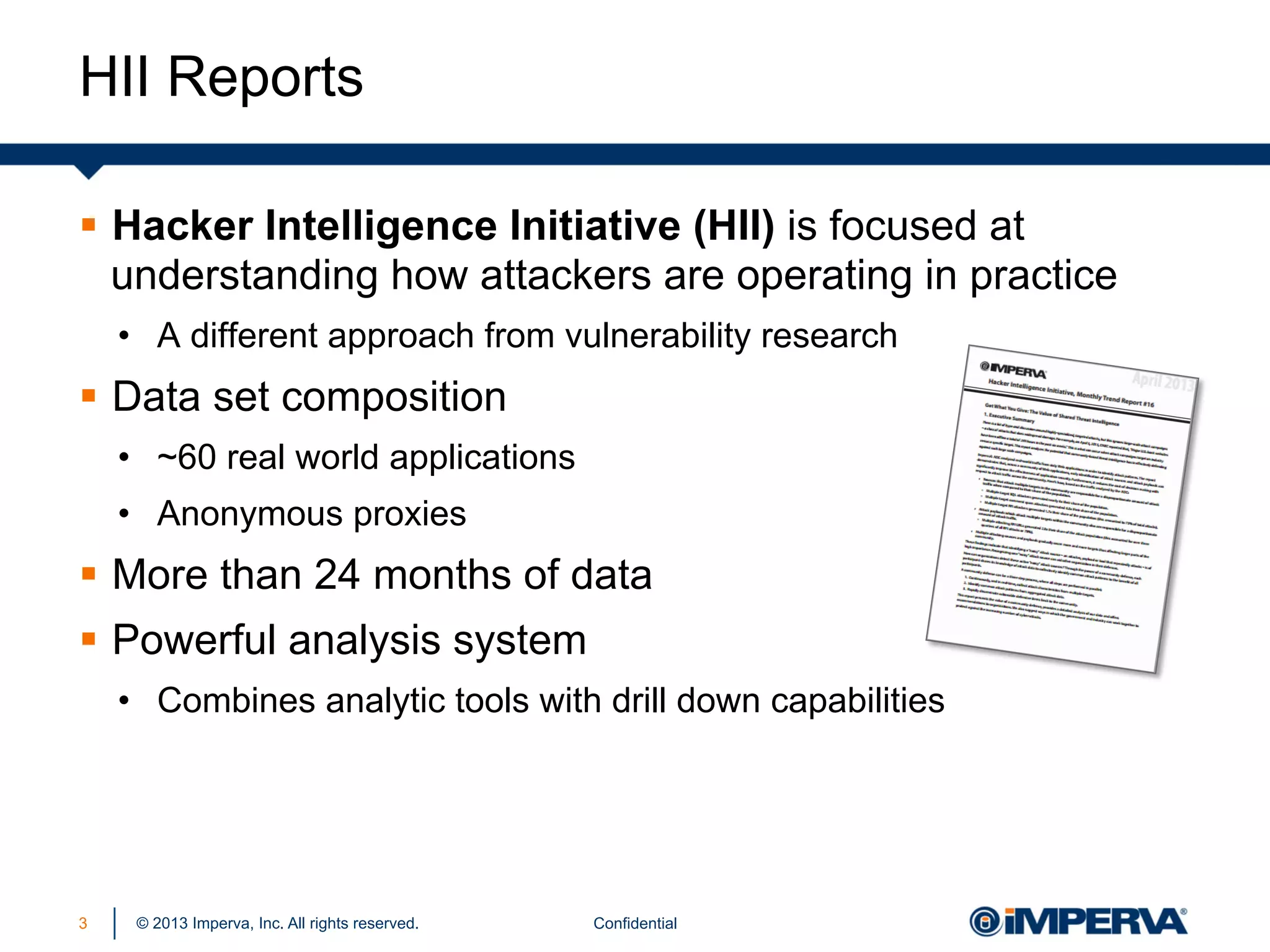
HII Reports
§  Hacker Intelligence Initiative (HII) is focused at
understanding how attackers are operating in practice
•  A different approach from vulnerability research

§  Data set composition
•  ~60 real world applications
•  Anonymous proxies

§  More than 24 months of data
§  Powerful analysis system
•  Combines analytic tools with drill down capabilities

3

© 2013 Imperva, Inc. All rights reserved.

Confidential
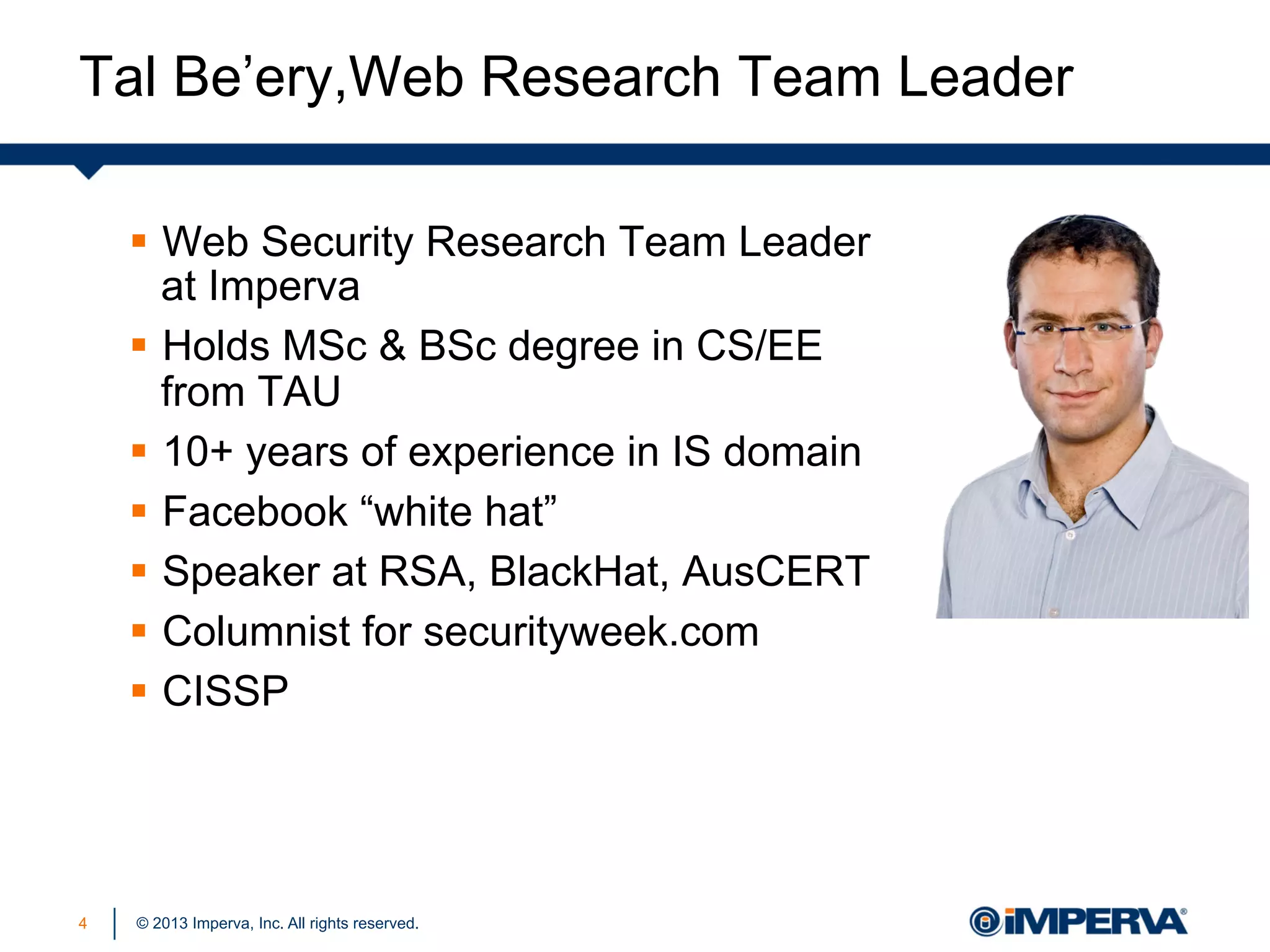
Tal Be’ery,Web Research Team Leader
§  Web Security Research Team Leader
at Imperva
§  Holds MSc & BSc degree in CS/EE
from TAU
§  10+ years of experience in IS domain
§  Facebook “white hat”
§  Speaker at RSA, BlackHat, AusCERT
§  Columnist for securityweek.com
§  CISSP

4

© 2013 Imperva, Inc. All rights reserved.
Introduction

5

© 2013 Imperva, Inc. All rights reserved.

Confidential
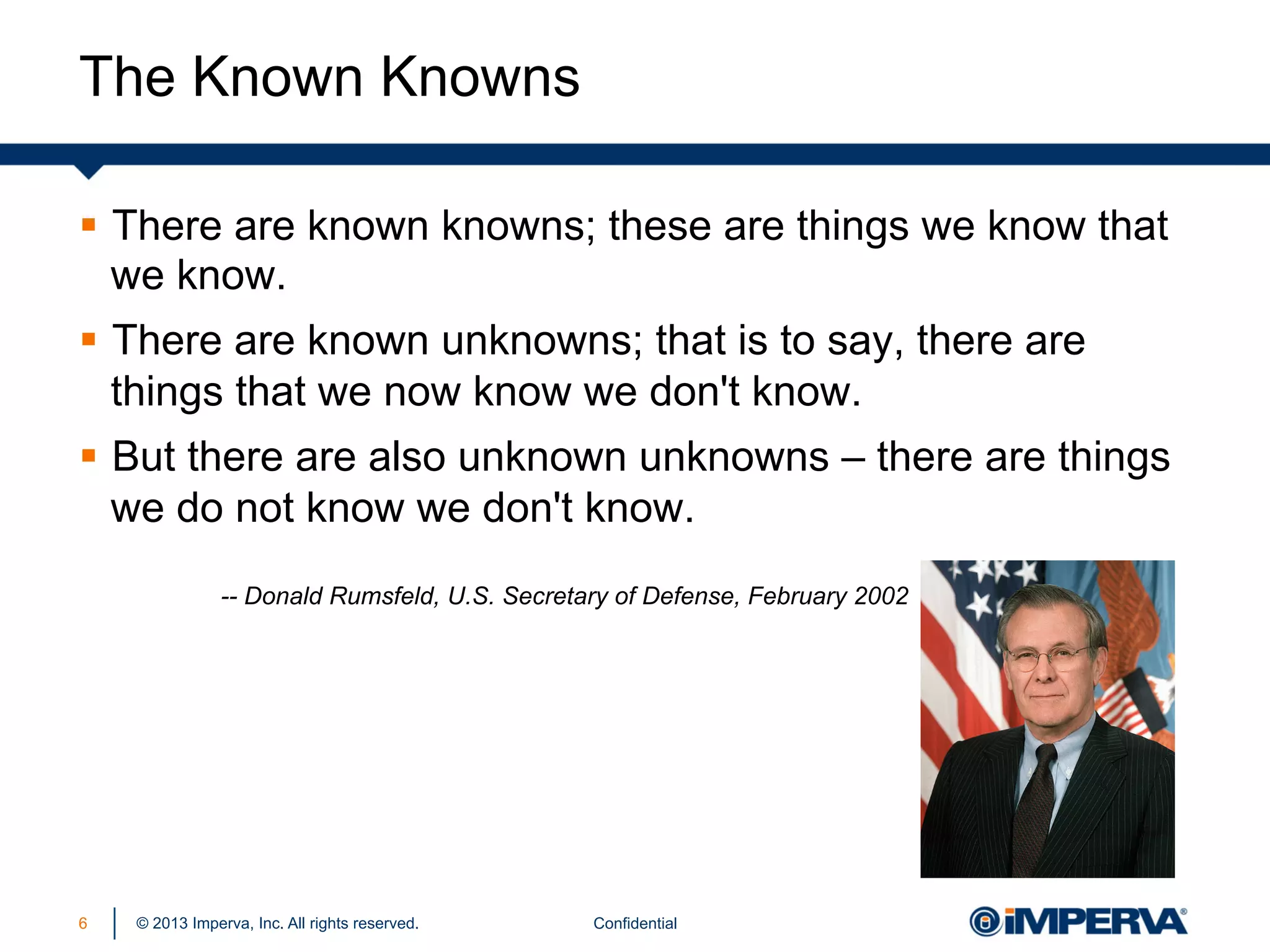
The Known Knowns
§  There are known knowns; these are things we know that
we know.
§  There are known unknowns; that is to say, there are
things that we now know we don't know.
§  But there are also unknown unknowns – there are things
we do not know we don't know.
-- Donald Rumsfeld, U.S. Secretary of Defense, February 2002

6

© 2013 Imperva, Inc. All rights reserved.

Confidential
Security’s Knowns and Unknowns Defined
§  Unknown Unkowns: Zero-Days
A zero-day attack is an attack that exploits a previously unknown
vulnerability in a computer application, meaning that the attack
occurs on "day zero" of awareness of the vulnerability
(Wikipedia http://en.wikipedia.org/wiki/Zero-day_attack)

§  Known Knowns: Known vulnerabilities
Vulnerable components (e.g., framework libraries) can be identified
and exploited
(OWASP
https://www.owasp.org/index.php/Top_10_2013-A9Using_Components_with_Known_Vulnerabilities)

7

© 2013 Imperva, Inc. All rights reserved.

Confidential
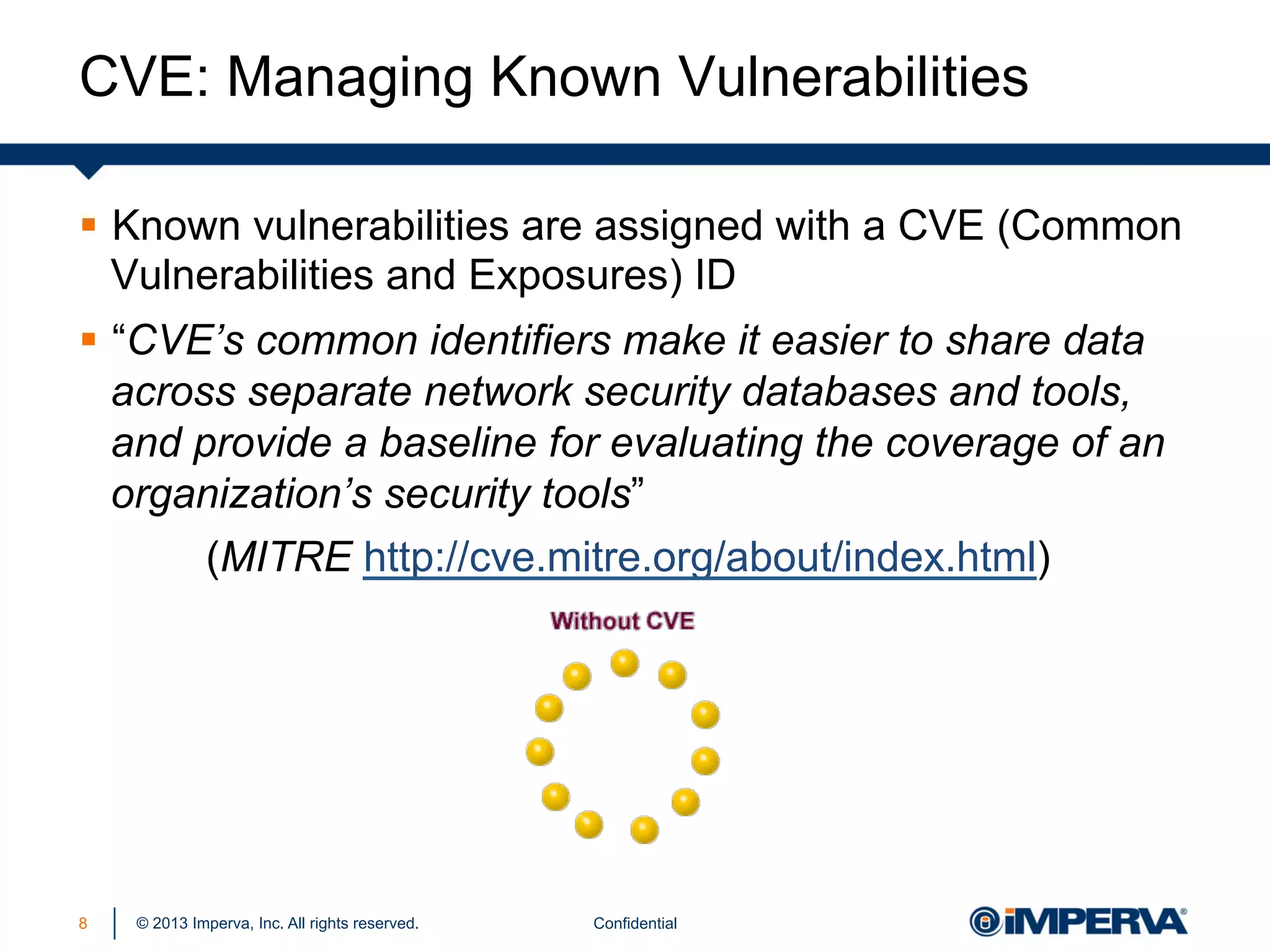
CVE: Managing Known Vulnerabilities
§  Known vulnerabilities are assigned with a CVE (Common
Vulnerabilities and Exposures) ID
§  “CVE’s common identifiers make it easier to share data
across separate network security databases and tools,
and provide a baseline for evaluating the coverage of an
organization’s security tools”
(MITRE http://cve.mitre.org/about/index.html)

8

© 2013 Imperva, Inc. All rights reserved.

Confidential
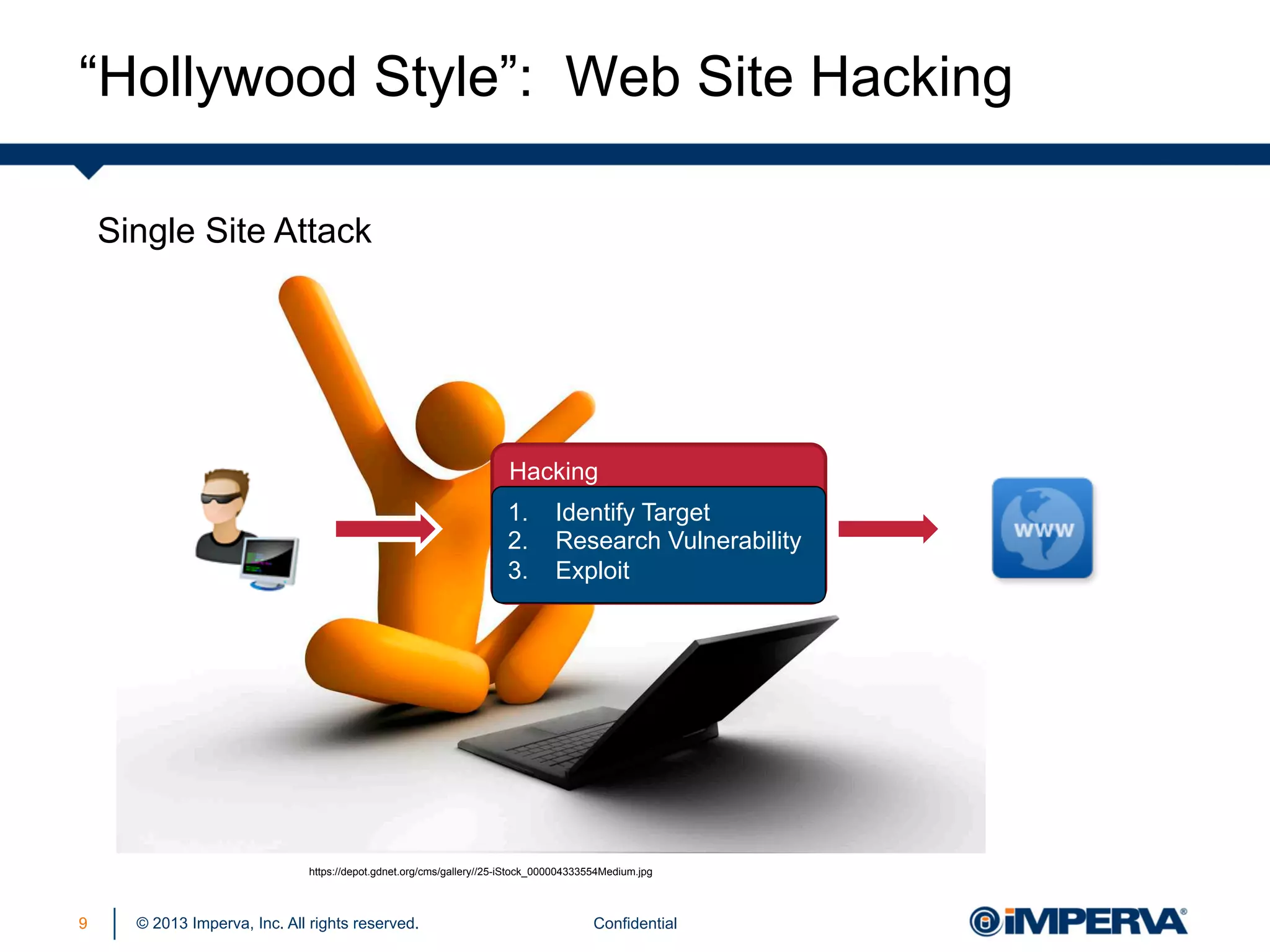
“Hollywood Style”: Web Site Hacking
Single Site Attack

Hacking
1.  Identify Target
2.  Research Vulnerability
3.  Exploit

https://depot.gdnet.org/cms/gallery//25-iStock_000004333554Medium.jpg

9

© 2013 Imperva, Inc. All rights reserved.

Confidential
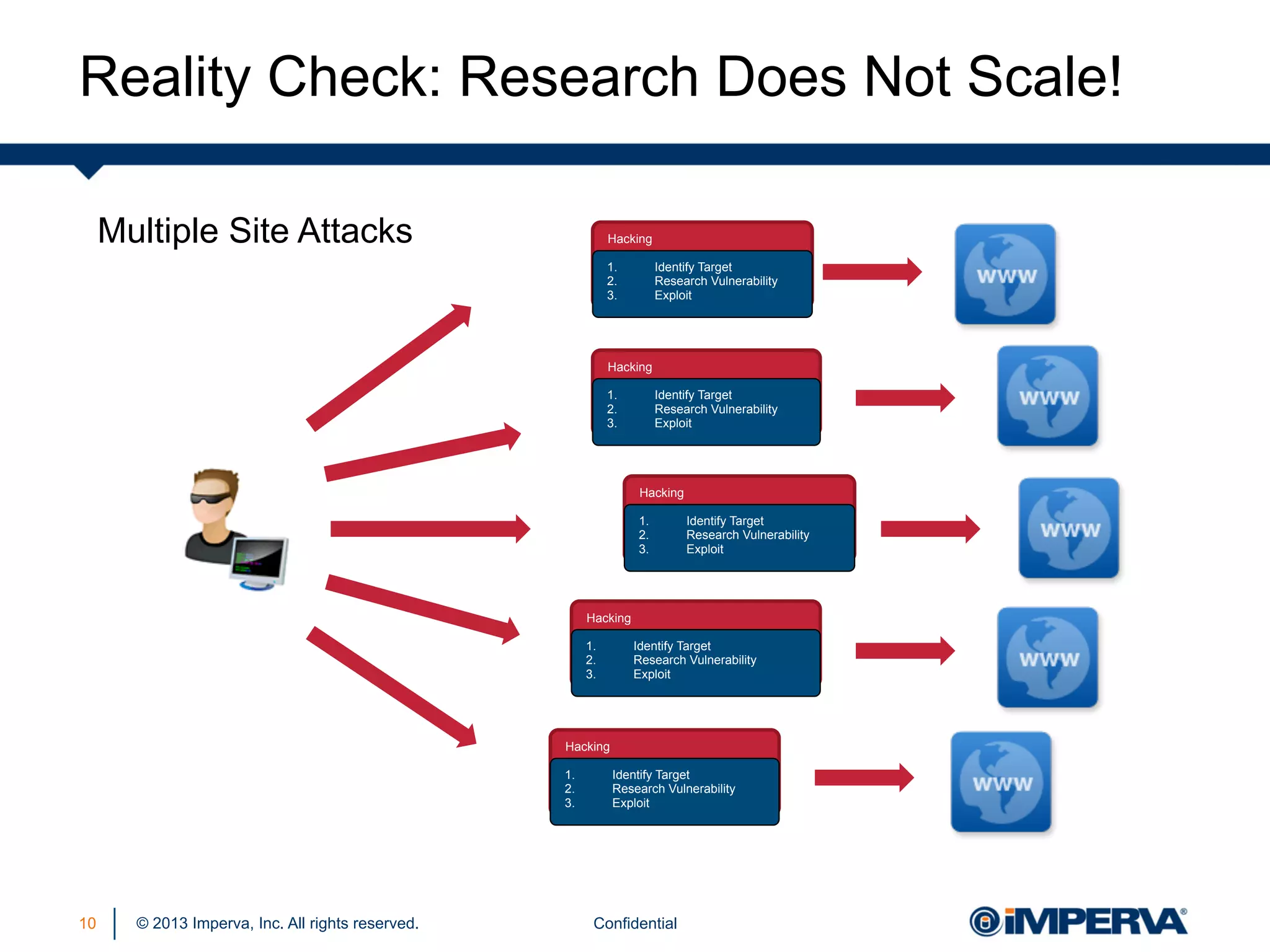
Reality Check: Research Does Not Scale!
Multiple Site Attacks

Hacking
1. 
2. 
3. 

Identify Target
Research Vulnerability
Exploit

Hacking
1. 
2. 
3. 

Identify Target
Research Vulnerability
Exploit

Hacking
1. 
2. 
3. 

Identify Target
Research Vulnerability
Exploit

Hacking
1. 
2. 
3. 

Identify Target
Research Vulnerability
Exploit

Hacking
1. 
2. 
3. 

10

© 2013 Imperva, Inc. All rights reserved.

Identify Target
Research Vulnerability
Exploit

Confidential
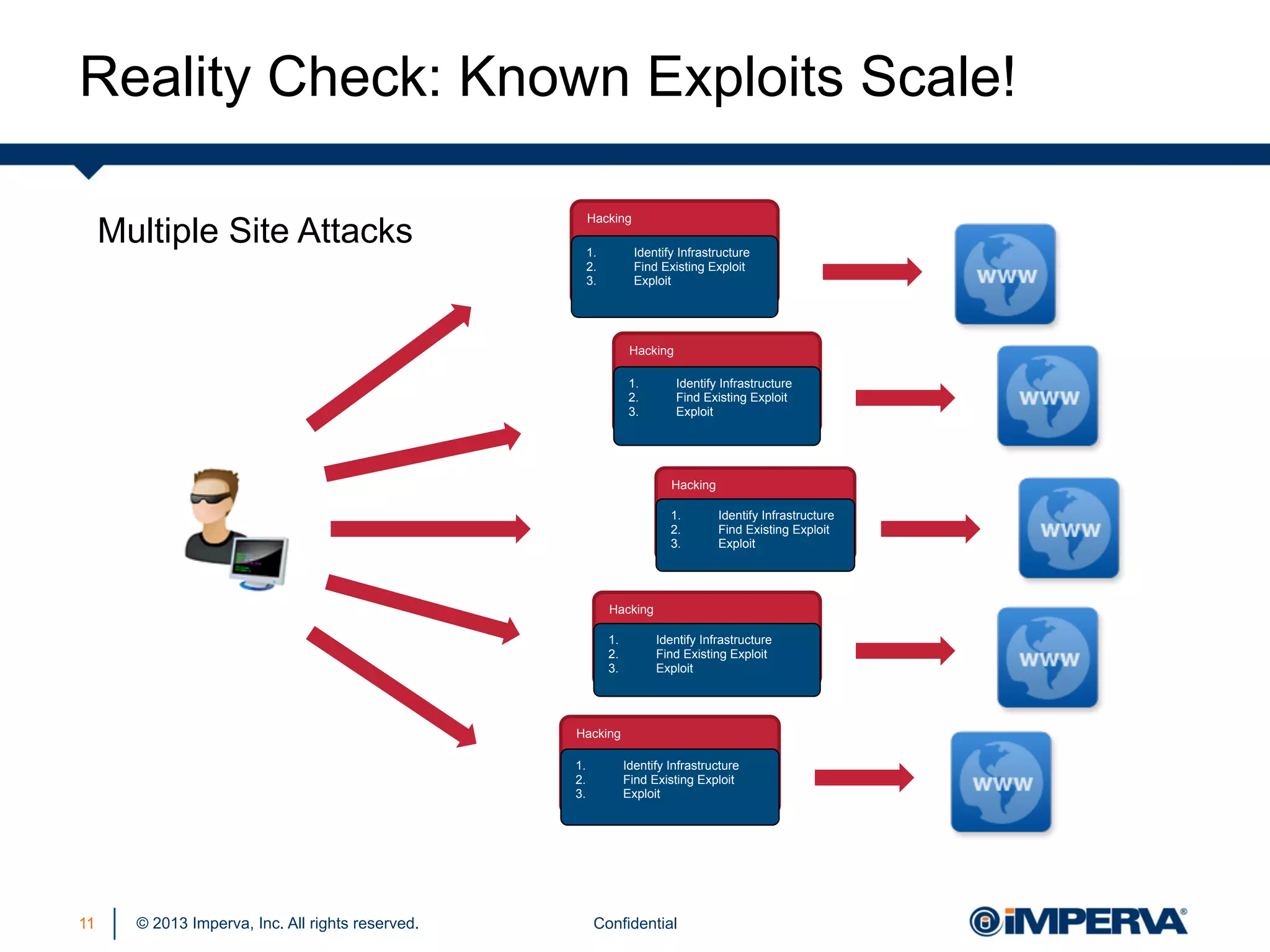
Reality Check: Known Exploits Scale!
Multiple Site Attacks

Hacking
1. 
2. 
3. 

Identify Infrastructure
Find Existing Exploit
Exploit

Hacking
1. 
2. 
3. 

Identify Infrastructure
Find Existing Exploit
Exploit

Hacking
1. 
2. 
3. 

Identify Infrastructure
Find Existing Exploit
Exploit

Hacking
1. 
2. 
3. 

Identify Infrastructure
Find Existing Exploit
Exploit

Hacking
1. 
2. 
3. 

11

© 2013 Imperva, Inc. All rights reserved.

Identify Infrastructure
Find Existing Exploit
Exploit

Confidential
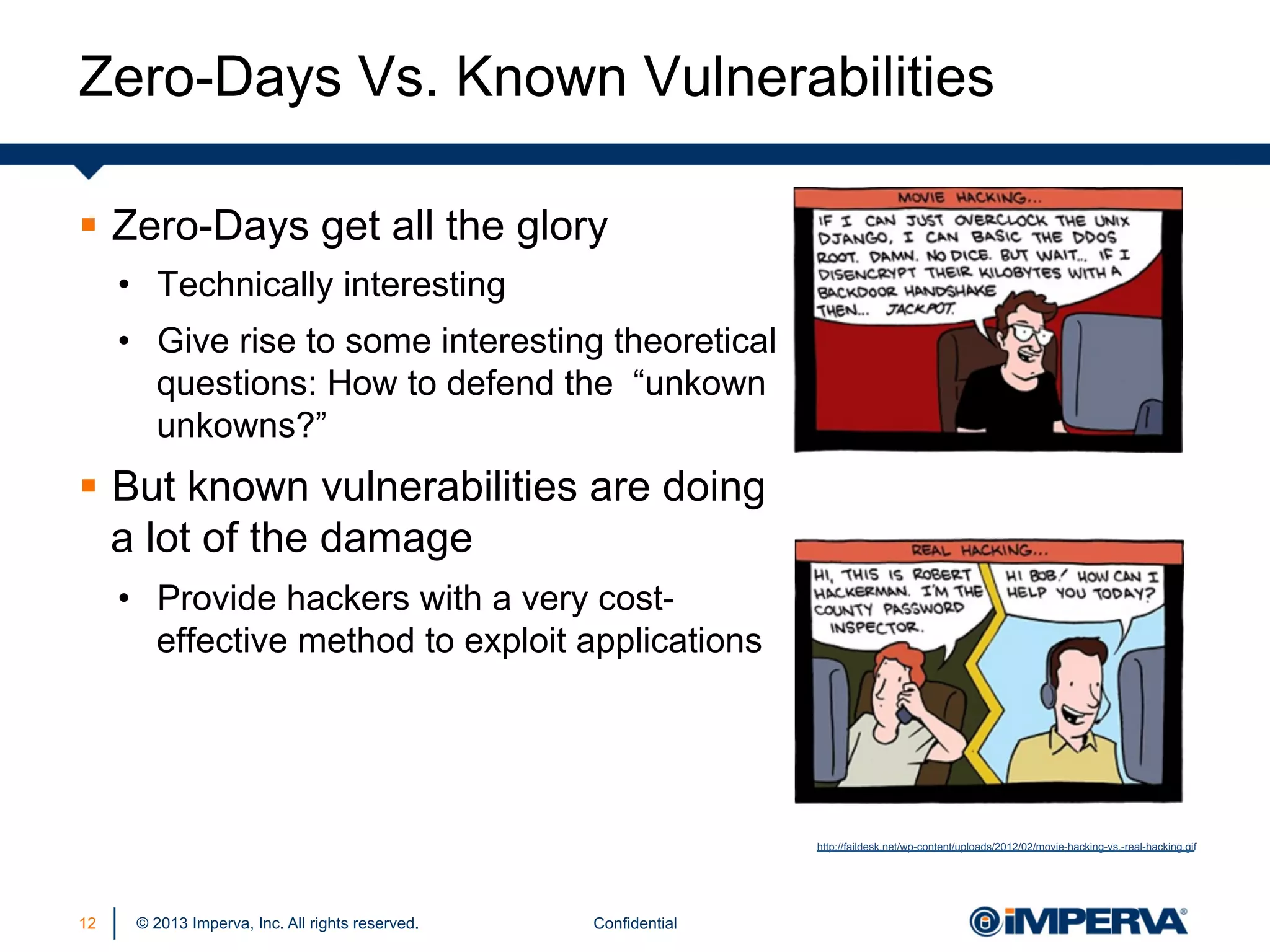
Zero-Days Vs. Known Vulnerabilities
§  Zero-Days get all the glory
•  Technically interesting
•  Give rise to some interesting theoretical
questions: How to defend the “unkown
unkowns?”

§  But known vulnerabilities are doing
a lot of the damage
•  Provide hackers with a very costeffective method to exploit applications

http://faildesk.net/wp-content/uploads/2012/02/movie-hacking-vs.-real-hacking.gif

12

© 2013 Imperva, Inc. All rights reserved.

Confidential
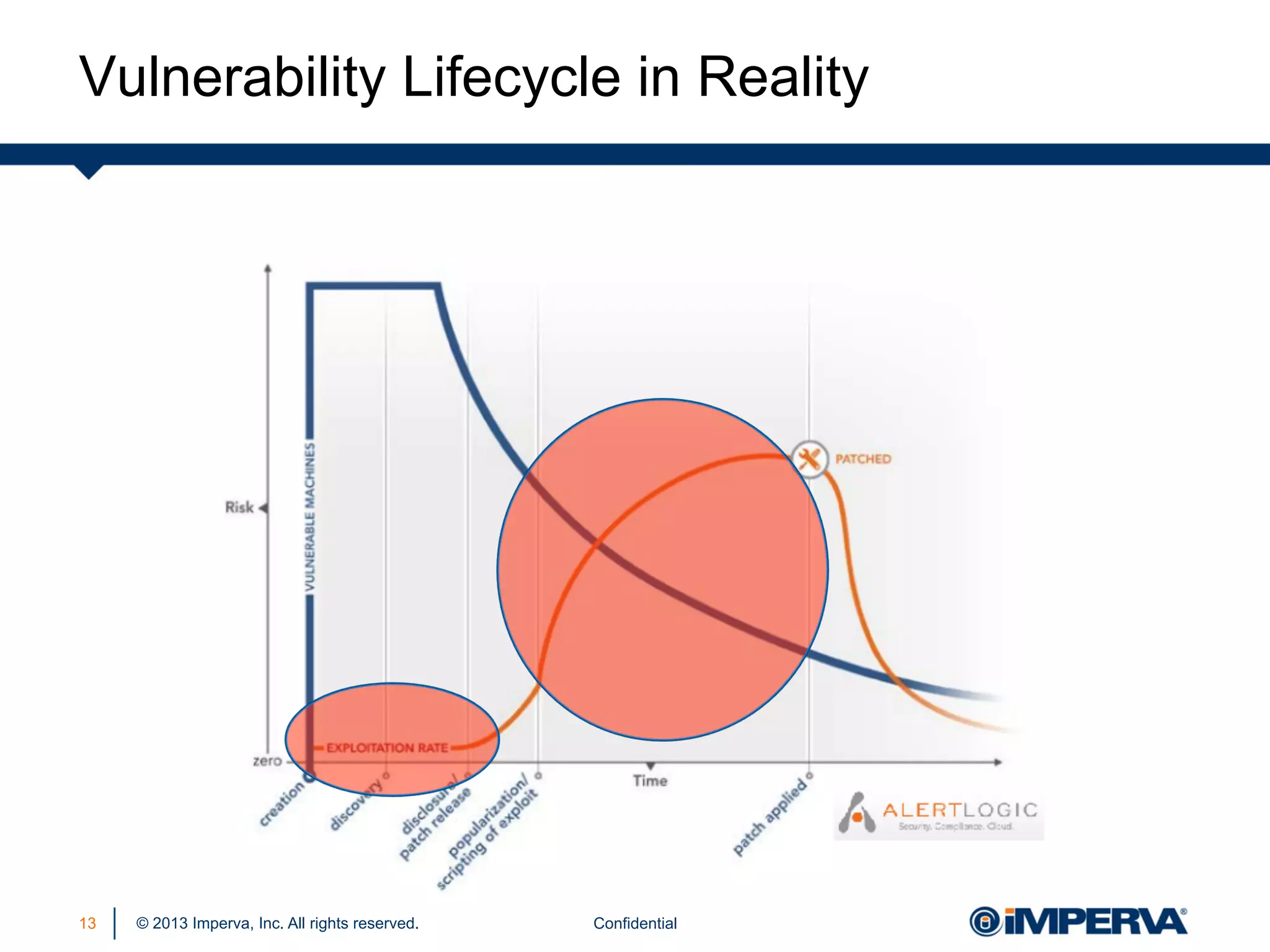
Vulnerability Lifecycle in Reality

13

© 2013 Imperva, Inc. All rights reserved.

Confidential
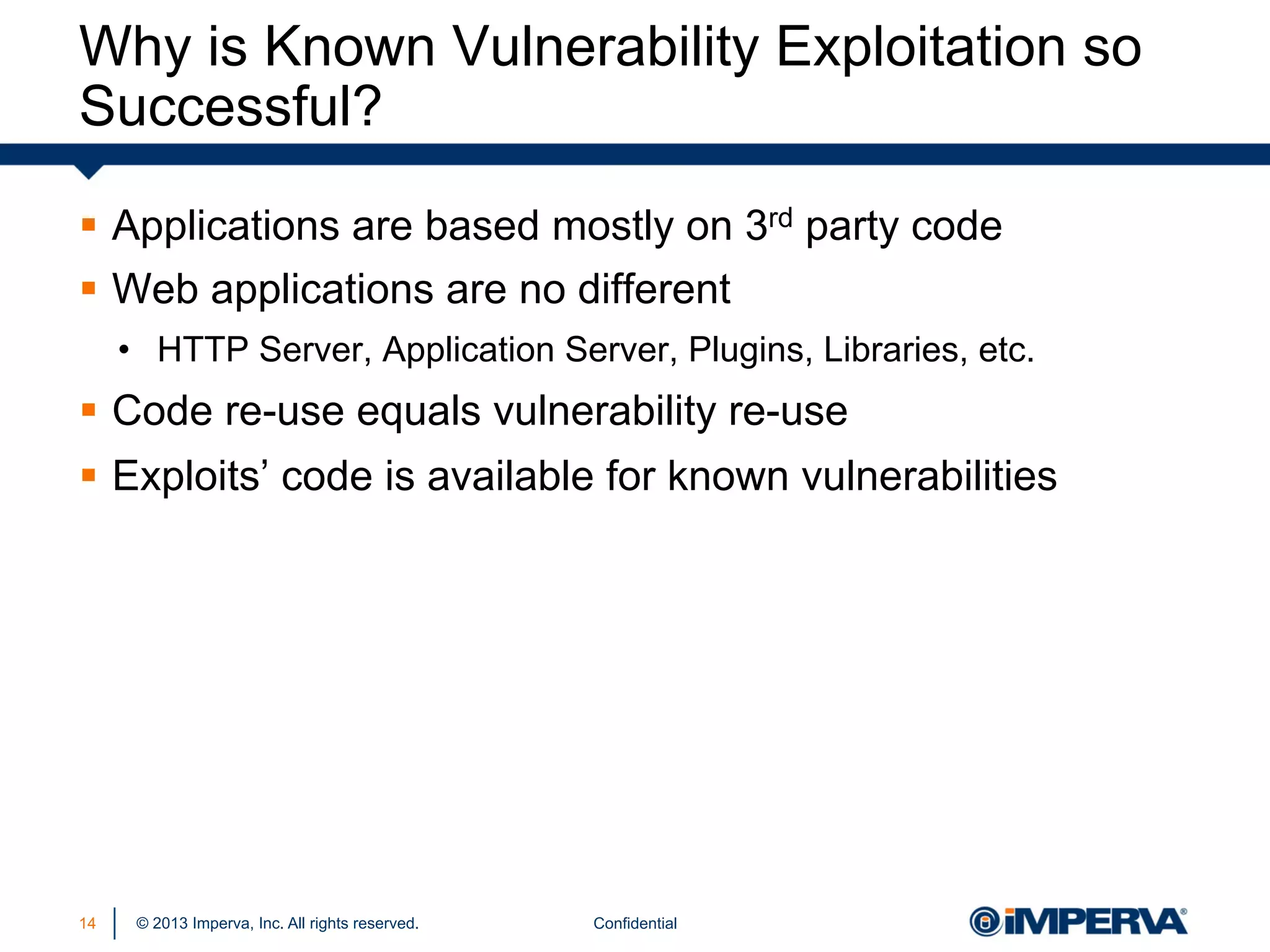
Why is Known Vulnerability Exploitation so
Successful?
§  Applications are based mostly on 3rd party code
§  Web applications are no different
•  HTTP Server, Application Server, Plugins, Libraries, etc.

§  Code re-use equals vulnerability re-use
§  Exploits’ code is available for known vulnerabilities

14

© 2013 Imperva, Inc. All rights reserved.

Confidential
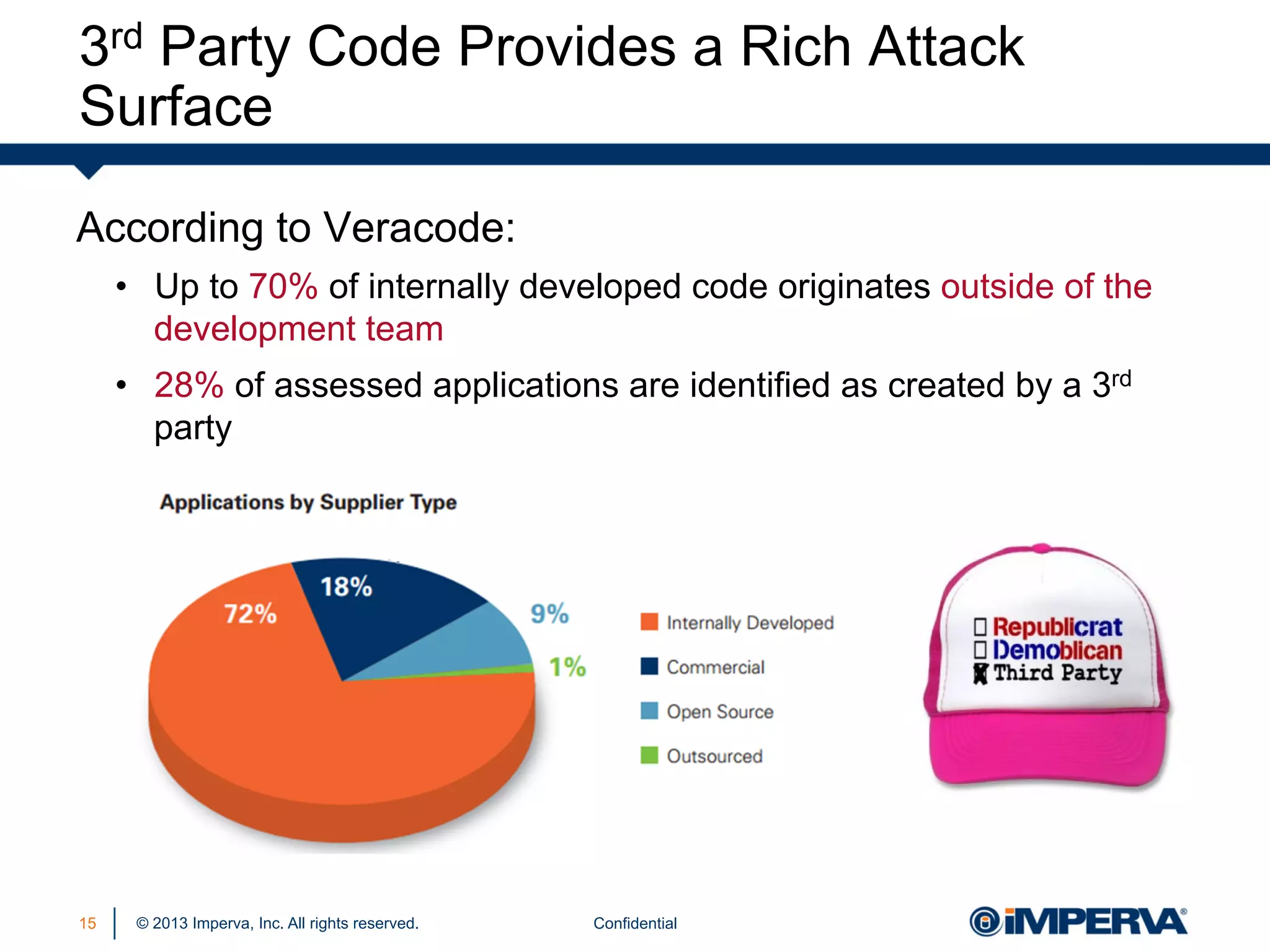
3rd Party Code Provides a Rich Attack
Surface
According to Veracode:
•  Up to 70% of internally developed code originates outside of the
development team
•  28% of assessed applications are identified as created by a 3rd
party

15

© 2013 Imperva, Inc. All rights reserved.

Confidential
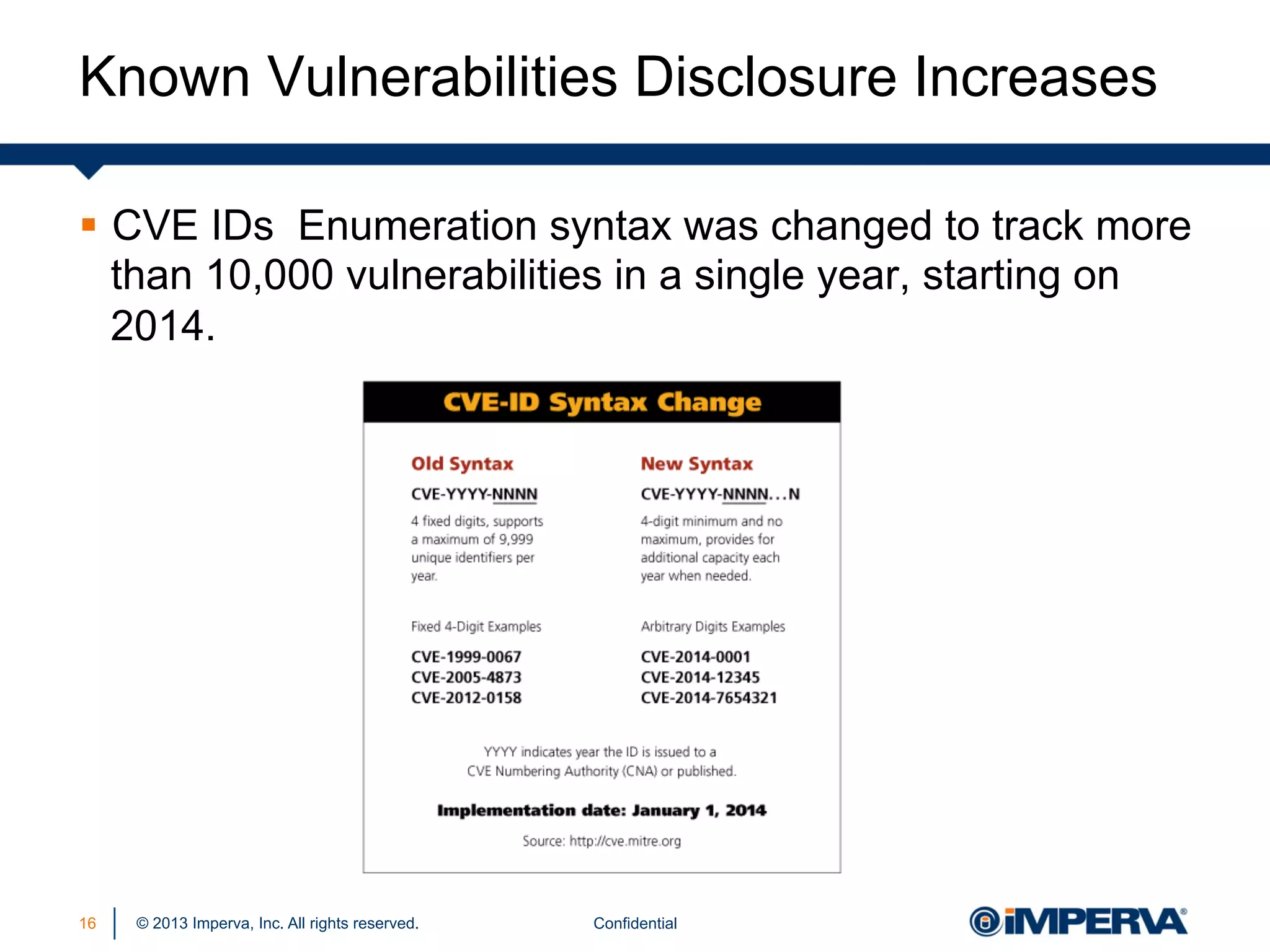
Known Vulnerabilities Disclosure Increases
§  CVE IDs Enumeration syntax was changed to track more
than 10,000 vulnerabilities in a single year, starting on
2014.

16

© 2013 Imperva, Inc. All rights reserved.

Confidential
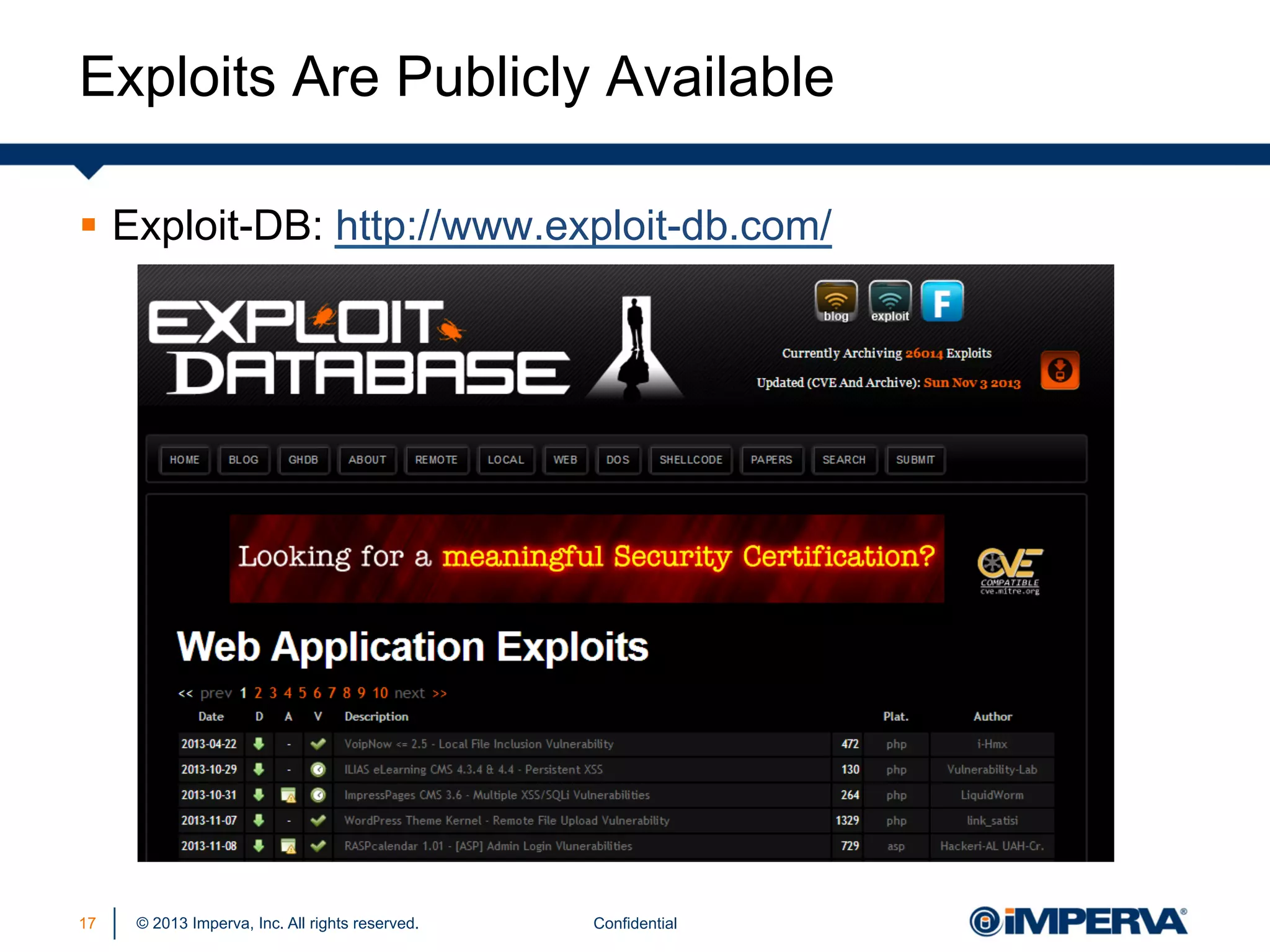
Exploits Are Publicly Available
§  Exploit-DB: http://www.exploit-db.com/

17

© 2013 Imperva, Inc. All rights reserved.

Confidential
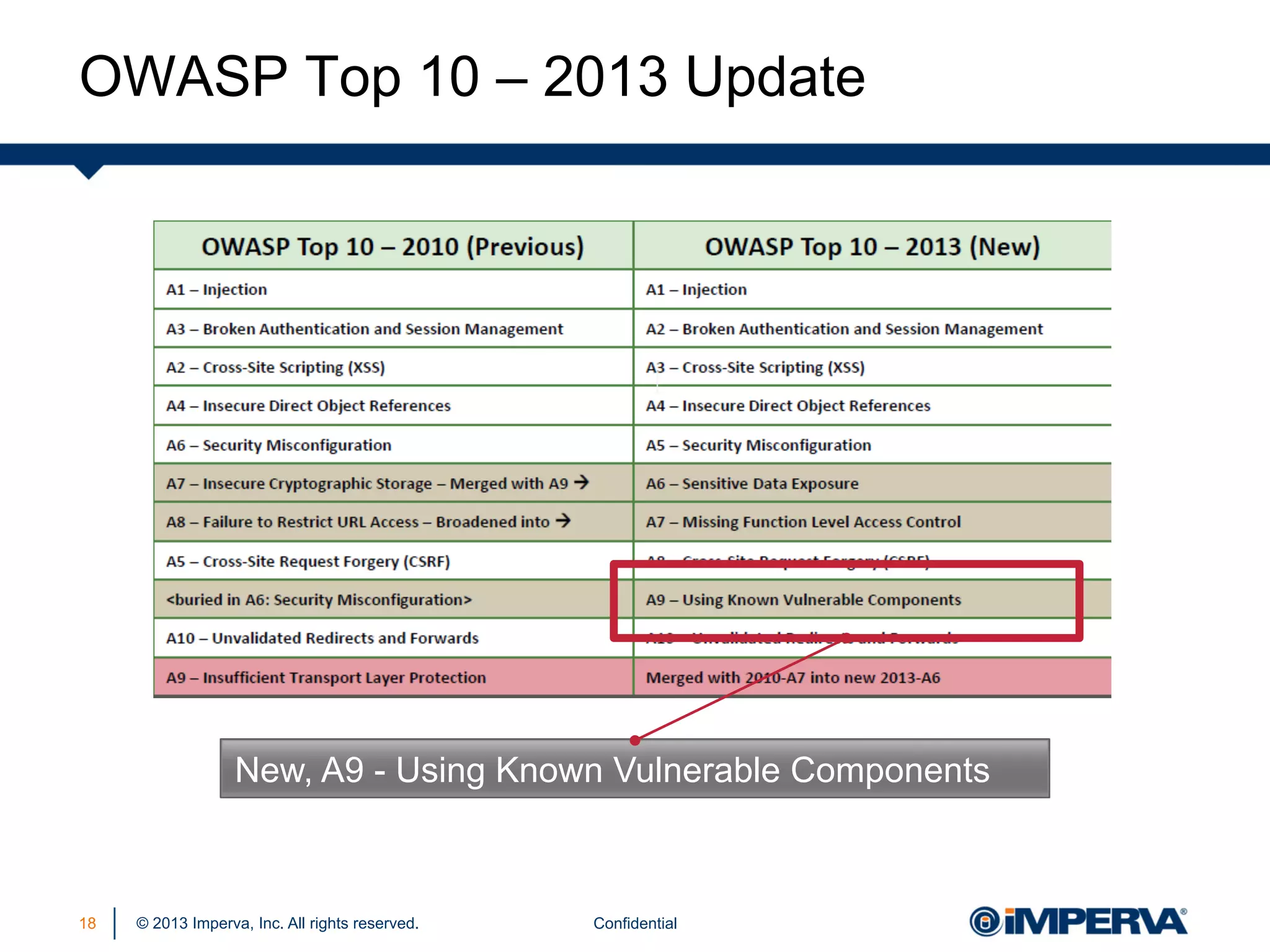
OWASP Top 10 – 2013 Update

New, A9 - Using Known Vulnerable Components

18

© 2013 Imperva, Inc. All rights reserved.

Confidential
The Anatomy of a Known Vulnerability
Web attack
Attacking a Specific Victim

19

© 2013 Imperva, Inc. All rights reserved.

Confidential
Attacking a Specific Application: Theory
§  Step 1: Fingerprinting of the victim application to discover
third party components and infrastructure
§  Step 2: For the discovered components, find known
vulnerabilities and exploits that gives the hacker the
desired access level
§  Step 3: Apply the exploit to the victim’s application

20

© 2013 Imperva, Inc. All rights reserved.

Confidential
The Art of Fingerprinting
Identify a fingerprint in victim application
A fingerprint can be
•  Image
•  URL
•  Content
•  Object Reference
•  Response to a query
•  Etc.

21

© 2013 Imperva, Inc. All rights reserved.

Confidential
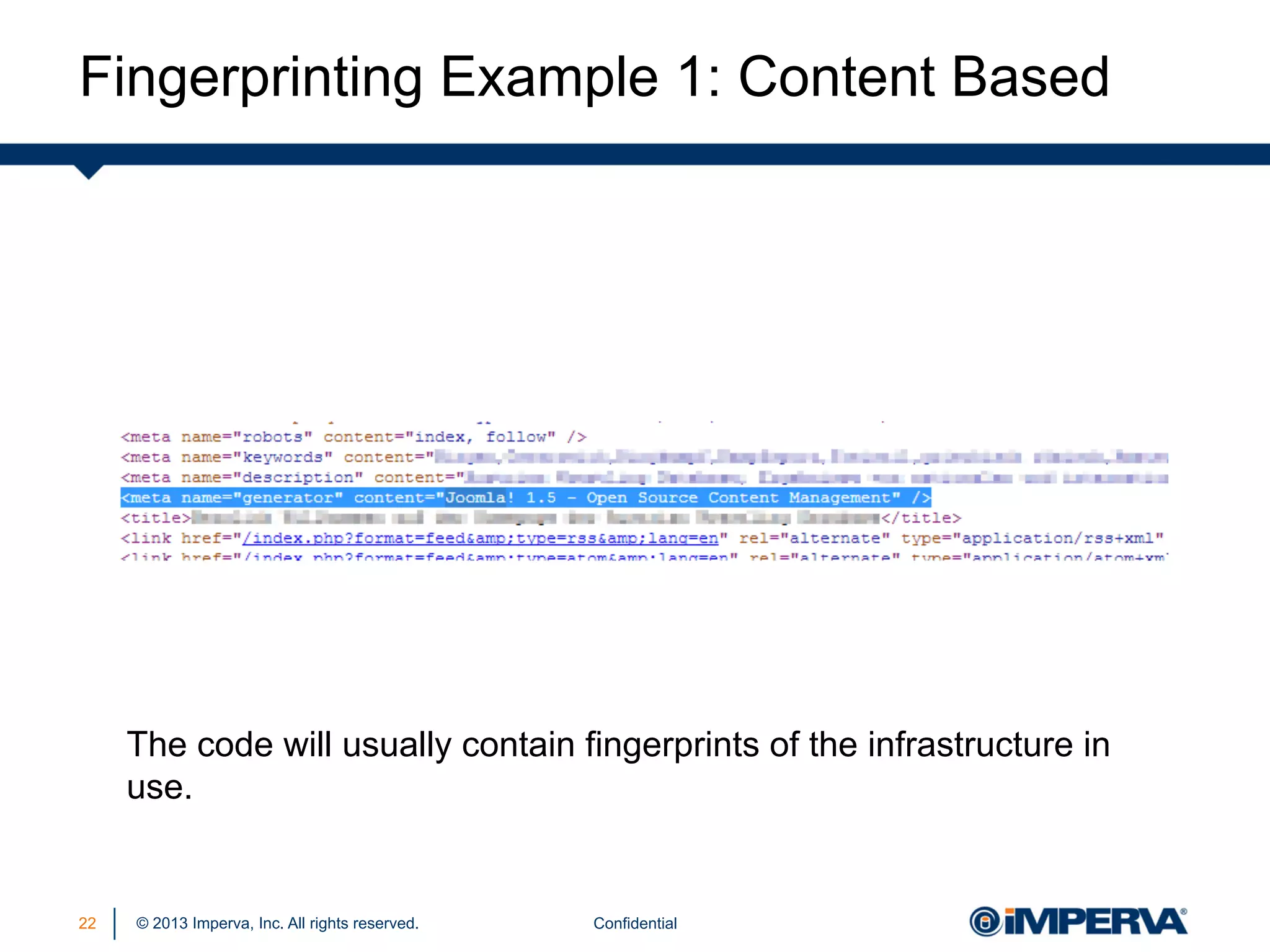
Fingerprinting Example 1: Content Based

The code will usually contain fingerprints of the infrastructure in
use.

22

© 2013 Imperva, Inc. All rights reserved.

Confidential
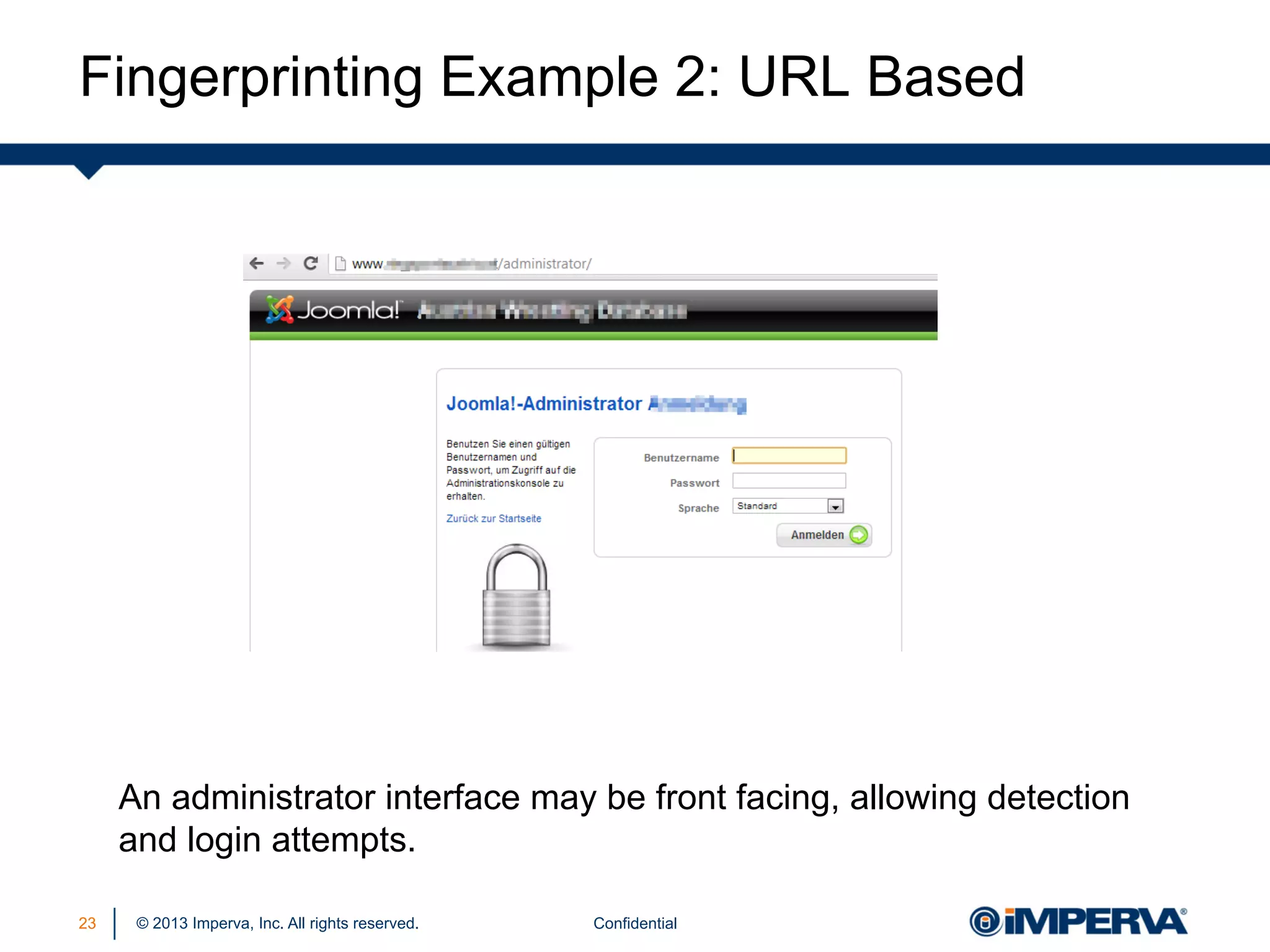
Fingerprinting Example 2: URL Based

An administrator interface may be front facing, allowing detection
and login attempts.
23

© 2013 Imperva, Inc. All rights reserved.

Confidential
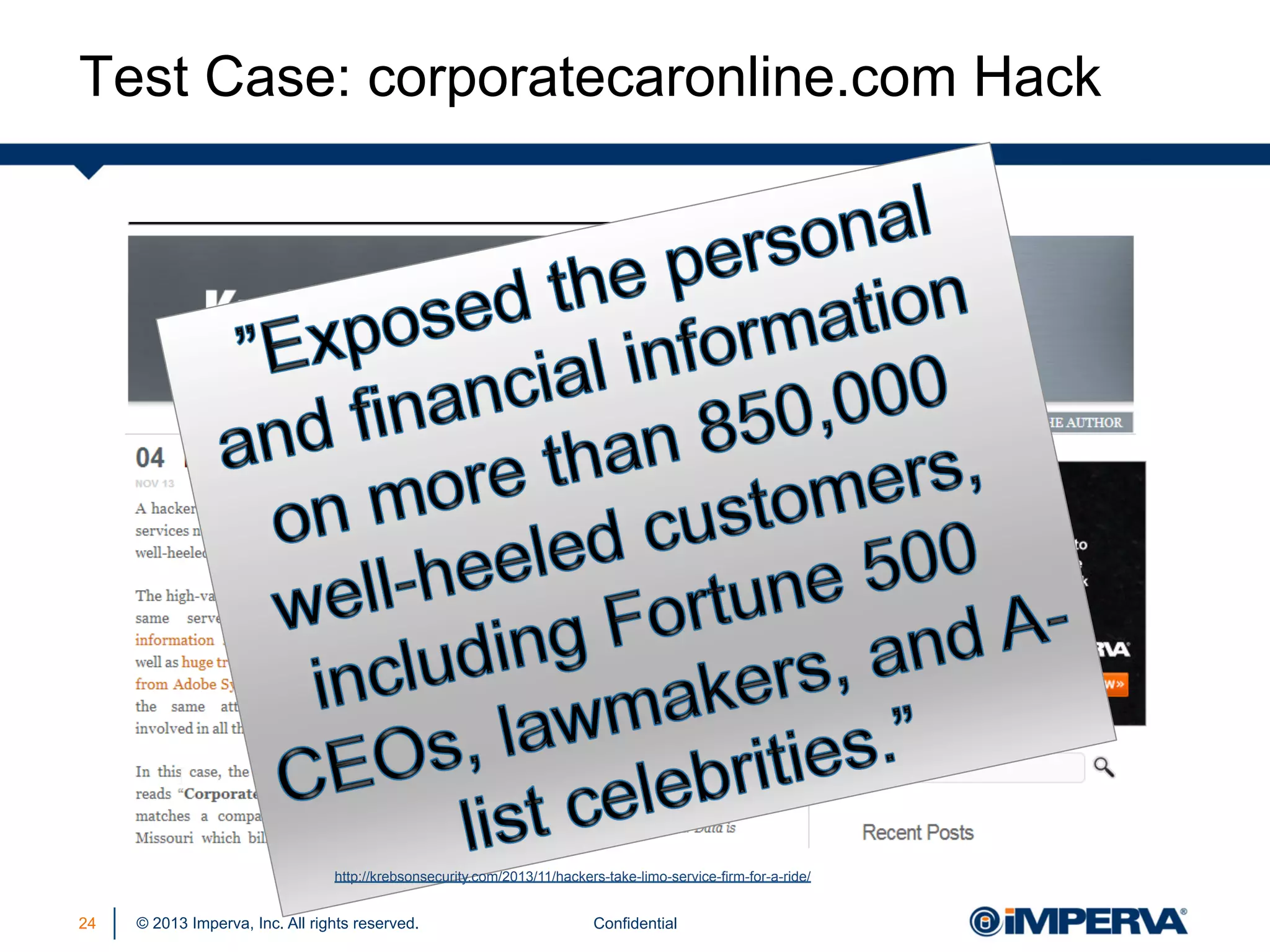
Test Case: corporatecaronline.com Hack

http://krebsonsecurity.com/2013/11/hackers-take-limo-service-firm-for-a-ride/

24

© 2013 Imperva, Inc. All rights reserved.

Confidential
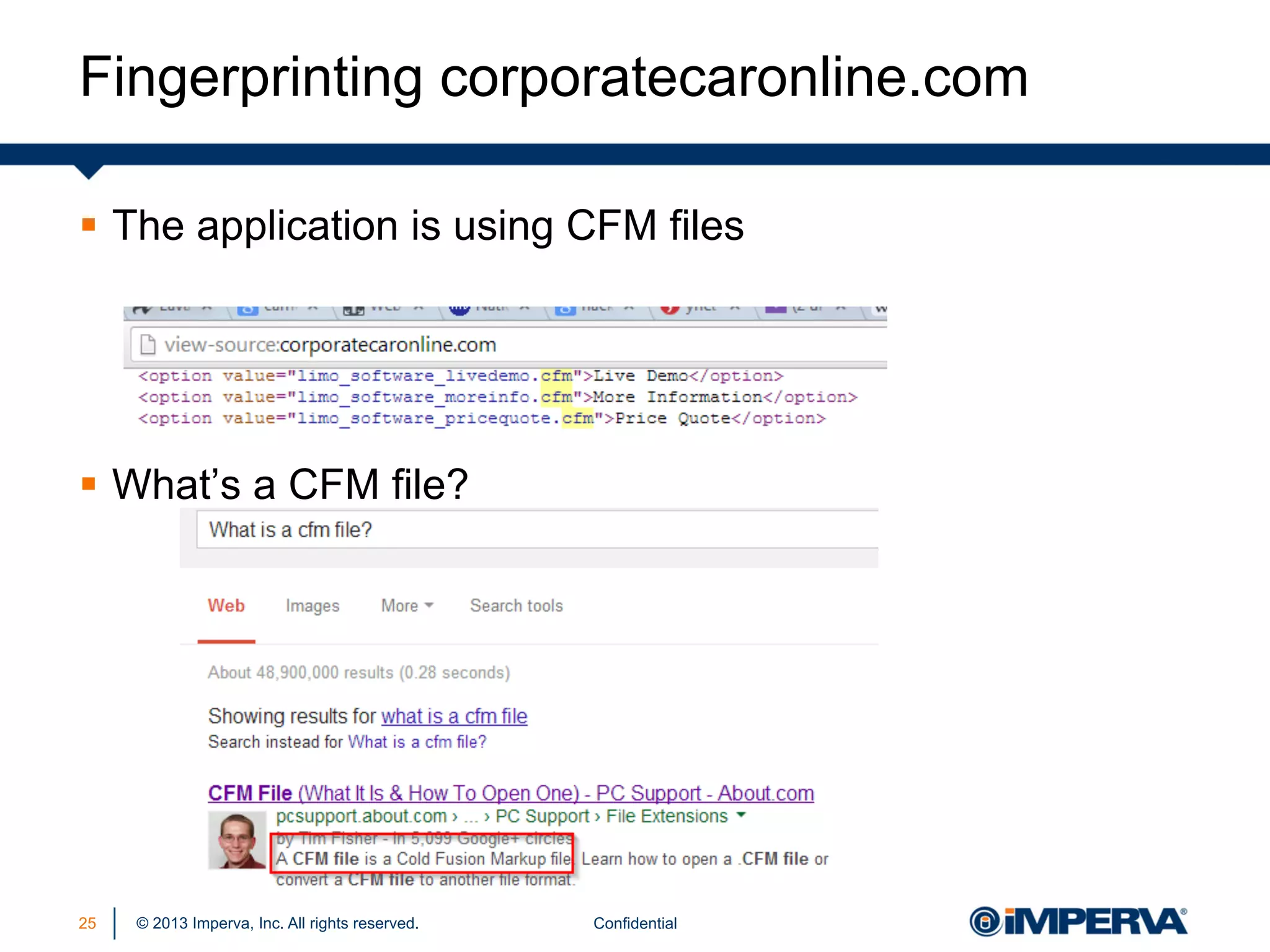
Fingerprinting corporatecaronline.com
§  The application is using CFM files

§  What’s a CFM file?

25

© 2013 Imperva, Inc. All rights reserved.

Confidential
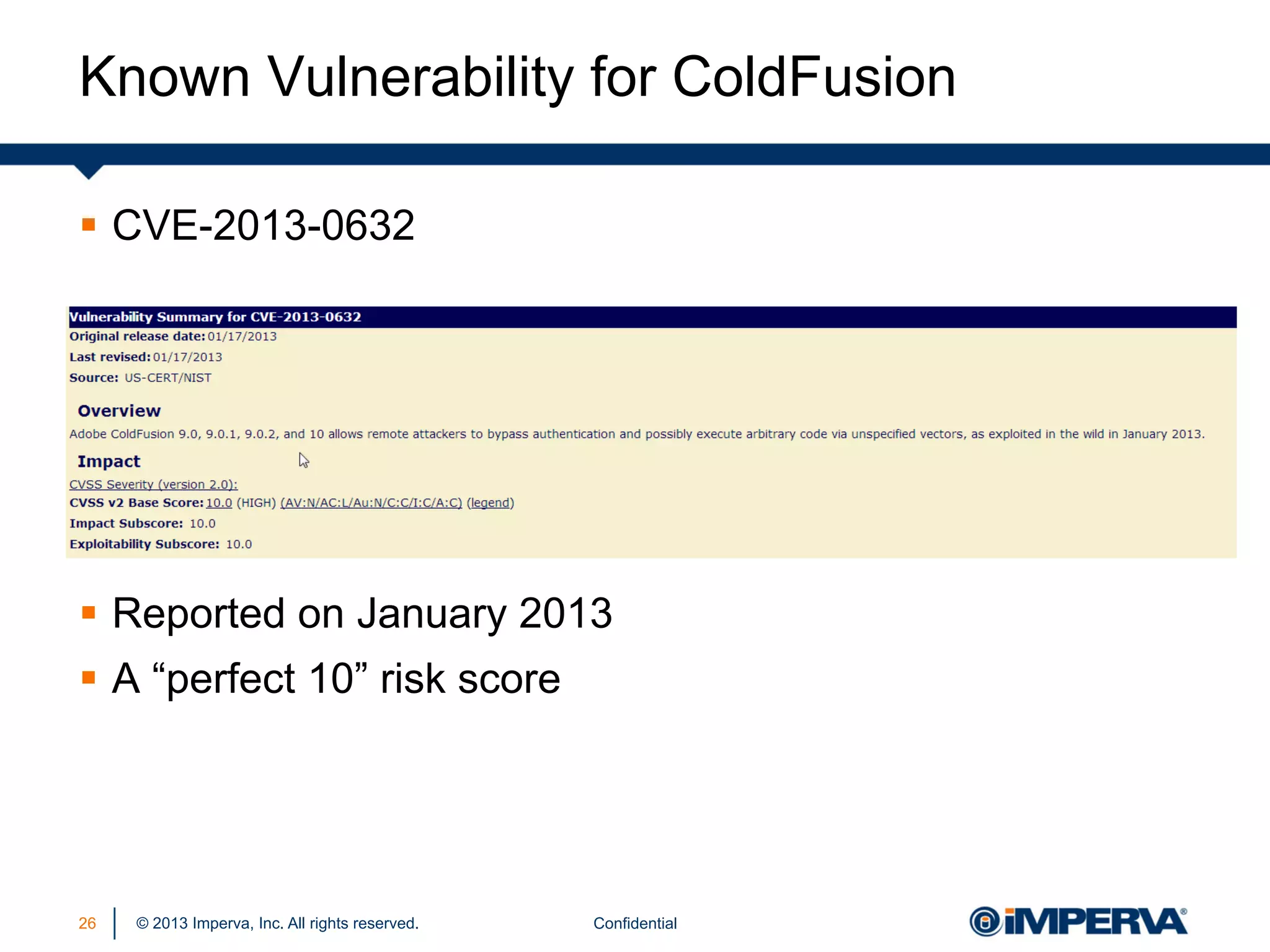
Known Vulnerability for ColdFusion
§  CVE-2013-0632

§  Reported on January 2013
§  A “perfect 10” risk score

26

© 2013 Imperva, Inc. All rights reserved.

Confidential
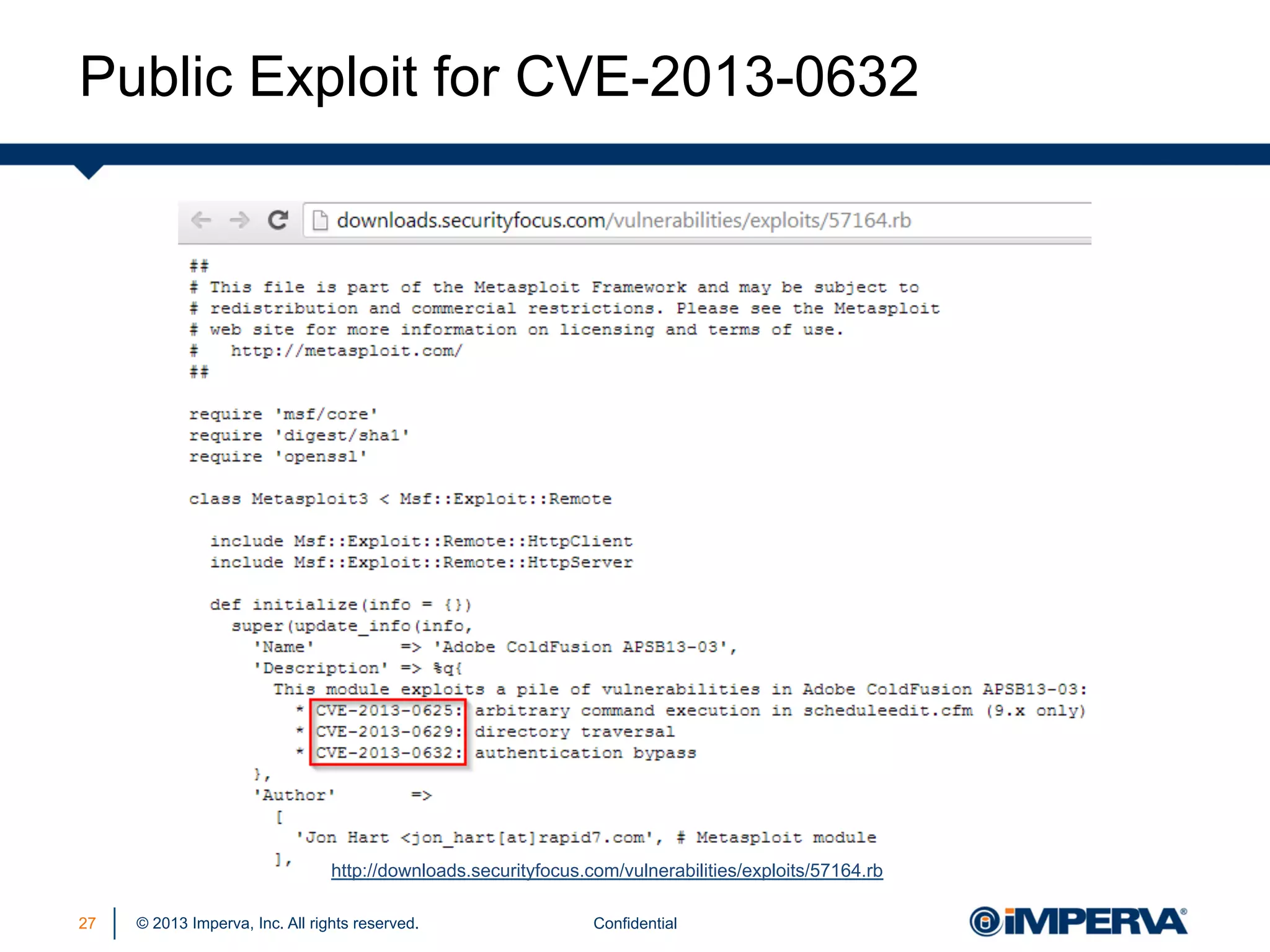
Public Exploit for CVE-2013-0632

http://downloads.securityfocus.com/vulnerabilities/exploits/57164.rb
27

© 2013 Imperva, Inc. All rights reserved.

Confidential
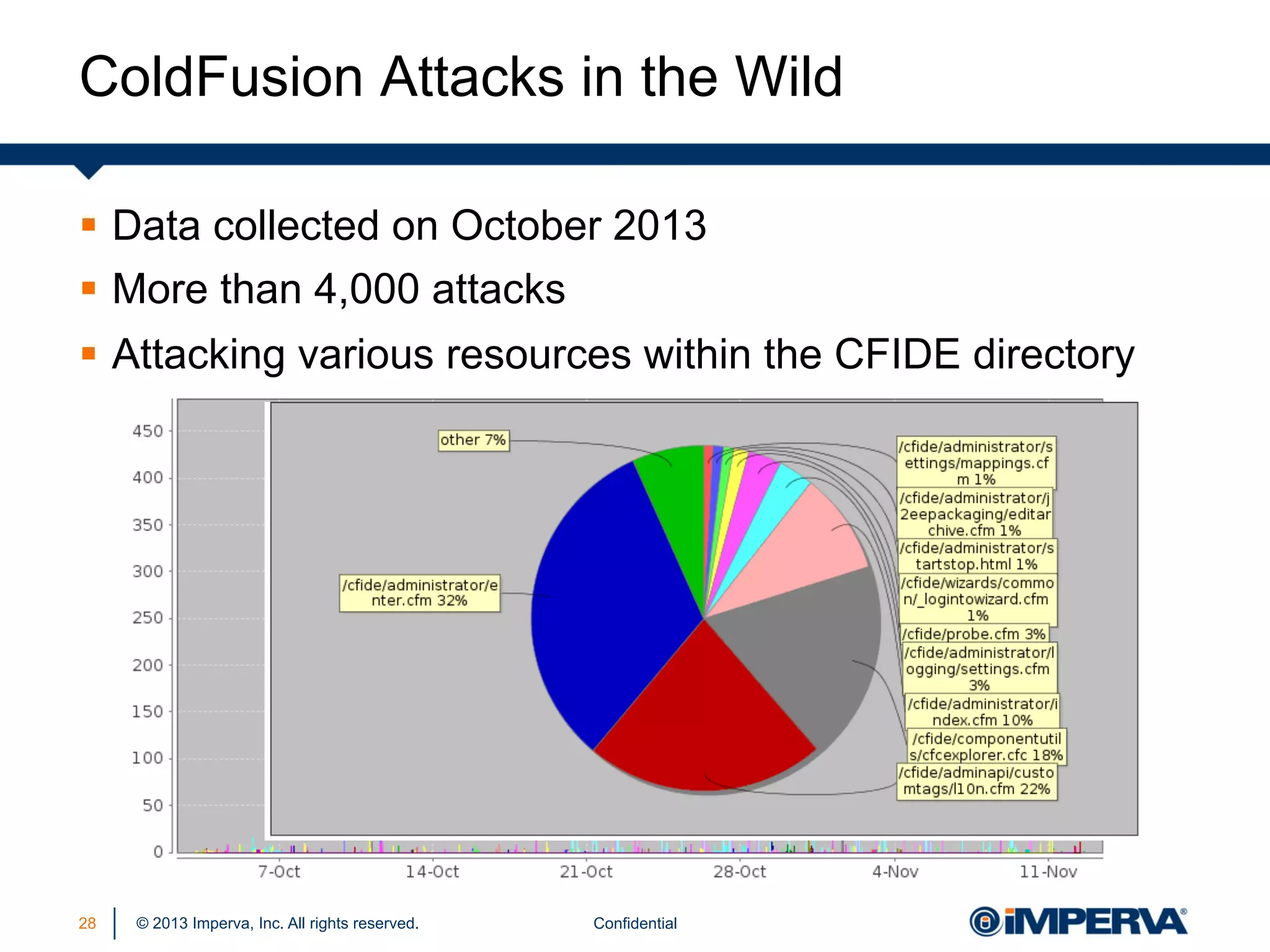
ColdFusion Attacks in the Wild
§  Data collected on October 2013
§  More than 4,000 attacks
§  Attacking various resources within the CFIDE directory

28

© 2013 Imperva, Inc. All rights reserved.

Confidential
The Anatomy of a Known Vulnerability
Web attack
Mass Hacking

29

© 2013 Imperva, Inc. All rights reserved.

Confidential
Mass Hacking: Theory
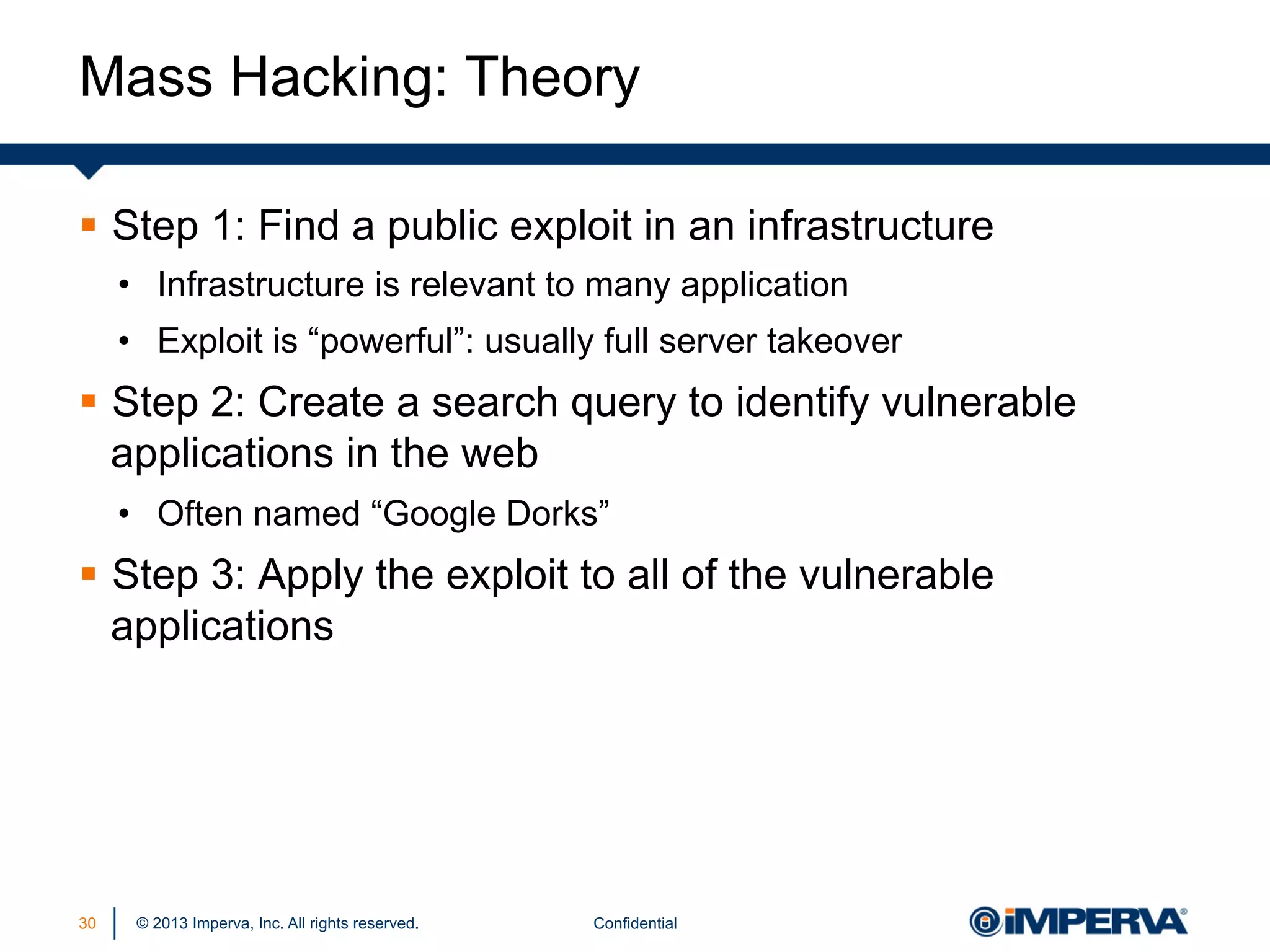
§  Step 1: Find a public exploit in an infrastructure
•  Infrastructure is relevant to many application
•  Exploit is “powerful”: usually full server takeover

§  Step 2: Create a search query to identify vulnerable
applications in the web
•  Often named “Google Dorks”

§  Step 3: Apply the exploit to all of the vulnerable
applications

30

© 2013 Imperva, Inc. All rights reserved.

Confidential
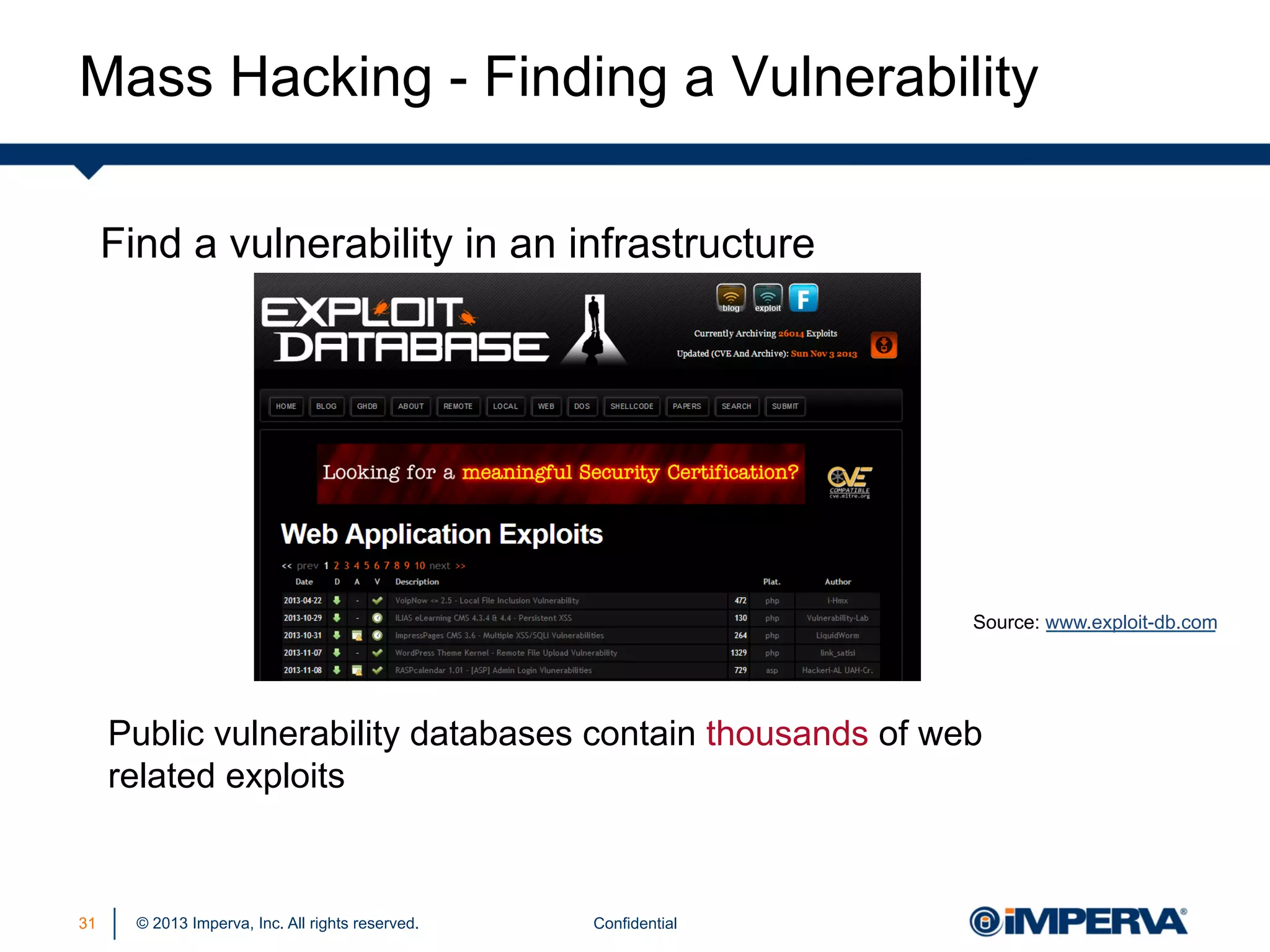
Mass Hacking - Finding a Vulnerability
Find a vulnerability in an infrastructure

Source: www.exploit-db.com

Public vulnerability databases contain thousands of web
related exploits

31

© 2013 Imperva, Inc. All rights reserved.

Confidential
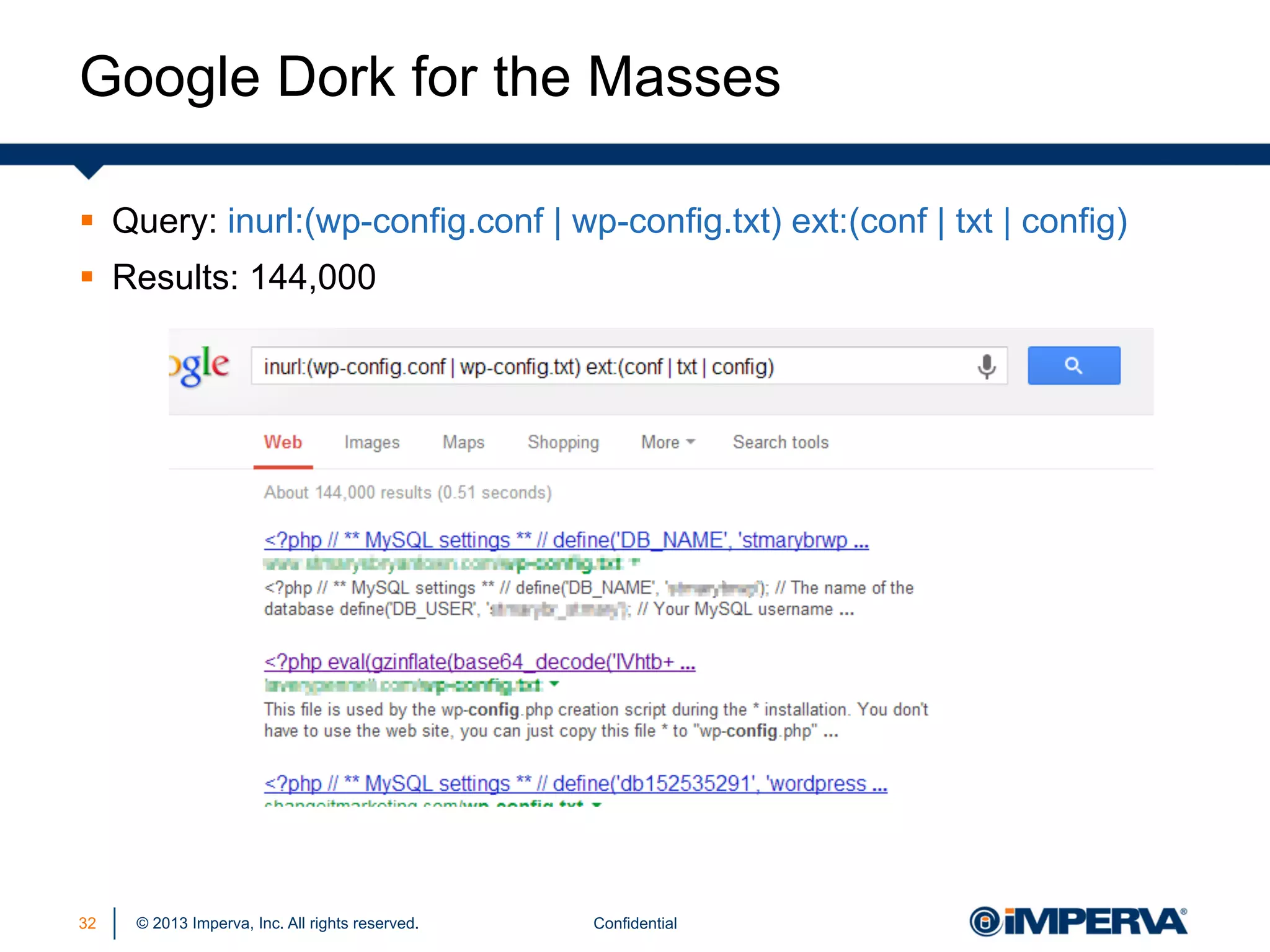
Google Dork for the Masses
§  Query: inurl:(wp-config.conf | wp-config.txt) ext:(conf | txt | config)
§  Results: 144,000

32

© 2013 Imperva, Inc. All rights reserved.

Confidential
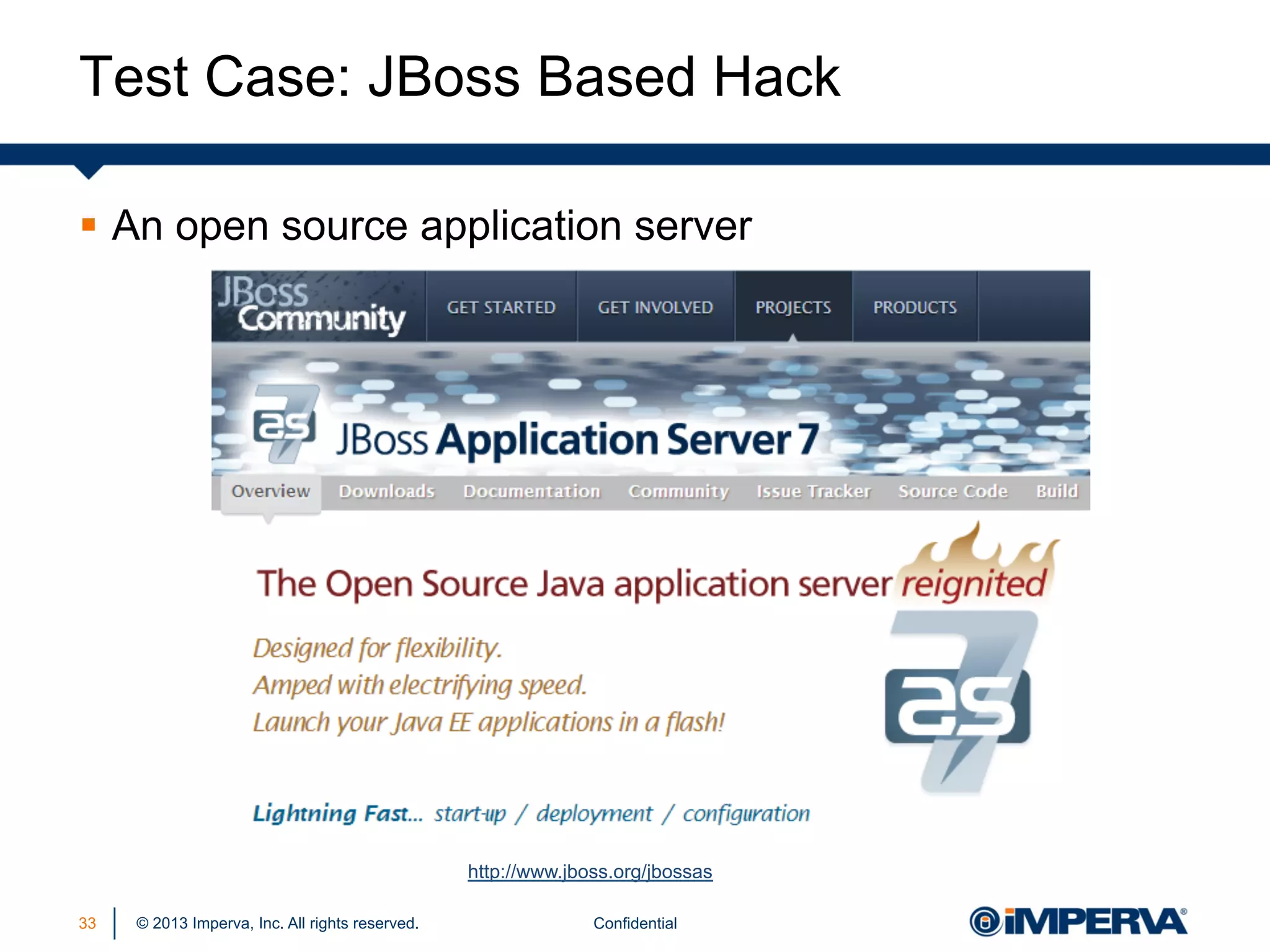
Test Case: JBoss Based Hack
§  An open source application server

http://www.jboss.org/jbossas
33

© 2013 Imperva, Inc. All rights reserved.

Confidential
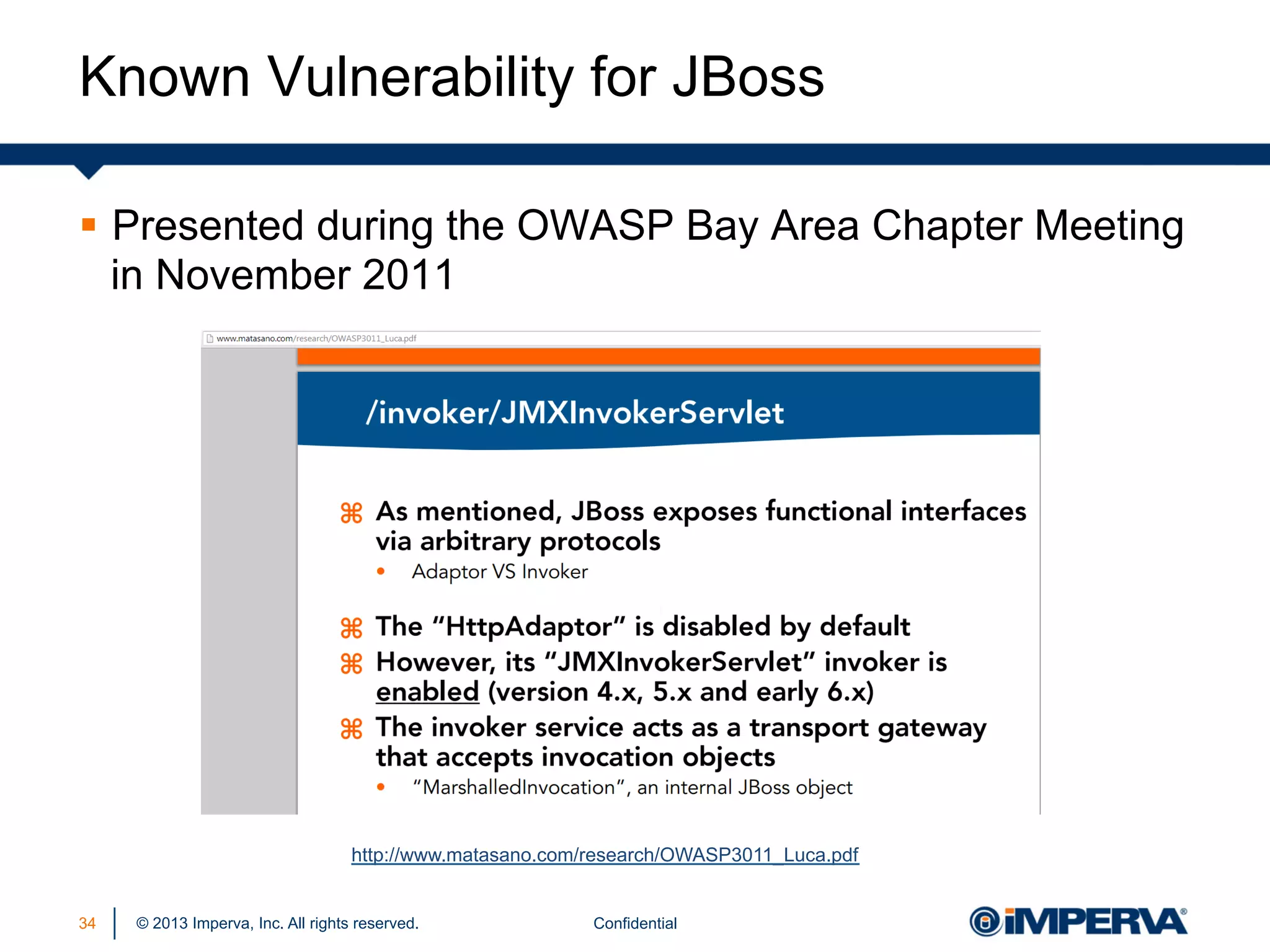
Known Vulnerability for JBoss
§  Presented during the OWASP Bay Area Chapter Meeting
in November 2011

http://www.matasano.com/research/OWASP3011_Luca.pdf

34

© 2013 Imperva, Inc. All rights reserved.

Confidential
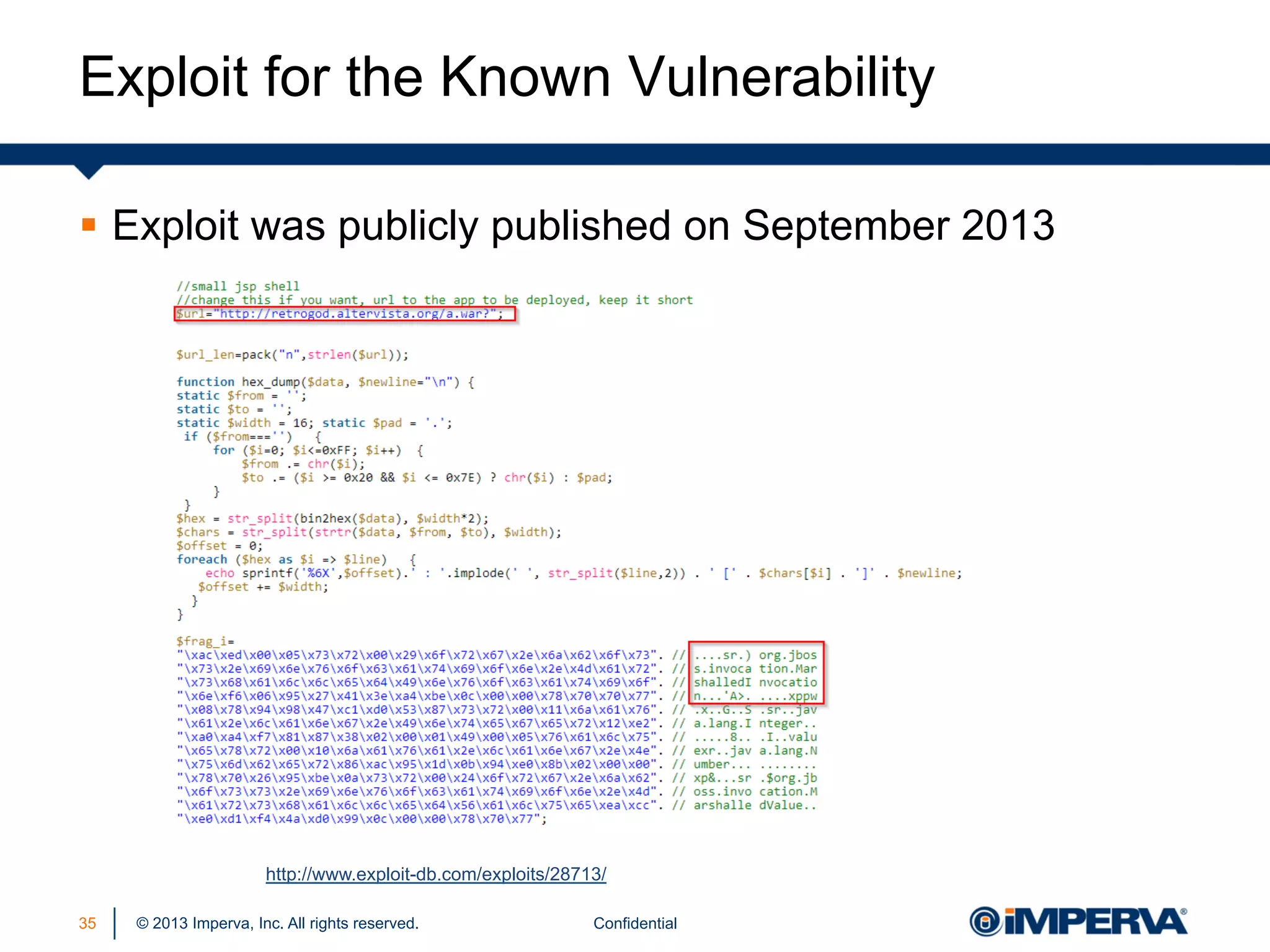
Exploit for the Known Vulnerability
§  Exploit was publicly published on September 2013

http://www.exploit-db.com/exploits/28713/
35

© 2013 Imperva, Inc. All rights reserved.

Confidential
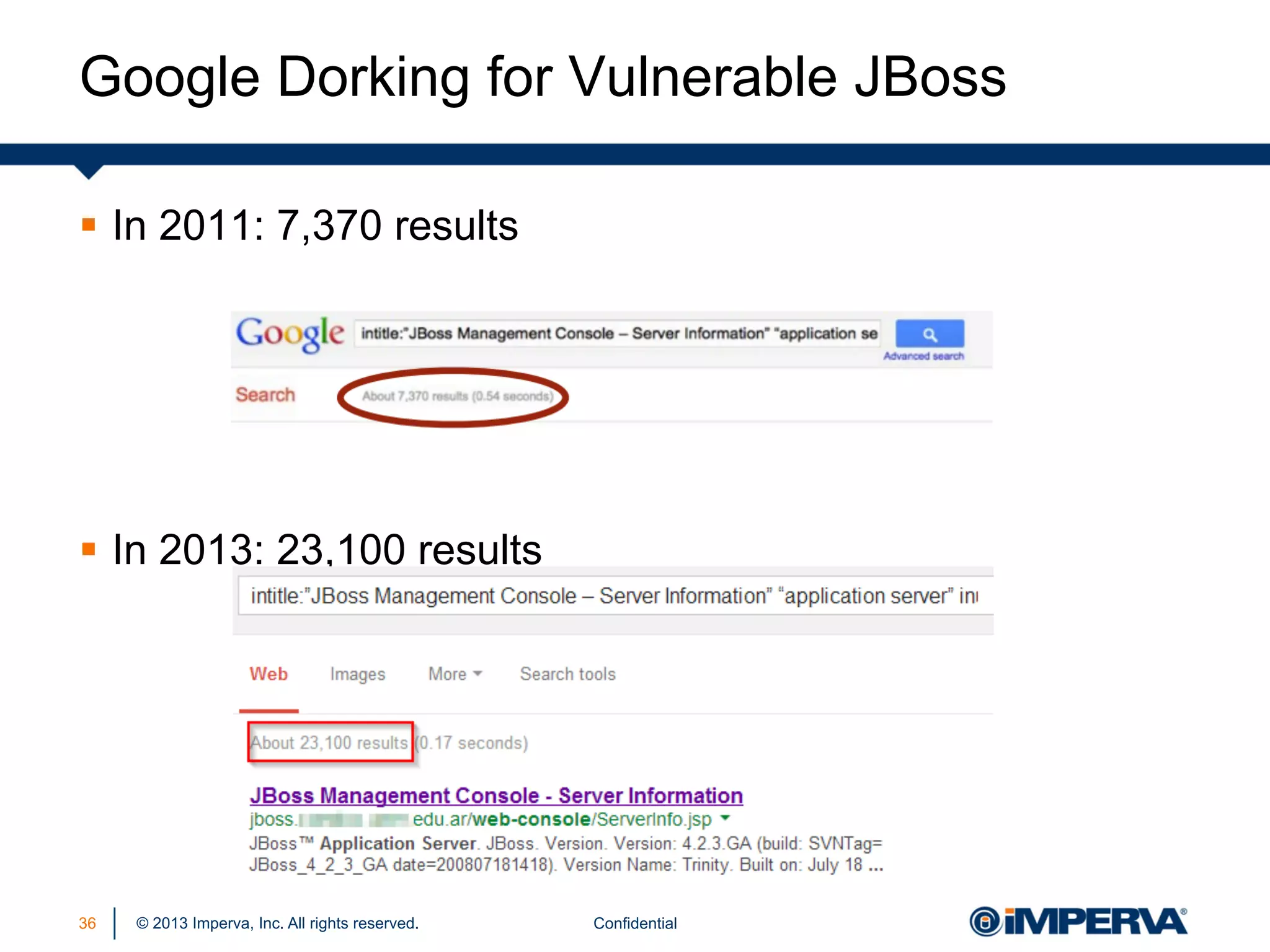
Google Dorking for Vulnerable JBoss
§  In 2011: 7,370 results

§  In 2013: 23,100 results

36

© 2013 Imperva, Inc. All rights reserved.

Confidential
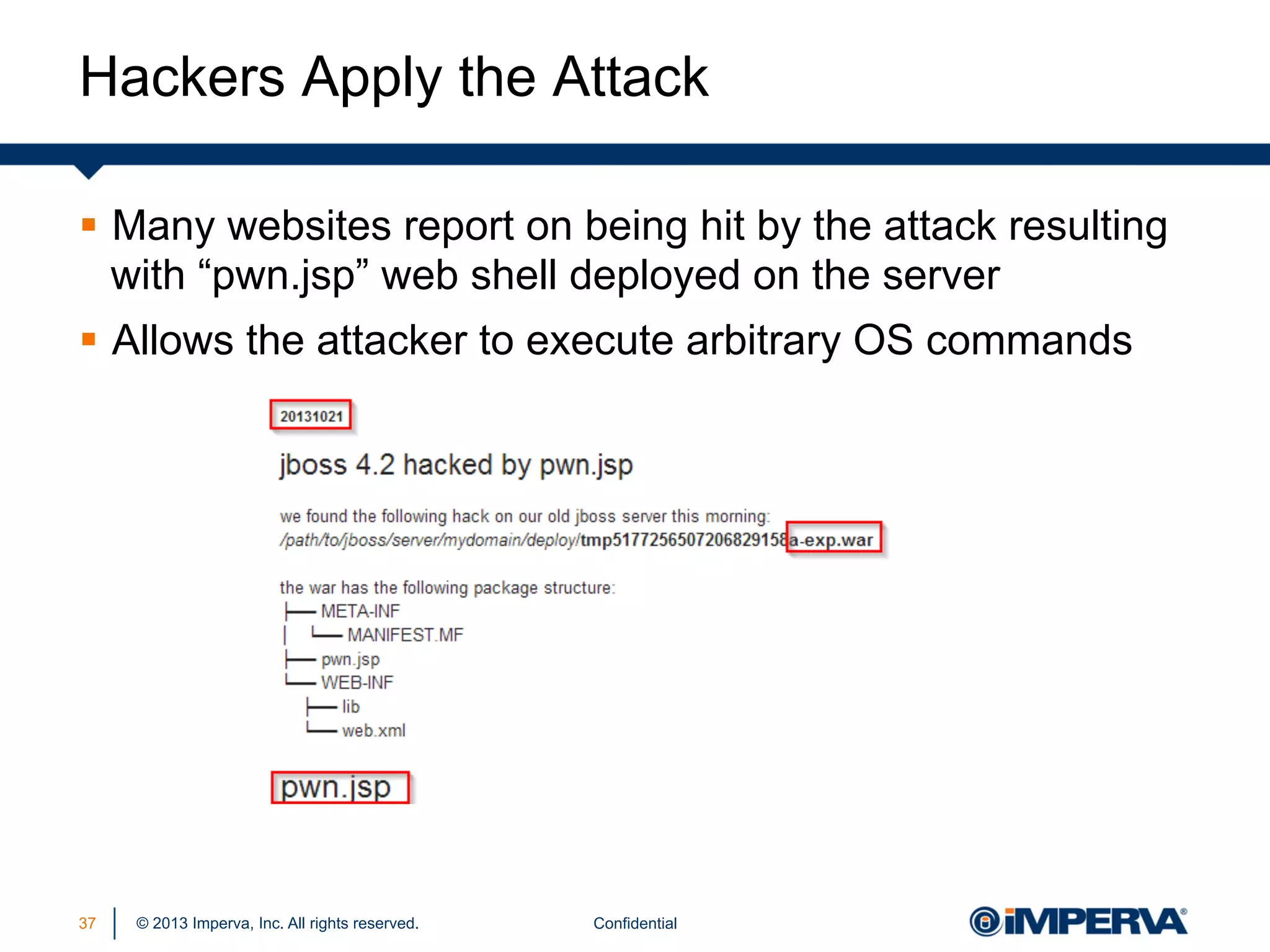
Hackers Apply the Attack
§  Many websites report on being hit by the attack resulting
with “pwn.jsp” web shell deployed on the server
§  Allows the attacker to execute arbitrary OS commands

37

© 2013 Imperva, Inc. All rights reserved.

Confidential
Summary & Conclusion

38

© 2013 Imperva, Inc. All rights reserved.

Confidential
Vendor’s Patches Are Not Enough (1)
§  Security does not necessarily know all components
§  Security does not necessarily know all vulnerabilities for
components
•  Not everything is reported as CVE

§  Vendor patches may not be available
•  System reached End of Support (EoS)
•  Open source product with no SLA

39

© 2013 Imperva, Inc. All rights reserved.

Confidential
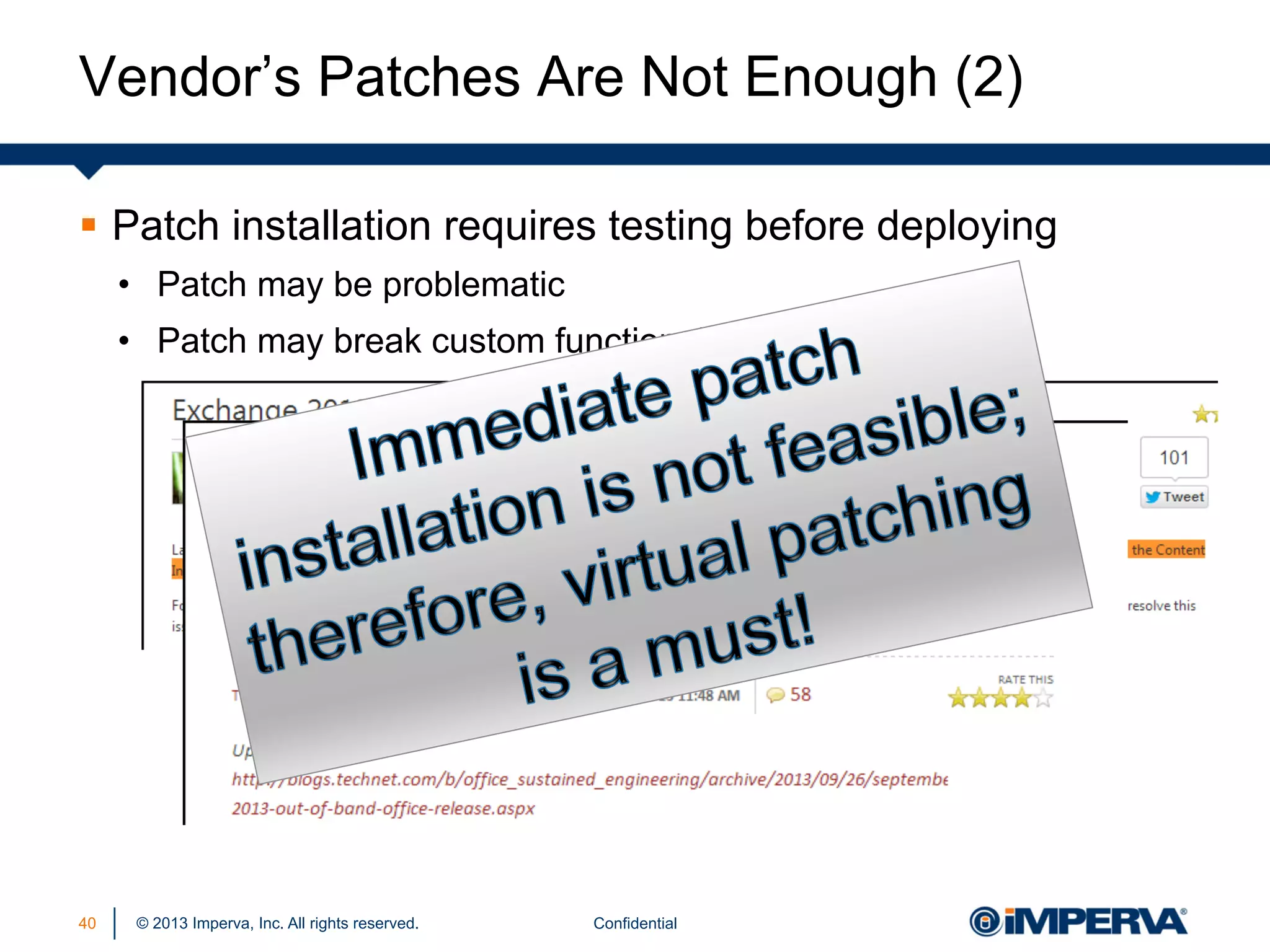
Vendor’s Patches Are Not Enough (2)
§  Patch installation requires testing before deploying
•  Patch may be problematic
•  Patch may break custom functionality

40

© 2013 Imperva, Inc. All rights reserved.

Confidential
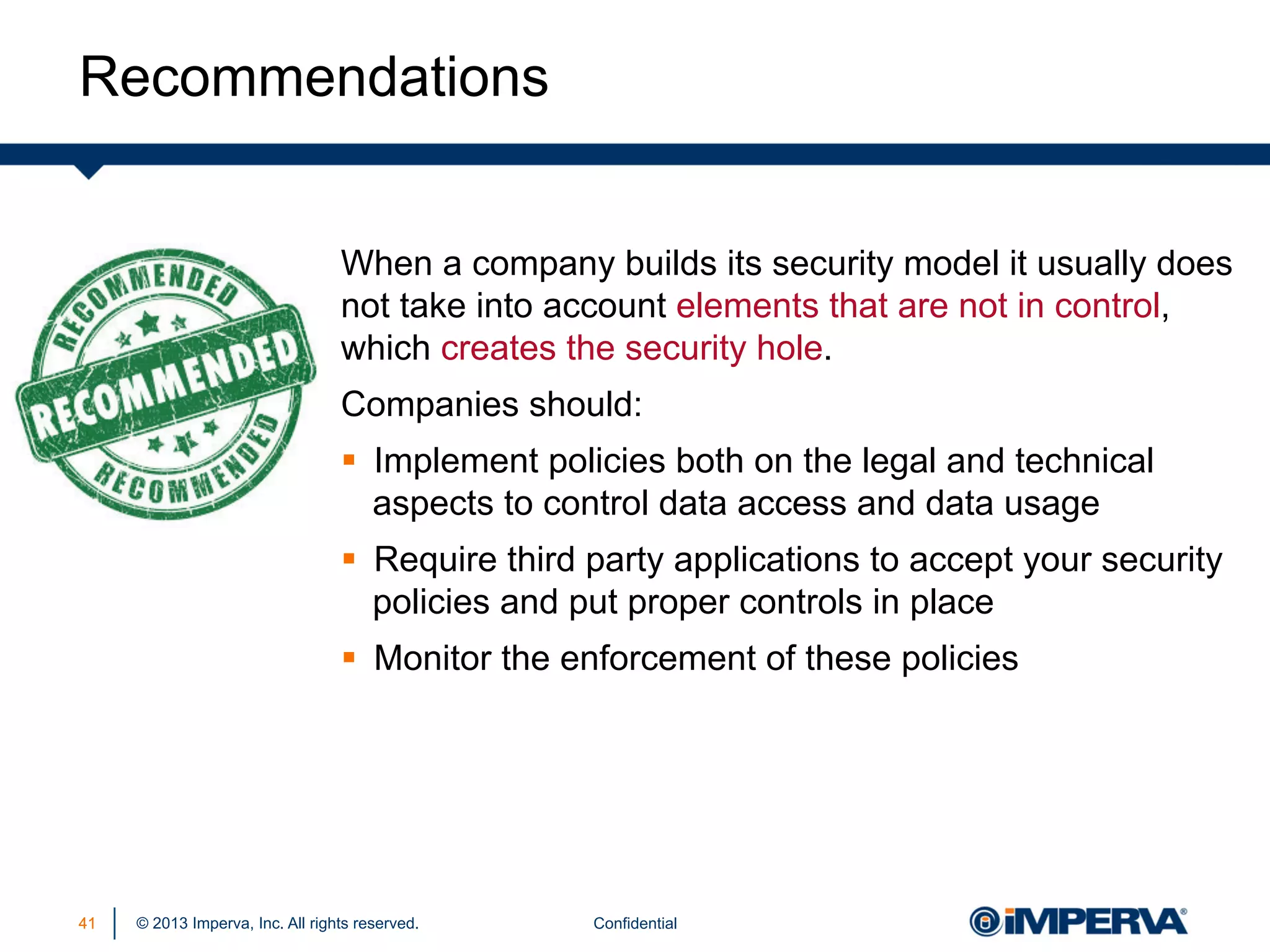
Recommendations
When a company builds its security model it usually does
not take into account elements that are not in control,
which creates the security hole.
Companies should:
§  Implement policies both on the legal and technical
aspects to control data access and data usage
§  Require third party applications to accept your security
policies and put proper controls in place
§  Monitor the enforcement of these policies

41

© 2013 Imperva, Inc. All rights reserved.

Confidential
Technical Recommendations
§  Assume third-party code – coming from partners,
vendors, or mergers and acquisitions – contains
serious vulnerabilities
§  Pen test before deployment to identify these issues
§  Deploy the application behind a WAF to
•  Virtually patch pen test findings
•  Mitigate new risks (unknown on the pen test time)
•  Mitigate issues the pen tester missed
•  Use cloud WAF for remotely hosted applications

§  Apply vendor patches, when possible
§  Virtually patch newly discovered CVEs

42

© 2013 Imperva, Inc. All rights reserved.

Confidential
Virtual Patching Check List
§  Virtually patch newly discovered CVEs

§  Requires a robust security update service
•  Timely: Attackers are very quick to on board newly
discovered exploit into their hacking code
•  Coverage: Cover all relevant vulnerabilities in the relevant
domain
•  Accurate: Tested for false positives
•  Secured by default :
§  Automatically loaded into the protecting system
§  No need to reboot

43

© 2013 Imperva, Inc. All rights reserved.

Confidential
www.imperva.com

44

© 2013 Imperva, Inc. All rights reserved.

Confidential

Hiding in Plain Sight: The Danger of Known Vulnerabilities

  • 1.
    Hiding in PlainSight – The Danger of Known Vulnerabilities Tal Be’ery, Web Security Research Team Leader 1 © 2013 Imperva, Inc. All rights reserved. Confidential
  • 2.
    Agenda §  Introduction •  Zero-daysVs. Known vulnerabilities §  The anatomy of a known vulnerability web attack: Attacking a specific victim •  Theory •  Test case analysis: A vulnerable ColdFusion application §  The anatomy of a known vulnerability web attack: Mass attacks •  Theory •  Test case analysis: Abusing JBOSS §  Summary & conclusion §  Q&A 2 © 2013 Imperva, Inc. All rights reserved. Confidential
  • 3.
    HII Reports §  HackerIntelligence Initiative (HII) is focused at understanding how attackers are operating in practice •  A different approach from vulnerability research §  Data set composition •  ~60 real world applications •  Anonymous proxies §  More than 24 months of data §  Powerful analysis system •  Combines analytic tools with drill down capabilities 3 © 2013 Imperva, Inc. All rights reserved. Confidential
  • 4.
    Tal Be’ery,Web ResearchTeam Leader §  Web Security Research Team Leader at Imperva §  Holds MSc & BSc degree in CS/EE from TAU §  10+ years of experience in IS domain §  Facebook “white hat” §  Speaker at RSA, BlackHat, AusCERT §  Columnist for securityweek.com §  CISSP 4 © 2013 Imperva, Inc. All rights reserved.
  • 5.
    Introduction 5 © 2013 Imperva,Inc. All rights reserved. Confidential
  • 6.
    The Known Knowns § There are known knowns; these are things we know that we know. §  There are known unknowns; that is to say, there are things that we now know we don't know. §  But there are also unknown unknowns – there are things we do not know we don't know. -- Donald Rumsfeld, U.S. Secretary of Defense, February 2002 6 © 2013 Imperva, Inc. All rights reserved. Confidential
  • 7.
    Security’s Knowns andUnknowns Defined §  Unknown Unkowns: Zero-Days A zero-day attack is an attack that exploits a previously unknown vulnerability in a computer application, meaning that the attack occurs on "day zero" of awareness of the vulnerability (Wikipedia http://en.wikipedia.org/wiki/Zero-day_attack) §  Known Knowns: Known vulnerabilities Vulnerable components (e.g., framework libraries) can be identified and exploited (OWASP https://www.owasp.org/index.php/Top_10_2013-A9Using_Components_with_Known_Vulnerabilities) 7 © 2013 Imperva, Inc. All rights reserved. Confidential
  • 8.
    CVE: Managing KnownVulnerabilities §  Known vulnerabilities are assigned with a CVE (Common Vulnerabilities and Exposures) ID §  “CVE’s common identifiers make it easier to share data across separate network security databases and tools, and provide a baseline for evaluating the coverage of an organization’s security tools” (MITRE http://cve.mitre.org/about/index.html) 8 © 2013 Imperva, Inc. All rights reserved. Confidential
  • 9.
    “Hollywood Style”: WebSite Hacking Single Site Attack Hacking 1.  Identify Target 2.  Research Vulnerability 3.  Exploit https://depot.gdnet.org/cms/gallery//25-iStock_000004333554Medium.jpg 9 © 2013 Imperva, Inc. All rights reserved. Confidential
  • 10.
    Reality Check: ResearchDoes Not Scale! Multiple Site Attacks Hacking 1.  2.  3.  Identify Target Research Vulnerability Exploit Hacking 1.  2.  3.  Identify Target Research Vulnerability Exploit Hacking 1.  2.  3.  Identify Target Research Vulnerability Exploit Hacking 1.  2.  3.  Identify Target Research Vulnerability Exploit Hacking 1.  2.  3.  10 © 2013 Imperva, Inc. All rights reserved. Identify Target Research Vulnerability Exploit Confidential
  • 11.
    Reality Check: KnownExploits Scale! Multiple Site Attacks Hacking 1.  2.  3.  Identify Infrastructure Find Existing Exploit Exploit Hacking 1.  2.  3.  Identify Infrastructure Find Existing Exploit Exploit Hacking 1.  2.  3.  Identify Infrastructure Find Existing Exploit Exploit Hacking 1.  2.  3.  Identify Infrastructure Find Existing Exploit Exploit Hacking 1.  2.  3.  11 © 2013 Imperva, Inc. All rights reserved. Identify Infrastructure Find Existing Exploit Exploit Confidential
  • 12.
    Zero-Days Vs. KnownVulnerabilities §  Zero-Days get all the glory •  Technically interesting •  Give rise to some interesting theoretical questions: How to defend the “unkown unkowns?” §  But known vulnerabilities are doing a lot of the damage •  Provide hackers with a very costeffective method to exploit applications http://faildesk.net/wp-content/uploads/2012/02/movie-hacking-vs.-real-hacking.gif 12 © 2013 Imperva, Inc. All rights reserved. Confidential
  • 13.
    Vulnerability Lifecycle inReality 13 © 2013 Imperva, Inc. All rights reserved. Confidential
  • 14.
    Why is KnownVulnerability Exploitation so Successful? §  Applications are based mostly on 3rd party code §  Web applications are no different •  HTTP Server, Application Server, Plugins, Libraries, etc. §  Code re-use equals vulnerability re-use §  Exploits’ code is available for known vulnerabilities 14 © 2013 Imperva, Inc. All rights reserved. Confidential
  • 15.
    3rd Party CodeProvides a Rich Attack Surface According to Veracode: •  Up to 70% of internally developed code originates outside of the development team •  28% of assessed applications are identified as created by a 3rd party 15 © 2013 Imperva, Inc. All rights reserved. Confidential
  • 16.
    Known Vulnerabilities DisclosureIncreases §  CVE IDs Enumeration syntax was changed to track more than 10,000 vulnerabilities in a single year, starting on 2014. 16 © 2013 Imperva, Inc. All rights reserved. Confidential
  • 17.
    Exploits Are PubliclyAvailable §  Exploit-DB: http://www.exploit-db.com/ 17 © 2013 Imperva, Inc. All rights reserved. Confidential
  • 18.
    OWASP Top 10– 2013 Update New, A9 - Using Known Vulnerable Components 18 © 2013 Imperva, Inc. All rights reserved. Confidential
  • 19.
    The Anatomy ofa Known Vulnerability Web attack Attacking a Specific Victim 19 © 2013 Imperva, Inc. All rights reserved. Confidential
  • 20.
    Attacking a SpecificApplication: Theory §  Step 1: Fingerprinting of the victim application to discover third party components and infrastructure §  Step 2: For the discovered components, find known vulnerabilities and exploits that gives the hacker the desired access level §  Step 3: Apply the exploit to the victim’s application 20 © 2013 Imperva, Inc. All rights reserved. Confidential
  • 21.
    The Art ofFingerprinting Identify a fingerprint in victim application A fingerprint can be •  Image •  URL •  Content •  Object Reference •  Response to a query •  Etc. 21 © 2013 Imperva, Inc. All rights reserved. Confidential
  • 22.
    Fingerprinting Example 1:Content Based The code will usually contain fingerprints of the infrastructure in use. 22 © 2013 Imperva, Inc. All rights reserved. Confidential
  • 23.
    Fingerprinting Example 2:URL Based An administrator interface may be front facing, allowing detection and login attempts. 23 © 2013 Imperva, Inc. All rights reserved. Confidential
  • 24.
    Test Case: corporatecaronline.comHack http://krebsonsecurity.com/2013/11/hackers-take-limo-service-firm-for-a-ride/ 24 © 2013 Imperva, Inc. All rights reserved. Confidential
  • 25.
    Fingerprinting corporatecaronline.com §  Theapplication is using CFM files §  What’s a CFM file? 25 © 2013 Imperva, Inc. All rights reserved. Confidential
  • 26.
    Known Vulnerability forColdFusion §  CVE-2013-0632 §  Reported on January 2013 §  A “perfect 10” risk score 26 © 2013 Imperva, Inc. All rights reserved. Confidential
  • 27.
    Public Exploit forCVE-2013-0632 http://downloads.securityfocus.com/vulnerabilities/exploits/57164.rb 27 © 2013 Imperva, Inc. All rights reserved. Confidential
  • 28.
    ColdFusion Attacks inthe Wild §  Data collected on October 2013 §  More than 4,000 attacks §  Attacking various resources within the CFIDE directory 28 © 2013 Imperva, Inc. All rights reserved. Confidential
  • 29.
    The Anatomy ofa Known Vulnerability Web attack Mass Hacking 29 © 2013 Imperva, Inc. All rights reserved. Confidential
  • 30.
    Mass Hacking: Theory § Step 1: Find a public exploit in an infrastructure •  Infrastructure is relevant to many application •  Exploit is “powerful”: usually full server takeover §  Step 2: Create a search query to identify vulnerable applications in the web •  Often named “Google Dorks” §  Step 3: Apply the exploit to all of the vulnerable applications 30 © 2013 Imperva, Inc. All rights reserved. Confidential
  • 31.
    Mass Hacking -Finding a Vulnerability Find a vulnerability in an infrastructure Source: www.exploit-db.com Public vulnerability databases contain thousands of web related exploits 31 © 2013 Imperva, Inc. All rights reserved. Confidential
  • 32.
    Google Dork forthe Masses §  Query: inurl:(wp-config.conf | wp-config.txt) ext:(conf | txt | config) §  Results: 144,000 32 © 2013 Imperva, Inc. All rights reserved. Confidential
  • 33.
    Test Case: JBossBased Hack §  An open source application server http://www.jboss.org/jbossas 33 © 2013 Imperva, Inc. All rights reserved. Confidential
  • 34.
    Known Vulnerability forJBoss §  Presented during the OWASP Bay Area Chapter Meeting in November 2011 http://www.matasano.com/research/OWASP3011_Luca.pdf 34 © 2013 Imperva, Inc. All rights reserved. Confidential
  • 35.
    Exploit for theKnown Vulnerability §  Exploit was publicly published on September 2013 http://www.exploit-db.com/exploits/28713/ 35 © 2013 Imperva, Inc. All rights reserved. Confidential
  • 36.
    Google Dorking forVulnerable JBoss §  In 2011: 7,370 results §  In 2013: 23,100 results 36 © 2013 Imperva, Inc. All rights reserved. Confidential
  • 37.
    Hackers Apply theAttack §  Many websites report on being hit by the attack resulting with “pwn.jsp” web shell deployed on the server §  Allows the attacker to execute arbitrary OS commands 37 © 2013 Imperva, Inc. All rights reserved. Confidential
  • 38.
    Summary & Conclusion 38 ©2013 Imperva, Inc. All rights reserved. Confidential
  • 39.
    Vendor’s Patches AreNot Enough (1) §  Security does not necessarily know all components §  Security does not necessarily know all vulnerabilities for components •  Not everything is reported as CVE §  Vendor patches may not be available •  System reached End of Support (EoS) •  Open source product with no SLA 39 © 2013 Imperva, Inc. All rights reserved. Confidential
  • 40.
    Vendor’s Patches AreNot Enough (2) §  Patch installation requires testing before deploying •  Patch may be problematic •  Patch may break custom functionality 40 © 2013 Imperva, Inc. All rights reserved. Confidential
  • 41.
    Recommendations When a companybuilds its security model it usually does not take into account elements that are not in control, which creates the security hole. Companies should: §  Implement policies both on the legal and technical aspects to control data access and data usage §  Require third party applications to accept your security policies and put proper controls in place §  Monitor the enforcement of these policies 41 © 2013 Imperva, Inc. All rights reserved. Confidential
  • 42.
    Technical Recommendations §  Assumethird-party code – coming from partners, vendors, or mergers and acquisitions – contains serious vulnerabilities §  Pen test before deployment to identify these issues §  Deploy the application behind a WAF to •  Virtually patch pen test findings •  Mitigate new risks (unknown on the pen test time) •  Mitigate issues the pen tester missed •  Use cloud WAF for remotely hosted applications §  Apply vendor patches, when possible §  Virtually patch newly discovered CVEs 42 © 2013 Imperva, Inc. All rights reserved. Confidential
  • 43.
    Virtual Patching CheckList §  Virtually patch newly discovered CVEs §  Requires a robust security update service •  Timely: Attackers are very quick to on board newly discovered exploit into their hacking code •  Coverage: Cover all relevant vulnerabilities in the relevant domain •  Accurate: Tested for false positives •  Secured by default : §  Automatically loaded into the protecting system §  No need to reboot 43 © 2013 Imperva, Inc. All rights reserved. Confidential
  • 44.
    www.imperva.com 44 © 2013 Imperva,Inc. All rights reserved. Confidential