










PROFESSIONAL ADJUSTMENTS
Midwives
Ryan Michael F. Oducado. MAN, MAEd, RN, RM
4.10.2015
West town Hotel, Illoilo
Professions
have a body of knowledge,
scope of practice, agreed upon
values, oath or code and
accountability to our society for
their profession and their
professional behavior.
• Describes a certain type of behavior in
the workplace
• Based on our values and
understanding of our professional
roles
• Evidenced in our behavior
How professionalism is judged?
• Against a set of expectations or
standards
• From our own personal values set a
nd understanding of what
“professionalism” means
• May be situational in nature
• Strongly influenced by culture
Professional judged through:
• Our Image
• Our Communication
• Our Competence
• Our Demeanor
“TATAK”
of a true Professional
“Willingness to accept a set of
professional and ethical
principles and follow these
principles in the conduct of their
daily affairs.”
Bases
CODE OF GOOD GOVERNANCE
the professions in the Philippines
This code is adopted by the PRC
and the Professional Regulatory
Boards to cover an environment of
good governance in which all
Filipino professionals shall perfor
m their tasks.
Professionals are committed to a
life of service to others. They
protect life, property, and public
welfare.
1. Service to Others
Professionals shall perform their
responsibilities with the highest
sense of integrity, imbued with
nationalism and spiritual values,
be free of conflicts of interests,
without prejudice and shall at all
times maintain objectivity.
2. Integrity and Objectivity
Professionals shall undertake
only those professional services
that they can reasonably deliver
with professional competence.
3. Professional Competence
Professional competence refers to the capability to
perform the duties of one's profession. To provide
professional services, a certain level of competence is
necessary.
Each profession shall nurture and
support one organization for all
its members.
4. Solidarity and Teamwork
Together Everyone Achieves More
Solidarity refers to the ties in a society – “social relations
” - that bind people to one another.
Teamwork refers to the cooperative effort by the
members of a group or team to achieve a common goal.
Professionals shall always carry
out their professional duties with
due consideration of the broader
interest of the publics.
5. Social and Civic Responsibility
Social responsibility the obligation to take action that
protects and improves the welfare of society as a whole as
well as organizational interests.
Civic responsibility refers to the actions of a good
citizen in which the individual acts in a manner designed to
promote the common good.
Every professional shall remain
open to the challenges of a
more dynamic and
interconnected world.
6. Global Competitiveness
Globally competitive professionals who gain a
thorough understanding of the economic, social, and
technological changes taking place across the globe
enhance their ability to compete in the worldwide
market.
All professionals shall treat their
colleagues with respect and shall
strive to be fair in their dealings
with one another.
7. Equality of All Professionals
All Professions are EQUAL!
Everyone shall treat other professionals with respect and
fairness.
Professionalism in the
Workplace Study
The 2012 study surveyed a national sample
of HR professionals, upper class
undergraduates, and managers or
supervisors.
The study helped to define professionalism
and provide numbers to analyze the current
state of professionalism in the American
workforce.
Patient’s
• Trustworthy
• Competent
• Empathetic
• Respectful
• Caring
Co-workers
• Trustworthy
• Competent
• Supportive
• Respectful
• Accountable
How professionalism is judged?
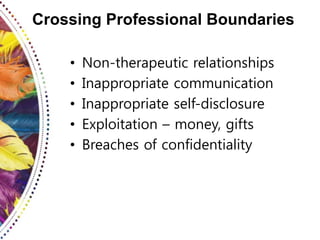
Crossing Professional Boundaries
• Non-therapeutic relationships
• Inappropriate communication
• Inappropriate self-disclosure
• Exploitation – money, gifts
• Breaches of confidentiality
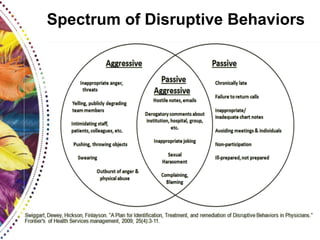
Spectrum of Disruptive Behaviors
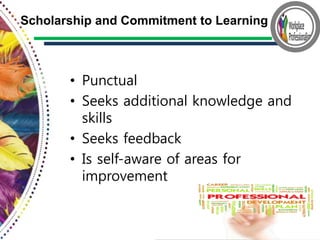
• Punctual
• Seeks additional knowledge and
skills
• Seeks feedback
• Is self-aware of areas for
improvement
Scholarship and Commitment to Learning
• Flexible
• Accepts personal responsibility
for mistakes
• Asks for help when needed
• Discloses medical error when
appropriate
Accountability and Initiative
• Completes assigned tasks
• Sets and achieves realistic goals
• Follow policies
• Responds promptly when called
• Places patients needs firsts
Responsibility and Sense of Duty
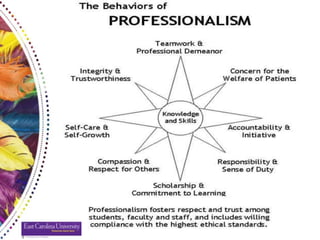
• Considerate
• Cooperative
• Empathic
• Respectful of different socio-
economic background and
cultural differences
• Sensitive
Compassion and Respect for Others
• Displays honestly and
forthrightness
• Adheres to ethical standards
• Truthful in all communications
• Maintains confidentiality
• Reports inappropriate behavior
by colleagues
Integrity and Trustworthiness
• Works well with others
• Maintains composure in difficult
circumstances
• Inspires trust
• Avoids inappropriate remarks
• Adheres to dress codes
Teamwork & Professional Demeanor
• Treats patients and families with
dignity
• Respects patient privacy and
cultural values
• Maintains accurate patient
records
• Advocates for patients
Concern for the Welfare of Patients
• Maintains personal health and
hygiene
• Cares for self
• Seeks advice, counsel and
tutoring when needed
• Avoids harmful behaviors
Self-Care and Self-Worth
Philippine Code of Ethics
For Midwives
Principles and rules of conduct
Patients
Co-practitioners
Members of allied professions
Public
Section I
Primary objective: within the
scope of their legitimate functions
Patients, regardless of status,
deserve respect
Render to each dedicated and
selfless service
Section II
Continually improve knowledge
& skill
Share with her co-practitioners
any valuable practical knowledge
Section III
Practice on a scientific basis
Desist performance of procedure
which is of doubtful or
questionable propriety
Section IV
Contribute to the safeguarding
of public health
Protect itself against the
admission into its membership
midwives who are deficient in
professional competence and
requisite moral character
Section IV
Observe the law, to uphold the
honor and dignity of her profession,
and to adhere to professional
discipline
To bring to the attention of the
proper authority, through legitimate
procedures, the illegal or unethical
conduct of any co-member of the
midwifery profession
Section V
Practice on a scientific basis
Desist performance of procedure
which is of doubtful or
questionable propriety
Section VI
Not compromise her services
which would impair the quality of
patients care.
Section VII
Fees should be commensurate
with the services performed and,
if need be, with the patient’s
ability to pay
Highly improper to receive a
commission for referral of
patients
Section VIII
Legitimate functions cover
midwifery services only to
normal pregnant women and nor
mal newborn infants.
Should seek consultation or
refer to a qualified obstetrician or
physician
Section IX
Not to reveal any information
given by her patient
Unless under the law, she is
required to testify on such
information to serve the ends of
justice
Section X
Ideals of service call for a
dedication not only individual
but also to the community
Section XI
Participate in research activities or in
any effort of the midwifery profession
to improve midwifery training and
practice
Take part in establishing and
maintaining conditions of employment
conducive to high-quality maternity
and infant care.
Section XII
Work with interest and concern,
together with other members of
the health team
Section XII
Limitations:
may not point out how a midwife may
resolve or reconcile a conflict between
personal and professional views.
may not likewise indicate a remedy for
resolving conflict that may stem from
changing social principles, goals and
standards
Such inadequacy of the code ultimately leaves
the midwife to herself in deciding what
moral principles should govern her course of
action when faced with ethical problems in
the practice of her profession
It is incumbent upon her to observe at all tim
es the ideals of her profession and to adhe
re faithfully to the well-recognized
unwritten ethical and professional rules
generally accepted by the midwifery
profession
“We judged ourselves by our
motives whereas others judged
us by our behaviors”
-AA saying
References
Can, Rai. Code of good governance. Retrieved from
https://www.scribd.com/doc/46797813/Code-of-Good-Gov
ernance-final
Thornby, R. Professionalism in the workplace. Retrieved from
http://www.slideshare.net/ringer21/professionalism-in-the-
workplace
Dewey, C.M. Creating culture of professionalism. Retrieved
from http://www.mc.vanderbilt.edu/documents/cph/files/Sli
des_CreatingaCultureofProfessionalism_2012_Show%281%2
9.pps
Broody School of Medicine East Carolina University.
Professionalism in medical education. Retrieved from http:
//www.ecu.edu/cs-dhs/medicaleducation/profMedicalEduc
ation.cfm
Ryan Michael F. Oducado
MAN, MAEd, RN RM
Thank you!

Professional Adjustments for Midwives

  • 1.
    PROFESSIONAL ADJUSTMENTS Midwives Ryan MichaelF. Oducado. MAN, MAEd, RN, RM 4.10.2015 West town Hotel, Illoilo
  • 3.
    Professions have a bodyof knowledge, scope of practice, agreed upon values, oath or code and accountability to our society for their profession and their professional behavior.
  • 4.
    • Describes acertain type of behavior in the workplace • Based on our values and understanding of our professional roles • Evidenced in our behavior
  • 5.
    How professionalism isjudged? • Against a set of expectations or standards • From our own personal values set a nd understanding of what “professionalism” means • May be situational in nature • Strongly influenced by culture
  • 6.
    Professional judged through: •Our Image • Our Communication • Our Competence • Our Demeanor
  • 8.
    “TATAK” of a trueProfessional “Willingness to accept a set of professional and ethical principles and follow these principles in the conduct of their daily affairs.”
  • 9.
  • 10.
    CODE OF GOODGOVERNANCE the professions in the Philippines This code is adopted by the PRC and the Professional Regulatory Boards to cover an environment of good governance in which all Filipino professionals shall perfor m their tasks.
  • 11.
    Professionals are committedto a life of service to others. They protect life, property, and public welfare. 1. Service to Others
  • 12.
    Professionals shall performtheir responsibilities with the highest sense of integrity, imbued with nationalism and spiritual values, be free of conflicts of interests, without prejudice and shall at all times maintain objectivity. 2. Integrity and Objectivity
  • 13.
    Professionals shall undertake onlythose professional services that they can reasonably deliver with professional competence. 3. Professional Competence Professional competence refers to the capability to perform the duties of one's profession. To provide professional services, a certain level of competence is necessary.
  • 14.
    Each profession shallnurture and support one organization for all its members. 4. Solidarity and Teamwork Together Everyone Achieves More Solidarity refers to the ties in a society – “social relations ” - that bind people to one another. Teamwork refers to the cooperative effort by the members of a group or team to achieve a common goal.
  • 15.
    Professionals shall alwayscarry out their professional duties with due consideration of the broader interest of the publics. 5. Social and Civic Responsibility Social responsibility the obligation to take action that protects and improves the welfare of society as a whole as well as organizational interests. Civic responsibility refers to the actions of a good citizen in which the individual acts in a manner designed to promote the common good.
  • 16.
    Every professional shallremain open to the challenges of a more dynamic and interconnected world. 6. Global Competitiveness Globally competitive professionals who gain a thorough understanding of the economic, social, and technological changes taking place across the globe enhance their ability to compete in the worldwide market.
  • 17.
    All professionals shalltreat their colleagues with respect and shall strive to be fair in their dealings with one another. 7. Equality of All Professionals All Professions are EQUAL! Everyone shall treat other professionals with respect and fairness.
  • 18.
    Professionalism in the WorkplaceStudy The 2012 study surveyed a national sample of HR professionals, upper class undergraduates, and managers or supervisors. The study helped to define professionalism and provide numbers to analyze the current state of professionalism in the American workforce.
  • 21.
    Patient’s • Trustworthy • Competent •Empathetic • Respectful • Caring Co-workers • Trustworthy • Competent • Supportive • Respectful • Accountable How professionalism is judged?
  • 22.
    Crossing Professional Boundaries •Non-therapeutic relationships • Inappropriate communication • Inappropriate self-disclosure • Exploitation – money, gifts • Breaches of confidentiality
  • 23.
  • 25.
    • Punctual • Seeksadditional knowledge and skills • Seeks feedback • Is self-aware of areas for improvement Scholarship and Commitment to Learning
  • 26.
    • Flexible • Acceptspersonal responsibility for mistakes • Asks for help when needed • Discloses medical error when appropriate Accountability and Initiative
  • 27.
    • Completes assignedtasks • Sets and achieves realistic goals • Follow policies • Responds promptly when called • Places patients needs firsts Responsibility and Sense of Duty
  • 28.
    • Considerate • Cooperative •Empathic • Respectful of different socio- economic background and cultural differences • Sensitive Compassion and Respect for Others
  • 29.
    • Displays honestlyand forthrightness • Adheres to ethical standards • Truthful in all communications • Maintains confidentiality • Reports inappropriate behavior by colleagues Integrity and Trustworthiness
  • 30.
    • Works wellwith others • Maintains composure in difficult circumstances • Inspires trust • Avoids inappropriate remarks • Adheres to dress codes Teamwork & Professional Demeanor
  • 31.
    • Treats patientsand families with dignity • Respects patient privacy and cultural values • Maintains accurate patient records • Advocates for patients Concern for the Welfare of Patients
  • 32.
    • Maintains personalhealth and hygiene • Cares for self • Seeks advice, counsel and tutoring when needed • Avoids harmful behaviors Self-Care and Self-Worth
  • 33.
    Philippine Code ofEthics For Midwives Principles and rules of conduct Patients Co-practitioners Members of allied professions Public
  • 35.
    Section I Primary objective:within the scope of their legitimate functions Patients, regardless of status, deserve respect Render to each dedicated and selfless service
  • 36.
    Section II Continually improveknowledge & skill Share with her co-practitioners any valuable practical knowledge
  • 37.
    Section III Practice ona scientific basis Desist performance of procedure which is of doubtful or questionable propriety
  • 38.
    Section IV Contribute tothe safeguarding of public health Protect itself against the admission into its membership midwives who are deficient in professional competence and requisite moral character
  • 39.
    Section IV Observe thelaw, to uphold the honor and dignity of her profession, and to adhere to professional discipline To bring to the attention of the proper authority, through legitimate procedures, the illegal or unethical conduct of any co-member of the midwifery profession
  • 40.
    Section V Practice ona scientific basis Desist performance of procedure which is of doubtful or questionable propriety
  • 41.
    Section VI Not compromiseher services which would impair the quality of patients care.
  • 42.
    Section VII Fees shouldbe commensurate with the services performed and, if need be, with the patient’s ability to pay Highly improper to receive a commission for referral of patients
  • 43.
    Section VIII Legitimate functionscover midwifery services only to normal pregnant women and nor mal newborn infants. Should seek consultation or refer to a qualified obstetrician or physician
  • 44.
    Section IX Not toreveal any information given by her patient Unless under the law, she is required to testify on such information to serve the ends of justice
  • 45.
    Section X Ideals ofservice call for a dedication not only individual but also to the community
  • 46.
    Section XI Participate inresearch activities or in any effort of the midwifery profession to improve midwifery training and practice Take part in establishing and maintaining conditions of employment conducive to high-quality maternity and infant care.
  • 47.
    Section XII Work withinterest and concern, together with other members of the health team
  • 48.
    Section XII Limitations: may notpoint out how a midwife may resolve or reconcile a conflict between personal and professional views. may not likewise indicate a remedy for resolving conflict that may stem from changing social principles, goals and standards
  • 49.
    Such inadequacy ofthe code ultimately leaves the midwife to herself in deciding what moral principles should govern her course of action when faced with ethical problems in the practice of her profession It is incumbent upon her to observe at all tim es the ideals of her profession and to adhe re faithfully to the well-recognized unwritten ethical and professional rules generally accepted by the midwifery profession
  • 50.
    “We judged ourselvesby our motives whereas others judged us by our behaviors” -AA saying
  • 51.
    References Can, Rai. Codeof good governance. Retrieved from https://www.scribd.com/doc/46797813/Code-of-Good-Gov ernance-final Thornby, R. Professionalism in the workplace. Retrieved from http://www.slideshare.net/ringer21/professionalism-in-the- workplace Dewey, C.M. Creating culture of professionalism. Retrieved from http://www.mc.vanderbilt.edu/documents/cph/files/Sli des_CreatingaCultureofProfessionalism_2012_Show%281%2 9.pps Broody School of Medicine East Carolina University. Professionalism in medical education. Retrieved from http: //www.ecu.edu/cs-dhs/medicaleducation/profMedicalEduc ation.cfm
  • 52.
    Ryan Michael F.Oducado MAN, MAEd, RN RM Thank you!

Editor's Notes

  • #13 Integrity from the Latin adjective integer which means “whole or complete” In ethics, integrity is regarded as the quality of having an intuitive sense of honesty and truthfulness in regard to the motivations for one’s actions Objectivity the state or quality of being objective Objective of, or relating to a goal or aim undistorted by emotion or personal bias
  • #23 Professional lapses
  • #24 Disruptive behaviors – behaviors or behaviors that undermine the culture of safety