B.Sc. Nursing
Semester IV
Professionalism,
professional values and
ethics including bioethics
Theory : 20 hours
Objectives
1. Describe profession and professionalism.
2. Identify the challenges of professionalism.
3. Maintain respectful communication and
relationship with other health team
members, patients and society.
4. Demonstrate professional conduct.
5. Describe various regulatory bodies and
professional organizations related to
nursing.
6. Discuss the importance of professional
values in patient care.
7. Explain the professional values and demonstrate
appropriate professional values in nursing practice.
8. Demonstrate and reflect on the role and
responsibilities in providing compassionate care in
the healthcare setting.
9. Demonstrate respect, human dignity and privacy and
confidentiality to self, patients and their caregivers
and other health team members.
10. Advocate for patients’ wellbeing, professional
growth and advancing the profession.
11. Identify ethical and bioethical concerns, issues and
dilemmas in nursing and healthcare.
12. Apply knowledge of ethics and bioethics in ethical
decision making along with health team members.
Profession
A Profession is a disciplined group of individuals who
adhere to ethical standards and who hold themselves out
as, and are accepted by the public as possessing special
knowledge and skills in a widely recognized body of
learning derived from research, education and training at
a high level, and who are prepared to apply this
knowledge and exercise these skills in the interest of
others.
Australian Council of Professions, 2003
Characteristics of
profession
1. well body of knowledge and experience
2. Autonomy
3. accountability
4. Formal organization (One unifying organization
which is recognized by the State.)
5. Code of Ethics
6. Social Function
Criteria for a profession
Kelly L (1981) modified and expanded Flexner's criteria of
profession
• The services provided are vital to humanity and the welfare of
society.
• There is a special body of knowledge which is continually
enlarged through research.
• The services involve, intellectual activities, individual
responsibility (accountability) is a strong feature.
• Practitioners are educated in institutions of higher learning.
• Practitioners are relatively independent and control their own
policies and activities (autonomy).
• Practitioners are motivated by service (altruism) and consider
their work as an important component of their lives.
• There is a code of ethics to guide the decisions and conduct of
practitioners.
• There is an organization (association) which encourages and
supports high standards of practice.
Nursing as a profession
In 1959, appraised nursing according to criteria, noting the
progress made in nursing, as profession.
• A profession utilizes in its practice a well-defined and well-
organized body of specialized knowledge, which is on the
intellectual level of the higher learning.
• A profession constantly enlarges the body of knowledge, it
uses and improves its techniques of education and service
by the use of the scientific method.
• A profession entrusts the education of its practitioners to
institutions of higher education.
• A profession applies its body of knowledge in
practical services which are vital to human and social
welfare.
• A profession functions autonomously in the formation
of professional policy and the control of professional
activity thereby.
• A profession attracts individuals of intellectual and
personal qualities who exalt service above personal
gain and who recognize their chosen occupation as a
life work.
• A profession strives to compensate its practitioners by
providing freedom of action, opportunity for
continuous professional growth and economic
security.
Professionalism
Professionalism’ is defined as the personally held
beliefs of a Professional about their own conduct as
a member of a Profession. It is often linked to the
upholding of the principles, laws, ethics and
conventions of a Profession in the form of a code of
practice.
Australian Council of Professions,
2003
Characteristics of
professionalism
“Professionalism is not
the job you do, it's how
you do the job.”
• Competence
• Knowledge
• Reliable
• Integrity (faithfulness)
• Respect
• Emotional Intelligence
• Appropriateness
• Confidence
Concept of professionalism
The origin of professionalism may be traced from
Hippocrates. Professionalism has redefined for the
21st century; the advancement has changed to
significant revisions to the professionalism. Although
the criteria differ from between professions
1. Professionalism as a Holistic construct
2. Professionalism as Good clinical care
3. Professionalism as an Expression of self
4. Professionalism as Attitudes and
behaviors
5. Professionalism as Appearance
Attributes of
professionalism
According to modi J N et.al (2014)
• Competence
• Team work
• Caring
• Insightful and self awareness
• Commitment
• Confidentiality
• Altruism (selfless concern)
• Integrity(faith-full)
• Morality and ethics
• Responsibility to profession
According to arnold and stern
(2006)
• Clinical competence
• Ethical and legal understanding
• Humanism altruism
• Communication skill
• Excellence
• accountability
Indicators of
professionalism
• Time management
• Positive attitude
• Separate personal issues from work matter
• Well groomed
• Accountable
• Genuineness
• Master the art of organization
• Learn how to indicate well
• Teamwork
• Seek help when needed
• integrity
Challenges of professionalism
• Personal identity versus professional identity
• Preservation of self integrity
• Falsification of records
• Deceiving patient
COMMUNICATION &
RELATIONSHIP WITH TEAM
MEMBERS
• Respectful and open communication
• Communicate on the basis of critical analysis
• Cooperate with co-workers and maintain
interpersonal relationship
• Prefer the view point and experiences of team
members
• Identify the problems and obstacles of team
members and clarify it
BASIC PRINCIPLES OFETHICAL
COMMUNICATION
1. Identify the relationship needs
2. Consider emotional intelligence
3. Identify and manage the boundaries
4. Be truthful and honest.
5. practice mindful and Active Listening
6. Speak Non-Judgmentally
7. Share Your Personal Experience
8. Consider the receiver's preferred communication
channel.
9. Strive to understand
10.Be positive, Avoid Using a Negative Tone
11.Please do not interrupt others.
12.Respect privacy and confidentiality
13.Accept responsibility
RELATIONSHIP WITH PATIENT AND SOCIETY
Respect for people, non-maleficence,
beneficence, honesty, autonomy, and justice are
among the most fundamental values. As long as
there have been professionals and patients, these
traits have always been important.
Code of ethics
American nurses association developed
code of ethics for nurses. These principles
help nurses make good judgment, provide
high quality care and support patients and
their loved ones emotionally , physically
and mentally
Principles of ethics in
nursing
1) Accountability
Nurse must be responsible for his or
her own choice and actions in the
course of patient care.
2) justice
The nurse have to treat patients
irrespective of their age ,
gender, religion, ethnicity,
socioeconomic status
3) Non-maleficence
To do no harm. which means the
selection of care, treatments, and
treatment modalities that will cause the
least amount of harm is the responsibility
of nurses
4) autonomy
Patients have the right to make
decisions for themselves. the nurse
ensuring that patient have all the
necessary information with him
5) Beneficence
The generic definition of beneficence is an
act of charity, mercy, and kindness, doing
good or acting in the best interest of the
patient.
ensuring that the patient's best interest is
considered, regardless of the nurse's
personal opinion
6) fidelity
• Nurse should be honest and loyal to
each patient
• Making sure that all statements and
interactions with a client are
truthful and accurate
7) veracity
Being completely open and honest with
patients, even if the truth causes
distress
Adhering to policies, rules
and regulations of the
institution
• Make sure the institution operates
efficiently and effectively
• Obeying rules, create stable work
place. Maintaining uniformity , high
quality care and reduce errors
Professional etiquettes and
behaviors
Professional etiquettes and behaviors contributing to
a successful health outcome and shows commitment
to the society
Important measures are
• Introduce self
• Dress code
• Communicate effectively
• Collaborate with and mentor others
• Maintain positive attitude
• Uphold the standards of care
• Be accountable and honest
Professional grooming
First impression and the professional
look express how they carry
themselves it creates potential
impact on clients
• Wear clean attire
• No special fragrance, avoid
excessive perfume
• Hair should neatly combed
• Nail length should not excess
• Avoid excess makeup
• Minimal jewelry
• Tattoos may not be visible
• Clothing should be clean
Professional boundaries
• Boundaries make relationship make
professional and safe
• It includes restriction of personal
information sharing, prohibition on
physical contact
Professional relationship
with patient
• Be polite
• Respect individuality
• Support patient
• Maintain therapeutic nurse client
relationship
• Be transparent
Professional relationship
with caregiver
• Relationship that help significant
influence in quality patient care
• Honesty in communication
• Doubt clarification
• Specific skill training
• Maintain positive relation ships
Professional relationship
with team members
• Professional relationship involve people
working together to achieve a common
goal,
• Team members relationships are
characterized interpersonal relationship
which is like as friendship
The foundation of a
successful working
relationship is trust
Regulatory Bodies
Regulatory body is an external
organization that has been empowered by
legislation and that are usually a part of the
executive branch of the government, and
they has statutory authority. Regulatory
authorities are commonly set up to enforce
standards and safety.
Role of regulatory bodies
• To support and assist professional members
• To set and enforce standards of nursing practice
• To monitor and enforce standards of nursing practice
and nursing education
• To ensure the publics rights to quality health care
services
• To set the requirement for registration of nursing
professionals
Regulatory bodies in India
• Indian nursing council
• State nursing council
Indian Nursing Council
The Indian Nursing Council is an
autonomous body under the Government of India,
Ministry of Health & Family Welfare. It was
constituted by the Central Government under
section 3(1) of the Indian Nursing Council Act,
1947, of Parliament in order to establish a uniform
standard of training for nurses, midwives, and
health visitors.
Aims of INC
• To establish a uniform standards of training for nurse
midwives and health visitors
• To upgrade and develop the nursing education
Functions of INC
• To establish and monitor uniform standards of nursing
for nurse midwives, auxiliary midwives, and health
visitors' education
• To recognise the qualification for the purpose of
registration and employment in India and abroad.
• To prescribe minimum standards of education and
training in various nursing programmes prescribe the
syllabus and regulations for nursing programmes
• Power to withdraw the recognition of qualification
when an institution recognised by a state council
• To recognise degrees, diplomas, and certificates
awarded by foreign universities. To give approval
for registration of Indian and foreign nurses
possessing foreign qualification
• To maintain the Indian Nurses Register for the registration
of nursing personnel.
• To advise the state nursing councils, examination boards,
state governments, and central rent various important items
regarding nursing education in the country.
• To promote research in nursing
• To prescribe a code of ethics and professional conduct
• To regulate the policies of training nursing programmes in
the field of nursing to improve the quality of nursing
education
Services provided by
INC
1. To attend to all matters relating to the recognition of nursing
qualifications awarded by different universities under the INC
3. to verify the nurse credentials of qualifications,
4. Nurses Registration and Tracking System:
State Nursing Council
• The state nurses and midwives council was established
in 1948 under the Nurse and Midwives Act with the
purpose of better training for nurses, midwives, and
health visitors.
• It works as an autonomous body under the government
of the respective state's department of health and family
welfare.
Functions of SNC
1. Regulation of the training programme for the
diploma, graduate, and postgraduate courses
2. Supervision of the practice of the profession by
its members.
3. Granting recognition to the training institutions
and periodical Inspection there on, as the
Council is governing authority of physical and
clinical facilities in almost all the nursing
courses conducted in the institution.
3. Prescribing the syllabus and curriculum for
various nursing courses and conducting the
qualifying examinations therefore.
4. Registration and granting certificate to qualified
persons
Collaboration of INC and
SNC
• State nursing council coordinates with
Indian nursing council in the for
• State nursing council must implement the
syllabus prescribed by INC
• Registrars of the state nursing council
meeting with Indian nursing council
periodically to discuss the various problem
• State nursing council with the help of INC
monitors any unethical practices
Professional organization
• International Council For Nurses (ICN)
•Trained nurses association of India
•Student nurses association
•Nurses league of Christian medical
association of India
•International confederation of midwives
International Council For
Nurses (ICN)
The International Council of Nurses, founded in 1899,
It is a federation of non political and self governing
national nurses association
the head quarters are in Geneva, Switzerland
ICN Mission: To repent nursing worldwide, advance
the nursing profession, promote the wellbeing of nurses
ICN Vision: The advocate for health in all policies.
community recognises, supports, and invests in nurses
and nursing to lead and deliver health for all
Objectives of ICN
• Quality nursing care for all
• Sound health policies("decisions, plans,
and actions that are undertaken to achieve
specific health care goals within a society)
• Advancement of nursing knowledge
• Competent & satisfied work force
FUNCTIONS OF ICN
• To promote the development of strong
national nurses association.
• To assist national nurse association to
improve the standards of nursing and the
competencies of nurses.
• To assist national nurses association to
improve the status of nurses with in their
countries
• To serve as the authoritative voice for
nurse and nursing internationally.
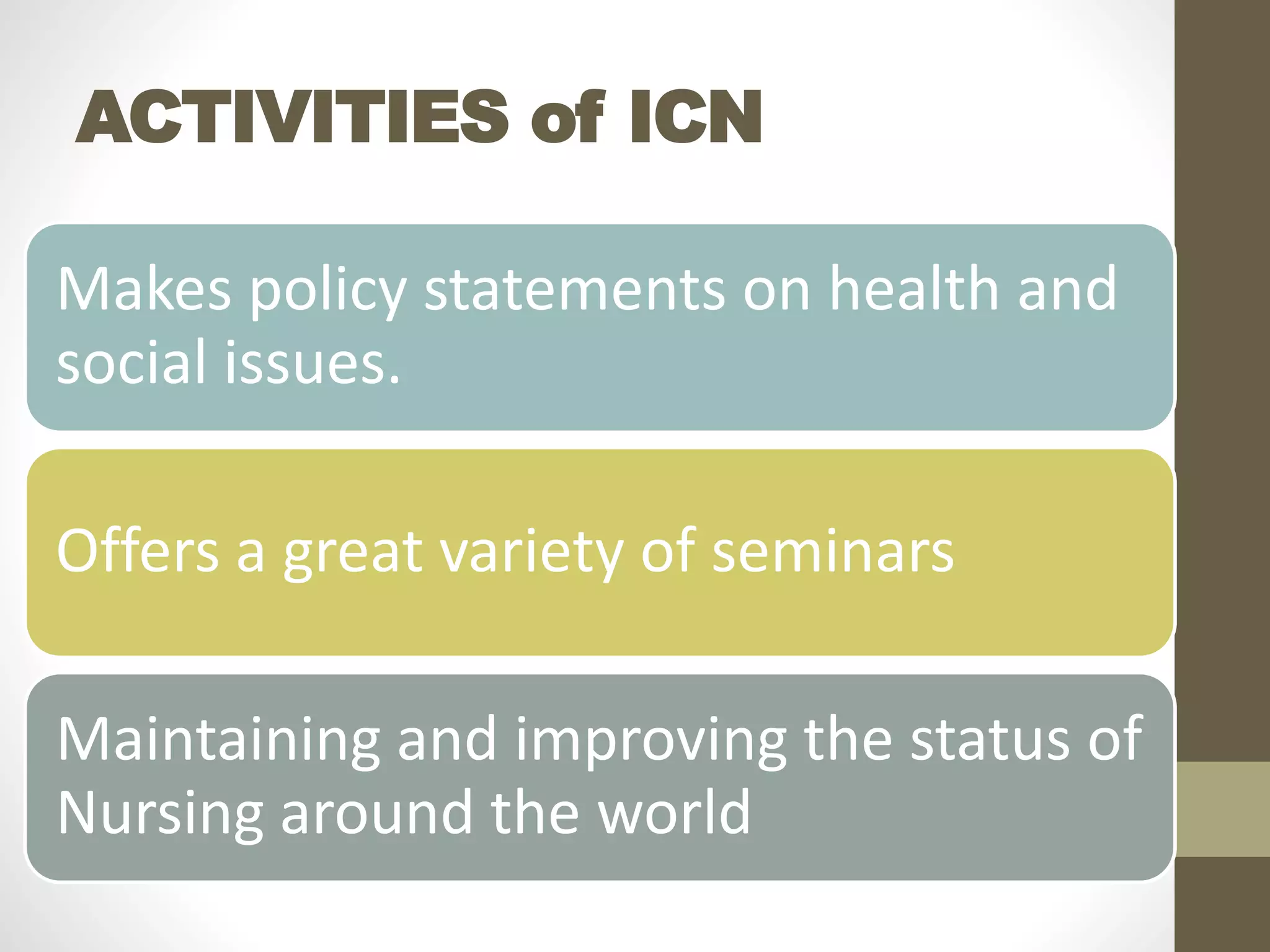
ACTIVITIES of ICN
Makes policy statements on health and
social issues.
Offers a great variety of seminars
Maintaining and improving the status of
Nursing around the world
American Nurses Association
(ANA)
The American Nurses Association (ANA) is a
professional organization to advance and protect
profession of nursing. It started in 1896.
Functions of ANA
• Establish standards of practice nursing
education and services Establish a ethical
code of conduct .
• Support systematic study, evaluation and
research in nursing
• Conduct an action programs (equal
opportunity for recruitment, selection,
advancement and every other term)
Trained Nurses Association
of India (TNAI)
Founded in 1908
First known as association of nursing
superintendents.
Government recognised as a service
organisation- 1950.
Aims of TNAI
1. Upgrading the development and standardisation
of nursing education
2. Improvements to nurses' living and working
conditions in India
3. Registration for qualified nurses .
Functions of TNAI
1. to prepare standards of nursing education and
implement these through appropriate channels
2. to establish standards and qualifications for nursing
practice.
3. to prepare standards of nursing service and
implement these through appropriate channels.
4. to establish a code of ethical conduct for practitioners.
6. To stimulate and promote research design to
enhance the knowledge base for evidence-
based nursing practice
7. to promote legislation and speak for nurses
with regard to legislative action.
8. to promote and protect the economic welfare
of nurses.
9. to provide professional counselling and
placement services for nurses.
10.to provide for the continuing professional
development of practitioners.
10. to represent nurses and serve as their spokes, person
with allied national and international organisations,
governmental and other bodies, and the public.
11. To serve as the official representative of the Nurses
of India as a member of the International Council of
Nurses.
12. To promote the general health and welfare of the
public through the association's programmes,
relationships, and activities, e.g., disaster
management.
13. To render care as per the changing needs of society.
Activities
The Nurses League of
the Christian Medical
Association
The Nurses League of the Christian Medical Association
of India was founded in 1930. It became affiliated with
the TNAI in 1936 and promotes membership in this
organisation.
• .
Objectives:
• Promote cooperation and encouragement among
Christian Nurses.
• • Promote efficiency in nursing education and
service.
• Secure the highest standards possible in Christian
nursing education through the Christian school of
nursing
• Considering the special work and problems of
Christian nurses wherever employed
Activities:
• Activities include national and area conferences
and retreats for its members.
• Development leadership abilities is encouraged
by participation in these meetings.
• Each meeting also allows for sharing of
problems common to the Christian nurse.
• Provides expert professional advice.
• Provides scholarships for advanced study.
Provides financial assistance for professional
meetings and seminars
International Confederation
of Midwives (ICM)
The International Confederation of Midwives
supports, represents and works to strengthen professional
associations of midwives on a global basis.
Vision: ICM envisions a world where every
childbearing woman has access to a midwife's
care for herself and her new-born.
Mission: ICM seeks to "advance world-wide the
aims and aspirations of midwives in the
attainment of improved outcomes for women in
their childbearing years, their new-born and their
families wherever they reside"

unit I.pptx

  • 1.
  • 2.
  • 3.
    Theory : 20hours Objectives 1. Describe profession and professionalism. 2. Identify the challenges of professionalism. 3. Maintain respectful communication and relationship with other health team members, patients and society. 4. Demonstrate professional conduct. 5. Describe various regulatory bodies and professional organizations related to nursing. 6. Discuss the importance of professional values in patient care.
  • 4.
    7. Explain theprofessional values and demonstrate appropriate professional values in nursing practice. 8. Demonstrate and reflect on the role and responsibilities in providing compassionate care in the healthcare setting. 9. Demonstrate respect, human dignity and privacy and confidentiality to self, patients and their caregivers and other health team members. 10. Advocate for patients’ wellbeing, professional growth and advancing the profession. 11. Identify ethical and bioethical concerns, issues and dilemmas in nursing and healthcare. 12. Apply knowledge of ethics and bioethics in ethical decision making along with health team members.
  • 5.
    Profession A Profession isa disciplined group of individuals who adhere to ethical standards and who hold themselves out as, and are accepted by the public as possessing special knowledge and skills in a widely recognized body of learning derived from research, education and training at a high level, and who are prepared to apply this knowledge and exercise these skills in the interest of others. Australian Council of Professions, 2003
  • 6.
    Characteristics of profession 1. wellbody of knowledge and experience 2. Autonomy 3. accountability 4. Formal organization (One unifying organization which is recognized by the State.) 5. Code of Ethics 6. Social Function
  • 7.
    Criteria for aprofession Kelly L (1981) modified and expanded Flexner's criteria of profession • The services provided are vital to humanity and the welfare of society. • There is a special body of knowledge which is continually enlarged through research. • The services involve, intellectual activities, individual responsibility (accountability) is a strong feature. • Practitioners are educated in institutions of higher learning.
  • 8.
    • Practitioners arerelatively independent and control their own policies and activities (autonomy). • Practitioners are motivated by service (altruism) and consider their work as an important component of their lives. • There is a code of ethics to guide the decisions and conduct of practitioners. • There is an organization (association) which encourages and supports high standards of practice.
  • 9.
    Nursing as aprofession In 1959, appraised nursing according to criteria, noting the progress made in nursing, as profession. • A profession utilizes in its practice a well-defined and well- organized body of specialized knowledge, which is on the intellectual level of the higher learning. • A profession constantly enlarges the body of knowledge, it uses and improves its techniques of education and service by the use of the scientific method. • A profession entrusts the education of its practitioners to institutions of higher education.
  • 10.
    • A professionapplies its body of knowledge in practical services which are vital to human and social welfare. • A profession functions autonomously in the formation of professional policy and the control of professional activity thereby. • A profession attracts individuals of intellectual and personal qualities who exalt service above personal gain and who recognize their chosen occupation as a life work. • A profession strives to compensate its practitioners by providing freedom of action, opportunity for continuous professional growth and economic security.
  • 11.
    Professionalism Professionalism’ is definedas the personally held beliefs of a Professional about their own conduct as a member of a Profession. It is often linked to the upholding of the principles, laws, ethics and conventions of a Profession in the form of a code of practice. Australian Council of Professions, 2003
  • 12.
    Characteristics of professionalism “Professionalism isnot the job you do, it's how you do the job.”
  • 13.
    • Competence • Knowledge •Reliable • Integrity (faithfulness) • Respect • Emotional Intelligence • Appropriateness • Confidence
  • 14.
    Concept of professionalism Theorigin of professionalism may be traced from Hippocrates. Professionalism has redefined for the 21st century; the advancement has changed to significant revisions to the professionalism. Although the criteria differ from between professions
  • 15.
    1. Professionalism asa Holistic construct 2. Professionalism as Good clinical care 3. Professionalism as an Expression of self 4. Professionalism as Attitudes and behaviors 5. Professionalism as Appearance
  • 16.
    Attributes of professionalism According tomodi J N et.al (2014) • Competence • Team work • Caring • Insightful and self awareness • Commitment • Confidentiality • Altruism (selfless concern) • Integrity(faith-full) • Morality and ethics • Responsibility to profession
  • 17.
    According to arnoldand stern (2006) • Clinical competence • Ethical and legal understanding • Humanism altruism • Communication skill • Excellence • accountability
  • 18.
    Indicators of professionalism • Timemanagement • Positive attitude • Separate personal issues from work matter • Well groomed • Accountable • Genuineness • Master the art of organization • Learn how to indicate well • Teamwork • Seek help when needed • integrity
  • 19.
    Challenges of professionalism •Personal identity versus professional identity
  • 20.
    • Preservation ofself integrity
  • 21.
  • 22.
  • 23.
    COMMUNICATION & RELATIONSHIP WITHTEAM MEMBERS • Respectful and open communication • Communicate on the basis of critical analysis • Cooperate with co-workers and maintain interpersonal relationship • Prefer the view point and experiences of team members • Identify the problems and obstacles of team members and clarify it
  • 24.
    BASIC PRINCIPLES OFETHICAL COMMUNICATION 1.Identify the relationship needs 2. Consider emotional intelligence 3. Identify and manage the boundaries 4. Be truthful and honest. 5. practice mindful and Active Listening 6. Speak Non-Judgmentally
  • 25.
    7. Share YourPersonal Experience 8. Consider the receiver's preferred communication channel. 9. Strive to understand 10.Be positive, Avoid Using a Negative Tone 11.Please do not interrupt others. 12.Respect privacy and confidentiality 13.Accept responsibility
  • 26.
    RELATIONSHIP WITH PATIENTAND SOCIETY Respect for people, non-maleficence, beneficence, honesty, autonomy, and justice are among the most fundamental values. As long as there have been professionals and patients, these traits have always been important.
  • 27.
    Code of ethics Americannurses association developed code of ethics for nurses. These principles help nurses make good judgment, provide high quality care and support patients and their loved ones emotionally , physically and mentally
  • 28.
    Principles of ethicsin nursing 1) Accountability Nurse must be responsible for his or her own choice and actions in the course of patient care.
  • 29.
    2) justice The nursehave to treat patients irrespective of their age , gender, religion, ethnicity, socioeconomic status
  • 30.
    3) Non-maleficence To dono harm. which means the selection of care, treatments, and treatment modalities that will cause the least amount of harm is the responsibility of nurses
  • 31.
    4) autonomy Patients havethe right to make decisions for themselves. the nurse ensuring that patient have all the necessary information with him
  • 32.
    5) Beneficence The genericdefinition of beneficence is an act of charity, mercy, and kindness, doing good or acting in the best interest of the patient. ensuring that the patient's best interest is considered, regardless of the nurse's personal opinion
  • 33.
    6) fidelity • Nurseshould be honest and loyal to each patient • Making sure that all statements and interactions with a client are truthful and accurate
  • 34.
    7) veracity Being completelyopen and honest with patients, even if the truth causes distress
  • 35.
    Adhering to policies,rules and regulations of the institution • Make sure the institution operates efficiently and effectively • Obeying rules, create stable work place. Maintaining uniformity , high quality care and reduce errors
  • 36.
    Professional etiquettes and behaviors Professionaletiquettes and behaviors contributing to a successful health outcome and shows commitment to the society Important measures are • Introduce self • Dress code • Communicate effectively • Collaborate with and mentor others • Maintain positive attitude • Uphold the standards of care • Be accountable and honest
  • 37.
    Professional grooming First impressionand the professional look express how they carry themselves it creates potential impact on clients
  • 38.
    • Wear cleanattire • No special fragrance, avoid excessive perfume • Hair should neatly combed • Nail length should not excess • Avoid excess makeup • Minimal jewelry • Tattoos may not be visible • Clothing should be clean
  • 39.
    Professional boundaries • Boundariesmake relationship make professional and safe • It includes restriction of personal information sharing, prohibition on physical contact
  • 40.
    Professional relationship with patient •Be polite • Respect individuality • Support patient • Maintain therapeutic nurse client relationship • Be transparent
  • 41.
    Professional relationship with caregiver •Relationship that help significant influence in quality patient care • Honesty in communication • Doubt clarification • Specific skill training • Maintain positive relation ships
  • 42.
    Professional relationship with teammembers • Professional relationship involve people working together to achieve a common goal, • Team members relationships are characterized interpersonal relationship which is like as friendship
  • 43.
    The foundation ofa successful working relationship is trust
  • 44.
    Regulatory Bodies Regulatory bodyis an external organization that has been empowered by legislation and that are usually a part of the executive branch of the government, and they has statutory authority. Regulatory authorities are commonly set up to enforce standards and safety.
  • 45.
    Role of regulatorybodies • To support and assist professional members • To set and enforce standards of nursing practice • To monitor and enforce standards of nursing practice and nursing education • To ensure the publics rights to quality health care services • To set the requirement for registration of nursing professionals
  • 46.
    Regulatory bodies inIndia • Indian nursing council • State nursing council
  • 47.
    Indian Nursing Council TheIndian Nursing Council is an autonomous body under the Government of India, Ministry of Health & Family Welfare. It was constituted by the Central Government under section 3(1) of the Indian Nursing Council Act, 1947, of Parliament in order to establish a uniform standard of training for nurses, midwives, and health visitors.
  • 48.
    Aims of INC •To establish a uniform standards of training for nurse midwives and health visitors • To upgrade and develop the nursing education
  • 49.
    Functions of INC •To establish and monitor uniform standards of nursing for nurse midwives, auxiliary midwives, and health visitors' education • To recognise the qualification for the purpose of registration and employment in India and abroad. • To prescribe minimum standards of education and training in various nursing programmes prescribe the syllabus and regulations for nursing programmes
  • 50.
    • Power towithdraw the recognition of qualification when an institution recognised by a state council • To recognise degrees, diplomas, and certificates awarded by foreign universities. To give approval for registration of Indian and foreign nurses possessing foreign qualification
  • 51.
    • To maintainthe Indian Nurses Register for the registration of nursing personnel. • To advise the state nursing councils, examination boards, state governments, and central rent various important items regarding nursing education in the country. • To promote research in nursing • To prescribe a code of ethics and professional conduct • To regulate the policies of training nursing programmes in the field of nursing to improve the quality of nursing education
  • 52.
    Services provided by INC 1.To attend to all matters relating to the recognition of nursing qualifications awarded by different universities under the INC 3. to verify the nurse credentials of qualifications, 4. Nurses Registration and Tracking System:
  • 53.
    State Nursing Council •The state nurses and midwives council was established in 1948 under the Nurse and Midwives Act with the purpose of better training for nurses, midwives, and health visitors. • It works as an autonomous body under the government of the respective state's department of health and family welfare.
  • 54.
    Functions of SNC 1.Regulation of the training programme for the diploma, graduate, and postgraduate courses 2. Supervision of the practice of the profession by its members. 3. Granting recognition to the training institutions and periodical Inspection there on, as the Council is governing authority of physical and clinical facilities in almost all the nursing courses conducted in the institution.
  • 55.
    3. Prescribing thesyllabus and curriculum for various nursing courses and conducting the qualifying examinations therefore. 4. Registration and granting certificate to qualified persons
  • 56.
    Collaboration of INCand SNC • State nursing council coordinates with Indian nursing council in the for • State nursing council must implement the syllabus prescribed by INC • Registrars of the state nursing council meeting with Indian nursing council periodically to discuss the various problem • State nursing council with the help of INC monitors any unethical practices
  • 57.
    Professional organization • InternationalCouncil For Nurses (ICN) •Trained nurses association of India •Student nurses association •Nurses league of Christian medical association of India •International confederation of midwives
  • 58.
    International Council For Nurses(ICN) The International Council of Nurses, founded in 1899, It is a federation of non political and self governing national nurses association the head quarters are in Geneva, Switzerland ICN Mission: To repent nursing worldwide, advance the nursing profession, promote the wellbeing of nurses ICN Vision: The advocate for health in all policies. community recognises, supports, and invests in nurses and nursing to lead and deliver health for all
  • 59.
    Objectives of ICN •Quality nursing care for all • Sound health policies("decisions, plans, and actions that are undertaken to achieve specific health care goals within a society) • Advancement of nursing knowledge • Competent & satisfied work force
  • 60.
    FUNCTIONS OF ICN •To promote the development of strong national nurses association. • To assist national nurse association to improve the standards of nursing and the competencies of nurses. • To assist national nurses association to improve the status of nurses with in their countries • To serve as the authoritative voice for nurse and nursing internationally.
  • 61.
    ACTIVITIES of ICN Makespolicy statements on health and social issues. Offers a great variety of seminars Maintaining and improving the status of Nursing around the world
  • 62.
    American Nurses Association (ANA) TheAmerican Nurses Association (ANA) is a professional organization to advance and protect profession of nursing. It started in 1896.
  • 63.
    Functions of ANA •Establish standards of practice nursing education and services Establish a ethical code of conduct . • Support systematic study, evaluation and research in nursing • Conduct an action programs (equal opportunity for recruitment, selection, advancement and every other term)
  • 64.
    Trained Nurses Association ofIndia (TNAI) Founded in 1908 First known as association of nursing superintendents. Government recognised as a service organisation- 1950.
  • 65.
    Aims of TNAI 1.Upgrading the development and standardisation of nursing education 2. Improvements to nurses' living and working conditions in India 3. Registration for qualified nurses .
  • 66.
    Functions of TNAI 1.to prepare standards of nursing education and implement these through appropriate channels 2. to establish standards and qualifications for nursing practice. 3. to prepare standards of nursing service and implement these through appropriate channels. 4. to establish a code of ethical conduct for practitioners.
  • 67.
    6. To stimulateand promote research design to enhance the knowledge base for evidence- based nursing practice 7. to promote legislation and speak for nurses with regard to legislative action. 8. to promote and protect the economic welfare of nurses. 9. to provide professional counselling and placement services for nurses. 10.to provide for the continuing professional development of practitioners.
  • 68.
    10. to representnurses and serve as their spokes, person with allied national and international organisations, governmental and other bodies, and the public. 11. To serve as the official representative of the Nurses of India as a member of the International Council of Nurses. 12. To promote the general health and welfare of the public through the association's programmes, relationships, and activities, e.g., disaster management. 13. To render care as per the changing needs of society. Activities
  • 69.
    The Nurses Leagueof the Christian Medical Association The Nurses League of the Christian Medical Association of India was founded in 1930. It became affiliated with the TNAI in 1936 and promotes membership in this organisation. • .
  • 70.
    Objectives: • Promote cooperationand encouragement among Christian Nurses. • • Promote efficiency in nursing education and service. • Secure the highest standards possible in Christian nursing education through the Christian school of nursing • Considering the special work and problems of Christian nurses wherever employed
  • 71.
    Activities: • Activities includenational and area conferences and retreats for its members. • Development leadership abilities is encouraged by participation in these meetings. • Each meeting also allows for sharing of problems common to the Christian nurse. • Provides expert professional advice. • Provides scholarships for advanced study. Provides financial assistance for professional meetings and seminars
  • 72.
    International Confederation of Midwives(ICM) The International Confederation of Midwives supports, represents and works to strengthen professional associations of midwives on a global basis.
  • 73.
    Vision: ICM envisionsa world where every childbearing woman has access to a midwife's care for herself and her new-born. Mission: ICM seeks to "advance world-wide the aims and aspirations of midwives in the attainment of improved outcomes for women in their childbearing years, their new-born and their families wherever they reside"