PROFESSIONALISM
Dr Deepa P
PROFESSIONALISM
 PROFESSIONALISM Profession Definition of profession Criteria of a
 
profession Nursing as a profession Professionalism Definition and
 
characteristics of professionalism Concepts, attributes and indicators of

professionalism Challenges of professionalism o Personal identity vs

professional identity o Preservation of selfintegrity: threat to integrity,
Deceiving patient: withholding information and falsifying records o
Communication & Relationship with team members: Respectful and open
communication and relationship pertaining to relevant interests for ethical
decision making o Relationship with patients and society
 Professional Conduct Following ethical principles Adhering to policies,
 
rules and regulation of the institutions Professional etiquettes and

behaviors Professional grooming: Uniform, Dress codeProfessional

boundaries: Professional relationship with the patients, caregivers and team
members
 Regulatory Bodies & Professional Organizations:
 Roles & Responsibilities Regulatory bodies:

 Indian Nursing Council,
 State Nursing Council 
 Professional Organizations:
 Trained Nurses Association of India (TNAI),
 Student Nurses Association (SNA),
 Nurses League of Christian Medical Association of India,
 International Council of Nurses (ICN) and
 International Confederation of Midwives
 PROFESSIONAL VALUES Values: Definition and characteristics of values
 
Value clarification Personal and professional values Professional
 
socialization: Integration of professional values with personal values
Professional values in nursing Importance of professional values in nursing

and health care Caring: definition, and process Compassion: Sympathy Vs
 
empathy, Altruism Conscientiousness Dedication/devotion to work
  
Respect for the personHuman dignity Privacy and confidentiality: Incidental

disclosure Honesty and integrity: Truth telling Trust and credibility:
 
Fidelity, Loyalty Advocacy: Advocacy for patients, work environment,

nursing education and practice, and for advancing the profession
 ETHICS & BIOETHICS Definitions: Ethics, Bioethics and Ethical Principles 
Beneficence Non-maleficence: Patient safety, protecting patient from harm,

Reporting errors Justice: Treating each person as equal Care without
 
discrimination, equitable access to care and safety of the public Autonomy:

Respects patients‘ autonomy, Selfdetermination, Freedom of choice Ethical
issues and ethical dilemma: Common ethical problems Conflict of interest
 
Paternalism Deception Privacy and confidentiality Valid consent and
  
refusal Allocation of scarce nursing resources Conflicts concerning new
 
technologies  Whistle-blowing  Beginning of life issues • Abortion •
Substance abuse • Fetal therapy • Selective deduction • Intrauterine treatment
of fetal conditions • Mandated contraception • Fetal injury • Infertility
treatment End of life issues • End of life • Euthanasia • Do Not Resuscitate

(DNR) Issues related to psychiatric care • Non compliance • Restrain and

seclusion Refuse to take food

 Process of ethical decision making Assess the situation (collect information) Identify the ethical
 
problem Identify the alternative decisions Choose the solution to the ethical decision Implement
  
the decision Evaluate the decision Ethics committee: Roles and responsibilities Clinical decision
 
making Research
 Code of Ethics International Council of Nurses (ICN) Indian Nursing Council
 
Patients’ Bill of Rights17 patients’ rights (MoH & FW, GoI)
 1. Right to emergency medical care
 2. Right to safety and quality care according to standards
 3. Right to preserve dignity
 4. Right to nondiscrimination
 5. Right to privacy and confidentiality
 6. Right to information
 7. Right to records and reports
 8. Right to informed consent
 9. Right to second opinion
 10. Right to patient education
 11. Right to choose alternative treatment options if available
 12. Right to choose source for obtaining medicines or tests
 13. Right to proper referral and transfer, which is free from perverse commercial influences
 14. Right to take discharge of patient or receive body of deceased from hospital
 15. Right to information on the rates to be charged by the hospital for each type of service provided and
facilities available on a prominent display board and a brochure
 16. Right to protection for patients involved in clinical trials, biomedical and health research
 17. Right to be heard and seek redressal
 . Ann Zwemer. Professional Adjustments and Ethics for Nurses in India,
Ecumenical Book Services, Chennai 2. Carvalho S. Reeves, M Orford J.
Fundamental Aspects of Legal, Ethical and Professional Issues in Nursing,
United Kingdom: Quay. 3. Herman Wheeler Law, Ethics and Professional Issues
for Nursing - A Reflective and Portfolio-Building Approach, Routledge Taylor
and Francis group, London. 4. Joyce Beebe Thompson, Professional Ethics in
Nursing, R.E. Krieger Publishing Company. 5. I Clement. Professional Trends
and Adjustments in Nursing, Jaypee Publishers Medical Publishers, New Delhi.
6. Beth Perry Black. Professional Nursing: Concepts and Challenges, Elsevier
Saunders publishers, Philadelphia. 7. Janie B. Butts, Karen L. Rich. Nursing
Ethics- Across the curriculum and in to Practice, Jones & Bartlett Learning.
United States. 8. Olinda Timms. Biomedical Ethics, Elsevier
PROFESSIONALISM
Profession
 Definition of profession
 Criteria of a profession
 Nursing as a profession
Profession- definition
 Dictionary meaning
 An occupation, trade, craft or activity in which one has a professed expertise
in a particular area
 A job especially one requiring a high level of skill or training
Definition
 Profession is defined as an occupational group with a set of attitudes. Chitty
KK,2005
 A paid occupation, especially one that involves prolonged training and a
formal qualification
Criteria
 They are standards of judging something
CRITERIA- GENEVIEVE K, ROY K BIXLER
INTELLECTUAL
SCIENTIFIC
REQUIRES HIGHER EDUCATION
ESSENTIAL
SELF GOVERNING
SERVICE ORIENTED
PROFESSIONAL DEVELOPMENT AND ECONOMIC SECURITY
Criteria contd..
1. Utilizes in its practice a well defined and well organised body of specialized knowledge
which is on the intellectual level of higher learning
2. Constantly enlarges the body of knowledge, its uses and improves its techniques of
education and service by the use of the scientific method
3. Entrusts the education of its practitioners to institutions of higher education
4. Applies its body of knowledge in practical services which are vital to human and social
welfare
5. Functions autonomously in the formulation of professional policy and in the control of
professional activity thereby
6. Attracts individuals of intellectual and personal qualities who exalt service above personal
gain and who recognise their chosen occupation as a life work
7. Strives to compensate its practitioners by providing freedom of action, opportunity for
continuous professional growth and economic security
FLEXNER
 Is intellectual and is accompanied by a high degree of individual responsibility
 Is based on a body of knowledge that can be learned and is refreshed and
refined through research
 Is practical, in addition to being theoretical
 Can be taught through a process of highly specialised professional education
 Has a strong internal organisation of members and a well developed group
consciousness
 Has practitioners who are motivated by altruism and who are responsive to
public interests
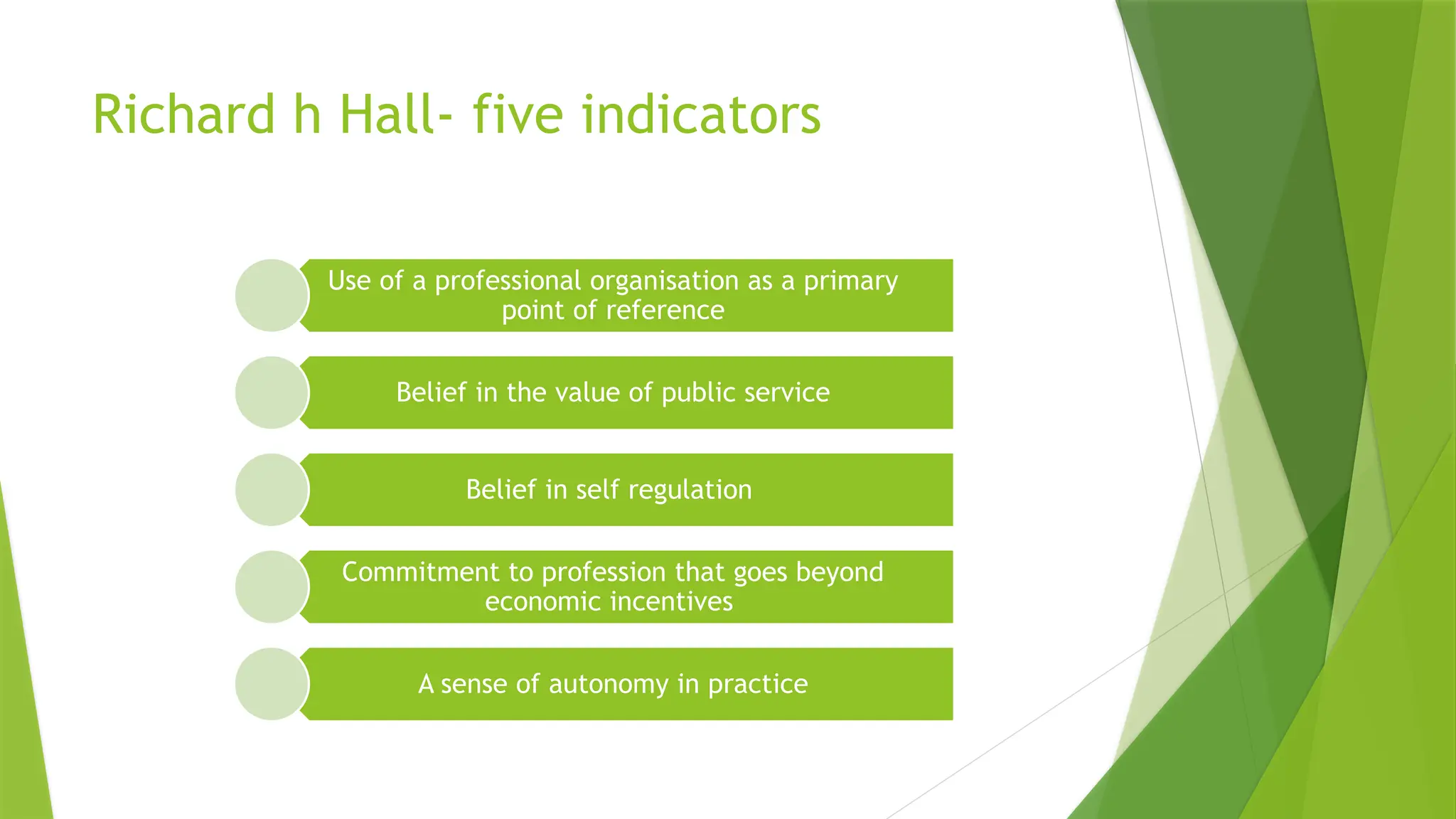
Richard h Hall- five indicators
Use of a professional organisation as a primary
point of reference
Belief in the value of public service
Belief in self regulation
Commitment to profession that goes beyond
economic incentives
A sense of autonomy in practice
Nursing as a profession
 Service
 Art
 Science
 Closer to a true profession
 Professional nurse
Professional nurse
 Intellectual or mechanical
 Latest trends
 Practical application
 Share knowledge
 Belong to professional organisations
 Interpret profession to public
 Concern for human element
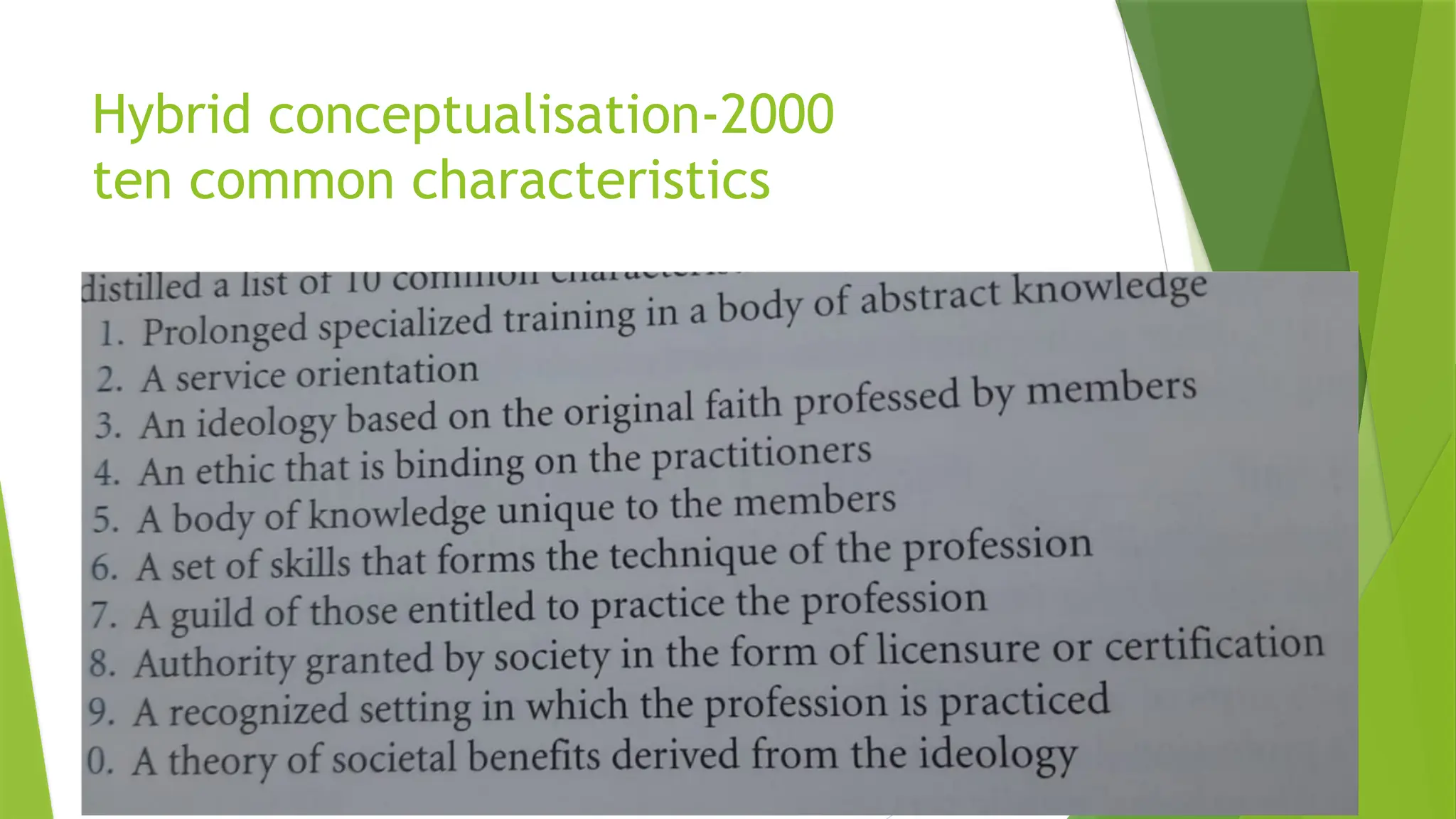
Hybrid conceptualisation-2000
ten common characteristics
Occupation to profession
Evolution
 Practitioners performed full time work in the discipline
 Determined work standards
 Identified a body of knowledge
 Established educational programmes in institutions of higher learning
 Promoted organisations into effective occupational associations
 Worked towards legal protection that limited practice of their unique skills by
outsiders
 Established code of ethics
 Process of professionalization
 “Emerging profession”
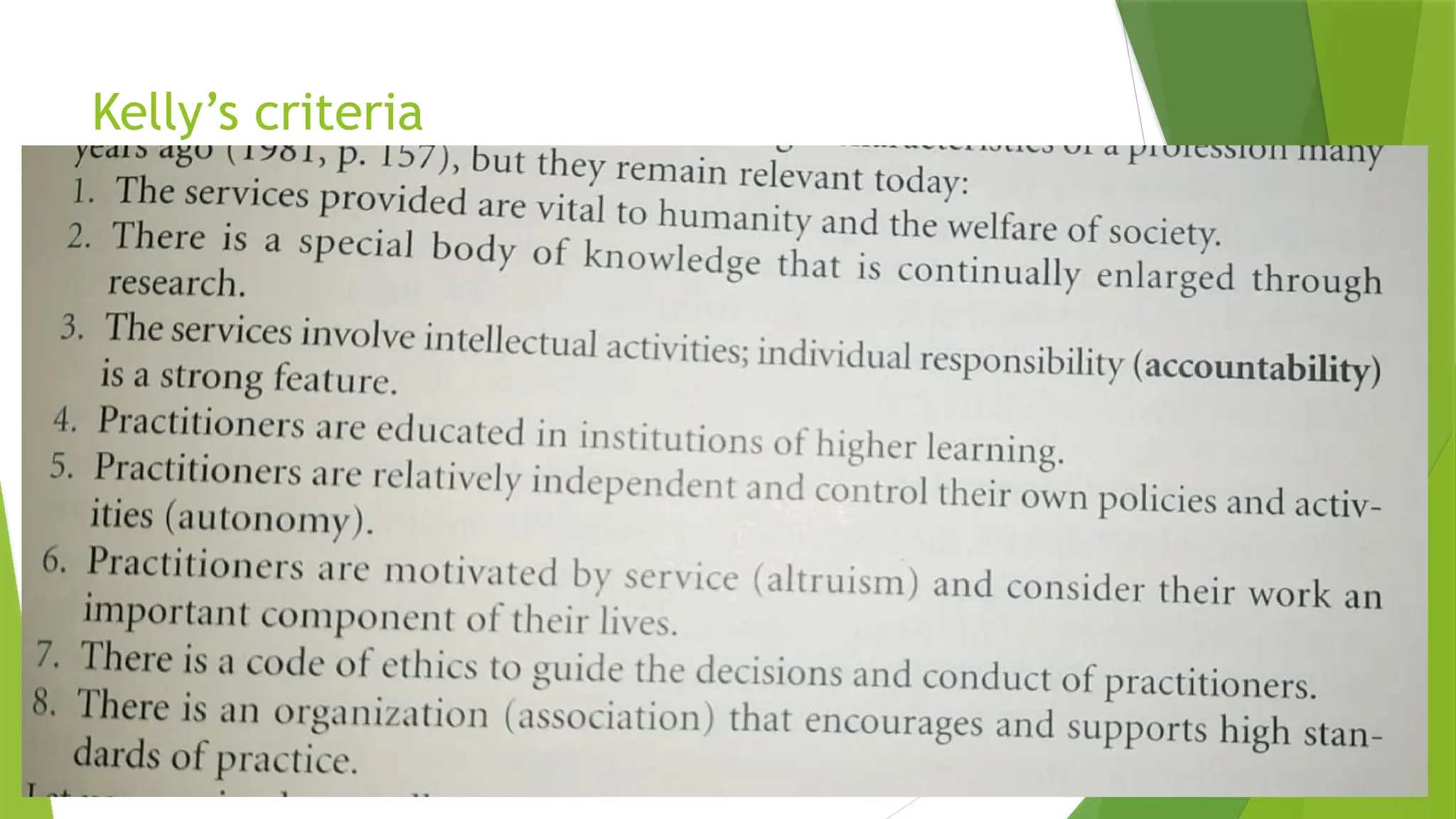
Kelly’s criteria
Definition of Professionalism
 Professionalism refers to the conduct, aims, or qualities
that characterize a profession or a professional person.
It encompasses a set of values, behaviors, and attitudes
that are expected in a professional setting, ensuring
that individuals perform their roles competently,
ethically, and with integrity.
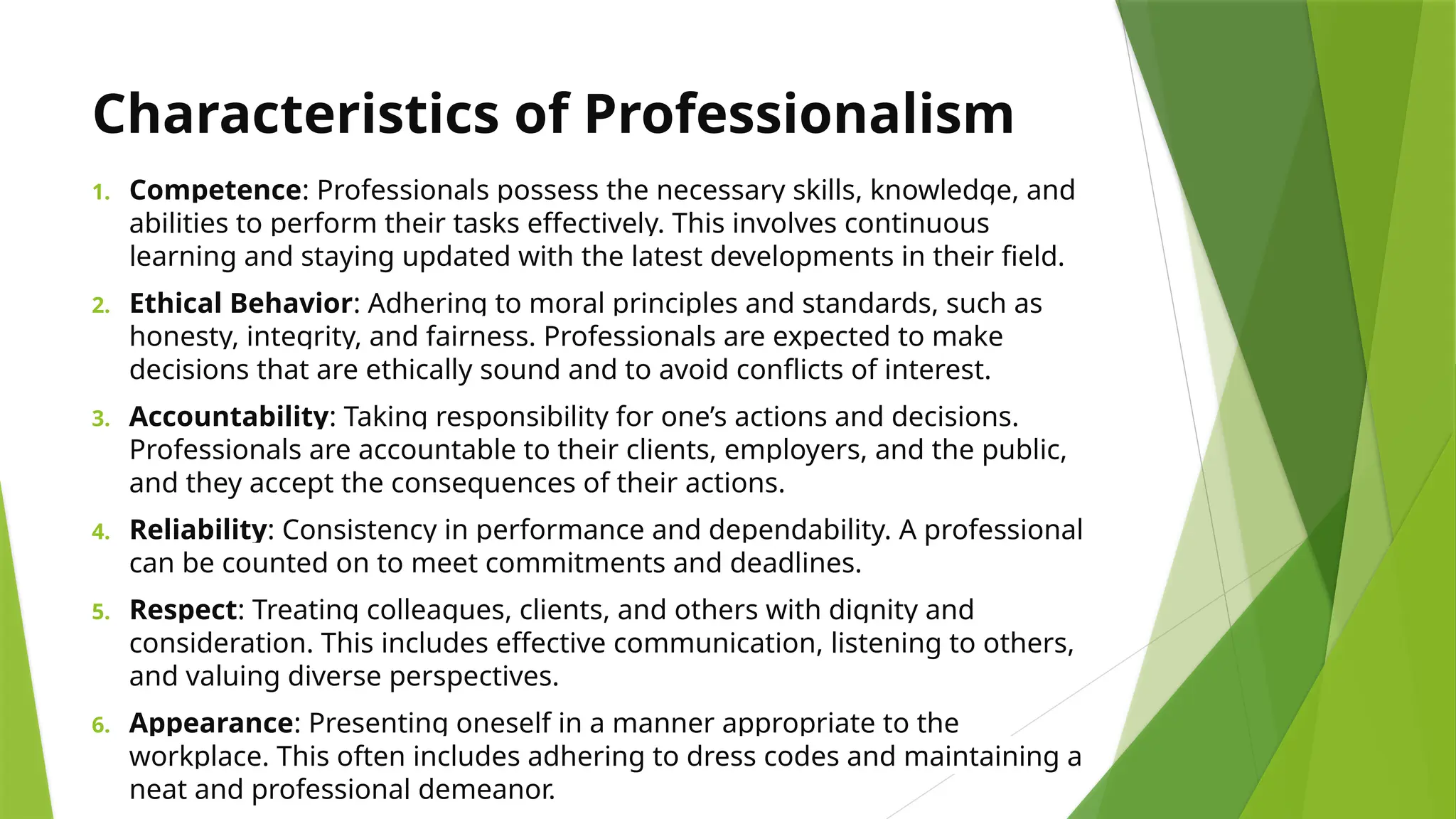
Characteristics of Professionalism
1. Competence: Professionals possess the necessary skills, knowledge, and
abilities to perform their tasks effectively. This involves continuous
learning and staying updated with the latest developments in their field.
2. Ethical Behavior: Adhering to moral principles and standards, such as
honesty, integrity, and fairness. Professionals are expected to make
decisions that are ethically sound and to avoid conflicts of interest.
3. Accountability: Taking responsibility for one’s actions and decisions.
Professionals are accountable to their clients, employers, and the public,
and they accept the consequences of their actions.
4. Reliability: Consistency in performance and dependability. A professional
can be counted on to meet commitments and deadlines.
5. Respect: Treating colleagues, clients, and others with dignity and
consideration. This includes effective communication, listening to others,
and valuing diverse perspectives.
6. Appearance: Presenting oneself in a manner appropriate to the
workplace. This often includes adhering to dress codes and maintaining a
neat and professional demeanor.
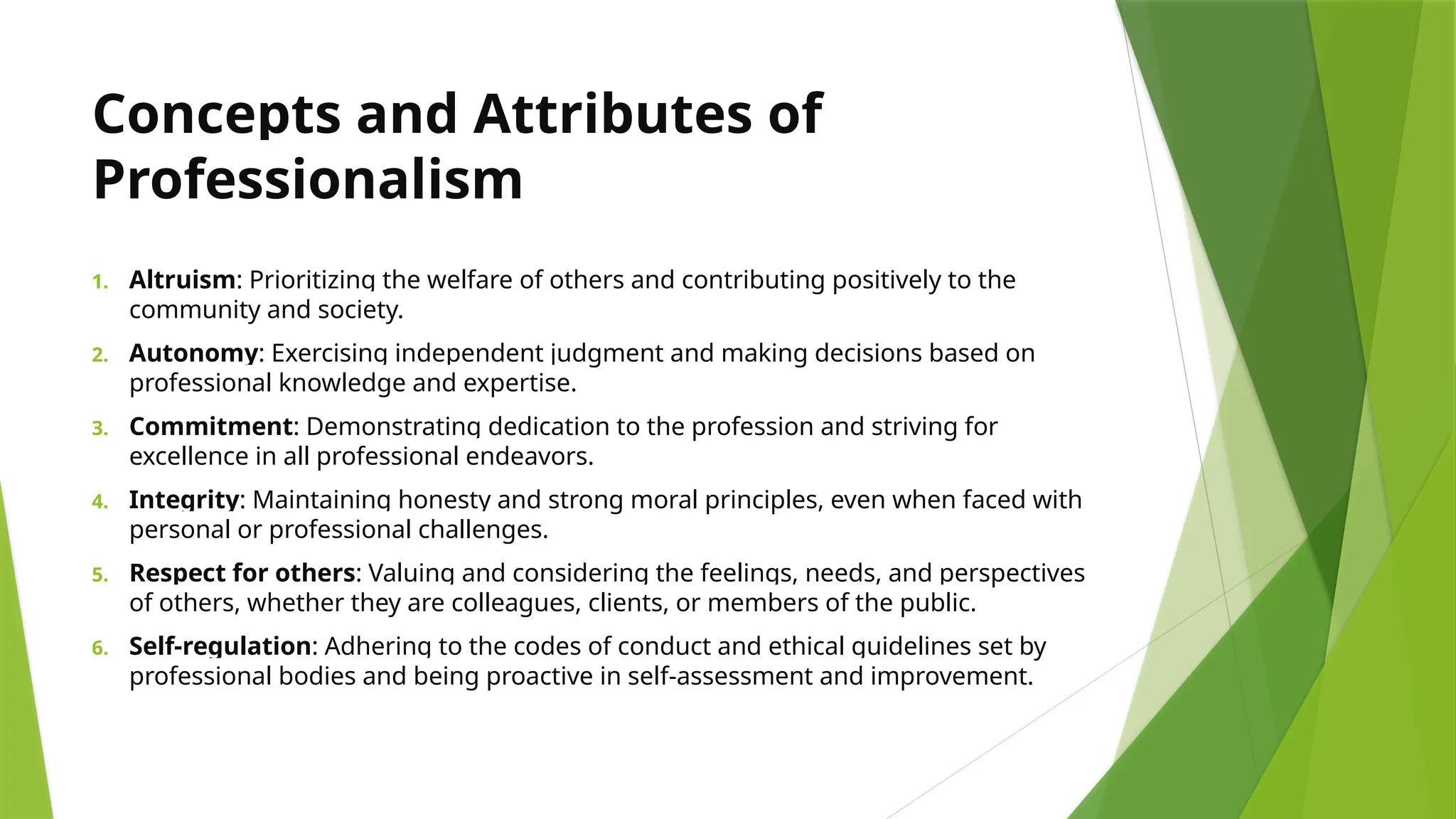
Concepts and Attributes of
Professionalism
1. Altruism: Prioritizing the welfare of others and contributing positively to the
community and society.
2. Autonomy: Exercising independent judgment and making decisions based on
professional knowledge and expertise.
3. Commitment: Demonstrating dedication to the profession and striving for
excellence in all professional endeavors.
4. Integrity: Maintaining honesty and strong moral principles, even when faced with
personal or professional challenges.
5. Respect for others: Valuing and considering the feelings, needs, and perspectives
of others, whether they are colleagues, clients, or members of the public.
6. Self-regulation: Adhering to the codes of conduct and ethical guidelines set by
professional bodies and being proactive in self-assessment and improvement.
Concept of professionalism in Nursing-
Miller BK,1987, 2001
Education in
university setting
and scientific
background in
Nursing
Adherence to
Code for Nurses
Theory deve,
use, evaluation
Community
service
orientation
Continuing
education,
competence
Research-
dev,use,evaluat
ion
Self regulatory,
autonomy
Professional org
participation
Publication and
communication
Indicators of Professionalism
1. Certification and Licensing: Obtaining and maintaining
credentials that demonstrate expertise and compliance with
industry standards.
2. Continuing Education: Engaging in ongoing learning and
professional development activities to stay current in one’s field.
3. Professional Associations: Active membership and participation in
professional organizations that set standards and provide
resources for the profession.
4. Performance Evaluations: Regular assessments of one’s work by
supervisors or peers, demonstrating a commitment to quality and
improvement.
5. Adherence to Standards: Following industry best practices,
regulations, and ethical guidelines.
6. Professional Relationships: Building and maintaining positive
relationships with colleagues, clients, and other stakeholders.
Challenges of Professionalism
1. Balancing Personal and Professional Life: Maintaining a healthy
work-life balance can be difficult, leading to stress and burnout.
2. Ethical Dilemmas: Navigating complex ethical issues where the right
course of action is not always clear.
3. Maintaining Competence: Keeping up with rapid advancements in
technology and changes in the industry requires continuous effort
and learning.
4. Managing Expectations: Meeting the high expectations of clients,
employers, and society while maintaining personal and professional
integrity.
5. Dealing with Conflicts: Resolving conflicts that arise with colleagues,
clients, or within the organization in a professional manner.
6. Pressure to Conform: Facing pressure to conform to organizational
culture or practices that may conflict with personal values or ethical
standards.
Challenges to professionalism in Nursing
 Personal identity vs professional identity
 Preservation of self-integrity:
 A threat to integrity,
 Deceiving patient: withholding information and falsifying records
 Communication & Relationship with team members:
Respectful and open communication and relationship
about relevant interests for ethical decision-making
 Relationship with patients and society
1.Personal identity vs professional
identity
 Personal identity refers to an individual's unique characteristics, experiences,
values, beliefs, and personality traits that define who they are.
 For a nurse, personal identity includes their motivations for entering the
nursing profession, their values like compassion and empathy, and their life
experiences shaping how they interact with patients and colleagues.
 This identity influences how they approach work, manage stress, and maintain
work-life balance.
 Professional Identity: Professional identity as a nurse involves the integration
of personal identity with the roles, responsibilities, and standards of the
nursing profession.
 It includes the knowledge, skills, and competencies acquired through education
and experience and adherence to ethical standards and professional codes of
conduct.
 A nurse’s professional identity is characterized by a commitment to patient
care, collaboration with healthcare teams, continuous learning, and advocacy
for patients' rights and well-being.
Personal and professional integrity
 Personal Integrity: Personal integrity refers to the adherence to moral and ethical
principles in one’s personal life. It involves being honest, trustworthy, and
consistent in actions and beliefs, regardless of external pressures.
 Professional Integrity: Professional integrity, on the other hand, pertains to
ethical conduct within the workplace and professional settings. It involves adhering
to the standards and codes of conduct specific to one's profession. This includes
maintaining confidentiality, being impartial, delivering quality work, and avoiding
conflicts of interest. Professional integrity is critical for maintaining trust with
colleagues, clients, and the broader community.
 Key Differences:
1. Context: Personal integrity is exercised in everyday life, while professional integrity
is specific to professional environments.
2. Guiding Principles: Personal integrity is guided by individual values, whereas
professional integrity is often guided by formal codes of ethics and professional
standards.
3. Accountability: Personal integrity is often self-regulated, whereas professional
integrity is regulated by professional bodies and workplace policies.
2.Preservation of self integrity
 Preservation of self-integrity refers to maintaining a sense of self-worth and
coherence in one's identity despite challenges or external pressures. It
involves upholding personal values, beliefs, and ethics even when faced
with adversity or temptation to compromise.
 Key aspects
1. Self-Awareness: Understanding one's core values, strengths, and
weaknesses.
2. Consistency: Acting in ways that are congruent with one's beliefs and
principles.
3. Boundaries: Setting and maintaining limits to protect one's values and well-
being.
4. Authenticity: Being true to oneself in thoughts, words, and actions.
5. Resilience: The ability to bounce back and stay true to oneself after
setbacks or failures.
Nursing- threat to integrity
 Emotional and physical exhaustion
 Moral distress
 Workplace violence and bullying
 Lack of autonomy
 Role strain and identity confusion
 Underappreciation and low compensation
 Exposure to traumatic events
 Ethical dilemmas
Strategies to Mitigate These Threats
• Self-Care and Professional Support: Encouraging regular self-care,
seeking support from colleagues, and utilizing mental health resources
can help nurses manage stress and maintain their self-integrity.
• Continuing Education and Training: Providing ongoing education and
training can empower nurses with the skills and knowledge needed to
handle ethical dilemmas and challenging situations effectively.
• Improved Workplace Policies: Implementing policies that promote a
safe, supportive, and empowering work environment can reduce
workplace violence, bullying, and role strain.
• Recognition and Fair Compensation: Ensuring that nurses receive
adequate recognition and compensation for their work can enhance their
sense of value and professional pride.
• Promoting Autonomy: Encouraging a work environment that values
nurses' input and allows for greater autonomy can improve job
satisfaction and personal fulfillment.
Withholding information and falsifying
records
 Withholding information and falsifying records in nursing is a
serious ethical and legal issue. Nurses are entrusted with the
responsibility of providing honest and accurate care to patients.
Engaging in deceitful practices, such as withholding information or
falsifying records, can have severe consequences for patient safety,
professional integrity, and legal standing.
 Breach of trust, cause patient harm, and interfere with our
professional integrity
 Legal consequences like malpractice penalties, licensure
withdrawals, legal penalties can occur
 Egs:Medication errors, vital signs, informed consents
3.Communication & Relationship with team members:
Respectful and open communication and relationship about
relevant interests for ethical decision-making
1. Patient Safety and Care Quality
2. Team Cohesion
3. Job Satisfaction
4.Relationship with patients and society
 Ethical dilemmas
 Confidentiality vs. Advocacy
 Informed consent and autonomy
 Emotional boundaries
 Empathy vs. Professional distance
 Handling grief and loss
 Societal expectations
 Public perception of nursing:
 Workload and resource constraints
 Interprofessional dynamics.
 Role clarity and respect
 Collaborative practice
Barriers to professionalism- Nursing
Variability in
educational
preparation
Gender issues
Historical
influences- religious
orders and military
External conflicts-
with medicine and
other profession
Internal conflicts-
subgroups- educational
levels, associations
Professional conduct
 It encompasses a set of ethical principles, behaviors, and
standards that guide nurses in their interactions with
patients, colleagues, and the broader healthcare community.
 Features
1. Ethical Practice: Nurses must adhere to ethical guidelines, such as those outlined in
the American Nurses Association (ANA) Code of Ethics. This includes maintaining
patient confidentiality, obtaining informed consent, and advocating for patients' rights
and needs.
2. Respect and Compassion: Professional conduct involves treating all patients with
dignity, respect, and compassion, regardless of their background or circumstances.
Nurses should provide empathetic care and support, recognizing the individuality of
each patient.
3. Accountability and Responsibility: Nurses are accountable for their actions and
decisions. They must practice within their scope of competence and seek guidance
when needed. Continuous professional development and staying updated with current
practices are also part of this responsibility.
contd
4. Professional Relationships: Effective communication and collaboration with
other healthcare professionals are essential. Nurses must work as part of a
multidisciplinary team, fostering a positive work environment and ensuring
the best patient outcomes.
5. Legal and Regulatory Compliance: Nurses must comply with all relevant
laws, regulations, and institutional policies. This includes accurate
documentation, adherence to safety protocols, and reporting any unethical
or unsafe practices.
6. Cultural Competence: Recognizing and respecting cultural diversity is
crucial in nursing. Nurses should provide culturally sensitive care and be
aware of their own biases, striving to eliminate disparities in healthcare
delivery.
7. Integrity and Honesty: Maintaining integrity and honesty in all professional
interactions is fundamental. This involves being truthful with patients,
families, and colleagues, and upholding the trust placed in the nursing
profession.
Professional conduct
 Following ethical principles
 Nurses must adhere to ethical guidelines, such as those outlined in the
American Nurses Association (ANA) Code of Ethics, Indian Nursing Council.
This includes maintaining patient confidentiality, obtaining informed
consent, and advocating for patients' rights and needs.
 Adhering to policies, rules and regulation of the institutions
 Nurses must comply with all relevant laws, regulations, and institutional
policies. This includes accurate documentation, adherence to safety
protocols, and reporting any unethical or unsafe practices.
 Professional etiquettes and behaviors
 It means good manners in professional relationships. Starts learning during
student period. Based on consideration and respect for others. There should be
professional relationship with
 Position of authority and responsibility
 Patient and family
 Colleagues
 Other professions
 Community
contd
 Professional grooming: Uniform, Dress code
 A neat, clean and pleasant appearance should be practiced. It adds a
feeling of peace and order to the environment. Adhere to the facility’s
dress code. Scrubs, ID cards, good sneakers, minimal jewelry and
accessories, and adequate PPEs are needed. Minimises risk for infection
and maintains safety at the workplace.
 Professional boundaries: Professional relationship with the patients,
caregivers and team members
 Clear, concise communication, active listening, and good nonverbal
cues should be maintained. Nurses must work as part of a
multidisciplinary team, fostering a positive work environment and
ensuring the best patient outcomes.
 Maintaining integrity and honesty in all professional interactions is
fundamental. This involves being truthful with patients, families, and
colleagues, and upholding the trust in the nursing profession. Nurses
should provide empathetic care and support, recognizing the
individuality of each patient.
Unit II
 Professional values
 PROFESSIONAL VALUES Values: Definition and characteristics of values
 
Value clarification Personal and professional values Professional
 
socialization: Integration of professional values with personal values
 Professional values in nursing Importance of professional values in nursing

and health care Caring: definition, and process Compassion: Sympathy Vs
 
empathy, Altruism Conscientiousness Dedication/devotion to work
  
Respect for the personHuman dignity Privacy and confidentiality: Incidental

disclosure Honesty and integrity: Truth telling Trust and credibility:
 
Fidelity, Loyalty Advocacy: Advocacy for patients, work environment,

nursing education and practice, and for advancing the profession
Definition of Values
 Values are the principles, standards, or qualities
considered worthwhile or desirable in a person,
society, or organization. They guide behavior
and decision-making, reflecting what is
important to individuals and groups.
Characteristics of values
•Guiding Principles: Values act as guiding principles that influence behavior and
decision-making. They provide a framework for what is considered right, important,
and desirable.
•Enduring and Stable: Values are relatively stable and enduring over time. They are
deeply ingrained and do not change easily with circumstances or over short periods.
•Abstract: Values are abstract concepts rather than specific actions or behaviors. For
example, honesty is a value, while telling the truth is a behavior that stems from this
value.
•Hierarchical: Values are organized in a hierarchical structure, with some values
being more important than others. Individuals prioritize values differently based on
their personal beliefs and experiences.
•Culturally Specific: While some values are universal, many are influenced by
cultural, social, and environmental contexts. What is valued in one culture may not
hold the same importance in another.
contd
•Emotional Investment: People have strong emotional attachments to
their values. Violating one's values can lead to feelings of guilt, shame, or
distress.
•Behavioral Influence: Values significantly influence behavior and
actions. They serve as standards against which individuals evaluate their
own and others' behaviors.
•Consistency: Values contribute to the consistency and predictability of
behavior. Individuals strive to act in ways that are congruent with their
values.
•Identity Formation: Values play a critical role in the formation of personal
and group identity. They help define who we are and what we stand for.
•Moral and Ethical Dimension: Many values have a moral or ethical
dimension, guiding judgments about what is right and wrong, good and
bad.
Contd..
•Conflict Potential: Differences in values can lead to conflicts
between individuals or groups. These conflicts often arise
because values are deeply held and emotionally charged.
•Influence on Perception: Values influence how we perceive
and interpret information and events. They act as filters
through which we view the world.
Value clarification
 Value clarification is a process by which individuals identify and
reflect on their personal values to understand better how they
influence behavior and decision-making. It involves:
1. Self-Assessment: Reflecting on personal beliefs, attitudes, and
behaviors.
2. Prioritization: Determining which values are most important.
3. Alignment: Ensuring that actions and decisions align with these
prioritized values.
4. Articulation: Clearly expressing one's values to others.
5. Evaluation: Periodically reassessing values to ensure they remain
relevant and aligned with personal growth and professional
responsibilities.
Personal and Professional Values
 Personal values are the core beliefs and principles that
guide an individual's life and decisions. These may
include honesty, family, health, and financial security.
 Professional values are specific to one's career and
professional responsibilities, guiding behavior and
decision-making in a work context. While they may
overlap with personal values, professional values often
emphasize ethics, competence, and service to others.
Characteristics of Professional
Values
 Professional values are specific to a profession and guide the
behavior, decisions, and actions of its members. These values are
essential for maintaining integrity, trust, and excellence in
professional practice. Characteristics include:
• Ethical Standards: Uphold principles of honesty, confidentiality,
and fairness.
• Competence: Commitment to ongoing education and skill
development.
• Accountability: Taking responsibility for one's actions and their
outcomes.
• Respect: Valuing clients, colleagues, and the broader community.
• Altruism: Prioritizing the welfare of clients and society over
personal gains.
• Integrity: Adhering to moral and ethical principles consistently.
Professional socialisation
 Professional socialization is the process through which
individuals learn and adopt the values, norms, and
practices of their chosen profession.
Integration of professional values
with personal values
1. Education and Training: Exposure to professional values through
formal education and on-the-job training.
2. Role Models and Mentorship: Learning from experienced
professionals who exemplify the profession's values.
3. Experiential Learning: Gaining practical experience that reinforces
professional values.
4. Reflective Practice: Continuously reflecting on one's experiences
to integrate personal and professional values effectively.
5. Community of Practice: Engaging with a professional community
to support and reinforce value integration.
Integration of personal and professional values
contd
6. Alignment: Ensuring personal values support and
enhance professional responsibilities.
7. Conflict Resolution: Addressing and resolving conflicts
between personal and professional values through
reflection and dialogue.
8. Boundary Setting: Establishing clear boundaries to
maintain professionalism while honoring personal values.
Professional values in Nursing
Importance of professional values in
nursing and health care
1. Patient-Centered Care
Professional values prioritize the needs and well-being of patients. Values
such as empathy, compassion, and respect are critical for establishing trust
and rapport with patients, which are essential for effective care.
2. Ethical Decision-Making
Values such as integrity, honesty, and accountability ensure that decisions are
made in the best interests of patients, upholding their rights and dignity.
3. Quality of Care
Commitment to excellence, competence, and continuous improvement
encourages healthcare professionals to maintain high standards, pursue
ongoing education, and adopt evidence-based practices.
CONTD..
4. Professionalism
Values such as responsibility, reliability, and teamwork promote a culture of mutual
respect and collaboration, which is vital for a cohesive and efficient healthcare
environment.
5. Cultural Sensitivity and Inclusiveness
Healthcare professionals often work with diverse populations. Values such as cultural
competence, inclusiveness, and respect for diversity ensure that care is equitable
and responsive to the unique needs of different patient groups.
6. Advocacy
Values such as justice, advocacy, and leadership empower professionals to speak up
for vulnerable populations, influence health policy, and contribute to societal well-
being.
7. Personal and Professional Growth
8. Trust and Public Confidence
The public's trust in healthcare systems is underpinned by the ethical behavior and
integrity of its professionals. Upholding professional values builds and maintains this
trust, ensuring that patients feel safe and confident in the care they receive.
1.Caring- definition, process
 Caring encompasses a holistic approach that goes beyond mere clinical tasks
to address patients' emotional, psychological, and social needs. It involves
building trusting relationships, demonstrating empathy, and providing
compassionate, patient-centered care.
Importance of Caring in Nursing
• Improves Patient Outcomes: Caring behaviors can lead to better patient
outcomes, including faster recovery, increased patient satisfaction, and
improved mental health.
• Enhances Patient Trust: Patients are more likely to trust and cooperate with
nurses who demonstrate caring behaviors, leading to more effective
treatment and care plans.
• Promotes Job Satisfaction: Nurses who practice caring are often more
satisfied with their jobs, experiencing a deeper sense of fulfillment and
purpose.
Theories
•Jean Watson’s Theory of Human Caring: Watson’s
theory posits that caring is central to nursing and
involves a deep, interpersonal relationship between the
nurse and patient, characterized by empathy,
compassion, and respect.
•Kristen Swanson’s Theory of Caring: Swanson’s
theory outlines five caring processes: knowing, being
with, doing for, enabling, and maintaining belief, which
guide nurses in providing comprehensive, empathetic
care.
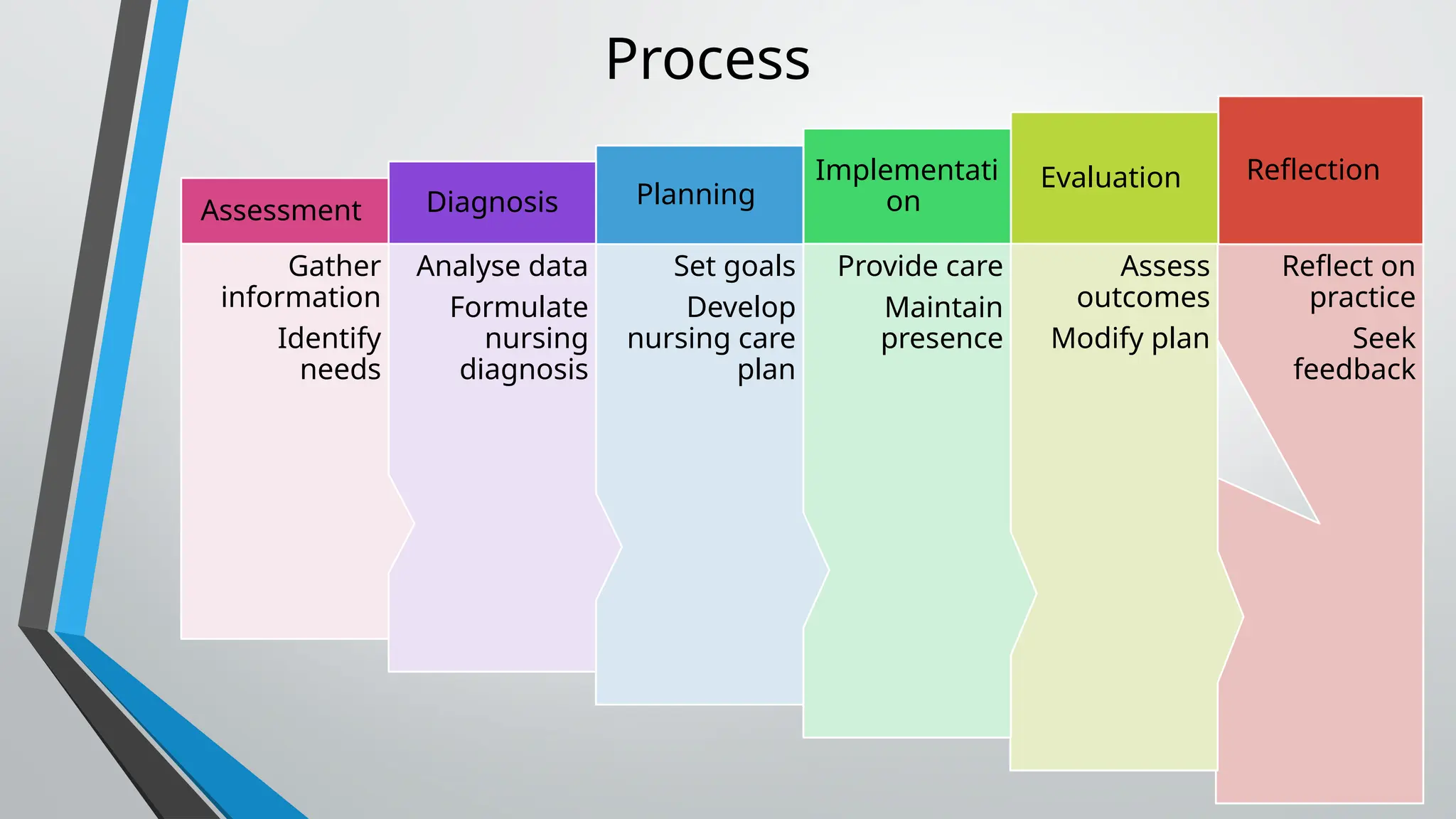
Caring- process
 The process of caring in nursing is a systematic approach
that ensures holistic, patient-centered care.
Process
Reflect on
practice
Seek
feedback
Reflection
Assess
outcomes
Modify plan
Evaluation
Provide care
Maintain
presence
Implementati
on
Set goals
Develop
nursing care
plan
Planning
Analyse data
Formulate
nursing
diagnosis
Diagnosis
Gather
information
Identify
needs
Assessment
Process
 1. Assessment
• Gather Information: Collect comprehensive data about the patient's physical,
emotional, social, and spiritual health through observations, interviews,
physical examinations, and medical history reviews.
• Identify Needs: Determine the patient's needs, preferences, and concerns,
including pain levels, mobility issues, emotional state, and support systems.
Contd.
 2. Diagnosis
• Analyze Data: Analyze the collected information to identify actual or
potential health problems.
• Formulate Nursing Diagnoses: Develop nursing diagnoses that address the
patient's health issues, which guide the planning and implementation of care.
 3. Planning
• Set Goals: Collaborate with the patient and their family to set realistic,
patient-centered goals and outcomes.
• Develop Care Plan: Create a comprehensive care plan that outlines the
interventions needed to achieve the set goals, considering the patient's
preferences and cultural background.
contd
 4. Implementation
• Provide Care: Deliver the planned interventions, which may include
administering medications, providing emotional support, assisting with daily
activities, and educating the patient and their family.
• Maintain Presence: Be physically and emotionally present with the patient,
offering a supportive and reassuring presence.
 5. Evaluation
• Assess Outcomes: Evaluate the effectiveness of the care provided by
assessing whether the patient's goals and outcomes have been met.
• Modify Plan: Adjust the care plan as needed based on the patient's progress
and any changes in their condition.
Contd..
 6. Reflection
• Reflect on Practice: Reflect on the care provided, considering what went
well and what could be improved.
• Seek Feedback: Obtain feedback from the patient and their family about
their care experience to continuously improve nursing practice.
2. Compassion: Sympathy Vs empathy,
Altruism
 Compassion is the emotional response of empathy and understanding towards
the suffering of others, coupled with a genuine desire to alleviate that
suffering.
 Compassion goes beyond mere sympathy; it includes a proactive element of
wanting to make a difference.
Sympathy vs empathy
Criteria Sympathy Empathy
Definition: Sympathy involves feeling pity or sorrow for
someone else's misfortune.
Empathy is the ability to understand and
share the feelings of another person.
Emotional Distance or
connection
It maintains a certain level of emotional
distance; you feel for the person but do not
necessarily share their emotional experience.
It involves a deeper emotional
connection, where you put yourself in
the other person's shoes and experience
their emotions as if they were your own.
Perspective: Sympathy is more about acknowledging
someone's pain and offering comfort from an
external standpoint.
Empathy requires seeing the situation
from the other person's perspective.
Expression: It often manifests as expressions of concern,
such as saying, "I'm sorry for your loss."
It often involves reflective listening and
responses that show you truly grasp
what the other person is going through,
such as saying, "I can imagine how
difficult this must be for you."
feeling for someone feeling with someone.
Altruism
 Regard for others, both natural and moral without regard for oneself,
devotion to the interests of others, brotherly kindness.
 Philanthropy
 Misanthropy- opposite
 Altruism is the selfless concern for the well-being of others. It involves
actions or behaviors aimed at benefiting others without expecting anything in
return, often at a personal cost.
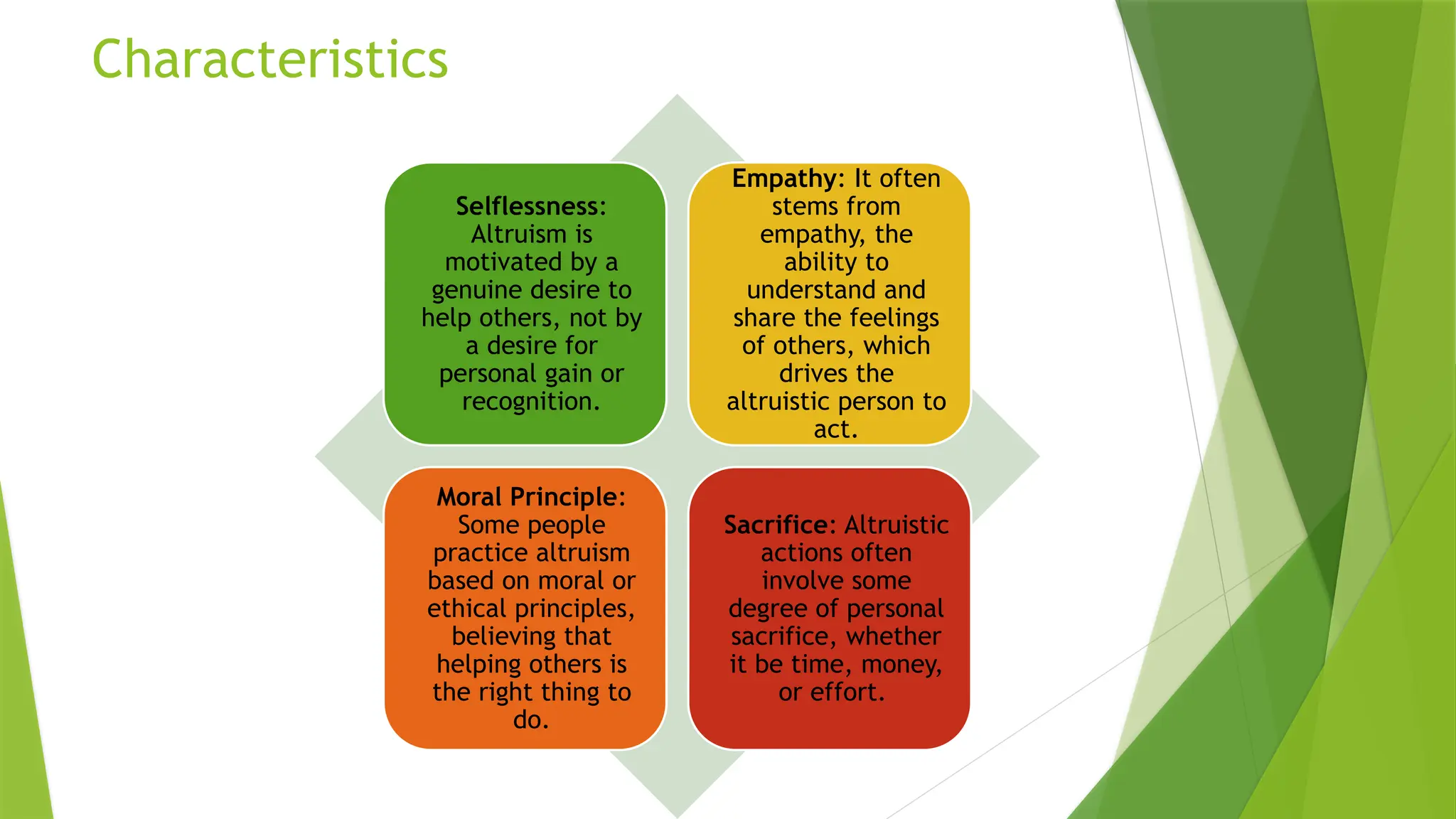
Characteristics
Selflessness:
Altruism is
motivated by a
genuine desire to
help others, not by
a desire for
personal gain or
recognition.
Empathy: It often
stems from
empathy, the
ability to
understand and
share the feelings
of others, which
drives the
altruistic person to
act.
Moral Principle:
Some people
practice altruism
based on moral or
ethical principles,
believing that
helping others is
the right thing to
do.
Sacrifice: Altruistic
actions often
involve some
degree of personal
sacrifice, whether
it be time, money,
or effort.
Nursing
 Altruism in Nursing leads to better patient care, a
supportive work environment, professional growth,
improved patient outcomes, and ethical practice.
 Historically it is being exploited by employers. If nurses
ask for salary hikes, their altruism will be questioned.
 Primary component of life- work? In and out of jobs-
retarded the development of professional attitudes and
behaviours for the profession as a whole.
Salary and service??
 Altruism in Nursing is essential for providing
compassionate care, but it must be balanced with fair
compensation to ensure the well-being, motivation, and
professional growth of nurses.
 Adequate salaries support the sustainability of altruistic
care, prevent burnout, and enhance job satisfaction,
leading to better patient outcomes and a more effective
healthcare system.
No altruism, what will happen?
 Decreased Quality of Patient Care:
1. Lack of Compassion: Without altruism, nurses may not provide the
same level of compassionate care, leading to patients feeling
neglected or less valued.
2. Minimal Effort: Nurses might only do the bare minimum required by
their duties, potentially overlooking the individual needs and
emotional well-being of patients.
3. Poor Patient Experience: The absence of altruistic behavior can
result in a less comforting and supportive environment for patients,
negatively affecting their overall experience and satisfaction with the
care they receive.
contd
 Impact on Patient Outcomes:
1. Delayed Recovery: Compassionate care has been linked
to better patient outcomes and faster recovery. Without
altruism, the healing process may be slower due to a lack
of emotional and psychological support.
2. Increased Stress: Patients may experience higher levels of
stress and anxiety if they feel their caregivers are
indifferent, which can further complicate their medical
conditions and recovery.
contd
 Work Environment and Team Dynamics:
1. Decreased Team Cohesion: Altruism promotes teamwork
and cooperation among nursing staff. Without it, there
may be less collaboration and support within the team,
leading to a more fragmented and less effective work
environment.
2. Higher Turnover: A lack of altruism can lead to job
dissatisfaction and burnout, increasing turnover rates
among nurses and causing staffing issues.
contd
 Professional and Ethical Standards:
1. Erosion of Ethical Care: Nursing is guided by ethical principles such as
beneficence, which requires acting in the best interests of patients. Without
altruism, adherence to these ethical standards may decline.
2. Compromised Professionalism: Altruism is a core value in nursing that
upholds the profession's reputation. Its absence can compromise the
perceived professionalism and integrity of nurses.
 Patient Trust and Relationship:
1. Reduced Trust: Patients are more likely to trust nurses who demonstrate
genuine care and concern. Without altruism, this trust can be eroded, making
patients less likely to communicate openly or adhere to treatment plans.
2. Weaker Patient-Nurse Relationships: Strong therapeutic relationships
between patients and nurses are crucial for effective care. Altruism fosters
these relationships, and without it, the connection and rapport between
patients and nurses may weaken.
contd
 Overall Healthcare Outcomes:
1. Lower Quality of Care: The overall quality of healthcare
can decline without altruistic nurses, as patient-centered
care is compromised.
2. Increased Healthcare Costs: Poor patient outcomes and
higher turnover rates can lead to increased healthcare
costs due to longer hospital stays, readmissions, and the
need for additional staffing.
3. Conscientiousness
 It describes a person's ability to be organized, dependable, disciplined, and goal-
oriented. Conscientious individuals tend to be thorough, careful, and diligent in
their approach to tasks and responsibilities.
 Characteristics of Conscientiousness:
1. Organization: Conscientious people are typically well-organized and detail-
oriented. They plan their activities and manage their time effectively.
2. Dependability: They are reliable and can be counted on to follow through with
commitments and responsibilities.
3. Discipline: Conscientious individuals have a strong sense of self-discipline and can
control their impulses. They are able to delay gratification to achieve long-term
goals.
4. Goal-Oriented: They set clear goals and work persistently to achieve them. They
are motivated by a sense of duty and accomplishment.
5. Thoroughness: They pay attention to detail and ensure that their work is
completed accurately and to a high standard.
4. Dedication/devotion to work
 Dedication refers to the quality of being committed or
devoted to a task or purpose. It implies a strong sense of
responsibility and enthusiasm toward achieving a goal.
 Devotion to work as a nurse encompasses a deep
commitment to providing high-quality care and support to
patients. It involves a combination of professional skills,
empathy, and a strong ethical foundation.
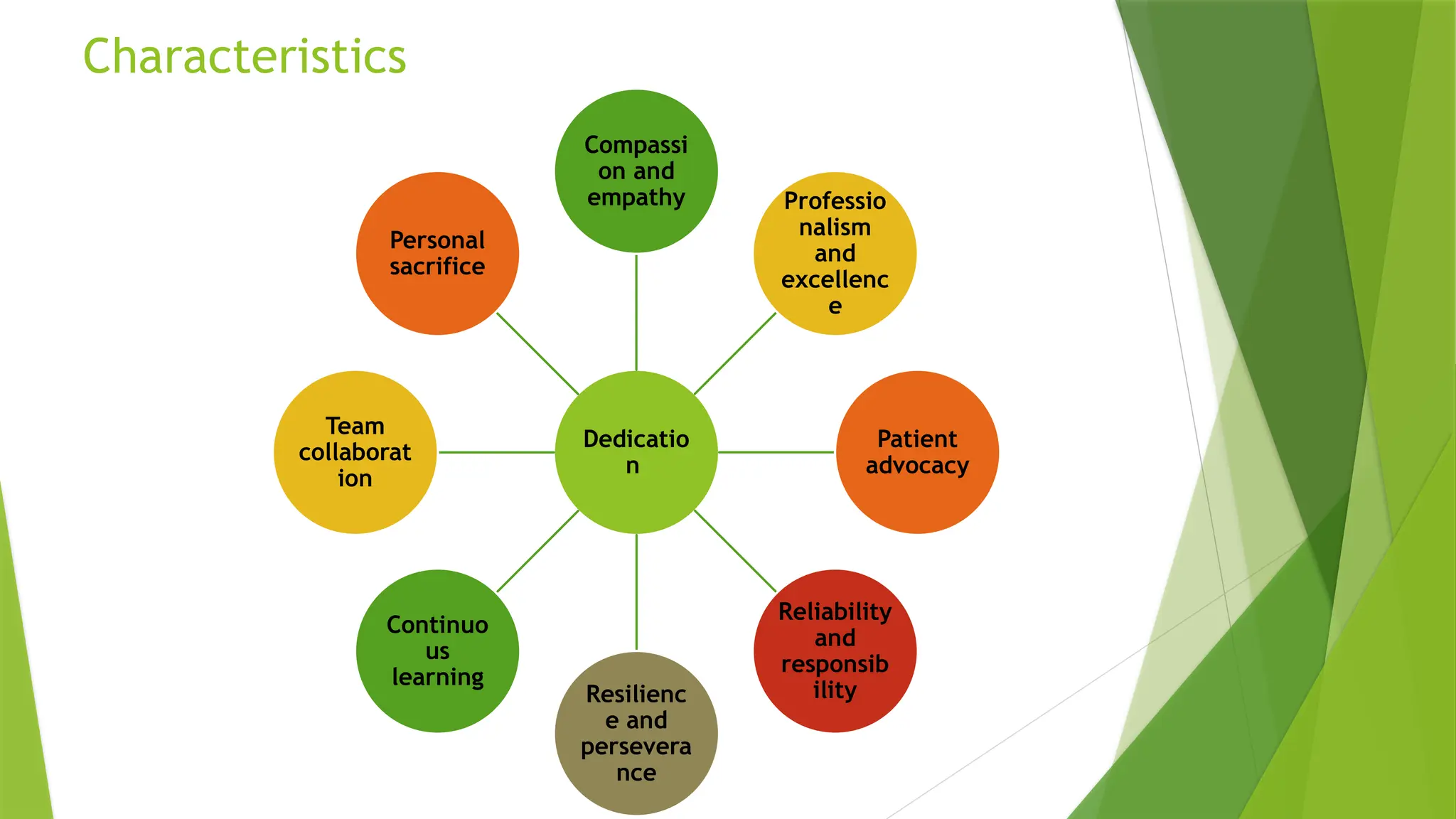
Characteristics
Dedicatio
n
Compassi
on and
empathy Professio
nalism
and
excellenc
e
Patient
advocacy
Reliability
and
responsib
ility
Resilienc
e and
persevera
nce
Continuo
us
learning
Team
collaborat
ion
Personal
sacrifice
5. Respect for the person-
Human dignity
 Human dignity is a concept that refers to the inherent worth
and value of every individual.
 It is the recognition that every person possesses an intrinsic
worth that should be respected and protected, regardless of
their status, abilities, or circumstances.
 Universal Declaration of Human Rights states in its preamble
that "recognition of the inherent dignity and of the equal
and inalienable rights of all members of the human family is
the foundation of freedom, justice, and peace in the world."
How to maintain human dignity?
 Treat each patient as an individual with unique needs,
preferences, and experiences.
 Show respect for patients' cultural, religious, and personal
beliefs, and accommodate them whenever possible.
 Listen attentively to patients' concerns, questions, and
preferences.
 Provide clear and understandable information
 Protect patients' personal and medical information.
 Conduct examinations and conversations in a private
setting to maintain patients' dignity.
contd
 Show empathy by acknowledging patients' emotions and experiences.
 Use touch appropriately
 Obtain informed consent for procedures and treatments.
 Involve patients in their care planning
 Treat all patients equally and avoid personal biases
 Advocate for patients' rights and needs
 Take patient complaints and concerns seriously, and work to resolve
issues promptly and effectively.
6. Privacy and confidentiality: Incidental
disclosure
 Store patient records securely, whether they are in paper or electronic form.
Ensure that only authorized personnel have access.
 Follow established policies and protocols regarding the handling and sharing
of patient information.
 Conduct conversations about patient care in private settings, away from
public areas where unauthorized individuals might overhear.
 Use private rooms or enclosed areas for patient examinations and discussions
to ensure privacy.
 Control noise levels
 Avoid using full names or other easily recognizable personal details.
Contd…
 Ensure that patient records, charts, and other documents are covered or
turned away from public view when not in use.
 Participate in regular training on privacy and confidentiality to stay updated
on best practices and legal requirements.
 Obtain explicit consent from patients before sharing their information with
third parties, except when required by law.
 Conduct regular audits of privacy practices
 Report any breaches of confidentiality immediately
 Have plans in place to mitigate the impact of any breaches, including
informing affected patients and taking corrective action to prevent future
incidents.
Incident disclosure
 Incidental disclosure refers to the unintentional or secondary exposure
of personal or sensitive information to individuals who are not the
intended recipients. In healthcare settings, this can happen during the
normal course of providing care, even when appropriate safeguards
are in place.
 Examples
 Healthcare providers discussing a patient's care in a hallway where
others might overhear.
 Patients in shared rooms overhearing conversations
 Patient records or computer screens visible to unauthorized individuals
 Patient information written on whiteboards
 Phone conversations about patient care overheard
Measures to prevent incident disclosure
 Conduct sensitive conversations in private rooms or areas whenever
possible.
 Position computer screens and patient records so they are not easily
visible to unauthorized individuals.
 Speak in low voices when discussing patient information in areas
where others might overhear.
 Use privacy filters on computer screens
 Ensure that documents containing patient information are disposed of
securely, such as through shredding.
 Regular training and clear policies
 Use physical barriers, such as partitions or curtains, to separate
patient areas.
7. Honesty and integrity: Truth telling
 Honesty in Nursing involves clear, truthful communication with
patients, families, and colleagues.
 Nurses should provide accurate information about diagnoses,
treatments, and prognoses, and must promptly admit and
rectify any errors. Upholding honesty also means respecting
patient confidentiality and consent, ensuring that patients are
fully informed about their care.
 Patients trust healthcare providers to be honest about their
conditions, treatments, and prognoses.
 Nurses have a professional and ethical obligation to provide
accurate information to patients, respecting their autonomy and
right to know.
 Honesty about risks, side effects, and expected outcomes helps
prevent misunderstandings and ensures patient safety during
treatment.
8. Trust and credibility: Fidelity, Loyalty
 Trust- confidence in or reliance on some reason or quality
 Credibility- reputation impacting one’s ability to be believed
 Fidelity- faithfulness to one’s duties
 Loyalty- faithfulness or devotion to some person, cause or nation
Importance of trust and credibility
Patient Compliance and
Outcomes
• Patients are more likely
to follow medical
advice and treatment
plans if they trust their
nurses. Trust fosters
open communication,
allowing patients to
share vital information
• Nurses with a
reputation for
competence and
reliability are
perceived as credible.
Patient safety
• Openness can prevent
medical errors
• Vigilant nurses reduce
mistakes
Professional relationships
and teamwork
• Better communication,
supportive work
environment,
coordinated care
• Their expertise and
reliability makes them
valuable team
members
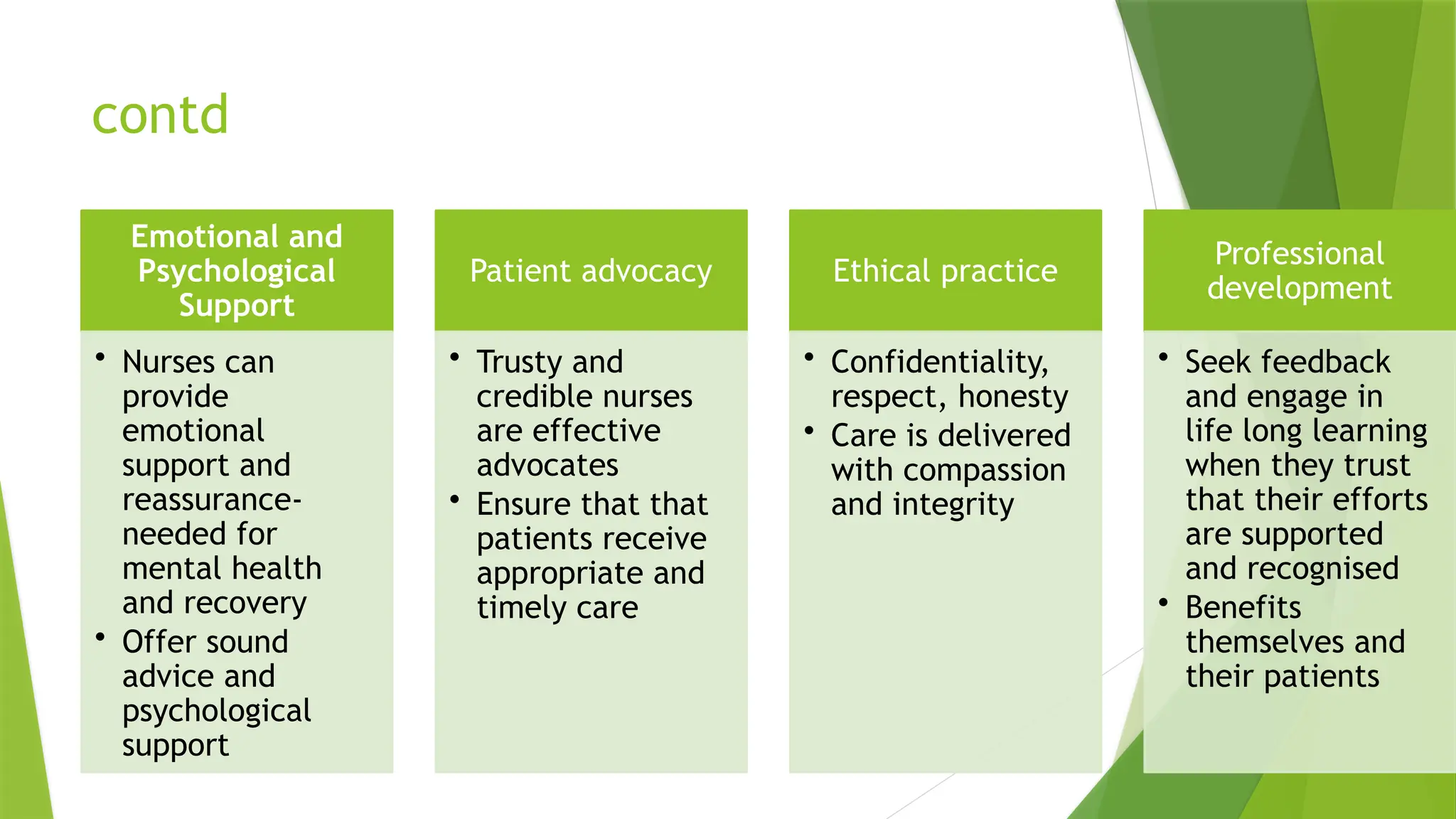
contd
Emotional and
Psychological
Support
• Nurses can
provide
emotional
support and
reassurance-
needed for
mental health
and recovery
• Offer sound
advice and
psychological
support
Patient advocacy
• Trusty and
credible nurses
are effective
advocates
• Ensure that that
patients receive
appropriate and
timely care
Ethical practice
• Confidentiality,
respect, honesty
• Care is delivered
with compassion
and integrity
Professional
development
• Seek feedback
and engage in
life long learning
when they trust
that their efforts
are supported
and recognised
• Benefits
themselves and
their patients
Fidelity in Nursing
Fidelity in Nursing encompasses a broad range of
behaviors and attitudes that reflect a deep commitment
to ethical practice, patient care, and professional
integrity.
By upholding fidelity, nurses maintain the trust and
respect of their patients, colleagues, and the broader
healthcare community, ensuring high-quality,
compassionate, and ethical care.
Characteristics of fidelity
 Commitment to Patients- Nurses are committed to prioritize their patients' well-
being and interests. This includes advocating for patients, respecting their choices,
and ensuring their safety.
 Adherence to Ethical Principles- Protecting patient privacy and confidentiality is a
fundamental ethical obligation. Fidelity involves safeguarding sensitive information
and only sharing it with authorized individuals.
 Professional Integrity- Nurses are accountable for their actions and decisions.
Reliability and reliability include punctuality, thoroughness, and a commitment to
ongoing education and skill development.
 Respect for Colleagues-Being a good mentor, sharing expertise, and helping
colleagues through difficult times is a sign of professional integrity.
 Advocacy and Moral Courage-involve challenging unethical practices or policies.
 Commitment to Professional Standards-Adhering to established standards of
practice and guidelines ensures that nursing care is safe, effective, and evidence-
based.
 Empathy and Compassion
Loyalty
 Patient loyalty is essential to nursing practice.
 Advocacy, secrecy, reliability, decency, honesty, dedication to high-
quality care, and emotional support are all involved.
 To guarantee that patients receive the finest care and support possible,
nurses can establish solid, trustworthy connections with their patients
by living up to these principles.
Professional values in Nursing-
continuing…..
1. Caring: definition, and process
2. Compassion: Sympathy Vs empathy, Altruism
3. Conscientiousness
4. Dedication/devotion to work
5. Respect for the person- Human dignity
6. Privacy and confidentiality: Incidental disclosure
7. Honesty and integrity: Truth telling
8. Trust and credibility: Fidelity, Loyalty
9. Advocacy: Advocacy for patients, work environment, nursing education and
practice, and for advancing the profession
9. Advocacy: Advocacy for patients, work environment, nursing
education and practice, and for advancing the profession
Advocacy for patients
 Patient advocates are nurses who realise that policies are important and
govern most situations well but occasionally can , and should, be broken.
 Health care institutions often employ patient advocates.
 Nurses should value patient self determination- patient independence and
decision making
 Nurses may sometimes bend the rules when it is in the patient’s best interests
and doing so will harm no one else.
Advocacy in work situations
 Nursing advocacy embraces activities including education, lobbying, and
individual and collective advocacy in order to advance nursing’s agenda.
 Individual nurses may use the tools of collective bargaining or workplace
advocacy to achieve their objectives
 There are associations who uses organising and collective bargaining to help
members reach their goals such as ending mandatory overtime and improving
staffing levels through legally binding negotiated contract language
 It also uses advocacy strategies such as educational campaigns that seek to
provide skills for nurses to use in their individual work settings
 Federal lobbying, media campaigns etc can be organised to support the core
issues of nursing- nursing shortage, appropriate staffing, patient safety and
advocacy, workplace health and safety and workplace rights.
 In India too such activities are carried out
Advocacy for work environment
 Educate yourself- labour laws, regulations
 Join a group- nursing advocacy group
 Communicate- encourage open communication and engage in direct communication
with stake holders
 Collaborate- promote teamwork and collaboration with colleagues to develop and
maintain a practice environment that support nurses
 Advocate for yourself- for fair treatment and work together to combat unfair hours
and workloads
 Make safety a priority- support a culture of safety and make sure the physical work
environment is clean, organised and well maintained. A zero tolerance policy
against bullying, intimidation, and harassment should be practised
 Provide resources- that enable quality nursing such as ongoing training and
education access to mental health support services and technology solutions
 Promote wellness- encourage programs focused on physical, mental and emotional
wellness and healthy habits
 Recognise the value-support a positive work-life balance and recognise nurses’ value
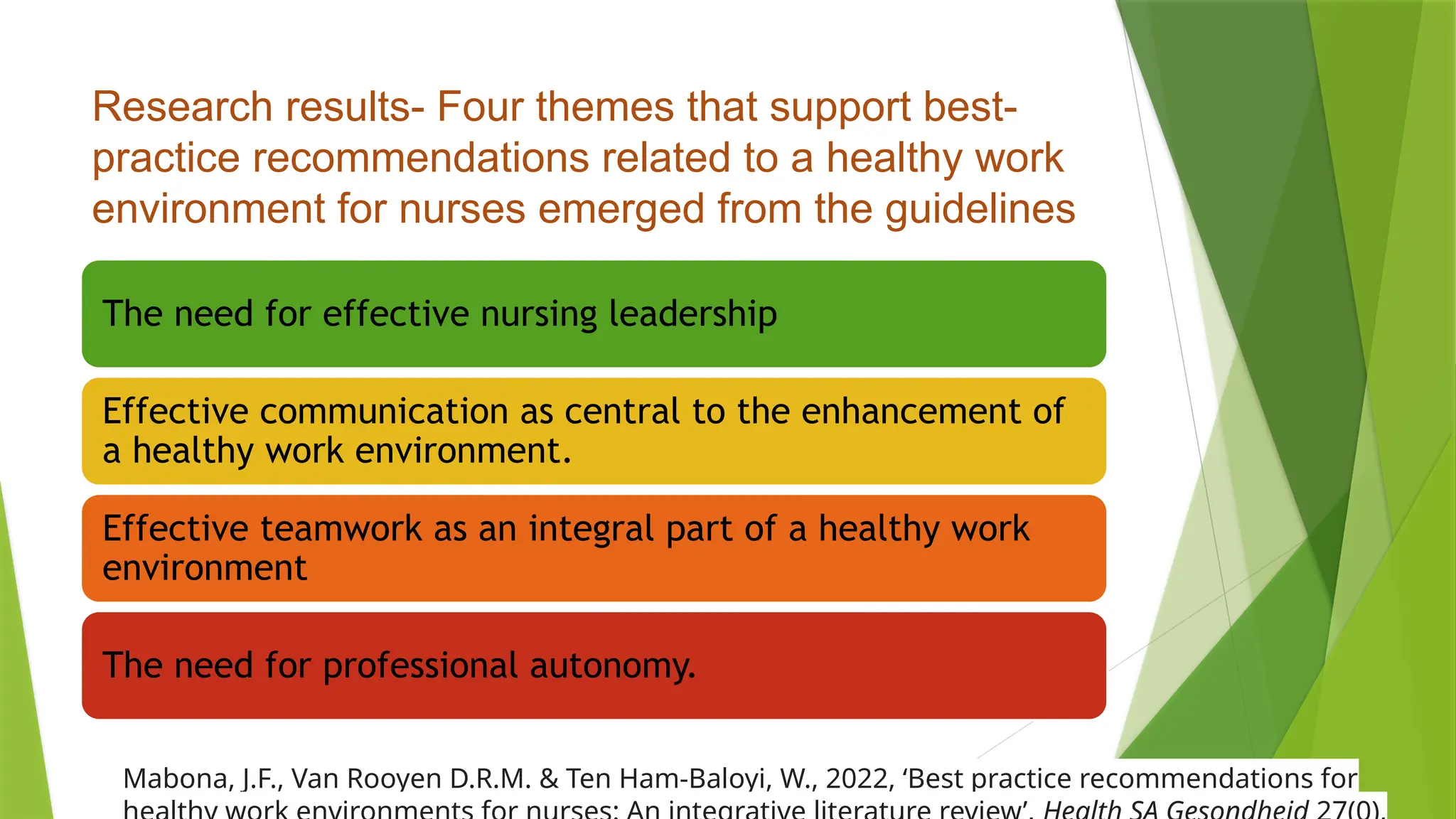
Research results- Four themes that support best-
practice recommendations related to a healthy work
environment for nurses emerged from the guidelines
The need for effective nursing leadership
Effective communication as central to the enhancement of
a healthy work environment.
Effective teamwork as an integral part of a healthy work
environment
The need for professional autonomy.
Mabona, J.F., Van Rooyen D.R.M. & Ten Ham-Baloyi, W., 2022, ‘Best practice recommendations for
Advocacy for education and practice
 Engage in Professional Organizations
 These organizations often have advocacy arms that focus on
policy changes and improvements in nursing education and
practice.
 Workshops and conferences provide platforms to learn about
the latest advancements, network with other professionals,
and discuss issues impacting the profession.
 Policy Advocacy
 Keep up-to-date with local, state, and national policies that
affect nursing practice and education. Write letters, make
phone calls, or visit lawmakers to discuss the importance of
legislation that supports nursing education and practice
improvements. Engage in organized efforts to support or
oppose specific health policies or regulations.
Advocacy for education and practice
contd
 Education and Mentorship
 Pursue advanced degrees or certifications to stay current
with the latest in nursing education and practice.
 Take on roles as educators or mentors to new nurses,
sharing knowledge and fostering a culture of continuous
improvement.
 Create and advocate for in-service training and continuing
education programs to keep nursing staff updated on best
practices and new developments.
contd
 Research and Evidence-Based Practice
 Engage in research activities to contribute to the body of
knowledge in nursing. Publish findings to influence practice
and education standards.
 Collaboration and Interprofessional Work
 Serve on committees or boards that focus on healthcare
quality and education.
 Community Engagement and Public Awareness
 Engage with the community to educate the public about
the nursing profession and the importance of high-quality
nursing education and practice. Participate in or organize
health fairs, vaccination drives, and other community
health initiatives.
contd
 Advocating for Resources
 Advocate for increased funding for nursing education
programs and for the resources needed to support high-
quality clinical practice.
 Use of Technology
 Advocate for the integration of modern technology in
nursing education and practice, such as simulation labs,
electronic health records, and telehealth services. Ensure
that nursing curricula include training on the latest
healthcare technologies and informatics.
Advocacy for advancing the profession
 Continuing Education and Professional Development
 Engage in Professional Organizations
 Advocate for Policy Changes
 Mentorship and Education
 Research and Evidence-Based Practice
 Interdisciplinary Collaboration
 Community Involvement
 Advocate for Workplace Improvements
The end unit II

Professionalism and values in Nursing.pptx

  • 1.
  • 2.
    PROFESSIONALISM  PROFESSIONALISM ProfessionDefinition of profession Criteria of a   profession Nursing as a profession Professionalism Definition and   characteristics of professionalism Concepts, attributes and indicators of  professionalism Challenges of professionalism o Personal identity vs  professional identity o Preservation of selfintegrity: threat to integrity, Deceiving patient: withholding information and falsifying records o Communication & Relationship with team members: Respectful and open communication and relationship pertaining to relevant interests for ethical decision making o Relationship with patients and society
  • 3.
     Professional ConductFollowing ethical principles Adhering to policies,   rules and regulation of the institutions Professional etiquettes and  behaviors Professional grooming: Uniform, Dress codeProfessional  boundaries: Professional relationship with the patients, caregivers and team members
  • 4.
     Regulatory Bodies& Professional Organizations:  Roles & Responsibilities Regulatory bodies:   Indian Nursing Council,  State Nursing Council   Professional Organizations:  Trained Nurses Association of India (TNAI),  Student Nurses Association (SNA),  Nurses League of Christian Medical Association of India,  International Council of Nurses (ICN) and  International Confederation of Midwives
  • 5.
     PROFESSIONAL VALUESValues: Definition and characteristics of values   Value clarification Personal and professional values Professional   socialization: Integration of professional values with personal values Professional values in nursing Importance of professional values in nursing  and health care Caring: definition, and process Compassion: Sympathy Vs   empathy, Altruism Conscientiousness Dedication/devotion to work    Respect for the personHuman dignity Privacy and confidentiality: Incidental  disclosure Honesty and integrity: Truth telling Trust and credibility:   Fidelity, Loyalty Advocacy: Advocacy for patients, work environment,  nursing education and practice, and for advancing the profession
  • 6.
     ETHICS &BIOETHICS Definitions: Ethics, Bioethics and Ethical Principles  Beneficence Non-maleficence: Patient safety, protecting patient from harm,  Reporting errors Justice: Treating each person as equal Care without   discrimination, equitable access to care and safety of the public Autonomy:  Respects patients‘ autonomy, Selfdetermination, Freedom of choice Ethical issues and ethical dilemma: Common ethical problems Conflict of interest   Paternalism Deception Privacy and confidentiality Valid consent and    refusal Allocation of scarce nursing resources Conflicts concerning new   technologies  Whistle-blowing  Beginning of life issues • Abortion • Substance abuse • Fetal therapy • Selective deduction • Intrauterine treatment of fetal conditions • Mandated contraception • Fetal injury • Infertility treatment End of life issues • End of life • Euthanasia • Do Not Resuscitate  (DNR) Issues related to psychiatric care • Non compliance • Restrain and  seclusion Refuse to take food 
  • 7.
     Process ofethical decision making Assess the situation (collect information) Identify the ethical   problem Identify the alternative decisions Choose the solution to the ethical decision Implement    the decision Evaluate the decision Ethics committee: Roles and responsibilities Clinical decision   making Research  Code of Ethics International Council of Nurses (ICN) Indian Nursing Council   Patients’ Bill of Rights17 patients’ rights (MoH & FW, GoI)  1. Right to emergency medical care  2. Right to safety and quality care according to standards  3. Right to preserve dignity  4. Right to nondiscrimination  5. Right to privacy and confidentiality  6. Right to information  7. Right to records and reports  8. Right to informed consent  9. Right to second opinion  10. Right to patient education  11. Right to choose alternative treatment options if available  12. Right to choose source for obtaining medicines or tests  13. Right to proper referral and transfer, which is free from perverse commercial influences  14. Right to take discharge of patient or receive body of deceased from hospital  15. Right to information on the rates to be charged by the hospital for each type of service provided and facilities available on a prominent display board and a brochure  16. Right to protection for patients involved in clinical trials, biomedical and health research  17. Right to be heard and seek redressal
  • 8.
     . AnnZwemer. Professional Adjustments and Ethics for Nurses in India, Ecumenical Book Services, Chennai 2. Carvalho S. Reeves, M Orford J. Fundamental Aspects of Legal, Ethical and Professional Issues in Nursing, United Kingdom: Quay. 3. Herman Wheeler Law, Ethics and Professional Issues for Nursing - A Reflective and Portfolio-Building Approach, Routledge Taylor and Francis group, London. 4. Joyce Beebe Thompson, Professional Ethics in Nursing, R.E. Krieger Publishing Company. 5. I Clement. Professional Trends and Adjustments in Nursing, Jaypee Publishers Medical Publishers, New Delhi. 6. Beth Perry Black. Professional Nursing: Concepts and Challenges, Elsevier Saunders publishers, Philadelphia. 7. Janie B. Butts, Karen L. Rich. Nursing Ethics- Across the curriculum and in to Practice, Jones & Bartlett Learning. United States. 8. Olinda Timms. Biomedical Ethics, Elsevier
  • 9.
  • 10.
    Profession  Definition ofprofession  Criteria of a profession  Nursing as a profession
  • 11.
    Profession- definition  Dictionarymeaning  An occupation, trade, craft or activity in which one has a professed expertise in a particular area  A job especially one requiring a high level of skill or training
  • 12.
    Definition  Profession isdefined as an occupational group with a set of attitudes. Chitty KK,2005  A paid occupation, especially one that involves prolonged training and a formal qualification
  • 13.
    Criteria  They arestandards of judging something
  • 14.
    CRITERIA- GENEVIEVE K,ROY K BIXLER INTELLECTUAL SCIENTIFIC REQUIRES HIGHER EDUCATION ESSENTIAL SELF GOVERNING SERVICE ORIENTED PROFESSIONAL DEVELOPMENT AND ECONOMIC SECURITY
  • 15.
    Criteria contd.. 1. Utilizesin its practice a well defined and well organised body of specialized knowledge which is on the intellectual level of higher learning 2. Constantly enlarges the body of knowledge, its uses and improves its techniques of education and service by the use of the scientific method 3. Entrusts the education of its practitioners to institutions of higher education 4. Applies its body of knowledge in practical services which are vital to human and social welfare 5. Functions autonomously in the formulation of professional policy and in the control of professional activity thereby 6. Attracts individuals of intellectual and personal qualities who exalt service above personal gain and who recognise their chosen occupation as a life work 7. Strives to compensate its practitioners by providing freedom of action, opportunity for continuous professional growth and economic security
  • 16.
    FLEXNER  Is intellectualand is accompanied by a high degree of individual responsibility  Is based on a body of knowledge that can be learned and is refreshed and refined through research  Is practical, in addition to being theoretical  Can be taught through a process of highly specialised professional education  Has a strong internal organisation of members and a well developed group consciousness  Has practitioners who are motivated by altruism and who are responsive to public interests
  • 17.
    Richard h Hall-five indicators Use of a professional organisation as a primary point of reference Belief in the value of public service Belief in self regulation Commitment to profession that goes beyond economic incentives A sense of autonomy in practice
  • 18.
    Nursing as aprofession  Service  Art  Science  Closer to a true profession  Professional nurse
  • 19.
    Professional nurse  Intellectualor mechanical  Latest trends  Practical application  Share knowledge  Belong to professional organisations  Interpret profession to public  Concern for human element
  • 20.
  • 21.
  • 22.
    Evolution  Practitioners performedfull time work in the discipline  Determined work standards  Identified a body of knowledge  Established educational programmes in institutions of higher learning  Promoted organisations into effective occupational associations  Worked towards legal protection that limited practice of their unique skills by outsiders  Established code of ethics  Process of professionalization  “Emerging profession”
  • 23.
  • 24.
    Definition of Professionalism Professionalism refers to the conduct, aims, or qualities that characterize a profession or a professional person. It encompasses a set of values, behaviors, and attitudes that are expected in a professional setting, ensuring that individuals perform their roles competently, ethically, and with integrity.
  • 25.
    Characteristics of Professionalism 1.Competence: Professionals possess the necessary skills, knowledge, and abilities to perform their tasks effectively. This involves continuous learning and staying updated with the latest developments in their field. 2. Ethical Behavior: Adhering to moral principles and standards, such as honesty, integrity, and fairness. Professionals are expected to make decisions that are ethically sound and to avoid conflicts of interest. 3. Accountability: Taking responsibility for one’s actions and decisions. Professionals are accountable to their clients, employers, and the public, and they accept the consequences of their actions. 4. Reliability: Consistency in performance and dependability. A professional can be counted on to meet commitments and deadlines. 5. Respect: Treating colleagues, clients, and others with dignity and consideration. This includes effective communication, listening to others, and valuing diverse perspectives. 6. Appearance: Presenting oneself in a manner appropriate to the workplace. This often includes adhering to dress codes and maintaining a neat and professional demeanor.
  • 26.
    Concepts and Attributesof Professionalism 1. Altruism: Prioritizing the welfare of others and contributing positively to the community and society. 2. Autonomy: Exercising independent judgment and making decisions based on professional knowledge and expertise. 3. Commitment: Demonstrating dedication to the profession and striving for excellence in all professional endeavors. 4. Integrity: Maintaining honesty and strong moral principles, even when faced with personal or professional challenges. 5. Respect for others: Valuing and considering the feelings, needs, and perspectives of others, whether they are colleagues, clients, or members of the public. 6. Self-regulation: Adhering to the codes of conduct and ethical guidelines set by professional bodies and being proactive in self-assessment and improvement.
  • 27.
    Concept of professionalismin Nursing- Miller BK,1987, 2001 Education in university setting and scientific background in Nursing Adherence to Code for Nurses Theory deve, use, evaluation Community service orientation Continuing education, competence Research- dev,use,evaluat ion Self regulatory, autonomy Professional org participation Publication and communication
  • 28.
    Indicators of Professionalism 1.Certification and Licensing: Obtaining and maintaining credentials that demonstrate expertise and compliance with industry standards. 2. Continuing Education: Engaging in ongoing learning and professional development activities to stay current in one’s field. 3. Professional Associations: Active membership and participation in professional organizations that set standards and provide resources for the profession. 4. Performance Evaluations: Regular assessments of one’s work by supervisors or peers, demonstrating a commitment to quality and improvement. 5. Adherence to Standards: Following industry best practices, regulations, and ethical guidelines. 6. Professional Relationships: Building and maintaining positive relationships with colleagues, clients, and other stakeholders.
  • 29.
    Challenges of Professionalism 1.Balancing Personal and Professional Life: Maintaining a healthy work-life balance can be difficult, leading to stress and burnout. 2. Ethical Dilemmas: Navigating complex ethical issues where the right course of action is not always clear. 3. Maintaining Competence: Keeping up with rapid advancements in technology and changes in the industry requires continuous effort and learning. 4. Managing Expectations: Meeting the high expectations of clients, employers, and society while maintaining personal and professional integrity. 5. Dealing with Conflicts: Resolving conflicts that arise with colleagues, clients, or within the organization in a professional manner. 6. Pressure to Conform: Facing pressure to conform to organizational culture or practices that may conflict with personal values or ethical standards.
  • 30.
    Challenges to professionalismin Nursing  Personal identity vs professional identity  Preservation of self-integrity:  A threat to integrity,  Deceiving patient: withholding information and falsifying records  Communication & Relationship with team members: Respectful and open communication and relationship about relevant interests for ethical decision-making  Relationship with patients and society
  • 31.
    1.Personal identity vsprofessional identity  Personal identity refers to an individual's unique characteristics, experiences, values, beliefs, and personality traits that define who they are.  For a nurse, personal identity includes their motivations for entering the nursing profession, their values like compassion and empathy, and their life experiences shaping how they interact with patients and colleagues.  This identity influences how they approach work, manage stress, and maintain work-life balance.  Professional Identity: Professional identity as a nurse involves the integration of personal identity with the roles, responsibilities, and standards of the nursing profession.  It includes the knowledge, skills, and competencies acquired through education and experience and adherence to ethical standards and professional codes of conduct.  A nurse’s professional identity is characterized by a commitment to patient care, collaboration with healthcare teams, continuous learning, and advocacy for patients' rights and well-being.
  • 32.
    Personal and professionalintegrity  Personal Integrity: Personal integrity refers to the adherence to moral and ethical principles in one’s personal life. It involves being honest, trustworthy, and consistent in actions and beliefs, regardless of external pressures.  Professional Integrity: Professional integrity, on the other hand, pertains to ethical conduct within the workplace and professional settings. It involves adhering to the standards and codes of conduct specific to one's profession. This includes maintaining confidentiality, being impartial, delivering quality work, and avoiding conflicts of interest. Professional integrity is critical for maintaining trust with colleagues, clients, and the broader community.  Key Differences: 1. Context: Personal integrity is exercised in everyday life, while professional integrity is specific to professional environments. 2. Guiding Principles: Personal integrity is guided by individual values, whereas professional integrity is often guided by formal codes of ethics and professional standards. 3. Accountability: Personal integrity is often self-regulated, whereas professional integrity is regulated by professional bodies and workplace policies.
  • 33.
    2.Preservation of selfintegrity  Preservation of self-integrity refers to maintaining a sense of self-worth and coherence in one's identity despite challenges or external pressures. It involves upholding personal values, beliefs, and ethics even when faced with adversity or temptation to compromise.  Key aspects 1. Self-Awareness: Understanding one's core values, strengths, and weaknesses. 2. Consistency: Acting in ways that are congruent with one's beliefs and principles. 3. Boundaries: Setting and maintaining limits to protect one's values and well- being. 4. Authenticity: Being true to oneself in thoughts, words, and actions. 5. Resilience: The ability to bounce back and stay true to oneself after setbacks or failures.
  • 34.
    Nursing- threat tointegrity  Emotional and physical exhaustion  Moral distress  Workplace violence and bullying  Lack of autonomy  Role strain and identity confusion  Underappreciation and low compensation  Exposure to traumatic events  Ethical dilemmas
  • 35.
    Strategies to MitigateThese Threats • Self-Care and Professional Support: Encouraging regular self-care, seeking support from colleagues, and utilizing mental health resources can help nurses manage stress and maintain their self-integrity. • Continuing Education and Training: Providing ongoing education and training can empower nurses with the skills and knowledge needed to handle ethical dilemmas and challenging situations effectively. • Improved Workplace Policies: Implementing policies that promote a safe, supportive, and empowering work environment can reduce workplace violence, bullying, and role strain. • Recognition and Fair Compensation: Ensuring that nurses receive adequate recognition and compensation for their work can enhance their sense of value and professional pride. • Promoting Autonomy: Encouraging a work environment that values nurses' input and allows for greater autonomy can improve job satisfaction and personal fulfillment.
  • 36.
    Withholding information andfalsifying records  Withholding information and falsifying records in nursing is a serious ethical and legal issue. Nurses are entrusted with the responsibility of providing honest and accurate care to patients. Engaging in deceitful practices, such as withholding information or falsifying records, can have severe consequences for patient safety, professional integrity, and legal standing.  Breach of trust, cause patient harm, and interfere with our professional integrity  Legal consequences like malpractice penalties, licensure withdrawals, legal penalties can occur  Egs:Medication errors, vital signs, informed consents
  • 37.
    3.Communication & Relationshipwith team members: Respectful and open communication and relationship about relevant interests for ethical decision-making 1. Patient Safety and Care Quality 2. Team Cohesion 3. Job Satisfaction
  • 38.
    4.Relationship with patientsand society  Ethical dilemmas  Confidentiality vs. Advocacy  Informed consent and autonomy  Emotional boundaries  Empathy vs. Professional distance  Handling grief and loss  Societal expectations  Public perception of nursing:  Workload and resource constraints  Interprofessional dynamics.  Role clarity and respect  Collaborative practice
  • 39.
    Barriers to professionalism-Nursing Variability in educational preparation Gender issues Historical influences- religious orders and military External conflicts- with medicine and other profession Internal conflicts- subgroups- educational levels, associations
  • 40.
    Professional conduct  Itencompasses a set of ethical principles, behaviors, and standards that guide nurses in their interactions with patients, colleagues, and the broader healthcare community.  Features 1. Ethical Practice: Nurses must adhere to ethical guidelines, such as those outlined in the American Nurses Association (ANA) Code of Ethics. This includes maintaining patient confidentiality, obtaining informed consent, and advocating for patients' rights and needs. 2. Respect and Compassion: Professional conduct involves treating all patients with dignity, respect, and compassion, regardless of their background or circumstances. Nurses should provide empathetic care and support, recognizing the individuality of each patient. 3. Accountability and Responsibility: Nurses are accountable for their actions and decisions. They must practice within their scope of competence and seek guidance when needed. Continuous professional development and staying updated with current practices are also part of this responsibility.
  • 41.
    contd 4. Professional Relationships:Effective communication and collaboration with other healthcare professionals are essential. Nurses must work as part of a multidisciplinary team, fostering a positive work environment and ensuring the best patient outcomes. 5. Legal and Regulatory Compliance: Nurses must comply with all relevant laws, regulations, and institutional policies. This includes accurate documentation, adherence to safety protocols, and reporting any unethical or unsafe practices. 6. Cultural Competence: Recognizing and respecting cultural diversity is crucial in nursing. Nurses should provide culturally sensitive care and be aware of their own biases, striving to eliminate disparities in healthcare delivery. 7. Integrity and Honesty: Maintaining integrity and honesty in all professional interactions is fundamental. This involves being truthful with patients, families, and colleagues, and upholding the trust placed in the nursing profession.
  • 42.
    Professional conduct  Followingethical principles  Nurses must adhere to ethical guidelines, such as those outlined in the American Nurses Association (ANA) Code of Ethics, Indian Nursing Council. This includes maintaining patient confidentiality, obtaining informed consent, and advocating for patients' rights and needs.  Adhering to policies, rules and regulation of the institutions  Nurses must comply with all relevant laws, regulations, and institutional policies. This includes accurate documentation, adherence to safety protocols, and reporting any unethical or unsafe practices.  Professional etiquettes and behaviors  It means good manners in professional relationships. Starts learning during student period. Based on consideration and respect for others. There should be professional relationship with  Position of authority and responsibility  Patient and family  Colleagues  Other professions  Community
  • 43.
    contd  Professional grooming:Uniform, Dress code  A neat, clean and pleasant appearance should be practiced. It adds a feeling of peace and order to the environment. Adhere to the facility’s dress code. Scrubs, ID cards, good sneakers, minimal jewelry and accessories, and adequate PPEs are needed. Minimises risk for infection and maintains safety at the workplace.  Professional boundaries: Professional relationship with the patients, caregivers and team members  Clear, concise communication, active listening, and good nonverbal cues should be maintained. Nurses must work as part of a multidisciplinary team, fostering a positive work environment and ensuring the best patient outcomes.  Maintaining integrity and honesty in all professional interactions is fundamental. This involves being truthful with patients, families, and colleagues, and upholding the trust in the nursing profession. Nurses should provide empathetic care and support, recognizing the individuality of each patient.
  • 44.
    Unit II  Professionalvalues  PROFESSIONAL VALUES Values: Definition and characteristics of values   Value clarification Personal and professional values Professional   socialization: Integration of professional values with personal values  Professional values in nursing Importance of professional values in nursing  and health care Caring: definition, and process Compassion: Sympathy Vs   empathy, Altruism Conscientiousness Dedication/devotion to work    Respect for the personHuman dignity Privacy and confidentiality: Incidental  disclosure Honesty and integrity: Truth telling Trust and credibility:   Fidelity, Loyalty Advocacy: Advocacy for patients, work environment,  nursing education and practice, and for advancing the profession
  • 45.
    Definition of Values Values are the principles, standards, or qualities considered worthwhile or desirable in a person, society, or organization. They guide behavior and decision-making, reflecting what is important to individuals and groups.
  • 46.
    Characteristics of values •GuidingPrinciples: Values act as guiding principles that influence behavior and decision-making. They provide a framework for what is considered right, important, and desirable. •Enduring and Stable: Values are relatively stable and enduring over time. They are deeply ingrained and do not change easily with circumstances or over short periods. •Abstract: Values are abstract concepts rather than specific actions or behaviors. For example, honesty is a value, while telling the truth is a behavior that stems from this value. •Hierarchical: Values are organized in a hierarchical structure, with some values being more important than others. Individuals prioritize values differently based on their personal beliefs and experiences. •Culturally Specific: While some values are universal, many are influenced by cultural, social, and environmental contexts. What is valued in one culture may not hold the same importance in another.
  • 47.
    contd •Emotional Investment: Peoplehave strong emotional attachments to their values. Violating one's values can lead to feelings of guilt, shame, or distress. •Behavioral Influence: Values significantly influence behavior and actions. They serve as standards against which individuals evaluate their own and others' behaviors. •Consistency: Values contribute to the consistency and predictability of behavior. Individuals strive to act in ways that are congruent with their values. •Identity Formation: Values play a critical role in the formation of personal and group identity. They help define who we are and what we stand for. •Moral and Ethical Dimension: Many values have a moral or ethical dimension, guiding judgments about what is right and wrong, good and bad.
  • 48.
    Contd.. •Conflict Potential: Differencesin values can lead to conflicts between individuals or groups. These conflicts often arise because values are deeply held and emotionally charged. •Influence on Perception: Values influence how we perceive and interpret information and events. They act as filters through which we view the world.
  • 49.
    Value clarification  Valueclarification is a process by which individuals identify and reflect on their personal values to understand better how they influence behavior and decision-making. It involves: 1. Self-Assessment: Reflecting on personal beliefs, attitudes, and behaviors. 2. Prioritization: Determining which values are most important. 3. Alignment: Ensuring that actions and decisions align with these prioritized values. 4. Articulation: Clearly expressing one's values to others. 5. Evaluation: Periodically reassessing values to ensure they remain relevant and aligned with personal growth and professional responsibilities.
  • 50.
    Personal and ProfessionalValues  Personal values are the core beliefs and principles that guide an individual's life and decisions. These may include honesty, family, health, and financial security.  Professional values are specific to one's career and professional responsibilities, guiding behavior and decision-making in a work context. While they may overlap with personal values, professional values often emphasize ethics, competence, and service to others.
  • 51.
    Characteristics of Professional Values Professional values are specific to a profession and guide the behavior, decisions, and actions of its members. These values are essential for maintaining integrity, trust, and excellence in professional practice. Characteristics include: • Ethical Standards: Uphold principles of honesty, confidentiality, and fairness. • Competence: Commitment to ongoing education and skill development. • Accountability: Taking responsibility for one's actions and their outcomes. • Respect: Valuing clients, colleagues, and the broader community. • Altruism: Prioritizing the welfare of clients and society over personal gains. • Integrity: Adhering to moral and ethical principles consistently.
  • 52.
    Professional socialisation  Professionalsocialization is the process through which individuals learn and adopt the values, norms, and practices of their chosen profession.
  • 53.
    Integration of professionalvalues with personal values 1. Education and Training: Exposure to professional values through formal education and on-the-job training. 2. Role Models and Mentorship: Learning from experienced professionals who exemplify the profession's values. 3. Experiential Learning: Gaining practical experience that reinforces professional values. 4. Reflective Practice: Continuously reflecting on one's experiences to integrate personal and professional values effectively. 5. Community of Practice: Engaging with a professional community to support and reinforce value integration.
  • 54.
    Integration of personaland professional values contd 6. Alignment: Ensuring personal values support and enhance professional responsibilities. 7. Conflict Resolution: Addressing and resolving conflicts between personal and professional values through reflection and dialogue. 8. Boundary Setting: Establishing clear boundaries to maintain professionalism while honoring personal values.
  • 55.
  • 56.
    Importance of professionalvalues in nursing and health care 1. Patient-Centered Care Professional values prioritize the needs and well-being of patients. Values such as empathy, compassion, and respect are critical for establishing trust and rapport with patients, which are essential for effective care. 2. Ethical Decision-Making Values such as integrity, honesty, and accountability ensure that decisions are made in the best interests of patients, upholding their rights and dignity. 3. Quality of Care Commitment to excellence, competence, and continuous improvement encourages healthcare professionals to maintain high standards, pursue ongoing education, and adopt evidence-based practices.
  • 57.
    CONTD.. 4. Professionalism Values suchas responsibility, reliability, and teamwork promote a culture of mutual respect and collaboration, which is vital for a cohesive and efficient healthcare environment. 5. Cultural Sensitivity and Inclusiveness Healthcare professionals often work with diverse populations. Values such as cultural competence, inclusiveness, and respect for diversity ensure that care is equitable and responsive to the unique needs of different patient groups. 6. Advocacy Values such as justice, advocacy, and leadership empower professionals to speak up for vulnerable populations, influence health policy, and contribute to societal well- being. 7. Personal and Professional Growth 8. Trust and Public Confidence The public's trust in healthcare systems is underpinned by the ethical behavior and integrity of its professionals. Upholding professional values builds and maintains this trust, ensuring that patients feel safe and confident in the care they receive.
  • 58.
    1.Caring- definition, process Caring encompasses a holistic approach that goes beyond mere clinical tasks to address patients' emotional, psychological, and social needs. It involves building trusting relationships, demonstrating empathy, and providing compassionate, patient-centered care.
  • 59.
    Importance of Caringin Nursing • Improves Patient Outcomes: Caring behaviors can lead to better patient outcomes, including faster recovery, increased patient satisfaction, and improved mental health. • Enhances Patient Trust: Patients are more likely to trust and cooperate with nurses who demonstrate caring behaviors, leading to more effective treatment and care plans. • Promotes Job Satisfaction: Nurses who practice caring are often more satisfied with their jobs, experiencing a deeper sense of fulfillment and purpose.
  • 60.
    Theories •Jean Watson’s Theoryof Human Caring: Watson’s theory posits that caring is central to nursing and involves a deep, interpersonal relationship between the nurse and patient, characterized by empathy, compassion, and respect. •Kristen Swanson’s Theory of Caring: Swanson’s theory outlines five caring processes: knowing, being with, doing for, enabling, and maintaining belief, which guide nurses in providing comprehensive, empathetic care.
  • 61.
    Caring- process  Theprocess of caring in nursing is a systematic approach that ensures holistic, patient-centered care.
  • 62.
    Process Reflect on practice Seek feedback Reflection Assess outcomes Modify plan Evaluation Providecare Maintain presence Implementati on Set goals Develop nursing care plan Planning Analyse data Formulate nursing diagnosis Diagnosis Gather information Identify needs Assessment
  • 63.
    Process  1. Assessment •Gather Information: Collect comprehensive data about the patient's physical, emotional, social, and spiritual health through observations, interviews, physical examinations, and medical history reviews. • Identify Needs: Determine the patient's needs, preferences, and concerns, including pain levels, mobility issues, emotional state, and support systems.
  • 64.
    Contd.  2. Diagnosis •Analyze Data: Analyze the collected information to identify actual or potential health problems. • Formulate Nursing Diagnoses: Develop nursing diagnoses that address the patient's health issues, which guide the planning and implementation of care.  3. Planning • Set Goals: Collaborate with the patient and their family to set realistic, patient-centered goals and outcomes. • Develop Care Plan: Create a comprehensive care plan that outlines the interventions needed to achieve the set goals, considering the patient's preferences and cultural background.
  • 65.
    contd  4. Implementation •Provide Care: Deliver the planned interventions, which may include administering medications, providing emotional support, assisting with daily activities, and educating the patient and their family. • Maintain Presence: Be physically and emotionally present with the patient, offering a supportive and reassuring presence.  5. Evaluation • Assess Outcomes: Evaluate the effectiveness of the care provided by assessing whether the patient's goals and outcomes have been met. • Modify Plan: Adjust the care plan as needed based on the patient's progress and any changes in their condition.
  • 66.
    Contd..  6. Reflection •Reflect on Practice: Reflect on the care provided, considering what went well and what could be improved. • Seek Feedback: Obtain feedback from the patient and their family about their care experience to continuously improve nursing practice.
  • 67.
    2. Compassion: SympathyVs empathy, Altruism  Compassion is the emotional response of empathy and understanding towards the suffering of others, coupled with a genuine desire to alleviate that suffering.  Compassion goes beyond mere sympathy; it includes a proactive element of wanting to make a difference.
  • 68.
    Sympathy vs empathy CriteriaSympathy Empathy Definition: Sympathy involves feeling pity or sorrow for someone else's misfortune. Empathy is the ability to understand and share the feelings of another person. Emotional Distance or connection It maintains a certain level of emotional distance; you feel for the person but do not necessarily share their emotional experience. It involves a deeper emotional connection, where you put yourself in the other person's shoes and experience their emotions as if they were your own. Perspective: Sympathy is more about acknowledging someone's pain and offering comfort from an external standpoint. Empathy requires seeing the situation from the other person's perspective. Expression: It often manifests as expressions of concern, such as saying, "I'm sorry for your loss." It often involves reflective listening and responses that show you truly grasp what the other person is going through, such as saying, "I can imagine how difficult this must be for you." feeling for someone feeling with someone.
  • 69.
    Altruism  Regard forothers, both natural and moral without regard for oneself, devotion to the interests of others, brotherly kindness.  Philanthropy  Misanthropy- opposite  Altruism is the selfless concern for the well-being of others. It involves actions or behaviors aimed at benefiting others without expecting anything in return, often at a personal cost.
  • 70.
    Characteristics Selflessness: Altruism is motivated bya genuine desire to help others, not by a desire for personal gain or recognition. Empathy: It often stems from empathy, the ability to understand and share the feelings of others, which drives the altruistic person to act. Moral Principle: Some people practice altruism based on moral or ethical principles, believing that helping others is the right thing to do. Sacrifice: Altruistic actions often involve some degree of personal sacrifice, whether it be time, money, or effort.
  • 71.
    Nursing  Altruism inNursing leads to better patient care, a supportive work environment, professional growth, improved patient outcomes, and ethical practice.  Historically it is being exploited by employers. If nurses ask for salary hikes, their altruism will be questioned.  Primary component of life- work? In and out of jobs- retarded the development of professional attitudes and behaviours for the profession as a whole.
  • 72.
    Salary and service?? Altruism in Nursing is essential for providing compassionate care, but it must be balanced with fair compensation to ensure the well-being, motivation, and professional growth of nurses.  Adequate salaries support the sustainability of altruistic care, prevent burnout, and enhance job satisfaction, leading to better patient outcomes and a more effective healthcare system.
  • 73.
    No altruism, whatwill happen?  Decreased Quality of Patient Care: 1. Lack of Compassion: Without altruism, nurses may not provide the same level of compassionate care, leading to patients feeling neglected or less valued. 2. Minimal Effort: Nurses might only do the bare minimum required by their duties, potentially overlooking the individual needs and emotional well-being of patients. 3. Poor Patient Experience: The absence of altruistic behavior can result in a less comforting and supportive environment for patients, negatively affecting their overall experience and satisfaction with the care they receive.
  • 74.
    contd  Impact onPatient Outcomes: 1. Delayed Recovery: Compassionate care has been linked to better patient outcomes and faster recovery. Without altruism, the healing process may be slower due to a lack of emotional and psychological support. 2. Increased Stress: Patients may experience higher levels of stress and anxiety if they feel their caregivers are indifferent, which can further complicate their medical conditions and recovery.
  • 75.
    contd  Work Environmentand Team Dynamics: 1. Decreased Team Cohesion: Altruism promotes teamwork and cooperation among nursing staff. Without it, there may be less collaboration and support within the team, leading to a more fragmented and less effective work environment. 2. Higher Turnover: A lack of altruism can lead to job dissatisfaction and burnout, increasing turnover rates among nurses and causing staffing issues.
  • 76.
    contd  Professional andEthical Standards: 1. Erosion of Ethical Care: Nursing is guided by ethical principles such as beneficence, which requires acting in the best interests of patients. Without altruism, adherence to these ethical standards may decline. 2. Compromised Professionalism: Altruism is a core value in nursing that upholds the profession's reputation. Its absence can compromise the perceived professionalism and integrity of nurses.  Patient Trust and Relationship: 1. Reduced Trust: Patients are more likely to trust nurses who demonstrate genuine care and concern. Without altruism, this trust can be eroded, making patients less likely to communicate openly or adhere to treatment plans. 2. Weaker Patient-Nurse Relationships: Strong therapeutic relationships between patients and nurses are crucial for effective care. Altruism fosters these relationships, and without it, the connection and rapport between patients and nurses may weaken.
  • 77.
    contd  Overall HealthcareOutcomes: 1. Lower Quality of Care: The overall quality of healthcare can decline without altruistic nurses, as patient-centered care is compromised. 2. Increased Healthcare Costs: Poor patient outcomes and higher turnover rates can lead to increased healthcare costs due to longer hospital stays, readmissions, and the need for additional staffing.
  • 78.
    3. Conscientiousness  Itdescribes a person's ability to be organized, dependable, disciplined, and goal- oriented. Conscientious individuals tend to be thorough, careful, and diligent in their approach to tasks and responsibilities.  Characteristics of Conscientiousness: 1. Organization: Conscientious people are typically well-organized and detail- oriented. They plan their activities and manage their time effectively. 2. Dependability: They are reliable and can be counted on to follow through with commitments and responsibilities. 3. Discipline: Conscientious individuals have a strong sense of self-discipline and can control their impulses. They are able to delay gratification to achieve long-term goals. 4. Goal-Oriented: They set clear goals and work persistently to achieve them. They are motivated by a sense of duty and accomplishment. 5. Thoroughness: They pay attention to detail and ensure that their work is completed accurately and to a high standard.
  • 79.
    4. Dedication/devotion towork  Dedication refers to the quality of being committed or devoted to a task or purpose. It implies a strong sense of responsibility and enthusiasm toward achieving a goal.  Devotion to work as a nurse encompasses a deep commitment to providing high-quality care and support to patients. It involves a combination of professional skills, empathy, and a strong ethical foundation.
  • 80.
  • 81.
    5. Respect forthe person- Human dignity  Human dignity is a concept that refers to the inherent worth and value of every individual.  It is the recognition that every person possesses an intrinsic worth that should be respected and protected, regardless of their status, abilities, or circumstances.  Universal Declaration of Human Rights states in its preamble that "recognition of the inherent dignity and of the equal and inalienable rights of all members of the human family is the foundation of freedom, justice, and peace in the world."
  • 82.
    How to maintainhuman dignity?  Treat each patient as an individual with unique needs, preferences, and experiences.  Show respect for patients' cultural, religious, and personal beliefs, and accommodate them whenever possible.  Listen attentively to patients' concerns, questions, and preferences.  Provide clear and understandable information  Protect patients' personal and medical information.  Conduct examinations and conversations in a private setting to maintain patients' dignity.
  • 83.
    contd  Show empathyby acknowledging patients' emotions and experiences.  Use touch appropriately  Obtain informed consent for procedures and treatments.  Involve patients in their care planning  Treat all patients equally and avoid personal biases  Advocate for patients' rights and needs  Take patient complaints and concerns seriously, and work to resolve issues promptly and effectively.
  • 84.
    6. Privacy andconfidentiality: Incidental disclosure  Store patient records securely, whether they are in paper or electronic form. Ensure that only authorized personnel have access.  Follow established policies and protocols regarding the handling and sharing of patient information.  Conduct conversations about patient care in private settings, away from public areas where unauthorized individuals might overhear.  Use private rooms or enclosed areas for patient examinations and discussions to ensure privacy.  Control noise levels  Avoid using full names or other easily recognizable personal details.
  • 85.
    Contd…  Ensure thatpatient records, charts, and other documents are covered or turned away from public view when not in use.  Participate in regular training on privacy and confidentiality to stay updated on best practices and legal requirements.  Obtain explicit consent from patients before sharing their information with third parties, except when required by law.  Conduct regular audits of privacy practices  Report any breaches of confidentiality immediately  Have plans in place to mitigate the impact of any breaches, including informing affected patients and taking corrective action to prevent future incidents.
  • 86.
    Incident disclosure  Incidentaldisclosure refers to the unintentional or secondary exposure of personal or sensitive information to individuals who are not the intended recipients. In healthcare settings, this can happen during the normal course of providing care, even when appropriate safeguards are in place.  Examples  Healthcare providers discussing a patient's care in a hallway where others might overhear.  Patients in shared rooms overhearing conversations  Patient records or computer screens visible to unauthorized individuals  Patient information written on whiteboards  Phone conversations about patient care overheard
  • 87.
    Measures to preventincident disclosure  Conduct sensitive conversations in private rooms or areas whenever possible.  Position computer screens and patient records so they are not easily visible to unauthorized individuals.  Speak in low voices when discussing patient information in areas where others might overhear.  Use privacy filters on computer screens  Ensure that documents containing patient information are disposed of securely, such as through shredding.  Regular training and clear policies  Use physical barriers, such as partitions or curtains, to separate patient areas.
  • 88.
    7. Honesty andintegrity: Truth telling  Honesty in Nursing involves clear, truthful communication with patients, families, and colleagues.  Nurses should provide accurate information about diagnoses, treatments, and prognoses, and must promptly admit and rectify any errors. Upholding honesty also means respecting patient confidentiality and consent, ensuring that patients are fully informed about their care.  Patients trust healthcare providers to be honest about their conditions, treatments, and prognoses.  Nurses have a professional and ethical obligation to provide accurate information to patients, respecting their autonomy and right to know.  Honesty about risks, side effects, and expected outcomes helps prevent misunderstandings and ensures patient safety during treatment.
  • 89.
    8. Trust andcredibility: Fidelity, Loyalty  Trust- confidence in or reliance on some reason or quality  Credibility- reputation impacting one’s ability to be believed  Fidelity- faithfulness to one’s duties  Loyalty- faithfulness or devotion to some person, cause or nation
  • 90.
    Importance of trustand credibility Patient Compliance and Outcomes • Patients are more likely to follow medical advice and treatment plans if they trust their nurses. Trust fosters open communication, allowing patients to share vital information • Nurses with a reputation for competence and reliability are perceived as credible. Patient safety • Openness can prevent medical errors • Vigilant nurses reduce mistakes Professional relationships and teamwork • Better communication, supportive work environment, coordinated care • Their expertise and reliability makes them valuable team members
  • 91.
    contd Emotional and Psychological Support • Nursescan provide emotional support and reassurance- needed for mental health and recovery • Offer sound advice and psychological support Patient advocacy • Trusty and credible nurses are effective advocates • Ensure that that patients receive appropriate and timely care Ethical practice • Confidentiality, respect, honesty • Care is delivered with compassion and integrity Professional development • Seek feedback and engage in life long learning when they trust that their efforts are supported and recognised • Benefits themselves and their patients
  • 92.
    Fidelity in Nursing Fidelityin Nursing encompasses a broad range of behaviors and attitudes that reflect a deep commitment to ethical practice, patient care, and professional integrity. By upholding fidelity, nurses maintain the trust and respect of their patients, colleagues, and the broader healthcare community, ensuring high-quality, compassionate, and ethical care.
  • 93.
    Characteristics of fidelity Commitment to Patients- Nurses are committed to prioritize their patients' well- being and interests. This includes advocating for patients, respecting their choices, and ensuring their safety.  Adherence to Ethical Principles- Protecting patient privacy and confidentiality is a fundamental ethical obligation. Fidelity involves safeguarding sensitive information and only sharing it with authorized individuals.  Professional Integrity- Nurses are accountable for their actions and decisions. Reliability and reliability include punctuality, thoroughness, and a commitment to ongoing education and skill development.  Respect for Colleagues-Being a good mentor, sharing expertise, and helping colleagues through difficult times is a sign of professional integrity.  Advocacy and Moral Courage-involve challenging unethical practices or policies.  Commitment to Professional Standards-Adhering to established standards of practice and guidelines ensures that nursing care is safe, effective, and evidence- based.  Empathy and Compassion
  • 94.
    Loyalty  Patient loyaltyis essential to nursing practice.  Advocacy, secrecy, reliability, decency, honesty, dedication to high- quality care, and emotional support are all involved.  To guarantee that patients receive the finest care and support possible, nurses can establish solid, trustworthy connections with their patients by living up to these principles.
  • 95.
    Professional values inNursing- continuing….. 1. Caring: definition, and process 2. Compassion: Sympathy Vs empathy, Altruism 3. Conscientiousness 4. Dedication/devotion to work 5. Respect for the person- Human dignity 6. Privacy and confidentiality: Incidental disclosure 7. Honesty and integrity: Truth telling 8. Trust and credibility: Fidelity, Loyalty 9. Advocacy: Advocacy for patients, work environment, nursing education and practice, and for advancing the profession
  • 96.
    9. Advocacy: Advocacyfor patients, work environment, nursing education and practice, and for advancing the profession Advocacy for patients  Patient advocates are nurses who realise that policies are important and govern most situations well but occasionally can , and should, be broken.  Health care institutions often employ patient advocates.  Nurses should value patient self determination- patient independence and decision making  Nurses may sometimes bend the rules when it is in the patient’s best interests and doing so will harm no one else.
  • 97.
    Advocacy in worksituations  Nursing advocacy embraces activities including education, lobbying, and individual and collective advocacy in order to advance nursing’s agenda.  Individual nurses may use the tools of collective bargaining or workplace advocacy to achieve their objectives  There are associations who uses organising and collective bargaining to help members reach their goals such as ending mandatory overtime and improving staffing levels through legally binding negotiated contract language  It also uses advocacy strategies such as educational campaigns that seek to provide skills for nurses to use in their individual work settings  Federal lobbying, media campaigns etc can be organised to support the core issues of nursing- nursing shortage, appropriate staffing, patient safety and advocacy, workplace health and safety and workplace rights.  In India too such activities are carried out
  • 98.
    Advocacy for workenvironment  Educate yourself- labour laws, regulations  Join a group- nursing advocacy group  Communicate- encourage open communication and engage in direct communication with stake holders  Collaborate- promote teamwork and collaboration with colleagues to develop and maintain a practice environment that support nurses  Advocate for yourself- for fair treatment and work together to combat unfair hours and workloads  Make safety a priority- support a culture of safety and make sure the physical work environment is clean, organised and well maintained. A zero tolerance policy against bullying, intimidation, and harassment should be practised  Provide resources- that enable quality nursing such as ongoing training and education access to mental health support services and technology solutions  Promote wellness- encourage programs focused on physical, mental and emotional wellness and healthy habits  Recognise the value-support a positive work-life balance and recognise nurses’ value
  • 99.
    Research results- Fourthemes that support best- practice recommendations related to a healthy work environment for nurses emerged from the guidelines The need for effective nursing leadership Effective communication as central to the enhancement of a healthy work environment. Effective teamwork as an integral part of a healthy work environment The need for professional autonomy. Mabona, J.F., Van Rooyen D.R.M. & Ten Ham-Baloyi, W., 2022, ‘Best practice recommendations for
  • 100.
    Advocacy for educationand practice  Engage in Professional Organizations  These organizations often have advocacy arms that focus on policy changes and improvements in nursing education and practice.  Workshops and conferences provide platforms to learn about the latest advancements, network with other professionals, and discuss issues impacting the profession.  Policy Advocacy  Keep up-to-date with local, state, and national policies that affect nursing practice and education. Write letters, make phone calls, or visit lawmakers to discuss the importance of legislation that supports nursing education and practice improvements. Engage in organized efforts to support or oppose specific health policies or regulations.
  • 101.
    Advocacy for educationand practice contd  Education and Mentorship  Pursue advanced degrees or certifications to stay current with the latest in nursing education and practice.  Take on roles as educators or mentors to new nurses, sharing knowledge and fostering a culture of continuous improvement.  Create and advocate for in-service training and continuing education programs to keep nursing staff updated on best practices and new developments.
  • 102.
    contd  Research andEvidence-Based Practice  Engage in research activities to contribute to the body of knowledge in nursing. Publish findings to influence practice and education standards.  Collaboration and Interprofessional Work  Serve on committees or boards that focus on healthcare quality and education.  Community Engagement and Public Awareness  Engage with the community to educate the public about the nursing profession and the importance of high-quality nursing education and practice. Participate in or organize health fairs, vaccination drives, and other community health initiatives.
  • 103.
    contd  Advocating forResources  Advocate for increased funding for nursing education programs and for the resources needed to support high- quality clinical practice.  Use of Technology  Advocate for the integration of modern technology in nursing education and practice, such as simulation labs, electronic health records, and telehealth services. Ensure that nursing curricula include training on the latest healthcare technologies and informatics.
  • 104.
    Advocacy for advancingthe profession  Continuing Education and Professional Development  Engage in Professional Organizations  Advocate for Policy Changes  Mentorship and Education  Research and Evidence-Based Practice  Interdisciplinary Collaboration  Community Involvement  Advocate for Workplace Improvements
  • 105.

Editor's Notes