PRODUCTION AND
OPERATIONS
PROCESS IN
CEMENT INDUSTRY
• Lafarge is a manufacturer of building materials (primarily
cement, aggregates and concrete) which claims to be the
largest in the world, with a presence in 90 countries and
115,000 employees. It was formed by the merger on 10 July
2015 of cement companies Holcim and Lafarge which had
combined net sales of CHF 33 billion (EUR 27 billion) in
2014.
• The Group is based in Switzerland but its central functions
remain divided between Zurich and Paris. The company's
research facilities are in Lyon, France.
THE COMPANY
• The entire plant is operated from central control room where the process
operating personnel closely monitor, the plant operation on visual
display unit. The computerized process control system with field
instrumentation ensures the steady and smooth operations of the plant.
• Flow chart of the cement production process:
i. Raw material extraction/ Quarry
ii. Grinding, Proportioning and Blending
iii. Pre-heater Phase
iv. Kiln Phase
v. Cooling and Final Grinding
vi. Packing & Shipping
OPERATIONS
THE CEMENT MANUFACTURING PROCESS
1. BLASTING : The raw materials that are used to manufacture cement (mainly limestone and clay) are blasted from the
quarry.
Quarry face
1. BLASTING 2. TRANSPORT
3. CRUSHING AND TRANSPORTATION : The raw materials, after crushing, are transported to the plant by conveyor. The
plant stores the materials before they are homogenized.
Quarry
3. CRUSHING & TRANSPORTATION
2. TRANSPORT : The raw materials are loaded into a dumper.
crushing
conveyor
dumper
storage at
the plant
loader
THE CEMENT MANUFACTURING PROCESS
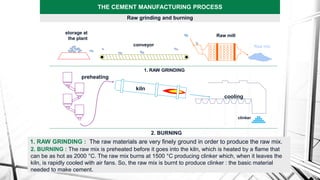
1. RAW GRINDING : The raw materials are very finely ground in order to produce the raw mix.
1. RAW GRINDING
Raw grinding and burning
2. BURNING
2. BURNING : The raw mix is preheated before it goes into the kiln, which is heated by a flame that
can be as hot as 2000 °C. The raw mix burns at 1500 °C producing clinker which, when it leaves the
kiln, is rapidly cooled with air fans. So, the raw mix is burnt to produce clinker : the basic material
needed to make cement.
conveyor Raw mix
kiln
cooling
preheating
clinker
storage at
the plant
Raw mill
THE CEMENT MANUFACTURING PROCESS
1.GRINDING : The clinker and the gypsum are very finely ground giving a “pure cement”. Other
secondary additives and cementations materials can also be added to make a blended cement.
1. GRINDING
Grinding, storage, packing, dispatch
2. STORAGE, PACKING, DISPATCH
2. STORAGE, PACKING, DISPATCH : The cement is stored in silos before being dispatched
either in bulk or in bags to its final destination.
Clinker
Storage
Gypsum and the secondary additives are
added to the clinker.
silos
dispatch
bags
Finish grinding
• The Gujarat-based Nirma group, with presence in detergent, soap and chemicals
sector, has bought Lafarge India’s cement business, consisting of 11 MT
production capacity, for US$ 1.4 billion.
• LafargeHolcim’s net sales have fallen by 7.5% year-on-year to Euro18.9bn in the
first nine months of 2016, from Euro20.4bn in the same period of 2015
• The Government of India plans to enact a law that will allow the companies
which have received mining licenses without having gone through the auction
process, to transfer these leases, in a move that is expected to make mergers and
acquisitions (M&As) easier in the steel, cement, and metals sectors.
• India has joined hands with Switzerland to reduce energy consumption and
develop newer methods in the country for more efficient cement production,
which will help India meet its rising demand for cement in the infrastructure
sector.
INVESTMENTS
Source:
a)http://www.globalcement.com/news
/itemlist/tag/LafargeHolcim
b) www.economictimes.com

Production & Operations Management

  • 1.
  • 2.
    • Lafarge isa manufacturer of building materials (primarily cement, aggregates and concrete) which claims to be the largest in the world, with a presence in 90 countries and 115,000 employees. It was formed by the merger on 10 July 2015 of cement companies Holcim and Lafarge which had combined net sales of CHF 33 billion (EUR 27 billion) in 2014. • The Group is based in Switzerland but its central functions remain divided between Zurich and Paris. The company's research facilities are in Lyon, France. THE COMPANY
  • 3.
    • The entireplant is operated from central control room where the process operating personnel closely monitor, the plant operation on visual display unit. The computerized process control system with field instrumentation ensures the steady and smooth operations of the plant. • Flow chart of the cement production process: i. Raw material extraction/ Quarry ii. Grinding, Proportioning and Blending iii. Pre-heater Phase iv. Kiln Phase v. Cooling and Final Grinding vi. Packing & Shipping OPERATIONS
  • 4.
    THE CEMENT MANUFACTURINGPROCESS 1. BLASTING : The raw materials that are used to manufacture cement (mainly limestone and clay) are blasted from the quarry. Quarry face 1. BLASTING 2. TRANSPORT 3. CRUSHING AND TRANSPORTATION : The raw materials, after crushing, are transported to the plant by conveyor. The plant stores the materials before they are homogenized. Quarry 3. CRUSHING & TRANSPORTATION 2. TRANSPORT : The raw materials are loaded into a dumper. crushing conveyor dumper storage at the plant loader
  • 5.
    THE CEMENT MANUFACTURINGPROCESS 1. RAW GRINDING : The raw materials are very finely ground in order to produce the raw mix. 1. RAW GRINDING Raw grinding and burning 2. BURNING 2. BURNING : The raw mix is preheated before it goes into the kiln, which is heated by a flame that can be as hot as 2000 °C. The raw mix burns at 1500 °C producing clinker which, when it leaves the kiln, is rapidly cooled with air fans. So, the raw mix is burnt to produce clinker : the basic material needed to make cement. conveyor Raw mix kiln cooling preheating clinker storage at the plant Raw mill
  • 6.
    THE CEMENT MANUFACTURINGPROCESS 1.GRINDING : The clinker and the gypsum are very finely ground giving a “pure cement”. Other secondary additives and cementations materials can also be added to make a blended cement. 1. GRINDING Grinding, storage, packing, dispatch 2. STORAGE, PACKING, DISPATCH 2. STORAGE, PACKING, DISPATCH : The cement is stored in silos before being dispatched either in bulk or in bags to its final destination. Clinker Storage Gypsum and the secondary additives are added to the clinker. silos dispatch bags Finish grinding
  • 7.
    • The Gujarat-basedNirma group, with presence in detergent, soap and chemicals sector, has bought Lafarge India’s cement business, consisting of 11 MT production capacity, for US$ 1.4 billion. • LafargeHolcim’s net sales have fallen by 7.5% year-on-year to Euro18.9bn in the first nine months of 2016, from Euro20.4bn in the same period of 2015 • The Government of India plans to enact a law that will allow the companies which have received mining licenses without having gone through the auction process, to transfer these leases, in a move that is expected to make mergers and acquisitions (M&As) easier in the steel, cement, and metals sectors. • India has joined hands with Switzerland to reduce energy consumption and develop newer methods in the country for more efficient cement production, which will help India meet its rising demand for cement in the infrastructure sector. INVESTMENTS
  • 8.