What is cement ?
 Cement: is a material with adhesive and cohesive
properties which make it capable of bonding
minerals fragments into a compact whole.
 For constructional purposes, the meaning of the
term "cement" is restricted to the bonding materials
used with stones, sand, bricks, building stones, etc.
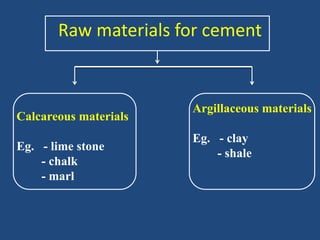
Raw materials for cement
Calcareous materials
Eg. - lime stone
- chalk
- marl
Argillaceous materials
Eg. - clay
- shale
THE CEMENT MANUFACTURING PROCESS
Quarry face
1. BLASTING 2. TRANSPORT
quarry
3. CRUSHING & TRANSPORTATION
crushing
conveyor
Next
dumper
storage at
the plant
loader
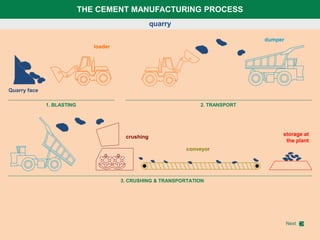
BLASTING : The raw materials that are used to
manufacture cement (mainly limestone and clay) are
blasted from the quarry.
2. TRANSPORT : The raw materials are loaded into a
dumper.
3. CRUSHING AND TRANSPORTATION : The raw
materials, after crushing, are transported to the plant by
conveyor. The plant stores the materials before they are
homogenized.
THE CEMENT MANUFACTURING PROCESS
1. RAW GRINDING
Raw grinding and burning
2. BURNING
conveyor
Next
Raw mix
kiln
cooling
Back
preheating
clinker
storage at
the plant
Raw mill
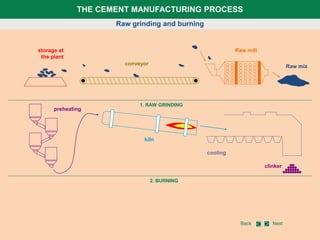
1.RAW GRINDING : The raw materials are very
finely ground in order to produce the raw mix.
2. BURNING : The raw mix is preheated before it goes
into the kiln, which is heated by a flame that can be as
hot as 2000 °C. The raw mix burns at 1500 °C producing
clinker which, when it leaves the kiln, is rapidly cooled
with air fans. So, the raw mix is burnt to produce clinker
: the basic material needed to make cement.
1.
THE CEMENT MANUFACTURING PROCESS
1. GRINDING
Grinding, storage, packing, dispatch
2. STORAGE, PACKING, DISPATCH
Back
clinker
storage
Gypsum and the secondary additives are added
to the clinker.
silos
Home page
dispatch
bags
Finish grinding
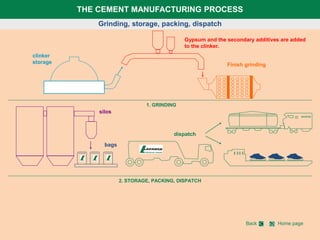
1.GRINDING : The clinker and the gypsum are very
finely ground giving a “pure cement”. Other secondary
additives and cementitious materials can also be added
to make a blended cement.
2. STORAGE, PACKING, DISPATCH :The cement
is stored in silos before being dispatched either in bulk
or in bags to its final destination.
Cement manufacturing & process

Cement manufacturing & process

  • 1.
    What is cement?  Cement: is a material with adhesive and cohesive properties which make it capable of bonding minerals fragments into a compact whole.  For constructional purposes, the meaning of the term "cement" is restricted to the bonding materials used with stones, sand, bricks, building stones, etc.
  • 2.
    Raw materials forcement Calcareous materials Eg. - lime stone - chalk - marl Argillaceous materials Eg. - clay - shale
  • 3.
    THE CEMENT MANUFACTURINGPROCESS Quarry face 1. BLASTING 2. TRANSPORT quarry 3. CRUSHING & TRANSPORTATION crushing conveyor Next dumper storage at the plant loader
  • 4.
    BLASTING : Theraw materials that are used to manufacture cement (mainly limestone and clay) are blasted from the quarry. 2. TRANSPORT : The raw materials are loaded into a dumper. 3. CRUSHING AND TRANSPORTATION : The raw materials, after crushing, are transported to the plant by conveyor. The plant stores the materials before they are homogenized.
  • 5.
    THE CEMENT MANUFACTURINGPROCESS 1. RAW GRINDING Raw grinding and burning 2. BURNING conveyor Next Raw mix kiln cooling Back preheating clinker storage at the plant Raw mill
  • 6.
    1.RAW GRINDING :The raw materials are very finely ground in order to produce the raw mix. 2. BURNING : The raw mix is preheated before it goes into the kiln, which is heated by a flame that can be as hot as 2000 °C. The raw mix burns at 1500 °C producing clinker which, when it leaves the kiln, is rapidly cooled with air fans. So, the raw mix is burnt to produce clinker : the basic material needed to make cement. 1.
  • 7.
    THE CEMENT MANUFACTURINGPROCESS 1. GRINDING Grinding, storage, packing, dispatch 2. STORAGE, PACKING, DISPATCH Back clinker storage Gypsum and the secondary additives are added to the clinker. silos Home page dispatch bags Finish grinding
  • 8.
    1.GRINDING : Theclinker and the gypsum are very finely ground giving a “pure cement”. Other secondary additives and cementitious materials can also be added to make a blended cement. 2. STORAGE, PACKING, DISPATCH :The cement is stored in silos before being dispatched either in bulk or in bags to its final destination.