J.K. Cement Ltd.
NIMBAHERA, CHITTORGARH
1
PRESENTATION ON
INDUSTRIAL TRAINING UNDERTAKEN
AT
SUBMITTED BY:-
PRAVEEN NUWAL
Roll no - 2101079
(B.tech ME 7th
sem.)
DEPARTMENT OF MECHANICAL ENGINEERING
NATIONAL INSTITUTE OF TECHNOLOGY PATNA
PATNA - 800005
Content :-
Introduction to JK Cement
Types of Cement
Cement Manufacturing Process
Energy Optimization
Cement Processing Equipment
Conclusion
Introduction to JK Cement
• J.K. stands for juggilal kamlapath singhania.
• It was founded by Lala Kamlapat Singhania in 1975.
• J.K.Cement started commercial production in May 1975 in
Nimbahera.
• Today J.K. Cement has an installed grey cement capacity of
10.5 MTPA making it one of the leading manufacturers in
the country.
• The Company revenue in FY23 was around $1.4 billions.
Types of Cement Produced
• JK Cement produces three grades of Ordinary Portland
Cement (OPC):
33-grade, 43-grade, and 53-grade
• White Portland Cement
• Rapid Hardening Cement
JK Cement is one of the world's largest manufacturers of
white cement and one of the largest manufacturers of grey
cement in India
Cement Manufacturing Process
• Main materials:
• Limestone
• Clay
• Additional materials
• Aluminium & Iron
• Gypsum
Raw materials of cement
THE CEMENT MANUFACTURING PROCESS
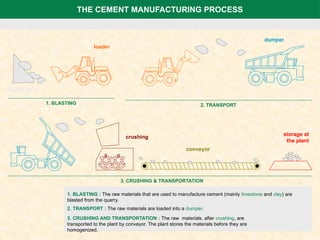
1. BLASTING : The raw materials that are used to manufacture cement (mainly limestone and clay) are
blasted from the quarry.
Quarry face
1. BLASTING 2. TRANSPORT
3. CRUSHING AND TRANSPORTATION : The raw materials, after crushing, are
transported to the plant by conveyor. The plant stores the materials before they are
homogenized.
quarry
3. CRUSHING & TRANSPORTATION
2. TRANSPORT : The raw materials are loaded into a dumper.
crushing
conveyor
dumper
storage at
the plant
loader
THE CEMENT MANUFACTURING PROCESS
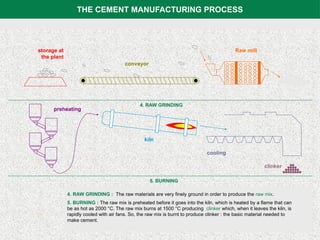
4. RAW GRINDING : The raw materials are very finely ground in order to produce the raw mix.
4. RAW GRINDING
Raw grinding and burning
5. BURNING
5. BURNING : The raw mix is preheated before it goes into the kiln, which is heated by a flame that can
be as hot as 2000 °C. The raw mix burns at 1500 °C producing clinker which, when it leaves the kiln, is
rapidly cooled with air fans. So, the raw mix is burnt to produce clinker : the basic material needed to
make cement.
conveyor
Raw mix
kiln
cooling
preheating
clinker
storage at
the plant
Raw mill
THE CEMENT MANUFACTURING PROCESS
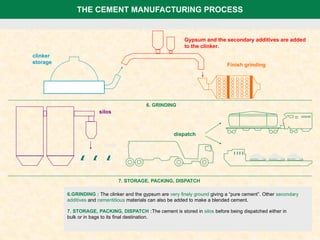
6.GRINDING : The clinker and the gypsum are very finely ground giving a “pure cement”. Other secondary
additives and cementitious materials can also be added to make a blended cement.
6. GRINDING
Grinding, storage, packing, dispatch
7. STORAGE, PACKING, DISPATCH
7. STORAGE, PACKING, DISPATCH :The cement is stored in silos before being dispatched either in
bulk or in bags to its final destination.
clinker
storage
Gypsum and the secondary additives are added
to the clinker.
silos
dispatch
bags
Finish grinding
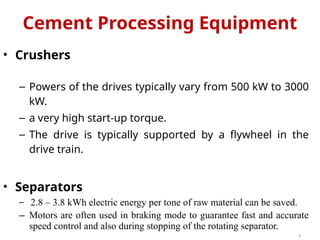
• Crushers
– Powers of the drives typically vary from 500 kW to 3000
kW.
– a very high start-up torque.
– The drive is typically supported by a flywheel in the
drive train.
• Separators
− 2.8 – 3.8 kWh electric energy per tone of raw material can be saved.
– Motors are often used in braking mode to guarantee fast and accurate
speed control and also during stopping of the rotating separator.
9
Cement Processing Equipment
10
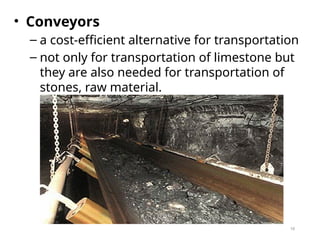
• Conveyors
– a cost-efficient alternative for transportation
– not only for transportation of limestone but
they are also needed for transportation of
stones, raw material.
11
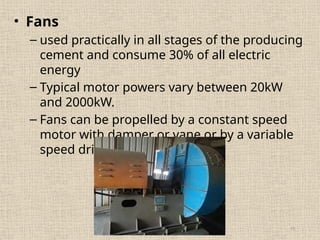
• Fans
– used practically in all stages of the producing
cement and consume 30% of all electric
energy
– Typical motor powers vary between 20kW
and 2000kW.
– Fans can be propelled by a constant speed
motor with damper or vane or by a variable
speed drive
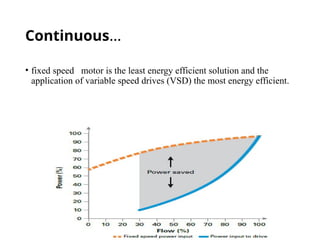
Continuous...
• fixed speed motor is the least energy efficient solution and the
application of variable speed drives (VSD) the most energy efficient.
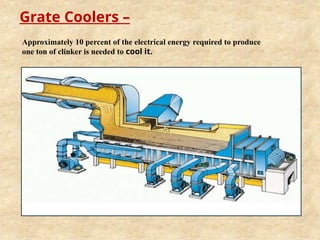
Grate Coolers –
Approximately 10 percent of the electrical energy required to produce
one ton of clinker is needed to cool it.
Continue……
•Clinker Cooling: Cools hot clinker (1,300–1,400°C) to a safe temperature for
handling.
•Heat Recovery: Recovers heat from clinker to preheat raw materials, improving
energy efficiency.
•Clinker Transport: Moves clinker through the cooler while allowing efficient heat
exchange.
•Prevent Overheating: Controls temperature to avoid undesirable chemical
reactions in the clinker.
•Dust Collection: Filters dust from the cooling air to meet environmental
standards.
•Energy Savings: Reduces fuel consumption by recovering heat.
•Improved Clinker Quality: Ensures uniform cooling for better clinker composition
and cement quality.
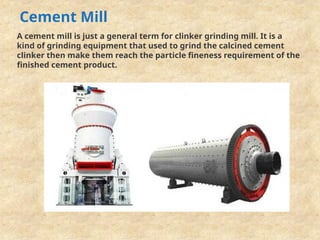
Cement Mill
A cement mill is just a general term for clinker grinding mill. It is a
kind of grinding equipment that used to grind the calcined cement
clinker then make them reach the particle fineness requirement of the
finished cement product.
Thermal energy savings using Expert Optimizer (EO)
Expert Optimizer (EO) is a computer-based system that uses advanced process
control (APC) to optimize the temperature and other processes in a cement plant.
Burning zone temperature (BZT) is the predictor of product quality. If the BZT is
low, it is expected that the clinker will be insufficiently burnt and if the BZT is high
it is expected the clinker will be over burnt
The temperature of preheating chamber is approx.
The kiln BZT temperature is approx.
So that BZT should be moderate, to maintain BZT expert optimizer is used.
Energy optimization in cement
manufacturing
>Cement producers are large consumers of
thermal and electrical energy
>Efforts to reduce demands by using higher
efficiency equipment and substituting fuels
>To optimize the overall performance of a cement
manufacturing unit requires a plant wide
automation strategy
Conclusion:-
In conclusion, my industrial training at JK
Cement has been an enriching and insightful
experience.
It has provided me with a practical
understanding of the cement manufacturing
process, from raw material handling to the final
product.
The exposure to various departments,
including production, quality control, and
energy management.
Thank You

JK CEMENT ppt 1.pptx

  • 1.
    J.K. Cement Ltd. NIMBAHERA,CHITTORGARH 1 PRESENTATION ON INDUSTRIAL TRAINING UNDERTAKEN AT SUBMITTED BY:- PRAVEEN NUWAL Roll no - 2101079 (B.tech ME 7th sem.) DEPARTMENT OF MECHANICAL ENGINEERING NATIONAL INSTITUTE OF TECHNOLOGY PATNA PATNA - 800005
  • 2.
    Content :- Introduction toJK Cement Types of Cement Cement Manufacturing Process Energy Optimization Cement Processing Equipment Conclusion
  • 3.
    Introduction to JKCement • J.K. stands for juggilal kamlapath singhania. • It was founded by Lala Kamlapat Singhania in 1975. • J.K.Cement started commercial production in May 1975 in Nimbahera. • Today J.K. Cement has an installed grey cement capacity of 10.5 MTPA making it one of the leading manufacturers in the country. • The Company revenue in FY23 was around $1.4 billions.
  • 4.
    Types of CementProduced • JK Cement produces three grades of Ordinary Portland Cement (OPC): 33-grade, 43-grade, and 53-grade • White Portland Cement • Rapid Hardening Cement JK Cement is one of the world's largest manufacturers of white cement and one of the largest manufacturers of grey cement in India
  • 5.
    Cement Manufacturing Process •Main materials: • Limestone • Clay • Additional materials • Aluminium & Iron • Gypsum Raw materials of cement
  • 6.
    THE CEMENT MANUFACTURINGPROCESS 1. BLASTING : The raw materials that are used to manufacture cement (mainly limestone and clay) are blasted from the quarry. Quarry face 1. BLASTING 2. TRANSPORT 3. CRUSHING AND TRANSPORTATION : The raw materials, after crushing, are transported to the plant by conveyor. The plant stores the materials before they are homogenized. quarry 3. CRUSHING & TRANSPORTATION 2. TRANSPORT : The raw materials are loaded into a dumper. crushing conveyor dumper storage at the plant loader
  • 7.
    THE CEMENT MANUFACTURINGPROCESS 4. RAW GRINDING : The raw materials are very finely ground in order to produce the raw mix. 4. RAW GRINDING Raw grinding and burning 5. BURNING 5. BURNING : The raw mix is preheated before it goes into the kiln, which is heated by a flame that can be as hot as 2000 °C. The raw mix burns at 1500 °C producing clinker which, when it leaves the kiln, is rapidly cooled with air fans. So, the raw mix is burnt to produce clinker : the basic material needed to make cement. conveyor Raw mix kiln cooling preheating clinker storage at the plant Raw mill
  • 8.
    THE CEMENT MANUFACTURINGPROCESS 6.GRINDING : The clinker and the gypsum are very finely ground giving a “pure cement”. Other secondary additives and cementitious materials can also be added to make a blended cement. 6. GRINDING Grinding, storage, packing, dispatch 7. STORAGE, PACKING, DISPATCH 7. STORAGE, PACKING, DISPATCH :The cement is stored in silos before being dispatched either in bulk or in bags to its final destination. clinker storage Gypsum and the secondary additives are added to the clinker. silos dispatch bags Finish grinding
  • 9.
    • Crushers – Powersof the drives typically vary from 500 kW to 3000 kW. – a very high start-up torque. – The drive is typically supported by a flywheel in the drive train. • Separators − 2.8 – 3.8 kWh electric energy per tone of raw material can be saved. – Motors are often used in braking mode to guarantee fast and accurate speed control and also during stopping of the rotating separator. 9 Cement Processing Equipment
  • 10.
    10 • Conveyors – acost-efficient alternative for transportation – not only for transportation of limestone but they are also needed for transportation of stones, raw material.
  • 11.
    11 • Fans – usedpractically in all stages of the producing cement and consume 30% of all electric energy – Typical motor powers vary between 20kW and 2000kW. – Fans can be propelled by a constant speed motor with damper or vane or by a variable speed drive
  • 12.
    Continuous... • fixed speedmotor is the least energy efficient solution and the application of variable speed drives (VSD) the most energy efficient.
  • 13.
    Grate Coolers – Approximately10 percent of the electrical energy required to produce one ton of clinker is needed to cool it.
  • 14.
    Continue…… •Clinker Cooling: Coolshot clinker (1,300–1,400°C) to a safe temperature for handling. •Heat Recovery: Recovers heat from clinker to preheat raw materials, improving energy efficiency. •Clinker Transport: Moves clinker through the cooler while allowing efficient heat exchange. •Prevent Overheating: Controls temperature to avoid undesirable chemical reactions in the clinker. •Dust Collection: Filters dust from the cooling air to meet environmental standards. •Energy Savings: Reduces fuel consumption by recovering heat. •Improved Clinker Quality: Ensures uniform cooling for better clinker composition and cement quality.
  • 15.
    Cement Mill A cementmill is just a general term for clinker grinding mill. It is a kind of grinding equipment that used to grind the calcined cement clinker then make them reach the particle fineness requirement of the finished cement product.
  • 16.
    Thermal energy savingsusing Expert Optimizer (EO) Expert Optimizer (EO) is a computer-based system that uses advanced process control (APC) to optimize the temperature and other processes in a cement plant. Burning zone temperature (BZT) is the predictor of product quality. If the BZT is low, it is expected that the clinker will be insufficiently burnt and if the BZT is high it is expected the clinker will be over burnt The temperature of preheating chamber is approx. The kiln BZT temperature is approx. So that BZT should be moderate, to maintain BZT expert optimizer is used.
  • 17.
    Energy optimization incement manufacturing >Cement producers are large consumers of thermal and electrical energy >Efforts to reduce demands by using higher efficiency equipment and substituting fuels >To optimize the overall performance of a cement manufacturing unit requires a plant wide automation strategy
  • 18.
    Conclusion:- In conclusion, myindustrial training at JK Cement has been an enriching and insightful experience. It has provided me with a practical understanding of the cement manufacturing process, from raw material handling to the final product. The exposure to various departments, including production, quality control, and energy management.
  • 19.