CEMENT INDUSTRY ANALYSIS
(INDIA)
Prakash Kumar
Student, Pune Institute of Business Management
Prakashkrsinngh@gmail.com
www.linkedin.com/in/prakashkrsinngh
INDUSTRY OVERVIEW
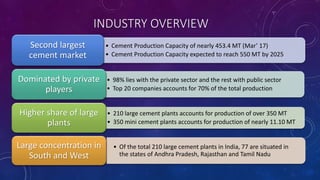
• Cement Production Capacity of nearly 453.4 MT (Mar’ 17)
• Cement Production Capacity expected to reach 550 MT by 2025
Second largest
cement market
• 98% lies with the private sector and the rest with public sector
• Top 20 companies accounts for 70% of the total production
Dominated by private
players
• 210 large cement plants accounts for production of over 350 MT
• 350 mini cement plants accounts for production of nearly 11.10 MT
Higher share of large
plants
• Of the total 210 large cement plants in India, 77 are situated in
the states of Andhra Pradesh, Rajasthan and Tamil Nadu
Large concentration in
South and West
2483.18
453.4
80.36 77.95 74.32 72.57 71.63 67.39 66.81
0
500
1000
1500
2000
2500
3000
China India USA Iran Indonesia Brazil Turkey Russia Vietnam
Top Cement Producers in FY17 (in MTPA)
MAJOR COMPANIES
25%
16%
13%
11%
9%
7%
5%
5%
5%
4%
Market Share
Ultratech Cement
ACC
Ambuja Cements
Shree Cements
India Cements
Prism Cement
J.K. Cement
Ramco Cement
Birla Corp
OCL India
1. Ultratech Cement
2. ACC
3. Ambuja Cements
4. Shree Cements
5. India Cements
6. Prism Cement
7. J.K. Cement
8. Ramco Cement
9. Birla Corp
10. OCL India
PORTER’S FIVE FORCE ANALYSIS
Threat of Substitutes
Low- Practically cement has no
direct substitutes
Bargaining Power of Suppliers
Moderate- Cement players have
to depend on the railways for
carriage and coal companies for
fuel
Bargaining Power of Buyers
Low- Substantial market
concentration among large
players ensures low bargaining
power of buyers
Competitive Rivalry
High- There are large number of
players in the market with high
degree of product homogeneity
Threat of New Entrants
High- High capital requirement
and long gestation period makes
very difficult for any new entrant
to enter into the market
PEST ANALYSIS
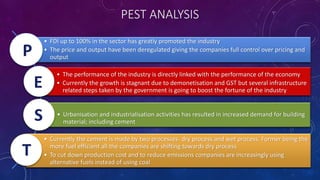
• FDI up to 100% in the sector has greatly promoted the industry
• The price and output have been deregulated giving the companies full control over pricing and
output
• The performance of the industry is directly linked with the performance of the economy
• Currently the growth is stagnant due to demonetisation and GST but several infrastructure
related steps taken by the government is going to boost the fortune of the industry
• Urbanisation and industrialisation activities has resulted in increased demand for building
material; including cement
• Currently the cement is made by two processes- dry process and wet process. Former being the
more fuel efficient all the companies are shifting towards dry process
• To cut down production cost and to reduce emissions companies are increasingly using
alternative fuels instead of using coal
P
E
S
T
FUTURE PROSPECTS
Housing
• Real estate
market to
increase at
11.6%
CAGR* in
2011-20
• Government
initiatives
like housing
for all to
push
demand in
the sector
Infrastructure
• 100 Smart
Cities planned
• Dedicated
freight corridor
and ports
under
development
• Metro rail
projects in
major cities
Urbanization
• Development
of 500 cities
with
population of
more than
100000 under
new urban
development
mission
9%
11%
13%
67%
0%
10%
20%
30%
40%
50%
60%
70%
80%
Industrial Commercial Infrastructure Housing
Per cent share of cement demand in FY17
*Current CAGR- 6.7%
THANK YOU
Prakash Kumar
Student, Pune Institute of Business Management
Prakashkrsinngh@gmail.com
www.linkedin.com/in/prakashkrsinngh

Cement Industry Analysis (India)

  • 1.
    CEMENT INDUSTRY ANALYSIS (INDIA) PrakashKumar Student, Pune Institute of Business Management Prakashkrsinngh@gmail.com www.linkedin.com/in/prakashkrsinngh
  • 2.
    INDUSTRY OVERVIEW • CementProduction Capacity of nearly 453.4 MT (Mar’ 17) • Cement Production Capacity expected to reach 550 MT by 2025 Second largest cement market • 98% lies with the private sector and the rest with public sector • Top 20 companies accounts for 70% of the total production Dominated by private players • 210 large cement plants accounts for production of over 350 MT • 350 mini cement plants accounts for production of nearly 11.10 MT Higher share of large plants • Of the total 210 large cement plants in India, 77 are situated in the states of Andhra Pradesh, Rajasthan and Tamil Nadu Large concentration in South and West
  • 3.
    2483.18 453.4 80.36 77.95 74.3272.57 71.63 67.39 66.81 0 500 1000 1500 2000 2500 3000 China India USA Iran Indonesia Brazil Turkey Russia Vietnam Top Cement Producers in FY17 (in MTPA)
  • 4.
    MAJOR COMPANIES 25% 16% 13% 11% 9% 7% 5% 5% 5% 4% Market Share UltratechCement ACC Ambuja Cements Shree Cements India Cements Prism Cement J.K. Cement Ramco Cement Birla Corp OCL India 1. Ultratech Cement 2. ACC 3. Ambuja Cements 4. Shree Cements 5. India Cements 6. Prism Cement 7. J.K. Cement 8. Ramco Cement 9. Birla Corp 10. OCL India
  • 5.
    PORTER’S FIVE FORCEANALYSIS Threat of Substitutes Low- Practically cement has no direct substitutes Bargaining Power of Suppliers Moderate- Cement players have to depend on the railways for carriage and coal companies for fuel Bargaining Power of Buyers Low- Substantial market concentration among large players ensures low bargaining power of buyers Competitive Rivalry High- There are large number of players in the market with high degree of product homogeneity Threat of New Entrants High- High capital requirement and long gestation period makes very difficult for any new entrant to enter into the market
  • 6.
    PEST ANALYSIS • FDIup to 100% in the sector has greatly promoted the industry • The price and output have been deregulated giving the companies full control over pricing and output • The performance of the industry is directly linked with the performance of the economy • Currently the growth is stagnant due to demonetisation and GST but several infrastructure related steps taken by the government is going to boost the fortune of the industry • Urbanisation and industrialisation activities has resulted in increased demand for building material; including cement • Currently the cement is made by two processes- dry process and wet process. Former being the more fuel efficient all the companies are shifting towards dry process • To cut down production cost and to reduce emissions companies are increasingly using alternative fuels instead of using coal P E S T
  • 7.
    FUTURE PROSPECTS Housing • Realestate market to increase at 11.6% CAGR* in 2011-20 • Government initiatives like housing for all to push demand in the sector Infrastructure • 100 Smart Cities planned • Dedicated freight corridor and ports under development • Metro rail projects in major cities Urbanization • Development of 500 cities with population of more than 100000 under new urban development mission 9% 11% 13% 67% 0% 10% 20% 30% 40% 50% 60% 70% 80% Industrial Commercial Infrastructure Housing Per cent share of cement demand in FY17 *Current CAGR- 6.7%
  • 8.
    THANK YOU Prakash Kumar Student,Pune Institute of Business Management Prakashkrsinngh@gmail.com www.linkedin.com/in/prakashkrsinngh