Tailoring  Strategy  to  Fit  Specific  Industry  and  Company  Situations
“ The best strategy for a given firm is ultimately a unique construction reflecting its particular circumstances.” Michael E. Porter
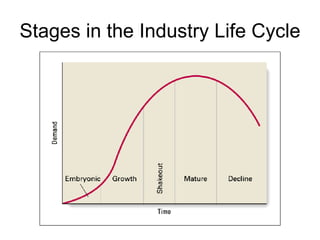
Industry Life Cycle Analysis The strength and nature of the five forces change as an industry evolves through its life cycle Managers must anticipate how the forces will changes as the industry evolves and formulate appropriate strategies
Stages in the Industry Life Cycle
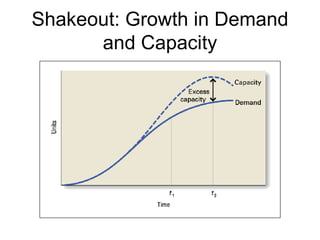
Shakeout: Growth in Demand and Capacity
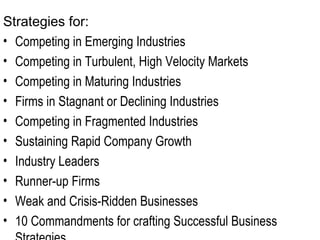
Strategies for:  Competing in Emerging Industries Competing in Turbulent, High Velocity Markets Competing in Maturing Industries Firms in Stagnant or Declining Industries Competing in Fragmented Industries Sustaining Rapid Company Growth  Industry Leaders Runner-up Firms Weak and Crisis-Ridden Businesses 10 Commandments for crafting Successful Business Strategies
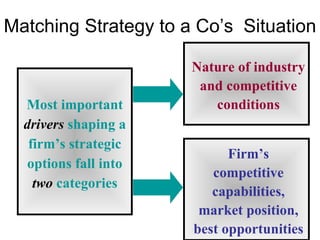
Matching Strategy to a Co’s  Situation Most important  drivers   shaping a firm’s strategic options fall into  two   categories Firm’s competitive capabilities, market position, best opportunities Nature of industry and competitive conditions
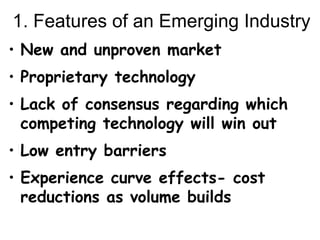
1. Features of an Emerging Industry New and unproven market Proprietary technology Lack of consensus regarding which competing technology will win out Low entry barriers Experience curve effects- cost reductions as volume builds
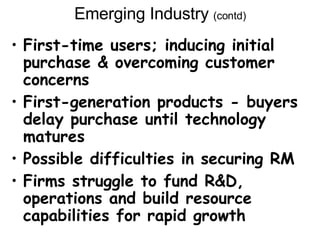
Emerging Industry  (contd) First-time users; inducing initial purchase & overcoming customer concerns First-generation products - buyers delay purchase until technology matures Possible difficulties in securing RM Firms struggle to fund R&D, operations and build resource capabilities for rapid growth
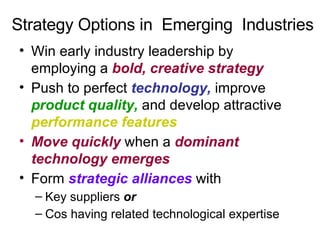
Strategy Options in  Emerging  Industries Win early industry leadership by employing a  bold, creative strategy Push to perfect  technology,  improve  product quality,  and develop attractive  performance features Move quickly  when a  dominant technology emerges Form  strategic alliances  with Key suppliers  or Cos having related technological expertise
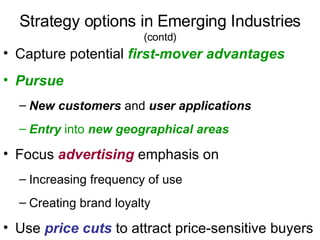
Strategy options in Emerging Industries   (contd) Capture potential  first-mover advantages Pursue   New customers  and  user applications Entry  into  new geographical areas Focus  advertising  emphasis on Increasing frequency of use  Creating brand loyalty Use  price cuts  to attract price-sensitive buyers
2. Features of High-Velocity  Markets Rapid-fire technological change Short product life-cycles Entry of important new rivals Frequent launches of new competitive moves Rapidly evolving customer expectations
Strategy Options in High-Velocity  Markets  Invest  aggressively in  R&D Develop  quick response capabilities   Shift resources Adapt competencies Create new competitive capabilities Speed new products to market Use  strategic partnerships  to develop specialized expertise and capabilities Initiate  fresh actions  every few months Keep  products/services fresh  and  exciting
Key Success Factors in High Velocity Markets Cutting-edge expertise Speed in responding to new developments Collaboration with others Agility Innovativeness Opportunism Resource flexibility First-to-market capabilities
3.Industry Maturity: Standout Features Slowing demand    stiffer competition More sophisticated buyers    bargains Greater emphasis on cost and service No addition in production capacity Product innovation & new end uses - rare International competition increases Industry profitability falls Mergers & acquisitions reduce no of  rivals
Strategy Options in a Mature  Industry Prune  marginal products and models Emphasize  innovation   in the  value chain   Strong focus on  cost reduction Increase sales  to present customers Purchase rivals  at bargain prices Expand  internationally Build new  flexible competitive capabilities
Strategic Pitfalls in Maturing  Industry Employing a ho-hum strategy with no distinctive features thus leaving firm  “stuck in the middle”   Concentrating  on  short-term  profits rather than strengthening long-term competitiveness  Being slow  to  adapt competencies  to  changing customer expectations Being slow  to  respond  to  price-cutting Having  too much  excess capacity Overspending  on  marketing Failing  to  pursue cost reductions  aggressively
Demand grows more slowly than economy as whole (or even declines) Competitive pressures intensify – rivals battle for market share To grow and prosper, firm must take market share from rivals Industry consolidates to a smaller number of key players via mergers and acquisitions Stagnant/declining industries: Standout  Features
Strategy Options in Stagnant/Declining  Industry Pursue  focus strategy  aimed at fastest growing market segments Stress  differentiation  based on quality improvement or product innovation Work diligently to  drive costs down Cut marginal activities from value chain  Use outsourcing Redesign internal processes to exploit e-commerce Consolidate under-utilized production facilities Add more distribution channels Close low-volume, high-cost distribution outlets Prune marginal products
Getting embroiled in a profitless battle for market share with stubborn rivals Diverting resources out of business too quickly Being overly optimistic about industry’s future (believing things will get better) Stagnant  Industry: Strategic  Mistakes
Limitations of Models for Industry Analysis Life cycle issues The embryonic stage can sometimes be skipped Industry growth can be revitalized The time span of the stages can vary Innovation and change Innovation can unfreeze and reshape industry structure An industry may be hypercompetitive, with permanent and ongoing change
Comp features-Fragmented  Industries Absence of market leaders  Buyer demand diverse & scattered that many firms are required to satisfy buyer needs Low entry barriers  Absence of scale economies Buyers require small amounts of customized products Market for industry’s product may be globalizing, putting cos across world in same market arena Exploding technologies force firms to specialize just to keep up in their area of expertise  Industry is young & crowded, with no firm having yet commanding a large market share
Examples - Fragmented  Industries Book publishing Landscaping and plant nurseries Auto repair Restaurant industry Women’s dresses Paperboard boxes Hotels and motels Furniture
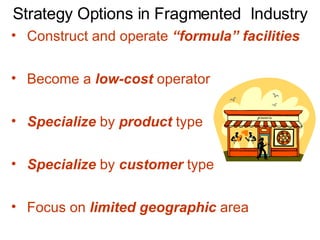
Construct and operate  “formula” facilities Become a  low-cost  operator Specialize  by  product  type Specialize  by  customer  type Focus on  limited geographic  area Strategy Options in Fragmented  Industry
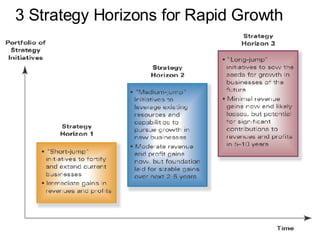
3 Strategy Horizons for Rapid Growth
Pursuing multiple Strategy Horizons Firm should not pursue all options to avoid stretching itself too thin Pursuit of medium & long-jump initiatives may cause firm to stray far from its core comptency Competitive advantage difficult to achieve in medium & long-jump businesses that do not mesh well with firm’s present strengths Payoffs of long-jump initiatives may prove elusive
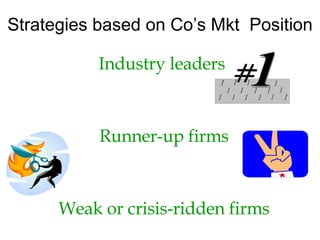
Industry leaders  Runner-up firms Weak or crisis-ridden firms Strategies based on Co’s Mkt  Position
# 1. INDUSTRY LEADERS
Defining Characteristics Strong to powerful market position Well-known reputation Proven strategy Key strategic concern –  How to sustain dominant leadership position
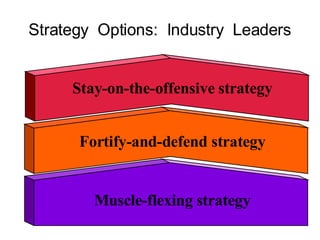
Strategy  Options:  Industry  Leaders Stay-on-the-offensive strategy Fortify-and-defend strategy Muscle-flexing strategy
Stay-on-the-Offensive  Strategies Be a first-mover, leading industry change Best defense is a good offense Pursue continuous improvement & innovation Force rivals to scramble to keep up Launch fresh initiatives to keep rivals off balance Grow faster than industry, taking mkt share from rivals
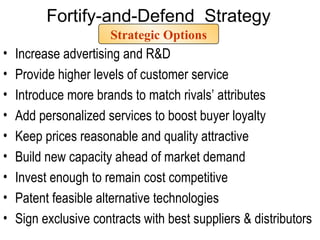
Fortify-and-Defend  Strategy Make it harder for new firms to enter and for challengers to gain ground Hold onto present market share Strengthen current market position Protect competitive advantage Objectives
Strategic Options Increase advertising and R&D Provide higher levels of customer service  Introduce more brands to match rivals’ attributes  Add personalized services to boost buyer loyalty Keep prices reasonable and quality attractive Build new capacity ahead of market demand Invest enough to remain cost competitive Patent feasible alternative technologies Sign exclusive contracts with best suppliers & distributors Fortify-and-Defend  Strategy
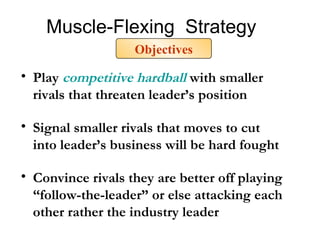
Muscle-Flexing  Strategy Play  competitive hardball   with smaller rivals that threaten leader’s position Signal smaller rivals that moves to cut into leader’s business will be hard fought Convince rivals they are better off playing  “follow-the-leader” or else attacking each other rather the industry leader Objectives
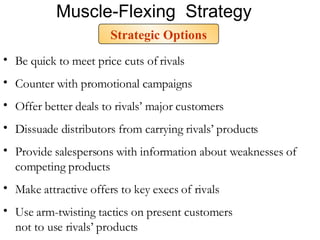
Muscle-Flexing  Strategy Strategic Options Be quick to meet price cuts of rivals Counter with promotional campaigns  Offer better deals to rivals’ major customers  Dissuade distributors from carrying rivals’ products Provide salespersons with information about weaknesses of competing products Make attractive offers to key execs of rivals Use arm-twisting tactics on present customers not to use rivals’ products
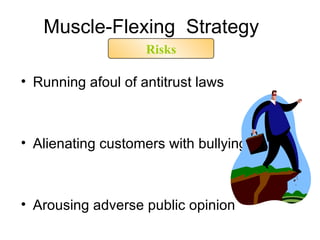
Muscle-Flexing  Strategy Risks Running afoul of antitrust laws Alienating customers with bullying tactics Arousing adverse public opinion
#2. RUNNER-UP FIRMS
Types  of  Runner-up  Firms Market challengers Use offensive strategies to gain market share Focusers Concentrate on serving a limited portion of market Perennial runners-up Lack competitive strength to do more than continue in trailing position
Less access to economies of scale Difficulty in gaining customer recognition Inability to afford mass media advertising Difficulty in funding capital requirements Obstacles for Runner-Up Firms
Strategic  Options When  big size  provides larger rivals with a  cost advantage,  runner-up firms have  two options Build market share Lower costs and prices to grow sales or  Out-differentiate rivals in ways to grow sales Withdraw from market
Building  Market  Share Strategic options  for building market share to overcome cost advantage of larger rivals  Use  lower prices  to win customers from weak, higher-cost rivals Merge  or  acquire rivals  to achieve size needed to capture greater scale economies Invest  in new  cost-saving facilities  &  equipment,  relocating operations where costs are lower Pursue  technological innovations  or radical value chain revamping  to achieve cost-savings
Where  big size  does  not  yield a  cost advantage,  runner-up firms have 7 options 1.  Offensive strategies to build market share 2.  Growth-via-acquisition strategy 3.  Vacant niche strategy 4.  Specialist strategy 5.  Superior product strategy 6.  Distinctive image strategy 7.  Content follower strategy Strategic  Options  for  Runner-Up  Firms  Not  Disadvantaged  By  Smaller  Size
Offensive  Strategies for  Runner-Up  Firms Best  “mover-and-shaker” offensives Pioneer a leapfrog technological breakthrough Get new/better products into market ahead of rivals and build reputation for product leadership Be more agile and innovative in adapting to evolving market conditions and customer needs Forge attractive strategic alliances with key distributors and/or marketers of similar products Find innovative ways to dramatically drive down costs to win customers from higher-cost rivals Craft an attractive differentiation strategy
Acquisition Strategies  Frequently used strategy  of ambitious runner-up firms To succeed, top managers must have skills to Assimilate operations of acquired firms, eliminating duplication and overlap, Generate efficiencies and cost savings,  and Structure combined resources to create stronger competitive capabilities
Focus strategy  concentrated on end-use applications market leaders have neglected Characteristics  of an  ideal vacant niche Sufficient size to be profitable Growth potential Well-suited to a firm’s capabilities Hard for leaders to serve Vacant  Niche  Strategies
Specialist  Strategy  for Runner-Up  Firms Strategy  concentrated on being a leader based on Specific technology  Product uniqueness Expertise in  Special-purpose products Specialized know-how Delivering distinctive customer services
Superior  Product  Strategy Differentiation-based focused strategy   based on Superior product quality  or Unique product attributes Approaches Fine craftsmanship Prestige quality Frequent product innovations Close contact with customers to gain input for better quality product
Strategy   concentrated on ways to  stand out  from rivals Approaches Reputation for charging lowest price Prestige quality at a good price Superior customer service Unique product attributes New product introductions Unusually creative advertising Distinctive  Image  Strategy
Content  Follower  Strategy Strategy  involves  avoiding Trend-setting moves  and Aggressive moves to steal customers  Approaches Do not provoke competitive retaliation React and respond Defense rather than offense Keep same price as leaders Attempt to maintain market position
# 3. WEAK  BUSINESSES
Strategic  Options Launch an  offensive turnaround strategy   (if resources permit) Employ a  fortify-and-defend strategy (to the extent resources permit) Pursue a  fast-exit strategy Adopt an  end-game strategy
Achieving  a  Turnaround  Sell off assets to generate cash  reduce debt  Revise existing strategy Launch efforts to boost revenues Cut costs Combination of efforts
Liquidation  Strategy Wisest  strategic  option  if: Lack of resources Dim profit prospects Unpleasant  strategic  option Hardship of job eliminations Effects of closing on local community
End-Game  Strategy? Objectives Short-term  - Generate largest feasible cash flow Long-term  - Exit market Sacrificing market position  for  near-term  cash flow/profit
Types  of End-Game  Options Reduce operating budget to rock-bottom Hold reinvestment to minimum Emphasize stringent internal cost controls Low priority on new capital investments Raise price gradually Trim promotional expenses Reduce quality in non-visible ways Curtail non-essential customer services Shave equipment maintenance
When  Should  an  End-Game Strategy  be  Considered? Industry’s long-term prospects are unattractive Building up business would be too costly Market share is increasingly costly to maintain Lesser competitive effort will not trigger immediate fall-off in sales Freed-up resources can be redeployed in higher opportunity areas Business is not a major component of diversified firm’s portfolio of businesses Business does not contribute other desired features to overall business portfolio
10 Commandments for crafting Successful Business Strategies
Always put top priority on crafting & executing strategic moves that enhance a firm’s competitive position in long-term and that helps establish it as an industry   leader.
Be prompt in adapting and responding to changing market conditions and unmet customer needs for better, emerging technological alternatives, and new initiatives of rivals.
Invest in creating sustainable competitive advantage. Avoid strategies capable of succeeding only in the best of circumstances. Don’t underestimate the reactions and the commitment of rival firms.
Consider that attacking competitive weakness is usually more profitable than attacking competitive strength. Be judicious in cutting prices without an established cost advantage.
Employ bold strategic moves in pursuing differentiation strategies so as to open up very meaningful gaps in quality/service/etc Endeavor not to get stuck with no coherent long-term strategy or distinctive competitive position, and little prospect of climbing into the ranks of the industry leaders.
Be aware that aggressive strategic moves to wrest crucial market share away from rivals often provoke aggressive retaliation in the form of a marketing “arms race” and/or price wars.

Topic5 Tailoring Strtgs

  • 1.
    Tailoring Strategy to Fit Specific Industry and Company Situations
  • 2.
    “ The beststrategy for a given firm is ultimately a unique construction reflecting its particular circumstances.” Michael E. Porter
  • 3.
    Industry Life CycleAnalysis The strength and nature of the five forces change as an industry evolves through its life cycle Managers must anticipate how the forces will changes as the industry evolves and formulate appropriate strategies
  • 4.
    Stages in theIndustry Life Cycle
  • 5.
    Shakeout: Growth inDemand and Capacity
  • 6.
    Strategies for: Competing in Emerging Industries Competing in Turbulent, High Velocity Markets Competing in Maturing Industries Firms in Stagnant or Declining Industries Competing in Fragmented Industries Sustaining Rapid Company Growth Industry Leaders Runner-up Firms Weak and Crisis-Ridden Businesses 10 Commandments for crafting Successful Business Strategies
  • 7.
    Matching Strategy toa Co’s Situation Most important drivers shaping a firm’s strategic options fall into two categories Firm’s competitive capabilities, market position, best opportunities Nature of industry and competitive conditions
  • 8.
    1. Features ofan Emerging Industry New and unproven market Proprietary technology Lack of consensus regarding which competing technology will win out Low entry barriers Experience curve effects- cost reductions as volume builds
  • 9.
    Emerging Industry (contd) First-time users; inducing initial purchase & overcoming customer concerns First-generation products - buyers delay purchase until technology matures Possible difficulties in securing RM Firms struggle to fund R&D, operations and build resource capabilities for rapid growth
  • 10.
    Strategy Options in Emerging Industries Win early industry leadership by employing a bold, creative strategy Push to perfect technology, improve product quality, and develop attractive performance features Move quickly when a dominant technology emerges Form strategic alliances with Key suppliers or Cos having related technological expertise
  • 11.
    Strategy options inEmerging Industries (contd) Capture potential first-mover advantages Pursue New customers and user applications Entry into new geographical areas Focus advertising emphasis on Increasing frequency of use Creating brand loyalty Use price cuts to attract price-sensitive buyers
  • 12.
    2. Features ofHigh-Velocity Markets Rapid-fire technological change Short product life-cycles Entry of important new rivals Frequent launches of new competitive moves Rapidly evolving customer expectations
  • 13.
    Strategy Options inHigh-Velocity Markets Invest aggressively in R&D Develop quick response capabilities Shift resources Adapt competencies Create new competitive capabilities Speed new products to market Use strategic partnerships to develop specialized expertise and capabilities Initiate fresh actions every few months Keep products/services fresh and exciting
  • 14.
    Key Success Factorsin High Velocity Markets Cutting-edge expertise Speed in responding to new developments Collaboration with others Agility Innovativeness Opportunism Resource flexibility First-to-market capabilities
  • 15.
    3.Industry Maturity: StandoutFeatures Slowing demand  stiffer competition More sophisticated buyers  bargains Greater emphasis on cost and service No addition in production capacity Product innovation & new end uses - rare International competition increases Industry profitability falls Mergers & acquisitions reduce no of rivals
  • 16.
    Strategy Options ina Mature Industry Prune marginal products and models Emphasize innovation in the value chain Strong focus on cost reduction Increase sales to present customers Purchase rivals at bargain prices Expand internationally Build new flexible competitive capabilities
  • 17.
    Strategic Pitfalls inMaturing Industry Employing a ho-hum strategy with no distinctive features thus leaving firm “stuck in the middle” Concentrating on short-term profits rather than strengthening long-term competitiveness Being slow to adapt competencies to changing customer expectations Being slow to respond to price-cutting Having too much excess capacity Overspending on marketing Failing to pursue cost reductions aggressively
  • 18.
    Demand grows moreslowly than economy as whole (or even declines) Competitive pressures intensify – rivals battle for market share To grow and prosper, firm must take market share from rivals Industry consolidates to a smaller number of key players via mergers and acquisitions Stagnant/declining industries: Standout Features
  • 19.
    Strategy Options inStagnant/Declining Industry Pursue focus strategy aimed at fastest growing market segments Stress differentiation based on quality improvement or product innovation Work diligently to drive costs down Cut marginal activities from value chain Use outsourcing Redesign internal processes to exploit e-commerce Consolidate under-utilized production facilities Add more distribution channels Close low-volume, high-cost distribution outlets Prune marginal products
  • 20.
    Getting embroiled ina profitless battle for market share with stubborn rivals Diverting resources out of business too quickly Being overly optimistic about industry’s future (believing things will get better) Stagnant Industry: Strategic Mistakes
  • 21.
    Limitations of Modelsfor Industry Analysis Life cycle issues The embryonic stage can sometimes be skipped Industry growth can be revitalized The time span of the stages can vary Innovation and change Innovation can unfreeze and reshape industry structure An industry may be hypercompetitive, with permanent and ongoing change
  • 22.
    Comp features-Fragmented Industries Absence of market leaders Buyer demand diverse & scattered that many firms are required to satisfy buyer needs Low entry barriers Absence of scale economies Buyers require small amounts of customized products Market for industry’s product may be globalizing, putting cos across world in same market arena Exploding technologies force firms to specialize just to keep up in their area of expertise Industry is young & crowded, with no firm having yet commanding a large market share
  • 23.
    Examples - Fragmented Industries Book publishing Landscaping and plant nurseries Auto repair Restaurant industry Women’s dresses Paperboard boxes Hotels and motels Furniture
  • 24.
    Construct and operate “formula” facilities Become a low-cost operator Specialize by product type Specialize by customer type Focus on limited geographic area Strategy Options in Fragmented Industry
  • 25.
    3 Strategy Horizonsfor Rapid Growth
  • 26.
    Pursuing multiple StrategyHorizons Firm should not pursue all options to avoid stretching itself too thin Pursuit of medium & long-jump initiatives may cause firm to stray far from its core comptency Competitive advantage difficult to achieve in medium & long-jump businesses that do not mesh well with firm’s present strengths Payoffs of long-jump initiatives may prove elusive
  • 27.
    Industry leaders Runner-up firms Weak or crisis-ridden firms Strategies based on Co’s Mkt Position
  • 28.
  • 29.
    Defining Characteristics Strongto powerful market position Well-known reputation Proven strategy Key strategic concern – How to sustain dominant leadership position
  • 30.
    Strategy Options: Industry Leaders Stay-on-the-offensive strategy Fortify-and-defend strategy Muscle-flexing strategy
  • 31.
    Stay-on-the-Offensive StrategiesBe a first-mover, leading industry change Best defense is a good offense Pursue continuous improvement & innovation Force rivals to scramble to keep up Launch fresh initiatives to keep rivals off balance Grow faster than industry, taking mkt share from rivals
  • 32.
    Fortify-and-Defend StrategyMake it harder for new firms to enter and for challengers to gain ground Hold onto present market share Strengthen current market position Protect competitive advantage Objectives
  • 33.
    Strategic Options Increaseadvertising and R&D Provide higher levels of customer service Introduce more brands to match rivals’ attributes Add personalized services to boost buyer loyalty Keep prices reasonable and quality attractive Build new capacity ahead of market demand Invest enough to remain cost competitive Patent feasible alternative technologies Sign exclusive contracts with best suppliers & distributors Fortify-and-Defend Strategy
  • 34.
    Muscle-Flexing StrategyPlay competitive hardball with smaller rivals that threaten leader’s position Signal smaller rivals that moves to cut into leader’s business will be hard fought Convince rivals they are better off playing “follow-the-leader” or else attacking each other rather the industry leader Objectives
  • 35.
    Muscle-Flexing StrategyStrategic Options Be quick to meet price cuts of rivals Counter with promotional campaigns Offer better deals to rivals’ major customers Dissuade distributors from carrying rivals’ products Provide salespersons with information about weaknesses of competing products Make attractive offers to key execs of rivals Use arm-twisting tactics on present customers not to use rivals’ products
  • 36.
    Muscle-Flexing StrategyRisks Running afoul of antitrust laws Alienating customers with bullying tactics Arousing adverse public opinion
  • 37.
  • 38.
    Types of Runner-up Firms Market challengers Use offensive strategies to gain market share Focusers Concentrate on serving a limited portion of market Perennial runners-up Lack competitive strength to do more than continue in trailing position
  • 39.
    Less access toeconomies of scale Difficulty in gaining customer recognition Inability to afford mass media advertising Difficulty in funding capital requirements Obstacles for Runner-Up Firms
  • 40.
    Strategic OptionsWhen big size provides larger rivals with a cost advantage, runner-up firms have two options Build market share Lower costs and prices to grow sales or Out-differentiate rivals in ways to grow sales Withdraw from market
  • 41.
    Building Market Share Strategic options for building market share to overcome cost advantage of larger rivals Use lower prices to win customers from weak, higher-cost rivals Merge or acquire rivals to achieve size needed to capture greater scale economies Invest in new cost-saving facilities & equipment, relocating operations where costs are lower Pursue technological innovations or radical value chain revamping to achieve cost-savings
  • 42.
    Where bigsize does not yield a cost advantage, runner-up firms have 7 options 1. Offensive strategies to build market share 2. Growth-via-acquisition strategy 3. Vacant niche strategy 4. Specialist strategy 5. Superior product strategy 6. Distinctive image strategy 7. Content follower strategy Strategic Options for Runner-Up Firms Not Disadvantaged By Smaller Size
  • 43.
    Offensive Strategiesfor Runner-Up Firms Best “mover-and-shaker” offensives Pioneer a leapfrog technological breakthrough Get new/better products into market ahead of rivals and build reputation for product leadership Be more agile and innovative in adapting to evolving market conditions and customer needs Forge attractive strategic alliances with key distributors and/or marketers of similar products Find innovative ways to dramatically drive down costs to win customers from higher-cost rivals Craft an attractive differentiation strategy
  • 44.
    Acquisition Strategies Frequently used strategy of ambitious runner-up firms To succeed, top managers must have skills to Assimilate operations of acquired firms, eliminating duplication and overlap, Generate efficiencies and cost savings, and Structure combined resources to create stronger competitive capabilities
  • 45.
    Focus strategy concentrated on end-use applications market leaders have neglected Characteristics of an ideal vacant niche Sufficient size to be profitable Growth potential Well-suited to a firm’s capabilities Hard for leaders to serve Vacant Niche Strategies
  • 46.
    Specialist Strategy for Runner-Up Firms Strategy concentrated on being a leader based on Specific technology Product uniqueness Expertise in Special-purpose products Specialized know-how Delivering distinctive customer services
  • 47.
    Superior Product Strategy Differentiation-based focused strategy based on Superior product quality or Unique product attributes Approaches Fine craftsmanship Prestige quality Frequent product innovations Close contact with customers to gain input for better quality product
  • 48.
    Strategy concentrated on ways to stand out from rivals Approaches Reputation for charging lowest price Prestige quality at a good price Superior customer service Unique product attributes New product introductions Unusually creative advertising Distinctive Image Strategy
  • 49.
    Content Follower Strategy Strategy involves avoiding Trend-setting moves and Aggressive moves to steal customers Approaches Do not provoke competitive retaliation React and respond Defense rather than offense Keep same price as leaders Attempt to maintain market position
  • 50.
    # 3. WEAK BUSINESSES
  • 51.
    Strategic OptionsLaunch an offensive turnaround strategy (if resources permit) Employ a fortify-and-defend strategy (to the extent resources permit) Pursue a fast-exit strategy Adopt an end-game strategy
  • 52.
    Achieving a Turnaround Sell off assets to generate cash reduce debt Revise existing strategy Launch efforts to boost revenues Cut costs Combination of efforts
  • 53.
    Liquidation StrategyWisest strategic option if: Lack of resources Dim profit prospects Unpleasant strategic option Hardship of job eliminations Effects of closing on local community
  • 54.
    End-Game Strategy?Objectives Short-term - Generate largest feasible cash flow Long-term - Exit market Sacrificing market position for near-term cash flow/profit
  • 55.
    Types ofEnd-Game Options Reduce operating budget to rock-bottom Hold reinvestment to minimum Emphasize stringent internal cost controls Low priority on new capital investments Raise price gradually Trim promotional expenses Reduce quality in non-visible ways Curtail non-essential customer services Shave equipment maintenance
  • 56.
    When Should an End-Game Strategy be Considered? Industry’s long-term prospects are unattractive Building up business would be too costly Market share is increasingly costly to maintain Lesser competitive effort will not trigger immediate fall-off in sales Freed-up resources can be redeployed in higher opportunity areas Business is not a major component of diversified firm’s portfolio of businesses Business does not contribute other desired features to overall business portfolio
  • 57.
    10 Commandments forcrafting Successful Business Strategies
  • 58.
    Always put toppriority on crafting & executing strategic moves that enhance a firm’s competitive position in long-term and that helps establish it as an industry leader.
  • 59.
    Be prompt inadapting and responding to changing market conditions and unmet customer needs for better, emerging technological alternatives, and new initiatives of rivals.
  • 60.
    Invest in creatingsustainable competitive advantage. Avoid strategies capable of succeeding only in the best of circumstances. Don’t underestimate the reactions and the commitment of rival firms.
  • 61.
    Consider that attackingcompetitive weakness is usually more profitable than attacking competitive strength. Be judicious in cutting prices without an established cost advantage.
  • 62.
    Employ bold strategicmoves in pursuing differentiation strategies so as to open up very meaningful gaps in quality/service/etc Endeavor not to get stuck with no coherent long-term strategy or distinctive competitive position, and little prospect of climbing into the ranks of the industry leaders.
  • 63.
    Be aware thataggressive strategic moves to wrest crucial market share away from rivals often provoke aggressive retaliation in the form of a marketing “arms race” and/or price wars.