

Three Questions
You Need to
Ask About Your
How can a firm develop and
establish an effective
positioning in the market?
Important
Factors for brand
positioning
Frame of
Reference
Point-of-Parity
Point-of-
Difference
Frame of Reference
Have we established a frame?
Signals to consumers the goal they
can expect to achieve by using a
brand.
It dictates the type of associations
that will function as point of parity and point
of difference.
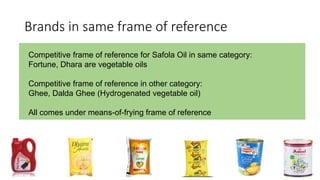
Brands in same frame of reference
Competitive frame of reference for Safola Oil in same category:
Fortune, Dhara are vegetable oils
Competitive frame of reference in other category:
Ghee, Dalda Ghee (Hydrogenated vegetable oil)
All comes under means-of-frying frame of reference
The more innovative
the product, the greater the difficulty of
fitting it into an established frame and
meeting the
frame’s minimum requirements.
Example: Motorola’s Envoy
Envoy was a personal digital assistant launched in 1994.
It received messages wirelessly like a pager, but no one viewed it as a pager
because it’s expensive and large.
Envoy lacked sufficient points of parity to belong to any existing category.
Without a clear frame of reference, consumers weren’t sure why
Points of
Parity
Are We Leveraging Our Points of Parity?
After considering frame of reference, the
points of parity must be met if consumers are
to perceive your product as a legitimate and
credible player
within that frame.
Example: Banks
Consumers might not consider a bank truly a “bank” unless it offers
checking and savings plans, safe-deposit boxes, traveller's checks, and
so on.
The approach
you use to meet these minimum
requirements for playing the game will
depend on where
your product is in its life cycle.
Factors
Frame of
Reference
Points of
Parity
New Brand
Brand
Extension
Established
Brand
Points of
Difference
New Brand
There is importance of identifying points of parity
when introducing a new brand.
The brand positioning focusing only on a point of difference leaves out the
important issues,
but it should not forget what business it’s in.
Example: Maruti Gypusy
India’s first ever SUV, this brand was launched in 1985, and promoted
as offroader.
It started on a very good note but didn’t last long.
Reason being:
Ambiguous target market and frame of reference
Indians don’t use SUVs only on rough terrains but use it as a proper
car.
Low mileage, high price, improper seating arrangement
Brand Extension
It’s easy—and dangerous—to short change points of parity.
The more an extension differs from a base brand, the greater the importance
of focusing on the frame of reference.
Establish point of parities with competitors before stressing its difference.
Example: Harpic Toilet cleaner
Harpic has recently introduced its Bathroom cleaning product in Indian market
years after establishing its main product toilet cleaner.
The another innovative product, Harpic flushmatic, which they have positioned
keeping the desire to keep toilet clean after every use in mind.
Established Brand
Established brands also need to reassess points of parity from
time to time, because attributes that were once differentiators
can become minimum requirements.
Hold off competitors’ point of difference by creating it competitive
point of parity.
Example: Dettol launched hand wash with a particular packaging which was
soon copied by other established brands as Lifebuoy
Hence, it is still trying to work on its packaging and trying to innovate
more on its No-Touch technology
A brand can “break even” in an area where competitors are
trying to
break away and then achieve a point of difference in some
other area.
Example: American express and Visa
Visa: More convenient, can be used at many places
American express: Prestige associated with card
Both are trying to blunt each other’s advantage.
Points of Difference
Are the Points of Difference Compelling?
Strong, favourable, unique associations that distinguish a
brand from others in the same frame of reference are
fundamental to successful brand positioning. But it’s
important to avoid a one dimensional
view of differentiation.
Important
Factors for brand
positioning
Frame of
Reference
Point-of-Parity
Point-of-
Difference
Brand
performance
association
Brand imagery
association
Consumer
insight
association
Brand Performance Association
Relate to the ways in which a product or service attempts to meet customers’
functional needs.
These associations, which are based on intrinsic properties of the brand.
Come into play when brands are assessed on characteristics a buyer can
investigate prior to purchase.
Important
Factors for brand
positioning
Frame of
Reference
Point-of-Parity
Point-of-
Difference
Brand
performance
association
Prompting
benefits
Reliability,
Durability and
Serviceability
Effectiveness,
Efficiency and
Empathy
Style and Design Value and price
Brand imagery
association
Consumer
insight
association
When product’s concrete qualities and features. In such cases,
brand performance associations may be all you need to
distinguish your product.
Brand Imagery Association
Brand imagery is typically established by
depicting who uses the brand and under what circumstances.
Example: Subway represents its point
of difference by using a spokesman who
has lost weight. This device implies that
Subway is
for the average person who wants a simple
way to get in shape.
Consumer Insight Association
Consumer insight associations are generally used when a brand’s
performance and imagery don’t differ much from those of the
competition.
Show consumers it has insight into their problems or goals can
then make the case that it is the solution.
Can’t be relied too much on this only as insight into consumer’s
goals are readily emulated.
Example: Introduction of Move, ointment as Spray.
Are point of difference
desirable to customers,
and can you deliver them?
Desirability
Should be perceived by audience relevant and beliveable.
Example: Introduction of milk base in soaps, providing moisturized skin after bathing.
Before this soaps which makes skin oil free considered to be good.
Deliverability
Point of difference need to meet three criteria to be
deliverable:
Feasible
Profitable
Preemptive, Defensible and difficult to attack
All these three elements need to be internally
consistent at any point of time and over time.
In some cases, the brand’s position is
sufficiently rich that exactly the same position
can be sustained over time.
Example: Parle- G
Product was instantly recognized by its iconic white and yellow wax paper which
was after many years replaced by plastic wrapper featuring the same young girl.
Presenting same point of difference over time does
not sustain a brand’s performance.
The meaning associated with brand can be deepen by the following ways:
Laddering Up
A process where brand is positioned in such a way that its point of differences
become its essence and implies goal attainment.
Done by demonstrating more explicitly how the brand is related to the customers’
goals and requires insight about what motivates consumers to use a brand
Focuses on
Unique feature
first
Implication of
reliable service
Then More
general
implication
Big Idea
Entails identifying a differentiating benefit that is important to consumers
and presenting, over time, a variety of attributes that imply the benefit.
The context is kept constant so that people can readily associate the
ad with the brand name, ensuring strong brand linkage.
Recap
The key questions you need to ask about your brand—
Have we established a frame?
Are we leveraging our points of parity?
Are the points of difference compelling?
may not change, but their context certainly will.
Disclaimer
Created by Namrata Yadav, IIT Roorkee, during an internship by
Prof. Sameer Mathur, IIM Lucknow.
www.IIMinternship.com
Thank you!

Brand Positioning

  • 1.
    Three Questions You Needto Ask About Your
  • 2.
    How can afirm develop and establish an effective positioning in the market?
  • 3.
    Important Factors for brand positioning Frameof Reference Point-of-Parity Point-of- Difference
  • 4.
    Frame of Reference Havewe established a frame?
  • 5.
    Signals to consumersthe goal they can expect to achieve by using a brand.
  • 6.
    It dictates thetype of associations that will function as point of parity and point of difference.
  • 7.
    Brands in sameframe of reference Competitive frame of reference for Safola Oil in same category: Fortune, Dhara are vegetable oils Competitive frame of reference in other category: Ghee, Dalda Ghee (Hydrogenated vegetable oil) All comes under means-of-frying frame of reference
  • 8.
    The more innovative theproduct, the greater the difficulty of fitting it into an established frame and meeting the frame’s minimum requirements.
  • 9.
    Example: Motorola’s Envoy Envoywas a personal digital assistant launched in 1994. It received messages wirelessly like a pager, but no one viewed it as a pager because it’s expensive and large. Envoy lacked sufficient points of parity to belong to any existing category. Without a clear frame of reference, consumers weren’t sure why
  • 10.
    Points of Parity Are WeLeveraging Our Points of Parity?
  • 11.
    After considering frameof reference, the points of parity must be met if consumers are to perceive your product as a legitimate and credible player within that frame.
  • 12.
    Example: Banks Consumers mightnot consider a bank truly a “bank” unless it offers checking and savings plans, safe-deposit boxes, traveller's checks, and so on.
  • 13.
    The approach you useto meet these minimum requirements for playing the game will depend on where your product is in its life cycle.
  • 14.
    Factors Frame of Reference Points of Parity NewBrand Brand Extension Established Brand Points of Difference
  • 15.
    New Brand There isimportance of identifying points of parity when introducing a new brand. The brand positioning focusing only on a point of difference leaves out the important issues, but it should not forget what business it’s in.
  • 16.
    Example: Maruti Gypusy India’sfirst ever SUV, this brand was launched in 1985, and promoted as offroader. It started on a very good note but didn’t last long. Reason being: Ambiguous target market and frame of reference Indians don’t use SUVs only on rough terrains but use it as a proper car. Low mileage, high price, improper seating arrangement
  • 17.
    Brand Extension It’s easy—anddangerous—to short change points of parity. The more an extension differs from a base brand, the greater the importance of focusing on the frame of reference. Establish point of parities with competitors before stressing its difference.
  • 18.
    Example: Harpic Toiletcleaner Harpic has recently introduced its Bathroom cleaning product in Indian market years after establishing its main product toilet cleaner. The another innovative product, Harpic flushmatic, which they have positioned keeping the desire to keep toilet clean after every use in mind.
  • 19.
    Established Brand Established brandsalso need to reassess points of parity from time to time, because attributes that were once differentiators can become minimum requirements. Hold off competitors’ point of difference by creating it competitive point of parity.
  • 20.
    Example: Dettol launchedhand wash with a particular packaging which was soon copied by other established brands as Lifebuoy Hence, it is still trying to work on its packaging and trying to innovate more on its No-Touch technology
  • 21.
    A brand can“break even” in an area where competitors are trying to break away and then achieve a point of difference in some other area.
  • 22.
    Example: American expressand Visa Visa: More convenient, can be used at many places American express: Prestige associated with card Both are trying to blunt each other’s advantage.
  • 23.
    Points of Difference Arethe Points of Difference Compelling?
  • 24.
    Strong, favourable, uniqueassociations that distinguish a brand from others in the same frame of reference are fundamental to successful brand positioning. But it’s important to avoid a one dimensional view of differentiation.
  • 25.
    Important Factors for brand positioning Frameof Reference Point-of-Parity Point-of- Difference Brand performance association Brand imagery association Consumer insight association
  • 26.
    Brand Performance Association Relateto the ways in which a product or service attempts to meet customers’ functional needs. These associations, which are based on intrinsic properties of the brand. Come into play when brands are assessed on characteristics a buyer can investigate prior to purchase.
  • 27.
    Important Factors for brand positioning Frameof Reference Point-of-Parity Point-of- Difference Brand performance association Prompting benefits Reliability, Durability and Serviceability Effectiveness, Efficiency and Empathy Style and Design Value and price Brand imagery association Consumer insight association
  • 28.
    When product’s concretequalities and features. In such cases, brand performance associations may be all you need to distinguish your product.
  • 29.
    Brand Imagery Association Brandimagery is typically established by depicting who uses the brand and under what circumstances. Example: Subway represents its point of difference by using a spokesman who has lost weight. This device implies that Subway is for the average person who wants a simple way to get in shape.
  • 30.
    Consumer Insight Association Consumerinsight associations are generally used when a brand’s performance and imagery don’t differ much from those of the competition. Show consumers it has insight into their problems or goals can then make the case that it is the solution. Can’t be relied too much on this only as insight into consumer’s goals are readily emulated. Example: Introduction of Move, ointment as Spray.
  • 31.
    Are point ofdifference desirable to customers, and can you deliver them?
  • 32.
    Desirability Should be perceivedby audience relevant and beliveable. Example: Introduction of milk base in soaps, providing moisturized skin after bathing. Before this soaps which makes skin oil free considered to be good.
  • 33.
    Deliverability Point of differenceneed to meet three criteria to be deliverable: Feasible Profitable Preemptive, Defensible and difficult to attack
  • 34.
    All these threeelements need to be internally consistent at any point of time and over time.
  • 35.
    In some cases,the brand’s position is sufficiently rich that exactly the same position can be sustained over time.
  • 36.
    Example: Parle- G Productwas instantly recognized by its iconic white and yellow wax paper which was after many years replaced by plastic wrapper featuring the same young girl.
  • 37.
    Presenting same pointof difference over time does not sustain a brand’s performance. The meaning associated with brand can be deepen by the following ways:
  • 38.
    Laddering Up A processwhere brand is positioned in such a way that its point of differences become its essence and implies goal attainment. Done by demonstrating more explicitly how the brand is related to the customers’ goals and requires insight about what motivates consumers to use a brand Focuses on Unique feature first Implication of reliable service Then More general implication
  • 39.
    Big Idea Entails identifyinga differentiating benefit that is important to consumers and presenting, over time, a variety of attributes that imply the benefit. The context is kept constant so that people can readily associate the ad with the brand name, ensuring strong brand linkage.
  • 40.
    Recap The key questionsyou need to ask about your brand— Have we established a frame? Are we leveraging our points of parity? Are the points of difference compelling? may not change, but their context certainly will.
  • 41.
    Disclaimer Created by NamrataYadav, IIT Roorkee, during an internship by Prof. Sameer Mathur, IIM Lucknow. www.IIMinternship.com
  • 42.