Pr obl em Sol vi ng Met hodol ogy
The Product
Desi gn
Process
Everyt hi ng i s desi gned
Few t hi ngs are desi gned wel l
“
“
The Four C’ s of
Desi gn
Creativity
• Requires creation of something that has not existed before or not existed in the
designer’s mind before
Complexity
• Requires decisions on many variables and parameters
Choice
• Requires making choices between many possible solutions at all levels, from basic
concepts to smallest detail of shapes
Compromise
• Requires balancing multiple and sometimes conflicting requirements
What i s
Desi gn?
• Difference between Design and Discovery:
Discovery is getting the first sight of something but design is the product of
planning and work
• Good design requires both analysis and synthesis
(Analysis is to breakdown complex problems to manageable parts and synthesis
involves the identification of the design elements that will compromise the
product and the combination of the part solutions into a total workable system)
Desi gn est abl i shes and def i nes sol ut i ons t o and per t i nent
st r uct ur es f or pr obl ems not sol ved bef or e, or new sol ut i ons t o
pr obl ems whi ch have pr evi ousl y been sol ved i n a di f f er ent way
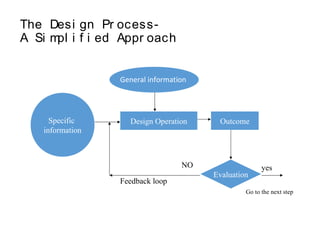
The Desi gn Pr ocess-
A Si mpl i f i ed Appr oach
General information
Design Operation OutcomeSpecific
information
Evaluation
yesNO
Feedback loop
Go to the next step
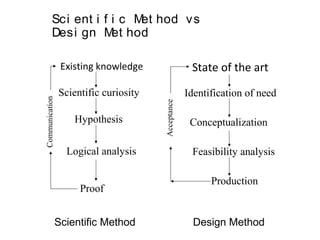
Sci ent i f i c Met hod vs
Desi gn Met hod
Existing knowledge State of the art
Scientific curiosity
Hypothesis
Logical analysis
Proof
Identification of need
Conceptualization
Feasibility analysis
Production
Communication
Acceptance
Scientific Method Design Method
Consi der at i on of Good Desi gn
• Design Requirements
• Functional performance (F, σ, power, deflection)
• Complementary performance (life of design, robustness,
reliability, ease, economy, safety of maintenance)
• Total Life Cycle
Material selection, productivity, durability
• Regulatory and Social Issues
ASTM, ASME standards, codes of ethics, EPA
requirements
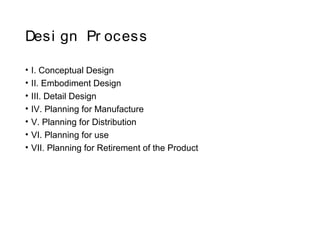
Desi gn Pr ocess
• I. Conceptual Design
• II. Embodiment Design
• III. Detail Design
• IV. Planning for Manufacture
• V. Planning for Distribution
• VI. Planning for use
• VII. Planning for Retirement of the Product
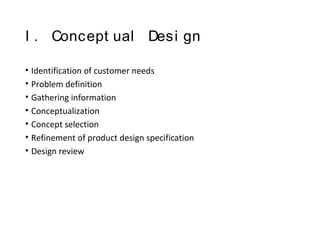
I . Concept ual Desi gn
• Identification of customer needs
• Problem definition
• Gathering information
• Conceptualization
• Concept selection
• Refinement of product design specification
• Design review
I I . Embodi ment Desi gn
• Product architecture
• Configuration design of parts and components (feature present like
holes, ribs, splines, and curves are configured). Modeling and simulation may be
performed. The generation of physical model of the part with rapid prototyping
processes may be appropriate)
• Parametric design of parts and components (exact dimensions and
tolerances, materials and processes, robustness)
I I I . Det ai l Desi gn
• In this phase the design is brought to the stage of a complete
engineering description of a tested and producible product.
I V. Pl anni ng f or Manuf act ur e
•Designing specialized tools and fixtures
•Specifying the production plant that will be used
•Planning the work schedules and inventory controls
•Planning the quality assurance systems
•Establishing the standard time and labor costs for
each operation
•Establishing the system of information flow
necessary to control the manufacturing operation
V. Pl anni ng f or Di st r i but i on
• Shelf life consideration
• System of warehouses for distribution of the product needs to be
designed
• Marketing efforts on advertising and news media techniques must be
selected
• For technical activities specialized sale brochures and performance
test data must be generated.
VI . Pl anni ng f or use
•Ease of maintenance, reliability, product safety,
convenience in use (human factors engineering),
aesthetic appeal, economy of operation, and
duration of service are some of the questions to be
answered in a consumer oriented product.
•Acquisition of reliable data on failure, service lives,
and consumer complaint and attitudes to provide a
basis for product improvement in the next design is
an important phase VI activity.
VI I . Pl anni ng f or Ret i r ement
of t he Pr oduct
• The final step in the design process is the disposal of the product when it
has reached the end of its useful life.
• Useful life may be determined by actual deterioration and wear or it
may be determined by technological obsolescence.
• Industrial ecology considerations dictate a plan for either disposal of the
product in an environmentally safe way or, better, the recycling of its
materials, or remanufacture or reuse of product components.

Product Design Process

  • 1.
    Pr obl emSol vi ng Met hodol ogy The Product Desi gn Process
  • 2.
    Everyt hi ngi s desi gned Few t hi ngs are desi gned wel l “ “
  • 3.
    The Four C’s of Desi gn Creativity • Requires creation of something that has not existed before or not existed in the designer’s mind before Complexity • Requires decisions on many variables and parameters Choice • Requires making choices between many possible solutions at all levels, from basic concepts to smallest detail of shapes Compromise • Requires balancing multiple and sometimes conflicting requirements
  • 4.
    What i s Design? • Difference between Design and Discovery: Discovery is getting the first sight of something but design is the product of planning and work • Good design requires both analysis and synthesis (Analysis is to breakdown complex problems to manageable parts and synthesis involves the identification of the design elements that will compromise the product and the combination of the part solutions into a total workable system) Desi gn est abl i shes and def i nes sol ut i ons t o and per t i nent st r uct ur es f or pr obl ems not sol ved bef or e, or new sol ut i ons t o pr obl ems whi ch have pr evi ousl y been sol ved i n a di f f er ent way
  • 5.
    The Desi gnPr ocess- A Si mpl i f i ed Appr oach General information Design Operation OutcomeSpecific information Evaluation yesNO Feedback loop Go to the next step
  • 6.
    Sci ent if i c Met hod vs Desi gn Met hod Existing knowledge State of the art Scientific curiosity Hypothesis Logical analysis Proof Identification of need Conceptualization Feasibility analysis Production Communication Acceptance Scientific Method Design Method
  • 7.
    Consi der ati on of Good Desi gn • Design Requirements • Functional performance (F, σ, power, deflection) • Complementary performance (life of design, robustness, reliability, ease, economy, safety of maintenance) • Total Life Cycle Material selection, productivity, durability • Regulatory and Social Issues ASTM, ASME standards, codes of ethics, EPA requirements
  • 8.
    Desi gn Process • I. Conceptual Design • II. Embodiment Design • III. Detail Design • IV. Planning for Manufacture • V. Planning for Distribution • VI. Planning for use • VII. Planning for Retirement of the Product
  • 9.
    I . Conceptual Desi gn • Identification of customer needs • Problem definition • Gathering information • Conceptualization • Concept selection • Refinement of product design specification • Design review
  • 10.
    I I .Embodi ment Desi gn • Product architecture • Configuration design of parts and components (feature present like holes, ribs, splines, and curves are configured). Modeling and simulation may be performed. The generation of physical model of the part with rapid prototyping processes may be appropriate) • Parametric design of parts and components (exact dimensions and tolerances, materials and processes, robustness)
  • 11.
    I I I. Det ai l Desi gn • In this phase the design is brought to the stage of a complete engineering description of a tested and producible product.
  • 12.
    I V. Planni ng f or Manuf act ur e •Designing specialized tools and fixtures •Specifying the production plant that will be used •Planning the work schedules and inventory controls •Planning the quality assurance systems •Establishing the standard time and labor costs for each operation •Establishing the system of information flow necessary to control the manufacturing operation
  • 13.
    V. Pl anning f or Di st r i but i on • Shelf life consideration • System of warehouses for distribution of the product needs to be designed • Marketing efforts on advertising and news media techniques must be selected • For technical activities specialized sale brochures and performance test data must be generated.
  • 14.
    VI . Planni ng f or use •Ease of maintenance, reliability, product safety, convenience in use (human factors engineering), aesthetic appeal, economy of operation, and duration of service are some of the questions to be answered in a consumer oriented product. •Acquisition of reliable data on failure, service lives, and consumer complaint and attitudes to provide a basis for product improvement in the next design is an important phase VI activity.
  • 15.
    VI I .Pl anni ng f or Ret i r ement of t he Pr oduct • The final step in the design process is the disposal of the product when it has reached the end of its useful life. • Useful life may be determined by actual deterioration and wear or it may be determined by technological obsolescence. • Industrial ecology considerations dictate a plan for either disposal of the product in an environmentally safe way or, better, the recycling of its materials, or remanufacture or reuse of product components.