































Product
Decision-Making
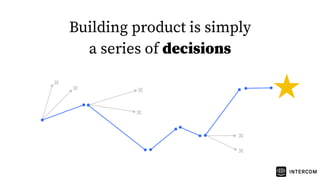
Building product is simply
a series of decisions
Quality
Decisions
Quality
Product
The speed at which quality decisions
are made dictates how fast we can
bring value to customers
And impact for our business
$
$ $
$
$
$
Our principles and process exist to
ensure we make high quality
decisions quickly and consistently
And theyʼve done a great job so far
But weʼre now operating at a
new scale with even bigger
ambitions
And what got us here,
wonʼt get us there
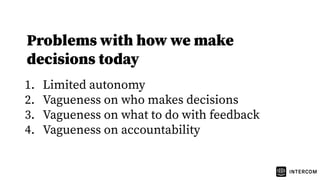
Problems with how we make
decisions today
1. Limited autonomy
2. Vagueness on who makes decisions
3. Vagueness on what to do with feedback
4. Vagueness on accountability
This results in
1. Slow decision-making
2. Lower quality decisions
3. Poor experience for everyone involved
And ultimately, less market impact.
Thatʼs why our principles and
process for making decisions
need to evolve
Here are 4 principles to make
us better at decision-making
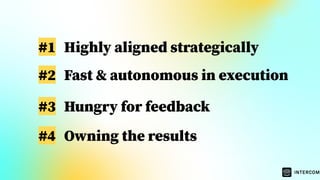
#1 Highly aligned strategically
#2 Fast & autonomous in execution
#3 Hungry for feedback
#4 Owning the results
Highly aligned
strategically
All our decisions are aligned with
our company strategy, product
strategy, and any relevant
program and group strategies.
PRINCIPLE #1
We have big ambitions
Reinvent customer support and
customer engagement
Become a multibillion
dollar company
But...
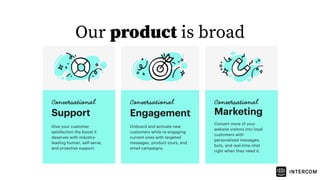
Our product is broad
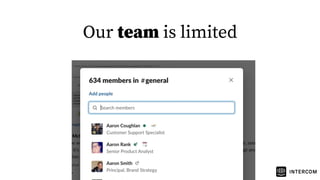
Our team is limited
Our time is limited
WEEKS IN A YEAR
YEARS
Our competition is strong
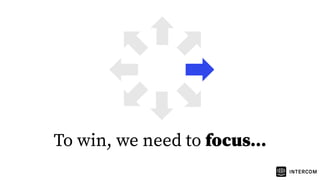
To win, we need to focus...
...and be aligned
Misaligned strategic decisions
are expensive
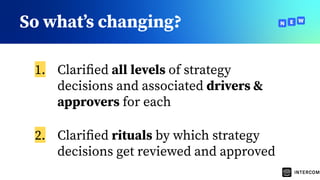
So whatʼs changing?
1. Clarified all levels of strategy
decisions and associated drivers &
approvers for each
2. Clarified rituals by which strategy
decisions get reviewed and approved
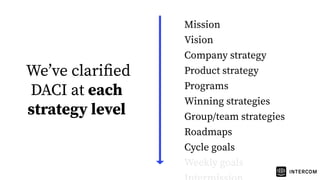
Mission
Vision
Company strategy
Product strategy
Programs
Winning strategies
Group/team strategies
Roadmaps
Cycle goals
Weekly goals
Weʼve clarified
DACI at each
strategy level
Including who needs to approve
strategic decisions and whoʼs
ultimately accountable
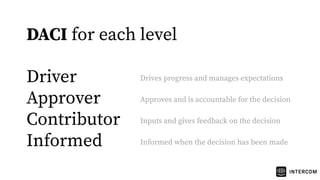
DACI for each level
Driver
Approver
Contributor
Informed
Drives progress and manages expectations
Approves and is accountable for the decision
Inputs and gives feedback on the decision
Informed when the decision has been made
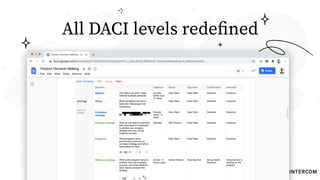
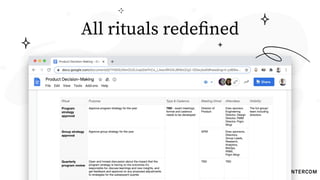
All DACI levels redefined
And for each strategy
decision-making ritual, weʼve
clarified its purpose, cadence,
driver, and attendees
All rituals redefined
Fast &
autonomous in
execution
When executing based on an
agreed strategy, we move fast and
autonomously, without approval
processes.
PRINCIPLE #2
You might
remember Des
talk about...
speed
Speed.
It’s not just about what
we do.
It’s about how quickly we
do it.
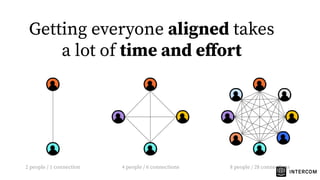
Getting everyone aligned takes
a lot of time and effort
2 people / 1 connection 4 people / 6 connections 8 people / 28 connections
We believe itʼs worth it for
strategic decisions
But...
Itʼs slowing us down when it
comes to execution
speed
Thatʼs why we believe teams
should be fast & autonomous
when executing based on an
agreed strategy
We work hard to hire
smart people like you
And create an environment of
high transparency and candor
Teams talk to their customers
regularly and understand their
problems deeply
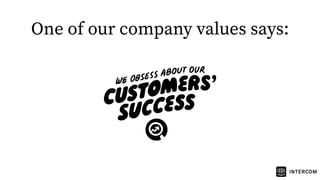
One of our company values says:
Theyʼre well set-up to make
smart decisions and trade-offs
So whatʼs changing?
1. Making it explicit that there is no
approval for executional decisions
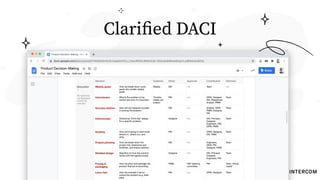
2. Clarified DACI for each type of
executional decision
We believe teams will be able to
deliver quality work faster by
not having to get approval for
executional decisions
Itʼs still up to the manager and their report to decide how involved the manager needs to be.
And by having shared
expectations of each otherʼs
roles for executional decisions
Clarified DACI
Hungry for
feedback
To make better decisions we
proactively seek feedback to gain
different perspectives. We listen and
consider all feedback with an open
mind and then accept or discard it.
PRINCIPLE #3
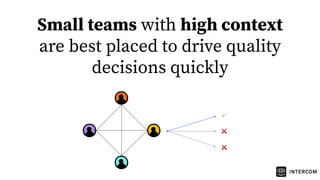
Small teams with high context
are best placed to drive quality
decisions quickly
✅
❌
❌
But no one has all the context to
make quality decisions alone
One of our company values says:
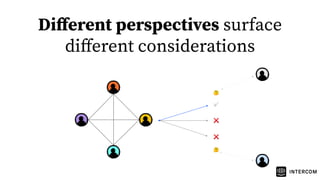
Different perspectives surface
different considerations
✅
❌
❌
🤔
🤔
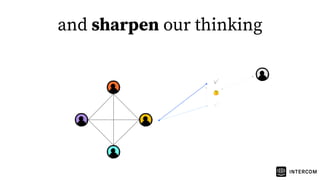
and sharpen our thinking
✅
🤔
✅
Helping us make higher quality
decisions
Thatʼs why we should be
hungry for feedback
Photo credit
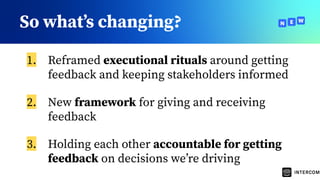
So whatʼs changing?
1. Reframed executional rituals around getting
feedback and keeping stakeholders informed
2. New framework for giving and receiving
feedback
3. Holding each other accountable for getting
feedback on decisions weʼre driving
Weʼre making product forums
smaller and explicitly focused on
feedback, not decision-making
To get director feedback, weʼre
introducing project reviews,
which will happen on ad-hoc basis
To keep stakeholders informed,
weʼre introducing lightweight
async status updates
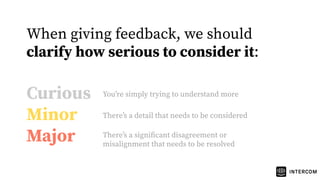
Curious
Minor
Major
Youʼre simply trying to understand more
Thereʼs a detail that needs to be considered
Thereʼs a significant disagreement or
misalignment that needs to be resolved
When giving feedback, we should
clarify how serious to consider it:
We believe feedback is critical to
making quality decisions
Thatʼs why weʼll hold each other
accountable for getting feedback
on our work
This can be through product
forums, project reviews, team
rituals, peer reviews...
...or any other medium that best
suits the decision
The important point is that weʼre
hungry for feedback and expect the
same from everyone else
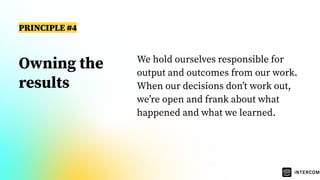
Owning the
results
We hold ourselves responsible for
output and outcomes from our work.
When our decisions donʼt work out,
weʼre open and frank about what
happened and what we learned.
PRINCIPLE #4
You might also
remember Des
telling us...
Our job is market impact
We ship product
That solves problems
for our customers
Which ultimately should result
in impact for our business
With increased autonomy comes
an increased responsibility to
own the results of our work
We have good rituals for holding
ourselves responsible for output
But we historically havenʼt been
as good at holding ourselves
responsible for outcomes
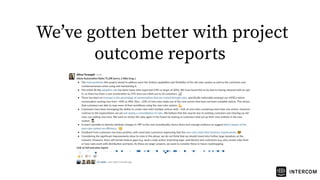
Weʼve gotten better with project
outcome reports
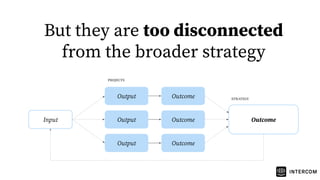
Output Outcome
Input
But they are too disconnected
from the broader strategy
Output Outcome
Output Outcome
Outcome
PROJECTS
STRATEGY
And arenʼt well set up for having
an honest debate about the real
impact and its implications
We need to apply a
growth mindset to
driving outcomes
Where weʼre open and frank about
the real impact of our work
And focus on learnings
One of our company values says:
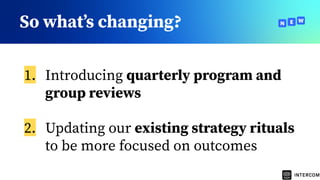
So whatʼs changing?
1. Introducing quarterly program and
group reviews
2. Updating our existing strategy rituals
to be more focused on outcomes
The purpose of quarterly
reviews will be to...
Have an open and honest
discussion about the impact on
outcomes weʼre having
1.
Discuss learnings and new
insights
2.
Get feedback and approval on
adjustments to strategy for the
subsequent quarter
3.
To further encourage this
mindset, weʼll also update our
other existing strategy rituals
and roadmap reviews
Whew! That was a lot.
��
Take a breath
��
Ok, so...
Hereʼs a summary of all
principles & changes to how we
work that will make us better at
decision making
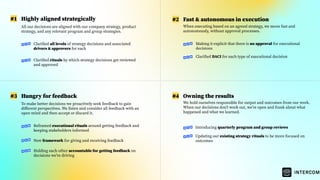
#1 Highly aligned strategically
Clarified all levels of strategy decisions and associated
drivers & approvers for each
Clarified rituals by which strategy decisions get reviewed
and approved
All our decisions are aligned with our company strategy, product
strategy, and any relevant program and group strategies.
#3 Hungry for feedback #4 Owning the results
Reframed executional rituals around getting feedback and
keeping stakeholders informed
New framework for giving and receiving feedback
Holding each other accountable for getting feedback on
decisions weʼre driving
Introducing quarterly program and group reviews
Updating our existing strategy rituals to be more focused on
outcomes
To make better decisions we proactively seek feedback to gain
different perspectives. We listen and consider all feedback with an
open mind and then accept or discard it.
We hold ourselves responsible for output and outcomes from our work.
When our decisions donʼt work out, weʼre open and frank about what
happened and what we learned.
#2 Fast & autonomous in execution
Making it explicit that there is no approval for executional
decisions
Clarified DACI for each type of executional decision
When executing based on an agreed strategy, we move fast and
autonomously, without approval processes.
Weʼre at a new scale
Our ambitions are huge
We have exceptional people
Like you
We want to set you up to
make exceptional decisions
That drive a huge
impact to our business
Quickly
But more importantly...
Enjoyably
We want Intercom to be the
best work of your career
We believe these principles
will help us get there
Thank you

Product decision-making framework