





Technical Direction
Communication, ROI and Triage
MIKE ACTON (ENGINE DIRECTOR, INSOMNIAC GAMES)
@MIKE_ACTON
Why?
1. Nothing really new
2. Only my experience
3. Only my perspective
4. Things I’ve learned
My experience
1. 10+ yr Engine Director @
Insomniac Games
2. See the problems…
3. …to the end.
Why this talk?
1. Very hard to talk about!
2. Clichés and The Obvious
3. The Gap
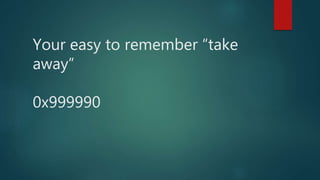
Your easy to remember “take
away”
0x999990
What does it mean to manage
technical direction (for me)?
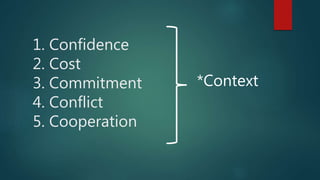
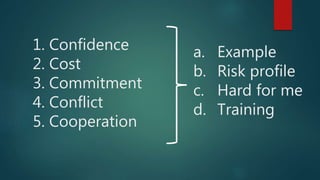
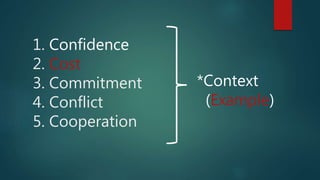
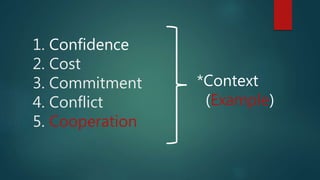
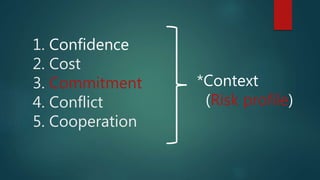
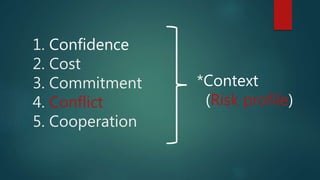
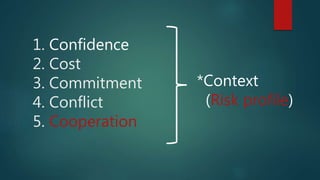
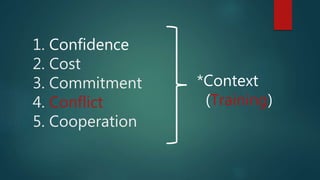
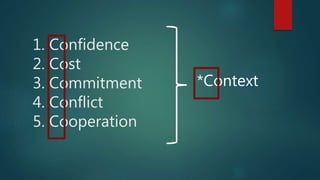
1. Confidence
2. Cost
3. Commitment
4. Conflict
5. Cooperation
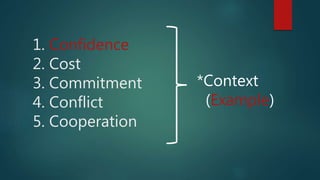
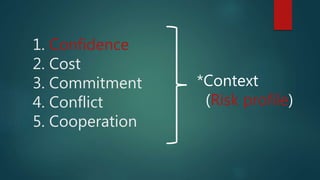
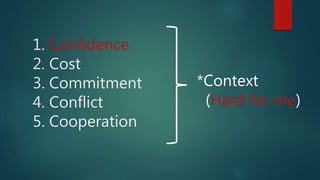
*Context
1. Confidence
2. Cost
3. Commitment
4. Conflict
5. Cooperation
a. Example
b. Risk profile
c. Hard for me
d. Training
1. Confidence
2. Cost
3. Commitment
4. Conflict
5. Cooperation
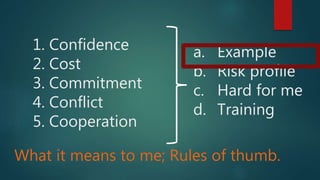
a. Example
b. Risk profile
c. Hard for me
d. Training
What it means to me; Rules of thumb.
1. Confidence
2. Cost
3. Commitment
4. Conflict
5. Cooperation
*Context
(Example)
“PM is making unrealistic
schedules!”
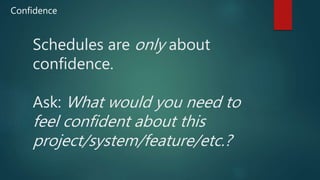
Confidence
Schedules are only about
confidence.
Confidence
Schedules are only about
confidence.
Ask: What would you need to
feel confident about this
project/system/feature/etc.?
Confidence
80/50 Rule
Confidence
1. Confidence
2. Cost
3. Commitment
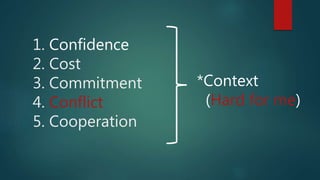
4. Conflict
5. Cooperation
*Context
(Example)
“You can’t know how long it’s going
to take to solve a problem you
haven’t solved before!”
Cost
If you don’t know how much it’s
worth, you don’t know enough
to work on it.
Cost
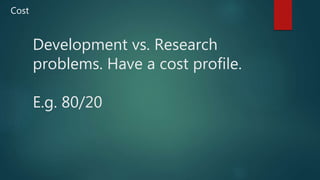
Development vs. Research
problems. Have a cost profile.
E.g. 80/20
Cost
Development problems: Have
an expected return.
E.g. 5:1
Cost
Build vs. Buy: Have a function.
E.g. Can we create a
competitive advantage by
knowing our context better
than anyone else?
Cost
1. Confidence
2. Cost
3. Commitment
4. Conflict
5. Cooperation
*Context
(Example)
Q: “Can we do X?”
A1: “Well it depends… on the art,
design, animation, etc., etc.”
A2: “Well anything is possible…”
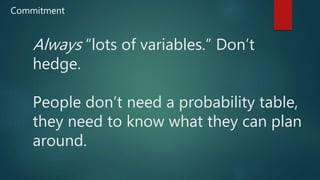
Commitment
Always “lots of variables.” Don’t
hedge.
People don’t need a probability table,
they need to know what they can plan
around.
Commitment
What are you willing to stake your
reputation/job on?
Commitment
What would you be proud to say you
did five years from now?
Commitment
Choices aren’t forever.
But 10 years is a pretty good bet.
Commitment
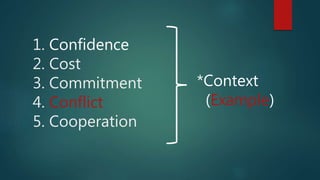
1. Confidence
2. Cost
3. Commitment
4. Conflict
5. Cooperation
*Context
(Example)
1. How do you not be like Uber?
2. “I don’t want to work with that guy
anymore! He’s always so abrasive!”
Conflict
Put process to protect people from
my biases, when they conflict with
my values.
Conflict
Need to represent the company well
– What does the company stand for?
E.g. “To be a force for good.”
Conflict
If someone thinks there is a problem,
there is a problem. Even if it’s “just” a
perception problem.
Conflict
Accountability: Prepared to accept
the cost to fix mistakes that affect
others.
Conflict
Conflict cockroaches.
Insidious, stubborn, and very, very
hard to kill completely.
Conflict
1. Confidence
2. Cost
3. Commitment
4. Conflict
5. Cooperation
*Context
(Example)
1. “It’s not working because they’re
not using the tool/engine/system
correctly!”
2. “I had to rewrite it because they
couldn’t tell me what they wanted!”
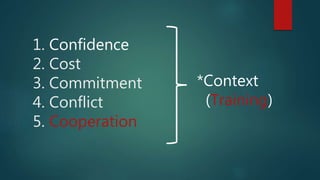
Cooperation
Surprise is the enemy.
Every day find a way to make
something more boring.
Cooperation
80% of the thing is selling the thing
1. Know what people say they want
2. Paint a picture for the future you’re
selling
Cooperation
Super boring: Roadmap
1Q
2Y
5Y
Cooperation
Every feature needs a user-side
champion.
Cooperation
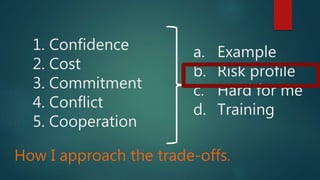
1. Confidence
2. Cost
3. Commitment
4. Conflict
5. Cooperation
a. Example
b. Risk profile
c. Hard for me
d. Training
How I approach the trade-offs.
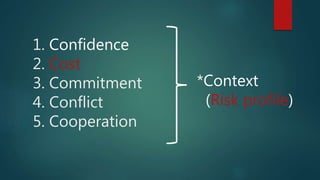
1. Confidence
2. Cost
3. Commitment
4. Conflict
5. Cooperation
*Context
(Risk profile)
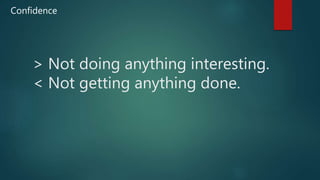
> Not doing anything interesting.
< Not getting anything done.
Confidence
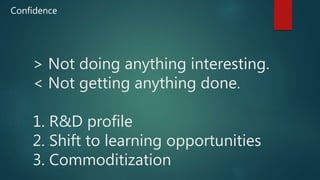
> Not doing anything interesting.
< Not getting anything done.
1. R&D profile
2. Shift to learning opportunities
3. Commoditization
Confidence
1. Confidence
2. Cost
3. Commitment
4. Conflict
5. Cooperation
*Context
(Risk profile)
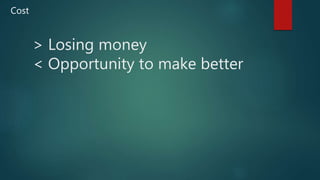
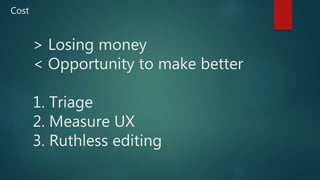
> Losing money
< Opportunity to make better
Cost
> Losing money
< Opportunity to make better
1. Triage
2. Measure UX
3. Ruthless editing
Cost
1. Confidence
2. Cost
3. Commitment
4. Conflict
5. Cooperation
*Context
(Risk profile)
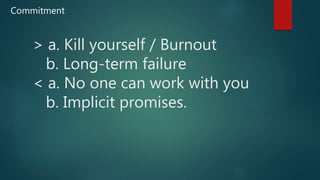
> a. Kill yourself / Burnout
b. Long-term failure
< a. No one can work with you
b. Implicit promises.
Commitment
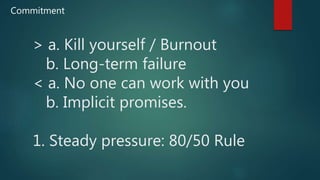
> a. Kill yourself / Burnout
b. Long-term failure
< a. No one can work with you
b. Implicit promises.
1. Steady pressure: 80/50 Rule
Commitment
> a. Kill yourself / Burnout
b. Long-term failure
< a. No one can work with you
b. Implicit promises.
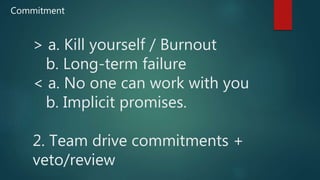
2. Team drive commitments +
veto/review
Commitment
> a. Kill yourself / Burnout
b. Long-term failure
< a. No one can work with you
b. Implicit promises.
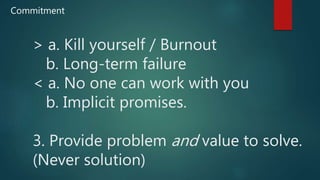
3. Provide problem and value to solve.
(Never solution)
Commitment
1. Confidence
2. Cost
3. Commitment
4. Conflict
5. Cooperation
*Context
(Risk profile)
> Toxic environment
< a. No creative energy
b. No critical review
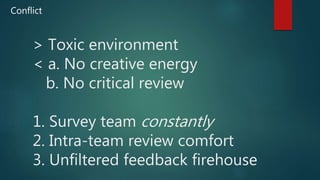
Conflict
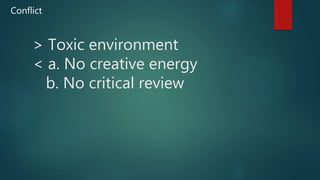
> Toxic environment
< a. No creative energy
b. No critical review
1. Survey team constantly
2. Intra-team review comfort
3. Unfiltered feedback firehouse
Conflict
1. Confidence
2. Cost
3. Commitment
4. Conflict
5. Cooperation
*Context
(Risk profile)
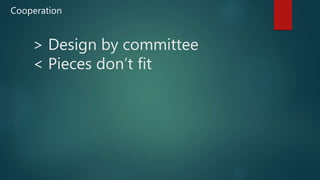
> Design by committee
< Pieces don’t fit
Cooperation
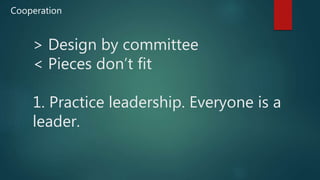
> Design by committee
< Pieces don’t fit
1. Practice leadership. Everyone is a
leader.
Cooperation
> Design by committee
< Pieces don’t fit
2. Champion for/of every feature.
Cooperation
> Design by committee
< Pieces don’t fit
3. Work backward from production
schedule
Cooperation
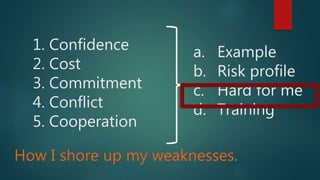
1. Confidence
2. Cost
3. Commitment
4. Conflict
5. Cooperation
a. Example
b. Risk profile
c. Hard for me
d. Training
How I shore up my weaknesses.
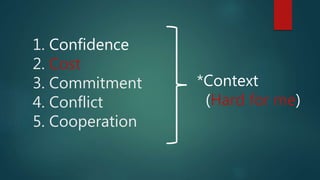
1. Confidence
2. Cost
3. Commitment
4. Conflict
5. Cooperation
*Context
(Hard for me)
Scale of communication.
- Unique per person: Want every
single person to have confidence.
Confidence
Scale of communication.
1. Leads needs to know messaging.
2. Easier for people to react. Make
commitments loud and early.
3. All the 1:1s
Confidence
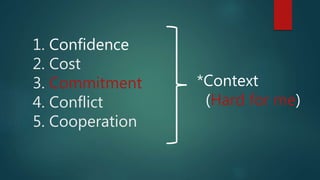
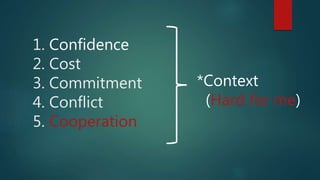
1. Confidence
2. Cost
3. Commitment
4. Conflict
5. Cooperation
*Context
(Hard for me)
Perception is reality.
- Subjective measures of value.
A. How much is 1ms worth?
B. How much is one person slightly
less frustrated worth?
Cost
Perception is reality.
1. Lots of surveys
2. Budget time for bunch of low-
hanging fruit
3. Budget time for optimization
sprints
Cost
1. Confidence
2. Cost
3. Commitment
4. Conflict
5. Cooperation
*Context
(Hard for me)
Autonomy vs. Management
1. Self-burnout
2. “Oh yeah, that would probably be
pretty easy to do…”
Commitment
Autonomy vs. Management
1. Strongly encourage time off
2. We don’t want “heroism” – always
represent it as a problem to be
solved.
3. Examples of implied promises
Commitment
1. Confidence
2. Cost
3. Commitment
4. Conflict
5. Cooperation
*Context
(Hard for me)
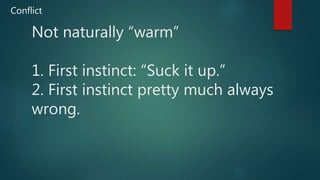
Not naturally “warm”
1. First instinct: “Suck it up.”
2. First instinct pretty much always
wrong.
Conflict
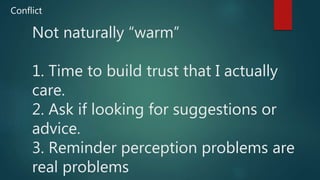
Not naturally “warm”
1. Time to build trust that I actually
care.
2. Ask if looking for suggestions or
advice.
3. Reminder perception problems are
real problems
Conflict
1. Confidence
2. Cost
3. Commitment
4. Conflict
5. Cooperation
*Context
(Hard for me)
Timing
The next thing is always the most
important thing, ever.
Cooperation
Timing
1. Goal is to stay out of the way of the
next thing (demo, etc.)
2. Build reference targets
3. Dedicated resources to immediate
concerns
Cooperation
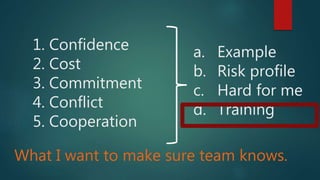
1. Confidence
2. Cost
3. Commitment
4. Conflict
5. Cooperation
a. Example
b. Risk profile
c. Hard for me
d. Training
What I want to make sure team knows.
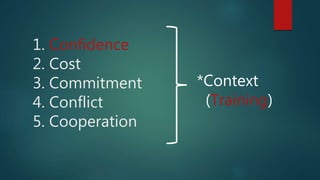
1. Confidence
2. Cost
3. Commitment
4. Conflict
5. Cooperation
*Context
(Training)
How to pitch
What do I need to know most in
order to be confident?
Confidence
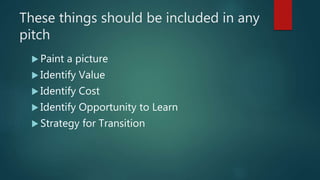
These things should be included in any
pitch
 Paint a picture
 Identify Value
 Identify Cost
 Identify Opportunity to Learn
 Strategy for Transition
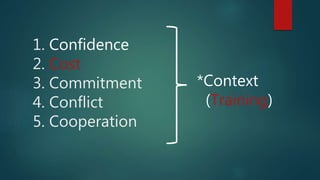
1. Confidence
2. Cost
3. Commitment
4. Conflict
5. Cooperation
*Context
(Training)
Cost/Value metrics
Can you articulate return on
investment (ROI)?
Cost
These things should be part of ROI
 Development cost
 Maintenance cost
 Cost of entry
 Efficiency return (if applicable)
 Player value (if applicable)
 Learning value
1. Confidence
2. Cost
3. Commitment
4. Conflict
5. Cooperation
*Context
(Training)
Minimum viable product (MVP)
“You will be able to…”
Separate would-be-nice from
guarantees.
Commitment
These things should be part of
commitment
 Concrete changes (What will you be able to do
you can’t do now?)
 Problem and part of problem solved. (Not
tasks or tech description.)
 Clear expectations about what will not be
done.
1. Confidence
2. Cost
3. Commitment
4. Conflict
5. Cooperation
*Context
(Training)
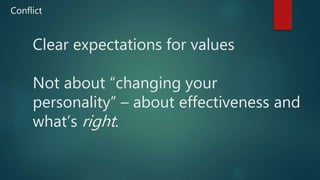
Clear expectations for values
Not about “changing your
personality” – about effectiveness and
what’s right.
Conflict
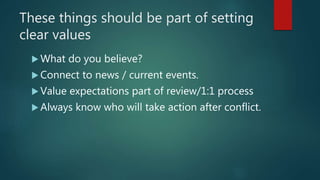
These things should be part of setting
clear values
 What do you believe?
 Connect to news / current events.
 Value expectations part of review/1:1 process
 Always know who will take action after conflict.
1. Confidence
2. Cost
3. Commitment
4. Conflict
5. Cooperation
*Context
(Training)
Champion a solution
Follow through end-to-end.
Force sign-off to give yourself
confidence.
Cooperation
These things should be part of
championing solutions
 Articulate how the studio/games will be
radically different.
 Articulate why the change is important to you,
personally.
 Need to know how to gather support.
1. Confidence
2. Cost
3. Commitment
4. Conflict
5. Cooperation
*Context
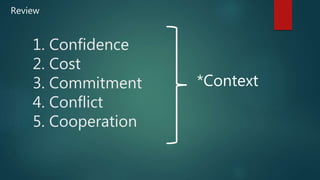
Review
Your easy to remember “take
away”
0x999990
Review
1. Confidence
2. Cost
3. Commitment
4. Conflict
5. Cooperation
*Context
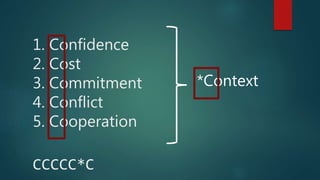
1. Confidence
2. Cost
3. Commitment
4. Conflict
5. Cooperation
CCCCC*C
*Context
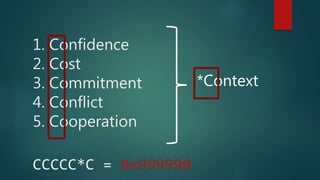
1. Confidence
2. Cost
3. Commitment
4. Conflict
5. Cooperation
CCCCC*C = 0x999990
*Context
0x999990
Mike Acton
Engine Director,
Insomniac Games
@mike_acton
macton@insomniacgames.com

Technical direction

  • 1.
    Technical Direction Communication, ROIand Triage MIKE ACTON (ENGINE DIRECTOR, INSOMNIAC GAMES) @MIKE_ACTON
  • 2.
    Why? 1. Nothing reallynew 2. Only my experience 3. Only my perspective 4. Things I’ve learned
  • 3.
    My experience 1. 10+yr Engine Director @ Insomniac Games 2. See the problems… 3. …to the end.
  • 4.
    Why this talk? 1.Very hard to talk about! 2. Clichés and The Obvious 3. The Gap
  • 5.
    Your easy toremember “take away” 0x999990
  • 6.
    What does itmean to manage technical direction (for me)?
  • 7.
    1. Confidence 2. Cost 3.Commitment 4. Conflict 5. Cooperation *Context
  • 8.
    1. Confidence 2. Cost 3.Commitment 4. Conflict 5. Cooperation a. Example b. Risk profile c. Hard for me d. Training
  • 9.
    1. Confidence 2. Cost 3.Commitment 4. Conflict 5. Cooperation a. Example b. Risk profile c. Hard for me d. Training What it means to me; Rules of thumb.
  • 10.
    1. Confidence 2. Cost 3.Commitment 4. Conflict 5. Cooperation *Context (Example)
  • 11.
    “PM is makingunrealistic schedules!” Confidence
  • 12.
    Schedules are onlyabout confidence. Confidence
  • 13.
    Schedules are onlyabout confidence. Ask: What would you need to feel confident about this project/system/feature/etc.? Confidence
  • 14.
  • 15.
    1. Confidence 2. Cost 3.Commitment 4. Conflict 5. Cooperation *Context (Example)
  • 16.
    “You can’t knowhow long it’s going to take to solve a problem you haven’t solved before!” Cost
  • 17.
    If you don’tknow how much it’s worth, you don’t know enough to work on it. Cost
  • 18.
    Development vs. Research problems.Have a cost profile. E.g. 80/20 Cost
  • 19.
    Development problems: Have anexpected return. E.g. 5:1 Cost
  • 20.
    Build vs. Buy:Have a function. E.g. Can we create a competitive advantage by knowing our context better than anyone else? Cost
  • 21.
    1. Confidence 2. Cost 3.Commitment 4. Conflict 5. Cooperation *Context (Example)
  • 22.
    Q: “Can wedo X?” A1: “Well it depends… on the art, design, animation, etc., etc.” A2: “Well anything is possible…” Commitment
  • 23.
    Always “lots ofvariables.” Don’t hedge. People don’t need a probability table, they need to know what they can plan around. Commitment
  • 24.
    What are youwilling to stake your reputation/job on? Commitment
  • 25.
    What would yoube proud to say you did five years from now? Commitment
  • 26.
    Choices aren’t forever. But10 years is a pretty good bet. Commitment
  • 27.
    1. Confidence 2. Cost 3.Commitment 4. Conflict 5. Cooperation *Context (Example)
  • 28.
    1. How doyou not be like Uber? 2. “I don’t want to work with that guy anymore! He’s always so abrasive!” Conflict
  • 29.
    Put process toprotect people from my biases, when they conflict with my values. Conflict
  • 30.
    Need to representthe company well – What does the company stand for? E.g. “To be a force for good.” Conflict
  • 31.
    If someone thinksthere is a problem, there is a problem. Even if it’s “just” a perception problem. Conflict
  • 32.
    Accountability: Prepared toaccept the cost to fix mistakes that affect others. Conflict
  • 33.
    Conflict cockroaches. Insidious, stubborn,and very, very hard to kill completely. Conflict
  • 34.
    1. Confidence 2. Cost 3.Commitment 4. Conflict 5. Cooperation *Context (Example)
  • 35.
    1. “It’s notworking because they’re not using the tool/engine/system correctly!” 2. “I had to rewrite it because they couldn’t tell me what they wanted!” Cooperation
  • 36.
    Surprise is theenemy. Every day find a way to make something more boring. Cooperation
  • 37.
    80% of thething is selling the thing 1. Know what people say they want 2. Paint a picture for the future you’re selling Cooperation
  • 38.
  • 39.
    Every feature needsa user-side champion. Cooperation
  • 40.
    1. Confidence 2. Cost 3.Commitment 4. Conflict 5. Cooperation a. Example b. Risk profile c. Hard for me d. Training How I approach the trade-offs.
  • 41.
    1. Confidence 2. Cost 3.Commitment 4. Conflict 5. Cooperation *Context (Risk profile)
  • 42.
    > Not doinganything interesting. < Not getting anything done. Confidence
  • 43.
    > Not doinganything interesting. < Not getting anything done. 1. R&D profile 2. Shift to learning opportunities 3. Commoditization Confidence
  • 44.
    1. Confidence 2. Cost 3.Commitment 4. Conflict 5. Cooperation *Context (Risk profile)
  • 45.
    > Losing money <Opportunity to make better Cost
  • 46.
    > Losing money <Opportunity to make better 1. Triage 2. Measure UX 3. Ruthless editing Cost
  • 47.
    1. Confidence 2. Cost 3.Commitment 4. Conflict 5. Cooperation *Context (Risk profile)
  • 48.
    > a. Killyourself / Burnout b. Long-term failure < a. No one can work with you b. Implicit promises. Commitment
  • 49.
    > a. Killyourself / Burnout b. Long-term failure < a. No one can work with you b. Implicit promises. 1. Steady pressure: 80/50 Rule Commitment
  • 50.
    > a. Killyourself / Burnout b. Long-term failure < a. No one can work with you b. Implicit promises. 2. Team drive commitments + veto/review Commitment
  • 51.
    > a. Killyourself / Burnout b. Long-term failure < a. No one can work with you b. Implicit promises. 3. Provide problem and value to solve. (Never solution) Commitment
  • 52.
    1. Confidence 2. Cost 3.Commitment 4. Conflict 5. Cooperation *Context (Risk profile)
  • 53.
    > Toxic environment <a. No creative energy b. No critical review Conflict
  • 54.
    > Toxic environment <a. No creative energy b. No critical review 1. Survey team constantly 2. Intra-team review comfort 3. Unfiltered feedback firehouse Conflict
  • 55.
    1. Confidence 2. Cost 3.Commitment 4. Conflict 5. Cooperation *Context (Risk profile)
  • 56.
    > Design bycommittee < Pieces don’t fit Cooperation
  • 57.
    > Design bycommittee < Pieces don’t fit 1. Practice leadership. Everyone is a leader. Cooperation
  • 58.
    > Design bycommittee < Pieces don’t fit 2. Champion for/of every feature. Cooperation
  • 59.
    > Design bycommittee < Pieces don’t fit 3. Work backward from production schedule Cooperation
  • 60.
    1. Confidence 2. Cost 3.Commitment 4. Conflict 5. Cooperation a. Example b. Risk profile c. Hard for me d. Training How I shore up my weaknesses.
  • 61.
    1. Confidence 2. Cost 3.Commitment 4. Conflict 5. Cooperation *Context (Hard for me)
  • 62.
    Scale of communication. -Unique per person: Want every single person to have confidence. Confidence
  • 63.
    Scale of communication. 1.Leads needs to know messaging. 2. Easier for people to react. Make commitments loud and early. 3. All the 1:1s Confidence
  • 64.
    1. Confidence 2. Cost 3.Commitment 4. Conflict 5. Cooperation *Context (Hard for me)
  • 65.
    Perception is reality. -Subjective measures of value. A. How much is 1ms worth? B. How much is one person slightly less frustrated worth? Cost
  • 66.
    Perception is reality. 1.Lots of surveys 2. Budget time for bunch of low- hanging fruit 3. Budget time for optimization sprints Cost
  • 67.
    1. Confidence 2. Cost 3.Commitment 4. Conflict 5. Cooperation *Context (Hard for me)
  • 68.
    Autonomy vs. Management 1.Self-burnout 2. “Oh yeah, that would probably be pretty easy to do…” Commitment
  • 69.
    Autonomy vs. Management 1.Strongly encourage time off 2. We don’t want “heroism” – always represent it as a problem to be solved. 3. Examples of implied promises Commitment
  • 70.
    1. Confidence 2. Cost 3.Commitment 4. Conflict 5. Cooperation *Context (Hard for me)
  • 71.
    Not naturally “warm” 1.First instinct: “Suck it up.” 2. First instinct pretty much always wrong. Conflict
  • 72.
    Not naturally “warm” 1.Time to build trust that I actually care. 2. Ask if looking for suggestions or advice. 3. Reminder perception problems are real problems Conflict
  • 73.
    1. Confidence 2. Cost 3.Commitment 4. Conflict 5. Cooperation *Context (Hard for me)
  • 74.
    Timing The next thingis always the most important thing, ever. Cooperation
  • 75.
    Timing 1. Goal isto stay out of the way of the next thing (demo, etc.) 2. Build reference targets 3. Dedicated resources to immediate concerns Cooperation
  • 76.
    1. Confidence 2. Cost 3.Commitment 4. Conflict 5. Cooperation a. Example b. Risk profile c. Hard for me d. Training What I want to make sure team knows.
  • 77.
    1. Confidence 2. Cost 3.Commitment 4. Conflict 5. Cooperation *Context (Training)
  • 78.
    How to pitch Whatdo I need to know most in order to be confident? Confidence
  • 79.
    These things shouldbe included in any pitch  Paint a picture  Identify Value  Identify Cost  Identify Opportunity to Learn  Strategy for Transition
  • 80.
    1. Confidence 2. Cost 3.Commitment 4. Conflict 5. Cooperation *Context (Training)
  • 81.
    Cost/Value metrics Can youarticulate return on investment (ROI)? Cost
  • 82.
    These things shouldbe part of ROI  Development cost  Maintenance cost  Cost of entry  Efficiency return (if applicable)  Player value (if applicable)  Learning value
  • 83.
    1. Confidence 2. Cost 3.Commitment 4. Conflict 5. Cooperation *Context (Training)
  • 84.
    Minimum viable product(MVP) “You will be able to…” Separate would-be-nice from guarantees. Commitment
  • 85.
    These things shouldbe part of commitment  Concrete changes (What will you be able to do you can’t do now?)  Problem and part of problem solved. (Not tasks or tech description.)  Clear expectations about what will not be done.
  • 86.
    1. Confidence 2. Cost 3.Commitment 4. Conflict 5. Cooperation *Context (Training)
  • 87.
    Clear expectations forvalues Not about “changing your personality” – about effectiveness and what’s right. Conflict
  • 88.
    These things shouldbe part of setting clear values  What do you believe?  Connect to news / current events.  Value expectations part of review/1:1 process  Always know who will take action after conflict.
  • 89.
    1. Confidence 2. Cost 3.Commitment 4. Conflict 5. Cooperation *Context (Training)
  • 90.
    Champion a solution Followthrough end-to-end. Force sign-off to give yourself confidence. Cooperation
  • 91.
    These things shouldbe part of championing solutions  Articulate how the studio/games will be radically different.  Articulate why the change is important to you, personally.  Need to know how to gather support.
  • 92.
    1. Confidence 2. Cost 3.Commitment 4. Conflict 5. Cooperation *Context Review
  • 93.
    Your easy toremember “take away” 0x999990 Review
  • 94.
    1. Confidence 2. Cost 3.Commitment 4. Conflict 5. Cooperation *Context
  • 95.
    1. Confidence 2. Cost 3.Commitment 4. Conflict 5. Cooperation CCCCC*C *Context
  • 96.
    1. Confidence 2. Cost 3.Commitment 4. Conflict 5. Cooperation CCCCC*C = 0x999990 *Context
  • 97.
    0x999990 Mike Acton Engine Director, InsomniacGames @mike_acton macton@insomniacgames.com