Submitted by
Saloni Agrawal
Shivani Puranik
Mohit Sarraf
Mahima Jain
Jai Kumar Pandit
Haider Ali
Submitted To
Arpan Shrivastav
Touching lives, improving life
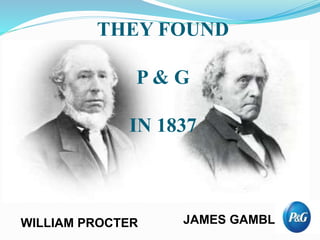
THEY FOUND
P & G
IN 1837
WILLIAM PROCTER JAMES GAMBLE
Introduction
 Procter & Gamble Co., also known as P&G, is an
American consumer goods corporation
headquartered in downtown Cincinnati, Ohio, United
States of America, founded in 1837 by William Procter
and James Gamble.
 It primarily specializes in a wide range of cleaning
agents, personal care and hygienic products. Before
the sale of Pringles to the Kellogg Company, its
product portfolio also included foods, snacks and
beverages.
Continue…
 In 2014, P&G recorded $83.1 billion in sales. On August 1,
2014, P&G announced it was streamlining the company,
dropping and selling off around 100 brands from its
product portfolio in order to focus on the remaining 65
brands, which produced 95% of the company's profits. A.G.
Lafley, the company's chairman, president, and CEO until
October 31, 2015, said the future P&G would be "a much
simpler, much less complex company of leading brands
that's easier to manage and operate“.
 David Taylor is the current president and CEO of
Procter & Gamble.
BACK GROUND OF COMPANY
 Established in 1964, P&G India now serves 650 million consumer across
India.
 P&G is one the largest and amongst the fastest growing consumer
goods companies in India.
 Its presence pans across the Beauty & Grooming segment, the
Household care segment as well as the Health & Well Being segment,
with trusted brands that are house hold names across India.
 P&G operates under three entities in India – two listed entities
1. “Procter & Gamble hygiene and health care limited” and
2. “Gillette India Limited”,
as well as one 100% subsidiary of the parent company in the U.S. called
3. “Procter & Gamble Home product”.
Continue…
Now it has a direct reach of 1.3 million outlets across
India.
At present, India is one of the smallest markets for
P&G with just $1-billion sales across three subsidiaries
-Procter & Gamble Health & Hygiene, Gillette
India and Procter & Gamble Home Products
P & G currently invested in the country via its five
plants and over nine contract manufacturing sites
It creates 26,000 jobs directly and indirectly.
Procter & Gamble, will build its largest manufacturing
plant in the Indian sub-continent in Hyderabad by
investing 345 crore.
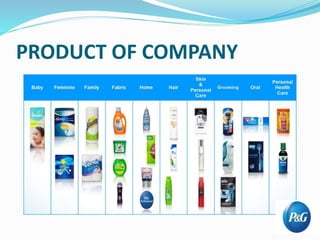
PRODUCT OF COMPANY
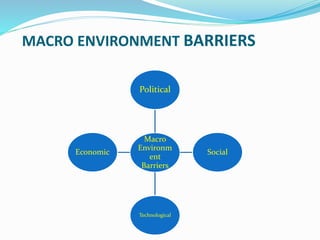
Macro
Environm
ent
Barriers
Political
Social
Technological
Economic
MACRO ENVIRONMENT BARRIERS
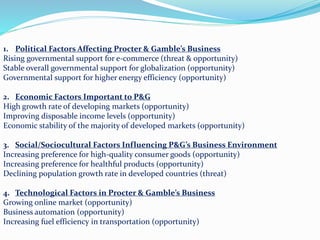
1. Political Factors Affecting Procter & Gamble’s Business
Rising governmental support for e-commerce (threat & opportunity)
Stable overall governmental support for globalization (opportunity)
Governmental support for higher energy efficiency (opportunity)
2. Economic Factors Important to P&G
High growth rate of developing markets (opportunity)
Improving disposable income levels (opportunity)
Economic stability of the majority of developed markets (opportunity)
3. Social/Sociocultural Factors Influencing P&G’s Business Environment
Increasing preference for high-quality consumer goods (opportunity)
Increasing preference for healthful products (opportunity)
Declining population growth rate in developed countries (threat)
4. Technological Factors in Procter & Gamble’s Business
Growing online market (opportunity)
Business automation (opportunity)
Increasing fuel efficiency in transportation (opportunity)
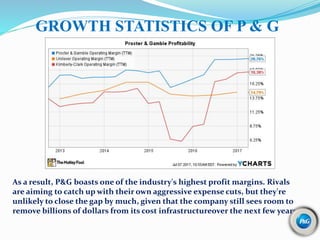
As a result, P&G boasts one of the industry's highest profit margins. Rivals
are aiming to catch up with their own aggressive expense cuts, but they're
unlikely to close the gap by much, given that the company still sees room to
remove billions of dollars from its cost infrastructureover the next few years
GROWTH STATISTICS OF P & G
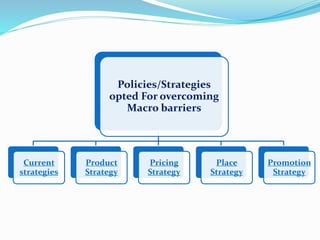
Policies/Strategies
opted For overcoming
Macro barriers
Current
strategies
Product
Strategy
Pricing
Strategy
Place
Strategy
Promotion
Strategy
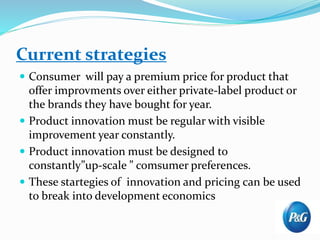
Current strategies
 Consumer will pay a premium price for product that
offer improvments over either private-label product or
the brands they have bought for year.
 Product innovation must be regular with visible
improvement year constantly.
 Product innovation must be designed to
constantly”up-scale ” comsumer preferences.
 These startegies of innovation and pricing can be used
to break into development economics
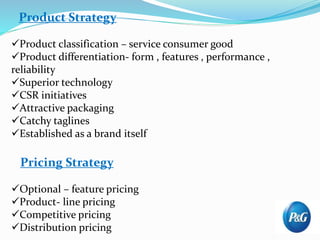
Product Strategy
Product classification – service consumer good
Product differentiation- form , features , performance ,
reliability
Superior technology
CSR initiatives
Attractive packaging
Catchy taglines
Established as a brand itself
Pricing Strategy
Optional – feature pricing
Product- line pricing
Competitive pricing
Distribution pricing
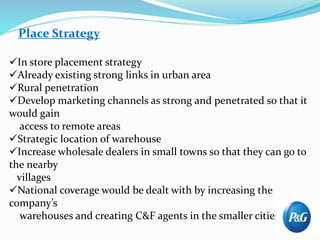
Place Strategy
In store placement strategy
Already existing strong links in urban area
Rural penetration
Develop marketing channels as strong and penetrated so that it
would gain
access to remote areas
Strategic location of warehouse
Increase wholesale dealers in small towns so that they can go to
the nearby
villages
National coverage would be dealt with by increasing the
company’s
warehouses and creating C&F agents in the smaller cities
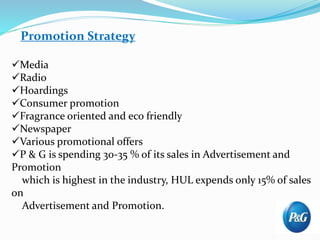
Promotion Strategy
Media
Radio
Hoardings
Consumer promotion
Fragrance oriented and eco friendly
Newspaper
Various promotional offers
P & G is spending 30-35 % of its sales in Advertisement and
Promotion
which is highest in the industry, HUL expends only 15% of sales
on
Advertisement and Promotion.
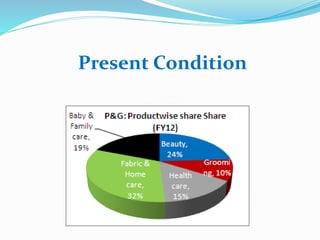
Present Condition
 As we know this market is known as FMCG market so
there are many competitor in this time in the market so
P&G company were focused in this time and target the
middle class segment for increasing the sales as well as
market shares
 Some products like Gillette is made by the company to
target the higher segment of the market.
 In India HUL is biggest competitor in FMCG market.
CONCLUSION
Procter and gamble

Procter and gamble

  • 1.
    Submitted by Saloni Agrawal ShivaniPuranik Mohit Sarraf Mahima Jain Jai Kumar Pandit Haider Ali Submitted To Arpan Shrivastav Touching lives, improving life
  • 2.
    THEY FOUND P &G IN 1837 WILLIAM PROCTER JAMES GAMBLE
  • 3.
    Introduction  Procter &Gamble Co., also known as P&G, is an American consumer goods corporation headquartered in downtown Cincinnati, Ohio, United States of America, founded in 1837 by William Procter and James Gamble.  It primarily specializes in a wide range of cleaning agents, personal care and hygienic products. Before the sale of Pringles to the Kellogg Company, its product portfolio also included foods, snacks and beverages.
  • 4.
    Continue…  In 2014,P&G recorded $83.1 billion in sales. On August 1, 2014, P&G announced it was streamlining the company, dropping and selling off around 100 brands from its product portfolio in order to focus on the remaining 65 brands, which produced 95% of the company's profits. A.G. Lafley, the company's chairman, president, and CEO until October 31, 2015, said the future P&G would be "a much simpler, much less complex company of leading brands that's easier to manage and operate“.  David Taylor is the current president and CEO of Procter & Gamble.
  • 5.
    BACK GROUND OFCOMPANY  Established in 1964, P&G India now serves 650 million consumer across India.  P&G is one the largest and amongst the fastest growing consumer goods companies in India.  Its presence pans across the Beauty & Grooming segment, the Household care segment as well as the Health & Well Being segment, with trusted brands that are house hold names across India.  P&G operates under three entities in India – two listed entities 1. “Procter & Gamble hygiene and health care limited” and 2. “Gillette India Limited”, as well as one 100% subsidiary of the parent company in the U.S. called 3. “Procter & Gamble Home product”.
  • 6.
    Continue… Now it hasa direct reach of 1.3 million outlets across India. At present, India is one of the smallest markets for P&G with just $1-billion sales across three subsidiaries -Procter & Gamble Health & Hygiene, Gillette India and Procter & Gamble Home Products P & G currently invested in the country via its five plants and over nine contract manufacturing sites It creates 26,000 jobs directly and indirectly. Procter & Gamble, will build its largest manufacturing plant in the Indian sub-continent in Hyderabad by investing 345 crore.
  • 7.
  • 9.
  • 10.
    1. Political FactorsAffecting Procter & Gamble’s Business Rising governmental support for e-commerce (threat & opportunity) Stable overall governmental support for globalization (opportunity) Governmental support for higher energy efficiency (opportunity) 2. Economic Factors Important to P&G High growth rate of developing markets (opportunity) Improving disposable income levels (opportunity) Economic stability of the majority of developed markets (opportunity) 3. Social/Sociocultural Factors Influencing P&G’s Business Environment Increasing preference for high-quality consumer goods (opportunity) Increasing preference for healthful products (opportunity) Declining population growth rate in developed countries (threat) 4. Technological Factors in Procter & Gamble’s Business Growing online market (opportunity) Business automation (opportunity) Increasing fuel efficiency in transportation (opportunity)
  • 11.
    As a result,P&G boasts one of the industry's highest profit margins. Rivals are aiming to catch up with their own aggressive expense cuts, but they're unlikely to close the gap by much, given that the company still sees room to remove billions of dollars from its cost infrastructureover the next few years GROWTH STATISTICS OF P & G
  • 12.
    Policies/Strategies opted For overcoming Macrobarriers Current strategies Product Strategy Pricing Strategy Place Strategy Promotion Strategy
  • 13.
    Current strategies  Consumerwill pay a premium price for product that offer improvments over either private-label product or the brands they have bought for year.  Product innovation must be regular with visible improvement year constantly.  Product innovation must be designed to constantly”up-scale ” comsumer preferences.  These startegies of innovation and pricing can be used to break into development economics
  • 15.
    Product Strategy Product classification– service consumer good Product differentiation- form , features , performance , reliability Superior technology CSR initiatives Attractive packaging Catchy taglines Established as a brand itself Pricing Strategy Optional – feature pricing Product- line pricing Competitive pricing Distribution pricing
  • 16.
    Place Strategy In storeplacement strategy Already existing strong links in urban area Rural penetration Develop marketing channels as strong and penetrated so that it would gain access to remote areas Strategic location of warehouse Increase wholesale dealers in small towns so that they can go to the nearby villages National coverage would be dealt with by increasing the company’s warehouses and creating C&F agents in the smaller cities
  • 17.
    Promotion Strategy Media Radio Hoardings Consumer promotion Fragranceoriented and eco friendly Newspaper Various promotional offers P & G is spending 30-35 % of its sales in Advertisement and Promotion which is highest in the industry, HUL expends only 15% of sales on Advertisement and Promotion.
  • 18.
  • 19.
     As weknow this market is known as FMCG market so there are many competitor in this time in the market so P&G company were focused in this time and target the middle class segment for increasing the sales as well as market shares  Some products like Gillette is made by the company to target the higher segment of the market.  In India HUL is biggest competitor in FMCG market. CONCLUSION