Measurement Scale
Research Methodology
SCALE
• A Scale is a tool or mechanism by which individuals are
distinguished as to how they differ from one another on the variables
of interest to our study. The scale or tool could be a gross one in the
sense that it would only broadly categorize individual on certain
variables, or it could be a fine-tuned tool that would differentiate
individual on the variables with varying degrees of sophistication.
• There are four basic type of scale:
1. Nominal
2. Ordinal
3. Interval
4. ratio
Nominal Scale
• A nominal scale is one that allows the researcher to
assign subjects to certain categories or group.
For example, With respect to the variable of gender,
respondents can be grouped into two categories– Male and
Female, These two group can be assigned code number 1
and 2.
Nominal Scales categorize individuals or objects into
mutually excusive and collectively exhaustive groups.
Other Example: Blues Eyes=1, Brown eyes=2, Black
Ordinal scale
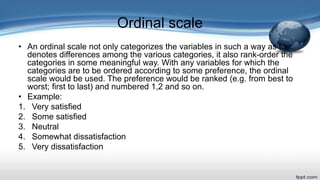
• An ordinal scale not only categorizes the variables in such a way as to
denotes differences among the various categories, it also rank-order the
categories in some meaningful way. With any variables for which the
categories are to be ordered according to some preference, the ordinal
scale would be used. The preference would be ranked (e.g. from best to
worst; first to last) and numbered 1,2 and so on.
• Example:
1. Very satisfied
2. Some satisfied
3. Neutral
4. Somewhat dissatisfaction
5. Very dissatisfaction
Interval Scale
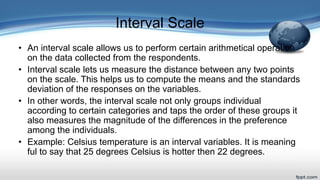
• An interval scale allows us to perform certain arithmetical operation
on the data collected from the respondents.
• Interval scale lets us measure the distance between any two points
on the scale. This helps us to compute the means and the standards
deviation of the responses on the variables.
• In other words, the interval scale not only groups individual
according to certain categories and taps the order of these groups it
also measures the magnitude of the differences in the preference
among the individuals.
• Example: Celsius temperature is an interval variables. It is meaning
ful to say that 25 degrees Celsius is hotter then 22 degrees.
Ratio scale
•
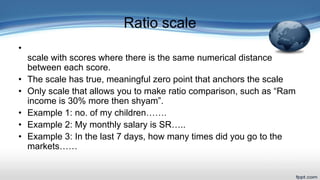
scale with scores where there is the same numerical distance
between each score.
• The scale has true, meaningful zero point that anchors the scale
• Only scale that allows you to make ratio comparison, such as “Ram
income is 30% more then shyam”.
• Example 1: no. of my children…….
• Example 2: My monthly salary is SR…..
• Example 3: In the last 7 days, how many times did you go to the
markets……
Measurement scale

Measurement scale

  • 1.
  • 2.
    SCALE • A Scaleis a tool or mechanism by which individuals are distinguished as to how they differ from one another on the variables of interest to our study. The scale or tool could be a gross one in the sense that it would only broadly categorize individual on certain variables, or it could be a fine-tuned tool that would differentiate individual on the variables with varying degrees of sophistication. • There are four basic type of scale: 1. Nominal 2. Ordinal 3. Interval 4. ratio
  • 3.
    Nominal Scale • Anominal scale is one that allows the researcher to assign subjects to certain categories or group. For example, With respect to the variable of gender, respondents can be grouped into two categories– Male and Female, These two group can be assigned code number 1 and 2. Nominal Scales categorize individuals or objects into mutually excusive and collectively exhaustive groups. Other Example: Blues Eyes=1, Brown eyes=2, Black
  • 4.
    Ordinal scale • Anordinal scale not only categorizes the variables in such a way as to denotes differences among the various categories, it also rank-order the categories in some meaningful way. With any variables for which the categories are to be ordered according to some preference, the ordinal scale would be used. The preference would be ranked (e.g. from best to worst; first to last) and numbered 1,2 and so on. • Example: 1. Very satisfied 2. Some satisfied 3. Neutral 4. Somewhat dissatisfaction 5. Very dissatisfaction
  • 5.
    Interval Scale • Aninterval scale allows us to perform certain arithmetical operation on the data collected from the respondents. • Interval scale lets us measure the distance between any two points on the scale. This helps us to compute the means and the standards deviation of the responses on the variables. • In other words, the interval scale not only groups individual according to certain categories and taps the order of these groups it also measures the magnitude of the differences in the preference among the individuals. • Example: Celsius temperature is an interval variables. It is meaning ful to say that 25 degrees Celsius is hotter then 22 degrees.
  • 6.
    Ratio scale • scale withscores where there is the same numerical distance between each score. • The scale has true, meaningful zero point that anchors the scale • Only scale that allows you to make ratio comparison, such as “Ram income is 30% more then shyam”. • Example 1: no. of my children……. • Example 2: My monthly salary is SR….. • Example 3: In the last 7 days, how many times did you go to the markets……