Process Safety KPI’s
Determination based on the

Bow Tie methodology
Arthur Groot
04 februari 2014
From HAZARD to HARM

04 februari 2014
Methodology and key-elements
Identification and monitoring KPI’s




C-level




BU-level


Plant en site management

04 februari 2014






Bottom-up approach
Direct connection between
safety management
system and risks
Compliance with
legislation (Seveso
II), HSG 254 methodology
and CCPS
Identification of relevant
KPI’-s process safety by
using BowTiemethodology
Dedicated Bow-Tie
software
Mandate and commitment
Training programs
ISO 31000
Approach in 4 phases
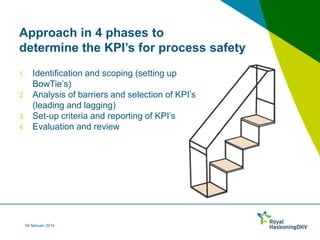
Approach in 4 phases to
determine the KPI’s for process safety
1.
2.
3.
4.

Identification and scoping (setting up
BowTie’s)
Analysis of barriers and selection of KPI’s
(leading and lagging)
Set-up criteria and reporting of KPI’s
Evaluation and review

04 februari 2014
Phase 1: identification


Setting-up BowTie’s in 12 steps at operational installation
level by using the following reports:
 HAZOP/HAZID’s
 Safety reports (Seveso II)
 SIL/LOPA assesments
 FMECA analysis

Result: a set of barriers including escalation factor control

04 februari 2014
Phase 2, Key Performance Indicators


Starting point:
“You don’t improve what you don’t measure”
 Indicators:



Leading indicators: “performance of barriers before the
consequence”
Lagging indicators: “number of near misses or the
consequences itself”

04 februari 2014
Phase 2, analysis of barriers and
selection of KPI’s



Selection of KPI’s, leading (barriers), max. 1 per threat
or consequence line and lagging (consequences)
Connecting barriers (KPI’s) to business model (safety management
system)

04 februari 2014
Phase 3, Set-up criteria and
reporting of KPI’s




Setting up PR (performance requirements) for the KPI’s,. the
FISM (Functionality, Integrity, Survivability and Management)
methodology
Setting-up PS (performance standards) for (KPI’s) defining
grades, scoring and assessment criteria

04 februari 2014
Performance requirements






Functionality
 definition the expected task(s)
Integrity
 definition of the reliability of the barrier
Survivability
 describes the barrier during an incident
Management
 description of the processes, activities, procedures, competences
to control the barrier

04 februari 2014
Performance standard


Grades, scoring methods & assessment criteria

Effectiveness of barrier
Condition of barrier is very bad
Condition of barrier is bad

Performance criteria
Design
i.e procedure not
updated last 4 years
i.e. procedure not
updated last 2 years

Condition of barrier is good

Etc.

Condition of barrier is very good

Etc.

Very Good

04 februari 2014

Good

Moderate

Etc.

Etc.

i.e.producedure

Operational

Etc.

Condition of barrier is moderate

Integrity
Not audited on
performance
Not audited in
the last year
Not audited this
year

Etc.

Not trained operators
Operator trained not in
last 2 years
Operators trained last
year

Bad

Very Bad
Phase 3, integration of
Key Performance Indicators
Generic KPI’s related to management systems
 Percentage of completed HSE audits
 Implementation of lesson learned TRIPOD investigations
(progress)
 Validation of procedures for operational and maintenance tasks
(progress is parameter)
 Percentage of underperforming operational documents noticed
during (HSE) audits
 Job-specific trained personal (percentage)
 Etc.

04 februari 2014
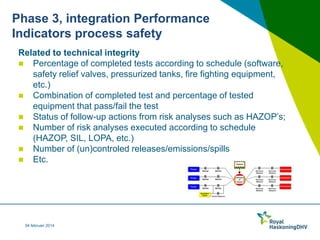
Phase 3, integration Performance
Indicators process safety
Related to technical integrity
 Percentage of completed tests according to schedule (software,
safety relief valves, pressurized tanks, fire fighting equipment,
etc.)
 Combination of completed test and percentage of tested
equipment that pass/fail the test
 Status of follow-up actions from risk analyses such as HAZOP’s;
 Number of risk analyses executed according to schedule
(HAZOP, SIL, LOPA, etc.)
 Number of (un)controled releases/emissions/spills
 Etc.

04 februari 2014
Phase 4, Start reporting, evaluation
and review






Starting with risk optimization
Starting improvement cycle (Plan, Do, Check, Act cycle)
Transparency check
Integrating incident data for risk management

04 februari 2014
Phase 4, ‘live’ data of the (HSE) management
system into the Bow-Tie

Management System
04 februari 2014
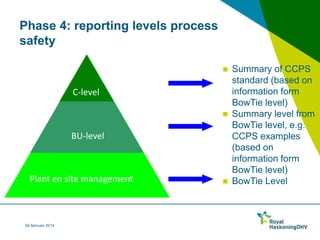
Phase 4: reporting levels process
safety


C-level

BU-level

Plant en site management

04 februari 2014

Summary of CCPS
standard (based on
information form
BowTie level)
 Summary level from
BowTie level, e.g.
CCPS examples
(based on
information form
BowTie level)
 BowTie Level
Conclusions KPI’s




Bottom-up approach
Identification of relevant KPI’-s (process) safety by using
BowTie- methodology
Compliance with (HSE) legislation. i.e. (Seveso II), HSG
254 methodology (HSE) and meets criteria set by CCPS

04 februari 2014
Services Royal HaskoningDHV
Policy and strategy

Culture

•Development of Environment & Safety Policy
•Corporate Environment Plan
•Stakeholder Analysis
•Carbon Capture and Storage
•REACH and GHS
•Corporate Social Responsibility
•Carbon Trading
•Policy on the Prevention of Serious Accidents
•Energy

•SHWE growth model (based
on Hearts and Minds)
•Safety culture scan
•Incident analysis (TRIPOD)
•Management system audits
•Compliance Audits

Organization and processes
•Environmental Management Systems
•Safety Management Systems
•Occupational Health Management Systems
•HSE Risk Management
•Interim HSE Management
•Training and Coaching
•Environmental and Sustainability Reporting
•Process safety management

04 februari 2014

Compliance
•Environmental impact
assessment (EIA)
•Environmental permitting
•Safety Report
•Fire Report
•QRA/external Safety
•EIA
•Emission studies
•Noise/odor dispersion studies
•IPPC studies

HSE engineering
•Safety Case
•HAZID and HAZOP
•ENVID
•Fire Protection Analyses
•QRA, IRPA
•Technical Safety Review
•Process Hazard Analysis
•Hazard Consequence Modeling
•Asset integrity studies (SIL, IPF
and LOPA)
•Reliability, Availability &
Maintainability Studies (RAMS)
•FME(C)A studies
•BowTie Risk Analyses
•Escape, Evacuation &
Rescue Analysis (EERA)

Process Safety Kpi

  • 1.
    Process Safety KPI’s Determinationbased on the Bow Tie methodology Arthur Groot 04 februari 2014
  • 2.
    From HAZARD toHARM 04 februari 2014
  • 3.
    Methodology and key-elements Identificationand monitoring KPI’s   C-level   BU-level  Plant en site management 04 februari 2014     Bottom-up approach Direct connection between safety management system and risks Compliance with legislation (Seveso II), HSG 254 methodology and CCPS Identification of relevant KPI’-s process safety by using BowTiemethodology Dedicated Bow-Tie software Mandate and commitment Training programs ISO 31000 Approach in 4 phases
  • 4.
    Approach in 4phases to determine the KPI’s for process safety 1. 2. 3. 4. Identification and scoping (setting up BowTie’s) Analysis of barriers and selection of KPI’s (leading and lagging) Set-up criteria and reporting of KPI’s Evaluation and review 04 februari 2014
  • 5.
    Phase 1: identification  Setting-upBowTie’s in 12 steps at operational installation level by using the following reports:  HAZOP/HAZID’s  Safety reports (Seveso II)  SIL/LOPA assesments  FMECA analysis Result: a set of barriers including escalation factor control 04 februari 2014
  • 6.
    Phase 2, KeyPerformance Indicators  Starting point: “You don’t improve what you don’t measure”  Indicators:   Leading indicators: “performance of barriers before the consequence” Lagging indicators: “number of near misses or the consequences itself” 04 februari 2014
  • 7.
    Phase 2, analysisof barriers and selection of KPI’s   Selection of KPI’s, leading (barriers), max. 1 per threat or consequence line and lagging (consequences) Connecting barriers (KPI’s) to business model (safety management system) 04 februari 2014
  • 8.
    Phase 3, Set-upcriteria and reporting of KPI’s   Setting up PR (performance requirements) for the KPI’s,. the FISM (Functionality, Integrity, Survivability and Management) methodology Setting-up PS (performance standards) for (KPI’s) defining grades, scoring and assessment criteria 04 februari 2014
  • 9.
    Performance requirements     Functionality  definitionthe expected task(s) Integrity  definition of the reliability of the barrier Survivability  describes the barrier during an incident Management  description of the processes, activities, procedures, competences to control the barrier 04 februari 2014
  • 10.
    Performance standard  Grades, scoringmethods & assessment criteria Effectiveness of barrier Condition of barrier is very bad Condition of barrier is bad Performance criteria Design i.e procedure not updated last 4 years i.e. procedure not updated last 2 years Condition of barrier is good Etc. Condition of barrier is very good Etc. Very Good 04 februari 2014 Good Moderate Etc. Etc. i.e.producedure Operational Etc. Condition of barrier is moderate Integrity Not audited on performance Not audited in the last year Not audited this year Etc. Not trained operators Operator trained not in last 2 years Operators trained last year Bad Very Bad
  • 11.
    Phase 3, integrationof Key Performance Indicators Generic KPI’s related to management systems  Percentage of completed HSE audits  Implementation of lesson learned TRIPOD investigations (progress)  Validation of procedures for operational and maintenance tasks (progress is parameter)  Percentage of underperforming operational documents noticed during (HSE) audits  Job-specific trained personal (percentage)  Etc. 04 februari 2014
  • 12.
    Phase 3, integrationPerformance Indicators process safety Related to technical integrity  Percentage of completed tests according to schedule (software, safety relief valves, pressurized tanks, fire fighting equipment, etc.)  Combination of completed test and percentage of tested equipment that pass/fail the test  Status of follow-up actions from risk analyses such as HAZOP’s;  Number of risk analyses executed according to schedule (HAZOP, SIL, LOPA, etc.)  Number of (un)controled releases/emissions/spills  Etc. 04 februari 2014
  • 13.
    Phase 4, Startreporting, evaluation and review     Starting with risk optimization Starting improvement cycle (Plan, Do, Check, Act cycle) Transparency check Integrating incident data for risk management 04 februari 2014
  • 14.
    Phase 4, ‘live’data of the (HSE) management system into the Bow-Tie Management System 04 februari 2014
  • 15.
    Phase 4: reportinglevels process safety  C-level BU-level Plant en site management 04 februari 2014 Summary of CCPS standard (based on information form BowTie level)  Summary level from BowTie level, e.g. CCPS examples (based on information form BowTie level)  BowTie Level
  • 16.
    Conclusions KPI’s    Bottom-up approach Identificationof relevant KPI’-s (process) safety by using BowTie- methodology Compliance with (HSE) legislation. i.e. (Seveso II), HSG 254 methodology (HSE) and meets criteria set by CCPS 04 februari 2014
  • 17.
    Services Royal HaskoningDHV Policyand strategy Culture •Development of Environment & Safety Policy •Corporate Environment Plan •Stakeholder Analysis •Carbon Capture and Storage •REACH and GHS •Corporate Social Responsibility •Carbon Trading •Policy on the Prevention of Serious Accidents •Energy •SHWE growth model (based on Hearts and Minds) •Safety culture scan •Incident analysis (TRIPOD) •Management system audits •Compliance Audits Organization and processes •Environmental Management Systems •Safety Management Systems •Occupational Health Management Systems •HSE Risk Management •Interim HSE Management •Training and Coaching •Environmental and Sustainability Reporting •Process safety management 04 februari 2014 Compliance •Environmental impact assessment (EIA) •Environmental permitting •Safety Report •Fire Report •QRA/external Safety •EIA •Emission studies •Noise/odor dispersion studies •IPPC studies HSE engineering •Safety Case •HAZID and HAZOP •ENVID •Fire Protection Analyses •QRA, IRPA •Technical Safety Review •Process Hazard Analysis •Hazard Consequence Modeling •Asset integrity studies (SIL, IPF and LOPA) •Reliability, Availability & Maintainability Studies (RAMS) •FME(C)A studies •BowTie Risk Analyses •Escape, Evacuation & Rescue Analysis (EERA)