Bow tie method
John Baker
Objective
• Explain the bow tie method
• Consider whether it is a useful tool for
safety event investigation
Slide 2
Initiating
event
Success
event 1
Success
event 2
Failure
event 2
Failure
event 1
Success
event 3
Failure
event 3
Accident
Failure 3
Failure 1
Failure 2
Failure 5Failure 4
Fault and event trees
Slide 3
FAULTTREE EVENTTREE
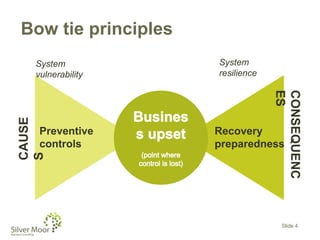
Bow ties use the principles of both fault trees and event trees, forming a
‘bow tie’ shape:
Bow tie principles
Slide 4
Recovery
preparedness
Preventive
controls
CONSEQUENC
ES
CAUSE
S
System
vulnerability
System
resilience
Bow tie models
Bow ties:
• are graphical, not numerical
• link to known threats
• Provide qualitative indication of how
sufficient a control measure is
Slide 5
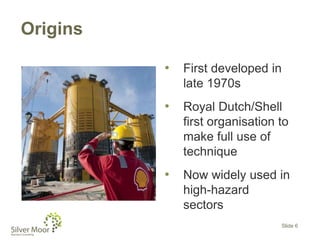
Origins
• First developed in
late 1970s
• Royal Dutch/Shell
first organisation to
make full use of
technique
• Now widely used in
high-hazard
sectors
Slide 6
Sector applications
• Oil & gas
• Aviation
• Mining
• Marine
• Healthcare
• Rail (fairly recently)
Slide 7
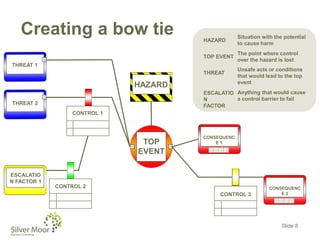
Creating a bow tie
Slide 8
HAZARD
TOP
EVENT
CONTROL 1
CONTROL 2
CONTROL 3
THREAT 1
THREAT 2
ESCALATIO
N FACTOR 1
CONSEQUENC
E 1
CONSEQUENC
E 2
HAZARD
Situation with the potential
to cause harm
TOP EVENT
The point where control
over the hazard is lost
THREAT
Unsafe acts or conditions
that would lead to the top
event
ESCALATIO
N
FACTOR
Anything that would cause
a control barrier to fail
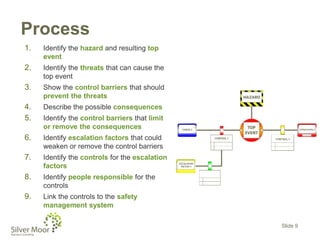
Process
1. Identify the hazard and resulting top
event
2. Identify the threats that can cause the
top event
3. Show the control barriers that should
prevent the threats
4. Describe the possible consequences
5. Identify the control barriers that limit
or remove the consequences
6. Identify escalation factors that could
weaken or remove the control barriers
7. Identify the controls for the escalation
factors
8. Identify people responsible for the
controls
9. Link the controls to the safety
management system
Slide 9
Example – confined space training
Slide 10
Smoke/fume
s
Pressure
gauge
Insufficient air
in BA cylinder
Death or major
injury
Discomfort
Insufficient
breathable
air for
firefighter to
get to safety
Warning
whistle
Routine
charging
BA cylinder
valve
switched off
Buddy
checks
Moisture in
system
causes
freezing
Compressor
filters
Filters
blocked
Maintenanc
e schedule
Safety
doors
Safety
Officer
Safety
doors
Safety
Officer
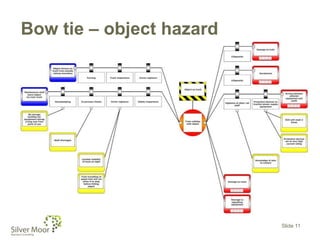
Bow tie – object hazard
Slide 11
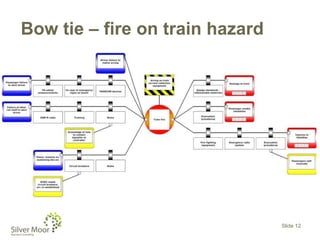
Bow tie – fire on train hazard
Slide 12
Bow tie – moving train hazard
Slide 13
Bow tie – station fire hazard
Slide 14
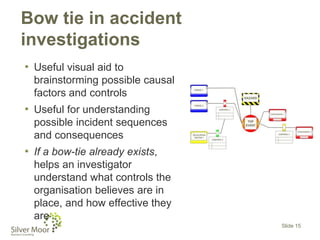
Bow tie in accident
investigations
• Useful visual aid to
brainstorming possible causal
factors and controls
• Useful for understanding
possible incident sequences
and consequences
• If a bow-tie already exists,
helps an investigator
understand what controls the
organisation believes are in
place, and how effective they
are
Slide 15
Bow tie as a risk assessment
tool - strengths
• Provides a way of visualising risk assessments
• Gets people involved – promotes understanding
of hazard management and their role in it
• Helps make the distinction between preventive
controls and resilience controls
• Includes all credible scenarios *****
• Structured approach where quantification is not
possible or desirable
Slide 16
www.silvermoorconsulting.co.
uk
Silver Moor Business Consulting LLP
t: 01934 824609 | m: 07551 124383
Registered in England and Wales, OC389666. Registered office: Cannaways
Farm, Banwell, North Somerset, BS29 6LQ

The bow tie method

  • 1.
  • 2.
    Objective • Explain thebow tie method • Consider whether it is a useful tool for safety event investigation Slide 2
  • 3.
    Initiating event Success event 1 Success event 2 Failure event2 Failure event 1 Success event 3 Failure event 3 Accident Failure 3 Failure 1 Failure 2 Failure 5Failure 4 Fault and event trees Slide 3 FAULTTREE EVENTTREE Bow ties use the principles of both fault trees and event trees, forming a ‘bow tie’ shape:
  • 4.
    Bow tie principles Slide4 Recovery preparedness Preventive controls CONSEQUENC ES CAUSE S System vulnerability System resilience
  • 5.
    Bow tie models Bowties: • are graphical, not numerical • link to known threats • Provide qualitative indication of how sufficient a control measure is Slide 5
  • 6.
    Origins • First developedin late 1970s • Royal Dutch/Shell first organisation to make full use of technique • Now widely used in high-hazard sectors Slide 6
  • 7.
    Sector applications • Oil& gas • Aviation • Mining • Marine • Healthcare • Rail (fairly recently) Slide 7
  • 8.
    Creating a bowtie Slide 8 HAZARD TOP EVENT CONTROL 1 CONTROL 2 CONTROL 3 THREAT 1 THREAT 2 ESCALATIO N FACTOR 1 CONSEQUENC E 1 CONSEQUENC E 2 HAZARD Situation with the potential to cause harm TOP EVENT The point where control over the hazard is lost THREAT Unsafe acts or conditions that would lead to the top event ESCALATIO N FACTOR Anything that would cause a control barrier to fail
  • 9.
    Process 1. Identify thehazard and resulting top event 2. Identify the threats that can cause the top event 3. Show the control barriers that should prevent the threats 4. Describe the possible consequences 5. Identify the control barriers that limit or remove the consequences 6. Identify escalation factors that could weaken or remove the control barriers 7. Identify the controls for the escalation factors 8. Identify people responsible for the controls 9. Link the controls to the safety management system Slide 9
  • 10.
    Example – confinedspace training Slide 10 Smoke/fume s Pressure gauge Insufficient air in BA cylinder Death or major injury Discomfort Insufficient breathable air for firefighter to get to safety Warning whistle Routine charging BA cylinder valve switched off Buddy checks Moisture in system causes freezing Compressor filters Filters blocked Maintenanc e schedule Safety doors Safety Officer Safety doors Safety Officer
  • 11.
    Bow tie –object hazard Slide 11
  • 12.
    Bow tie –fire on train hazard Slide 12
  • 13.
    Bow tie –moving train hazard Slide 13
  • 14.
    Bow tie –station fire hazard Slide 14
  • 15.
    Bow tie inaccident investigations • Useful visual aid to brainstorming possible causal factors and controls • Useful for understanding possible incident sequences and consequences • If a bow-tie already exists, helps an investigator understand what controls the organisation believes are in place, and how effective they are Slide 15
  • 16.
    Bow tie asa risk assessment tool - strengths • Provides a way of visualising risk assessments • Gets people involved – promotes understanding of hazard management and their role in it • Helps make the distinction between preventive controls and resilience controls • Includes all credible scenarios ***** • Structured approach where quantification is not possible or desirable Slide 16
  • 17.
    www.silvermoorconsulting.co. uk Silver Moor BusinessConsulting LLP t: 01934 824609 | m: 07551 124383 Registered in England and Wales, OC389666. Registered office: Cannaways Farm, Banwell, North Somerset, BS29 6LQ