1
Process Oriented Knowledge Management
Model and Methodology
&
Integration
Michael Wyrsch
Vice President, Head Global Knowledge Management OE, Credit Suisse
© Wyrsch & Partner
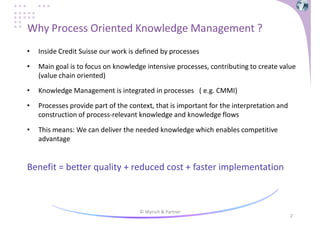
Why Process Oriented Knowledge Management ?
• Inside Credit Suisse our work is defined by processes
• Main goal is to focus on knowledge intensive processes, contributing to create value
(value chain oriented)
• Knowledge Management is integrated in processes ( e.g. CMMI)
• Processes provide part of the context, that is important for the interpretation and
construction of process-relevant knowledge and knowledge flows
• This means: We can deliver the needed knowledge which enables competitive
advantage
Benefit = better quality + reduced cost + faster implementation
© Wyrsch & Partner
2
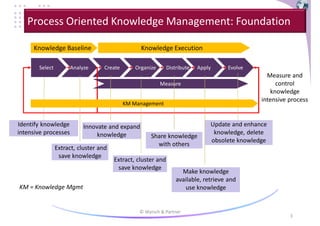
KM = Knowledge Mgmt
Identify knowledge
intensive processes
Innovate and expand
knowledge Share knowledge
with others
Make knowledge
available, retrieve and
use knowledge
Update and enhance
knowledge, delete
obsolete knowledge
Measure and
control
knowledge
intensive process
Knowledge ExecutionKnowledge Baseline
Select Analyze Create Organize Distribute Apply Evolve
Extract, cluster and
save knowledge
Extract, cluster and
save knowledge
Measure
Process Oriented Knowledge Management: Foundation
© Wyrsch & Partner
3
KM Management
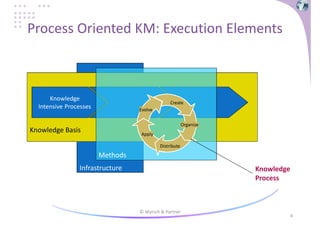
Process Oriented KM: Execution Elements
© Wyrsch & Partner
4
Knowledge
Process
Infrastructure
Knowledge Basis
Knowledge
Intensive Processes
MethodsMethods
CreateCreate
EvolveEvolve
OrganizeOrganize
DistributeDistribute
ApplyApply
Create
Evolve
Organize
Distribute
Apply
Create
Evolve
Organize
Distribute
Apply
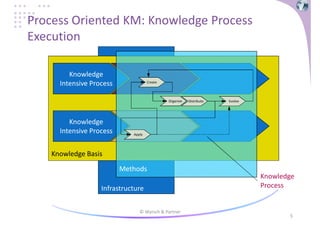
Process Oriented KM: Knowledge Process
Execution
© Wyrsch & Partner
5
Infrastructure
Knowledge Basis
Knowledge
Intensive Process
Knowledge
Intensive Process
MethodsMethods
Knowledge
Process
Create
Organize
Apply
Distribute Evolve
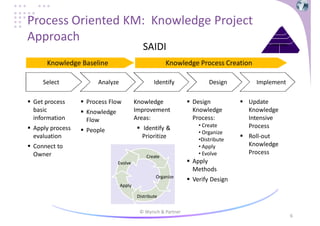
Process Oriented KM: Knowledge Project
Approach
© Wyrsch & Partner
6
Select Analyze Identify Design Implement
Get process
basic
information
Apply process
evaluation
Connect to
Owner
Process Flow
Knowledge
Flow
People
Knowledge
Improvement
Areas:
Identify &
Prioritize
Design
Knowledge
Process:
• Create
• Organize
•Distribute
• Apply
• Evolve
Apply
Methods
Verify Design
Update
Knowledge
Intensive
Process
Roll-out
Knowledge
Process
SAIDI
Knowledge Baseline Knowledge Process Creation
Create
Evolve
Organize
Distribute
Apply
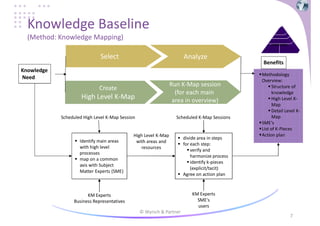
Knowledge Baseline
(Method: Knowledge Mapping)
© Wyrsch & Partner
7
Select
Create
High Level K-Map
Run K-Map session
(for each main
area in overview)
Analyze
Identify main areas
with high level
processes
map on a common
axis with Subject
Matter Experts (SME)
divide area in steps
for each step:
verify and
harmonize process
identify k-pieces
(explicit/tacit)
Agree on action plan
High Level K-Map
with areas and
resources
Knowledge
Need
Scheduled High Level K-Map Session
KM Experts
Business Representatives
KM Experts
SME's
users
Scheduled K-Map Sessions
Methodology
Overview:
Structure of
knowledge
High Level K-
Map
Detail Level K-
Map
SME's
List of K-Pieces
Action plan
Benefits
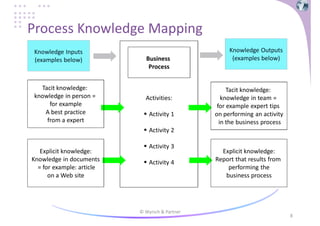
Process Knowledge Mapping
© Wyrsch & Partner
8
Activities:
Activity 1
Activity 2
Activity 3
Activity 4
Business
Process
Knowledge Outputs
(examples below)
Knowledge Inputs
(examples below)
Explicit knowledge:
Knowledge in documents
= for example: article
on a Web site
Tacit knowledge:
knowledge in person =
for example
A best practice
from a expert
Explicit knowledge:
Report that results from
performing the
business process
Tacit knowledge:
knowledge in team =
for example expert tips
on performing an activity
in the business process
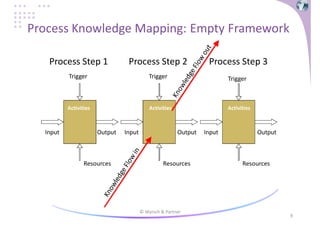
Process Knowledge Mapping: Empty Framework
© Wyrsch & Partner
9
Trigger
Input Output
Resources
Activities
Trigger
Input Output
Resources
Activities
Trigger
Input Output
Resources
Activities
Process Step 1 Process Step 2 Process Step 3
Knowledge Process Examples
Out of the requirements from CMMI we implemented:
• Lessons Learned (LL)
• Practical Example (PE) – Good / Best Practice (G/BP)
• Process Risk Management
© Wyrsch & Partner
10
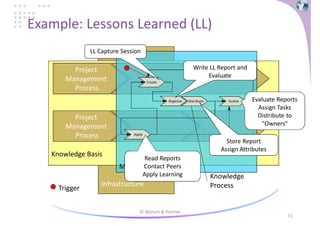
Example: Lessons Learned (LL)
© Wyrsch & Partner
11
Infrastructure
Knowledge Basis
Project
Management
Process
Project
Management
Process
MethodsMethods
Knowledge
ProcessTrigger
Create
Organize
Apply
Distribute Evolve
LL Capture Session
Write LL Report and
Evaluate
Store Report
Assign Attributes
Read Reports
Contact Peers
Apply Learning
Evaluate Reports
Assign Tasks
Distribute to
"Owners"
Lessons Learned (LL)
© Wyrsch & Partner
12
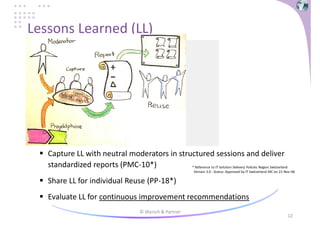
Capture LL with neutral moderators in structured sessions and deliver
standardized reports (PMC-10*)
Share LL for individual Reuse (PP-18*)
Evaluate LL for continuous improvement recommendations
* Reference to IT Solution Delivery Policies Region Switzerland
Version 3.0 - Status: Approved by IT Switzerland MC on 21-Nov-06
Lessons Learned (LL)
Establish contacts and networks for similar situations and projects.
© Wyrsch & Partner
13
Processes well established
LL repository/portal available
Trained moderators
Continuous improvements recommendation by
dedicated quarterly reports
Personal and professional development
Team building and common understanding
Additional insights to project from other roles
Experience in open group reflection with a neutral moderator and
improved quality of the Lessons Learned Report
Bridging projects and situations with LL for reuse – improving project
performance
Current
state
Lessons Learned: Current State (since Oct. 2006)
• Numbers:
– 350+ Lessons Learned Reports
– > 7000 recommendations
– ~ 3000 user hits monthly
– calculated 6 person days saved by reuse (organizational + individual)
– survey results 3 persons days saved by individual reuse
• Locations:
– Switzerland
– Singapore (rollout planned to all locations)
– Video Conferencing
• Staffing:
– 2 Lead Moderators (KSMF 5)
– 13 Moderators: 4 Business, 9 IT (they stay for a year)
© Wyrsch & Partner
14
Lessons Learned Customer Feedback
© Wyrsch & Partner
15
Efficient, well prepared,
least effort for the
project team
Simple efficient method that involves
all participants.
Good moderation of workshop
We keep making the same
mistakes. Deadlines too
short, not enough
resources. I hope this will
help our line management
see these problems in a
structured way so that they
have arguments for their
line managers.
I found the mix business/IT
extremely useful. Our viewpoints
at times were really very different
even though we were addressing
the same issues.
the objective was clear
the purpose was clear
people spoke up
moderator made people feel
comfortable
moderator was effective as
in whenever the team was
going on an 'offline' subject
this was brought back to the
main focus
feelings were captured
perfectly
finger-pointing was avoided,
instead facts and events
were analyzed
I personally learned on the
go during this exercise, it's
useful to hear the other side
of the story.
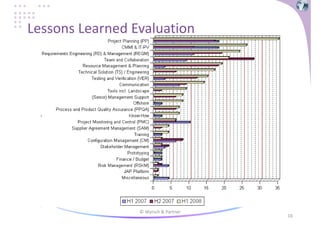
Lessons Learned Evaluation
© Wyrsch & Partner
16
Lessons Learned implementation issues
© Wyrsch & Partner
17
Evaluate Reports
Assign Tasks
Distribute to
"Owners"
Does not work really good! Process-Owners have problem
to convert lessons in process changes because of:
• Other priorities
• Other changes requests
• Understanding the indivdual case
• Etc.
Personnel impact = high
Organizational impact = low
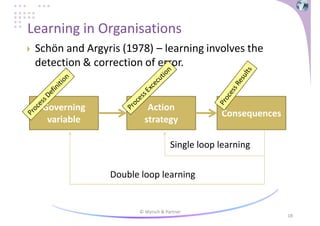
Learning in Organisations
© Wyrsch & Partner
18
Schön and Argyris (1978) – learning involves the
detection & correction of error.
Governing
variable
Action
strategy
Consequences
Single loop learning
Double loop learning
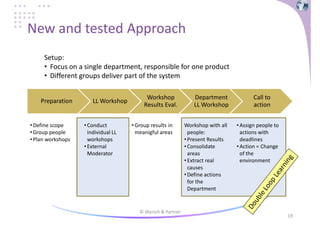
New and tested Approach
© Wyrsch & Partner
19
Preparation LL Workshop
Workshop
Results Eval.
Department
LL Workshop
Call to
action
Setup:
• Focus on a single department, responsible for one product
• Different groups deliver part of the system
•Define scope
•Group people
•Plan workshops
•Conduct
individual LL
workshops
•External
Moderator
•Group results in
meanigful areas
Workshop with all
people:
•Present Results
•Consolidate
areas
•Extract real
causes
•Define actions
for the
Department
•Assign people to
actions with
deadlines
•Action = Change
of the
environment
KM build-in the Methodology: SCRUM
© Wyrsch & Partner
20
RETROSPECTIVE:
• Went Well?
• Went Poorly?
• Improve ?
© Wyrsch & Partner
21
For development teams:
Risk, Outcomes and Practices (ROP) Model
Infrastructure
Knowledge Basis
Project
Management
Process
Project
Management
Process
MethodsMethods
Knowledge
Process
Example: Practical Example (PE) – Good / Best Practice
(G/BP)
© Wyrsch & Partner
22
DiscoverPractical Example
Publish PE
Assign Attributes
Collect PE-G/BP
Apply to Current
Work
Out of several
PE:
Create
Good/Best
Practice
Publish G/BP
Trigger
Create
Organize
Apply
Distribute Evolve
Store PE
Review PE
Practical Example Good/Best Practice
(PE G/BP)
© Wyrsch & Partner
23
Enable the proposal and identification of Practical Examples (PE)
Coordinate the conversion of PE G/BP and maintain the quality of the content
Provide a central storage of PE and G/BP
Practical Example Good/Best Practice
(PE G/BP)
© Wyrsch & Partner
24
High quality and up-to-date examples for projects
Reduce the reinvention of wheel
Valuable material as input for Good/Best Practices
Central and guided process to collect and maintain our
knowledge and experience
Implementation of Best Practice Management for CMMI L2, L3, ...
Definition in IT Glossary
Process defined/reviewed
Repository available
Ongoing flow of examples
~ 200 examples online
Strong support of the templates
Online feedback possible
Feedback shows about 2-4 person days saved by reuse (per document)
Current
state
Process Risk Management
© Wyrsch & Partner
25
Infrastructure
Knowledge Basis
Project
Management
Process
Project
Management
Process
MethodsMethods
Knowledge
Process
Trigger
Create
Organize
Apply
Distribute Evolve
Submit Risk-Plan
to KAR
Evaluate Risk
mitigations
Store good risk
mitigation
Assign
Attributes
Read Risk mitigations
Contact Peers
Apply Learning
Evaluate risk
mitigations
Derive process /
environment
improvements
Distribute to
"Owners"
Continuous Update Risk-Plan
Process Risk Management: Current state
• Started in January 2010
• ~ 40 Risk mitigations stored
• Continuous flow depends on project close (= trigger for
submission)
• Reuse benefits not yet calculated
© Wyrsch & Partner
26
And bring it all together on one system:
© Wyrsch & Partner
27
© Wyrsch & Partner
28
If you give me an egg and I give you an egg , we each have
one egg
If you give me an idea and I give you an idea , we each have
two ideas :
West African proverb
A last word:
© Wyrsch & Partner
29
Contact
MichaelMichaelMichaelMichael WyrschWyrschWyrschWyrsch
Wyrsch & PartnerWyrsch & PartnerWyrsch & PartnerWyrsch & Partner
Geisswies 24Geisswies 24Geisswies 24Geisswies 24
8414 Buch a. I.8414 Buch a. I.8414 Buch a. I.8414 Buch a. I.
http://www.wyrschhttp://www.wyrschhttp://www.wyrschhttp://www.wyrsch----partner.chpartner.chpartner.chpartner.ch
michael@wyrschmichael@wyrschmichael@wyrschmichael@wyrsch----partner.chpartner.chpartner.chpartner.ch
✆✆✆✆ +41 79 207 78 86+41 79 207 78 86+41 79 207 78 86+41 79 207 78 86

Process Oriented Knowledge Management

  • 1.
    1 Process Oriented KnowledgeManagement Model and Methodology & Integration Michael Wyrsch Vice President, Head Global Knowledge Management OE, Credit Suisse © Wyrsch & Partner
  • 2.
    Why Process OrientedKnowledge Management ? • Inside Credit Suisse our work is defined by processes • Main goal is to focus on knowledge intensive processes, contributing to create value (value chain oriented) • Knowledge Management is integrated in processes ( e.g. CMMI) • Processes provide part of the context, that is important for the interpretation and construction of process-relevant knowledge and knowledge flows • This means: We can deliver the needed knowledge which enables competitive advantage Benefit = better quality + reduced cost + faster implementation © Wyrsch & Partner 2
  • 3.
    KM = KnowledgeMgmt Identify knowledge intensive processes Innovate and expand knowledge Share knowledge with others Make knowledge available, retrieve and use knowledge Update and enhance knowledge, delete obsolete knowledge Measure and control knowledge intensive process Knowledge ExecutionKnowledge Baseline Select Analyze Create Organize Distribute Apply Evolve Extract, cluster and save knowledge Extract, cluster and save knowledge Measure Process Oriented Knowledge Management: Foundation © Wyrsch & Partner 3 KM Management
  • 4.
    Process Oriented KM:Execution Elements © Wyrsch & Partner 4 Knowledge Process Infrastructure Knowledge Basis Knowledge Intensive Processes MethodsMethods CreateCreate EvolveEvolve OrganizeOrganize DistributeDistribute ApplyApply Create Evolve Organize Distribute Apply Create Evolve Organize Distribute Apply
  • 5.
    Process Oriented KM:Knowledge Process Execution © Wyrsch & Partner 5 Infrastructure Knowledge Basis Knowledge Intensive Process Knowledge Intensive Process MethodsMethods Knowledge Process Create Organize Apply Distribute Evolve
  • 6.
    Process Oriented KM:Knowledge Project Approach © Wyrsch & Partner 6 Select Analyze Identify Design Implement Get process basic information Apply process evaluation Connect to Owner Process Flow Knowledge Flow People Knowledge Improvement Areas: Identify & Prioritize Design Knowledge Process: • Create • Organize •Distribute • Apply • Evolve Apply Methods Verify Design Update Knowledge Intensive Process Roll-out Knowledge Process SAIDI Knowledge Baseline Knowledge Process Creation Create Evolve Organize Distribute Apply
  • 7.
    Knowledge Baseline (Method: KnowledgeMapping) © Wyrsch & Partner 7 Select Create High Level K-Map Run K-Map session (for each main area in overview) Analyze Identify main areas with high level processes map on a common axis with Subject Matter Experts (SME) divide area in steps for each step: verify and harmonize process identify k-pieces (explicit/tacit) Agree on action plan High Level K-Map with areas and resources Knowledge Need Scheduled High Level K-Map Session KM Experts Business Representatives KM Experts SME's users Scheduled K-Map Sessions Methodology Overview: Structure of knowledge High Level K- Map Detail Level K- Map SME's List of K-Pieces Action plan Benefits
  • 8.
    Process Knowledge Mapping ©Wyrsch & Partner 8 Activities: Activity 1 Activity 2 Activity 3 Activity 4 Business Process Knowledge Outputs (examples below) Knowledge Inputs (examples below) Explicit knowledge: Knowledge in documents = for example: article on a Web site Tacit knowledge: knowledge in person = for example A best practice from a expert Explicit knowledge: Report that results from performing the business process Tacit knowledge: knowledge in team = for example expert tips on performing an activity in the business process
  • 9.
    Process Knowledge Mapping:Empty Framework © Wyrsch & Partner 9 Trigger Input Output Resources Activities Trigger Input Output Resources Activities Trigger Input Output Resources Activities Process Step 1 Process Step 2 Process Step 3
  • 10.
    Knowledge Process Examples Outof the requirements from CMMI we implemented: • Lessons Learned (LL) • Practical Example (PE) – Good / Best Practice (G/BP) • Process Risk Management © Wyrsch & Partner 10
  • 11.
    Example: Lessons Learned(LL) © Wyrsch & Partner 11 Infrastructure Knowledge Basis Project Management Process Project Management Process MethodsMethods Knowledge ProcessTrigger Create Organize Apply Distribute Evolve LL Capture Session Write LL Report and Evaluate Store Report Assign Attributes Read Reports Contact Peers Apply Learning Evaluate Reports Assign Tasks Distribute to "Owners"
  • 12.
    Lessons Learned (LL) ©Wyrsch & Partner 12 Capture LL with neutral moderators in structured sessions and deliver standardized reports (PMC-10*) Share LL for individual Reuse (PP-18*) Evaluate LL for continuous improvement recommendations * Reference to IT Solution Delivery Policies Region Switzerland Version 3.0 - Status: Approved by IT Switzerland MC on 21-Nov-06
  • 13.
    Lessons Learned (LL) Establishcontacts and networks for similar situations and projects. © Wyrsch & Partner 13 Processes well established LL repository/portal available Trained moderators Continuous improvements recommendation by dedicated quarterly reports Personal and professional development Team building and common understanding Additional insights to project from other roles Experience in open group reflection with a neutral moderator and improved quality of the Lessons Learned Report Bridging projects and situations with LL for reuse – improving project performance Current state
  • 14.
    Lessons Learned: CurrentState (since Oct. 2006) • Numbers: – 350+ Lessons Learned Reports – > 7000 recommendations – ~ 3000 user hits monthly – calculated 6 person days saved by reuse (organizational + individual) – survey results 3 persons days saved by individual reuse • Locations: – Switzerland – Singapore (rollout planned to all locations) – Video Conferencing • Staffing: – 2 Lead Moderators (KSMF 5) – 13 Moderators: 4 Business, 9 IT (they stay for a year) © Wyrsch & Partner 14
  • 15.
    Lessons Learned CustomerFeedback © Wyrsch & Partner 15 Efficient, well prepared, least effort for the project team Simple efficient method that involves all participants. Good moderation of workshop We keep making the same mistakes. Deadlines too short, not enough resources. I hope this will help our line management see these problems in a structured way so that they have arguments for their line managers. I found the mix business/IT extremely useful. Our viewpoints at times were really very different even though we were addressing the same issues. the objective was clear the purpose was clear people spoke up moderator made people feel comfortable moderator was effective as in whenever the team was going on an 'offline' subject this was brought back to the main focus feelings were captured perfectly finger-pointing was avoided, instead facts and events were analyzed I personally learned on the go during this exercise, it's useful to hear the other side of the story.
  • 16.
    Lessons Learned Evaluation ©Wyrsch & Partner 16
  • 17.
    Lessons Learned implementationissues © Wyrsch & Partner 17 Evaluate Reports Assign Tasks Distribute to "Owners" Does not work really good! Process-Owners have problem to convert lessons in process changes because of: • Other priorities • Other changes requests • Understanding the indivdual case • Etc. Personnel impact = high Organizational impact = low
  • 18.
    Learning in Organisations ©Wyrsch & Partner 18 Schön and Argyris (1978) – learning involves the detection & correction of error. Governing variable Action strategy Consequences Single loop learning Double loop learning
  • 19.
    New and testedApproach © Wyrsch & Partner 19 Preparation LL Workshop Workshop Results Eval. Department LL Workshop Call to action Setup: • Focus on a single department, responsible for one product • Different groups deliver part of the system •Define scope •Group people •Plan workshops •Conduct individual LL workshops •External Moderator •Group results in meanigful areas Workshop with all people: •Present Results •Consolidate areas •Extract real causes •Define actions for the Department •Assign people to actions with deadlines •Action = Change of the environment
  • 20.
    KM build-in theMethodology: SCRUM © Wyrsch & Partner 20 RETROSPECTIVE: • Went Well? • Went Poorly? • Improve ?
  • 21.
    © Wyrsch &Partner 21 For development teams: Risk, Outcomes and Practices (ROP) Model
  • 22.
    Infrastructure Knowledge Basis Project Management Process Project Management Process MethodsMethods Knowledge Process Example: PracticalExample (PE) – Good / Best Practice (G/BP) © Wyrsch & Partner 22 DiscoverPractical Example Publish PE Assign Attributes Collect PE-G/BP Apply to Current Work Out of several PE: Create Good/Best Practice Publish G/BP Trigger Create Organize Apply Distribute Evolve Store PE Review PE
  • 23.
    Practical Example Good/BestPractice (PE G/BP) © Wyrsch & Partner 23 Enable the proposal and identification of Practical Examples (PE) Coordinate the conversion of PE G/BP and maintain the quality of the content Provide a central storage of PE and G/BP
  • 24.
    Practical Example Good/BestPractice (PE G/BP) © Wyrsch & Partner 24 High quality and up-to-date examples for projects Reduce the reinvention of wheel Valuable material as input for Good/Best Practices Central and guided process to collect and maintain our knowledge and experience Implementation of Best Practice Management for CMMI L2, L3, ... Definition in IT Glossary Process defined/reviewed Repository available Ongoing flow of examples ~ 200 examples online Strong support of the templates Online feedback possible Feedback shows about 2-4 person days saved by reuse (per document) Current state
  • 25.
    Process Risk Management ©Wyrsch & Partner 25 Infrastructure Knowledge Basis Project Management Process Project Management Process MethodsMethods Knowledge Process Trigger Create Organize Apply Distribute Evolve Submit Risk-Plan to KAR Evaluate Risk mitigations Store good risk mitigation Assign Attributes Read Risk mitigations Contact Peers Apply Learning Evaluate risk mitigations Derive process / environment improvements Distribute to "Owners" Continuous Update Risk-Plan
  • 26.
    Process Risk Management:Current state • Started in January 2010 • ~ 40 Risk mitigations stored • Continuous flow depends on project close (= trigger for submission) • Reuse benefits not yet calculated © Wyrsch & Partner 26
  • 27.
    And bring itall together on one system: © Wyrsch & Partner 27
  • 28.
    © Wyrsch &Partner 28 If you give me an egg and I give you an egg , we each have one egg If you give me an idea and I give you an idea , we each have two ideas : West African proverb A last word:
  • 29.
    © Wyrsch &Partner 29 Contact MichaelMichaelMichaelMichael WyrschWyrschWyrschWyrsch Wyrsch & PartnerWyrsch & PartnerWyrsch & PartnerWyrsch & Partner Geisswies 24Geisswies 24Geisswies 24Geisswies 24 8414 Buch a. I.8414 Buch a. I.8414 Buch a. I.8414 Buch a. I. http://www.wyrschhttp://www.wyrschhttp://www.wyrschhttp://www.wyrsch----partner.chpartner.chpartner.chpartner.ch michael@wyrschmichael@wyrschmichael@wyrschmichael@wyrsch----partner.chpartner.chpartner.chpartner.ch ✆✆✆✆ +41 79 207 78 86+41 79 207 78 86+41 79 207 78 86+41 79 207 78 86