Knowledge Management and Me
Putting People before Process and Technology
2017
Synopsis
• Knowledge Management projects are notorious for failing to deliver
benefits. It’s not the actual implementation that fails; installing Yammer,
Jives, Workplace or any other tool is not particularly challenging. The

problem is that many organisations switch their focus once the tool
implementation is complete.
• Before wasting time and money, what needs to be understood, is that
Knowledge Management is not something that can be implemented. It is
not defined by the tools that are used, nor the processes that are followed
to create articles in a knowledgebase.
• Knowledge Management is first and foremost a willingness and desire of
people within the organisation to help each other make things better. If
this desire is not truly there, all that your process and technology-related
investments will lead to, are expensive and embarrassing white elephants.
Jamie Donoghue
Director and Principal Consultant
MBA, CISA, CGEIT, CISM, CRISC, COBIT, P3O, MSP, PRINCE2,
PMP, ITIL Expert, ScrumMaster, Lean Change, DevOps, Six Sigma
Speaker
Jamie, a dual citizen of the UK and NZ, has spent over 19 years
improving IT Services for public and private organisations in
the UK, Australia and South East Asia.
As the architect and lead coach for VisionLed’s 7 Principles of
Business Agility, he specialises in guiding organisations through
their transformational process.
jamie@visionled.co
Agenda
What’s in it for our customer? Our organisation? For me?
What goes wrong when we put technology and process
before people?
How can we start on the right foot?
How will we know if we’re on the right track?
Common Approaches to Knowledge Management
1. Knowledge Base
2. Communities of Practice
3. Lessons Learned
4. Learning Management Systems
5. Training
6. Collaborative Platforms
Knowledge Base
Knowledge Base
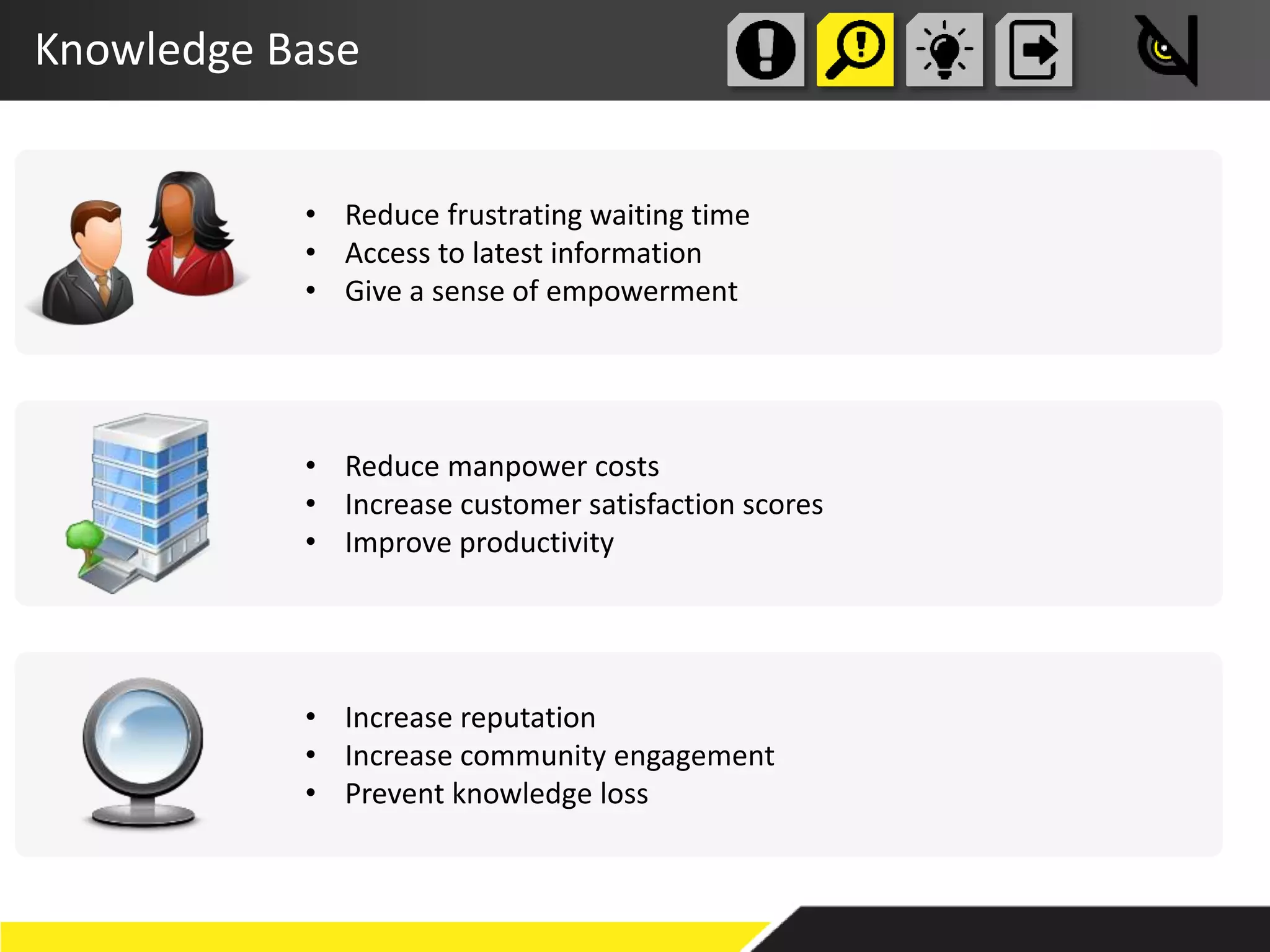
• Reduce frustrating waiting time
• Access to latest information
• Give a sense of empowerment
• Reduce manpower costs
• Increase customer satisfaction scores
• Improve productivity
• Increase reputation
• Increase community engagement
• Prevent knowledge loss
Knowledge Base
 Set a limit on the number of active articles
– Per product / service
– Measure number of times accessed (is it current?)
– Measure relevance (were the tags / search strings correct?)
– Measure integrity ‘did it help?’
• If not, should it be revised or replaced?
 Ask your colleague to search for your article but don’t give
them your tags / keywords
– (don’t cheat by searching by author!)
 Measure who is and is not contributing
– If not why? Need help?
 Measure value of each article
– How much time did it save?
– How much pain did we avoid?
Knowledge Base
Knowledge Base
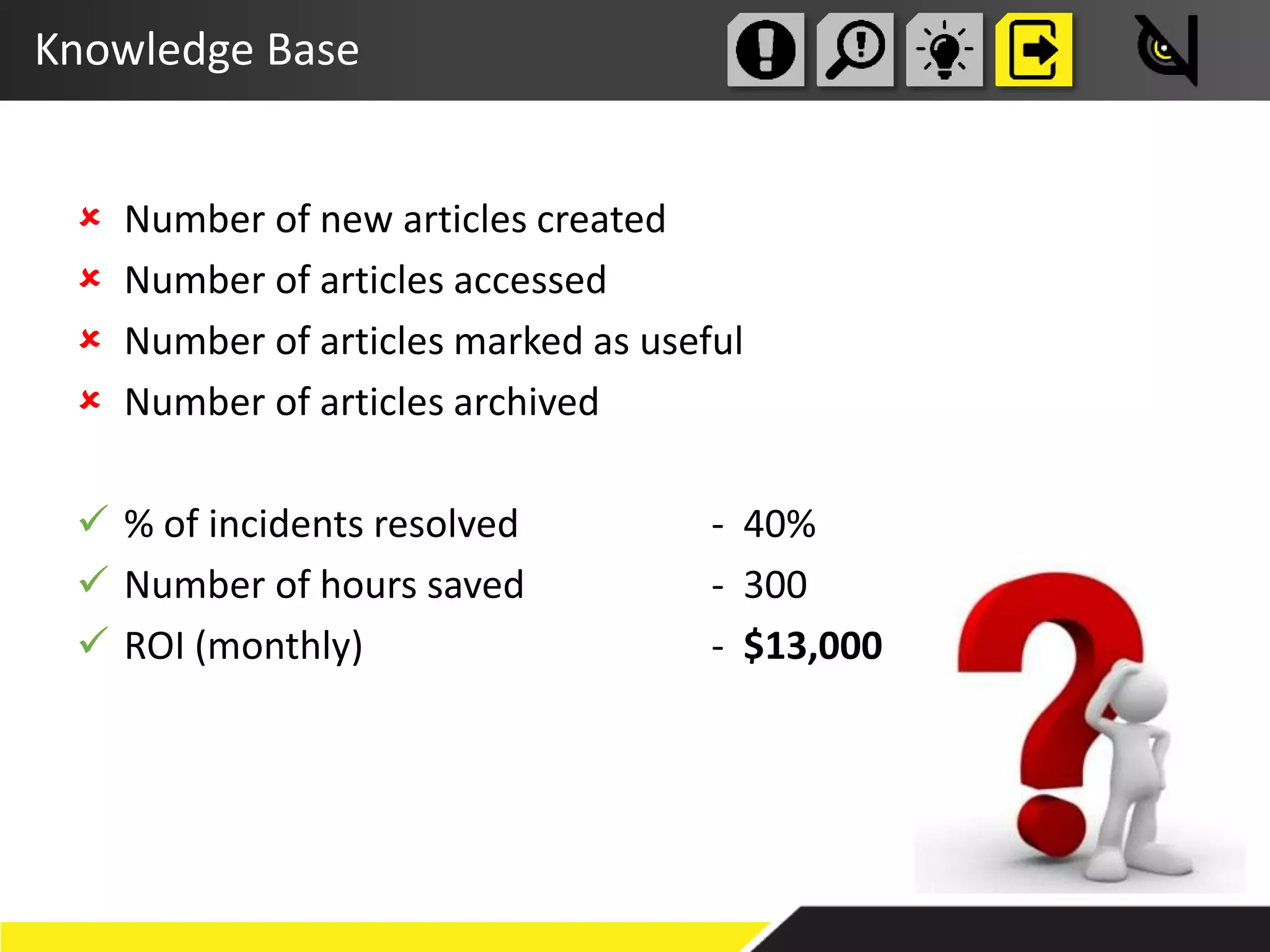
 Number of new articles created
 Number of articles accessed
 Number of articles marked as useful
 Number of articles archived
 % of incidents resolved - 40%
 Number of hours saved - 300
 ROI (monthly) - $13,000
Knowledge Base
New Incidents (project / operations) 500
Incidents solved using knowledgebase articles 200
Average incident duration (no article) 4 hours
Average incident duration (with article) 1 hour
Number of hours saved by knowledgebase 900
Average hourly rate $20
Total value of hours saved $18,000
Monthly cost of Knowledge Base
Time to create new articles (50 new articles x 1 hour x $20) $1,000
IT Costs (hardware, software) $4,000
Return this month $13,000
Knowledge Base
Need some inspiration?
https://asana.com/guide
https://kb.yoast.com/
https://www.dropbox.com/help
Use case scenarios are important. Put yourself in the position of
the searcher, even better get a searcher and watch how they go
about getting the information they need.
Communities of Practice
• Give customers direct access to experts
• Provide an avenue to request new features / products / services
• Shows the customer that we care about our relationship
• Increase innovative ideas
• Reduce attrition costs
• Use CoP to validate and drive strategy
• Gain access to new ideas and knowledge
• Learn positive / negative lessons from others
• Increase story telling ability
Communities of Practice
 Get together and start talking
 Use Lean Coffee to come up with ideas/options
 Design a ‘process’ that you can follow
 Don’t get caught up with fancy tools (at first)
 Speaking to each other and sharing stories is the best way to
retain new information
– What went wrong (pain point)
– How you fixed it
– Ways that it could happen again (warning signs)
Communities of Practice
Critical Success Factors
• Communities are self-organising
– We want to attend
– We have the time to attend
• Communities are grouped around ‘problems’
• Communities are not too big
• We have the ability to tell interesting business stories
KPIs
• % of CoP sessions that have customer involvement
• % of CoP sessions that have actionable outcomes
Lessons Learned
• During Presales, a decision was made to reduce the implementation
timeline of a project by 20% in order the make the bid price more
competitive and show that we are faster than our competitors
• The total contract value was $5m over 5 years.
• Profitability was expected to be 15%
• The initial timeline for implementation was 10 months, with a project
resource cost of $500k
• This was reduced to 8 months with a new resource cost of $400k
Lessons Learned
Lesson
• We were unable to deliver the requested scope within the timeline stated
in the contract
• We needed at least 15% more time
• Our customer satisfaction rating was below the accepted benchmark
• We lost x2 Project Managers during the implementation
• The delays cost us $50k in penalties
Cost of Lesson
• Customer may not renew the contract
• $30k Hiring cost of replacement Project Managers (HR + Agency)
• $50k penalty
• 3 Members of the project team are looking for new roles
How do we make
this a Lesson
Learned?
Lessons Learned
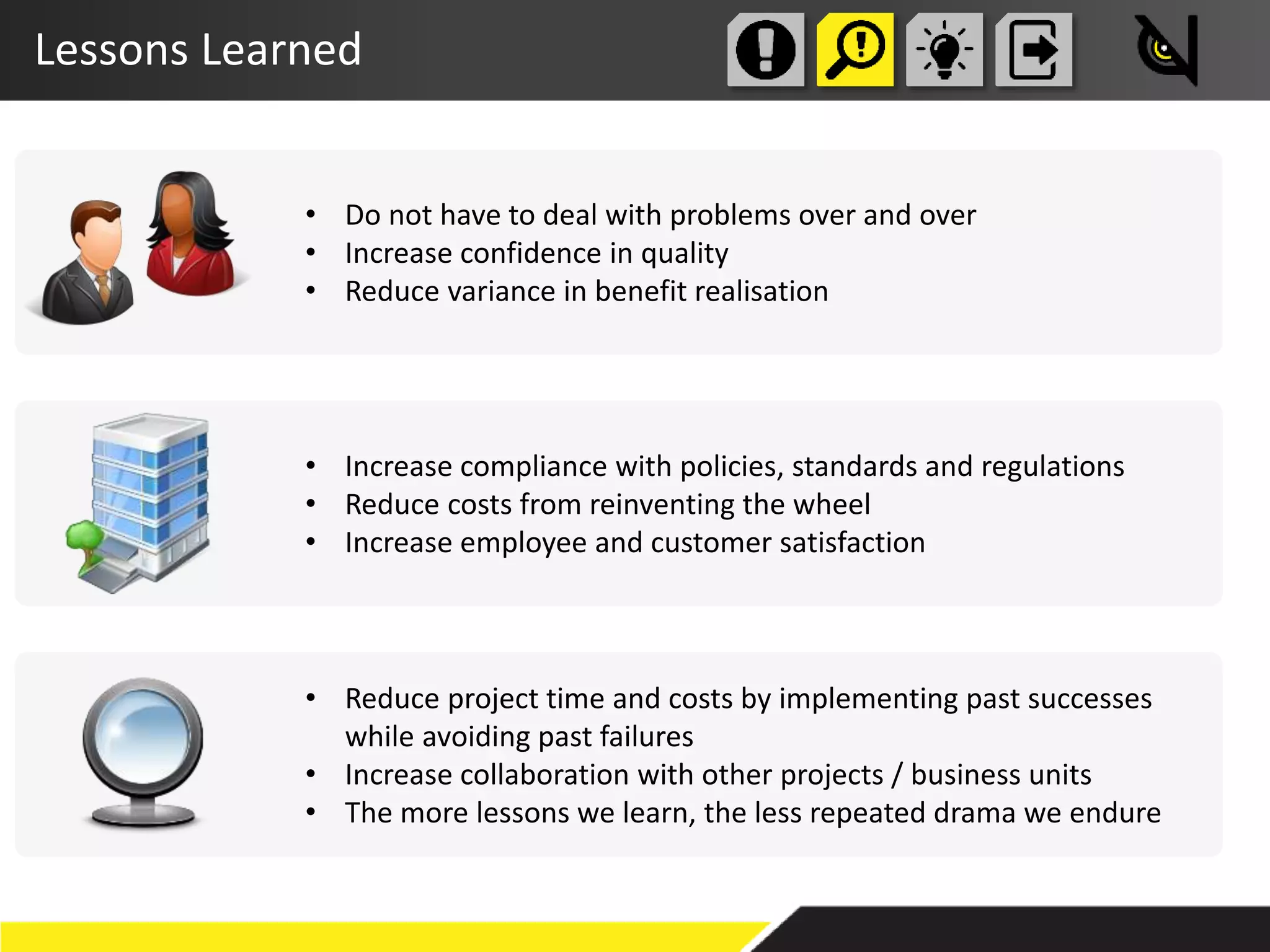
• Do not have to deal with problems over and over
• Increase confidence in quality
• Reduce variance in benefit realisation
• Increase compliance with policies, standards and regulations
• Reduce costs from reinventing the wheel
• Increase employee and customer satisfaction
• Reduce project time and costs by implementing past successes
while avoiding past failures
• Increase collaboration with other projects / business units
• The more lessons we learn, the less repeated drama we endure
Lessons Learned
Lesson
• Supplier A is very unreliable which caused a 3 week delay to
our project
Action Implemented (closed)
 Supplier A has been blacklisted by procurement
OR
Action Implemented (open)
 If you decide to use Supplier A, we recommend you have a
backup plan with Supplier B
Lessons Learned
Critical Success Factors
• The business is willing to act upon lessons i.e. close them
KPI’s
• % of projects / business units with recorded Lessons
• % of Lessons marked as closed
Learning Management Systems
• Reduce reliance upon busy experts
• Access to latest information (for free / or cheaper)
• Give a sense of empowerment
• Reduce physical training costs
• Reduce negative lessons (repeated mistakes)
• Increase employee and customer satisfaction
• Easy access to valuable training
• Ability to easily track performance and progress
• Prepare for new / or higher roles
Learning Management Systems
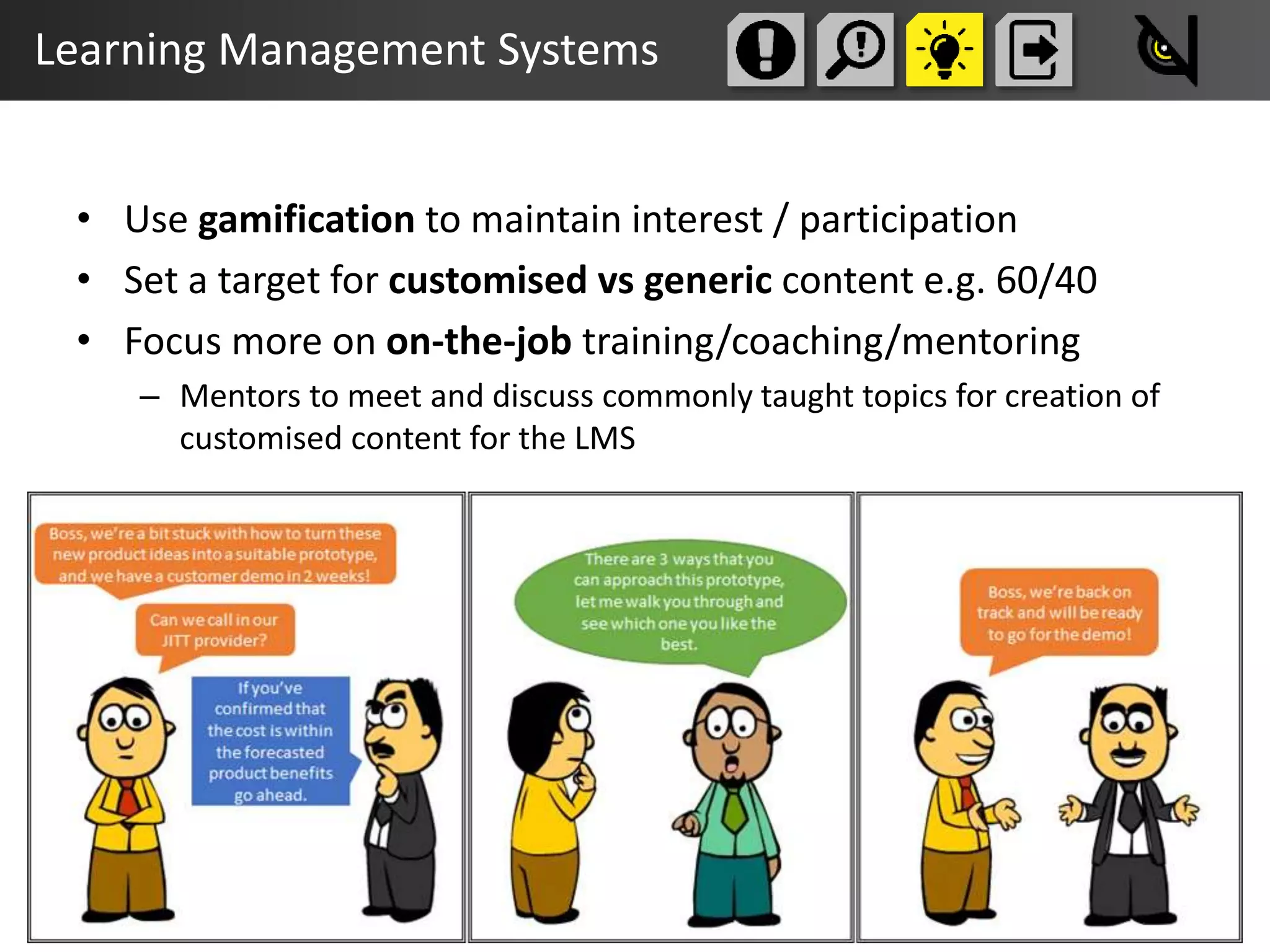
• Use gamification to maintain interest / participation
• Set a target for customised vs generic content e.g. 60/40
• Focus more on on-the-job training/coaching/mentoring
– Mentors to meet and discuss commonly taught topics for creation of
customised content for the LMS
Learning Management Systems
Critical Success Factors
• Agreement upon the ratio of customised to generic content
• Access to quality content providers
• Standards for customised content
KPIs
• % of employees that have used the LMS to:
– Complete a task
– Solve a Problem
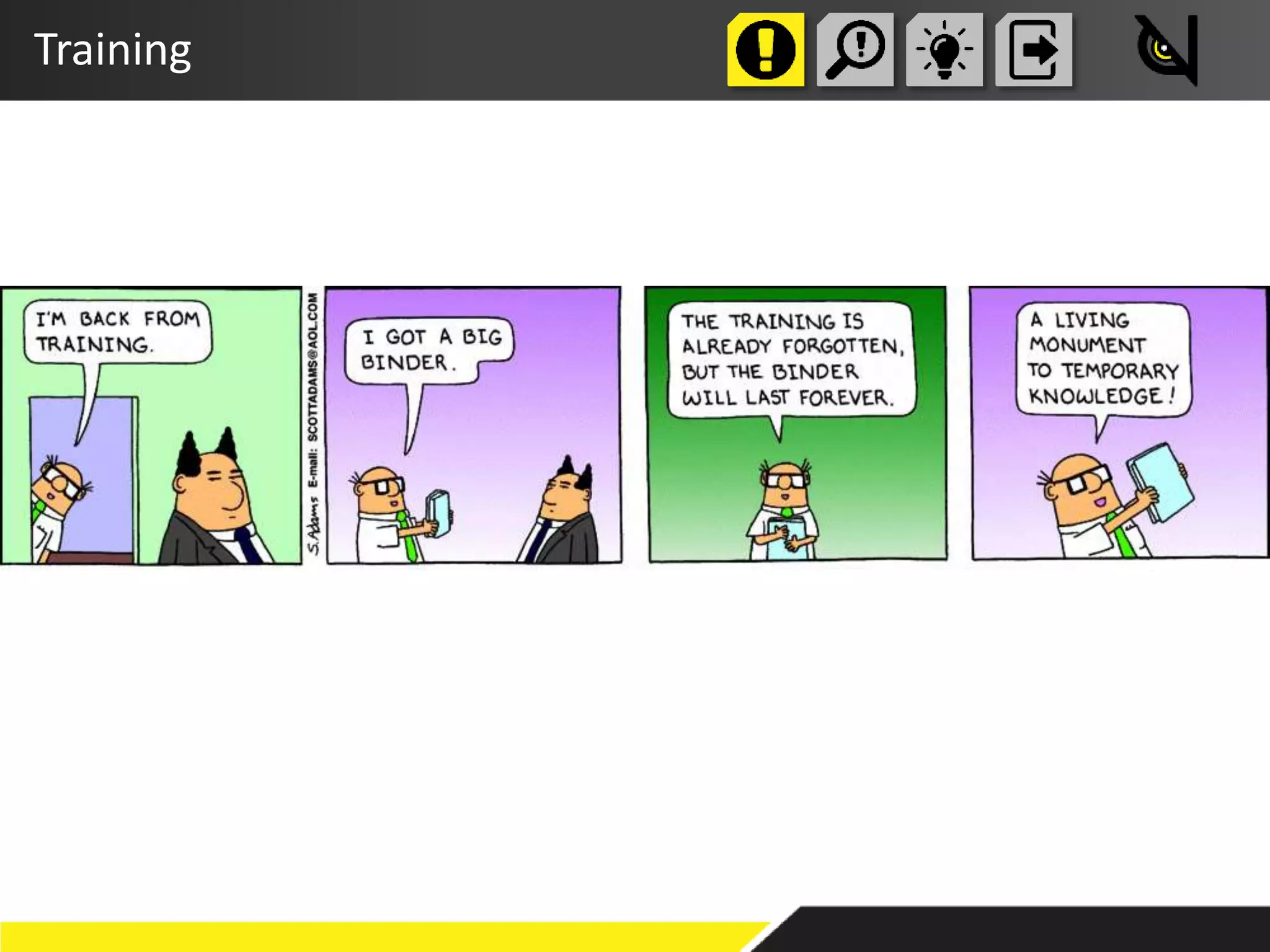
Training
Training
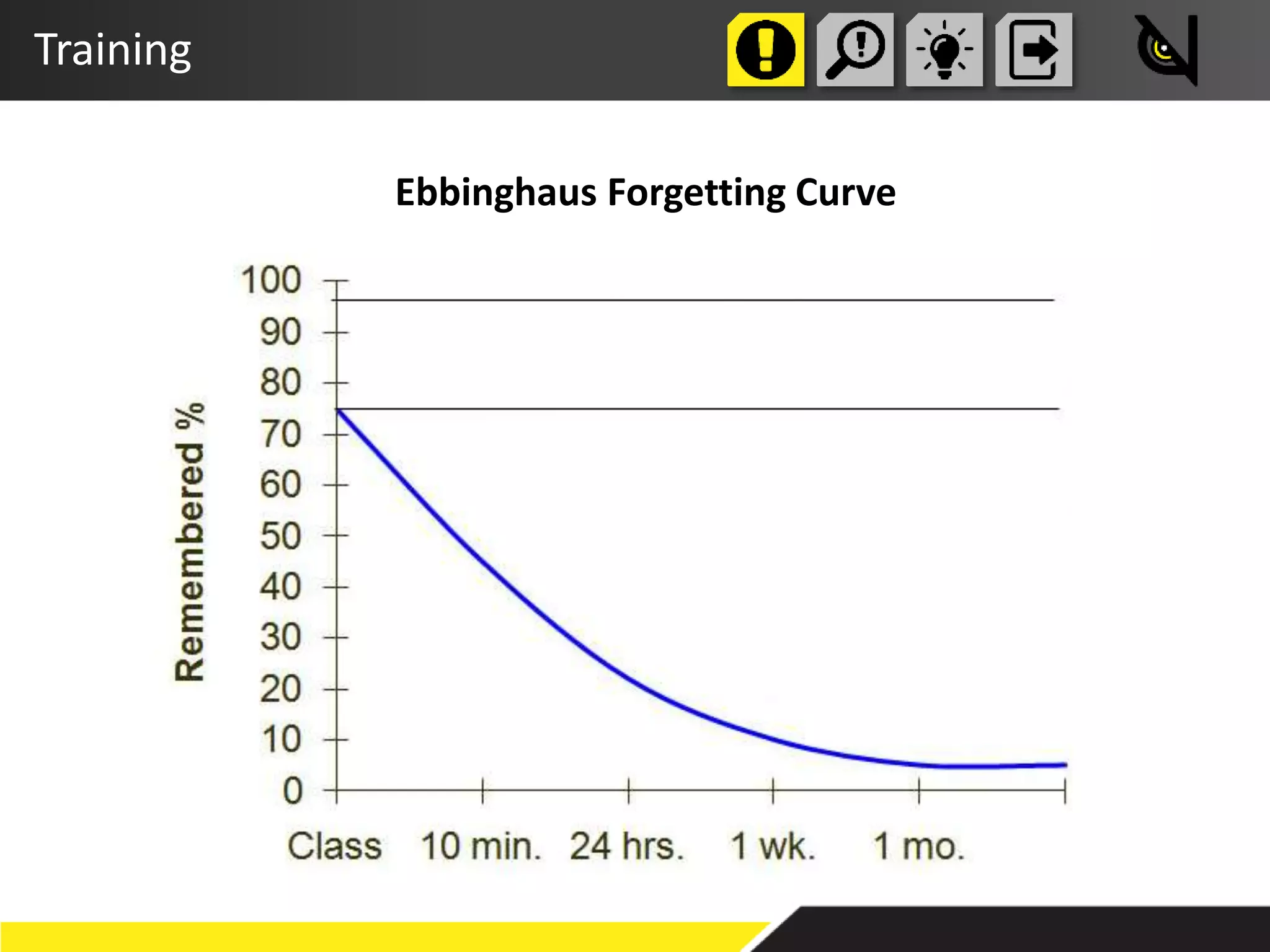
Ebbinghaus Forgetting Curve
Training
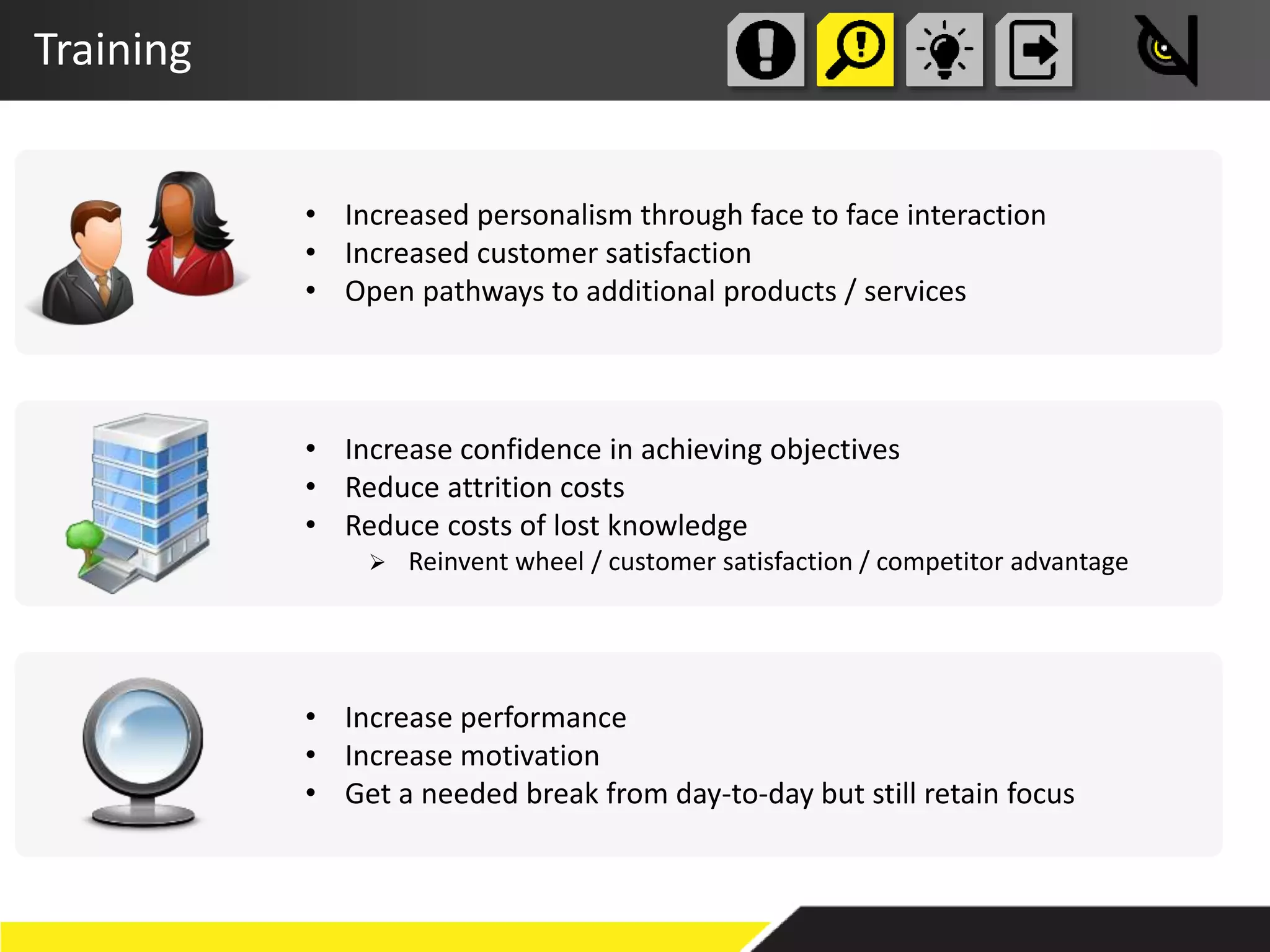
• Increased personalism through face to face interaction
• Increased customer satisfaction
• Open pathways to additional products / services
• Increase confidence in achieving objectives
• Reduce attrition costs
• Reduce costs of lost knowledge
 Reinvent wheel / customer satisfaction / competitor advantage
• Increase performance
• Increase motivation
• Get a needed break from day-to-day but still retain focus
Training
Training
Critical Success Factors
• Training clearly linked to measurable business value
KPIs
• % of training investments that realised business value
Collaborative Platforms
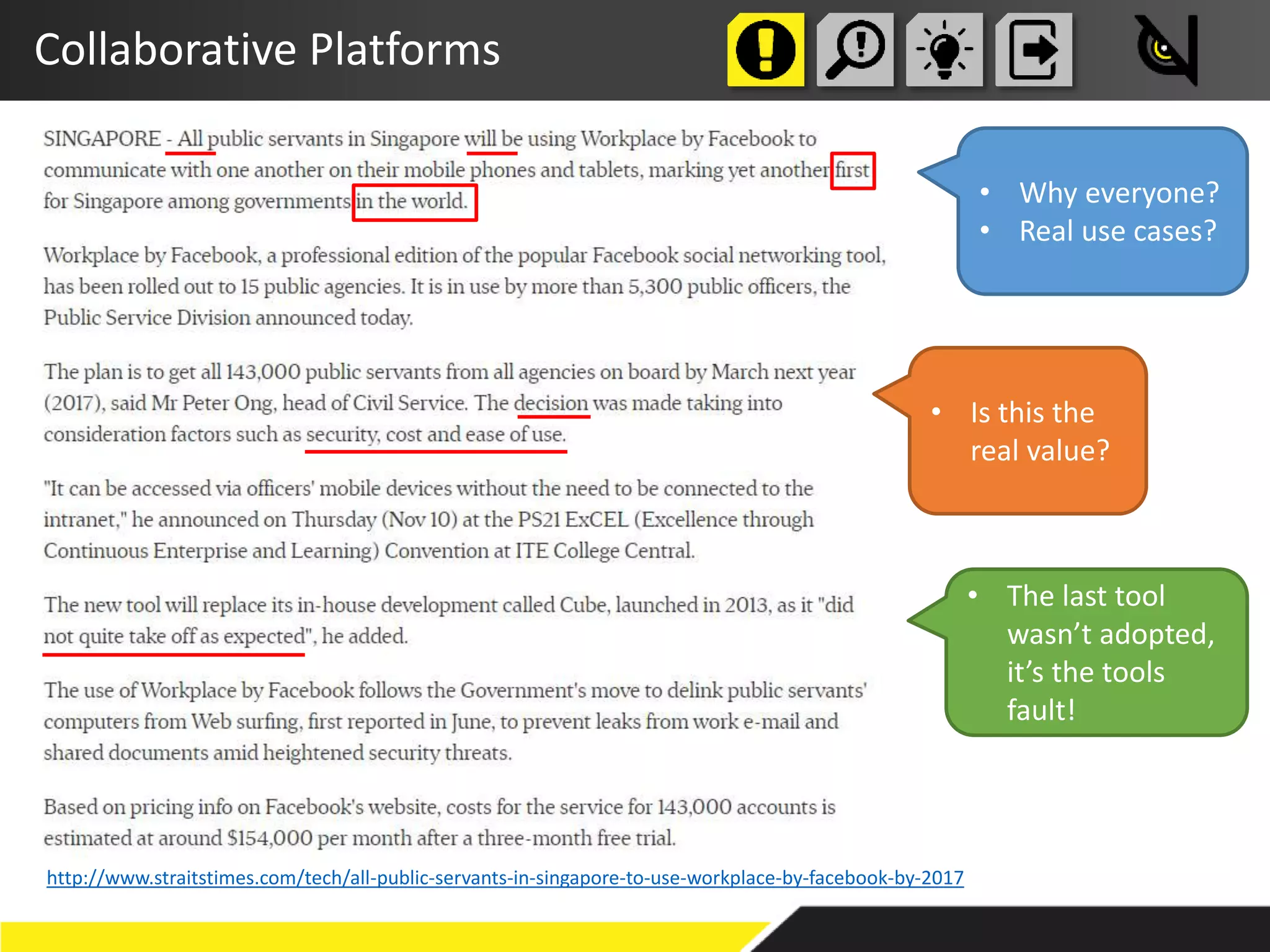
http://www.straitstimes.com/tech/all-public-servants-in-singapore-to-use-workplace-by-facebook-by-2017
• Why everyone?
• Real use cases?
• Is this the
real value?
• The last tool
wasn’t adopted,
it’s the tools
fault!
Collaborative Platforms
• Simplify the communication channels
• Faster response to questions
• Increased confidence in having a modern provider
• Increased participation in the innovation process
• Reduced attrition rate
• Enhanced communication channels (internal and external)
• Simplify document management processes
• Increased ability to have your voice heard
• Able to participate in initiatives beyond your natural boundaries
Collaborative Platforms
 Create a sense of urgency
– Why do we ‘need’ the platform?
– How are we hurting without it?
 Build up support
– Identify the early adopters, get them together
 Create a shared vision
– What will it look like in the future when we are all integrated on a
common platform?
– How is it amazing?
 Create and Celebrate Quick Wins
– What value did the early adopters achieve?
– Promote it!
– Get the fence sitters to participate
Collaborative Platforms
Critical Success Factors
• People are given the time to collaborate
• We are all clear on why and how we are going to use the platform
• The platform is integrated with our normal business processes
KPIs
• % of business units that ‘buy-in’ to the platform
Summary - The Sequence Matters
Should you try it?!?!
Questions?
Disclaimer: This material that follows is a presentation of general background information about SingTel’s activities current at the date of the presentation. The information contained in this document is intended only for use during the presentation and
should not be disseminated or distributed to parties outside the presentation. It is information given in summary form and does not purport to be complete. It is not to be relied upon as advice to investors or potential investors and does not take into
account the investment objectives, financial situation or needs of any particular investor. This material should be considered with professional advice when deciding if an investment is appropriate.

Knowledge management and me

  • 1.
    Knowledge Management andMe Putting People before Process and Technology 2017
  • 2.
    Synopsis • Knowledge Managementprojects are notorious for failing to deliver benefits. It’s not the actual implementation that fails; installing Yammer, Jives, Workplace or any other tool is not particularly challenging. The problem is that many organisations switch their focus once the tool implementation is complete. • Before wasting time and money, what needs to be understood, is that Knowledge Management is not something that can be implemented. It is not defined by the tools that are used, nor the processes that are followed to create articles in a knowledgebase. • Knowledge Management is first and foremost a willingness and desire of people within the organisation to help each other make things better. If this desire is not truly there, all that your process and technology-related investments will lead to, are expensive and embarrassing white elephants.
  • 3.
    Jamie Donoghue Director andPrincipal Consultant MBA, CISA, CGEIT, CISM, CRISC, COBIT, P3O, MSP, PRINCE2, PMP, ITIL Expert, ScrumMaster, Lean Change, DevOps, Six Sigma Speaker Jamie, a dual citizen of the UK and NZ, has spent over 19 years improving IT Services for public and private organisations in the UK, Australia and South East Asia. As the architect and lead coach for VisionLed’s 7 Principles of Business Agility, he specialises in guiding organisations through their transformational process. jamie@visionled.co
  • 4.
    Agenda What’s in itfor our customer? Our organisation? For me? What goes wrong when we put technology and process before people? How can we start on the right foot? How will we know if we’re on the right track?
  • 5.
    Common Approaches toKnowledge Management 1. Knowledge Base 2. Communities of Practice 3. Lessons Learned 4. Learning Management Systems 5. Training 6. Collaborative Platforms
  • 6.
  • 7.
    Knowledge Base • Reducefrustrating waiting time • Access to latest information • Give a sense of empowerment • Reduce manpower costs • Increase customer satisfaction scores • Improve productivity • Increase reputation • Increase community engagement • Prevent knowledge loss
  • 8.
    Knowledge Base  Seta limit on the number of active articles – Per product / service – Measure number of times accessed (is it current?) – Measure relevance (were the tags / search strings correct?) – Measure integrity ‘did it help?’ • If not, should it be revised or replaced?  Ask your colleague to search for your article but don’t give them your tags / keywords – (don’t cheat by searching by author!)  Measure who is and is not contributing – If not why? Need help?  Measure value of each article – How much time did it save? – How much pain did we avoid?
  • 9.
  • 10.
    Knowledge Base  Numberof new articles created  Number of articles accessed  Number of articles marked as useful  Number of articles archived  % of incidents resolved - 40%  Number of hours saved - 300  ROI (monthly) - $13,000
  • 11.
    Knowledge Base New Incidents(project / operations) 500 Incidents solved using knowledgebase articles 200 Average incident duration (no article) 4 hours Average incident duration (with article) 1 hour Number of hours saved by knowledgebase 900 Average hourly rate $20 Total value of hours saved $18,000 Monthly cost of Knowledge Base Time to create new articles (50 new articles x 1 hour x $20) $1,000 IT Costs (hardware, software) $4,000 Return this month $13,000
  • 12.
    Knowledge Base Need someinspiration? https://asana.com/guide https://kb.yoast.com/ https://www.dropbox.com/help Use case scenarios are important. Put yourself in the position of the searcher, even better get a searcher and watch how they go about getting the information they need.
  • 13.
  • 14.
    Communities of Practice •Give customers direct access to experts • Provide an avenue to request new features / products / services • Shows the customer that we care about our relationship • Increase innovative ideas • Reduce attrition costs • Use CoP to validate and drive strategy • Gain access to new ideas and knowledge • Learn positive / negative lessons from others • Increase story telling ability
  • 15.
    Communities of Practice Get together and start talking  Use Lean Coffee to come up with ideas/options  Design a ‘process’ that you can follow  Don’t get caught up with fancy tools (at first)  Speaking to each other and sharing stories is the best way to retain new information – What went wrong (pain point) – How you fixed it – Ways that it could happen again (warning signs)
  • 16.
    Communities of Practice CriticalSuccess Factors • Communities are self-organising – We want to attend – We have the time to attend • Communities are grouped around ‘problems’ • Communities are not too big • We have the ability to tell interesting business stories KPIs • % of CoP sessions that have customer involvement • % of CoP sessions that have actionable outcomes
  • 17.
    Lessons Learned • DuringPresales, a decision was made to reduce the implementation timeline of a project by 20% in order the make the bid price more competitive and show that we are faster than our competitors • The total contract value was $5m over 5 years. • Profitability was expected to be 15% • The initial timeline for implementation was 10 months, with a project resource cost of $500k • This was reduced to 8 months with a new resource cost of $400k
  • 18.
    Lessons Learned Lesson • Wewere unable to deliver the requested scope within the timeline stated in the contract • We needed at least 15% more time • Our customer satisfaction rating was below the accepted benchmark • We lost x2 Project Managers during the implementation • The delays cost us $50k in penalties Cost of Lesson • Customer may not renew the contract • $30k Hiring cost of replacement Project Managers (HR + Agency) • $50k penalty • 3 Members of the project team are looking for new roles How do we make this a Lesson Learned?
  • 19.
    Lessons Learned • Donot have to deal with problems over and over • Increase confidence in quality • Reduce variance in benefit realisation • Increase compliance with policies, standards and regulations • Reduce costs from reinventing the wheel • Increase employee and customer satisfaction • Reduce project time and costs by implementing past successes while avoiding past failures • Increase collaboration with other projects / business units • The more lessons we learn, the less repeated drama we endure
  • 20.
    Lessons Learned Lesson • SupplierA is very unreliable which caused a 3 week delay to our project Action Implemented (closed)  Supplier A has been blacklisted by procurement OR Action Implemented (open)  If you decide to use Supplier A, we recommend you have a backup plan with Supplier B
  • 21.
    Lessons Learned Critical SuccessFactors • The business is willing to act upon lessons i.e. close them KPI’s • % of projects / business units with recorded Lessons • % of Lessons marked as closed
  • 22.
  • 23.
    Learning Management Systems •Reduce reliance upon busy experts • Access to latest information (for free / or cheaper) • Give a sense of empowerment • Reduce physical training costs • Reduce negative lessons (repeated mistakes) • Increase employee and customer satisfaction • Easy access to valuable training • Ability to easily track performance and progress • Prepare for new / or higher roles
  • 24.
    Learning Management Systems •Use gamification to maintain interest / participation • Set a target for customised vs generic content e.g. 60/40 • Focus more on on-the-job training/coaching/mentoring – Mentors to meet and discuss commonly taught topics for creation of customised content for the LMS
  • 25.
    Learning Management Systems CriticalSuccess Factors • Agreement upon the ratio of customised to generic content • Access to quality content providers • Standards for customised content KPIs • % of employees that have used the LMS to: – Complete a task – Solve a Problem
  • 26.
  • 27.
  • 28.
    Training • Increased personalismthrough face to face interaction • Increased customer satisfaction • Open pathways to additional products / services • Increase confidence in achieving objectives • Reduce attrition costs • Reduce costs of lost knowledge  Reinvent wheel / customer satisfaction / competitor advantage • Increase performance • Increase motivation • Get a needed break from day-to-day but still retain focus
  • 29.
  • 30.
    Training Critical Success Factors •Training clearly linked to measurable business value KPIs • % of training investments that realised business value
  • 31.
  • 32.
    Collaborative Platforms http://www.straitstimes.com/tech/all-public-servants-in-singapore-to-use-workplace-by-facebook-by-2017 • Whyeveryone? • Real use cases? • Is this the real value? • The last tool wasn’t adopted, it’s the tools fault!
  • 33.
    Collaborative Platforms • Simplifythe communication channels • Faster response to questions • Increased confidence in having a modern provider • Increased participation in the innovation process • Reduced attrition rate • Enhanced communication channels (internal and external) • Simplify document management processes • Increased ability to have your voice heard • Able to participate in initiatives beyond your natural boundaries
  • 34.
    Collaborative Platforms  Createa sense of urgency – Why do we ‘need’ the platform? – How are we hurting without it?  Build up support – Identify the early adopters, get them together  Create a shared vision – What will it look like in the future when we are all integrated on a common platform? – How is it amazing?  Create and Celebrate Quick Wins – What value did the early adopters achieve? – Promote it! – Get the fence sitters to participate
  • 35.
    Collaborative Platforms Critical SuccessFactors • People are given the time to collaborate • We are all clear on why and how we are going to use the platform • The platform is integrated with our normal business processes KPIs • % of business units that ‘buy-in’ to the platform
  • 36.
    Summary - TheSequence Matters
  • 37.
  • 38.
  • 39.
    Disclaimer: This materialthat follows is a presentation of general background information about SingTel’s activities current at the date of the presentation. The information contained in this document is intended only for use during the presentation and should not be disseminated or distributed to parties outside the presentation. It is information given in summary form and does not purport to be complete. It is not to be relied upon as advice to investors or potential investors and does not take into account the investment objectives, financial situation or needs of any particular investor. This material should be considered with professional advice when deciding if an investment is appropriate.

Editor's Notes

  • #7 We setup a knowledgebase, SharePoint or alternative and simply fill it up!
  • #25 Gamification does not need technology. You can simply introduce a manual point system with rewards that is tracked at the team
  • #30 Review and Reinforce Learning
  • #37 Technology – Process – People = Slave to the Tool Process – Technology – People = Best-practices that do not fit your business model People – Process – Technology = Work the way you want to, with maximum efficiency