The Application Layer
10/29/2023 Dr.T.Thendral - CN
DNS—The Domain Name System
• IP addresses: These addresses are hard for
people to remember
• To solve these problems, DNS (the Domain
Name System) was invented.
• DNS is the phonebook of the Internet
• DNS translates domain names to IP addresses
so browsers can load Internet resources.
10/29/2023 Dr.T.Thendral - CN
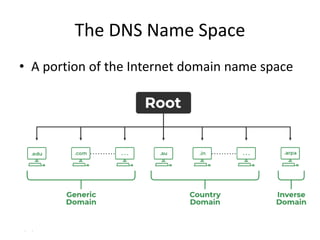
The DNS Name Space
• A portion of the Internet domain name space
10/29/2023 Dr.T.Thendral - CN
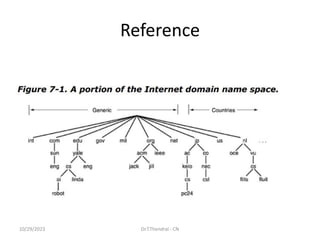
Reference
10/29/2023 Dr.T.Thendral - CN
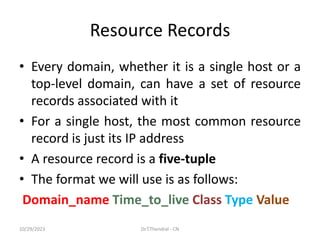
EXAMPLES
• 1. cs.yale.edu (Yale University, in the United
States)
• 2. cs.vu.nl (Vrije Universiteit, in The
Netherlands)
• 3. cs.keio.ac.jp (Keio University, in Japan)
10/29/2023 Dr.T.Thendral - CN
Resource Records
• Every domain, whether it is a single host or a
top-level domain, can have a set of resource
records associated with it
• For a single host, the most common resource
record is just its IP address
• A resource record is a five-tuple
• The format we will use is as follows:
Domain_name Time_to_live Class Type Value
10/29/2023 Dr.T.Thendral - CN
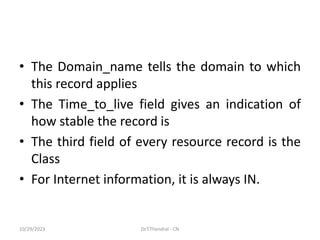
• The Domain_name tells the domain to which
this record applies
• The Time_to_live field gives an indication of
how stable the record is
• The third field of every resource record is the
Class
• For Internet information, it is always IN.
10/29/2023 Dr.T.Thendral - CN
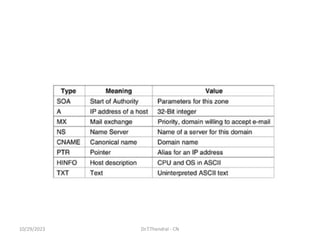
The Principal DNS Resource Record Types
For Internet Protocol version 4 (IPv4)
10/29/2023 Dr.T.Thendral - CN
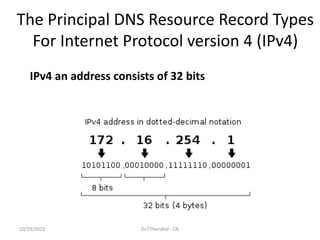
IPv4 an address consists of 32 bits
10/29/2023 Dr.T.Thendral - CN
Name Servers
• DNS name server is a server that stores the
DNS records
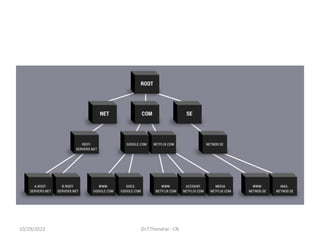
• To avoid the problems associated with having
only a single source of information, the DNS
name space is divided into nonoverlapping
zones
10/29/2023 Dr.T.Thendral - CN
Electronic Mail
• Electronic mail, or e-mail, as it is known to its many
fans, has been around for over two decades
• Before 1990, it was mostly used in academia
• E-mail, like most other forms of communication, has
its own conventions and styles
• In particular, it is very informal and has a low
threshold of use
• E-mail is full of jargon such as BTW (By The Way),
ROTFL (Rolling On The Floor Laughing), and IMHO (In
My Humble Opinion)
10/29/2023 Dr.T.Thendral - CN
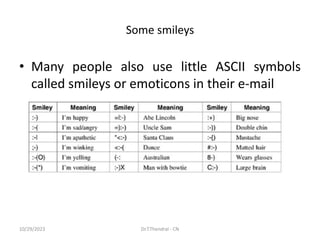
Some smileys
• Many people also use little ASCII symbols
called smileys or emoticons in their e-mail
10/29/2023 Dr.T.Thendral - CN
Some of the complaints were as follows:
1. Sending a message to a group of people was inconvenient. Managers often
need this facility to send memos to all their subordinates.
2. Messages had no internal structure, making computer processing difficult
For example, if a forwarded message was included in the body of another
message, extracting the forwarded part from the received message was
difficult.
3. The originator (sender) never knew if a message arrived or not.
4. If someone was planning to be away on business for several weeks and
wanted all incoming e-mail to be handled by his secretary, this was not easy to
arrange.
5. The user interface was poorly integrated with the transmission system
requiring users first to edit a file, then leave the editor and invoke the file
transfer program.
6. It was not possible to create and send messages containing a mixture of
text, drawings, facsimile, and voice
10/29/2023 Dr.T.Thendral - CN
Architecture and Services
• They normally consist of two subsystems:
• The user agents, which allow people to read
and send e-mail, and the message transfer
agents, which move the messages from the
source to the destination
• Typically, e-mail systems support five basic
functions
• Composition, Transfer, Reporting, Displaying,
Disposition
10/29/2023 Dr.T.Thendral - CN
• Most systems allow users to create mailboxes
to store incoming e-mail
• Commands are needed to create and destroy
mailboxes, inspect the contents of mailboxes,
insert and delete messages from mailboxes,
and so on.
• This gives rise to the idea of a mailing list,
which is a list of e-mail addresses
• A key idea in e-mail systems is the distinction
between the envelope and its contents
• The message inside the envelope consists of
two parts: the header and the body
10/29/2023 Dr.T.Thendral - CN
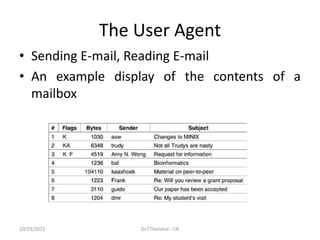
The User Agent
• Sending E-mail, Reading E-mail
• An example display of the contents of a
mailbox
10/29/2023 Dr.T.Thendral - CN
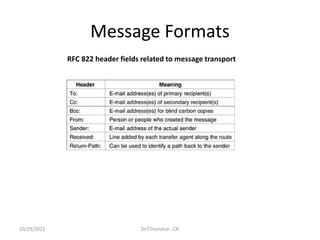
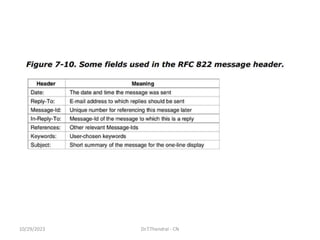
Message Formats
10/29/2023 Dr.T.Thendral - CN
RFC 822 header fields related to message transport
10/29/2023 Dr.T.Thendral - CN
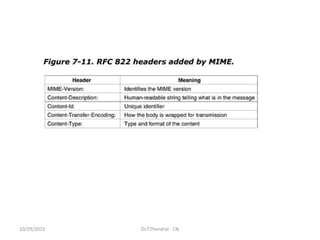
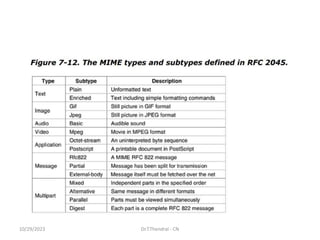
MIME—The Multipurpose Internet Mail
Extensions
1. Messages in languages with accents (e.g.,
French and German)
2. Messages in non-Latin alphabets (e.g.,
Hebrew and Russian)
3. Messages in languages without alphabets
(e.g., Chinese and Japanese)
4. Messages not containing text at all (e.g.,
audio or images)
10/29/2023 Dr.T.Thendral - CN
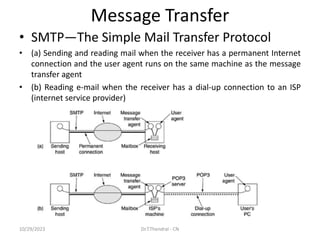
Message Transfer
• SMTP—The Simple Mail Transfer Protocol
• (a) Sending and reading mail when the receiver has a permanent Internet
connection and the user agent runs on the same machine as the message
transfer agent
• (b) Reading e-mail when the receiver has a dial-up connection to an ISP
(internet service provider)
10/29/2023 Dr.T.Thendral - CN
Network Security
• Most security problems are intentionally
caused by malicious people trying to gain
some benefit, get attention, or to harm
someone
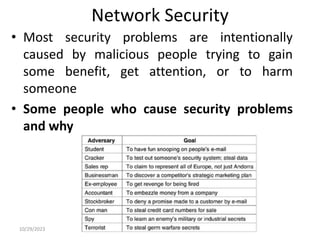
• Some people who cause security problems
and why
10/29/2023 Dr.T.Thendral - CN
• Network security problems can be divided
roughly into four areas:
• secrecy, authentication, nonrepudiation, and
integrity control
10/29/2023 Dr.T.Thendral - CN
Cryptography
• Cryptography comes from the Greek words for
''secret writing.'‘
• Professionals make a distinction between
ciphers and codes
• A cipher is a character-for-character or bit-
for-bit transformation, without regard to the
linguistic structure of the message
• In contrast, a code replaces one word with
another word or symbol
10/29/2023 Dr.T.Thendral - CN
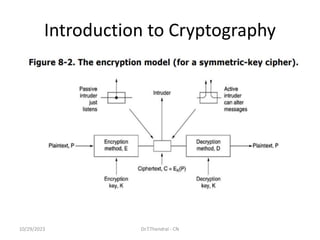
Introduction to Cryptography
10/29/2023 Dr.T.Thendral - CN
Substitution Ciphers
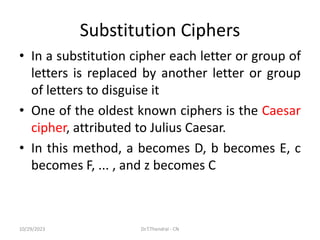
• In a substitution cipher each letter or group of
letters is replaced by another letter or group
of letters to disguise it
• One of the oldest known ciphers is the Caesar
cipher, attributed to Julius Caesar.
• In this method, a becomes D, b becomes E, c
becomes F, ... , and z becomes C
10/29/2023 Dr.T.Thendral - CN
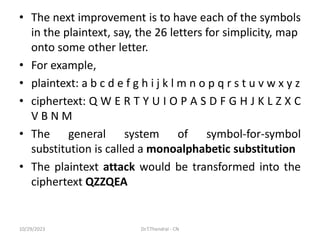
• The next improvement is to have each of the symbols
in the plaintext, say, the 26 letters for simplicity, map
onto some other letter.
• For example,
• plaintext: a b c d e f g h i j k l m n o p q r s t u v w x y z
• ciphertext: Q W E R T Y U I O P A S D F G H J K L Z X C
V B N M
• The general system of symbol-for-symbol
substitution is called a monoalphabetic substitution
• The plaintext attack would be transformed into the
ciphertext QZZQEA
10/29/2023 Dr.T.Thendral - CN
Transposition Ciphers
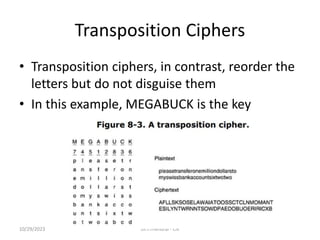
• Transposition ciphers, in contrast, reorder the
letters but do not disguise them
• In this example, MEGABUCK is the key
10/29/2023 Dr.T.Thendral - CN
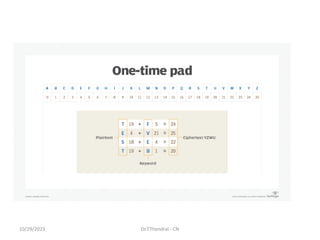
One-Time Pads
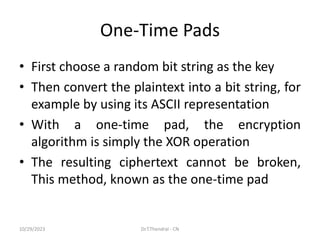
• First choose a random bit string as the key
• Then convert the plaintext into a bit string, for
example by using its ASCII representation
• With a one-time pad, the encryption
algorithm is simply the XOR operation
• The resulting ciphertext cannot be broken,
This method, known as the one-time pad
10/29/2023 Dr.T.Thendral - CN
Two Fundamental Cryptographic
Principles
• Redundancy - The first principle is that all
encrypted messages must contain some
redundancy, that is, information not needed
to understand the message
• Cryptographic principle 1: Messages must
contain some redundancy
• EX: CRC, Hamming or Reed Solomon code is a
more efficient way to do error detection and
correction
10/29/2023 Dr.T.Thendral - CN
Freshness
• Cryptographic principle 2: Some method is
needed to foil replay attacks
• The second cryptographic principle is that
some measures must be taken to ensure that
each message received can be verified as
being fresh, that is, sent very recently
10/29/2023 Dr.T.Thendral - CN

The Application Layer.ppt

  • 1.
  • 2.
    DNS—The Domain NameSystem • IP addresses: These addresses are hard for people to remember • To solve these problems, DNS (the Domain Name System) was invented. • DNS is the phonebook of the Internet • DNS translates domain names to IP addresses so browsers can load Internet resources. 10/29/2023 Dr.T.Thendral - CN
  • 3.
    The DNS NameSpace • A portion of the Internet domain name space 10/29/2023 Dr.T.Thendral - CN
  • 4.
  • 5.
    EXAMPLES • 1. cs.yale.edu(Yale University, in the United States) • 2. cs.vu.nl (Vrije Universiteit, in The Netherlands) • 3. cs.keio.ac.jp (Keio University, in Japan) 10/29/2023 Dr.T.Thendral - CN
  • 6.
    Resource Records • Everydomain, whether it is a single host or a top-level domain, can have a set of resource records associated with it • For a single host, the most common resource record is just its IP address • A resource record is a five-tuple • The format we will use is as follows: Domain_name Time_to_live Class Type Value 10/29/2023 Dr.T.Thendral - CN
  • 7.
    • The Domain_nametells the domain to which this record applies • The Time_to_live field gives an indication of how stable the record is • The third field of every resource record is the Class • For Internet information, it is always IN. 10/29/2023 Dr.T.Thendral - CN
  • 8.
    The Principal DNSResource Record Types For Internet Protocol version 4 (IPv4) 10/29/2023 Dr.T.Thendral - CN IPv4 an address consists of 32 bits
  • 9.
  • 10.
    Name Servers • DNSname server is a server that stores the DNS records • To avoid the problems associated with having only a single source of information, the DNS name space is divided into nonoverlapping zones 10/29/2023 Dr.T.Thendral - CN
  • 11.
  • 12.
  • 13.
    Electronic Mail • Electronicmail, or e-mail, as it is known to its many fans, has been around for over two decades • Before 1990, it was mostly used in academia • E-mail, like most other forms of communication, has its own conventions and styles • In particular, it is very informal and has a low threshold of use • E-mail is full of jargon such as BTW (By The Way), ROTFL (Rolling On The Floor Laughing), and IMHO (In My Humble Opinion) 10/29/2023 Dr.T.Thendral - CN
  • 14.
    Some smileys • Manypeople also use little ASCII symbols called smileys or emoticons in their e-mail 10/29/2023 Dr.T.Thendral - CN
  • 15.
    Some of thecomplaints were as follows: 1. Sending a message to a group of people was inconvenient. Managers often need this facility to send memos to all their subordinates. 2. Messages had no internal structure, making computer processing difficult For example, if a forwarded message was included in the body of another message, extracting the forwarded part from the received message was difficult. 3. The originator (sender) never knew if a message arrived or not. 4. If someone was planning to be away on business for several weeks and wanted all incoming e-mail to be handled by his secretary, this was not easy to arrange. 5. The user interface was poorly integrated with the transmission system requiring users first to edit a file, then leave the editor and invoke the file transfer program. 6. It was not possible to create and send messages containing a mixture of text, drawings, facsimile, and voice 10/29/2023 Dr.T.Thendral - CN
  • 16.
    Architecture and Services •They normally consist of two subsystems: • The user agents, which allow people to read and send e-mail, and the message transfer agents, which move the messages from the source to the destination • Typically, e-mail systems support five basic functions • Composition, Transfer, Reporting, Displaying, Disposition 10/29/2023 Dr.T.Thendral - CN
  • 17.
    • Most systemsallow users to create mailboxes to store incoming e-mail • Commands are needed to create and destroy mailboxes, inspect the contents of mailboxes, insert and delete messages from mailboxes, and so on. • This gives rise to the idea of a mailing list, which is a list of e-mail addresses • A key idea in e-mail systems is the distinction between the envelope and its contents • The message inside the envelope consists of two parts: the header and the body 10/29/2023 Dr.T.Thendral - CN
  • 18.
    The User Agent •Sending E-mail, Reading E-mail • An example display of the contents of a mailbox 10/29/2023 Dr.T.Thendral - CN
  • 19.
    Message Formats 10/29/2023 Dr.T.Thendral- CN RFC 822 header fields related to message transport
  • 20.
  • 21.
    MIME—The Multipurpose InternetMail Extensions 1. Messages in languages with accents (e.g., French and German) 2. Messages in non-Latin alphabets (e.g., Hebrew and Russian) 3. Messages in languages without alphabets (e.g., Chinese and Japanese) 4. Messages not containing text at all (e.g., audio or images) 10/29/2023 Dr.T.Thendral - CN
  • 22.
  • 23.
  • 24.
    Message Transfer • SMTP—TheSimple Mail Transfer Protocol • (a) Sending and reading mail when the receiver has a permanent Internet connection and the user agent runs on the same machine as the message transfer agent • (b) Reading e-mail when the receiver has a dial-up connection to an ISP (internet service provider) 10/29/2023 Dr.T.Thendral - CN
  • 25.
    Network Security • Mostsecurity problems are intentionally caused by malicious people trying to gain some benefit, get attention, or to harm someone • Some people who cause security problems and why 10/29/2023 Dr.T.Thendral - CN
  • 26.
    • Network securityproblems can be divided roughly into four areas: • secrecy, authentication, nonrepudiation, and integrity control 10/29/2023 Dr.T.Thendral - CN
  • 27.
    Cryptography • Cryptography comesfrom the Greek words for ''secret writing.'‘ • Professionals make a distinction between ciphers and codes • A cipher is a character-for-character or bit- for-bit transformation, without regard to the linguistic structure of the message • In contrast, a code replaces one word with another word or symbol 10/29/2023 Dr.T.Thendral - CN
  • 28.
  • 29.
    Substitution Ciphers • Ina substitution cipher each letter or group of letters is replaced by another letter or group of letters to disguise it • One of the oldest known ciphers is the Caesar cipher, attributed to Julius Caesar. • In this method, a becomes D, b becomes E, c becomes F, ... , and z becomes C 10/29/2023 Dr.T.Thendral - CN
  • 30.
    • The nextimprovement is to have each of the symbols in the plaintext, say, the 26 letters for simplicity, map onto some other letter. • For example, • plaintext: a b c d e f g h i j k l m n o p q r s t u v w x y z • ciphertext: Q W E R T Y U I O P A S D F G H J K L Z X C V B N M • The general system of symbol-for-symbol substitution is called a monoalphabetic substitution • The plaintext attack would be transformed into the ciphertext QZZQEA 10/29/2023 Dr.T.Thendral - CN
  • 31.
    Transposition Ciphers • Transpositionciphers, in contrast, reorder the letters but do not disguise them • In this example, MEGABUCK is the key 10/29/2023 Dr.T.Thendral - CN
  • 32.
    One-Time Pads • Firstchoose a random bit string as the key • Then convert the plaintext into a bit string, for example by using its ASCII representation • With a one-time pad, the encryption algorithm is simply the XOR operation • The resulting ciphertext cannot be broken, This method, known as the one-time pad 10/29/2023 Dr.T.Thendral - CN
  • 33.
  • 34.
    Two Fundamental Cryptographic Principles •Redundancy - The first principle is that all encrypted messages must contain some redundancy, that is, information not needed to understand the message • Cryptographic principle 1: Messages must contain some redundancy • EX: CRC, Hamming or Reed Solomon code is a more efficient way to do error detection and correction 10/29/2023 Dr.T.Thendral - CN
  • 35.
    Freshness • Cryptographic principle2: Some method is needed to foil replay attacks • The second cryptographic principle is that some measures must be taken to ensure that each message received can be verified as being fresh, that is, sent very recently 10/29/2023 Dr.T.Thendral - CN