UNIT TESTING
• Unit testing focuses verification effort on the
smallest unit of software design—the
software component or module
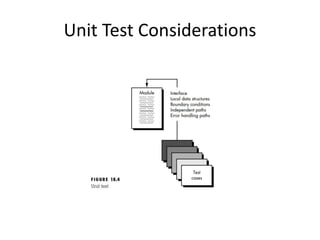
Unit Test Considerations
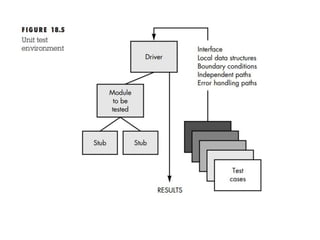
• The module interface is tested to ensure that
information properly flows into and out of the
program unit under test
• The local data structure is examined to ensure
that data stored temporarily maintains its
integrity during all steps in an algorithm's
execution
Among the more common errors in
computation are
• (1) misunderstood or incorrect arithmetic
precedence
• (2) mixed mode operations
• (3) incorrect initialization
• (4) precision inaccuracy
• (5) incorrect symbolic representation of an
expression
Test cases should uncover errors
• (1) comparison of different data types
• (2) incorrect logical operators or precedence
• (3) expectation of equality when precision error
makes equality unlikely
• (4) incorrect comparison of variables
• (5) improper or nonexistent loop termination
• (6) failure to exit when divergent iteration is
encountered
• (7) improperly modified loop variables
Among the potential errors that should be
tested when error handling is evaluated are
• 1. Error description is unintelligible
• 2. Error noted does not correspond to error
encountered
• 3. Error condition causes system intervention
prior to error handling
• 4. Exception-condition processing is incorrect
• 5. Error description does not provide enough
information to assist in the location of the
cause of the error
Unit Test Procedures
• Unit testing is simplified when a component
with high cohesion is designed
• When only one function is addressed by a
component, the number of test cases is
reduced and errors can be more easily
predicted and uncovered
VALIDATION TESTING
• The process of evaluating software during the
development process or at the end of the
development process to determine whether it
satisfies specified business requirements
• Validation Testing ensures that the product
actually meets the client's needs
• Are we building the right product
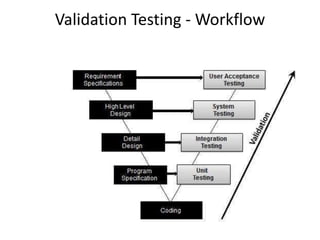
Validation Testing - Workflow
• The alpha test is conducted at the developer's
site by a customer
• The beta test is conducted at one or more
customer sites by the end-user of the software
• Unlike alpha testing, the developer is generally
not present
• Therefore, the beta test is a "live" application of
the software in an environment that cannot be
controlled by the developer
SYSTEM TESTING
• Ultimately, software is incorporated with other system
elements (e.g., hardware, people, information), and a
series of system integration and validation tests are
conducted
• These tests fall outside the scope of the software process
and are not conducted solely by software engineers
• However, steps taken during software design and testing
can greatly improve the probability of successful software
integration in the larger system
• A classic system testing problem is "finger-pointing”
• This occurs when an error is uncovered, and each system
element developer blames the other for the problem
• System testing is actually a series of different tests whose
primary purpose is to fully exercise the computer-based
system
• Here each test has a different purpose, all work to verify
that system elements have been properly integrated and
perform allocated functions
• There are different types of System tests that can be
performed given here:
• Recovery Testing
• Security Testing
• Stress Testing
• Performance Testing
Recovery Testing
• Computer Based Systems must recover from faults and resume
processing within a pre-specified time
• Sometimes, a system must be fault tolerant, that is, processing
faults must not cause overall system function to cease
• In other cases, a system failure must be corrected within a specified
period of time or severe economic damage will occur
• Recovery testing is a system test that forces the software to fail in a
variety of ways and verifies that recovery is properly performed
• If recovery is automatic (performed by the system itself), re-
initialization, check pointing mechanisms, data recovery, and restart
are evaluated for correctness
• If recovery requires human intervention, the mean-time-to-repair
(MTTR) is evaluated to determine whether it is within acceptable
limits.
Security Testing
• Computer-based system that manages sensitive
information or causes actions that can improperly
harm (or benefit) individuals is a target for
improper or illegal penetration
• hackers who attempt to penetrate systems for
sport, disgruntled employees who attempt to
penetrate for revenge, dishonest individuals who
attempt to penetrate for illicit personal gain
• Security testing attempts to verify that protection
mechanisms built into a system, in fact, protect it
from improper penetration or Not
Security Testing
• During security testing, the tester plays the role(s) of the individual
who desires to penetrate the system
• The tester may attempt to acquire passwords through external
clerical means, may attack the system with custom software
designed to breakdown any defenses that have been constructed
• may overwhelm the system, thereby denying service to others may
purposely cause system errors, hoping to penetrate during recovery
• may browse through insecure data, hoping to find the key to system
entry
• Given enough time and resources, good security testing will
ultimately penetrate a system
• The role of the system designer is to make penetration cost more
than the value of the information that will be obtained.
Stress Testing
• Stress tests are designed to confront programs with
abnormal situations
• The tester who performs stress testing asks:
• "How high can we crank this up before it fails?
• “Stress testing executes a system in a manner that
demands resources in abnormal quantity, frequency, or
volume
• E.g. Special tests may be designed that generate ten
interrupts per second, when one or two is the average rate,
• Input data rates may be increased by an order of
magnitude to determine how input functions will respond,
• Test cases that require maximum memory or other
resources are executed,
Stress Testing
• 4) Test cases that may cause thrashing in a virtual operating system
are designed
• 5) Test cases that may cause excessive hunting for disk-resident
data are created.
• Essentially, the tester attempts to break the program
• A variation of stress testing is a technique called sensitivity testing
• Sometimes, a very small range of data contained within the bounds
of valid data for a program may cause extreme erroneous
processing or profound performance degradation
• Sensitivity testing attempts to uncover data combinations within
valid input classes that may cause instability or improper
processing.
Performance Testing
• For real-time and embedded systems, software that
provides required function but does not conform to
performance requirements is unacceptable
• Performance testing is designed to test the run-time
performance of software within the context of an
integrated system
• Performance testing occurs throughout all steps in the
testing process
• Even at the unit level, the performance of an individual
module may be assessed as white-box tests are
conducted.
Performance Testing
• However, it is not until all system elements are fully integrated that
the true performance of a system can be ascertained
• Performance tests are often coupled with stress testing and usually
require both hardware and software instrumentation
• That is, it is often necessary to measure resource utilization (e.g.,
processor cycles) in an exacting fashion
• External instrumentation can monitor execution intervals, log
events (e.g., interrupts) as they occur, and sample machine states
on a regular basis
• By instrumenting a system, the tester can uncover situations that
lead to degradation and possible system failure

UNIT TESTING.pptx

  • 1.
  • 2.
    • Unit testingfocuses verification effort on the smallest unit of software design—the software component or module
  • 3.
  • 4.
    • The moduleinterface is tested to ensure that information properly flows into and out of the program unit under test • The local data structure is examined to ensure that data stored temporarily maintains its integrity during all steps in an algorithm's execution
  • 5.
    Among the morecommon errors in computation are • (1) misunderstood or incorrect arithmetic precedence • (2) mixed mode operations • (3) incorrect initialization • (4) precision inaccuracy • (5) incorrect symbolic representation of an expression
  • 6.
    Test cases shoulduncover errors • (1) comparison of different data types • (2) incorrect logical operators or precedence • (3) expectation of equality when precision error makes equality unlikely • (4) incorrect comparison of variables • (5) improper or nonexistent loop termination • (6) failure to exit when divergent iteration is encountered • (7) improperly modified loop variables
  • 7.
    Among the potentialerrors that should be tested when error handling is evaluated are • 1. Error description is unintelligible • 2. Error noted does not correspond to error encountered • 3. Error condition causes system intervention prior to error handling • 4. Exception-condition processing is incorrect • 5. Error description does not provide enough information to assist in the location of the cause of the error
  • 9.
    Unit Test Procedures •Unit testing is simplified when a component with high cohesion is designed • When only one function is addressed by a component, the number of test cases is reduced and errors can be more easily predicted and uncovered
  • 10.
    VALIDATION TESTING • Theprocess of evaluating software during the development process or at the end of the development process to determine whether it satisfies specified business requirements • Validation Testing ensures that the product actually meets the client's needs • Are we building the right product
  • 11.
  • 12.
    • The alphatest is conducted at the developer's site by a customer • The beta test is conducted at one or more customer sites by the end-user of the software • Unlike alpha testing, the developer is generally not present • Therefore, the beta test is a "live" application of the software in an environment that cannot be controlled by the developer
  • 13.
    SYSTEM TESTING • Ultimately,software is incorporated with other system elements (e.g., hardware, people, information), and a series of system integration and validation tests are conducted • These tests fall outside the scope of the software process and are not conducted solely by software engineers • However, steps taken during software design and testing can greatly improve the probability of successful software integration in the larger system • A classic system testing problem is "finger-pointing” • This occurs when an error is uncovered, and each system element developer blames the other for the problem
  • 14.
    • System testingis actually a series of different tests whose primary purpose is to fully exercise the computer-based system • Here each test has a different purpose, all work to verify that system elements have been properly integrated and perform allocated functions • There are different types of System tests that can be performed given here: • Recovery Testing • Security Testing • Stress Testing • Performance Testing
  • 15.
    Recovery Testing • ComputerBased Systems must recover from faults and resume processing within a pre-specified time • Sometimes, a system must be fault tolerant, that is, processing faults must not cause overall system function to cease • In other cases, a system failure must be corrected within a specified period of time or severe economic damage will occur • Recovery testing is a system test that forces the software to fail in a variety of ways and verifies that recovery is properly performed • If recovery is automatic (performed by the system itself), re- initialization, check pointing mechanisms, data recovery, and restart are evaluated for correctness • If recovery requires human intervention, the mean-time-to-repair (MTTR) is evaluated to determine whether it is within acceptable limits.
  • 16.
    Security Testing • Computer-basedsystem that manages sensitive information or causes actions that can improperly harm (or benefit) individuals is a target for improper or illegal penetration • hackers who attempt to penetrate systems for sport, disgruntled employees who attempt to penetrate for revenge, dishonest individuals who attempt to penetrate for illicit personal gain • Security testing attempts to verify that protection mechanisms built into a system, in fact, protect it from improper penetration or Not
  • 17.
    Security Testing • Duringsecurity testing, the tester plays the role(s) of the individual who desires to penetrate the system • The tester may attempt to acquire passwords through external clerical means, may attack the system with custom software designed to breakdown any defenses that have been constructed • may overwhelm the system, thereby denying service to others may purposely cause system errors, hoping to penetrate during recovery • may browse through insecure data, hoping to find the key to system entry • Given enough time and resources, good security testing will ultimately penetrate a system • The role of the system designer is to make penetration cost more than the value of the information that will be obtained.
  • 18.
    Stress Testing • Stresstests are designed to confront programs with abnormal situations • The tester who performs stress testing asks: • "How high can we crank this up before it fails? • “Stress testing executes a system in a manner that demands resources in abnormal quantity, frequency, or volume • E.g. Special tests may be designed that generate ten interrupts per second, when one or two is the average rate, • Input data rates may be increased by an order of magnitude to determine how input functions will respond, • Test cases that require maximum memory or other resources are executed,
  • 19.
    Stress Testing • 4)Test cases that may cause thrashing in a virtual operating system are designed • 5) Test cases that may cause excessive hunting for disk-resident data are created. • Essentially, the tester attempts to break the program • A variation of stress testing is a technique called sensitivity testing • Sometimes, a very small range of data contained within the bounds of valid data for a program may cause extreme erroneous processing or profound performance degradation • Sensitivity testing attempts to uncover data combinations within valid input classes that may cause instability or improper processing.
  • 20.
    Performance Testing • Forreal-time and embedded systems, software that provides required function but does not conform to performance requirements is unacceptable • Performance testing is designed to test the run-time performance of software within the context of an integrated system • Performance testing occurs throughout all steps in the testing process • Even at the unit level, the performance of an individual module may be assessed as white-box tests are conducted.
  • 21.
    Performance Testing • However,it is not until all system elements are fully integrated that the true performance of a system can be ascertained • Performance tests are often coupled with stress testing and usually require both hardware and software instrumentation • That is, it is often necessary to measure resource utilization (e.g., processor cycles) in an exacting fashion • External instrumentation can monitor execution intervals, log events (e.g., interrupts) as they occur, and sample machine states on a regular basis • By instrumenting a system, the tester can uncover situations that lead to degradation and possible system failure