Ally Gill, SEPG EUROPE 2009 
“Organisations churn through
one technique after another and
     at best get incremental
improvement on top of business
             as usual”
Richard Pascale (1938-, consultant, author and educator)


                                                           2 
  Understand the problem and consider an 
  alterna?ve 
     o  Why do SPI programmes fail? 
     o  What is SoFware Process Management? 

  Define a solu?on 
     o    PROMISE (Process Management in SoFware Engineering) 
  Implement the solu?on 
     o    Manage Processes using key PROMISE principles 


                                                           3 
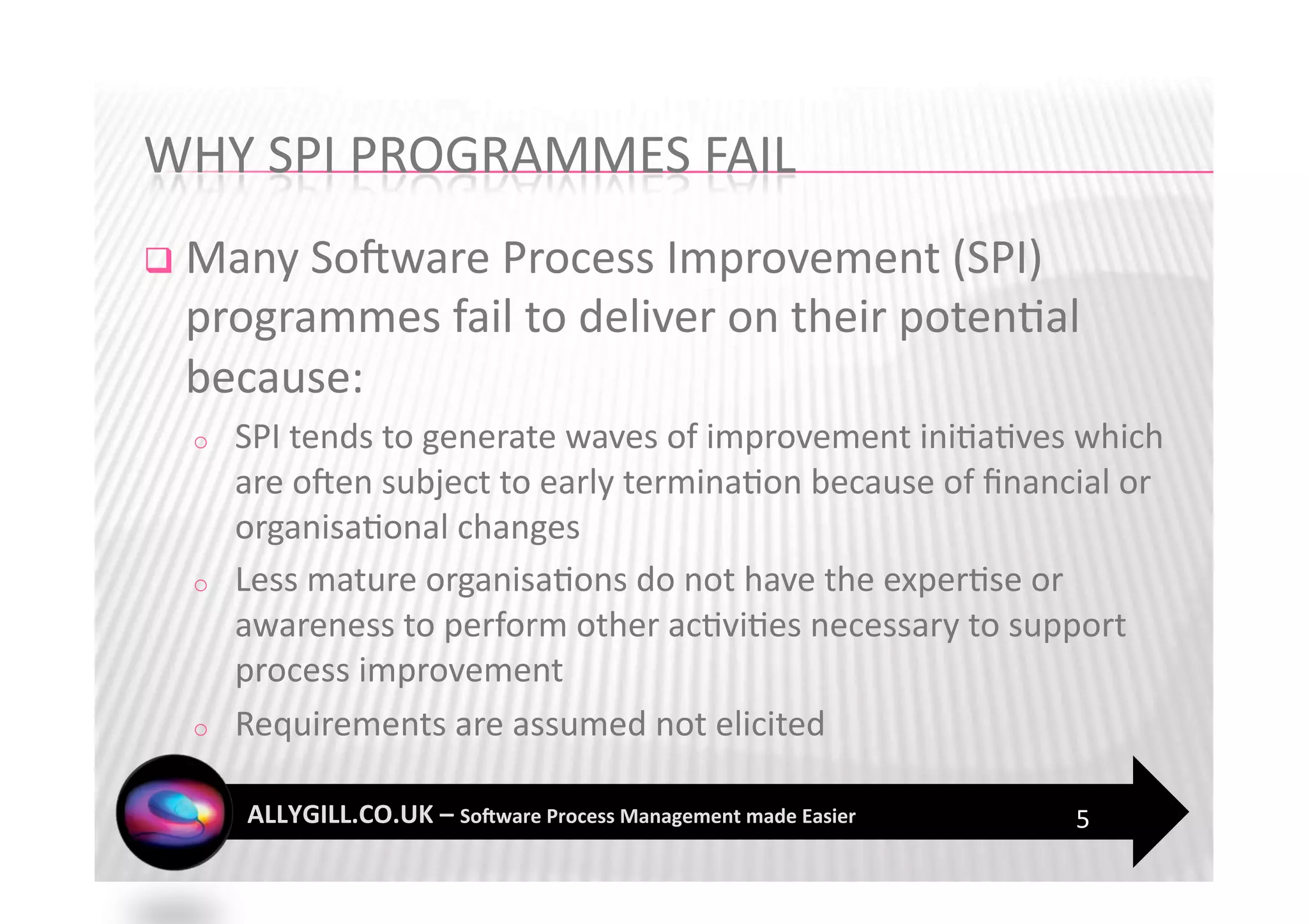
  Many SoFware Process Improvement (SPI) 
 programmes fail to deliver on their poten?al 
 because:  
  o    SPI tends to generate waves of improvement ini?a?ves which 
       are oFen subject to early termina?on because of financial or 
       organisa?onal changes  
  o    Less mature organisa?ons do not have the exper?se or 
       awareness to perform other ac?vi?es necessary to support 
       process improvement 
  o    Requirements are assumed not elicited 

                                                            5 
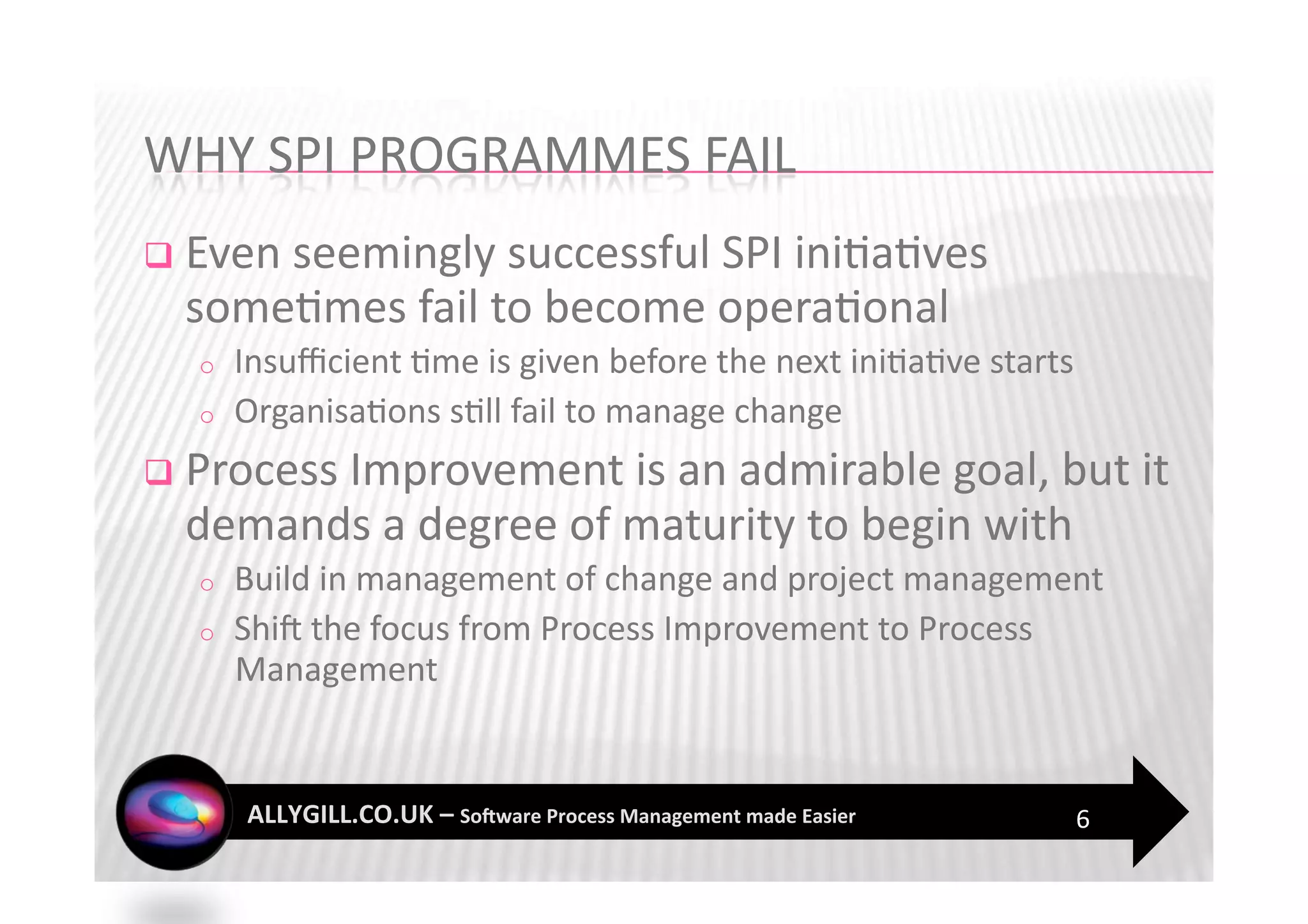
  Even seemingly successful SPI ini?a?ves 
  some?mes fail to become opera?onal 
  o    Insufficient ?me is given before the next ini?a?ve starts 
  o    Organisa?ons s?ll fail to manage change 
  Process Improvement is an admirable goal, but it 
  demands a degree of maturity to begin with 
  o    Build in management of change and project management 
  o    ShiF the focus from Process Improvement to Process 
       Management 


                                                              6 
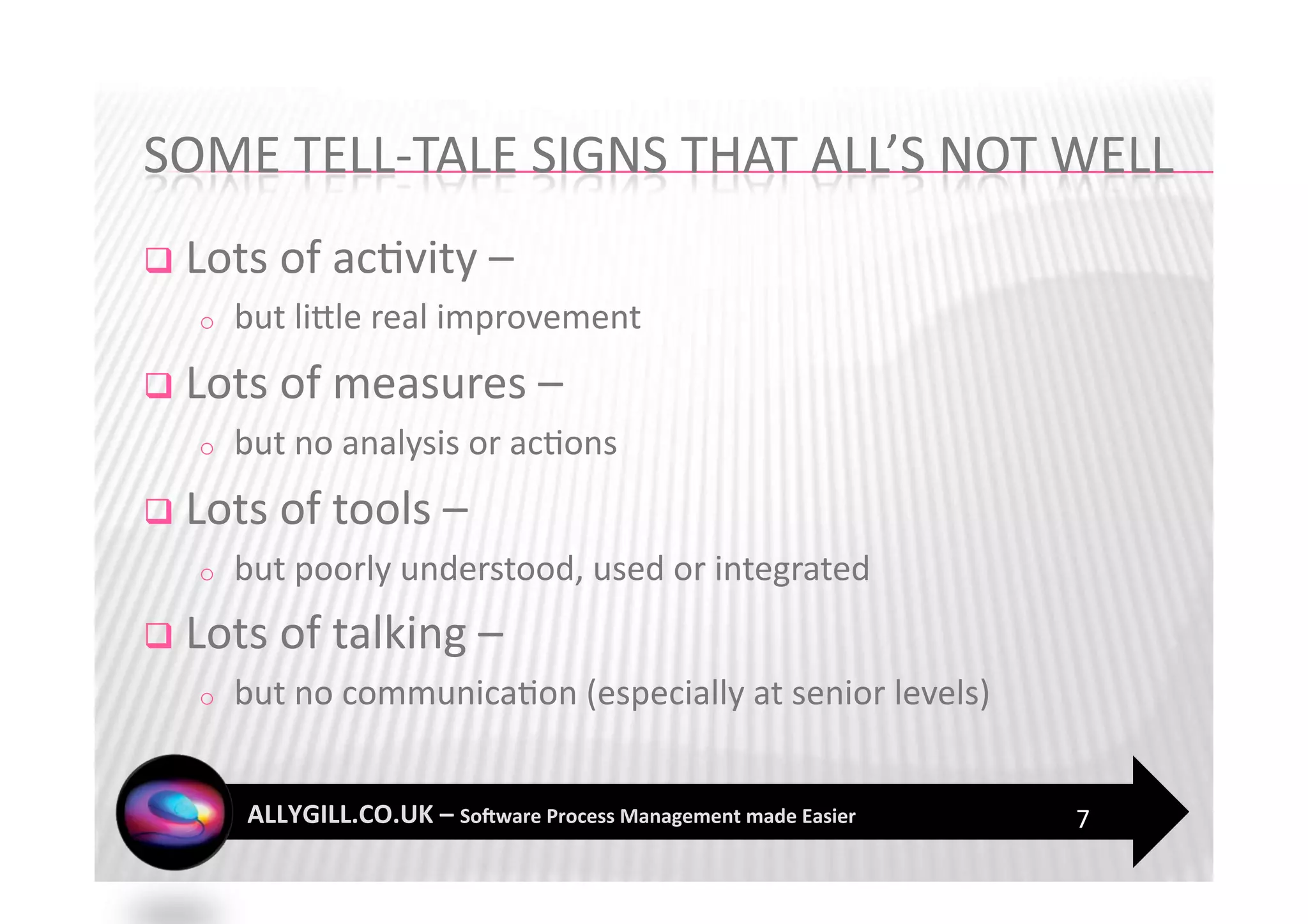
  Lots of ac?vity –  
   o    but liZle real improvement 
  Lots of measures –  
   o    but no analysis or ac?ons 
  Lots of tools – 
   o    but poorly understood, used or integrated 
  Lots of talking –  
   o    but no communica?on (especially at senior levels) 


                                                             7 
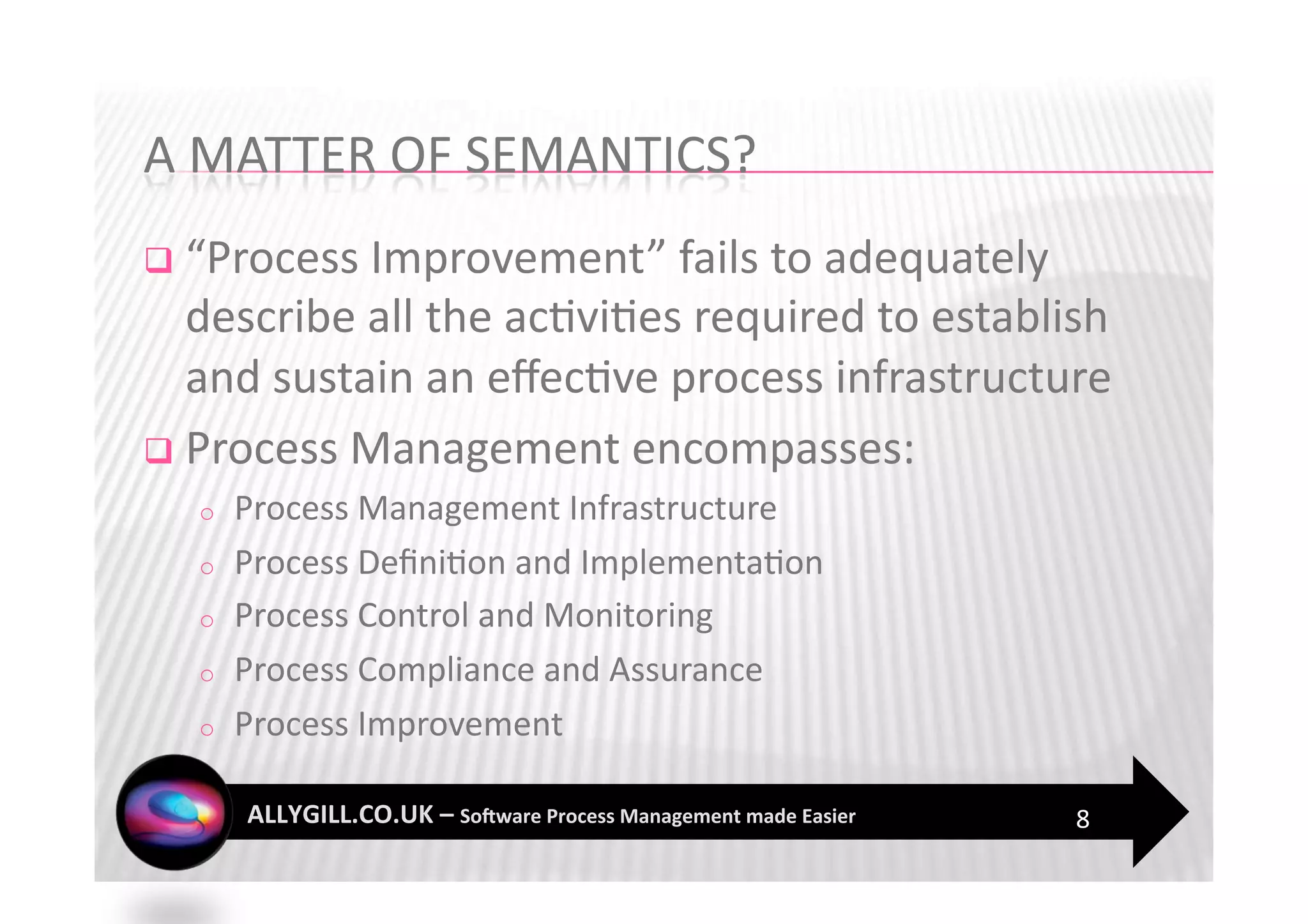
  “Process Improvement” fails to adequately 
   describe all the ac?vi?es required to establish 
   and sustain an effec?ve process infrastructure 
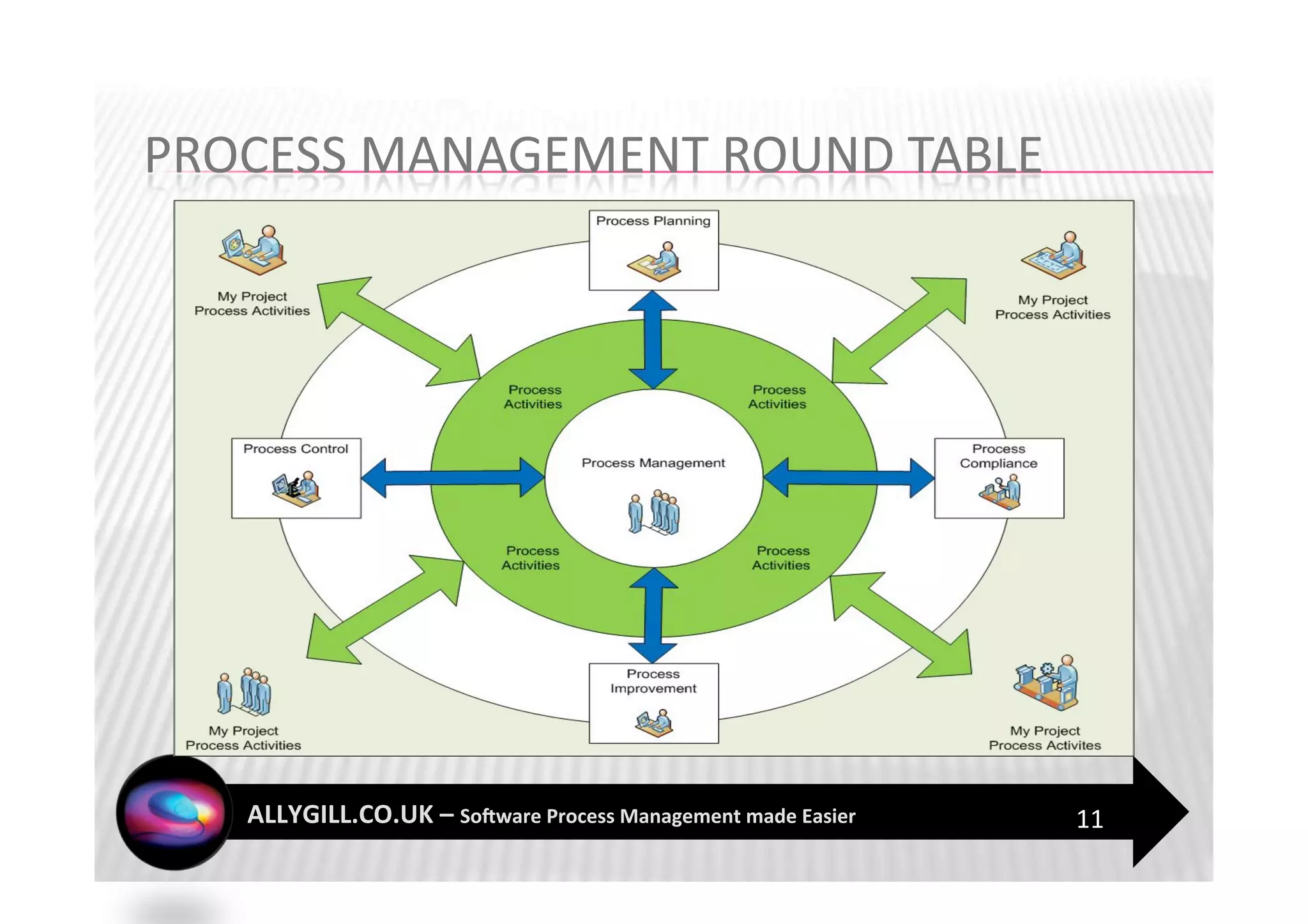
  Process Management encompasses: 
  o    Process Management Infrastructure  
  o    Process Defini?on and Implementa?on 
  o    Process Control and Monitoring 
  o    Process Compliance and Assurance 
  o    Process Improvement 

                                                8 
SoFware Process Management: 
  reinforces the idea of a long term strategic focus 
   for organisa?ons who want to perform beZer 
  builds a pla`orm for sustained performance 

  allows the enterprise to create the founda?ons 
   for all future improvement opportuni?es 
  promotes a culture of process and quality 
   awareness  
                                                 9 
10 
11 
  PROMISE ‐ Process Management in SoFware 
   Engineering – is a model for designing, building and 
   running a Process Management Func?on within a 
   SoFware Development enterprise 
  PROMISE focuses on People, Infrastructure and 
   Ac?vi?es associated with Process Management 
  PROMISE can be tailored and applied to single or 
   mul?ple reference models in any size of organisa?on 


                                                     13 
  SoFware Process Management is an essen?al full ?me 
   func?on within the soFware development and 
   maintenance environment 
  PROMISE has been designed for Process and Quality 
   Management leaders and teams, and their managers 
   and execu?ves 
  PROMISE will make a SoFware Process Management 
   func?on easier to build, run and sustain 


                                                 14 
  PROMISE – is the product of twenty five years of 
   experience in SoFware Engineering, Project 
   Management, Quality Management, Change 
   Management and Process Improvement & Management 
  PROMISE is a work in progress 


                                             15 
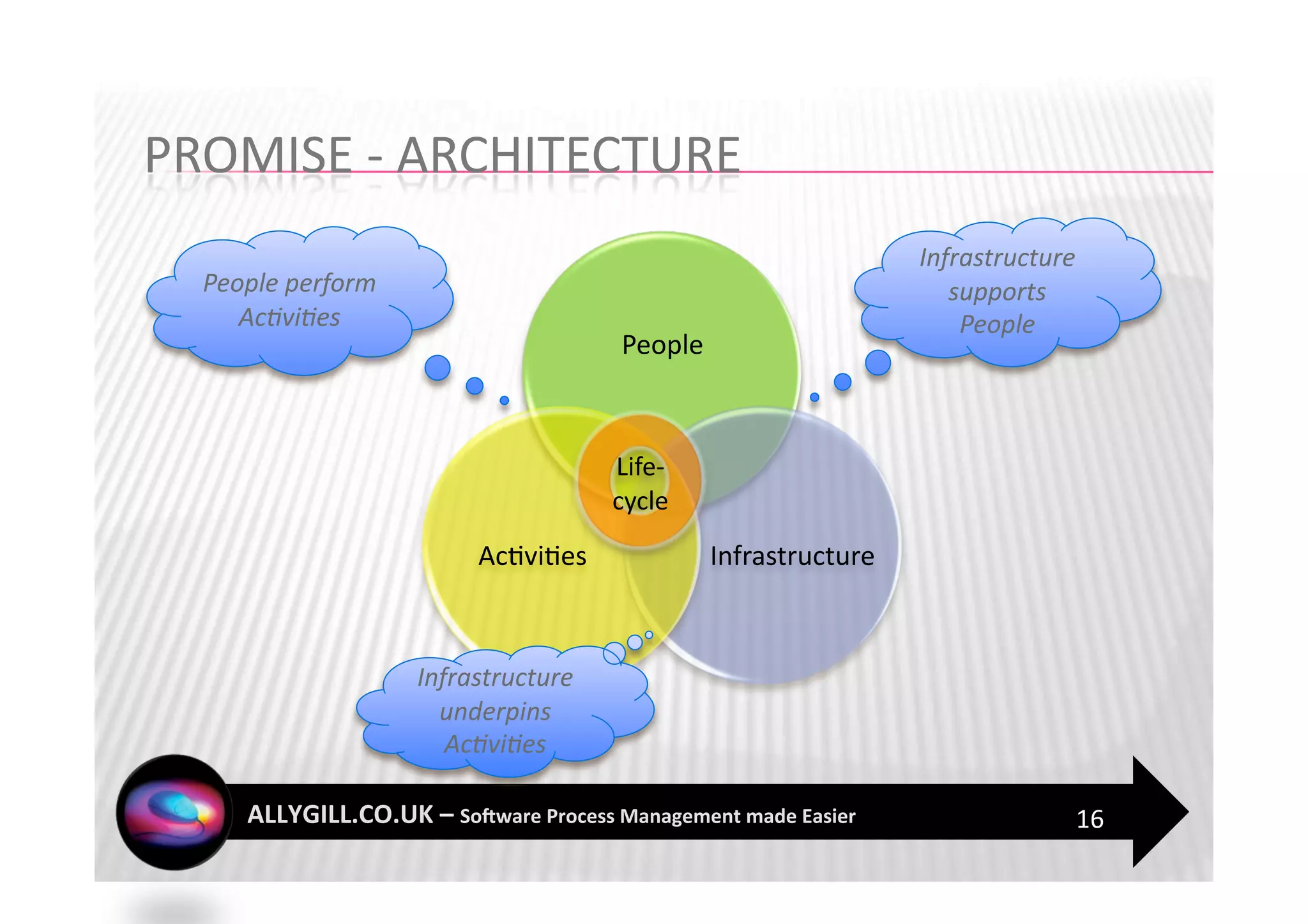
Infrastructure 
People perform                                                    supports 
   Ac,vi,es                                                        People 
                                    People 


                                    Life‐
                                    cycle 
                       Ac?vi?es              Infrastructure 


                  Infrastructure 
                    underpins 
                     Ac,vi,es 

                                                                             16 
  People are at the heart of PROMISE ac?vi?es 
  Roles and responsibili?es are not widely understood 
   even in organisa?ons with a history of SPI 
  PROMISE defines roles and responsibili?es 
   independently of other corporate job ?tles and codes  
  SPM skills are required across the organisa?on not just 
   within the SEPG or Quality Forum 
  SPM skills must be understood and used by all levels of 
   management 

                                                     17 
  Infrastructure refers to the IT and organisa?onal support 
   required to maintain an SPM func?on 
  A solid infrastructure facilitates the execu?on of SPM 
   ac?vi?es 
  Infrastructure includes process libraries, documenta?on, 
   data repositories and other suppor?ng tools 
  PROMISE helps support an integrated SPM environment 

  Within PROMISE infrastructure includes reference 
   models and methodologies 

                                                      18 
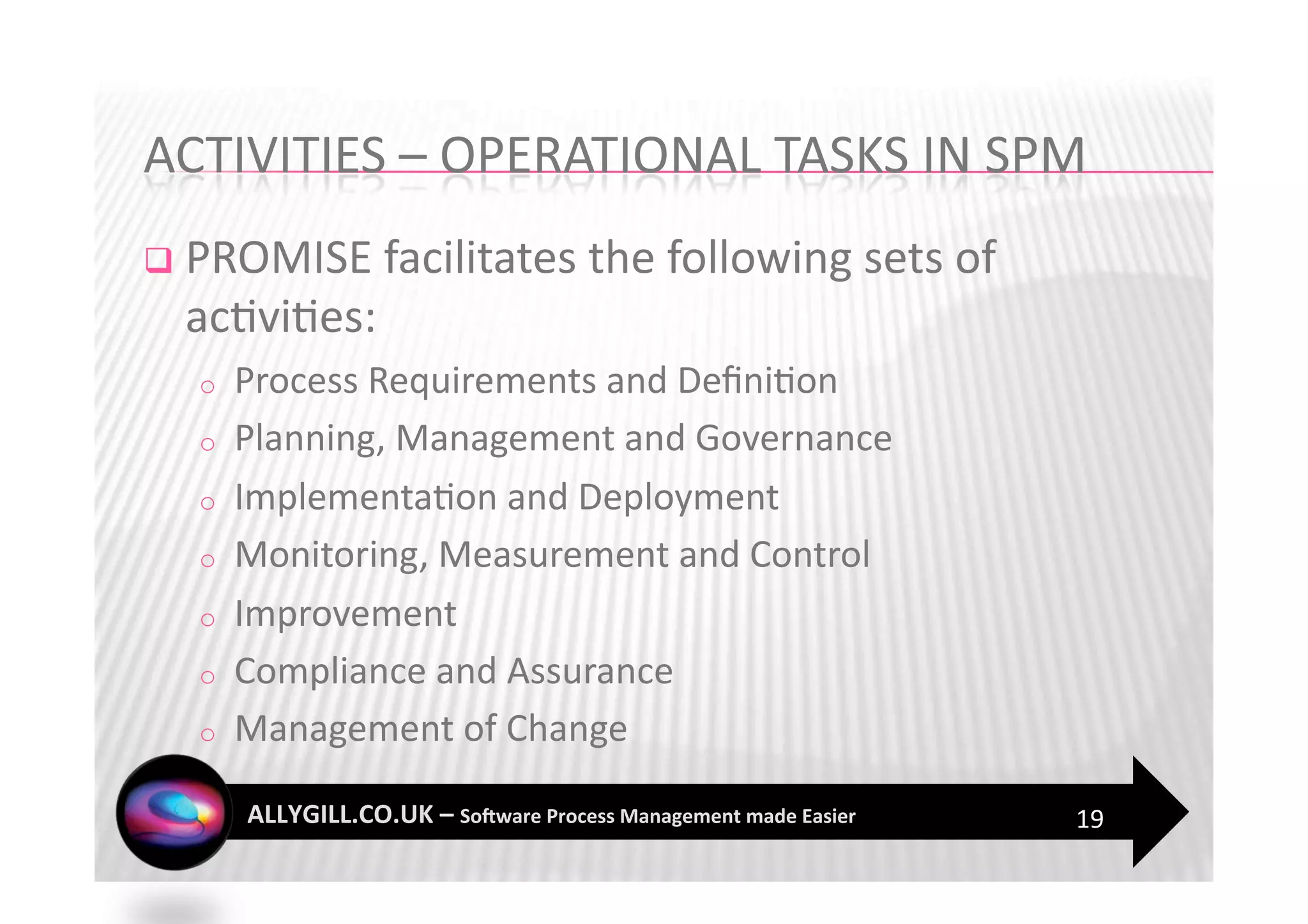
  PROMISE facilitates the following sets of 
  ac?vi?es: 
  o    Process Requirements and Defini?on 
  o    Planning, Management and Governance 
  o    Implementa?on and Deployment 
  o    Monitoring, Measurement and Control 
  o    Improvement 
  o    Compliance and Assurance 
  o    Management of Change 

                                                19 
Level 1 
Programme 


  Level 2 
 Project/ 
Sub‐Project 


  IPCIM 


               20 
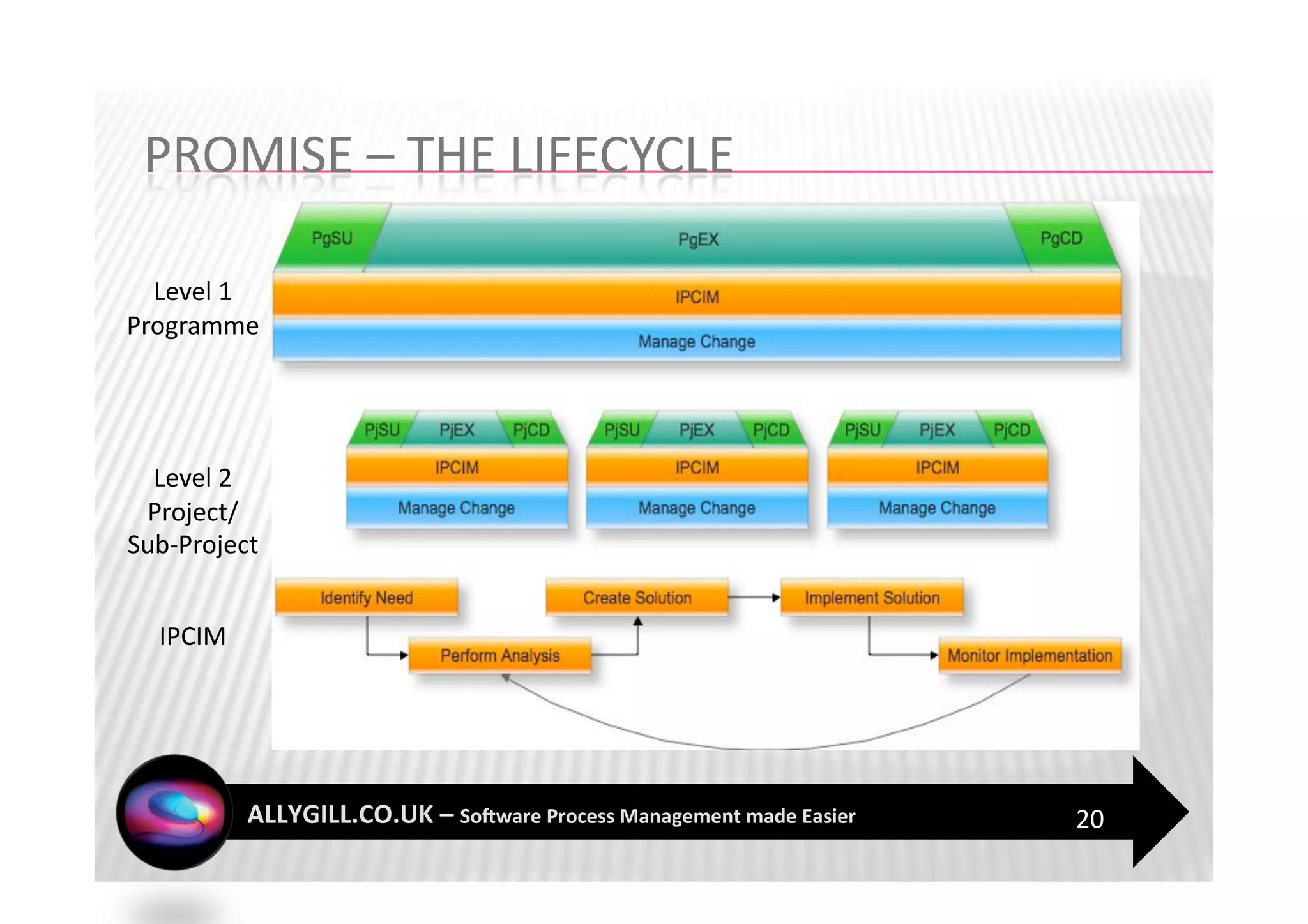
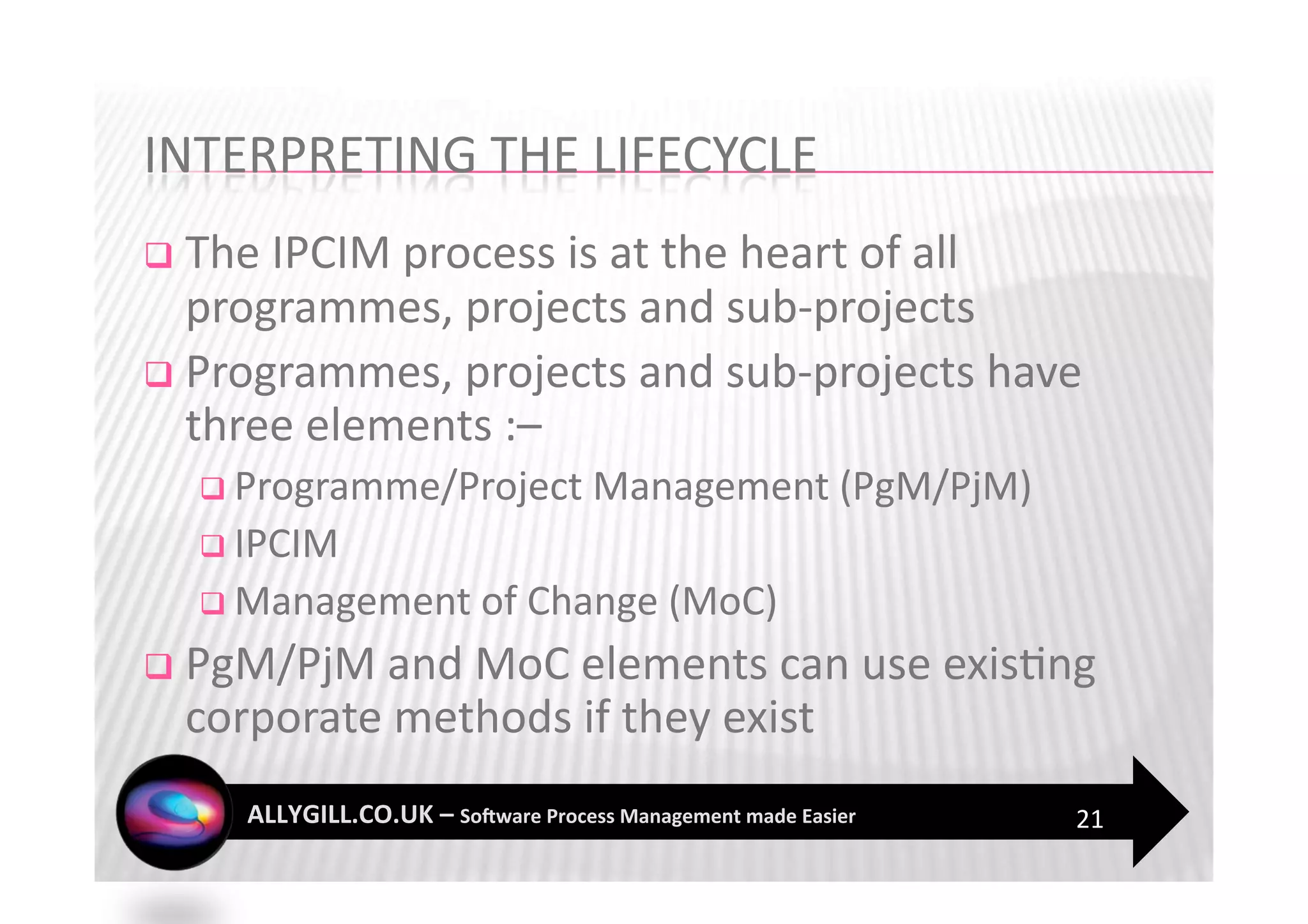
  The IPCIM process is at the heart of all 
   programmes, projects and sub‐projects 
  Programmes, projects and sub‐projects have 
   three elements :–  
    Programme/Project Management (PgM/PjM) 
    IPCIM 
    Management of Change (MoC) 

  PgM/PjM and MoC elements can use exis?ng 
  corporate methods if they exist 
                                               21 
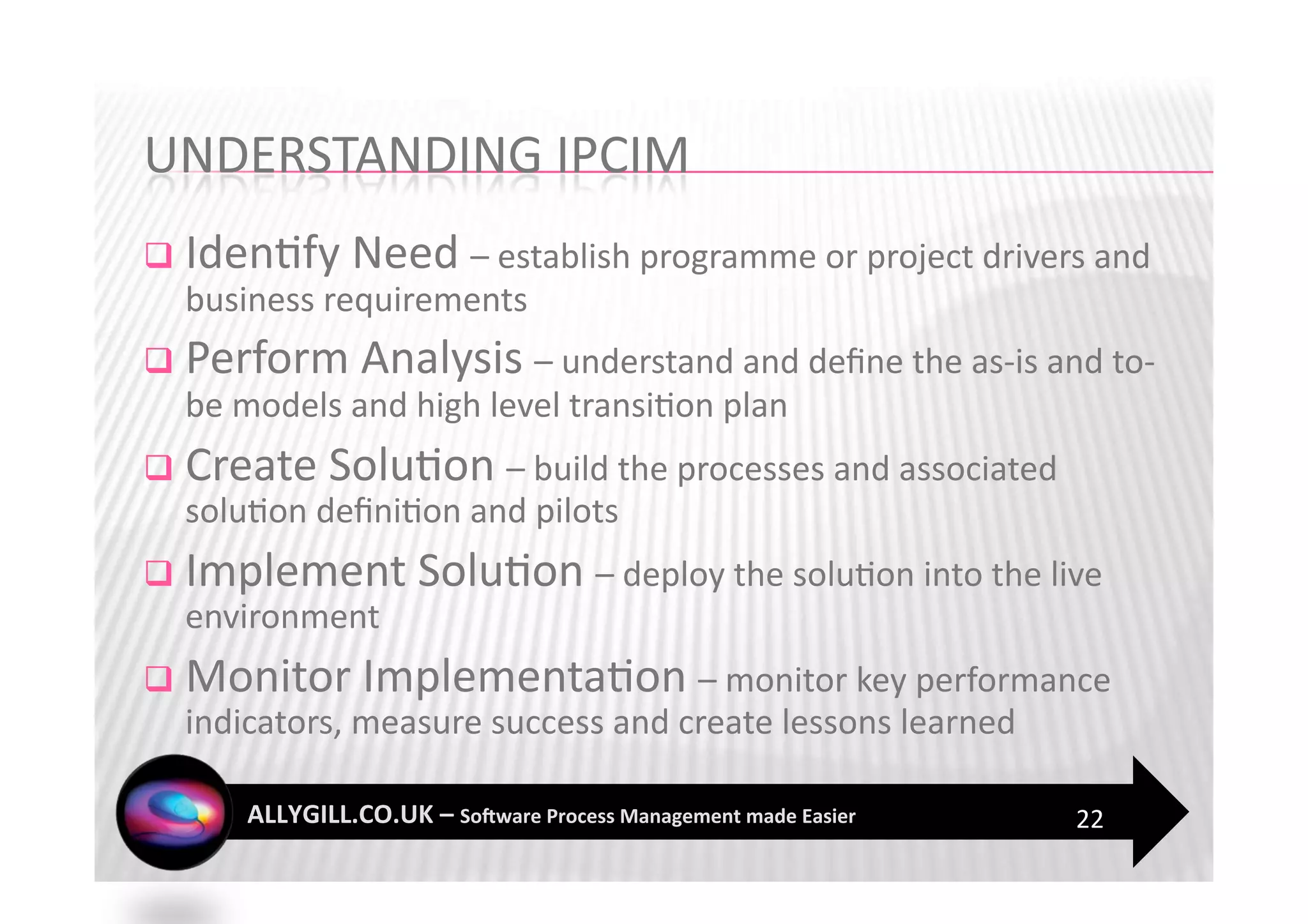
  Iden?fy Need – establish programme or project drivers and 
  business requirements 
  Perform Analysis – understand and define the as‐is and to‐
  be models and high level transi?on plan 
  Create Solu?on – build the processes and associated 
  solu?on defini?on and pilots 
  Implement Solu?on – deploy the solu?on into the live 
  environment  
  Monitor Implementa?on – monitor key performance 
  indicators, measure success and create lessons learned   

                                                              22 
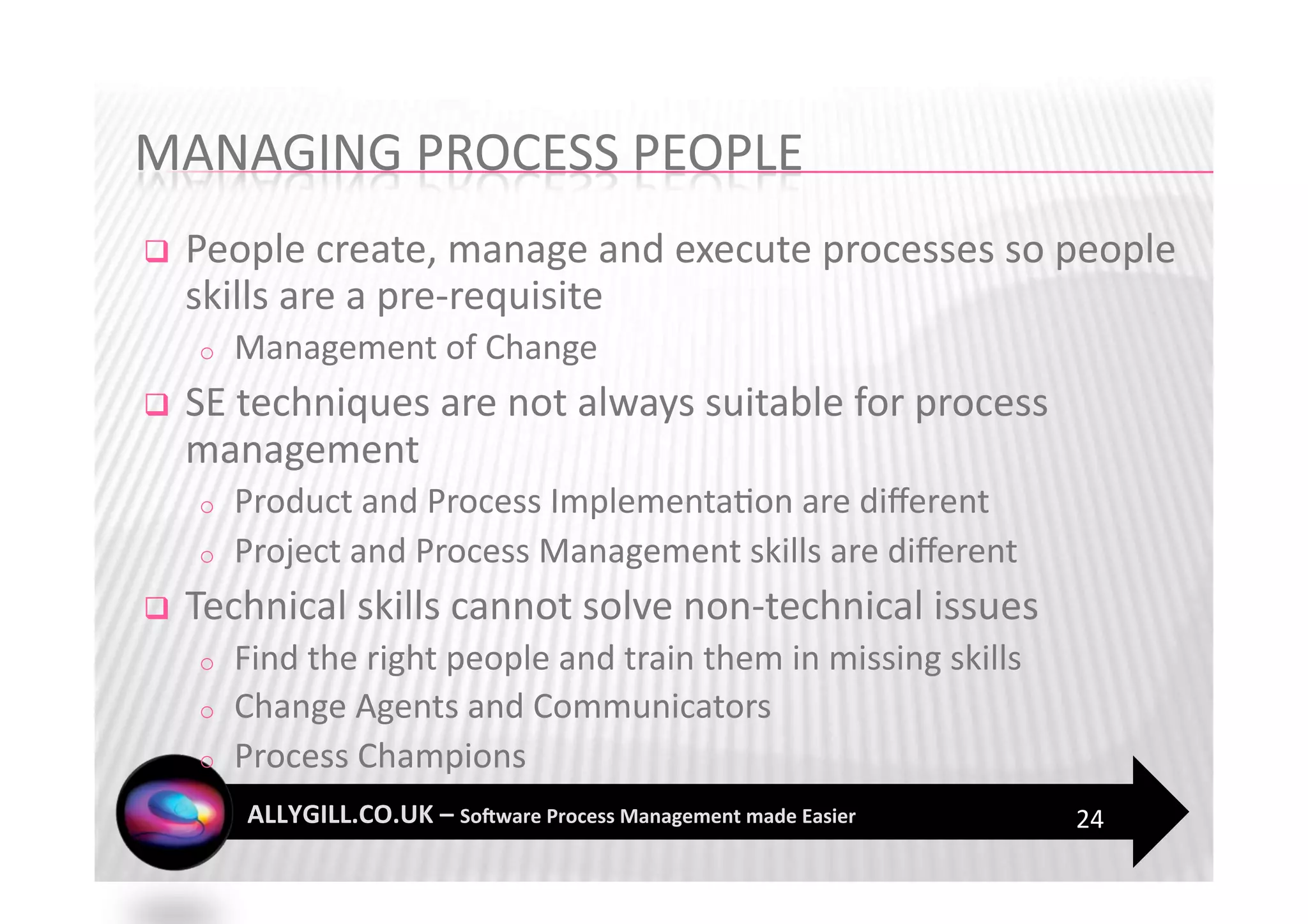
    People create, manage and execute processes so people 
     skills are a pre‐requisite 
     o    Management of Change 
    SE techniques are not always suitable for process 
     management 
     o    Product and Process Implementa?on are different 
     o    Project and Process Management skills are different 
    Technical skills cannot solve non‐technical issues 
     o    Find the right people and train them in missing skills 
     o    Change Agents and Communicators 
     o    Process Champions 
                                                                    24 
  Train your execu?ve team from day zero 

  Build on your exis?ng processes and culture 

  Acquire a “management of change” method and 
   use it 
  Keep things small and simple 

  Consider your audience 

  Define and reward “appropriate” behaviour 


                                               25 
    Develop a process management culture 
     o    Roles and Responsibili?es 
     o    Explicit Management Goals and Objec?ves 
     o    Process and Quality Synergy 
     o    Everybody's Responsibility 
    Build a risk based approach to process management 
     o    Where is the pain ? 
     o    What keeps the Chief Execu?ve awake at night ? 
     o    What prevents Delivery Managers from Delivering ? 


                                                               26 
    You need to get the right people 
     o    Balance managers and prac??oners with SPM staff and non‐IT 
          staff (HR, Finance etc.) 
    Set up the most appropriate forums 
     o    Get the appropriate level of granularity 
    Define and Publish the forum objec?ves 
     o    Ability and authority to make decisions 
    Create a Shared Understanding of what you’re trying to 
     achieve 

                                                             27 
    Understand the wider quality prac?ces and alterna?ve 
     models 
     o    ISO standards (ISO 9000, 10005, 10006, etc.) 
     o    SPICE (ISO 15504), AutoSPICE 
     o    Six Sigma 
     o    ITIL v3 
     o    IEEE Standards 
  Look outside IT for process tools and techniques (BPM) 
  Use a pick and mix approach to create an integrated 
   toolkit 

                                                          28 
“Learn all you can from the
  mistakes of others. You won’t
  have time to make them all
            yourself”
Anon


                                  29 
For more informa?on please contact : 

Ally Gill,  
Owner and Managing Director  
ALLYGILL.CO.UK 
ally@ally.gill.co.uk 
info@ally.gill.co.uk 
www.allygill.co.uk  


                                        30 

Why Software Process Improvement Is Not Enough

  • 1.
  • 2.
    “Organisations churn through onetechnique after another and at best get incremental improvement on top of business as usual” Richard Pascale (1938-, consultant, author and educator) 2 
  • 3.
      Understand the problem and consider an  alterna?ve  o  Why do SPI programmes fail?  o  What is SoFware Process Management?    Define a solu?on  o  PROMISE (Process Management in SoFware Engineering)    Implement the solu?on  o  Manage Processes using key PROMISE principles  3 
  • 5.
      Many SoFware Process Improvement (SPI)  programmes fail to deliver on their poten?al  because:   o  SPI tends to generate waves of improvement ini?a?ves which  are oFen subject to early termina?on because of financial or  organisa?onal changes   o  Less mature organisa?ons do not have the exper?se or  awareness to perform other ac?vi?es necessary to support  process improvement  o  Requirements are assumed not elicited  5 
  • 6.
      Even seemingly successful SPI ini?a?ves  some?mes fail to become opera?onal  o  Insufficient ?me is given before the next ini?a?ve starts  o  Organisa?ons s?ll fail to manage change    Process Improvement is an admirable goal, but it  demands a degree of maturity to begin with  o  Build in management of change and project management  o  ShiF the focus from Process Improvement to Process  Management  6 
  • 7.
      Lots of ac?vity –   o  but liZle real improvement    Lots of measures –   o  but no analysis or ac?ons    Lots of tools –  o  but poorly understood, used or integrated    Lots of talking –   o  but no communica?on (especially at senior levels)  7 
  • 8.
      “Process Improvement” fails to adequately  describe all the ac?vi?es required to establish  and sustain an effec?ve process infrastructure    Process Management encompasses:  o  Process Management Infrastructure   o  Process Defini?on and Implementa?on  o  Process Control and Monitoring  o  Process Compliance and Assurance  o  Process Improvement  8 
  • 9.
    SoFware Process Management:    reinforces the idea of a long term strategic focus  for organisa?ons who want to perform beZer    builds a pla`orm for sustained performance    allows the enterprise to create the founda?ons  for all future improvement opportuni?es    promotes a culture of process and quality  awareness   9 
  • 10.
  • 11.
  • 13.
      PROMISE ‐ Process Management in SoFware  Engineering – is a model for designing, building and  running a Process Management Func?on within a  SoFware Development enterprise    PROMISE focuses on People, Infrastructure and  Ac?vi?es associated with Process Management    PROMISE can be tailored and applied to single or  mul?ple reference models in any size of organisa?on  13 
  • 14.
      SoFware Process Management is an essen?al full ?me  func?on within the soFware development and  maintenance environment    PROMISE has been designed for Process and Quality  Management leaders and teams, and their managers  and execu?ves    PROMISE will make a SoFware Process Management  func?on easier to build, run and sustain  14 
  • 15.
      PROMISE – is the product of twenty five years of  experience in SoFware Engineering, Project  Management, Quality Management, Change  Management and Process Improvement & Management    PROMISE is a work in progress  15 
  • 16.
    Infrastructure  People perform  supports  Ac,vi,es  People  People  Life‐ cycle  Ac?vi?es  Infrastructure  Infrastructure  underpins  Ac,vi,es  16 
  • 17.
      People are at the heart of PROMISE ac?vi?es    Roles and responsibili?es are not widely understood  even in organisa?ons with a history of SPI    PROMISE defines roles and responsibili?es  independently of other corporate job ?tles and codes     SPM skills are required across the organisa?on not just  within the SEPG or Quality Forum    SPM skills must be understood and used by all levels of  management  17 
  • 18.
      Infrastructure refers to the IT and organisa?onal support  required to maintain an SPM func?on    A solid infrastructure facilitates the execu?on of SPM  ac?vi?es    Infrastructure includes process libraries, documenta?on,  data repositories and other suppor?ng tools    PROMISE helps support an integrated SPM environment    Within PROMISE infrastructure includes reference  models and methodologies  18 
  • 19.
      PROMISE facilitates the following sets of  ac?vi?es:  o  Process Requirements and Defini?on  o  Planning, Management and Governance  o  Implementa?on and Deployment  o  Monitoring, Measurement and Control  o  Improvement  o  Compliance and Assurance  o  Management of Change  19 
  • 20.
    Level 1  Programme  Level 2  Project/  Sub‐Project  IPCIM  20 
  • 21.
      The IPCIM process is at the heart of all  programmes, projects and sub‐projects    Programmes, projects and sub‐projects have  three elements :–     Programme/Project Management (PgM/PjM)    IPCIM    Management of Change (MoC)    PgM/PjM and MoC elements can use exis?ng  corporate methods if they exist  21 
  • 22.
      Iden?fy Need – establish programme or project drivers and  business requirements    Perform Analysis – understand and define the as‐is and to‐ be models and high level transi?on plan    Create Solu?on – build the processes and associated  solu?on defini?on and pilots    Implement Solu?on – deploy the solu?on into the live  environment     Monitor Implementa?on – monitor key performance  indicators, measure success and create lessons learned    22 
  • 24.
      People create, manage and execute processes so people  skills are a pre‐requisite  o  Management of Change    SE techniques are not always suitable for process  management  o  Product and Process Implementa?on are different  o  Project and Process Management skills are different    Technical skills cannot solve non‐technical issues  o  Find the right people and train them in missing skills  o  Change Agents and Communicators  o  Process Champions  24 
  • 25.
      Train your execu?ve team from day zero    Build on your exis?ng processes and culture   Acquire a “management of change” method and  use it    Keep things small and simple    Consider your audience    Define and reward “appropriate” behaviour  25 
  • 26.
      Develop a process management culture  o  Roles and Responsibili?es  o  Explicit Management Goals and Objec?ves  o  Process and Quality Synergy  o  Everybody's Responsibility    Build a risk based approach to process management  o  Where is the pain ?  o  What keeps the Chief Execu?ve awake at night ?  o  What prevents Delivery Managers from Delivering ?  26 
  • 27.
      You need to get the right people  o  Balance managers and prac??oners with SPM staff and non‐IT  staff (HR, Finance etc.)    Set up the most appropriate forums  o  Get the appropriate level of granularity    Define and Publish the forum objec?ves  o  Ability and authority to make decisions    Create a Shared Understanding of what you’re trying to  achieve  27 
  • 28.
      Understand the wider quality prac?ces and alterna?ve  models  o  ISO standards (ISO 9000, 10005, 10006, etc.)  o  SPICE (ISO 15504), AutoSPICE  o  Six Sigma  o  ITIL v3  o  IEEE Standards    Look outside IT for process tools and techniques (BPM)    Use a pick and mix approach to create an integrated  toolkit  28 
  • 29.
    “Learn all youcan from the mistakes of others. You won’t have time to make them all yourself” Anon 29 
  • 30.