1
CHAPTER 1
Chemical Process Diagrams
THE MOST EFFECTIVE WAY OF
COMMUNICATING INFORMATION
ABOUT A PROCESS IS THROUGH
THE USE OF FLOW DIAGRAMS
2
The Generic Block Flow Process Diagram
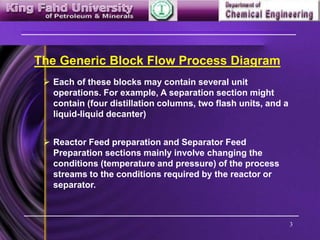
 There are features common to all chemical processes.
Figure below provides a generic Block Flow Process
Diagram that shows a chemical process broken down into
six basic areas or blocks.
3
The Generic Block Flow Process Diagram
 Each of these blocks may contain several unit
operations. For example, A separation section might
contain (four distillation columns, two flash units, and a
liquid-liquid decanter)
 Reactor Feed preparation and Separator Feed
Preparation sections mainly involve changing the
conditions (temperature and pressure) of the process
streams to the conditions required by the reactor or
separator.
4
CHAPTER 1
Chemical Process Diagrams
Design is an evolutionary process:
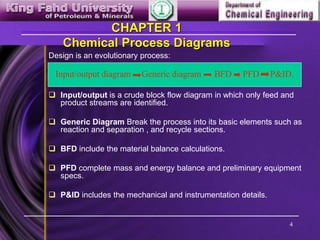
 Input/output is a crude block flow diagram in which only feed and
product streams are identified.
 Generic Diagram Break the process into its basic elements such as
reaction and separation , and recycle sections.
 BFD include the material balance calculations.
 PFD complete mass and energy balance and preliminary equipment
specs.
 P&ID includes the mechanical and instrumentation details.
Input/output diagram Generic diagram BFD PFD P&ID.
5
Chemical Process Diagrams
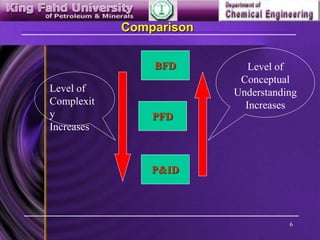
3 Main Levels of Diagrams
Block Flow Diagram (BFD)
Process Flow Diagram (PFD)
Piping and Instrumentation Diagram
(P&ID) – often referred to as Mechanical
Flow Diagram
6
Comparison
BFD
PFD
P&ID
Level of
Complexit
y
Increases
Level of
Conceptual
Understanding
Increases
7
The Block Flow Diagram (BFD)
Shows overall processing picture of a
chemical complex
Useful as an orientation tool
Used to sketch out and screen potential
process alternatives.
8
Definitions of BFD
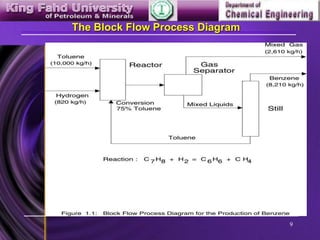
 Block Flow Process Diagram (BFPD)
BFPD forms the starting point for developing
PFD
BFPD is helpful in conceptualizing new
processes
See Fig 1.1
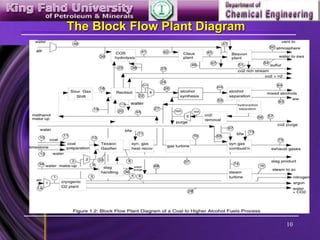
 Block Flow Plant Diagram
Gives a general view of a large complex plant
See Fig 1.2
9
The Block Flow Process Diagram
10
The Block Flow Plant Diagram
11
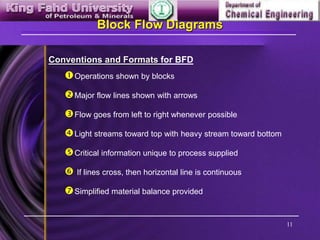
Block Flow Diagrams
Conventions and Formats for BFD
Operations shown by blocks
Major flow lines shown with arrows
Flow goes from left to right whenever possible
Light streams toward top with heavy stream toward bottom
Critical information unique to process supplied
 If lines cross, then horizontal line is continuous
Simplified material balance provided
12
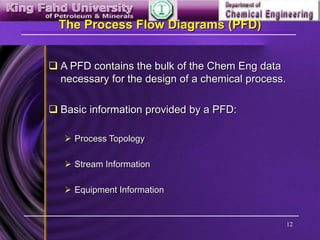
The Process Flow Diagrams (PFD)
 A PFD contains the bulk of the Chem Eng data
necessary for the design of a chemical process.
 Basic information provided by a PFD:
 Process Topology
 Stream Information
 Equipment Information
13
The Process Flow Diagrams (PFD)
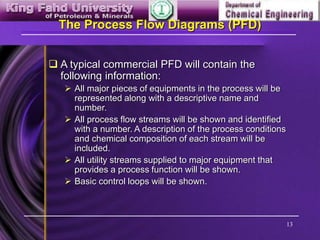
 A typical commercial PFD will contain the
following information:
 All major pieces of equipments in the process will be
represented along with a descriptive name and
number.
 All process flow streams will be shown and identified
with a number. A description of the process conditions
and chemical composition of each stream will be
included.
 All utility streams supplied to major equipment that
provides a process function will be shown.
 Basic control loops will be shown.
14
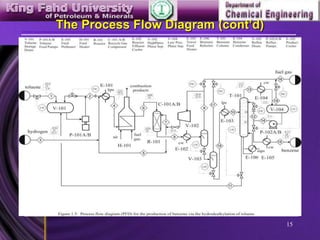
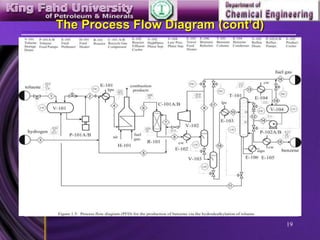
The Process Flow Diagram (cont’d)
 The topology of the process – showing the
connectivity of all the streams and the
equipment
 Example for toluene HDA – figures 1.3 and 1.5
 Tables 1.2 lists information that should be on the PFD
but cannot fit
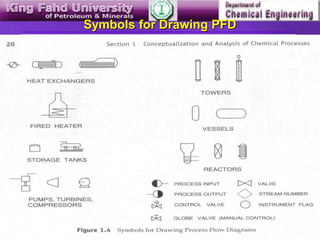
 Use appropriate conventions – consistency is important
in communication of process information ex. Table 1.2
15
The Process Flow Diagram (cont’d)
16
Symbols for Drawing PFD
17
The Process Flow Diagram (cont’d)
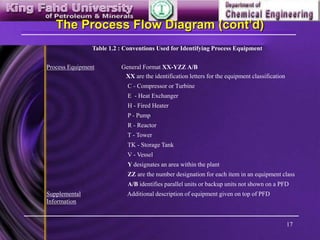
Table 1.2 : Conventions Used for Identifying Process Equipment
Process Equipment General Format XX-YZZ A/B
XX are the identification letters for the equipment classification
C - Compressor or Turbine
E - Heat Exchanger
H - Fired Heater
P - Pump
R - Reactor
T - Tower
TK - Storage Tank
V - Vessel
Y designates an area within the plant
ZZ are the number designation for each item in an equipment class
A/B identifies parallel units or backup units not shown on a PFD
Supplemental
Information
Additional description of equipment given on top of PFD
18
Equipment Numbering
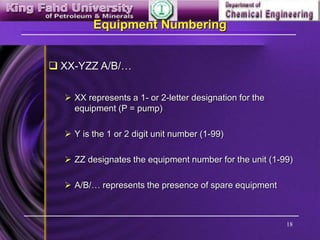
 XX-YZZ A/B/…
 XX represents a 1- or 2-letter designation for the
equipment (P = pump)
 Y is the 1 or 2 digit unit number (1-99)
 ZZ designates the equipment number for the unit (1-99)
 A/B/… represents the presence of spare equipment
19
The Process Flow Diagram (cont’d)
20
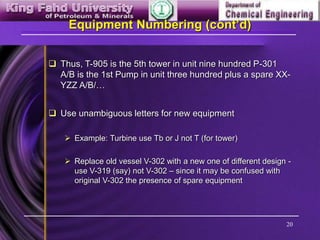
Equipment Numbering (cont’d)
 Thus, T-905 is the 5th tower in unit nine hundred P-301
A/B is the 1st Pump in unit three hundred plus a spare XX-
YZZ A/B/…
 Use unambiguous letters for new equipment
 Example: Turbine use Tb or J not T (for tower)
 Replace old vessel V-302 with a new one of different design -
use V-319 (say) not V-302 – since it may be confused with
original V-302 the presence of spare equipment
21
22
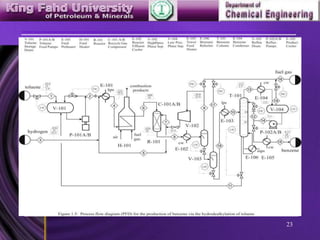
Stream Numbering and Drawing
 Number streams from left to right as much as possible
 Horizontal lines are dominant
23
24
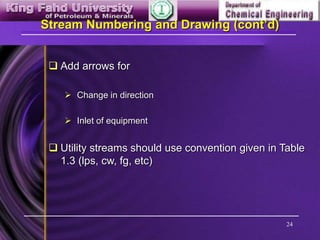
Stream Numbering and Drawing (cont’d)
 Add arrows for
 Change in direction
 Inlet of equipment
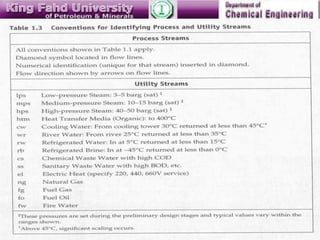
 Utility streams should use convention given in Table
1.3 (lps, cw, fg, etc)
25
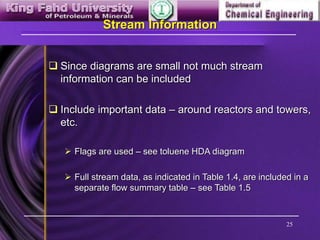
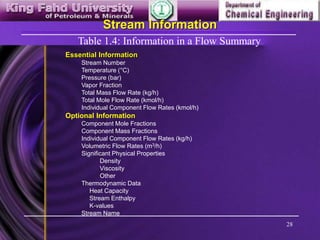
Stream Information
 Since diagrams are small not much stream
information can be included
 Include important data – around reactors and towers,
etc.
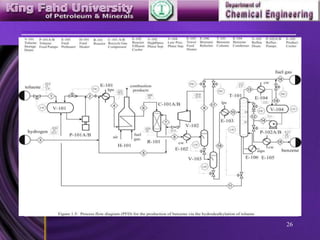
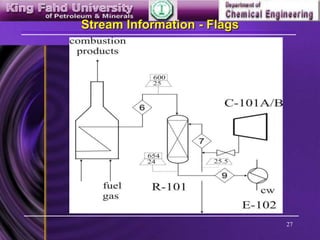
 Flags are used – see toluene HDA diagram
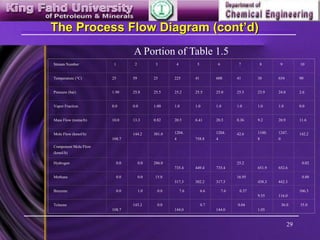
 Full stream data, as indicated in Table 1.4, are included in a
separate flow summary table – see Table 1.5
26
27
Stream Information - Flags
28
Stream Information
Essential Information
Stream Number
Temperature (°C)
Pressure (bar)
Vapor Fraction
Total Mass Flow Rate (kg/h)
Total Mole Flow Rate (kmol/h)
Individual Component Flow Rates (kmol/h)
Optional Information
Component Mole Fractions
Component Mass Fractions
Individual Component Flow Rates (kg/h)
Volumetric Flow Rates (m3/h)
Significant Physical Properties
Density
Viscosity
Other
Thermodynamic Data
Heat Capacity
Stream Enthalpy
K-values
Stream Name
Table 1.4: Information in a Flow Summary
29
The Process Flow Diagram (cont’d)
Stream Number 1 2 3 4 5 6 7 8 9 10
Temperature (°C) 25 59 25 225 41 600 41 38 654 90
Pressure (bar) 1.90 25.8 25.5 25.2 25.5 25.0 25.5 23.9 24.0 2.6
Vapor Fraction 0.0 0.0 1.00 1.0 1.0 1.0 1.0 1.0 1.0 0.0
Mass Flow (tonne/h) 10.0 13.3 0.82 20.5 6.41 20.5 0.36 9.2 20.9 11.6
Mole Flow (kmol/h)
108.7
144.2 301.0 1204.
4 758.8
1204.
4
42.6 1100.
8
1247.
0
142.2
Component Mole Flow
(kmol/h)
Hydrogen 0.0 0.0 286.0
735.4 449.4 735.4
25.2
651.9 652.6
0.02
Methane 0.0 0.0 15.0
317.3 302.2 317.3
16.95
438.3 442.3
0.88
Benzene 0.0 1.0 0.0 7.6 6.6 7.6 0.37
9.55 116.0
106.3
Toluene
108.7
143.2 0.0
144.0
0.7
144.0
0.04
1.05
36.0 35.0
A Portion of Table 1.5
30
Equipment Information
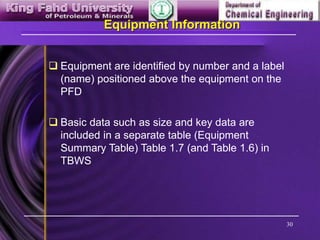
 Equipment are identified by number and a label
(name) positioned above the equipment on the
PFD
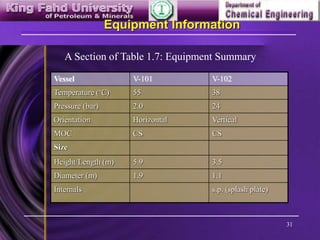
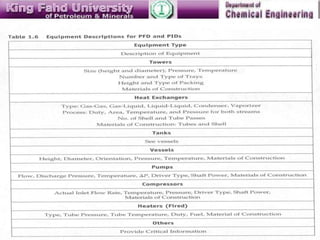
 Basic data such as size and key data are
included in a separate table (Equipment
Summary Table) Table 1.7 (and Table 1.6) in
TBWS
31
Equipment Information
Vessel V-101 V-102
Temperature (ºC) 55 38
Pressure (bar) 2.0 24
Orientation Horizontal Vertical
MOC CS CS
Size
Height/Length (m) 5.9 3.5
Diameter (m) 1.9 1.1
Internals s.p. (splash plate)
A Section of Table 1.7: Equipment Summary
32
33
PFD Summary
 PFD, Equipment Summary Table, and Flow
Summary Table represent a “true” PFD
 This information is sufficient for a preliminary
estimation of capital investment (Chapter 5) and
cost of manufacture (Chapter 6) to be made
34
The Piping and Instrument Diagram (P&ID)
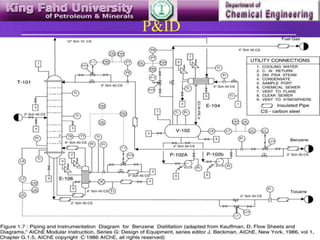
P&ID – Construction Manual
 Contains: plant construction information (piping,
process, instrumentation, and other diagrams)
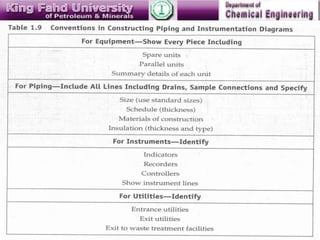
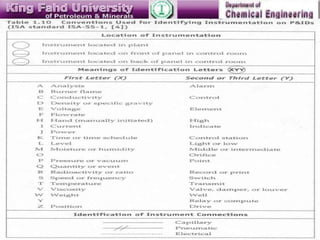
 P&ID construction convection is explained in Table1.9
 Conventions for instrumentation are shown in Table
1.10.
35
P&ID
36
37
38
39
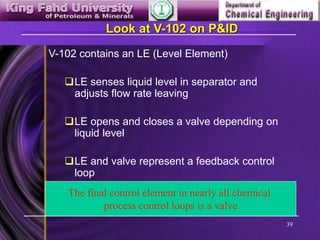
Look at V-102 on P&ID
V-102 contains an LE (Level Element)
LE senses liquid level in separator and
adjusts flow rate leaving
LE opens and closes a valve depending on
liquid level
LE and valve represent a feedback control
loop
The final control element in nearly all chemical
process control loops is a valve
40
P&ID
Based on the P&ID diagram:
 Mech and Civil Engrs will design and install pieces of
equipment.
 Instrument Engrs will specify, install and check control
systems.
 Piping Engrs will develop plant layout and elevation
drawings.
 Project Engrs will develop plant and construction
schedules.
41
Additional Diagrams
 UTILITY FLOWSHEET
 VESSEL SKETCHES
 WIRING DIAGRAMS
 SITE PLANS
 PLOT PLANS
 ELEVATION DIAGRAMS
DO NOT POSSESS ADDITIONAL PROCESS
INORMATION
42
Additional Diagrams
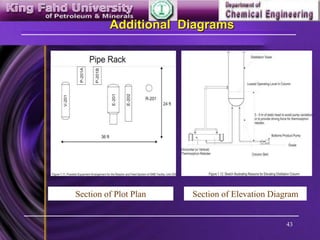
 Plot Plans – plan or map drawn looking down on
plant (drawn to scale with all major equipment
identified)
 Elevation Diagrams – show view from side and
give information about equipments distance from
ground
43
Additional Diagrams
Section of Plot Plan Section of Elevation Diagram
44
Additional Diagrams (cont’d)
 Piping Isometrics – show piping in 3-dimensions
 Vessel Sketches – show key dimensions of
equipment and locations of inlet and outlet
nozzles etc.
45
Scale Models and Virtual Plants
 25 years ago physical models were used for
review
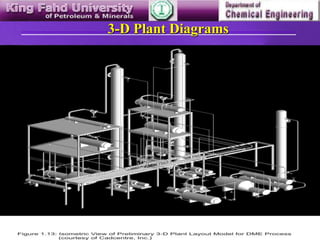
 Now virtual or electronic models are generated
using software (3-d plant diagrams)
 Purpose of Models – catch errors such as
 Piping clashes
 Misaligned piping
 Equipment not easily accessed
 Sample points not easily reached by operators
46
3-D Plant Diagrams
47
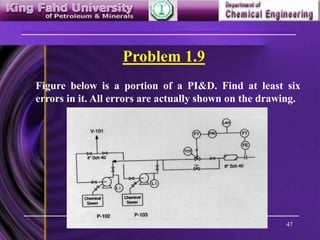
Problem 1.9
Figure below is a portion of a PI&D. Find at least six
errors in it. All errors are actually shown on the drawing.
48
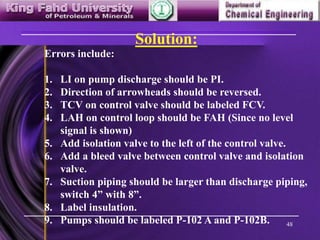
Solution:
Errors include:
1. LI on pump discharge should be PI.
2. Direction of arrowheads should be reversed.
3. TCV on control valve should be labeled FCV.
4. LAH on control loop should be FAH (Since no level
signal is shown)
5. Add isolation valve to the left of the control valve.
6. Add a bleed valve between control valve and isolation
valve.
7. Suction piping should be larger than discharge piping,
switch 4” with 8”.
8. Label insulation.
9. Pumps should be labeled P-102 A and P-102B.
49
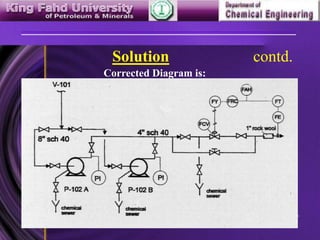
Solution contd.
Corrected Diagram is:

Chem Chapter.ppt

  • 1.
    1 CHAPTER 1 Chemical ProcessDiagrams THE MOST EFFECTIVE WAY OF COMMUNICATING INFORMATION ABOUT A PROCESS IS THROUGH THE USE OF FLOW DIAGRAMS
  • 2.
    2 The Generic BlockFlow Process Diagram  There are features common to all chemical processes. Figure below provides a generic Block Flow Process Diagram that shows a chemical process broken down into six basic areas or blocks.
  • 3.
    3 The Generic BlockFlow Process Diagram  Each of these blocks may contain several unit operations. For example, A separation section might contain (four distillation columns, two flash units, and a liquid-liquid decanter)  Reactor Feed preparation and Separator Feed Preparation sections mainly involve changing the conditions (temperature and pressure) of the process streams to the conditions required by the reactor or separator.
  • 4.
    4 CHAPTER 1 Chemical ProcessDiagrams Design is an evolutionary process:  Input/output is a crude block flow diagram in which only feed and product streams are identified.  Generic Diagram Break the process into its basic elements such as reaction and separation , and recycle sections.  BFD include the material balance calculations.  PFD complete mass and energy balance and preliminary equipment specs.  P&ID includes the mechanical and instrumentation details. Input/output diagram Generic diagram BFD PFD P&ID.
  • 5.
    5 Chemical Process Diagrams 3Main Levels of Diagrams Block Flow Diagram (BFD) Process Flow Diagram (PFD) Piping and Instrumentation Diagram (P&ID) – often referred to as Mechanical Flow Diagram
  • 6.
  • 7.
    7 The Block FlowDiagram (BFD) Shows overall processing picture of a chemical complex Useful as an orientation tool Used to sketch out and screen potential process alternatives.
  • 8.
    8 Definitions of BFD Block Flow Process Diagram (BFPD) BFPD forms the starting point for developing PFD BFPD is helpful in conceptualizing new processes See Fig 1.1  Block Flow Plant Diagram Gives a general view of a large complex plant See Fig 1.2
  • 9.
    9 The Block FlowProcess Diagram
  • 10.
    10 The Block FlowPlant Diagram
  • 11.
    11 Block Flow Diagrams Conventionsand Formats for BFD Operations shown by blocks Major flow lines shown with arrows Flow goes from left to right whenever possible Light streams toward top with heavy stream toward bottom Critical information unique to process supplied  If lines cross, then horizontal line is continuous Simplified material balance provided
  • 12.
    12 The Process FlowDiagrams (PFD)  A PFD contains the bulk of the Chem Eng data necessary for the design of a chemical process.  Basic information provided by a PFD:  Process Topology  Stream Information  Equipment Information
  • 13.
    13 The Process FlowDiagrams (PFD)  A typical commercial PFD will contain the following information:  All major pieces of equipments in the process will be represented along with a descriptive name and number.  All process flow streams will be shown and identified with a number. A description of the process conditions and chemical composition of each stream will be included.  All utility streams supplied to major equipment that provides a process function will be shown.  Basic control loops will be shown.
  • 14.
    14 The Process FlowDiagram (cont’d)  The topology of the process – showing the connectivity of all the streams and the equipment  Example for toluene HDA – figures 1.3 and 1.5  Tables 1.2 lists information that should be on the PFD but cannot fit  Use appropriate conventions – consistency is important in communication of process information ex. Table 1.2
  • 15.
    15 The Process FlowDiagram (cont’d)
  • 16.
  • 17.
    17 The Process FlowDiagram (cont’d) Table 1.2 : Conventions Used for Identifying Process Equipment Process Equipment General Format XX-YZZ A/B XX are the identification letters for the equipment classification C - Compressor or Turbine E - Heat Exchanger H - Fired Heater P - Pump R - Reactor T - Tower TK - Storage Tank V - Vessel Y designates an area within the plant ZZ are the number designation for each item in an equipment class A/B identifies parallel units or backup units not shown on a PFD Supplemental Information Additional description of equipment given on top of PFD
  • 18.
    18 Equipment Numbering  XX-YZZA/B/…  XX represents a 1- or 2-letter designation for the equipment (P = pump)  Y is the 1 or 2 digit unit number (1-99)  ZZ designates the equipment number for the unit (1-99)  A/B/… represents the presence of spare equipment
  • 19.
    19 The Process FlowDiagram (cont’d)
  • 20.
    20 Equipment Numbering (cont’d) Thus, T-905 is the 5th tower in unit nine hundred P-301 A/B is the 1st Pump in unit three hundred plus a spare XX- YZZ A/B/…  Use unambiguous letters for new equipment  Example: Turbine use Tb or J not T (for tower)  Replace old vessel V-302 with a new one of different design - use V-319 (say) not V-302 – since it may be confused with original V-302 the presence of spare equipment
  • 21.
  • 22.
    22 Stream Numbering andDrawing  Number streams from left to right as much as possible  Horizontal lines are dominant
  • 23.
  • 24.
    24 Stream Numbering andDrawing (cont’d)  Add arrows for  Change in direction  Inlet of equipment  Utility streams should use convention given in Table 1.3 (lps, cw, fg, etc)
  • 25.
    25 Stream Information  Sincediagrams are small not much stream information can be included  Include important data – around reactors and towers, etc.  Flags are used – see toluene HDA diagram  Full stream data, as indicated in Table 1.4, are included in a separate flow summary table – see Table 1.5
  • 26.
  • 27.
  • 28.
    28 Stream Information Essential Information StreamNumber Temperature (°C) Pressure (bar) Vapor Fraction Total Mass Flow Rate (kg/h) Total Mole Flow Rate (kmol/h) Individual Component Flow Rates (kmol/h) Optional Information Component Mole Fractions Component Mass Fractions Individual Component Flow Rates (kg/h) Volumetric Flow Rates (m3/h) Significant Physical Properties Density Viscosity Other Thermodynamic Data Heat Capacity Stream Enthalpy K-values Stream Name Table 1.4: Information in a Flow Summary
  • 29.
    29 The Process FlowDiagram (cont’d) Stream Number 1 2 3 4 5 6 7 8 9 10 Temperature (°C) 25 59 25 225 41 600 41 38 654 90 Pressure (bar) 1.90 25.8 25.5 25.2 25.5 25.0 25.5 23.9 24.0 2.6 Vapor Fraction 0.0 0.0 1.00 1.0 1.0 1.0 1.0 1.0 1.0 0.0 Mass Flow (tonne/h) 10.0 13.3 0.82 20.5 6.41 20.5 0.36 9.2 20.9 11.6 Mole Flow (kmol/h) 108.7 144.2 301.0 1204. 4 758.8 1204. 4 42.6 1100. 8 1247. 0 142.2 Component Mole Flow (kmol/h) Hydrogen 0.0 0.0 286.0 735.4 449.4 735.4 25.2 651.9 652.6 0.02 Methane 0.0 0.0 15.0 317.3 302.2 317.3 16.95 438.3 442.3 0.88 Benzene 0.0 1.0 0.0 7.6 6.6 7.6 0.37 9.55 116.0 106.3 Toluene 108.7 143.2 0.0 144.0 0.7 144.0 0.04 1.05 36.0 35.0 A Portion of Table 1.5
  • 30.
    30 Equipment Information  Equipmentare identified by number and a label (name) positioned above the equipment on the PFD  Basic data such as size and key data are included in a separate table (Equipment Summary Table) Table 1.7 (and Table 1.6) in TBWS
  • 31.
    31 Equipment Information Vessel V-101V-102 Temperature (ºC) 55 38 Pressure (bar) 2.0 24 Orientation Horizontal Vertical MOC CS CS Size Height/Length (m) 5.9 3.5 Diameter (m) 1.9 1.1 Internals s.p. (splash plate) A Section of Table 1.7: Equipment Summary
  • 32.
  • 33.
    33 PFD Summary  PFD,Equipment Summary Table, and Flow Summary Table represent a “true” PFD  This information is sufficient for a preliminary estimation of capital investment (Chapter 5) and cost of manufacture (Chapter 6) to be made
  • 34.
    34 The Piping andInstrument Diagram (P&ID) P&ID – Construction Manual  Contains: plant construction information (piping, process, instrumentation, and other diagrams)  P&ID construction convection is explained in Table1.9  Conventions for instrumentation are shown in Table 1.10.
  • 35.
  • 36.
  • 37.
  • 38.
  • 39.
    39 Look at V-102on P&ID V-102 contains an LE (Level Element) LE senses liquid level in separator and adjusts flow rate leaving LE opens and closes a valve depending on liquid level LE and valve represent a feedback control loop The final control element in nearly all chemical process control loops is a valve
  • 40.
    40 P&ID Based on theP&ID diagram:  Mech and Civil Engrs will design and install pieces of equipment.  Instrument Engrs will specify, install and check control systems.  Piping Engrs will develop plant layout and elevation drawings.  Project Engrs will develop plant and construction schedules.
  • 41.
    41 Additional Diagrams  UTILITYFLOWSHEET  VESSEL SKETCHES  WIRING DIAGRAMS  SITE PLANS  PLOT PLANS  ELEVATION DIAGRAMS DO NOT POSSESS ADDITIONAL PROCESS INORMATION
  • 42.
    42 Additional Diagrams  PlotPlans – plan or map drawn looking down on plant (drawn to scale with all major equipment identified)  Elevation Diagrams – show view from side and give information about equipments distance from ground
  • 43.
    43 Additional Diagrams Section ofPlot Plan Section of Elevation Diagram
  • 44.
    44 Additional Diagrams (cont’d) Piping Isometrics – show piping in 3-dimensions  Vessel Sketches – show key dimensions of equipment and locations of inlet and outlet nozzles etc.
  • 45.
    45 Scale Models andVirtual Plants  25 years ago physical models were used for review  Now virtual or electronic models are generated using software (3-d plant diagrams)  Purpose of Models – catch errors such as  Piping clashes  Misaligned piping  Equipment not easily accessed  Sample points not easily reached by operators
  • 46.
  • 47.
    47 Problem 1.9 Figure belowis a portion of a PI&D. Find at least six errors in it. All errors are actually shown on the drawing.
  • 48.
    48 Solution: Errors include: 1. LIon pump discharge should be PI. 2. Direction of arrowheads should be reversed. 3. TCV on control valve should be labeled FCV. 4. LAH on control loop should be FAH (Since no level signal is shown) 5. Add isolation valve to the left of the control valve. 6. Add a bleed valve between control valve and isolation valve. 7. Suction piping should be larger than discharge piping, switch 4” with 8”. 8. Label insulation. 9. Pumps should be labeled P-102 A and P-102B.
  • 49.