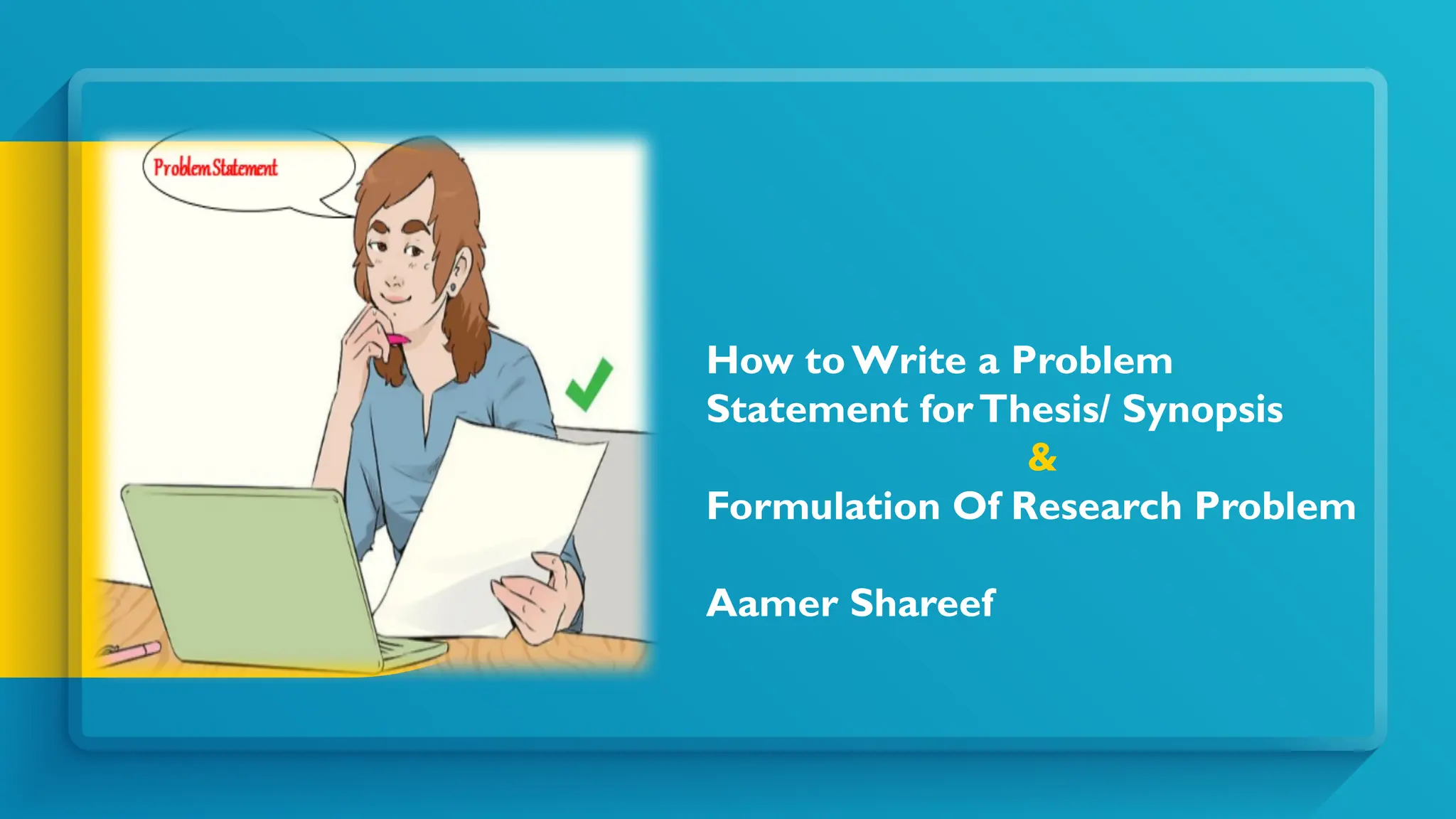
How toWrite a Problem
Statement forThesis/ Synopsis
&
Formulation Of Research Problem
Aamer Shareef
2
A research problem may be defined as an area of concern, a gap in the existing knowledge, or a
deviation in the norm or standard that points to the need for further understanding and
investigation (Bwisa, 2018
Definition of Research Problem
3
Principal Proposition
(Information already established. No doubt about it)
The principal proposition represents a discussion that establishes for the reader what information
that is generally considered as being beyond question.
Example
The polio vaccine reduces the chances of polio prevalence among children to a large extent.
Parts of Problem Statement- Part 1
4
Interacting Proposition
(What contradicts, which has already been established. Exemptions)
The interacting proposition is perhaps the most important part of the problem statement. In effect,
the interacting proposition and the discussion that supports it serves to contradict, show
exceptions to, or cast some doubt on the principal proposition. The form of the interacting
propositional statement almost always starts with a connecting adverb, such as: however,
although, but, or words that serve a similar function.
Example
In past few years, a number of polio cases have been reported in those areas of the world where
reportedly polio vaccines were administered to children.
Parts of Problem Statement- Part 2
5
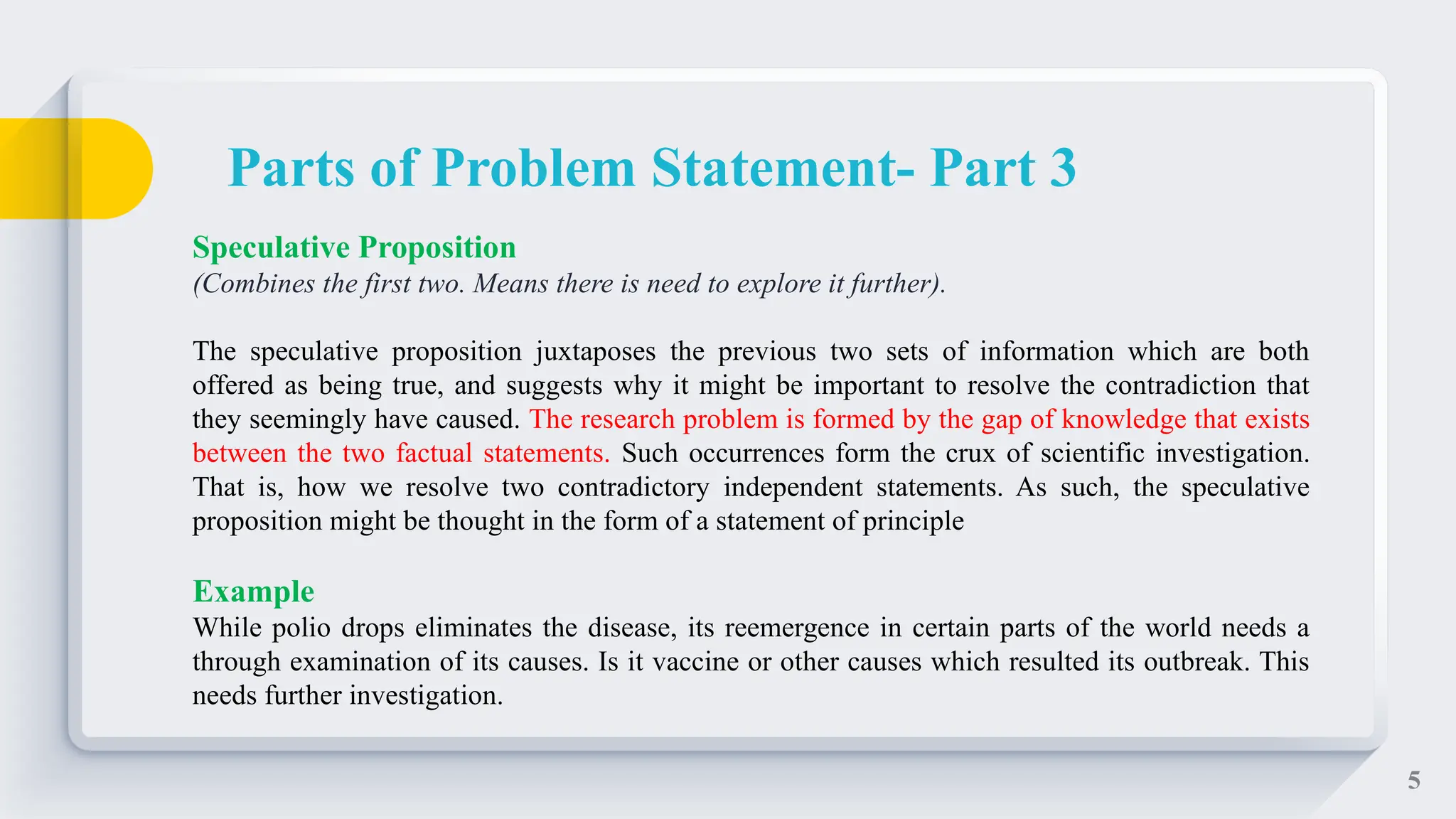
Speculative Proposition
(Combines the first two. Means there is need to explore it further).
The speculative proposition juxtaposes the previous two sets of information which are both
offered as being true, and suggests why it might be important to resolve the contradiction that
they seemingly have caused. The research problem is formed by the gap of knowledge that exists
between the two factual statements. Such occurrences form the crux of scientific investigation.
That is, how we resolve two contradictory independent statements. As such, the speculative
proposition might be thought in the form of a statement of principle
Example
While polio drops eliminates the disease, its reemergence in certain parts of the world needs a
through examination of its causes. Is it vaccine or other causes which resulted its outbreak. This
needs further investigation.
Parts of Problem Statement- Part 3
6
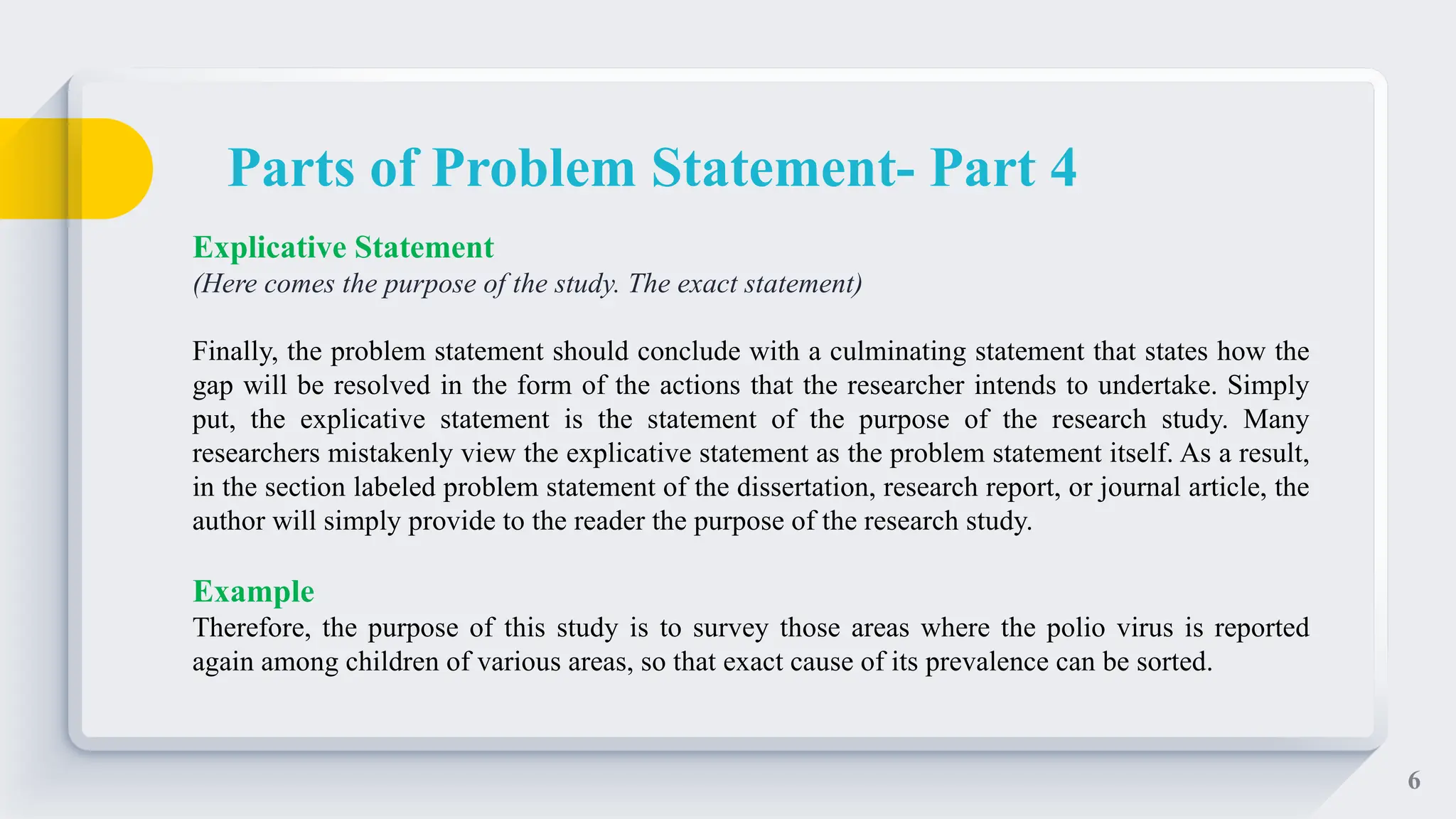
Explicative Statement
(Here comes the purpose of the study. The exact statement)
Finally, the problem statement should conclude with a culminating statement that states how the
gap will be resolved in the form of the actions that the researcher intends to undertake. Simply
put, the explicative statement is the statement of the purpose of the research study. Many
researchers mistakenly view the explicative statement as the problem statement itself. As a result,
in the section labeled problem statement of the dissertation, research report, or journal article, the
author will simply provide to the reader the purpose of the research study.
Example
Therefore, the purpose of this study is to survey those areas where the polio virus is reported
again among children of various areas, so that exact cause of its prevalence can be sorted.
Parts of Problem Statement- Part 4
7
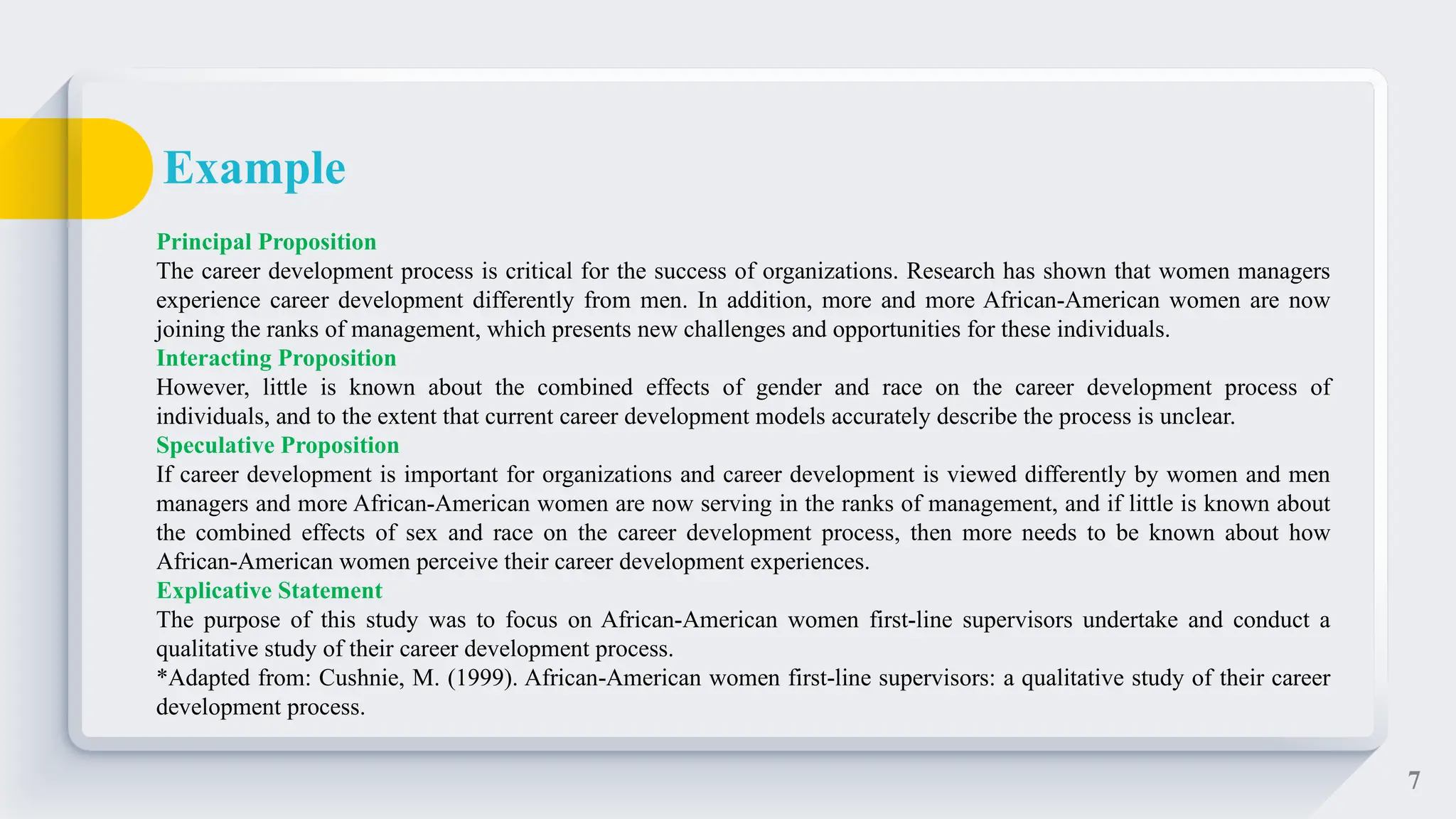
Principal Proposition
The career development process is critical for the success of organizations. Research has shown that women managers
experience career development differently from men. In addition, more and more African-American women are now
joining the ranks of management, which presents new challenges and opportunities for these individuals.
Interacting Proposition
However, little is known about the combined effects of gender and race on the career development process of
individuals, and to the extent that current career development models accurately describe the process is unclear.
Speculative Proposition
If career development is important for organizations and career development is viewed differently by women and men
managers and more African-American women are now serving in the ranks of management, and if little is known about
the combined effects of sex and race on the career development process, then more needs to be known about how
African-American women perceive their career development experiences.
Explicative Statement
The purpose of this study was to focus on African-American women first-line supervisors undertake and conduct a
qualitative study of their career development process.
*Adapted from: Cushnie, M. (1999). African-American women first-line supervisors: a qualitative study of their career
development process.
Example
8
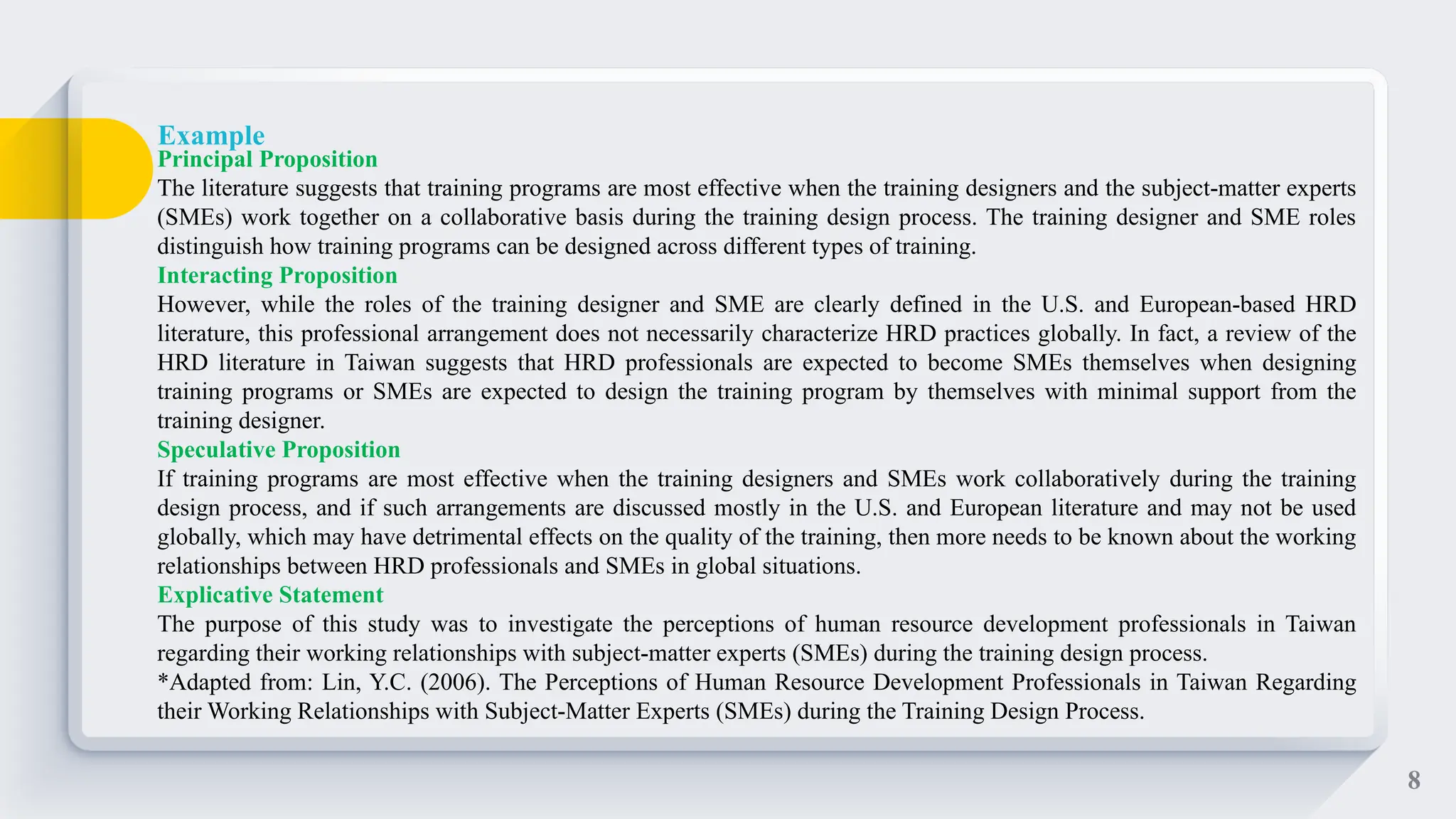
Principal Proposition
The literature suggests that training programs are most effective when the training designers and the subject-matter experts
(SMEs) work together on a collaborative basis during the training design process. The training designer and SME roles
distinguish how training programs can be designed across different types of training.
Interacting Proposition
However, while the roles of the training designer and SME are clearly defined in the U.S. and European-based HRD
literature, this professional arrangement does not necessarily characterize HRD practices globally. In fact, a review of the
HRD literature in Taiwan suggests that HRD professionals are expected to become SMEs themselves when designing
training programs or SMEs are expected to design the training program by themselves with minimal support from the
training designer.
Speculative Proposition
If training programs are most effective when the training designers and SMEs work collaboratively during the training
design process, and if such arrangements are discussed mostly in the U.S. and European literature and may not be used
globally, which may have detrimental effects on the quality of the training, then more needs to be known about the working
relationships between HRD professionals and SMEs in global situations.
Explicative Statement
The purpose of this study was to investigate the perceptions of human resource development professionals in Taiwan
regarding their working relationships with subject-matter experts (SMEs) during the training design process.
*Adapted from: Lin, Y.C. (2006). The Perceptions of Human Resource Development Professionals in Taiwan Regarding
their Working Relationships with Subject-Matter Experts (SMEs) during the Training Design Process.
Example
9
FORMULATION
OF
RESEARCH PROBLEM
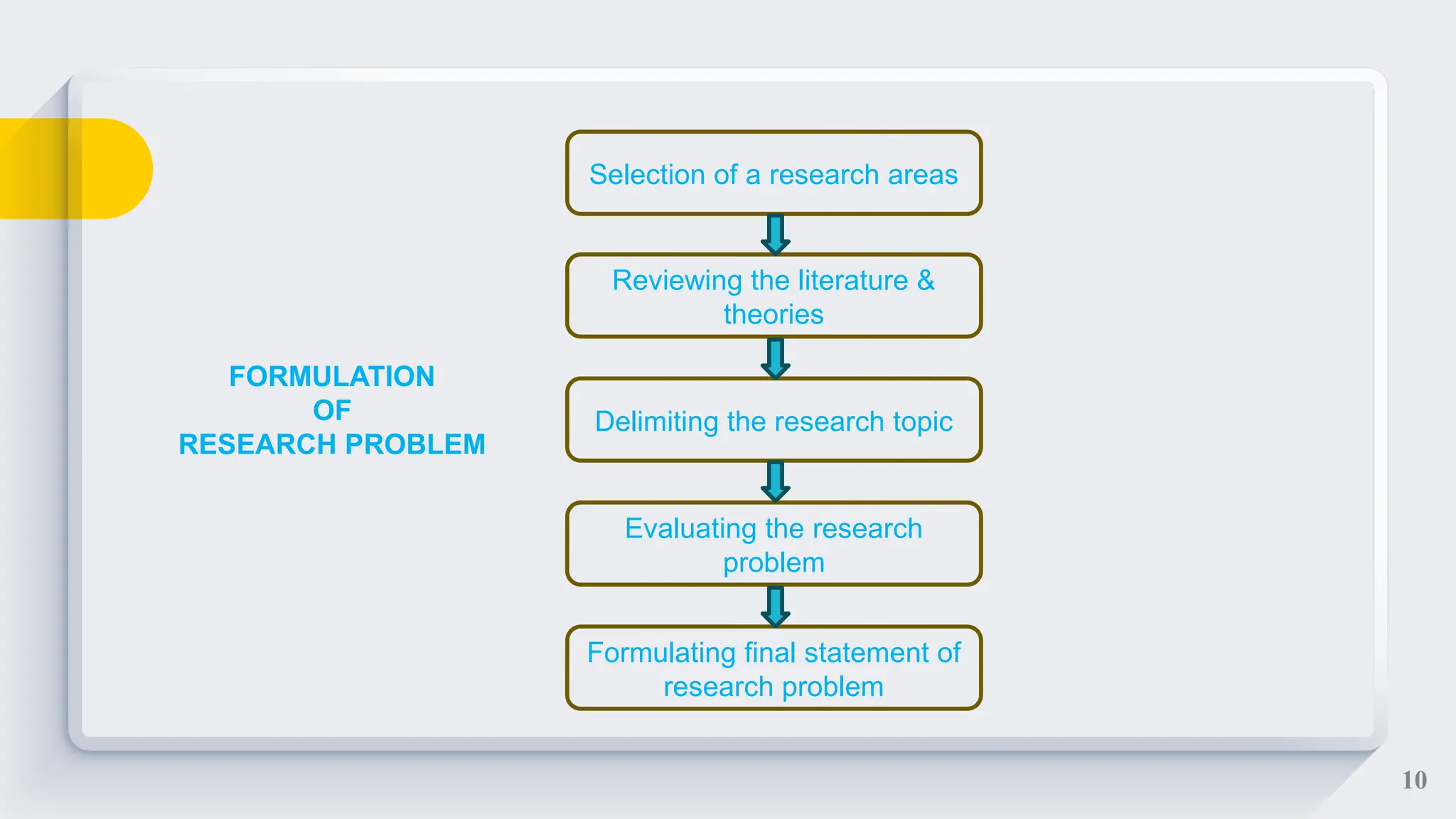
10
Selection of a research areas
Reviewing the literature &
theories
Delimiting the research topic
Evaluating the research
problem
Formulating final statement of
research problem
FORMULATION
OF
RESEARCH PROBLEM
11
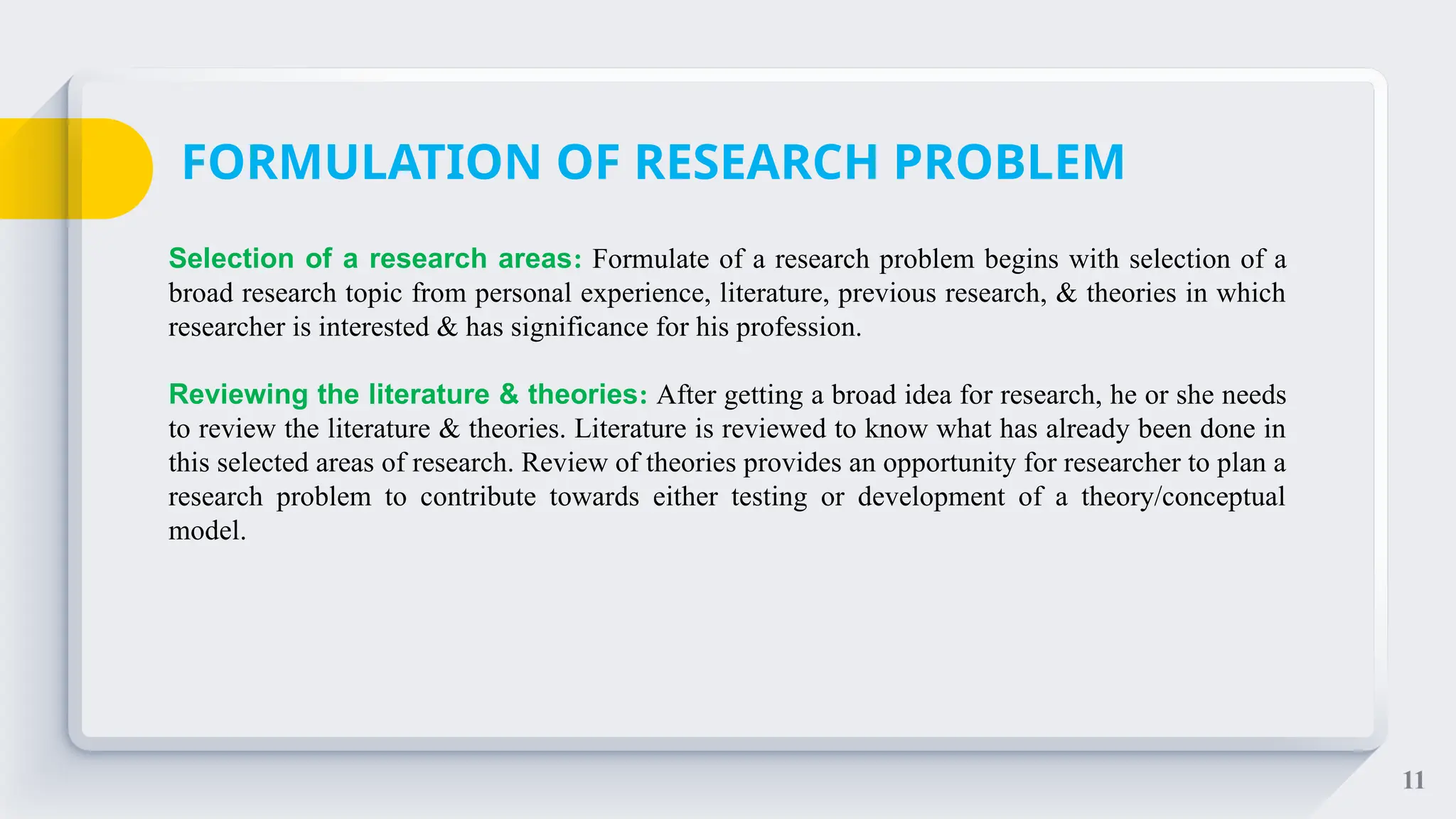
Selection of a research areas: Formulate of a research problem begins with selection of a
broad research topic from personal experience, literature, previous research, & theories in which
researcher is interested & has significance for his profession.
Reviewing the literature & theories: After getting a broad idea for research, he or she needs
to review the literature & theories. Literature is reviewed to know what has already been done in
this selected areas of research. Review of theories provides an opportunity for researcher to plan a
research problem to contribute towards either testing or development of a theory/conceptual
model.
FORMULATION OF RESEARCH PROBLEM
12
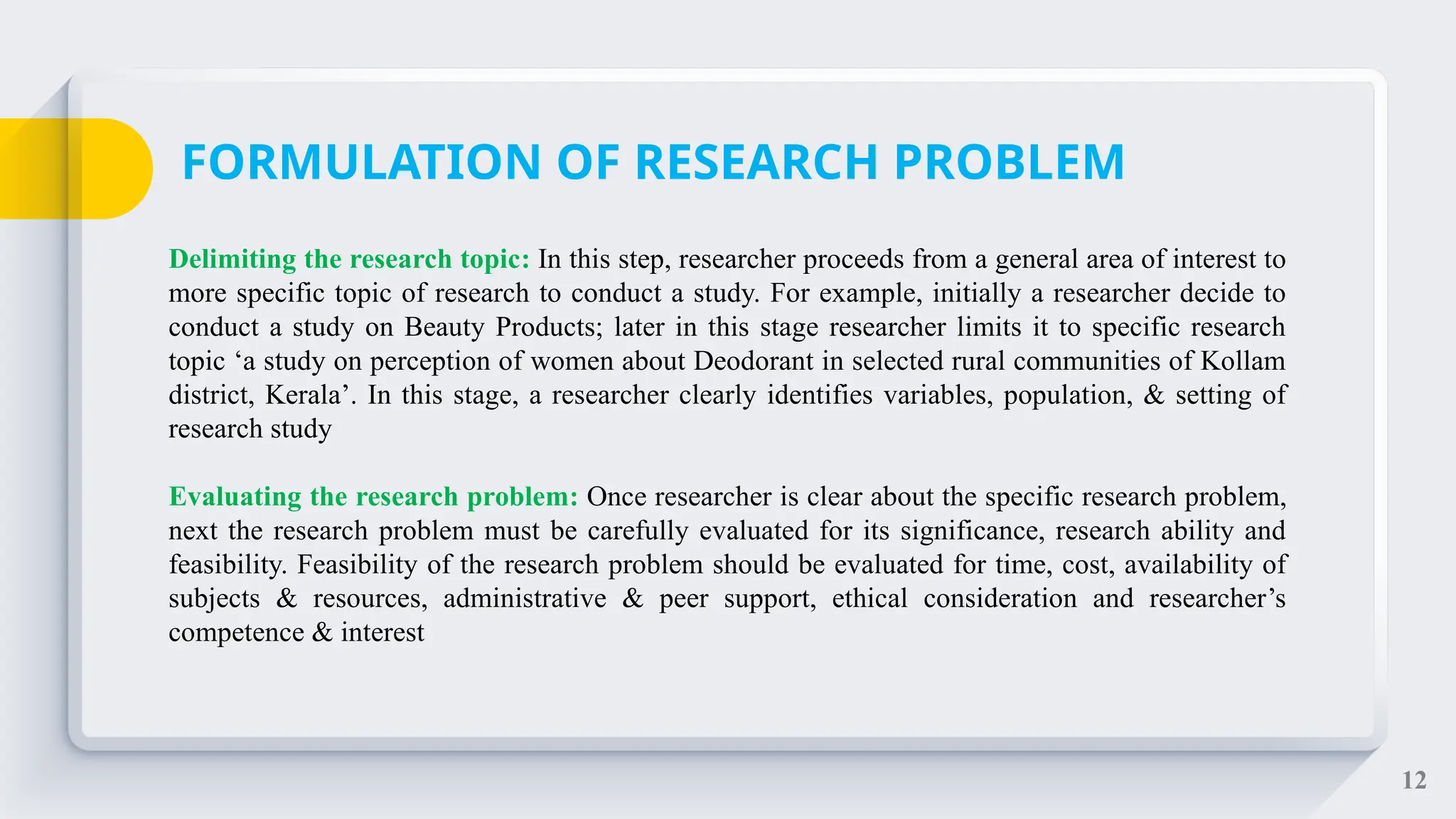
Delimiting the research topic: In this step, researcher proceeds from a general area of interest to
more specific topic of research to conduct a study. For example, initially a researcher decide to
conduct a study on Beauty Products; later in this stage researcher limits it to specific research
topic ‘a study on perception of women about Deodorant in selected rural communities of Kollam
district, Kerala’. In this stage, a researcher clearly identifies variables, population, & setting of
research study
Evaluating the research problem: Once researcher is clear about the specific research problem,
next the research problem must be carefully evaluated for its significance, research ability and
feasibility. Feasibility of the research problem should be evaluated for time, cost, availability of
subjects & resources, administrative & peer support, ethical consideration and researcher’s
competence & interest
FORMULATION OF RESEARCH PROBLEM
13
Formulating final statement of research problem: After establishing the significance, research
ability, & feasibility, then researcher finally formulates a final statement of a research problem.
FORMULATION OF RESEARCH PROBLEM

How to Write a Problem Statement for Thesis.pptx

  • 1.
    How toWrite aProblem Statement forThesis/ Synopsis & Formulation Of Research Problem Aamer Shareef
  • 2.
    2 A research problemmay be defined as an area of concern, a gap in the existing knowledge, or a deviation in the norm or standard that points to the need for further understanding and investigation (Bwisa, 2018 Definition of Research Problem
  • 3.
    3 Principal Proposition (Information alreadyestablished. No doubt about it) The principal proposition represents a discussion that establishes for the reader what information that is generally considered as being beyond question. Example The polio vaccine reduces the chances of polio prevalence among children to a large extent. Parts of Problem Statement- Part 1
  • 4.
    4 Interacting Proposition (What contradicts,which has already been established. Exemptions) The interacting proposition is perhaps the most important part of the problem statement. In effect, the interacting proposition and the discussion that supports it serves to contradict, show exceptions to, or cast some doubt on the principal proposition. The form of the interacting propositional statement almost always starts with a connecting adverb, such as: however, although, but, or words that serve a similar function. Example In past few years, a number of polio cases have been reported in those areas of the world where reportedly polio vaccines were administered to children. Parts of Problem Statement- Part 2
  • 5.
    5 Speculative Proposition (Combines thefirst two. Means there is need to explore it further). The speculative proposition juxtaposes the previous two sets of information which are both offered as being true, and suggests why it might be important to resolve the contradiction that they seemingly have caused. The research problem is formed by the gap of knowledge that exists between the two factual statements. Such occurrences form the crux of scientific investigation. That is, how we resolve two contradictory independent statements. As such, the speculative proposition might be thought in the form of a statement of principle Example While polio drops eliminates the disease, its reemergence in certain parts of the world needs a through examination of its causes. Is it vaccine or other causes which resulted its outbreak. This needs further investigation. Parts of Problem Statement- Part 3
  • 6.
    6 Explicative Statement (Here comesthe purpose of the study. The exact statement) Finally, the problem statement should conclude with a culminating statement that states how the gap will be resolved in the form of the actions that the researcher intends to undertake. Simply put, the explicative statement is the statement of the purpose of the research study. Many researchers mistakenly view the explicative statement as the problem statement itself. As a result, in the section labeled problem statement of the dissertation, research report, or journal article, the author will simply provide to the reader the purpose of the research study. Example Therefore, the purpose of this study is to survey those areas where the polio virus is reported again among children of various areas, so that exact cause of its prevalence can be sorted. Parts of Problem Statement- Part 4
  • 7.
    7 Principal Proposition The careerdevelopment process is critical for the success of organizations. Research has shown that women managers experience career development differently from men. In addition, more and more African-American women are now joining the ranks of management, which presents new challenges and opportunities for these individuals. Interacting Proposition However, little is known about the combined effects of gender and race on the career development process of individuals, and to the extent that current career development models accurately describe the process is unclear. Speculative Proposition If career development is important for organizations and career development is viewed differently by women and men managers and more African-American women are now serving in the ranks of management, and if little is known about the combined effects of sex and race on the career development process, then more needs to be known about how African-American women perceive their career development experiences. Explicative Statement The purpose of this study was to focus on African-American women first-line supervisors undertake and conduct a qualitative study of their career development process. *Adapted from: Cushnie, M. (1999). African-American women first-line supervisors: a qualitative study of their career development process. Example
  • 8.
    8 Principal Proposition The literaturesuggests that training programs are most effective when the training designers and the subject-matter experts (SMEs) work together on a collaborative basis during the training design process. The training designer and SME roles distinguish how training programs can be designed across different types of training. Interacting Proposition However, while the roles of the training designer and SME are clearly defined in the U.S. and European-based HRD literature, this professional arrangement does not necessarily characterize HRD practices globally. In fact, a review of the HRD literature in Taiwan suggests that HRD professionals are expected to become SMEs themselves when designing training programs or SMEs are expected to design the training program by themselves with minimal support from the training designer. Speculative Proposition If training programs are most effective when the training designers and SMEs work collaboratively during the training design process, and if such arrangements are discussed mostly in the U.S. and European literature and may not be used globally, which may have detrimental effects on the quality of the training, then more needs to be known about the working relationships between HRD professionals and SMEs in global situations. Explicative Statement The purpose of this study was to investigate the perceptions of human resource development professionals in Taiwan regarding their working relationships with subject-matter experts (SMEs) during the training design process. *Adapted from: Lin, Y.C. (2006). The Perceptions of Human Resource Development Professionals in Taiwan Regarding their Working Relationships with Subject-Matter Experts (SMEs) during the Training Design Process. Example
  • 9.
  • 10.
    10 Selection of aresearch areas Reviewing the literature & theories Delimiting the research topic Evaluating the research problem Formulating final statement of research problem FORMULATION OF RESEARCH PROBLEM
  • 11.
    11 Selection of aresearch areas: Formulate of a research problem begins with selection of a broad research topic from personal experience, literature, previous research, & theories in which researcher is interested & has significance for his profession. Reviewing the literature & theories: After getting a broad idea for research, he or she needs to review the literature & theories. Literature is reviewed to know what has already been done in this selected areas of research. Review of theories provides an opportunity for researcher to plan a research problem to contribute towards either testing or development of a theory/conceptual model. FORMULATION OF RESEARCH PROBLEM
  • 12.
    12 Delimiting the researchtopic: In this step, researcher proceeds from a general area of interest to more specific topic of research to conduct a study. For example, initially a researcher decide to conduct a study on Beauty Products; later in this stage researcher limits it to specific research topic ‘a study on perception of women about Deodorant in selected rural communities of Kollam district, Kerala’. In this stage, a researcher clearly identifies variables, population, & setting of research study Evaluating the research problem: Once researcher is clear about the specific research problem, next the research problem must be carefully evaluated for its significance, research ability and feasibility. Feasibility of the research problem should be evaluated for time, cost, availability of subjects & resources, administrative & peer support, ethical consideration and researcher’s competence & interest FORMULATION OF RESEARCH PROBLEM
  • 13.
    13 Formulating final statementof research problem: After establishing the significance, research ability, & feasibility, then researcher finally formulates a final statement of a research problem. FORMULATION OF RESEARCH PROBLEM